|
|
|
|
|
|
| |
| |
|
|
|
|
| |
| |
|
|
On 25-12-2011 0:34, Jim Henderson wrote:
> On Sat, 24 Dec 2011 10:01:39 -0800, Darren New wrote:
>
>> On 12/23/2011 19:28, Jim Henderson wrote:
>>> Methinks you missed the ironic twist in what he was writing,
>>> particularly
>>
>> I got well and truly POE'd.
>
> Power Over Etherneted? ;)

problably not. If it was Andy i might go for Pipe Organ Encounter but he
isn't, so I have no clue what he did mean.


--
tip: do not run in an unknown place when it is too dark to see the floor.
Post a reply to this message
|
|
| |
| |
|
|
|
|
| |
| |
|
|
On 12/25/2011 1:15, andrel wrote:
> problably not. If it was Andy i might go for Pipe Organ Encounter but he
> isn't, so I have no clue what he did mean.

http://rationalwiki.org/wiki/Poe%27s_Law

--
Darren New, San Diego CA, USA (PST)
   People tell me I am the counter-example.
Post a reply to this message
|
|
| |
| |
|
|
|
|
| |
| |
|
|
On Sun, 25 Dec 2011 09:45:08 -0800, Darren New wrote:

> On 12/25/2011 1:15, andrel wrote:
>> problably not. If it was Andy i might go for Pipe Organ Encounter but
>> he isn't, so I have no clue what he did mean.
>
> http://rationalwiki.org/wiki/Poe%27s_Law

Yeah, I found that after posting. :)

Jim
Post a reply to this message
|
|
| |
| |
|
|
|
|
| |
| |
|
|
On 12/25/2011 2:10 AM, andrel wrote:
> On 25-12-2011 3:31, Patrick Elliott wrote:
>> On 12/24/2011 4:20 AM, andrel wrote:
>>> I am not sure you got the irony either. I start doubting my ability to
>>> get any message across :( .
>>
>> Oh, and, in my own defense, I post commentary on at least three blogs
>> that have drive by stupid on them all the time,
>
> It is good to be reminded that on the internet there is always some
> place where you might be perceived as a drive by stupid.
>
Sorry. Lets just say that its a reflex action. :( And one that, I am
embarrassed to admit, I have called others on, more than once, when I
wasn't so certain the person in question wasn't asking an honest, but
poorly worded, question, instead of asserting complete gibberish. We
don't get the former often enough sadly.
Post a reply to this message
|
|
| |
| |
|
|
|
|
| |
| |
|
|
Patrick Elliott <sel### [at] npgcable com> wrote:
> Sorry. Lets just say that its a reflex action. :( And one that, I am
> embarrassed to admit, I have called others on, more than once, when I
> wasn't so certain the person in question wasn't asking an honest, but
> poorly worded, question, instead of asserting complete gibberish. We
> don't get the former often enough sadly.
In the Yahoo! Answers Religion & Spirituality room, certain questions are asked
so often (as in several times per day) that they are considered "drinking
questions." When one of these questions was posted, the regulars answered with
"drink!" The questions often try the maxim that there are no stupid questions.
Some questions earned the pinnacle status of double-drink question. Examples:
"Why do atheists come to the Religion section?" "Why do Catholics worship
Mary?" "If we evolved from monkeys, why are there still monkeys?" That last
question really belongs in the Biology room, but young-Earth creationists aren't
known for keeping their domains straight. Bottoms up twice!
I don't hang out there much any more, so I don't know if they still do the
drinking game. I have no doubt, though, that the same questions are still being
asked, over and over again, with not a thought given to the Search button. com> wrote:
> Sorry. Lets just say that its a reflex action. :( And one that, I am
> embarrassed to admit, I have called others on, more than once, when I
> wasn't so certain the person in question wasn't asking an honest, but
> poorly worded, question, instead of asserting complete gibberish. We
> don't get the former often enough sadly.
In the Yahoo! Answers Religion & Spirituality room, certain questions are asked
so often (as in several times per day) that they are considered "drinking
questions." When one of these questions was posted, the regulars answered with
"drink!" The questions often try the maxim that there are no stupid questions.
Some questions earned the pinnacle status of double-drink question. Examples:
"Why do atheists come to the Religion section?" "Why do Catholics worship
Mary?" "If we evolved from monkeys, why are there still monkeys?" That last
question really belongs in the Biology room, but young-Earth creationists aren't
known for keeping their domains straight. Bottoms up twice!
I don't hang out there much any more, so I don't know if they still do the
drinking game. I have no doubt, though, that the same questions are still being
asked, over and over again, with not a thought given to the Search button.
Post a reply to this message
|
|
| |
| |
|
|
|
|
| |
| |
|
|
On 12/27/2011 4:55 PM, Cousin Ricky wrote:
> Some questions earned the pinnacle status of double-drink question.  Examples:
> "Why do atheists come to the Religion section?"  "Why do Catholics worship
> Mary?"  "If we evolved from monkeys, why are there still monkeys?"  That last
> question really belongs in the Biology room, but young-Earth creationists aren't
> known for keeping their domains straight.  Bottoms up twice!
>
Yeah, its right up there in the logic level with, "If motorcycles where
based on bicycles, why are their still bicycles?", and similar
stupidities. Not just wrong category, but just.. like why they hell not?
Just because some of them got smarter meant that somehow the original
niche they filled disappeared? Brainless...

Usually, when those come up, on the blogs I go to, its some, "true
believer (tm)", trying to refute our horrible insistence on believing in
evolution, based on a laundry list of things they just can't believe we
could have possibly ever heard before. The "Drink!", thing is probably
more civilized. On the blogs, the usually result is a brief attempt to
explain, followed by, when the person proves impervious to that, a rapid
decline into, "Go look it up yourself, or at least try reading a damn
book that wasn't published by Answers In Genesis!", and then name calling.

We are the.. pit bull population, to some other people's attempts are
enlightened discussion. But then, we a) do get converts, who, every
place else they went, found someone patting them on the back, and
treating their clueless gibberish seriously, and b) the people running
the blogs have been shanghaied into enough "debates", in which they had
15 minutes to address one stupid assertion, semi-completely, out of the
endless fount of nonsense, half backed claims, outright lies, and
blatant misrepresentations that the creationist spewed in the same 15
minutes they had, that no one, from the blog owner, to the people that
post there, have *any* patience at all with people showing up with no
interest in learning, and a long list of objections that they mentally
photocopied off of what *we* call, "The list of worst claims, arguments,
and objections ever invented.", but which creationist sites insist on
labeling, "Unanswered questions, ideas that can't be refuted, and things
you should ask any biologist, museum owner, or other conspirator in the
spreed of the evils of Evolution."

Basically, you come to our bar with this sort of thing, and you won't
find many drunks, but you might find yourself dodging thrown bottles. ;) lol
Post a reply to this message
|
|
| |
| |
|
|
|
|
| |
| |
|
|
Cousin Ricky <rickysttATyahooDOTcom> wrote:
> "If we evolved from monkeys, why are there still monkeys?"  That last
> question really belongs in the Biology room, but young-Earth creationists aren't
> known for keeping their domains straight.  Bottoms up twice!

  I have seen many videos with titles like "ultimate proof of the existence
of God!" and the like, and which then proceed to try to disprove evolution.

  I'm like: "Wait, I thought you were going to prove the existence of God
rather than discuss biology. What gives?"

  It's a rather typical argumentative fallacy.

--
                                                          - Warp
Post a reply to this message
|
|
| |
| |
|
|
|
|
| |
| |
|
|
Patrick Elliott <sel### [at] npgcablecom> wrote:
> On 12/27/2011 4:55 PM, Cousin Ricky wrote:
> > Some questions earned the pinnacle status of double-drink question.  Examples:
> > "Why do atheists come to the Religion section?"  "Why do Catholics worship
> > Mary?"  "If we evolved from monkeys, why are there still monkeys?"  That last
> > question really belongs in the Biology room, but young-Earth creationists aren't
> > known for keeping their domains straight.  Bottoms up twice!
> >
> Yeah, its right up there in the logic level with, "If motorcycles where
> based on bicycles, why are their still bicycles?", and similar
> stupidities. Not just wrong category, but just.. like why they hell not?
> Just because some of them got smarter meant that somehow the original
> niche they filled disappeared? Brainless...

  It's actually it's wronger than that. According to cladistics(*) humans
did not "evolve from monkeys". Instead, humans and monkeys have a common
ancestor species. This ancestor species probably looked more like a monkey
than a human, but was still relatively different from either.

  (Also, apes are more closely related to humans than monkeys. It seems that
creationists and other people who want to mock the theory of evolution
deliberately use the more distantly related monkeys more as a mockery than
anything else. According to cladistics humans and apes have a common ancestor
species, which in turn has a common ancestor species with monkeys.)

(*) Unlike most creationists and many other people think, the theory of
evolution does not say what species humans evolved from. The theory of
evolution describes the mechanism, not the history of evolution. For the
history you need to turn to paleontology and cladistics.

--
                                                          - Warp
Post a reply to this message
|
|
| |
| |
|
|
|
|
| |
| |
|
|
On 23/12/2011 03:24 PM, Orchid XP v8 wrote:
> Yesterday, I burned my copy of Darwin's Black Box. Just so you know.

They say every cloud has a silver lining. And in a sense, I guess that's
true.

Darwin's Black Box is a book written by an ignorant man trying to bully
you into believing his fantasies, using the flimsiest of logic. (I gave
up approximately when he started arguing that the definition of
"science" is too limiting... Anyone who doesn't understand what science
is has no business calling themselves a scientist, in my view.)

On the other hand, reading Molecular Biology of the Gene [Watson et al]
left me uninterested, yet reading Darwin's Black Box showed me just how
interesting molecular biology is, and gave me decent intuitive
metaphores for how this stuff actually works - something which the dense
scientific reference text did not.

So I guess even something evil can harbour something good...

--
http://blog.orphi.me.uk/
http://www.zazzle.com/MathematicalOrchid*
Post a reply to this message
|
|
| |
| |
|
|
|
|
| |
| |
|
|
Orchid XP v8 <voi### [at] devnull> wrote:
> On the other hand, reading Molecular Biology of the Gene [Watson et al]
> left me uninterested, yet reading Darwin's Black Box showed me just how
> interesting molecular biology is, and gave me decent intuitive
> metaphores for how this stuff actually works - something which the dense
> scientific reference text did not.

  If you want to read two interesting books about biology and science,
try "The Greatest Show on Earth" by Richard Dawkins and "The Demon Haunted
World" by Carl Sagan.

--
                                                          - Warp
Post a reply to this message
|
|
| |
| |
|
|
|
|
| |
| |
|
|
On 28/12/2011 10:23 AM, Warp wrote:

>    If you want to read two interesting books about biology and science,
> try "The Greatest Show on Earth" by Richard Dawkins and "The Demon Haunted
> World" by Carl Sagan.

I got the former for Christmas last year. I haven't read the latter...

--
http://blog.orphi.me.uk/
http://www.zazzle.com/MathematicalOrchid*
Post a reply to this message
|
|
| |
| |
|
|
|
|
| |
| |
|
|
On 28-12-2011 9:18, Warp wrote:
> Patrick Elliott<sel### [at] npgcablecom>  wrote:
>> On 12/27/2011 4:55 PM, Cousin Ricky wrote:
>>> Some questions earned the pinnacle status of double-drink question.  Examples:
>>> "Why do atheists come to the Religion section?"  "Why do Catholics worship
>>> Mary?"  "If we evolved from monkeys, why are there still monkeys?"  That last
>>> question really belongs in the Biology room, but young-Earth creationists aren't
>>> known for keeping their domains straight.  Bottoms up twice!
>>>
>> Yeah, its right up there in the logic level with, "If motorcycles where
>> based on bicycles, why are their still bicycles?", and similar
>> stupidities. Not just wrong category, but just.. like why they hell not?
>> Just because some of them got smarter meant that somehow the original
>> niche they filled disappeared? Brainless...
>
>    It's actually it's wronger than that. According to cladistics(*) humans
> did not "evolve from monkeys". Instead, humans and monkeys have a common
> ancestor species. This ancestor species probably looked more like a monkey
> than a human, but was still relatively different from either.

it is a bit more complicated than that. the set of all monkeys *and*
homo is a clade. monkeys as a group are not. though the new world
monkeys are. monkeys are all simians except humans. so what was the last
common ancestor of man and chimps? that was not a member of the genus
homo, so i think that by the definition of monkey it was a monkey (and
an ape and a great ape). i am not sure if apes are considered monkeys.
(in the netherlands we don't have a distinct name for ape, a monkey is
an 'aap' and an ape is a 'mensaap' (mens==human). so here monkeys
include apes.) if apes are not monkeys we have another cladistic
problem. doesn't matter for the argument, just apply twice (or trice if
great apes are not apes).

i prefer a more cladistic definition of monkey, which implies that i did
not evolve from a monkey, but that i am a monkey and an ape and a great
ape. ook.

>    (Also, apes are more closely related to humans than monkeys. It seems that
> creationists and other people who want to mock the theory of evolution
> deliberately use the more distantly related monkeys more as a mockery than
> anything else. According to cladistics humans and apes have a common ancestor
> species, which in turn has a common ancestor species with monkeys.)

funny that if they take it a bit further and try to mock the idea that
we descend from mammals many more people would get the absurdity. otoh
it might give a clue why creationists are in general allergic to breasts
in public. perhaps they don't want to be confronted with things that
point to their fallacy*.

> (*) Unlike most creationists and many other people think, the theory of
> evolution does not say what species humans evolved from. The theory of
> evolution describes the mechanism, not the history of evolution. For the
> history you need to turn to paleontology and cladistics.
>

*) insert your own pun here
--
tip: do not run in an unknown place when it is too dark to see the floor.
Post a reply to this message
|
|
| |
| |
|
|
|
|
| |
| |
|
|
On Tue, 27 Dec 2011 18:55:09 -0500, Cousin Ricky wrote:

>  "If we evolved from monkeys, why are there still
> monkeys?"

Answer:  "Because you don't understand how evolution works."

Jim
Post a reply to this message
|
|
| |
| |
|
|
|
|
| |
| |
|
|
On 12/28/2011 1:18 AM, Warp wrote:
> Patrick Elliott<sel### [at] npgcablecom>  wrote:
>> On 12/27/2011 4:55 PM, Cousin Ricky wrote:
>>> Some questions earned the pinnacle status of double-drink question.  Examples:
>>> "Why do atheists come to the Religion section?"  "Why do Catholics worship
>>> Mary?"  "If we evolved from monkeys, why are there still monkeys?"  That last
>>> question really belongs in the Biology room, but young-Earth creationists aren't
>>> known for keeping their domains straight.  Bottoms up twice!
>>>
>> Yeah, its right up there in the logic level with, "If motorcycles where
>> based on bicycles, why are their still bicycles?", and similar
>> stupidities. Not just wrong category, but just.. like why they hell not?
>> Just because some of them got smarter meant that somehow the original
>> niche they filled disappeared? Brainless...
>
>    It's actually it's wronger than that. According to cladistics(*) humans
> did not "evolve from monkeys". Instead, humans and monkeys have a common
> ancestor species. This ancestor species probably looked more like a monkey
> than a human, but was still relatively different from either.
>
Yeah, more like, "If Motorcycles where derived from wagons, why are
there still horse carts?", or something...
Post a reply to this message
|
|
| |
| |
|
|
|
|
| |
| |
|
|
On 12/28/2011 3:12 AM, Orchid XP v8 wrote:
> On 23/12/2011 03:24 PM, Orchid XP v8 wrote:
>> Yesterday, I burned my copy of Darwin's Black Box. Just so you know.
>
> They say every cloud has a silver lining. And in a sense, I guess that's
> true.
>
> Darwin's Black Box is a book written by an ignorant man trying to bully
> you into believing his fantasies, using the flimsiest of logic. (I gave
> up approximately when he started arguing that the definition of
> "science" is too limiting... Anyone who doesn't understand what science
> is has no business calling themselves a scientist, in my view.)
>
> On the other hand, reading Molecular Biology of the Gene [Watson et al]
> left me uninterested, yet reading Darwin's Black Box showed me just how
> interesting molecular biology is, and gave me decent intuitive
> metaphores for how this stuff actually works - something which the dense
> scientific reference text did not.
>
Not that I would bet on the intuitive metaphors of some clown trying to
argue against its corner stone, as useful. Its far more likely that
their metaphors are just as useless as their arguments (due to being
based on entirely flawed assumptions). Way too much of science ends up
in a category of, "counter intuitive", like the absurd idea that you
would need to chop up 50 feet of rope, with DNA written on it, to get 3
inches of code. Intuitively, this is completely idiotic, since no sane
*person* would make something like that. And, the "intuitive"
assumption, made by people that write these sorts of books, tends to be
that you have something that looks more like a book chapter, rather than
an fragmented hard drive, which someone dumped gigs of empty file
fragments into, before asking the system to seek all the bits and pieces
scattered between them, over 50% of the entire drive surface. lol

That sort of thing, and other such stuff, is "unnatural" to these sorts
of people, so can't possibly be, you know, how nature actually does
stuff. Sadly, if they where looking at certain viruses, or single cell
organisms, which lack mitochondria, they would be correct. Its just,
species with lots of bloody extra energy available to process DNA and
RNA turn into the genetic equivalent of hoarders.
Post a reply to this message
|
|
| |
| |
|
|
|
|
| |
| |
|
|
On 12/28/2011 3:23 AM, Warp wrote:
> Orchid XP v8<voi### [at] devnull>  wrote:
>> On the other hand, reading Molecular Biology of the Gene [Watson et al]
>> left me uninterested, yet reading Darwin's Black Box showed me just how
>> interesting molecular biology is, and gave me decent intuitive
>> metaphores for how this stuff actually works - something which the dense
>> scientific reference text did not.
>
>    If you want to read two interesting books about biology and science,
> try "The Greatest Show on Earth" by Richard Dawkins and "The Demon Haunted
> World" by Carl Sagan.
>
Another one, like "The Demon Haunted World", which is interesting, is
Paranormality, but Richard Wiseman. He also has a couple others out, "59
Seconds: Think a Little, Change a Lot", which goes into why self help is
usually useless, and what sort of things, based on how people do think,
would be more effective, and "Quirkology", which covers some seriously
goofy studies that have been done over the years, which do a fair job of
dispelling the suggestion that the average person is *at all* rational,
outside of where they have to be to get something accomplished (and not
even always then).
Post a reply to this message
|
|
| |
| |
|
|
|
|
| |
| |
|
|
Warp <war### [at] tagpovrayorg> wrote:
>   It's actually it's wronger than that. According to cladistics(*) humans
> did not "evolve from monkeys". Instead, humans and monkeys have a common
> ancestor species. This ancestor species probably looked more like a monkey
> than a human, but was still relatively different from either.
>
>   (Also, apes are more closely related to humans than monkeys. It seems that
> creationists and other people who want to mock the theory of evolution
> deliberately use the more distantly related monkeys more as a mockery than
> anything else. According to cladistics humans and apes have a common ancestor
> species, which in turn has a common ancestor species with monkeys.)

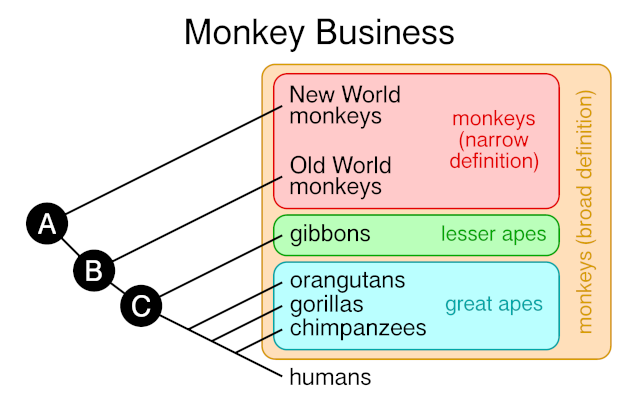
Please find attached a simplified cladogram.

Now, if C was the most recent common ancestor of all the apes, then how could C
not be an ape?

If C was an ape, then how can humans not be apes?

We were just getting comfortable with that conclusion, and then some
troublemakers pointed out...

If A was the most recent common ancestor of Old World monkeys and New World
monkeys, then how could A not be a monkey?

If A was a monkey, then how could B not be a monkey?

If B was a monkey, then how could C not be a monkey?

If C was a monkey, then how can apes not be a monkeys (which they *are*,
according to dictionaries)?

If apes are monkeys, then how can humans not be monkeys?

Just accept it.  Screw the creationists' fragile egos.
Post a reply to this message
Attachments:
Download 'monkeys.png' (57 KB)
Preview of image 'monkeys.png'
|
|
| |
| |
|
|
|
|
| |
| |
|
|
On 29-12-2011 0:16, Cousin Ricky wrote:
> Warp<war### [at] tagpovrayorg>  wrote:
>>    It's actually it's wronger than that. According to cladistics(*) humans
>> did not "evolve from monkeys". Instead, humans and monkeys have a common
>> ancestor species. This ancestor species probably looked more like a monkey
>> than a human, but was still relatively different from either.
>>
>>    (Also, apes are more closely related to humans than monkeys. It seems that
>> creationists and other people who want to mock the theory of evolution
>> deliberately use the more distantly related monkeys more as a mockery than
>> anything else. According to cladistics humans and apes have a common ancestor
>> species, which in turn has a common ancestor species with monkeys.)
>
> Please find attached a simplified cladogram.

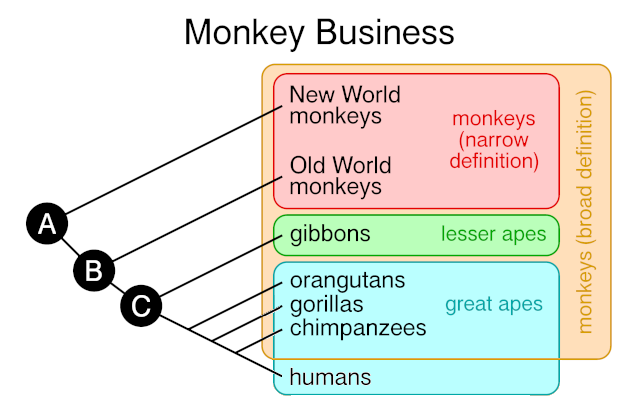
reading a bit more on wikipedia (possibly not the most reliable source,
but it will have to do for this year) that cladogram is not correct
[anymore]. there could have been an oval around the lesser apes, great
apes and humans. 'ape' is nowadays used for that entire clade. even
better, humans are great apes nowadays. monkeys still are not a clade as
the humans have to be left out. in short your ovals should intersect. i
added a correction for the great apes only.

this sort of things happen more often when names are used that date back
to when we did not know yet how the genetic relationships were. we have
it e.g. where birds are dinosaurs, dinosaurs (apart from birds) are
reptiles but birds are not reptiles.

--
tip: do not run in an unknown place when it is too dark to see the
floor, unless you prefer to not use uppercase.
Post a reply to this message
Attachments:
Download 'monkeys.png' (54 KB)
Preview of image 'monkeys.png'
|
|
| |
| |
|
|
|
|
| |
| |
|
|
andrel <byt### [at] gmailcom> wrote:
>  monkeys still are not a clade as
> the humans have to be left out.

Why should humans be left out?  Because someone's religion says so?  Because we
don't like being monkeys?

In everyday speech, it's fine to set humans apart from monkeys.  We do the same
thing when we talk about "humans and animals."  However, in scientific contexts,
there is no point to it.

> this sort of things happen more often when names are used that date back
> to when we did not know yet how the genetic relationships were. we have
> it e.g. where birds are dinosaurs, dinosaurs (apart from birds) are
> reptiles but birds are not reptiles.

Mammals are also descended from ancient reptiles.  The biological community is
going to have to decide what they want to do with the term "reptile."  And
"fish."  And perhaps "amphibian," although I haven't studied that term.

P.S. The bubbles in my Venn diagram show lay usage, not scientific.  That's why
humans aren't in any of the bubbles.  The image as a whole was intended to lay
bare how silly it is to set our species apart from other primates in light of
today's knowledge.
Post a reply to this message
|
|
| |
| |
|
|
|
|
| |
| |
|
|
Cousin Ricky <rickysttATyahooDOTcom> wrote:
> If A was the most recent common ancestor of Old World monkeys and New World
> monkeys, then how could A not be a monkey?

  It of course depends on how the ancestral species are named, but I don't
see your point.

  Just because archosaurs are the most recent common ancestors of both
birds and crocodiles doesn't mean that a bird is a crocodile (or the
other way around). They are (according to cladistics) both archosaurs,
but not each other.

  Likewise if humans and monkeys had a common ancestor, that doesn't mean
that humans are monkeys (or the other way around). Unless you specifically
name this common ancestor "monkey".

--
                                                          - Warp
Post a reply to this message
|
|
| |
| |
|
|
|
|
| |
| |
|
|
Patrick Elliott <sel### [at] npgcablecom> wrote:
> and "Quirkology", which covers some seriously
> goofy studies that have been done over the years, which do a fair job of
> dispelling the suggestion that the average person is *at all* rational,
> outside of where they have to be to get something accomplished (and not
> even always then).

  It indeed is so that the innate way of thinking for the human brain is
*not* rational skepticism. Rational skepticism is something that has to
be learned via years of study and the willingness to understand how the
world really works.

  The innate instinct of the human brain is to be naive, to believe what
you are told. This actually makes sense from an evolutionary perspective:
If a child is told "don't eat that plant, it's dangerous", this child had
a significantly higher chance of survival if he took that claim at face
value instead of being skeptical and testing it. Hence humans have been
naturally selected to be naive, especially in matter concerning dangers.
(It's no wonder that so many conspiracy theories are related to things
that are ostensibly dangerous. For example "vaccines are dangerous",
"fluoridated water is dangerous", "chemotherapy is poison", "the government
is out to get you", etc.)

--
                                                          - Warp
Post a reply to this message
|
|
| |
| |
|
|
|
|
| |
| |
|
|
On 29-12-2011 3:21, Cousin Ricky wrote:
> andrel<byt### [at] gmailcom>  wrote:
>>   monkeys still are not a clade as
>> the humans have to be left out.
>
> Why should humans be left out?  Because someone's religion says so?

in fact there is no religion that says explicitly so. simply because
there was no reason to say anything about it at the time.
what e.g. the bible says is (KJV) 'So God created man in his own image,
in the image of God created he him; male and female created he them.'
from this you can deduce that man was created and did not evolve from
anything else. it does not say that man is not a monkey however. in
genesis several groups of animals are named e.g. cattle, fish, and
whales. if everything is created independently you can not group several
species together. otoh if you are allowed to do that there is no reason
not to group man with e.g. the mammals. tertium non datur.

> Because we don't like being monkeys?

some people don't.

> In everyday speech, it's fine to set humans apart from monkeys.  We do the same
> thing when we talk about "humans and animals."  However, in scientific contexts,
> there is no point to it.

there is a very good reason. it is called 'tradition'.

>> this sort of things happen more often when names are used that date back
>> to when we did not know yet how the genetic relationships were. we have
>> it e.g. where birds are dinosaurs, dinosaurs (apart from birds) are
>> reptiles but birds are not reptiles.
>
> Mammals are also descended from ancient reptiles.

no

> The biological community is
> going to have to decide what they want to do with the term "reptile."

they did, although their definitions change over time.

> And
> "fish."  And perhaps "amphibian," although I haven't studied that term.
>
> P.S. The bubbles in my Venn diagram show lay usage, not scientific.  That's why
> humans aren't in any of the bubbles.  The image as a whole was intended to lay
> bare how silly it is to set our species apart from other primates in light of
> today's knowledge.
>


--
tip: do not run in an unknown place when it is too dark to see the
floor, unless you prefer to not use uppercase.
Post a reply to this message
|
|
| |
| |
|
|
|
|
| |
| |
|
|
On 29-12-2011 9:09, Warp wrote:
> Cousin Ricky<rickysttATyahooDOTcom>  wrote:
>> If A was the most recent common ancestor of Old World monkeys and New World
>> monkeys, then how could A not be a monkey?
>
>    It of course depends on how the ancestral species are named, but I don't
> see your point.
>
>    Just because archosaurs are the most recent common ancestors of both
> birds and crocodiles doesn't mean that a bird is a crocodile (or the
> other way around). They are (according to cladistics) both archosaurs,
> but not each other.
>
>    Likewise if humans and monkeys had a common ancestor, that doesn't mean
> that humans are monkeys (or the other way around). Unless you specifically
> name this common ancestor "monkey".

I answered that in a previous post. the last common ancestor of humans
and monkeys was by definition a monkey.
still, humans are not monkeys. they are, however, apes.


--
tip: do not run in an unknown place when it is too dark to see the
floor, unless you prefer to not use uppercase.
Post a reply to this message
|
|
| |
| |
|
|
|
|
| |
| |
|
|
andrel <byt### [at] gmailcom> wrote:
> I answered that in a previous post. the last common ancestor of humans
> and monkeys was by definition a monkey.

  What do you mean "by definition"?

--
                                                          - Warp
Post a reply to this message
|
|
| |
| |
|
|
|
|
| |
| |
|
|
>> On the other hand, reading Molecular Biology of the Gene [Watson et al]
>> left me uninterested, yet reading Darwin's Black Box showed me just how
>> interesting molecular biology is, and gave me decent intuitive
>> metaphores for how this stuff actually works - something which the dense
>> scientific reference text did not.
>>
> Not that I would bet on the intuitive metaphors of some clown trying to
> argue against its corner stone, as useful.

Well, yeah, some of the stuff in the book is /obviously/ insane.

I remember being particularly shocked at the bit where he waives his
hands around a bit, and then writes "now that we have conclusively
/proven/ that ID is the correct theory..." At which point, I have two
major objections:

1. You just spent two chapters utterly failing to convince me that
evolution is false. You haven't /proven/ it false, you've just whinged
that "X cannot evolve" (i.e., "I cannot imagine how X could evolve",
which follows directly from "I don't want it to be possible for X to
evolve").

2. Even if I accept that evolution is false, this does not prove that ID
is therefore true. DOES. NOT. FOLLOW.

It defies belief that the author was genuinely unaware of objection #2.
So what we are looking at here is willful deception of the less
attentive reader. Such a thing disgusts me.


When Behe stops talking nonesense about how evolution is "impossible"
and sticks to objective facts (like how rhodopsin works), things get
much better.

The weighty tome tells us that propeins are amino acid polymers, each
molecule weighting a few thousand Daltons, and that under physiological
conditions molecular degradation is thermodynamically unfavourable,
and... Behe, on the other hand, tells us that proteins are the cogs,
gears, wheels, pullies, scaffolding and building materials of the
cellular world.

A protein is a chemical. Usually you don't think much about individual
chemical molecules. You think of a whole glass of the chemical as one
essentially continuous entity. Much like a note from a piano is made of
many individual waves, but you think of it as a continuous thing. But
when you start thinking of molecules not as abstract things but as
physical objects that can bend, stretch, pull, push and so forth, and
you realise that enzymes work by grabbing molecules and slotting them
together the right way around... suddenly molecular biology makes far
more sense.

--
http://blog.orphi.me.uk/
http://www.zazzle.com/MathematicalOrchid*
Post a reply to this message
|
|
| |
| |
|
|
|
|
| |
| |
|
|
Orchid XP v8 <voi### [at] devnull> wrote:
> 2. Even if I accept that evolution is false, this does not prove that ID
> is therefore true. DOES. NOT. FOLLOW.

  This is a very typical false dichotomy. It naturally goes like: "Either
evolution is true, or ID is true. Hence if we prove evolution to the false,
the only possible conclusion is that ID is true."

  This argumentative fallacy is really, really common. If someone wants to
"prove" that ID is true, what is by far the most common tactic? Try to prove
evolution as false.

  Creationists use several other false dichotomies as well, such as for
example "either the Universe was created by nothing, or it was created by
an intelligent being", and "either life was formed by chance, or it was
created by an intelligent being".

  Of course the argument is inherently more fallacious than that. Let's
assume for a second that the universe was indeed created by an intelligent
being. This raises many obvious questions: What kind of being? Where is this
being now? Does this being still exist? Where did it come from? Are there
more than one? Was this being also created by another intelligent being?
How did this being create the universe? What kind of powers does it have?
Is this the only universe that it has created?

  The whole premise of ID doesn't actually answer anything at all, much
less anything useful. (Exactly what is the use in knowing that some kind
of "intelligent being" created the universe? How does this knowledge help
us in any way or form? We can't know anything at all about this hypothetical
"being", other than speculate that perhaps it created the universe. How does
this help us?)

  Of course the creationist will then turn to try to explain how the Bible
allegedly contains things that the people of the time could not have possibly
known. Even if that were true (and that's a big if), that's another fallacy.
(Writing some information that the people of the time "could not have
possibly known" doesn't tell anything about where that information came
from. Claiming that "it must have been given by God" is another false
dichotomy. There are many other possible explanations.)

--
                                                          - Warp
Post a reply to this message
|
|
| |
| |
|
|
|
|
| |
| |
|
|
On 29/12/2011 12:32 PM, Warp wrote:
> Orchid XP v8<voi### [at] devnull>  wrote:
>> 2. Even if I accept that evolution is false, this does not prove that ID
>> is therefore true. DOES. NOT. FOLLOW.
>
>    This is a very typical false dichotomy. It naturally goes like: "Either
> evolution is true, or ID is true. Hence if we prove evolution to the false,
> the only possible conclusion is that ID is true."

This is, of course, utter nonsense. It really annoys me.

>    This argumentative fallacy is really, really common. If someone wants to
> "prove" that ID is true, what is by far the most common tactic? Try to prove
> evolution as false.

Einstein didn't otherthrow Newton by proving that Newton's laws of
motion are flawed; he did it by offering an alternative, superior
explanation.

And yet, read any text proving how ID is correct, and you'll hear
"evolution this" and "evolution that" and "evolution the other"... I'm
sorry, I thought you were telling me about ID? What does ID claim the
answer is?

>    Of course the argument is inherently more fallacious than that. Let's
> assume for a second that the universe was indeed created by an intelligent
> being. This raises many obvious questions: What kind of being? Where is this
> being now? Does this being still exist? Where did it come from? Are there
> more than one? Was this being also created by another intelligent being?
> How did this being create the universe? What kind of powers does it have?
> Is this the only universe that it has created?
>
>    The whole premise of ID doesn't actually answer anything at all, much
> less anything useful.

How did we end up with such a vivid range of lifeforms on this planet?
It's baffling, and it demands explanation. Evolution says "there's this
specific mechanism by which it can happen". ID says "God did it". That's
not even an answer, that's an /excuse/.

Evolution makes several testable predictions - for example, that various
organisms should possess useless organs (because they once did something
useful, and are no longer needed, and yet their "cost" is not sufficient
to eliminate them). And all these predictions match the real world, as
far as we know.

ID predicts that evolution is false. It makes no further predictions. On
that metric alone, evolution is a superior theory. Even an incorrect
theory can be superior if it describes the world better. Hell, we still
teach people Newton's laws of motion, even though they have been
conclusively proven false.

As you point out, ID says "the Designer did it", and then tells us
nothing about the Designer. That's only half a theory. If you're saying
that the Designer designed everything that exists today in one instant
and then left, that's one theory. If you claim the Designer is invisibly
at work all around as, constantly, to this day, that's a completely
different theory, which yields utterly different predictions. So really,
ID is an incomplete theory. Make up your mind who or what this
"Designer" is, and then we might be able to have a sane discussion.

For example, WHY DID HE DO THIS? If we knew the design goal for life, we
might be able to measure various lifeforms and see whether they meet
this design goal. But noooo, ID does not specify.

Alternatively, HOW DID HE DO THIS? If we knew the design methods, the
cognative limitations of the Designer, the tools available to Him, we
might be able to look at life and see if its design is consistent with
these constraints or not. But again, noooo. ID does not specify.

If you claim that the genome of all modern organisms was encoded into
the original singular life form on Earth, we can do some math to compute
whether that's feasible. But nooo, ID doesn't actually say when or where
the design took place.

In short, if ID were to actually BE SPECIFIC, there's some danger that
it might become testable. As it is, ID is not a scientific theory. Not
because it is untrue [it is, but that isn't the reason], but because IT
DOESN'T PREDICT ANYTHING. Similarly, string theory is not a science,
because it makes no predictions. In the case of string theory, we can at
least append "yet". :-P

>    Of course the creationist will then turn to try to explain how the Bible
> allegedly contains things that the people of the time could not have possibly
> known.

Irrelevant. Does it contain the information that ID does not? No? Well
then you guys still have a problem, don't you? :-P

Of course, all of this is transparently a question of certain people NOT
LIKING a theory, and wanting to make people stop saying it's true. They
don't actually care about the truth, only what makes them happy. As if
truth can be influenced by what you believe.

--
http://blog.orphi.me.uk/
http://www.zazzle.com/MathematicalOrchid*
Post a reply to this message
|
|
| |
| |
|
|
|
|
| |
| |
|
|
On 12/29/2011 1:17 AM, Warp wrote:
> Patrick Elliott<sel### [at] npgcablecom>  wrote:
>> and "Quirkology", which covers some seriously
>> goofy studies that have been done over the years, which do a fair job of
>> dispelling the suggestion that the average person is *at all* rational,
>> outside of where they have to be to get something accomplished (and not
>> even always then).
>
>    It indeed is so that the innate way of thinking for the human brain is
> *not* rational skepticism. Rational skepticism is something that has to
> be learned via years of study and the willingness to understand how the
> world really works.
>
>    The innate instinct of the human brain is to be naive, to believe what
> you are told. This actually makes sense from an evolutionary perspective:
> If a child is told "don't eat that plant, it's dangerous", this child had
> a significantly higher chance of survival if he took that claim at face
> value instead of being skeptical and testing it. Hence humans have been
> naturally selected to be naive, especially in matter concerning dangers.
> (It's no wonder that so many conspiracy theories are related to things
> that are ostensibly dangerous. For example "vaccines are dangerous",
> "fluoridated water is dangerous", "chemotherapy is poison", "the government
> is out to get you", etc.)
>
A better analogy, perhaps (given the tendency of children to test damn
near anything once) is that, "Its better to a assume that the rustling
in the bush is a pouncing tiger, than to have to look, to find out for
certain."
Post a reply to this message
|
|
| |
| |
|
|
|
|
| |
| |
|
|
On 12/29/2011 5:00 AM, Orchid XP v8 wrote:
> The weighty tome tells us that propeins are amino acid polymers, each
> molecule weighting a few thousand Daltons, and that under physiological
> conditions molecular degradation is thermodynamically unfavourable,
> and... Behe, on the other hand, tells us that proteins are the cogs,
> gears, wheels, pullies, scaffolding and building materials of the
> cellular world.
>
Which makes one sort of wonder why he fails to grasp/explain why the
scaffolding, gears, wheels, pullies, etc. are all arranged in a DNA
strand such that one, to use an architecture analogy, one is required to
rearrange all the parts of the house, to open the door, since neither
the door, the entry, the hallway, the living room, nor the roof, are
arranged in such a manner as to be actually connected, or part of the
same structure at all, until you remove all the "scaffolding" from
between them, and crank the wheels, gears, and things, to cram it all
back into something that actually functions. lol

So, yeah. Its either disingenuous that he doesn't "notice" these sorts
of things, or he is like some guy that plots a long, complex, and
absolutely effective, escape from the mental hospital, while imagining
that he has invisible friends, who are watching the guards for him, is
casting magic spells on the locks, and needs to get out, before the
space aliens implant his brain in yet another body that doesn't belong
to him.
Post a reply to this message
|
|
| |
| |
|
|
|
|
| |
| |
|
|
On 12/29/2011 5:32 AM, Warp wrote:
> Orchid XP v8<voi### [at] devnull>  wrote:
>> 2. Even if I accept that evolution is false, this does not prove that ID
>> is therefore true. DOES. NOT. FOLLOW.
>
>    This is a very typical false dichotomy. It naturally goes like: "Either
> evolution is true, or ID is true. Hence if we prove evolution to the false,
> the only possible conclusion is that ID is true."
>
>    This argumentative fallacy is really, really common. If someone wants to
> "prove" that ID is true, what is by far the most common tactic? Try to prove
> evolution as false.
>
>    Creationists use several other false dichotomies as well, such as for
> example "either the Universe was created by nothing, or it was created by
> an intelligent being", and "either life was formed by chance, or it was
> created by an intelligent being".
>
>    Of course the argument is inherently more fallacious than that. Let's
> assume for a second that the universe was indeed created by an intelligent
> being. This raises many obvious questions: What kind of being? Where is this
> being now? Does this being still exist? Where did it come from? Are there
> more than one? Was this being also created by another intelligent being?
> How did this being create the universe? What kind of powers does it have?
> Is this the only universe that it has created?
>
Because, to every creationist, the "what does this do for us", is,
"proves that our cherry picked list of crazy laws, moral codes, and
personal prejudices, many of which we have to treat the Bible like its
the amazing Elastagirl, to fit it to, is true as well, or something way
closer than what you liberal, atheist, communist, scientists think."
Assuming of course that they don't simply assume that those 4 things are
all redundant, and mean the same thing anyway. You need to, apparently,
be all three to be a) rich, and b) have a trophy wife, which explains
why I haven't found a rich scientist/professor, and most of them would
rather kick a vacuous air head super model, than marry one.
Post a reply to this message
|
|
| |
| |
|
|
|
|
| |
| |
|
|
On 29-12-2011 12:42, Warp wrote:
> andrel<byt### [at] gmailcom>  wrote:
>> I answered that in a previous post. the last common ancestor of humans
>> and monkeys was by definition a monkey.
>
>    What do you mean "by definition"?
>
monkeys are the clade of simians except humans*, the last common
ancestor was not a human, hence a monkey.

*) in the dutch interpretation where apes are monkeys**. internationally
monkeys are the clade of simians except apes. if you follow that
definition, the last common ancestor of humans and monkeys was the last
common ancestor of monkeys and apes. again that was a monkey because it
was not an ape.
**) it is one of those occasions where language influences scientific
classification.


--
tip: do not run in an unknown place when it is too dark to see the
floor, unless you prefer to not use uppercase.
Post a reply to this message
|
|
| |
| |
|
|
|
|
| |
| |
|
|
Orchid XP v8 <voi### [at] devnull> wrote:
> Of course, all of this is transparently a question of certain people NOT
> LIKING a theory, and wanting to make people stop saying it's true. They
> don't actually care about the truth, only what makes them happy. As if
> truth can be influenced by what you believe.

  What I find amusing is that, in its core, creationists dislike the theory
of evolution for one single reason: Because it establishes that humans were
not created as-is, but evolved from ape-like creatures. That's it, that's
the whole objection.

  However, rather than attack this specific claim, they want to discredit
*everything* about evolution, and everything even remotely related to it,
no matter how simple or self-evident. Some creationist pseudodocumentaries
go so far as to, for example, try to discredit the notion that the
environment determines the color of butterflies, even though there's nothing
odd or unbelievable about it (if a butterfly blends with the background, it's
less visible and hence predators will miss it more easily; and color is
something that can be easily demonstrated to be hereditary). It doesn't matter
how easy it is to understand, if it's somehow related to evolution, it must
be false.

--
                                                          - Warp
Post a reply to this message
|
|
| |
| |
|
|
|
|
| |
| |
|
|
On 12/30/2011 9:23 AM, Warp wrote:
> Orchid XP v8<voi### [at] devnull>  wrote:
>> Of course, all of this is transparently a question of certain people NOT
>> LIKING a theory, and wanting to make people stop saying it's true. They
>> don't actually care about the truth, only what makes them happy. As if
>> truth can be influenced by what you believe.
>
>    What I find amusing is that, in its core, creationists dislike the theory
> of evolution for one single reason: Because it establishes that humans were
> not created as-is, but evolved from ape-like creatures. That's it, that's
> the whole objection.
>
Its not so odd, when you consider that they have, and do, attack other
sciences, on the grounds that it denies the age of the world, according
to them, or what they imagine the Bible says about anything. Evolution
was supposed to be the "wedge" to break everything else. However, due to
how bloody ignorant these people are about *everything*, it ended up
being the equivalent of attacking the strongest wall of a castle, using
sponges, in the theory that the whole castle will simply fall apart, if
you manage to breach it.
Post a reply to this message
|
|
| |
| |
|
|
|
|
| |
| |
|
|
Patrick Elliott <sel### [at] npgcablecom> wrote:
> Its not so odd, when you consider that they have, and do, attack other
> sciences, on the grounds that it denies the age of the world, according
> to them, or what they imagine the Bible says about anything. Evolution
> was supposed to be the "wedge" to break everything else. However, due to
> how bloody ignorant these people are about *everything*, it ended up
> being the equivalent of attacking the strongest wall of a castle, using
> sponges, in the theory that the whole castle will simply fall apart, if
> you manage to breach it.

  Speaking of which, it also amuses me how so many creationists seem to
think that if they can discredit Charles Darwin's personality, they will
somehow cast doubt on the theory of evolution. They will resort to dirty
tactics such as claiming that Darwin was a racist (which according to his
writings he really wasn't; basically the opposite), his father was a racist
and so on.

  It might not be immediately apparent (at least to a sane person) why they
think this tactic could work. After all, even if Darwin was the most horrible
person in the world, how does that affect the theory or evolution? A
scientific theory is evaluated by its own merits, not by who came up with
it first.

  The explanation seems to be that religious people have this notion that
"revelations" are as good as the "prophets" that deliver them. If the prophet
himself is somehow objectionable, then his message is objectionable too.
Hence if you discredit the prophet, you discredit the message.

--
                                                          - Warp
Post a reply to this message
|
|
| |
| |
|
|
|
|
| |
| |
|
|
On 12/31/2011 2:51 AM, Warp wrote:
>    The explanation seems to be that religious people have this notion that
> "revelations" are as good as the "prophets" that deliver them. If the prophet
> himself is somehow objectionable, then his message is objectionable too.
> Hence if you discredit the prophet, you discredit the message.
>
Yeah, that is pretty much it. That people had worked out some bits
before, that a lot of people, including some of the worst of them,
didn't like his version, precisely because there was no hierarchy of
ascent to it, etc., doesn't matter. That he was wrong about a mess of
stuff, and had no explanation for some of the other ideas, doesn't
matter. We say Darwin, so they assume Darwinism, and thus, *he* lies at
the center of the whole thing. Its kind of like if they objected to
Newton, so ignored Einstein, because they figured all the stuff they
don't like about gravity could be solved by attacking only Newton, and
not *every single person since*, never mind before.

But, I have kind of wondered about the rise of idiocy. It didn't seem to
exist in my parents generation. Penn pegged it in this video, I think:

http://boingboing.net/2011/12/30/penn-jillette-an-atheists-g.html

Basically, prior to the need for the true nuts of religion to band
together, they where scared to death of each other. You didn't dare say
you where a protestant during an election, without risking every
Catholic, and Baptist, and who knows who ever else, probably throwing
their vote at someone else instead. So, they took something that never
really existed, not really even when it was founded, and made Christian
a magic word. If you are one, it doesn't matter any more what you
disagree about, even if the disagreement is so serious that you might be
shooting each other, instead of suggesting shooting gays, or Muslims,
instead. It only matters that you belong to one of the thousands of
variations, and the one you are in happens to be part of the 50% willing
to go along with insane shit, or the 10% that actually believe
completely contradictory, and mutually exclusive, crazy shit. Against
the rest of the world, you fall under the magic, never before there,
tent, called "Christian". They can, in effect, blow each other to shit
over whether magic underwear, magic crackers, or magic bath water, is
more important, after they are done shitting on everyone else over the
"bigger" things.

We where better off where there was mutual fear between them, in some
respects. In other ways, blatant, and constant, insanity is weakening
their numbers, and if, as in the 1950, your "denomination" still
mattered, Atheism would, as Penn says, outnumber the membership of
*every* individual religious cult out there. Its only their redefinition
of their magic word, which not one bloody one of them actually thinks
means the same thing at all, that makes them a majority.
Post a reply to this message
|
|
| |
| |
|
|
|
|
| |
| |
|
|
Patrick Elliott <sel### [at] npgcablecom> wrote:
> We where better off where there was mutual fear between them, in some
> respects. In other ways, blatant, and constant, insanity is weakening
> their numbers, and if, as in the 1950, your "denomination" still
> mattered, Atheism would, as Penn says, outnumber the membership of
> *every* individual religious cult out there. Its only their redefinition
> of their magic word, which not one bloody one of them actually thinks
> means the same thing at all, that makes them a majority.

  Then there are those Americans who seriously claim that "freedom of
religion" means that you can freely be a catholic, pentecostal, baptist,
and so on, but it does not mean you can be an atheist. (For some reason they
never mention other religions such as islam, hinduism or buddhism.)

  And these are not only some dumb individuals in their homes saying this.
I have seen video clips of people saying this on TV. And it was not a joke
or parody.

--
                                                          - Warp
Post a reply to this message
|
|
| |
| |
|
|
|
|
| |
| |
|
|
On 1/1/2012 3:48 AM, Warp wrote:
> Patrick Elliott<sel### [at] npgcablecom>  wrote:
>> We where better off where there was mutual fear between them, in some
>> respects. In other ways, blatant, and constant, insanity is weakening
>> their numbers, and if, as in the 1950, your "denomination" still
>> mattered, Atheism would, as Penn says, outnumber the membership of
>> *every* individual religious cult out there. Its only their redefinition
>> of their magic word, which not one bloody one of them actually thinks
>> means the same thing at all, that makes them a majority.
>
>    Then there are those Americans who seriously claim that "freedom of
> religion" means that you can freely be a catholic, pentecostal, baptist,
> and so on, but it does not mean you can be an atheist. (For some reason they
> never mention other religions such as islam, hinduism or buddhism.)
>
>    And these are not only some dumb individuals in their homes saying this.
> I have seen video clips of people saying this on TV. And it was not a joke
> or parody.
>
Yep. The thing being that, not that long ago, they would have said the
same thing about each other. There was a poll some time back which
basically placed the trustworthiness of rapists higher than that of
atheists...

And, they will mention Buddhists, sometimes, only, I think they
understand what those are about as well as they understand evolution.
lol Buddhist is, in a sense, atheism that never gave up the
supernatural, as far as many of its fundamental concepts, including
trying to understand the world, not trusting what someone claims is
true, without evidence, etc. They just include, "It feels like its true,
or makes me happy.", as a valid criteria for testing an ideas validity,
which lets in everything from ghosts, to fantasy creatures, and
mythological events, to "enlightenment", and "ascension".

Which makes the fact that, when some 'Christian' has to pick some other
religion to be nice to, they pick Buddhists, hilarious.
Post a reply to this message
|
|
| |
| |
|
|
|
|
| |
| |
|
|
Patrick Elliott <sel### [at] npgcablecom> wrote:
> Yep. The thing being that, not that long ago, they would have said the
> same thing about each other. There was a poll some time back which
> basically placed the trustworthiness of rapists higher than that of
> atheists...

  I wonder at what point atheists became the big monsters. I'm assuming
it was somewhere around when communists stopped being so scary.

> And, they will mention Buddhists, sometimes, only, I think they
> understand what those are about as well as they understand evolution.
> lol Buddhist is, in a sense, atheism that never gave up the
> supernatural

  By the strict definition of atheism, buddhists are atheists. That's
because they don't believe in any gods (in the theistic sense). AFAIK
in buddhism the question of where the universe and life came from is
irrelevant, and one shouldn't bother oneself with such inconsequential
questions.

--
                                                          - Warp
Post a reply to this message
|
|
| |
| |
|
|
|
|
| |
| |
|
|
Warp <war### [at] tagpovrayorg> wrote:
>   I wonder at what point atheists became the big monsters. I'm assuming
> it was somewhere around when communists stopped being so scary.

It may have been when communists *started* being so scary--during the McCarthy
era (the 1950s), when we Americans started stamping "In God We Trust" all over
everything.  I've run across people whose argument against atheism is that
communism doesn't work.  In their minds, all atheists are communists.  Stalin
and Mao and Pol Pot were evil monsters, therefore all atheists are evil
monsters.
_________________

If you apply the identical reasoning to Hitler, Torquemada, Anders Behring
Breivik, Cho Seung-Hui, and Andrea Yates, it surely follows that all Christians
are evil monsters.  Alas, Christian logic doesn't work that way.  Since Hitler
was a monster, he must surely have been an atheist.  This piece of backward
reasoning is so slick that most Christians aren't aware that they're doing it.
(And the pope reinforces this ignorance when he lies through his teeth about the
Germany of his youth.)  Now, having ASSumed that Hitler was an atheist we can
see that all atheists are evil monsters.  As for the others, they weren't True
Christians(TM).  It's confirmation bias and circular reasoning at their most
intransigent.

It must be noted that Christian scriptures teach that atheists are
evil--specifically, Psalm 14, Psalm 53, and Romans 1.  This might explain why
some people (who'll believe an old book before they'll believe evidence) will
trust a rapist before they'll trust an atheist who has never harmed anyone.

There's also the "totally depraved" theology of original sin that we need to be
scared of a god to keep us in line.

Then there's the misunderstanding that evolution instructs us to be mean to each
other.  (It is never noticed that natural selection is no more "godless" than
any other scientific theory.)  It doesn't help that apologists are teaching the
lie that Hitler and Stalin based their policies on evolution.

I've also heard the nonsensical proposition that atheists believe themselves to
be God (or greater than God), and therefore feel justified in setting themselves
up as "God" over others' lives.  A case of projection, I think.
Post a reply to this message
|
|
| |
| |
|
|
|
|
| |
| |
|
|
On 1/2/2012 7:53 AM, Warp wrote:
> Patrick Elliott<sel### [at] npgcablecom>  wrote:
>> Yep. The thing being that, not that long ago, they would have said the
>> same thing about each other. There was a poll some time back which
>> basically placed the trustworthiness of rapists higher than that of
>> atheists...
>
>    I wonder at what point atheists became the big monsters. I'm assuming
> it was somewhere around when communists stopped being so scary.
>
Generally, they equate them. All the time, even back when communists
where the "biggie". The reason being, unfortunately, that to appose the
church, you have to either a) pick one that will support your tyranny,
or b) appose all of them. Its gotten.. slightly more complicated to pick
the first one, so... by definition, if you want to be a dictator, the
easiest way to do so is to also claim you think they should all be banned.

So, its understandable that, now that its hard to find a communist
threat, atheists get nailed instead. But, as someone pointed out, with
respect to their own view on the matter, and which I agree with, the
goal of atheists isn't necessarily to get rid of religion, or conquer
anyone. The main goal is to be made irrelevant, and so long as wackos
insist that stupid shit, that doesn't work, contradicts reality, etc.,
especially claims about gods, persist, apposing such nonsense isn't
irrelevant.

However, if everyone gave up on gods, most would still be skeptics.

>> And, they will mention Buddhists, sometimes, only, I think they
>> understand what those are about as well as they understand evolution.
>> lol Buddhist is, in a sense, atheism that never gave up the
>> supernatural
>
>    By the strict definition of atheism, buddhists are atheists. That's
> because they don't believe in any gods (in the theistic sense). AFAIK
> in buddhism the question of where the universe and life came from is
> irrelevant, and one shouldn't bother oneself with such inconsequential
> questions.
>
Yeah, but since when have the religious ever used the strict definition
for anything? They even redefine there own words, based on context,
depending on whether its convenient, embarrassing, or fight inducing.
Definitions of what things are, when it comes of faith and spirituality,
are entirely mercurial in their hands, and purely situational.
Post a reply to this message
|
|
| |
| |
|
|
|
|
| |
| |
|
|
On Mon, 02 Jan 2012 16:15:58 -0500, Cousin Ricky wrote:

> I've also heard the nonsensical proposition that atheists believe
> themselves to be God (or greater than God), and therefore feel justified
> in setting themselves up as "God" over others' lives.  A case of
> projection, I think.

That's an interesting observation, and I think quite nonsensical myself.

"Tell me, is 3 greater than 0/0?"

How does one evaluate an expression where one value is calculable, and
one value is nonsense (mathematically, "not a number").

Or perhaps more effectively, "is 3 greater than a fish?"

Jim
Post a reply to this message
|
|
| |
| |
|
|
|
|
| |
| |
|
|
On Mon, 02 Jan 2012 19:38:25 -0500, Jim Henderson wrote:

> On Mon, 02 Jan 2012 16:15:58 -0500, Cousin Ricky wrote:
>
>> I've also heard the nonsensical proposition that atheists believe
>> themselves to be God (or greater than God), and therefore feel
>> justified in setting themselves up as "God" over others' lives.  A case
>> of projection, I think.
>
> That's an interesting observation, and I think quite nonsensical myself.
>
> "Tell me, is 3 greater than 0/0?"
>
> How does one evaluate an expression where one value is calculable, and
> one value is nonsense (mathematically, "not a number").
>
> Or perhaps more effectively, "is 3 greater than a fish?"

Though arguably, "fish" is something demonstrably real.

Jim
Post a reply to this message
|
|
| |
| |
|
|
|
|
| |
| |
|
|
Le 2012/01/02 09:53, Warp a écrit :

>    By the strict definition of atheism, buddhists are atheists. That's
> because they don't believe in any gods (in the theistic sense). AFAIK
> in buddhism the question of where the universe and life came from is
> irrelevant, and one shouldn't bother oneself with such inconsequential
> questions.
>

In many ways, Buddhism is more a phylosophyc system than a religion.
It's about enlightment, and don't mention any "god".


Alain
Post a reply to this message
|
|
| |
| |
|
|
|
|
| |
| |
|
|
Cousin Ricky <rickysttATyahooDOTcom> wrote:
> are evil monsters.  Alas, Christian logic doesn't work that way.  Since Hitler
> was a monster, he must surely have been an atheist.  This piece of backward
> reasoning is so slick that most Christians aren't aware that they're doing it.

  The classical "no true scotsman" fallacy.

  And bonus points for circular argumentation on top of it: "Hitler must have
been an atheist because he was so evil. Because atheist *are* evil. How do you
know? Well, look at Hitler: He was an atheist and very evil. QED."

    while(true) std::cout << "circular logic works because ";

--
                                                          - Warp
Post a reply to this message
|
|
| |
| |
|
|
|
|
| |
| |
|
|
On 12/27/2011 15:55, Cousin Ricky wrote:
> there are no stupid questions.

There are no stupid questions. Only stupid people asking questions.

--
Darren New, San Diego CA, USA (PST)
   People tell me I am the counter-example.
Post a reply to this message
|
|
| |
| |
|
|
|
|
| |
| |
|
|
On 1/1/2012 21:14, Patrick Elliott wrote:
> include, "It feels like its true, or makes me happy.", as a valid criteria
> for testing an ideas validity,

To be fair, when the idea you're testing is "how can I be happy", this makes
perfect sense.

--
Darren New, San Diego CA, USA (PST)
   People tell me I am the counter-example.
Post a reply to this message
|
|
| |
| |
|
|
|
|
| |
| |
|
|
Darren New <dne### [at] sanrrcom> wrote:
> On 12/27/2011 15:55, Cousin Ricky wrote:
> > there are no stupid questions.

> There are no stupid questions. Only stupid people asking questions.

  "There are no stupid questions until you ask them."

--
                                                          - Warp
Post a reply to this message
|
|
| |
| |
|
|
|
|
| |
| |
|
|
On 1/3/2012 8:49 PM, Darren New wrote:
> On 1/1/2012 21:14, Patrick Elliott wrote:
>> include, "It feels like its true, or makes me happy.", as a valid
>> criteria
>> for testing an ideas validity,
>
> To be fair, when the idea you're testing is "how can I be happy", this
> makes perfect sense.
>
Usually its not though. Its quite often, "if it makes me happy,
shouldn't it make everyone else?" The logical answer is, "not
necessarily", the believers answer is, "of course, they just don't yet
comprehend how to be happy the way I am, so I need to make them." That
your basic assumptions may be wrong, those being that a) it would make
others happy, and b) your not just happy because your slightly nuts, may
be wrong is only part of the problem. There is the whole, "If I force
this one someone, will they be happy, even if I am right?", question can
be kind of important too. Sometimes, even if the answer to the later is,
"no, they wouldn't be", its short term pain, but if one, or both, of
your prior premises are wrong, and a lot of other people not being happy
*while* living under the same assumptions may be a hint there is a
problem, then you can also, logically, end up with long term unhappiness
too.

As a rule, such questions are not asked, assumed to already be answered,
or waved away as, "Not understanding how my exactly identical gibberish
is superior to that other persons gibberish, so you will be happy with
mine, even though you are not with their." Its got bells on it, or
something, so its, like, you know, different and stuff... lol
Post a reply to this message
|
|
| |
| |
|
|
|
|
| |
| |
|
|
On Tue, 03 Jan 2012 19:49:37 -0800, Darren New wrote:

> On 1/1/2012 21:14, Patrick Elliott wrote:
>> include, "It feels like its true, or makes me happy.", as a valid
>> criteria for testing an ideas validity,
>
> To be fair, when the idea you're testing is "how can I be happy", this
> makes perfect sense.

That depends on whether what it is that is making you happy is subjective
or objective.

Greta Christina had an excellent blog post about this topic (indeed, the
"Straw Vulcan" talk she references from Skepticon was also interesting).

http://freethoughtblogs.com/greta/2011/12/28/more-rational-than-thou/

Jim
Post a reply to this message
|
|
| |
| |
|
|
|
|
| |
| |
|
|
On 1/4/2012 19:30, Patrick Elliott wrote:
> Usually its not though. Its quite often, "if it makes me happy, shouldn't it
> make everyone else?"

I as particularly addressing your comment about Buddhism.

> As a rule, such questions are not asked, assumed to already be answered, or
> waved away as, "Not understanding how my exactly identical gibberish is
> superior to that other persons gibberish, so you will be happy with mine,
> even though you are not with their." Its got bells on it, or something, so
> its, like, you know, different and stuff... lol

Very true.

--
Darren New, San Diego CA, USA (PST)
   People tell me I am the counter-example.
Post a reply to this message
|
|
| |
| |
|
|
|
|
| |
|
|