|
|
|
|
|
|
| |
| |
|
|
|
|
| |
| |
|
|
Well, it comes down to this - you gentlemen know exactly how each of the
finish components interact and thus approach the task of creating textures
methodically and scientifically. I, on the other hand, have only a vague
understanding of what I'm doing, and just sit and wiggle the slider knobs
until I arrive at something acceptably close to the desired appearance. :-)
I am pretty happy with what I ended up, though, despite my hit-and-miss
approach. I prefer to think of textures as half art and half voodoo. If
you know what you're going to end up with before you start, then it takes
all the fun away!
Cris Williams
"Christoph Hormann" <chr### [at] gmx de> wrote in message
news:3A954E3F.FD34CF80@gmx.de...
>
>
> "Bob H." wrote:
> >
> > Ah yes, but in this case it does make a difference. Seeing this message
I
> > at first thought the roughness was 0.03308, not 0.3308. If it were then
> > both highlights would have been very similar in both intensity and size.
> > This texture actually has a relatively large specular and smaller phong
> > highlight.
> > I often use the both of them together. Anyway, I figure you might have
also
> > thought the two were close in appearance so I wanted to speak up here.
> >
>
> That's what i meant with 'special effects'. I'm not sure if i leads to
> visible results here, brilliance is also quite high giving a third factor
> to take into account.
>
> Christoph
>
> --
> Christoph Hormann <chr### [at] gmxde>
> IsoWood include, radiosity tutorial, TransSkin and other
> things on: http://www.schunter.etc.tu-bs.de/~chris/ de> wrote in message
news:3A954E3F.FD34CF80@gmx.de...
>
>
> "Bob H." wrote:
> >
> > Ah yes, but in this case it does make a difference. Seeing this message
I
> > at first thought the roughness was 0.03308, not 0.3308. If it were then
> > both highlights would have been very similar in both intensity and size.
> > This texture actually has a relatively large specular and smaller phong
> > highlight.
> > I often use the both of them together. Anyway, I figure you might have
also
> > thought the two were close in appearance so I wanted to speak up here.
> >
>
> That's what i meant with 'special effects'. I'm not sure if i leads to
> visible results here, brilliance is also quite high giving a third factor
> to take into account.
>
> Christoph
>
> --
> Christoph Hormann <chr### [at] gmxde>
> IsoWood include, radiosity tutorial, TransSkin and other
> things on: http://www.schunter.etc.tu-bs.de/~chris/
Post a reply to this message
|
|
| |
| |
|
|
|
|
| |
| |
|
|
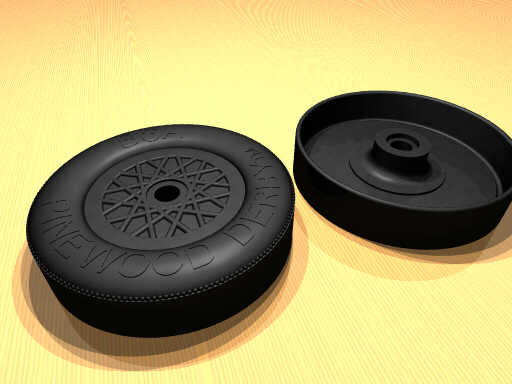
Actually, I merged the text and a torus to curve the text. It seemed more
efficient than subtracting a torus from a cylinder (or rectangle), and then
subtracting the result from the text. I'm using an AA setting of 0.3.
I'm not sure what you are saying about the CSG's. Which is faster,
difference or merge?
Cris Williams
"Dennis McDaniel" <dmc### [at] yahoocom> wrote in message
news:3a955e00$1@news.povray.org...
> I would say that's not totally outrageous for your render time. You have
> some pretty complex CSG going on there. I'm guessing that you've
subtracted
> a torus from your text to get the curved effect on the surface of the
wheel.
> If this is correct, then that's an even more complicated calculation.
Also,
> it depends on your AA settings. Finally, check for subtraction vs. merge
> settings on your CSG's. You might be able to speed things up a bit.
>
Post a reply to this message
|
|
| |
| |
|
|
|
|
| |
| |
|
|
Sorry couldn't resist.
This scene took 8m 18s at a 750MHz Athlon.
The picture doesn't exactly look like yours, but I think the important
parts are done.
Rendert with 512x384 Pixel and a antialiasing of 0.3
Stefan
--
http://home.t-online.de/home/StefanWz/
Post a reply to this message
Attachments:
Download 'reifen3.jpg' (19 KB)
Download 'reifen2.pov.txt' (5 KB)
Preview of image 'reifen3.jpg'
|
|
| |
| |
|
|
|
|
| |
| |
|
|
I am pretty happy with what I ended up, though, despite my hit-and-miss
approach. I prefer to think of textures as half art and half voodoo. If
you know what you're going to end up with before you start, then it takes
all the fun away!
***
Exactly !!!
My greatest finds are those things I discover because I've made a
wrong turn and ended up in a place that I never would have imagined
even existed if I hadn't strayed from the path. I never finish a program
. . . always something new to add or try . . . some new direction grabs
me and I'm off. Of course, I never complete anything either and that is
probably a fault. I am never lacking for ideas but If I worked for R&D,
I'd need a team of people to finish the task 'cause as soon as I've fingered
out how some thing works . . . I'm off to the next. Character flaw to be
sure but by god its MY flaw and I don't have time to worry about it ;) hehe
However, with POVray and MegaPOV . . . there is no need to worry
about getting bored . . . awesome stuff this !!! Thanks to all of you here
for making it work.
Y
where to next?
Post a reply to this message
|
|
| |
| |
|
|
|
|
| |
| |
|
|
So tell me! How was this done? (Um, and why?) :-)
Cris Williams
"Weinzierl Stefan" <Ste### [at] t-onlinede> wrote in message
news:3A9590DF.A2C9C05C@t-online.de...
> Sorry couldn't resist.
>
> This scene took 8m 18s at a 750MHz Athlon.
>
> The picture doesn't exactly look like yours, but I think the important
> parts are done.
>
> Rendert with 512x384 Pixel and a antialiasing of 0.3
>
> Stefan
>
> --
> http://home.t-online.de/home/StefanWz/
----------------------------------------------------------------------------
----
Post a reply to this message
|
|
| |
| |
|
|
|
|
| |
| |
|
|
Nekar Xenos wrote:
> Wait for a Googlehertz machine to come out...?
In one googolhert, an electrical signal in copper (~.7c) can travel 2.1e-68
yoctometers, or seven quadrillionths of one vigintillionth of the Compton
charge radius of an electron. I don't think we'll be seeing processors that
fast anytime soon. <G>
--
David Fontaine <dav### [at] faricynet> ICQ 55354965
My raytracing gallery: http://davidf.faricy.net/
Post a reply to this message
|
|
| |
| |
|
|
|
|
| |
| |
|
|
Still, it's nice to dream... :)
Just think... a game engine like 'the Matrix'...
Nekar Xenos
Post a reply to this message
|
|
| |
| |
|
|
|
|
| |
| |
|
|
Cris Williams wrote in message <3a958309@news.povray.org>...
>I am pretty happy with what I ended up, though, despite my hit-and-miss
>approach. I prefer to think of textures as half art and half voodoo. If
>you know what you're going to end up with before you start, then it takes
>all the fun away!
I agree. If you look back through the newsgroup, you'll find an image of a
spaceship I posted under the title of "Generation Blobship". I was trying
to get an oily metal texture for the surface, but instead got foam rubber!
--
Mark
Post a reply to this message
|
|
| |
| |
|
|
|
|
| |
| |
|
|
Hi,
Cris Williams schrieb:
>
> So tell me! How was this done? (Um, and why?) :-)
>
I've attached my scene at the first posting.
But I think that you used merge instead of union, which I think is a
little bit faster.
Stefan
--
http://home.t-online.de/home/StefanWz/
Post a reply to this message
|
|
| |
| |
|
|
|
|
| |
| |
|
|
Oh, yea - I missed the source the first time around. Thank you! After
comparing yours to mine I came to the conclusion that we weren't doing
anything differently enough to account for such a big render time
difference, that is until I looked at the lighting. Area lights kill! Of
course, I was using area lighting to the extreme, and when I changed them to
point lights my scene rendered 15 TIMES FASTER! Oh well, live and learn.
I'll probably still use area lights for my final renders, but it's nice to
know that I don't have to wait 5 hours for an intermediate render. Thanks
for your help!
Cris Williams
"Weinzierl Stefan" <Ste### [at] t-onlinede> wrote in message
news:3A963831.6B13C7B8@t-online.de...
> Hi,
>
> Cris Williams schrieb:
> >
> > So tell me! How was this done? (Um, and why?) :-)
> >
> I've attached my scene at the first posting.
> But I think that you used merge instead of union, which I think is a
> little bit faster.
>
> Stefan
>
> --
> http://home.t-online.de/home/StefanWz/
Post a reply to this message
|
|
| |
| |
|
|
|
|
| |