|
|
|
|
|
|
| |
| |
|
|
|
|
| |
| |
|
|
"KalleK" <kal### [at] gmx de> wrote in message news:3a003d96@news.povray.org...
>
> Than there was another problem. The problem of coincident surfaces. Try to
> modell a hollow glassphere half-filled with water. I didn't know a way to
> avoid the problem with coincident surfaces but a very difficult one (a union
> of{ the glass and a difference of {a union of { a bigger water and
> airpart }}cut out to fill the sphere} I know i can't describe it well, but I
> can send you the source. (Thinking of it now, clipped_by would improve it)
First of all, got to say that now I know someone made this before I ever got
around to starting on one. But I won't let that stop me :-)
About using clipped_by. Big mistake, if I understood you, because I think the
unioned difference is best to get a correct CSG. Since clipping leaves object
open it's not very conducive to refraction (ior), imo. At least not for all
things.
I'd just scale a copy of the object being used in the final union as the
cutaway object a fraction larger or smaller (depending on the desired result).
The laced cloth is a nice touch. You're own creation, or from a macro or
include file someplace?
Bob de> wrote in message news:3a003d96@news.povray.org...
>
> Than there was another problem. The problem of coincident surfaces. Try to
> modell a hollow glassphere half-filled with water. I didn't know a way to
> avoid the problem with coincident surfaces but a very difficult one (a union
> of{ the glass and a difference of {a union of { a bigger water and
> airpart }}cut out to fill the sphere} I know i can't describe it well, but I
> can send you the source. (Thinking of it now, clipped_by would improve it)
First of all, got to say that now I know someone made this before I ever got
around to starting on one. But I won't let that stop me :-)
About using clipped_by. Big mistake, if I understood you, because I think the
unioned difference is best to get a correct CSG. Since clipping leaves object
open it's not very conducive to refraction (ior), imo. At least not for all
things.
I'd just scale a copy of the object being used in the final union as the
cutaway object a fraction larger or smaller (depending on the desired result).
The laced cloth is a nice touch. You're own creation, or from a macro or
include file someplace?
Bob
Post a reply to this message
|
|
| |
| |
|
|
|
|
| |
| |
|
|
Hi Bob!
> About using clipped_by. Big mistake, if I understood you, because I think
the
> unioned difference is best to get a correct CSG. Since clipping leaves
object
> open it's not very conducive to refraction (ior), imo. At least not for
all
> things.
Yes. When I thought about finally improving my source I realized it's not
that easy. Exactly that problem with refraction...
> I'd just scale a copy of the object being used in the final union as the
> cutaway object a fraction larger or smaller (depending on the desired
result).
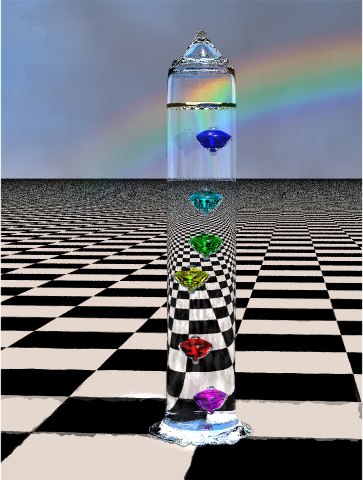
But I think that this can cause some unwanted results with complex objects
(like the thermometer-lathe). If you scale the letter "H" his new 'volume'
will not cover the old one. The result would be surfaces of the cutaway
object in the final union. Therefore I used a much bigger cylinder for the
cutaway object.
> The laced cloth is a nice touch. You're own creation, or from a macro or
> include file someplace?
It's my own creation. Some loops, no macros. It should match with reality
and represent the real crochet work the thermometer is placed on in reality.
In fact this detail encouraged me to finally post the scene.
As far as the lathe bug is concerned - i got no answers. Shell I ask in
povray.general? I want to avoid these artefacts and don't know how.
cukk
Post a reply to this message
|
|
| |
| |
|
|
|
|
| |
| |
|
|
"KalleK" <kal### [at] gmxde> wrote in message news:3a05920f@news.povray.org...
>
> As far as the lathe bug is concerned - i got no answers. Shell I ask in
> povray.general? I want to avoid these artefacts and don't know how.
I'm not so sure it can really be classified as a true "bug" since it's probably
more of a mathematics problem in the spline. They tend to wrap back on
themselves if the points which are set up for the profile aren't in good
relation to one another. sturm helps but can't seem to go beyond a certain
limit to clear it up. Numerical precision and all that, you know.
Anyhow, what I'm actually getting at is that the spline calculations are either
faulty or just can't reach correct accuracy. But if you place the points well
enough there wouldn't be artifacts. What it needs is a over-ride to prevent
bad points and thus bad splines. I guess in that respect it would be a bug
once the answer to that were found.
Didn't make perfect sense, did I ?
Bob
Post a reply to this message
|
|
| |
| |
|
|
|
|
| |
| |
|
|
Hi Bob!
> I'm not so sure it can really be classified as a true "bug" since it's
probably
> more of a mathematics problem in the spline. They tend to wrap back on
> themselves if the points which are set up for the profile aren't in good
> relation to one another. sturm helps but can't seem to go beyond a
certain
> limit to clear it up. Numerical precision and all that, you know.
Now I get what Grimdude answered. And I thought it was a joke. Because sturm
is a german word for storm. And If there was a dark line at the horizon, it
could be a storm. but it's that keyword sturm, he ment. I see and will try
sturm now.
> Anyhow, what I'm actually getting at is that the spline calculations are
either
> faulty or just can't reach correct accuracy. But if you place the points
well
> enough there wouldn't be artifacts. What it needs is a over-ride to
prevent
> bad points and thus bad splines. I guess in that respect it would be a
bug
> once the answer to that were found.
> Didn't make perfect sense, did I ?
Reading twice helped (but that are maybe language problems to be solved...)
Now I'm disappointed - I thought I prevented the spline from bad points,
therefore i did a cubicspline-prism first.
And having tried to find out what was wrong, I realized the error on the
lathe was exactly the height of the camera (those orthogonal rays to the
lathe, Thomas Willhelm mentioned in his answer to kens so called "media bug"
in march '99).
You answer is another direction, and i thought i had no "bad points" in the
lathe spline. Have to look at it.
Anyway, many thanks to you(r help)!
cukk
Post a reply to this message
|
|
| |
| |
|
|
|
|
| |
| |
|
|
I don't generally reply in German (my Deutsche being so poor).
Grim
Post a reply to this message
|
|
| |
| |
|
|
|
|
| |
| |
|
|
Hi GrimDude!
I didn't think, you would reply in german - I didn't think at all, I think.
I read "sturm" and thought "storm"... The english word for "sturm" would be
the same in german... (not true!)
Back ontoppic:
The helps says "sturm" is always used in cubic splines. So this is not the
solution... It's something with the precision, I can't help.
But thanks for the replies!
cukk
Post a reply to this message
|
|
| |
| |
|
|
|
|
| |
| |
|
|
> Back ontoppic:
> The helps says "sturm" is always used in cubic splines. So this is not the
> solution... It's something with the precision, I can't help.
>
> But thanks for the replies!
> cukk
>
>
What was your max_trace_level?
If that's not it, could you post your code to p.t.s.f?
Danke, viel gluck (no umlaut available)!
Grim
Post a reply to this message
|
|
| |
| |
|
|
|
|
| |
| |
|
|
Hi Grim!
> What was your max_trace_level?
it was 250. That's not the trick...
> If that's not it, could you post your code to p.t.s.f?
I do. But since the code consist of several files, I will post a zip to
p.b.s-f,
if you don't mind.
see "thermometer (glassthingie) code 6kbbu"
> Danke, viel gluck (no umlaut available)!
> Grim
Whenever I 'm not able to use an "Umlaut" I insert a 'e' after the vowel.
For
variables
in povray...)
See you in p.b.s-f
Kallek
Post a reply to this message
|
|
| |
| |
|
|
|
|
| |
| |
|
|
..and that would be why I don't reply in foreign tongues. :)
Thanks, I'll check out your code.
Grim
Post a reply to this message
|
|
| |
| |
|
|
|
|
| |
| |
|
|
Tried making one myself now.
"artifact" across it too, lined up with the horizon, but I don't think it's in
error.
max_trace_level was at 15 and the camera offset from any axis. The top of the
liquid is very prominent too but it's due to the surface tension or adhesion to
glass I put there. Too much exaggeration and reflection possibly.
Needs work, I know. Just showing what I got when making this same thing. I
had put a heat wave effect near the bottom of the picture but it's an awful
attempt.
Bob
Post a reply to this message
Attachments:
Download 'therm.jpg' (45 KB)
Preview of image 'therm.jpg'

|
|
| |
| |
|
|
|
|
| |