|
|
|
|
|
|
| |
| |
|
|
|
|
| |
| |
|
|
> Well well, put them in a light_group and fake it :-)
>
> G.
>
Well, well, you again, always faking... :-)
...but it would *sound* much better when I could say
all the lighting was done with radiosity.
-Ive
Post a reply to this message
|
|
| |
| |
|
|
|
|
| |
| |
|
|
Just something about music:
Hanna (she played the cello with our band) told me that
at this time it was strictly forbidden for a woman to play
a instrument like the viol or a gambe, because you had to
do this with widely spread legs. So this kind of instrument
was only played by men.
-Ive
Post a reply to this message
|
|
| |
| |
|
|
|
|
| |
| |
|
|
3da300eb$1@news.povray.org...
> But anyway, if he has used such advanced technologies and optical
> utilities, he could be considered as the first *raytracer* ever.
and he wrote a user's guide about it... The "rays" used were strings but the
main idea was there.
It took a lot of time, so that was certainly raytracing...
Here are the best links I could find (and sorry they're PDF) but if people
are interested I could post better images and a short description of how it
was done.
http://students.cec.wustl.edu/~cs453/lectures/14Raytracing.pdf
http://wwwicg.informatik.uni-rostock.de/Lehre/VSem_MG02/PhotorealBilder.pdf
G.
--
**********************
http://www.oyonale.com
**********************
- Graphic experiments
- POV-Ray and Poser computer images
- Posters
Post a reply to this message
|
|
| |
| |
|
|
|
|
| |
| |
|
|
> and he wrote a user's guide about it... The "rays" used were strings but the
> main idea was there.
>
Oops, what a shame. I was born in Nuremberg, the hometown of Albrecht
-Ive
Post a reply to this message
|
|
| |
| |
|
|
|
|
| |
| |
|
|
in news:3da300eb$1@news.povray.org Ive wrote:
> Yes, I know the rumours about his use of a camera obscura. In my
> opinion, this is not true.
If he did he wasn't the only one ...
> But anyway, if he has used such advanced technologies and optical
> utilities,
... there was a lot more technology available these days than one may
think. Doing this kind of work with a normal, pinhole, camera obscura is
near impossible due to the lack of strong light sources. But lenses
where already available, Christiaan Huygens (1624 - 1695) was one of the
great lens grinders of his time. Vermeer (1632 - 1675) may have been
very well aware of these tools. It is for example known that Rembrand
(1606 - 1669) used lenses and has met Huygens.
A great book on all this is:
Secret Knowledge: Rediscovering the Lost Techniques of the Old Masters
by David Hockney
Viking Press; ISBN: 0670030260
There also was a great documentary on the subject on the BBC:
http://news.bbc.co.uk/1/hi/entertainment/arts/1595979.stm
Ingo
Post a reply to this message
|
|
| |
| |
|
|
|
|
| |
| |
|
|
Another posibility is that Vermeer got his lenses from his friend Antoni van
Leeuwenhoek (1632-1723) , who made about 500 optical lenses during his life.
Van Leeuwenhoek lived also in Delft.
"ingo" <ing### [at] tag povrayorg> wrote in message
news:Xns### [at] povrayorg...
> in news:3da300eb$1@news.povray.org Ive wrote:
>
> > Yes, I know the rumours about his use of a camera obscura. In my
> > opinion, this is not true.
>
> If he did he wasn't the only one ...
>
> > But anyway, if he has used such advanced technologies and optical
> > utilities,
>
> ... there was a lot more technology available these days than one may
> think. Doing this kind of work with a normal, pinhole, camera obscura is
> near impossible due to the lack of strong light sources. But lenses
> where already available, Christiaan Huygens (1624 - 1695) was one of the
> great lens grinders of his time. Vermeer (1632 - 1675) may have been
> very well aware of these tools. It is for example known that Rembrand
> (1606 - 1669) used lenses and has met Huygens.
>
> A great book on all this is:
> Secret Knowledge: Rediscovering the Lost Techniques of the Old Masters
> by David Hockney
> Viking Press; ISBN: 0670030260
>
> There also was a great documentary on the subject on the BBC:
> http://news.bbc.co.uk/1/hi/entertainment/arts/1595979.stm
>
> Ingo povrayorg> wrote in message
news:Xns### [at] povrayorg...
> in news:3da300eb$1@news.povray.org Ive wrote:
>
> > Yes, I know the rumours about his use of a camera obscura. In my
> > opinion, this is not true.
>
> If he did he wasn't the only one ...
>
> > But anyway, if he has used such advanced technologies and optical
> > utilities,
>
> ... there was a lot more technology available these days than one may
> think. Doing this kind of work with a normal, pinhole, camera obscura is
> near impossible due to the lack of strong light sources. But lenses
> where already available, Christiaan Huygens (1624 - 1695) was one of the
> great lens grinders of his time. Vermeer (1632 - 1675) may have been
> very well aware of these tools. It is for example known that Rembrand
> (1606 - 1669) used lenses and has met Huygens.
>
> A great book on all this is:
> Secret Knowledge: Rediscovering the Lost Techniques of the Old Masters
> by David Hockney
> Viking Press; ISBN: 0670030260
>
> There also was a great documentary on the subject on the BBC:
> http://news.bbc.co.uk/1/hi/entertainment/arts/1595979.stm
>
> Ingo
Post a reply to this message
|
|
| |
| |
|
|
|
|
| |
| |
|
|
In article <web.3da2b808270812b5a077d9480@news.povray.org>,
nomail@nomail says...
> Ive wrote:
>
> > I assume that Vermeer would not have placed his easel in the darkest place of
> > the room . . . What does this mean? Has Vermeer closed the window shades
> > because he preferred this kind of lighting for the room even if this means
> > his canvas was lit very poor? Or did he close the window shades, looked at
> > the room, opened them to do some brush strokes, closed them again...
>
> Actually, Vermeer was probably using a camera obscura, which means that he
> was indeed sitting in the darkest part of the room. More info here:
>
> http://www.grand-illusions.com/vermeer/vermeer1.htm
>
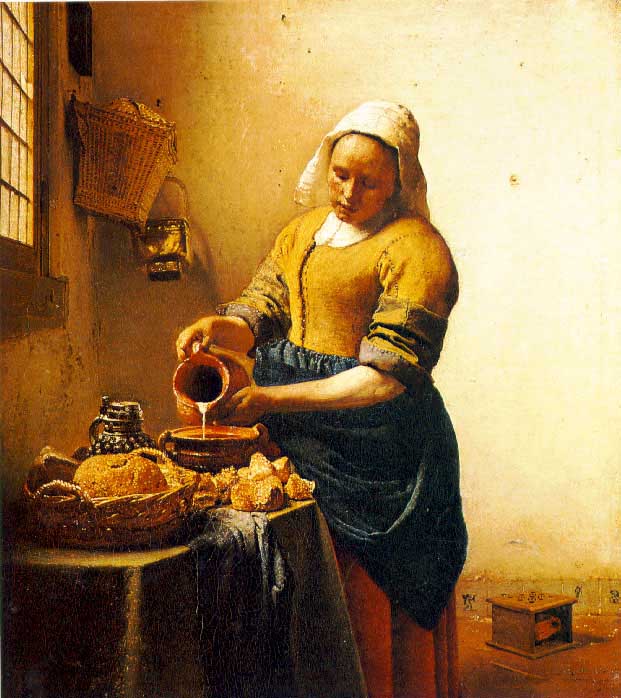
He certainly did not use a camera for his painting "Milkmaid". Try and
figure out the perspective in this painting! It's near impossible to get
it right. For one thing there is no room for the girl behind the table,
and the table cannot be rectangular, to name two points :)
--
Regards, Sander
Post a reply to this message
|
|
| |
| |
|
|
|
|
| |
| |
|
|
Post a reply to this message
Attachments:
Download 'VermeerMM3.jpg' (69 KB)
Preview of image 'VermeerMM3.jpg'
|
|
| |
| |
|
|
|
|
| |
| |
|
|
Post a reply to this message
|
|
| |
| |
|
|
From: Lance Birch
Subject: Re: Vermeer has finished... - VermeerMM3.jpg [1/2]
Date: 12 Oct 2002 04:40:53
Message: <3da7e015@news.povray.org>
|
|
|
| |
| |
|
|
Hi Sander, this message and [2/2] didn't display correctly for me. On this
message, I can't seem to open the JPEG, and on the second message, I just
get garbled text (that I guess is part of the attachment).
Is anyone else having this problem or is it just me?
Lance.
thezone.firewave.com.au
www.firewave.com.au
Post a reply to this message
|
|
| |
| |
|
|
|
|
| |