|
|
|
|
|
|
| |
| |
|
|
|
|
| |
| |
|
|
On 5/15/20 2:09 PM, Bald Eagle wrote:
> Whereupon Tor Olav Kristensen made a whopping follow-up post:
>
...
>
> And that's all I have for now.
>
Unsure how helpful, but I'd read in the past supertoroids a good way to
create various csg modeling shapes.
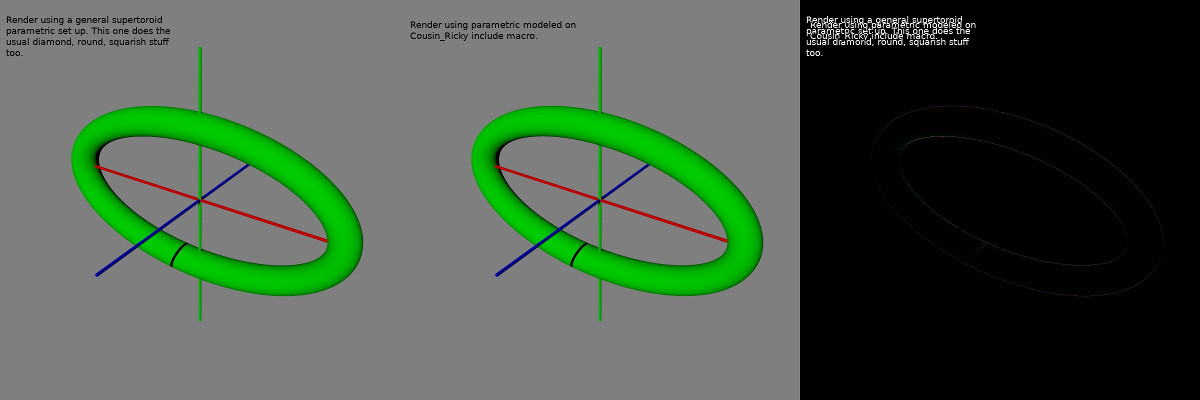
Along with other work brought up a parametric supertoroid alongside a
parametric of Cousin Ricky's include macro. The latter is a subset of
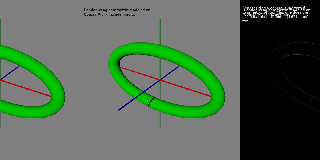
the former's function! See the attached image(2).
Good news, right... We can find, half a dozen, slightly different,
supposed, implicit equations in books, papers and the web for
supertoroids. Another day plus of struggle and I've not a single attempt
that does the a, b scaling correctly - most equations have other issues
too(3). I'm struggling with gradients in all of the implicit forms,
which makes trying ideas slow(4).
Aside:
----
I made an attempt too using my updated f_ellipsoid function creating
first an x,y shell with the proper scaling. Used my new f_multiply1to8
to get something torus like as well as some other forms.
The issue - perhaps like that you were up against in one of your posts -
is, while the surface (the roots) with respect to x,y are in the
correct(1) places, the gradients 'inside' are not of uniform value
around the ring. To a first order the multiplication affects z around
the ring, but I suspect the gradients are also not symmetrical about the
central supertorus axis. Not been able to come up with the right
corrections for even the first order z issue - yet again. :-)
If you or I get this going, Ricky's invoice is going to huge! :-)
Bill P.
(1) - Getting a supertoroid implicit which matches in every respect the
parametric one a worthy goal no matter, but I worry some whether the
resulting super torus will always be the right shape. I think it likely
depends on the approach taken with the rest of the 'csg' - and perhaps
some of the forms you've come up with might be what's needed.
(2) - Differences shown at a 2x multiple. These are due using compute
depths of 8 and 18 with other accuracy items the same. Not too
surprising, but interesting to see.
(3) - The function's terms and how they play with C++/SDL ones given
different e1/e2 parameters is tricky (abs() is your friend). Yep,
possible one or more forms is correctly as presented and it's me not
getting something right.
(4) - Isosurfaces, when not just slow, suddenly blinking out of
existence all or in part. It's as much the problem as slow renders and
forces high gradient settings 500, 1000 or to avoid.
Post a reply to this message
Attachments:
Download 'supertor_chapter7.jpg' (51 KB)
Preview of image 'supertor_chapter7.jpg'
|
|
| |
| |
|
|
|
|
| |
| |
|
|
I just stumbled across this while trying to regain my sanity,
and if even Ramanujan couldn't come up with anything but an approximation, than
I think the rest of us are Fuuuuuuuuuuuuuuuuuuuuuumbling around in the dark.
:)
https://www.youtube.com/watch?v=5nW3nJhBHL0
But don't anyone think that that will stop us from making another attempt, using
new inspiration and mathematical tools!
I think the above implies that due to the interesting properties of ellipses,
that a workable solution will use numerical methods.
Post a reply to this message
|
|
| |
| |
|
|
|
|
| |
| |
|
|
On 2020-09-20 6:24 PM (-4), Bald Eagle wrote:
> I just stumbled across this while trying to regain my sanity,
> and if even Ramanujan couldn't come up with anything but an approximation, than
> I think the rest of us are Fuuuuuuuuuuuuuuuuuuuuuumbling around in the dark.
>
> :)
>
> https://www.youtube.com/watch?v=5nW3nJhBHL0
You watch Matt Parker to regain your sanity? I have some of his videos
languishing in my "Watch later" list because I'm afraid I'll *lose* my
sanity if I watch them.
> But don't anyone think that that will stop us from making another attempt, using
> new inspiration and mathematical tools!
>
> I think the above implies that due to the interesting properties of ellipses,
> that a workable solution will use numerical methods.
I am not convinced that this property is directly relevant to the
problem I am trying to solve. I still think the key is in that quartic
equation I came up with, which should not require numerical methods
(beyond what's implicit in POV-Ray's built-in functions). The problem
is that I am not practiced in solving quartic equations.
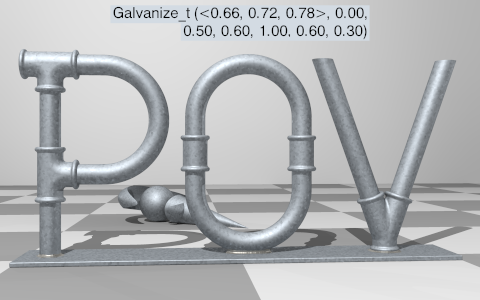
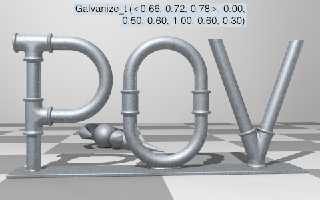
P.S. I have known since 2007 that there is no exact formula for an
ellipse's circumference. I discovered that while trying to weld this
'O' to the rectangular plate using an ellipse made out of blobs.
Post a reply to this message
Attachments:
Download 'povanized-b.png' (100 KB)
Preview of image 'povanized-b.png'
|
|
| |
| |
|
|
|
|
| |
| |
|
|
Cousin Ricky <ric### [at] yahoo com> wrote:
> You watch Matt Parker to regain your sanity?
After spending most of the weekend trying to work out partial differential
equations of 2D Bernstein polynomials, and Gaussian curvature?
Sure.
After that, lifting boxes at work on Monday was relaxing :D
Watching Daniel Shiffman would throw me over the edge, because it's
comedy/tragedy of errors, but I'm learning "important" things at the same
time.... It's like elective surgery with insufficient anaesthetic.
And, take a pre-emptive Advil for this one...
https://www.youtube.com/watch?v=YueAtA_YnSY
> I am not convinced that this property is directly relevant to the
> problem I am trying to solve. I still think the key is in that quartic
> equation I came up with, which should not require numerical methods
> (beyond what's implicit in POV-Ray's built-in functions). The problem
> is that I am not practiced in solving quartic equations.
Dumb question, but is there an online solver?
A language with the proper symbolic logic?
Cheat and get the right answer first, then use that knowledge as a light to
guide you along the path of working out the quartic.
> P.S. I have known since 2007 that there is no exact formula for an
> ellipse's circumference. I discovered that while trying to weld this
> 'O' to the rectangular plate using an ellipse made out of blobs.
It's always the "simple" things, isn't it? com> wrote:
> You watch Matt Parker to regain your sanity?
After spending most of the weekend trying to work out partial differential
equations of 2D Bernstein polynomials, and Gaussian curvature?
Sure.
After that, lifting boxes at work on Monday was relaxing :D
Watching Daniel Shiffman would throw me over the edge, because it's
comedy/tragedy of errors, but I'm learning "important" things at the same
time.... It's like elective surgery with insufficient anaesthetic.
And, take a pre-emptive Advil for this one...
https://www.youtube.com/watch?v=YueAtA_YnSY
> I am not convinced that this property is directly relevant to the
> problem I am trying to solve. I still think the key is in that quartic
> equation I came up with, which should not require numerical methods
> (beyond what's implicit in POV-Ray's built-in functions). The problem
> is that I am not practiced in solving quartic equations.
Dumb question, but is there an online solver?
A language with the proper symbolic logic?
Cheat and get the right answer first, then use that knowledge as a light to
guide you along the path of working out the quartic.
> P.S. I have known since 2007 that there is no exact formula for an
> ellipse's circumference. I discovered that while trying to weld this
> 'O' to the rectangular plate using an ellipse made out of blobs.
It's always the "simple" things, isn't it?
Post a reply to this message
|
|
| |
| |
|
|
|
|
| |
| |
|
|
Le 22/09/2020 à 12:28, Bald Eagle a écrit :
> Cousin Ricky <ric### [at] yahoocom> wrote:
>> I am not convinced that this property is directly relevant to the
>> problem I am trying to solve. I still think the key is in that quartic
>> equation I came up with, which should not require numerical methods
>> (beyond what's implicit in POV-Ray's built-in functions). The problem
>> is that I am not practiced in solving quartic equations.
>
> Dumb question, but is there an online solver?
Sir, Yes Sir !
mathworld wolfram (alpha) has such beast.
It take a bit of learning to get it do what is desired, but there is
some examples along the pages.
You can ask it to refactor, solve (even based on chosen parameters), and
far more.
We are more in algebra than geometry.
https://www.wolframalpha.com/examples/mathematics/algebra/
> A language with the proper symbolic logic?
>
> Cheat and get the right answer first, then use that knowledge as a light to
> guide you along the path of working out the quartic.
>
I think the elliptical torus with a minor radius of 0 should match the
equation of the ellipse.
That's the basic check of any solution: minor radius of 0 would simplify
the equation to an ellipse.
The difficulty is going backward: reintroduce a non-0 minor radius.
Post a reply to this message
|
|
| |
| |
|
|
|
|
| |
| |
|
|
Le 21/09/2020 à 00:24, Bald Eagle a écrit :
> I just stumbled across this while trying to regain my sanity,
> and if even Ramanujan couldn't come up with anything but an approximation, than
> I think the rest of us are Fuuuuuuuuuuuuuuuuuuuuuumbling around in the dark.
>
> :)
>
> https://www.youtube.com/watch?v=5nW3nJhBHL0
>
> But don't anyone think that that will stop us from making another attempt, using
> new inspiration and mathematical tools!
>
> I think the above implies that due to the interesting properties of ellipses,
> that a workable solution will use numerical methods.
>
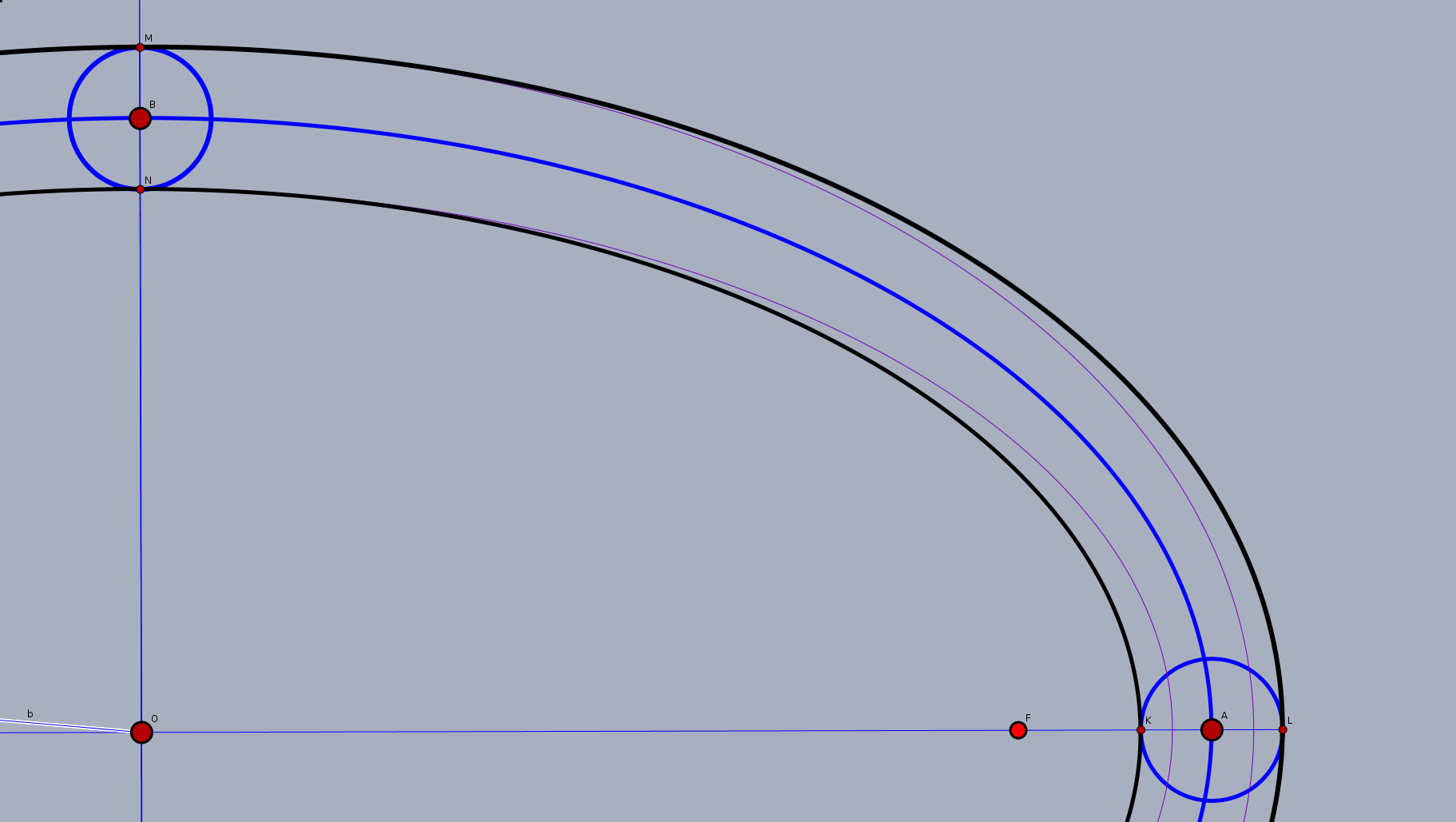
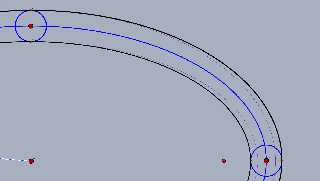
I tried to play a bit with the hope to transform the quartic equation of
circular torus into elliptical torus.
From (sqrt(x²+y²)-R)²+z²=r², replacing x²+y²=R² with (x/a)²+(y/b)²=1
And it is deception.
x^4/a^4
+ (2 x^2 y^2)/(a^2 b²)
- (2 r^2 x^2)/a²- (2 x^2)/a²
+ (2 x^2 z^2)/a²
+ y^4/b⁴
- (2 r^2 y^2)/b²- (2 y^2)/b²
+ (2 y^2 z^2)/b²
+ r⁴- 2 r²+ 1
- 2 r^2 z²+ 2 z²
+ z⁴
Because the scaling of x & y also influence the radius of the minor circle.
But it must be possible to have it with a 4th degree poly.
If F( Point ) is such polynomial, we have the following requirement
F( 0, +/- B , +/- Minor ) = 0 (point B)
F( +/- A, 0, +/- Minor ) = 0 (point A)
F( 0, +/- B +/- Minor, 0 ) = 0 (points M & N)
F( +/- A +/- Minor, 0, 0 ) = 0 (points K & L)
I guess, but cannot yet assert, that to avoid compressing the minor
circle, the z⁴, x⁴ and y⁴ must be 1.
And there might be some non-traditional power of x,y and z (aka odd) in
the non-null coefficient, which would disappear when A=B to have a
continuity with the circular torus.
Also, any point W On the central ellipse with z=+/- Minor is also F(W)=0
And if any more point is needed, there is the two minor circle at A & B
to explore more deeply than K, L, M & N.
Is that enough to try some spreadsheet solver, and how to do it ?
Post a reply to this message
Attachments:
Download 'torusellipse.png' (91 KB)
Preview of image 'torusellipse.png'
|
|
| |
| |
|
|
|
|
| |
| |
|
|
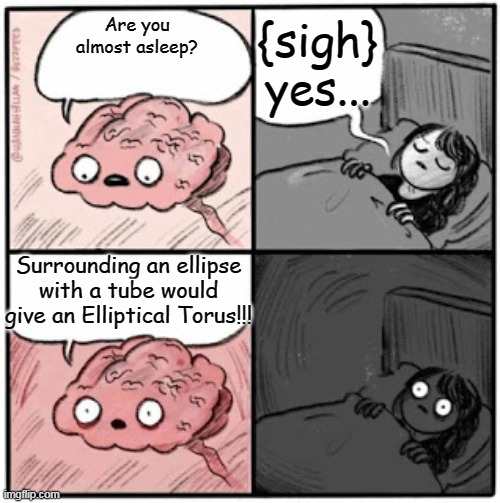
So....
After the whole "surround a function with a tube" got explored (and still not
completely sorted out in my head), my brain decided to alert me that therein
might lay the possible solution to this problem.
I copy-pasted some code, fought with Phi again, "won", and got an elliptical
shaped torus. For a=2, b=1.5 it looked good, but the problem had always been
the eccentric tori. a=4 and b=0.75 revealed the same old problem.
I can't find the thread where you list the required specifications, but I don't
think that it's possible using a cross-sectional circle of a constant radius.
Because that's what we're doing with the tube method. And this doesn't give
inner and outer curves that are themselves ellipses.
https://www.frassek.org/3d-mathe/funktionsgraph-als-rohr-r%C3%B6hre/
https://image.jimcdn.com/app/cms/image/transf/dimension=1920x400:format=gif/path/scee86bccd27a6ab2/image/i16edd265f402b
f7c/version/1580469937/image.gif
We can get signed distance functions,
https://iquilezles.org/articles/distfunctions2d/
https://www.shadertoy.com/view/4sS3zz
and we know that we can calculate the tangent and normal vectors to the central
ellipse.
What I'm thinking right now is that we can ditch trying to create the whole
surface and focus on the 3 ellipses - the central, and the inner and outer. If
the inner and outer aren't the same distance away from the central curve along
the normal vector, then I'd say that this demonstrates that a solution isn't
possible, given the parameters.
I think I ran into this issue with Mike Horvath wanting ellipsoid shells -
simply scaling an ellipsoid doesn't give a constant-distance shell from the
original ellipsoid. But those ARE ellipsoids themselves. And calculating a
constant-distance shell would give objects that WEREN'T ellipsoids.
I'mm betting that those level sets of the signed distance function of an ellipse
- aren't ellipses.
So I think that some of the constraints are mutually exclusive.
Post a reply to this message
Attachments:
Download 'tubememe.jpg' (71 KB)
Preview of image 'tubememe.jpg'
|
|
| |
| |
|
|
|
|
| |
| |
|
|
"Bald Eagle" <cre### [at] netscapenet> wrote:
> https://www.shadertoy.com/view/4sS3zz
Referenced in that code is this article with some comprehensive treatment of the
quartic equation.
https://iquilezles.org/articles/ellipsedist/
Post a reply to this message
|
|
| |
| |
|
|
|
|
| |
| |
|
|
"Bald Eagle" <cre### [at] netscapenet> wrote:
> ... I'd say that this demonstrates that a solution isn't
> possible, given the parameters.
>
> So I think that some of the constraints are mutually exclusive.
However; depending on if the design parameters can be modified and still provide
an acceptable solution to the intended goal:
Perhaps an elliptical "torus" that is in reality a Dupin cyclide would be just
the thing:
https://en.wikipedia.org/wiki/Dupin_cyclide#Elliptic_cyclides
- BW
Post a reply to this message
|
|
| |
| |
|
|
|
|
| |
| |
|
|
"Bald Eagle" <cre### [at] netscapenet> wrote:
> "Bald Eagle" <cre### [at] netscapenet> wrote:
> > ... I'd say that this demonstrates that a solution isn't
> > possible, given the parameters.
> >
>
> > So I think that some of the constraints are mutually exclusive.
>
> However; depending on if the design parameters can be modified and still provide
> an acceptable solution to the intended goal:
>
> Perhaps an elliptical "torus" that is in reality a Dupin cyclide would be just
> the thing:
> https://en.wikipedia.org/wiki/Dupin_cyclide#Elliptic_cyclides
>
> - BW
So, for whatever reason, my brain revisited this, and I wanted a quick
evaluation of if my intuition about using a cyclide in place of an actual torus
would work.
enjoy.
-----------------------------------------------------------------------
A section of a Dupin cyclide (specifically a ring cyclide) can play the
Below is the detailed geometric reasoning.
Why an elliptically‑centered circular torus is impossible
A standard torus is defined as the surface generated by revolving a circle of
rR>r. Its defining property is:
The tube centerline is a perfect circle of radius RRR.
A circle of radius rrr cannot remain perpendicular to an elliptical trajectory
while maintaining constant distance from the ellipse.
As the tube center attempts to follow the ellipse, the required orientation
twists inconsistently.
The surface self‑intersects unless the cross‑section distorts.
A constant‑radius normal field cannot exist along a plane ellipse.
Thus:
A torus with constant circular cross‑section and an elliptical major
radius cannot be embedded in R3\mathbb{R}^3R3 without distortion.
This is a classical result from differential geometry: a tube of constant radius
can only be swept around a curve whose curvature κ(s)\kappa(s)κ(s)
satisfies
r<1maxκ(s)r < \frac{1}{\max \kappa(s)}r<maxκ(s)1
and whose normal vector rotates consistently. A planar ellipse does not satisfy
this for a fixed radius circle.
How a Dupin cyclide solves this
Its cross sections by suitable families of spheres are circles, and the
curvature lines are circles.
That means:
The surface bends around in a general way not limited to being the
parallel‑offset of a single circle.
The curvature lines are Villarceau circles and orthogonal circular families,
giving a structure very similar to a torus but with more flexibility.
Why a cyclide can work:
A general ring cyclide is obtained from a torus by inversion in a sphere:
Cyclide=Inversion(Torus)\text{Cyclide} = \text{Inversion} ( \text{Torus}
)Cyclide=Inversion(Torus)
Inversion preserves:
circles → circles,
spheres → spheres,
constant‑curvature structure in a generalized way.
But inversion does not preserve distances, so the resulting surface can bend and
elliptical‑centerline torus.
Thus a Dupin cyclide:
has circular curvature lines (like a torus),
maintains circular cross‑sections in a transformed sense,
can be fitted to curves (directrices) that are not circles.
A partial ring cyclide can provide:
an elongated toroidal shape,
smooth curvature without singularities,
circular fiber curves (Villarceau circles),
This is used in:
CAD modeling systems,
sweep surfaces,
transition surfaces (Fillets/Blends),
quadric‑based modeling applications.
Practical interpretation:
If you want:
a circular tube,
bending around an ellipse,
without changing the tube radius,
then a cyclide patch is the mathematically correct surface.
structures. A selected region of a cyclide can approximate a torus stretched
around an ellipse, because the inversion mapping allows shapes impossible in
Euclidean rigid sweeps.
Summary
cyclides in geometric modeling.
If you want, I can:
derive the exact cyclide equation needed for a specific ellipse,
construct Villarceau circle fibrations along that cyclide,
generate POV‑Ray macros for a cyclide section that approximates a torus
swept along an ellipse,
create a PDF with diagrams and derivations,
provide a .pov scene with curvature‑coloring and isosurface rendering.
Would you like the full construction?
Post a reply to this message
|
|
| |
| |
|
|
|
|
| |
|
|