 |
|
|
|
|
|
| |
| |
|
|
|
|
| |
| |
|
|
On 30-11-2017 10:51, Stephen wrote:
> I don't really want to get distracted form what I am doing in Poser. I
> am having problems getting clothes to fit a model in a crouching
> position. The working title is: "How Christianity came to the Western
> Isles."

That /is/ difficult to do. Best I can suggest is to subdivide the cloth
as much as possible.

>
> BTW Do you (or anyone) know how to add a colour tint to a poser model?
> Say, give a green or blue tint to a skin tone.
>

You gave the answer :-)


--
Thomas
Post a reply to this message
|
|
| |
| |
|
|
|
|
| |
| |
|
|
Thomas de Groot <tho### [at] degroot org> wrote:
> That is looking good indeed. I need to ponder this a bit more; I think I
> know how to do this but I want to examine all the angles, so to speak. I
> can see the advantage of this procedure and it would avoid the
> subdividing of the container in discrete elements.
Right - sometimes it's easier to just develop something that's generally
applicable, because then you can use it with just about anything.
I had an idea last night about a way to fill the object, and if I ever get the
time to work it out, it would look great as an animation.
> Saving the point locations is certainly an excellent idea. I shall
> certainly come to that eventually.
I haven't gotten that far, I only had enough time to work out some code and
syntax on my work laptop, and then rewrite it all at home.
Thou shalt not forget thy USB stick.
IIRC, you had posted some read/write code for an evalpigment scene or something
- I'll probably work off of that.
> Well done indeed.
Thanks - as with most things, it's just a matter of getting around to actually
doing it.
It would be nice to have a few robust "FillObject()" macros in the ole' POV-Ray
toolkit. org> wrote:
> That is looking good indeed. I need to ponder this a bit more; I think I
> know how to do this but I want to examine all the angles, so to speak. I
> can see the advantage of this procedure and it would avoid the
> subdividing of the container in discrete elements.
Right - sometimes it's easier to just develop something that's generally
applicable, because then you can use it with just about anything.
I had an idea last night about a way to fill the object, and if I ever get the
time to work it out, it would look great as an animation.
> Saving the point locations is certainly an excellent idea. I shall
> certainly come to that eventually.
I haven't gotten that far, I only had enough time to work out some code and
syntax on my work laptop, and then rewrite it all at home.
Thou shalt not forget thy USB stick.
IIRC, you had posted some read/write code for an evalpigment scene or something
- I'll probably work off of that.
> Well done indeed.
Thanks - as with most things, it's just a matter of getting around to actually
doing it.
It would be nice to have a few robust "FillObject()" macros in the ole' POV-Ray
toolkit.
Post a reply to this message
|
|
| |
| |
|
|
|
|
| |
| |
|
|
On 30/11/2017 12:19, Thomas de Groot wrote:
> On 30-11-2017 10:51, Stephen wrote:
>> I don't really want to get distracted form what I am doing in Poser. I
>> am having problems getting clothes to fit a model in a crouching
>> position. The working title is: "How Christianity came to the Western
>> Isles."
>
> That /is/ difficult to do. Best I can suggest is to subdivide the cloth
> as much as possible.
>

Thanks but that is really not the big problem. My new installation of
Win7 is flaky. I think I am going to reinstall it. So I can get Poser
working properly. I've been going La, la, la to all the problems. In
denial. I've just bought an upgrade from Win7 home to Win7 Pro so I'll
try a clean install from that rather than upgrade it again.


>>
>> BTW Do you (or anyone) know how to add a colour tint to a poser model?
>> Say, give a green or blue tint to a skin tone.
>>
>
> You gave the answer :-)
>
>
I was thinking in terms of doing it in PovRay but it is much easier to
do it at source.

--

Regards
     Stephen
Post a reply to this message
|
|
| |
| |
|
|
|
|
| |
| |
|
|
On 30-11-2017 13:44, Bald Eagle wrote:
> Thomas de Groot <tho### [at] degrootorg> wrote:
>
>> That is looking good indeed. I need to ponder this a bit more; I think I
>> know how to do this but I want to examine all the angles, so to speak. I
>> can see the advantage of this procedure and it would avoid the
>> subdividing of the container in discrete elements.
>
> Right -  sometimes it's easier to just develop something that's generally
> applicable, because then you can use it with just about anything.
> I had an idea last night about a way to fill the object, and if I ever get the
> time to work it out, it would look great as an animation.

Agreed. Looking forward to it.

>
>> Saving the point locations is certainly an excellent idea. I shall
>> certainly come to that eventually.
>
> I haven't gotten that far, I only had enough time to work out some code and
> syntax on my work laptop, and then rewrite it all at home.
> Thou shalt not forget thy USB stick.
> IIRC, you had posted some read/write code for an evalpigment scene or something
> - I'll probably work off of that.

That's correct. Should work.

>
>
>> Well done indeed.
>
> Thanks - as with most things, it's just a matter of getting around to actually
> doing it.
>
> It would be nice to have a few robust "FillObject()" macros in the ole' POV-Ray
> toolkit.
>

Yep.


--
Thomas
Post a reply to this message
|
|
| |
| |
|
|
|
|
| |
| |
|
|
On 30-11-2017 16:02, Stephen wrote:
> On 30/11/2017 12:19, Thomas de Groot wrote:
>> On 30-11-2017 10:51, Stephen wrote:
>>> I don't really want to get distracted form what I am doing in Poser.
>>> I am having problems getting clothes to fit a model in a crouching
>>> position. The working title is: "How Christianity came to the Western
>>> Isles."
>>
>> That /is/ difficult to do. Best I can suggest is to subdivide the
>> cloth as much as possible.
>>
>
> Thanks but that is really not the big problem. My new installation of
> Win7 is flaky. I think I am going to reinstall it. So I can get Poser
> working properly. I've been going La, la, la to all the problems. In
> denial. I've just bought an upgrade from Win7 home to Win7 Pro so I'll
> try a clean install from that rather than upgrade it again.

Eventually, we (you and me) shall have to migrate to Win10. Not that I
enjoy that. I'll stick to Win7 as long as I can.

>
>
>>>
>>> BTW Do you (or anyone) know how to add a colour tint to a poser
>>> model? Say, give a green or blue tint to a skin tone.
>>>
>>
>> You gave the answer :-)
>>
>>
> I was thinking in terms of doing it in PovRay but it is much easier to
> do it at source.
>

To do the former, you can use the good old functions provided by Poseray:

#macro pigment_multiply(p1,p2)
//multiplies two pigments
#local PR1 = function {pigment{p1}}
#local PR2 = function {pigment{p2}}
#local PR_FRed=function (x,y,z) {PR1(x,y,z).red*PR2(x,y,z).red}
#local PR_FGrn=function (x,y,z) {PR1(x,y,z).green*PR2(x,y,z).green}
#local PR_FBlu=function (x,y,z) {PR1(x,y,z).blue*PR2(x,y,z).blue}
average pigment_map{
     [function{PR_FRed(x,y,z)} color_map{[0 rgb 0][1 rgb <1,0,0>*3]}]
     [function{PR_FGrn(x,y,z)} color_map{[0 rgb 0][1 rgb <0,1,0>*3]}]
     [function{PR_FBlu(x,y,z)} color_map{[0 rgb 0][1 rgb <0,0,1>*3]}]
   }
#end

Then use that in the material file. e.g:

material {
   texture {
     uv_mapping
     pigment {pigment_multiply(p_shalwar, pigment{color srgb
<1.00,0.67,0.00> }) }
     finish {diffuse 0.8}
   }
}


[watch out for the line feed above]


--
Thomas
Post a reply to this message
|
|
| |
| |
|
|
|
|
| |
| |
|
|
On 01/12/2017 08:00, Thomas de Groot wrote:
> On 30-11-2017 16:02, Stephen wrote:

>>>
>>
>> Thanks but that is really not the big problem. My new installation of
>> Win7 is flaky. I think I am going to reinstall it. So I can get Poser
>> working properly. I've been going La, la, la to all the problems. In
>> denial. I've just bought an upgrade from Win7 home to Win7 Pro so I'll
>> try a clean install from that rather than upgrade it again.
>
> Eventually, we (you and me) shall have to migrate to Win10. Not that I
> enjoy that. I'll stick to Win7 as long as I can.
>

I can't believe I am saying this. I think I would rather move to Linux.
I have Win 10 on my laptop and I now never use it.

Reply from Smith Micro.


Thank you for contacting Support. Make sure you have the last updates
installed

http://my.smithmicro.com/poser-pro-2010-updates.html

Please note… Poser 8/Poser Pro 2010 are not officially supported on the
last release of Windows 7

You will need to use the External Library along with the last available
AIR from Adobe

Poser Pro 11 is the current version and there is a Coupon

HOLIDAY17 available to use on the Upgrade Offers

http://my.smithmicro.com/poser-pro-11-upgrades.html


>>
>>
>>>>
>>>> BTW Do you (or anyone) know how to add a colour tint to a poser
>>>> model? Say, give a green or blue tint to a skin tone.
>>>>
>>>
>>> You gave the answer :-)
>>>
>>>
>> I was thinking in terms of doing it in PovRay but it is much easier to
>> do it at source.
>>
>
> To do the former, you can use the good old functions provided by Poseray:
>

The thought did cross my mind after I saw how easy it was to do in
Poser. Unfortunately since I use Bishop3d to put my scenes together I
need to use PoseRay Ver (quite old) as B3D cannot handle functions.


>      pigment {pigment_multiply(p_shalwar, pigment{color srgb
> <1.00,0.67,0.00> }) }

>
>
> [watch out for the line feed above]
>
>

That is the only one that gets broken in Tbird.

--

Regards
     Stephen
Post a reply to this message
|
|
| |
| |
|
|
|
|
| |
| |
|
|
On 12/01/2017 03:00 AM, Thomas de Groot wrote:
> On 30-11-2017 16:02, Stephen wrote:
>> On 30/11/2017 12:19, Thomas de Groot wrote:
>>
...
>>>>
>>>> BTW Do you (or anyone) know how to add a colour tint to a poser
>>>> model? Say, give a green or blue tint to a skin tone.
>>>>
>>>
>>> You gave the answer :-)
>>>
>>>
>> I was thinking in terms of doing it in PovRay but it is much easier to
>> do it at source.
>>
>
> To do the former, you can use the good old functions provided by Poseray:
>
> #macro pigment_multiply(p1,p2)
> //multiplies two pigments
> #local PR1 = function {pigment{p1}}
> #local PR2 = function {pigment{p2}}
> #local PR_FRed=function (x,y,z) {PR1(x,y,z).red*PR2(x,y,z).red}
> #local PR_FGrn=function (x,y,z) {PR1(x,y,z).green*PR2(x,y,z).green}
> #local PR_FBlu=function (x,y,z) {PR1(x,y,z).blue*PR2(x,y,z).blue}
> average pigment_map{
>      [function{PR_FRed(x,y,z)} color_map{[0 rgb 0][1 rgb <1,0,0>*3]}]
>      [function{PR_FGrn(x,y,z)} color_map{[0 rgb 0][1 rgb <0,1,0>*3]}]
>      [function{PR_FBlu(x,y,z)} color_map{[0 rgb 0][1 rgb <0,0,1>*3]}]
>    }
> #end
>
...

FYI. The pigment_multiply macro above can be coded in POV-Ray 3.8
somewhat more succinctly as:

//------------------- 3.8 ------------------------
//multiplies two pigments
#macro pigment_multiply(p1,p2)
#local PR1 = function {pigment{p1}}
#local PR2 = function {pigment{p2}}
user_defined {
     function { PR1(x,y,z).red*PR2(x,y,z).red },
     function { PR1(x,y,z).green*PR2(x,y,z).green },
     function { PR1(x,y,z).blue*PR2(x,y,z).blue },,
}
#end

Bill P.
Post a reply to this message
|
|
| |
| |
|
|
|
|
| |
| |
|
|
"Bald Eagle" <cre### [at] netscapenet> wrote:

> > That is looking good indeed. I need to ponder this a bit more; I think I
> > know how to do this but I want to examine all the angles, so to speak. I
> > can see the advantage of this procedure and it would avoid the
> > subdividing of the container in discrete elements.


Here's the relevant portion that does the scanning and filling.
I haven't had a chance yet to dig up the write/save vs read code and implement
it.

#declare Min = min_extent (Object);
#declare Max = max_extent (Object);

#declare MinZ = floor(Min.z);
#declare MinY = floor(Min.y);
#declare MinX = floor(Min.x);
#declare MaxZ = ceil(Max.z);
#declare MaxY = ceil(Max.y);
#declare MaxX = ceil(Max.x);
#declare Step = 0.5;

#declare ZRange = (MaxZ - MinZ)/Step;
#declare YRange = (MaxY - MinY)/Step;
#declare XRange = (MaxX - MinX)/Step;

#declare ArraySize = XRange*YRange*ZRange;

#declare TestArray = array [ArraySize];

#declare N = 0;
#for (Z, MinZ, MaxZ, Step)
 #for (Y, MinY, MaxY, Step)
  #for (X, MinX, MaxX, Step)
   #if(inside (Object, <X, Y, Z>))
    #declare TestArray [N] = <X, Y, Z>;
    //#debug concat ( "Point ", str (N, 3, 1), " = ", vstr(3, TestArray[N], ",
", 3, 0), " \n")
    #declare N = N +1;
   #end
  #end
 #end
#end

#declare InSize = N - 1;


#declare Stream  = seed (123456789);
#declare Stream1 = seed (456123789);
#declare Stream2 = seed (789456123);
#declare Stream3 = seed (135791113);
#declare Stream4 = seed (987654321);
#declare Stream5 = seed (987654321);
#declare ScaleRange = 3;

#declare Tries = 2000;

#for (N, 1, Tries)
 #declare P = int(rand (Stream5)*InSize);
 #declare rx = rand(Stream1)*90;
 #declare ry = rand(Stream2)*90;
 #declare rz = rand(Stream3)*90;
 #declare Scale = rand(Stream4)*ScaleRange;
 #declare TexNum = int (rand (Stream4) * dimension_size (TexArray, 1) );
 object {Jack rotate <rx, ry, rz> scale Scale translate TestArray [P] texture
{TexArray[TexNum]} }
#end
Post a reply to this message
|
|
| |
| |
|
|
|
|
| |
| |
|
|
On 1-12-2017 14:52, William F Pokorny wrote:
> On 12/01/2017 03:00 AM, Thomas de Groot wrote:
>> On 30-11-2017 16:02, Stephen wrote:
>>> On 30/11/2017 12:19, Thomas de Groot wrote:
>>>
> ...
>>>>>
>>>>> BTW Do you (or anyone) know how to add a colour tint to a poser
>>>>> model? Say, give a green or blue tint to a skin tone.
>>>>>
>>>>
>>>> You gave the answer :-)
>>>>
>>>>
>>> I was thinking in terms of doing it in PovRay but it is much easier
>>> to do it at source.
>>>
>>
>> To do the former, you can use the good old functions provided by Poseray:
>>
>> #macro pigment_multiply(p1,p2)
>> //multiplies two pigments
>> #local PR1 = function {pigment{p1}}
>> #local PR2 = function {pigment{p2}}
>> #local PR_FRed=function (x,y,z) {PR1(x,y,z).red*PR2(x,y,z).red}
>> #local PR_FGrn=function (x,y,z) {PR1(x,y,z).green*PR2(x,y,z).green}
>> #local PR_FBlu=function (x,y,z) {PR1(x,y,z).blue*PR2(x,y,z).blue}
>> average pigment_map{
>>      [function{PR_FRed(x,y,z)} color_map{[0 rgb 0][1 rgb <1,0,0>*3]}]
>>      [function{PR_FGrn(x,y,z)} color_map{[0 rgb 0][1 rgb <0,1,0>*3]}]
>>      [function{PR_FBlu(x,y,z)} color_map{[0 rgb 0][1 rgb <0,0,1>*3]}]
>>    }
>> #end
>>
> ...
>
> FYI. The pigment_multiply macro above can be coded in POV-Ray 3.8
> somewhat more succinctly as:
>
> //------------------- 3.8 ------------------------
> //multiplies two pigments
> #macro pigment_multiply(p1,p2)
> #local PR1 = function {pigment{p1}}
> #local PR2 = function {pigment{p2}}
> user_defined {
>      function { PR1(x,y,z).red*PR2(x,y,z).red },
>      function { PR1(x,y,z).green*PR2(x,y,z).green },
>      function { PR1(x,y,z).blue*PR2(x,y,z).blue },,
> }
> #end
>
> Bill P.
>


Aaaah! Progress! :-)

Thank you indeed. A good reason (if none other) to download version 3.8.

--
Thomas
Post a reply to this message
|
|
| |
| |
|
|
|
|
| |
| |
|
|
On 2-12-2017 2:47, Bald Eagle wrote:
> Here's the relevant portion that does the scanning and filling.
> I haven't had a chance yet to dig up the write/save vs read code and implement
> it.
>

Ah, thanks indeed! I was just starting to work on this - from a
different angle I must confess, but to the same ultimate result. THis
comes just in time.

--
Thomas
Post a reply to this message
|
|
| |
| |
|
|
|
|
| |
| |
|
|
Thomas de Groot <tho### [at] degrootorg> wrote:

> Ah, thanks indeed! I was just starting to work on this - from a
> different angle I must confess, but to the same ultimate result. THis
> comes just in time.

Certainly  :)
With so many people with so few Round Tuits, it's a lot easier to pitch in
1/4-of-a-Round-Tuit each and get 1 full final result.

I'll see if I can work on this some more - if you have any questions or ideas
for improvements, let me know.
One thing that comes to mind is to use trace() to limit scanning the entire
bounding box, though it seems to go fast enough at the moment.
Maybe that could be a switchable enable/disable feature for when high-density
scanning of sparse objects are used.
Post a reply to this message
|
|
| |
| |
|
|
|
|
| |
| |
|
|
On 2-12-2017 17:23, Bald Eagle wrote:
> Thomas de Groot <tho### [at] degrootorg> wrote:
>
>> Ah, thanks indeed! I was just starting to work on this - from a
>> different angle I must confess, but to the same ultimate result. THis
>> comes just in time.
>
> Certainly  :)
> With so many people with so few Round Tuits, it's a lot easier to pitch in
> 1/4-of-a-Round-Tuit each and get 1 full final result.

Like bitcoins, their value increases worryingly.

>
> I'll see if I can work on this some more - if you have any questions or ideas
> for improvements, let me know.
> One thing that comes to mind is to use trace() to limit scanning the entire
> bounding box, though it seems to go fast enough at the moment.
> Maybe that could be a switchable enable/disable feature for when high-density
> scanning of sparse objects are used.
>

At this point, I have the following code ready (write/read) installed,
based on (the first part of) your own code. I increased the container a
bit to be sure the model was completely inside. Nice to be working again
with arrays. I am not using them as often as I should:

//start code-----------------------
#if (Write)
   #debug "   writing object locations...\n"
   #fopen ObjLocs "ArrayFill.inc" write

#declare MinZ = floor(Min.z-0.1);
#declare MinY = floor(Min.y-0.1);
#declare MinX = floor(Min.x-0.1);
#declare MaxZ = ceil(Max.z+0.1);
#declare MaxY = ceil(Max.y+0.1);
#declare MaxX = ceil(Max.x+0.1);
#declare Step = 0.01;

#declare ZRange = (MaxZ - MinZ)/Step;
#declare YRange = (MaxY - MinY)/Step;
#declare XRange = (MaxX - MinX)/Step;

#declare ArraySize = XRange*YRange*ZRange;
#declare TestArray = array [ArraySize];

#declare N = 0;
#for (Z, MinZ, MaxZ, Step)
   #for (Y, MinY, MaxY, Step)
     #for (X, MinX, MaxX, Step)
       #if(inside (Model, <X, Y, Z>))
         #declare TestArray [N] = <X, Y, Z>;
         //#debug concat ( "Point ", str (N, 3, 1), " = ", vstr(3,
TestArray[N], ", ", 3, 3), " \n")
         #write (ObjLocs,"<",vstr(3, TestArray[N], ", ", 3, 3),">",",\n")
         #declare N = N +1;
       #end
     #end
   #end
#end

   #fclose ObjLocs

#end  //of Write

#debug "   reading sand locations...\n"
#fopen ObjLocs "ArrayFill.inc" read

union {
   #while (defined(ObjLocs))
     #read (ObjLocs, Locs)
     sphere {0, 0.01 translate Locs}
   #end
   rotate 20*y
}
//end code--------------------------------

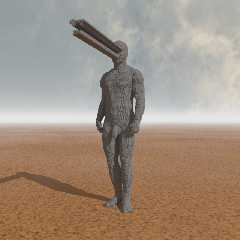
I have to correct the original model a bit: welding vertices and filling
holes. This has become critical for this method. The example image shows
why (eyes and mouth still with holes).

I have to study the second part of your code now. I do not yet fully
understand it.


--
Thomas
Post a reply to this message
Attachments:
Download 'antony gormley sim.png' (390 KB)
Preview of image 'antony gormley sim.png'
|
|
| |
| |
|
|
|
|
| |
| |
|
|
Hey!
I like the results you're getting.
In fact, I like the holes in the mesh so much, that maybe you could think about
exploiting that effect by randomly creating holes in the mesh to give a
"spiking" effect - I think that would be an excellent Gormley-inspired
methodology.

I think this is something Stephen would have fun playing with, and I'd have to
think about how to make it apply to DF3 files.
On the flip-side, if you wrote the points of the array to a DF3-format, then you
could create DF3 point clouds from any solid mesh or CSG construct, which would
be very cool indeed   :)

I have some explanatory comments on the code below to speed you along in your
studies.


"Bald Eagle" <cre### [at] netscapenet> wrote:

> #declare Min = min_extent (Object);
> #declare Max = max_extent (Object);

obviously this just gives the opposing bounding box coordinates

> #declare MinZ = floor(Min.z);
> #declare MinY = floor(Min.y);
> #declare MinX = floor(Min.x);
> #declare MaxZ = ceil(Max.z);
> #declare MaxY = ceil(Max.y);
> #declare MaxX = ceil(Max.x);

Then we do some rounding up and down

> #declare Step = 0.5;
>
> #declare ZRange = (MaxZ - MinZ)/Step;
> #declare YRange = (MaxY - MinY)/Step;
> #declare XRange = (MaxX - MinX)/Step;

This compensates for any "off-origin" positioning

> #declare ArraySize = XRange*YRange*ZRange;
>
> #declare TestArray = array [ArraySize];
>
> #declare N = 0;
> #for (Z, MinZ, MaxZ, Step)
>  #for (Y, MinY, MaxY, Step)
>   #for (X, MinX, MaxX, Step)
>    #if(inside (Object, <X, Y, Z>))
>     #declare TestArray [N] = <X, Y, Z>;

If the point being scanned is inside the object, stick that point on the array
"stack", and increment the stack pointer / array position.
If not, just keep scanning.

>     //#debug concat ( "Point ", str (N, 3, 1), " = ", vstr(3, TestArray[N], ",
> ", 3, 0), " \n")
>     #declare N = N +1;
>    #end
>   #end
>  #end
> #end
>
> #declare InSize = N - 1;

Nudge this back down to the pre-increment value to avoid unknown array element
error.

> #declare Stream  = seed (123456789);
> #declare Stream1 = seed (456123789);
> #declare Stream2 = seed (789456123);
> #declare Stream3 = seed (135791113);
> #declare Stream4 = seed (987654321);
> #declare Stream5 = seed (987654321);
> #declare ScaleRange = 3;

Random seeds and a varying scale between 1 and ScaleRange

> #declare Tries = 2000;

How many objects do you want to populate the inside of the arrayed space with?

> #for (N, 1, Tries)
>  #declare P = int(rand (Stream5)*InSize);

Since rand() returns 0-1, and Insize is the number of points in the array, you
get a position somewhere in that array.

>  #declare rx = rand(Stream1)*90;
>  #declare ry = rand(Stream2)*90;
>  #declare rz = rand(Stream3)*90;
>  #declare Scale = rand(Stream4)*ScaleRange;
>  #declare TexNum = int (rand (Stream4) * dimension_size (TexArray, 1) );

I just had an array here to vary the textures of the jacks randomly

>  object {Jack rotate <rx, ry, rz> scale Scale translate TestArray [P] texture
> {TexArray[TexNum]} }

Put an object at the randomly selected array position.  It gets rotated some
random amount around x, y, and z, and given a random texture before translation.

> #end
Post a reply to this message
|
|
| |
| |
|
|
|
|
| |
| |
|
|
On 3-12-2017 14:17, Bald Eagle wrote:
> Hey!
> I like the results you're getting.
> In fact, I like the holes in the mesh so much, that maybe you could think about
> exploiting that effect by randomly creating holes in the mesh to give a
> "spiking" effect - I think that would be an excellent Gormley-inspired
> methodology.

For the time being I treat them as artefacts.

>
> I think this is something Stephen would have fun playing with, and I'd have to
> think about how to make it apply to DF3 files.
> On the flip-side, if you wrote the points of the array to a DF3-format, then you
> could create DF3 point clouds from any solid mesh or CSG construct, which would
> be very cool indeed   :)

Stephen, your turn ;-)

>
> I have some explanatory comments on the code below to speed you along in your
> studies.
>
> [snip]

ah-HA! I see. Thanks indeed.

--
Thomas
Post a reply to this message
|
|
| |
| |
|
|
|
|
| |
| |
|
|
On 04/12/2017 08:11, Thomas de Groot wrote:
> On 3-12-2017 14:17, Bald Eagle wrote:
>> Hey!
>> I like the results you're getting.
>> In fact, I like the holes in the mesh so much, that maybe you could
>> think about
>> exploiting that effect by randomly creating holes in the mesh to give a
>> "spiking" effect - I think that would be an excellent Gormley-inspired
>> methodology.
>
> For the time being I treat them as artefacts.
>
>>
>> I think this is something Stephen would have fun playing with, and I'd
>> have to
>> think about how to make it apply to DF3 files.
>> On the flip-side, if you wrote the points of the array to a
>> DF3-format, then you
>> could create DF3 point clouds from any solid mesh or CSG construct,
>> which would
>> be very cool indeed   :)
>
> Stephen, your turn ;-)
>

I don't think writing the points from the array to a df3 would give you
the results you want. I think it would just give you a surface with
holes in it.
If you used the slicing method to create a df3. You would get spikes in
the direction of the inside vector extending to the edge of the container.
I have been thinking of trying to do the same with bullet physics. But I
am having PC problems.

>


--

Regards
     Stephen
Post a reply to this message
|
|
| |
| |
|
|
|
|
| |
| |
|
|
Stephen <mca### [at] aolcom> wrote:

> I don't think writing the points from the array to a df3 would give you
> the results you want. I think it would just give you a surface with
> holes in it.

Well, I scan the entire solid, so it ought to give more than that.

> If you used the slicing method to create a df3. You would get spikes in
> the direction of the inside vector extending to the edge of the container.

Ah, yes.  The inside_vector.   Good point.


I think Thomas was merely suggesting that you poke a few holes in a mesh for
testing purposes.


Apparently I'm having "PC issues" as well.   ;)
Post a reply to this message
|
|
| |
| |
|
|
|
|
| |
| |
|
|
On 04/12/2017 11:38, Bald Eagle wrote:
> Stephen <mca### [at] aolcom> wrote:
>
>> I don't think writing the points from the array to a df3 would give you
>> the results you want. I think it would just give you a surface with
>> holes in it.
>
> Well, I scan the entire solid, so it ought to give more than that.
>

I've not been following the technical side of the discussion. I thought
you were scanning a mesh. Which generally only defines a surface. At
least Poser ones do.

>> If you used the slicing method to create a df3. You would get spikes in
>> the direction of the inside vector extending to the edge of the container.
>
> Ah, yes.  The inside_vector.   Good point.
>
>
> I think Thomas was merely suggesting that you poke a few holes in a mesh for
> testing purposes.
>

I had better read the thread again. Something is not meshing. ;)

 >
> Apparently I'm having "PC issues" as well.   ;)
>

Indeed. One man's humour can be another man's deceleration to war. :)


--

Regards
     Stephen
Post a reply to this message
|
|
| |
| |
|
|
|
|
| |
| |
|
|
On 4-12-2017 9:11, Thomas de Groot wrote:
> On 3-12-2017 14:17, Bald Eagle wrote:
>> Hey!
>> I like the results you're getting.
>> In fact, I like the holes in the mesh so much, that maybe you could
>> think about
>> exploiting that effect by randomly creating holes in the mesh to give a
>> "spiking" effect - I think that would be an excellent Gormley-inspired
>> methodology.
>
> For the time being I treat them as artefacts.
>

I don't know what those spikes represent finally. I closed the model and
still the eyes show them, except if I increase minutely the Step
parameter. Any idea?

--
Thomas
Post a reply to this message
|
|
| |
| |
|
|
|
|
| |
| |
|
|
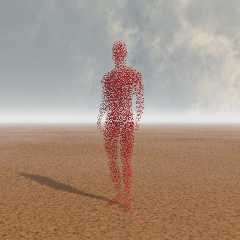
On 4-12-2017 9:11, Thomas de Groot wrote:
> ah-HA! I see. Thanks indeed.
>

Finally, as first approximation, I found it more expedient to randomise
the points in the array when reading them.

--
Thomas
Post a reply to this message
Attachments:
Download 'antony gormley sim.png' (409 KB)
Preview of image 'antony gormley sim.png'
|
|
| |
| |
|
|
|
|
| |
| |
|
|
Stephen <mca### [at] aolcom> wrote:

> I've not been following the technical side of the discussion. I thought
> you were scanning a mesh. Which generally only defines a surface. At
> least Poser ones do.

They are, until you define an inside_vector, and then it's a solid.
POV-Ray squawked about the mesh I was using not being a solid object when I
tried to use inside() until I defined an inside_vector.


> > I think Thomas was merely suggesting that you poke a few holes in a mesh for
> > testing purposes.
>
> I had better read the thread again. Something is not meshing. ;)

You're either not sober and should be, or sober and shouldn't be.
Post a reply to this message
|
|
| |
| |
|
|
|
|
| |
| |
|
|
Thomas de Groot <tho### [at] degrootorg> wrote:


> Finally, as first approximation, I found it more expedient to randomise
> the points in the array when reading them.

Hmmm.
Without seeing how you're going about that, I'm not sure I understand the
advantage of that over selecting a (pseudo)random point in an ordered array.

I do think that one thing that could be done is add a bit of randomization to
the point itself - since they are all regularly spaced in a cubic grid.
("cubic" is just easier to say/write than "rectangular solid")

So, perhaps define half the grid spacing as a multiplier (M), and randomly
translate along x, y, and z by rand_between (-M and M).
Add a rotation if you're using an asymmetric filler.

Or draw a cylinder between the original point and a randomly translated or
chosen outside point.


It's certainly looking more evenly filled - which I think is what you wanted.
Post a reply to this message
|
|
| |
| |
|
|
|
|
| |
| |
|
|
On 04/12/2017 12:45, Bald Eagle wrote:
> Stephen <mca### [at] aolcom> wrote:
>
>> I've not been following the technical side of the discussion. I thought
>> you were scanning a mesh. Which generally only defines a surface. At
>> least Poser ones do.
>
> They are, until you define an inside_vector, and then it's a solid.
> POV-Ray squawked about the mesh I was using not being a solid object when I
> tried to use inside() until I defined an inside_vector.
>
>

I need to look at your code and hope I can see what you are doing.
I don't recognise that warning/error. But I always use PoseRay to
convert OBJ files to Mesh2 and it always includes an inside vector.
What version of Pov are you using?


>>> I think Thomas was merely suggesting that you poke a few holes in a mesh for
>>> testing purposes.
>>
>> I had better read the thread again. Something is not meshing. ;)
>
> You're either not sober and should be, or sober and shouldn't be.
>
>
>
>

I resemble that remark. :(

--

Regards
     Stephen
Post a reply to this message
|
|
| |
| |
|
|
|
|
| |
| |
|
|
Am 04.12.2017 um 13:40 schrieb Thomas de Groot:
> On 4-12-2017 9:11, Thomas de Groot wrote:
>> On 3-12-2017 14:17, Bald Eagle wrote:
>>> Hey!
>>> I like the results you're getting.
>>> In fact, I like the holes in the mesh so much, that maybe you could
>>> think about
>>> exploiting that effect by randomly creating holes in the mesh to give a
>>> "spiking" effect - I think that would be an excellent Gormley-inspired
>>> methodology.
>>
>> For the time being I treat them as artefacts.
>>
>
> I don't know what those spikes represent finally. I closed the model and
> still the eyes show them, except if I increase minutely the Step
> parameter. Any idea?

My guess would be that your mesh is "closed" in a different sense than
what would constitute a "closed" mesh in the sense POV-Ray interprets it.

For instance, a human figure mesh may be comprised of (1) a surface
representing the skin, which is open at the eyes, and (2) a pair of
convex spheres representing the eyeballs.

In such a setup, no ray could travel from the "inside" of the figure's
head to the outside without encountering /at least one/ surface, which
you might consider "closed".

However, in POV-Ray's sense a mesh is only "closed" if a ray traveling
from the "inside" of the figure's head to the outside always encounters
an /odd number/ of surfaces.

This is the case if, and only if, there are no "open edges" in the mesh,
i.e. each edge joins an even number of triangles.
Post a reply to this message
|
|
| |
| |
|
|
|
|
| |
| |
|
|
On 4-12-2017 16:47, clipka wrote:
> Am 04.12.2017 um 13:40 schrieb Thomas de Groot:
>> I don't know what those spikes represent finally. I closed the model and
>> still the eyes show them, except if I increase minutely the Step
>> parameter. Any idea?
>
> My guess would be that your mesh is "closed" in a different sense than
> what would constitute a "closed" mesh in the sense POV-Ray interprets it.
>
> For instance, a human figure mesh may be comprised of (1) a surface
> representing the skin, which is open at the eyes, and (2) a pair of
> convex spheres representing the eyeballs.
>
> In such a setup, no ray could travel from the "inside" of the figure's
> head to the outside without encountering /at least one/ surface, which
> you might consider "closed".
>
> However, in POV-Ray's sense a mesh is only "closed" if a ray traveling
> from the "inside" of the figure's head to the outside always encounters
> an /odd number/ of surfaces.
>
> This is the case if, and only if, there are no "open edges" in the mesh,
> i.e. each edge joins an even number of triangles.
>

I agree about those eye orbits and balls. However, I deleted the eye
balls and closed the eye orbits. So, strictly speaking, the mesh is
completely 'closed'.

Remembering a more ancient discussion, I change the inside vector of the
mesh from the standard (Poseray-generated) <0,0,1> to <1,0,1>.
Interestingly, that generates an additional spike (see image).

--
Thomas
Post a reply to this message
Attachments:
Download 'antony gormley sim.png' (364 KB)
Preview of image 'antony gormley sim.png'

|
|
| |
| |
|
|
|
|
| |
| |
|
|
On 4-12-2017 14:20, Bald Eagle wrote:
> Thomas de Groot <tho### [at] degrootorg> wrote:
>
>
>> Finally, as first approximation, I found it more expedient to randomise
>> the points in the array when reading them.
>
> Hmmm.
> Without seeing how you're going about that, I'm not sure I understand the
> advantage of that over selecting a (pseudo)random point in an ordered array.
>
> I do think that one thing that could be done is add a bit of randomization to
> the point itself - since they are all regularly spaced in a cubic grid.
> ("cubic" is just easier to say/write than "rectangular solid")
>
> So, perhaps define half the grid spacing as a multiplier (M), and randomly
> translate along x, y, and z by rand_between (-M and M).
> Add a rotation if you're using an asymmetric filler.
>
> Or draw a cylinder between the original point and a randomly translated or
> chosen outside point.
>
>
> It's certainly looking more evenly filled - which I think is what you wanted.
>

Sorry, indeed. I use the following code:

union {
   #while (defined(ObjLocs))
     #read (ObjLocs, Locs)
     sphere {0, 0.01
       #local Locs = Locs*RRand(0.99, 1.01, Stream0);
       translate Locs
       pigment {Red}
     }
   #end
   rotate 20*y
}

As you can have noticed from my answer to Clipka, I am really puzzled by
the 'spikes'...

--
Thomas
Post a reply to this message
|
|
| |
| |
|
|
|
|
| |
| |
|
|
Incidentally, replacing:

#declare MinZ = floor(Min.z);
#declare MinY = floor(Min.y);
#declare MinX = floor(Min.x);
#declare MaxZ = ceil(Max.z);
#declare MaxY = ceil(Max.y);
#declare MaxX = ceil(Max.x);

by:

#declare MinZ = Min.z;
#declare MinY = Min.y;
#declare MinX = Min.x;
#declare MaxZ = Max.z;
#declare MaxY = Max.y;
#declare MaxX = Max.x;

speeds up the parsing manifold. From a couple of minutes (Steps=0.01;)
to a couple of seconds. Results are identical though it may generate
problems of course where the the limit and the object are identical.

--
Thomas
Post a reply to this message
|
|
| |
| |
|
|
|
|
| |
| |
|
|
On 4-12-2017 16:47, clipka wrote:
> My guess would be that your mesh is "closed" in a different sense than
> what would constitute a "closed" mesh in the sense POV-Ray interprets it.
>

Problem SOLVED (I guess).

To close the mesh, I left a number of quadrangular new surfaces. I
re-triangulated the model and the spikes disappeared. No entirely sure
/why/ this happened though; I do not remember having met this before.

--
Thomas
Post a reply to this message
|
|
| |
| |
|
|
|
|
| |
| |
|
|
Thomas de Groot <tho### [at] degrootorg> wrote:
> Incidentally, replacing:
>
> #declare MinZ = floor(Min.z);
> #declare MinY = floor(Min.y);
> #declare MinX = floor(Min.x);
> #declare MaxZ = ceil(Max.z);
> #declare MaxY = ceil(Max.y);
> #declare MaxX = ceil(Max.x);
>
> by:
>
> #declare MinZ = Min.z;
> #declare MinY = Min.y;
> #declare MinX = Min.x;
> #declare MaxZ = Max.z;
> #declare MaxY = Max.y;
> #declare MaxX = Max.x;
>
> speeds up the parsing manifold. From a couple of minutes (Steps=0.01;)
> to a couple of seconds. Results are identical though it may generate
> problems of course where the the limit and the object are identical.
>
> --
> Thomas

That's HIGHLY unexpected, since it's only 6 rounding directives.
I only did that to give integers for referencing array items.

It's not like any of that gets looped...   :O
Post a reply to this message
|
|
| |
| |
|
|
|
|
| |
| |
|
|
On 5-12-2017 13:35, Bald Eagle wrote:
> Thomas de Groot <tho### [at] degrootorg> wrote:
>> Incidentally, replacing:
>>
>> #declare MinZ = floor(Min.z);
>> #declare MinY = floor(Min.y);
>> #declare MinX = floor(Min.x);
>> #declare MaxZ = ceil(Max.z);
>> #declare MaxY = ceil(Max.y);
>> #declare MaxX = ceil(Max.x);
>>
>> by:
>>
>> #declare MinZ = Min.z;
>> #declare MinY = Min.y;
>> #declare MinX = Min.x;
>> #declare MaxZ = Max.z;
>> #declare MaxY = Max.y;
>> #declare MaxX = Max.x;
>>
>> speeds up the parsing manifold. From a couple of minutes (Steps=0.01;)
>> to a couple of seconds. Results are identical though it may generate
>> problems of course where the the limit and the object are identical.
>>
>> --
>> Thomas
>
> That's HIGHLY unexpected, since it's only 6 rounding directives.
> I only did that to give integers for referencing array items.
>
> It's not like any of that gets looped...   :O
>

Yes, I did not expect that at all either. I am baffled.

--
Thomas
Post a reply to this message
|
|
| |
| |
|
|
|
|
| |
| |
|
|
Thomas de Groot <tho### [at] degrootorg> wrote:

> >> Finally, as first approximation, I found it more expedient to randomise
> >> the points in the array when reading them.

Ah. I understand now.

"I found it more expedient to add a random translation to the point values
before storing them in the array, as they are read in from the file."

(I will admit, it's one of those things that's a bit hard to phrase before 2nd
coffee..   I'm likely further challenged by the damage that American compulsory
public education caused me.)

I think it's something that would save the time of one addition per point if the
number of points to be plotted exceeded the number of entries in the array, and
it would prevent overlap of objects slightly differing in position for the same
array entry.


http://izquotes.com/quotes-pictures/quote-schools-were-designed-by-horace-mann-and-barnard-sears-and-harper-of-the-univ
ersity-of-chicago-and-john-gatto-343105.jpg
https://i.pinimg.com/736x/57/14/a2/5714a25f482e091f882ffc1a52fed042--compulsory-education-education-system.jpg
https://i.pinimg.com/736x/c5/9f/3f/c59f3f93df48042001f325789ac42439--public-school-quotations.jpg
Post a reply to this message
|
|
| |
| |
|
|
|
|
| |
| |
|
|
On 5-12-2017 13:52, Bald Eagle wrote:
> Thomas de Groot <tho### [at] degrootorg> wrote:
>
>>>> Finally, as first approximation, I found it more expedient to randomise
>>>> the points in the array when reading them.
>
> Ah. I understand now.
>
> "I found it more expedient to add a random translation to the point values
> before storing them in the array, as they are read in from the file."
>
> (I will admit, it's one of those things that's a bit hard to phrase before 2nd
> coffee..   I'm likely further challenged by the damage that American compulsory
> public education caused me.)

LOL. Not being a native speaker, I have a hard time to formulate them in
such a way that it may puzzle you... ;-)

Stephen is much better at it than I am... :-)

>
> I think it's something that would save the time of one addition per point if the
> number of points to be plotted exceeded the number of entries in the array, and
> it would prevent overlap of objects slightly differing in position for the same
> array entry.

Still something I am not sure about, but I shall try.

>
>
>
>
>
>
>
http://izquotes.com/quotes-pictures/quote-schools-were-designed-by-horace-mann-and-barnard-sears-and-harper-of-the-univ
> ersity-of-chicago-and-john-gatto-343105.jpg
>
https://i.pinimg.com/736x/57/14/a2/5714a25f482e091f882ffc1a52fed042--compulsory-education-education-system.jpg
>
https://i.pinimg.com/736x/c5/9f/3f/c59f3f93df48042001f325789ac42439--public-school-quotations.jpg
>
>

I am not familiar with American school education systems, but from my
own experience in Europe, I disagree on most points and provide marginal
notes for the others. ;-)

--
Thomas
Post a reply to this message
|
|
| |
| |
|
|
|
|
| |
| |
|
|
On 06/12/2017 08:03, Thomas de Groot wrote:
> On 5-12-2017 13:52, Bald Eagle wrote:
>> Thomas de Groot <tho### [at] degrootorg> wrote:
>>
>>>>> Finally, as first approximation, I found it more expedient to
>>>>> randomise
>>>>> the points in the array when reading them.
>>
>> Ah. I understand now.
>>
>> "I found it more expedient to add a random translation to the point
>> values
>> before storing them in the array, as they are read in from the file."
>>
>> (I will admit, it's one of those things that's a bit hard to phrase
>> before 2nd
>> coffee..   I'm likely further challenged by the damage that American
>> compulsory
>> public education caused me.)
>
> LOL. Not being a native speaker, I have a hard time to formulate them in
> such a way that it may puzzle you... ;-)
>
> Stephen is much better at it than I am... :-)
>

English isn't a very good language to describe such things. You need to
use clauses and sub clause that exceeds common usage. Making the
statements hard to read without deliberately parsing it.


If I understand the sentence below. The only change I would make is:

of one addition *operation*, per point if the...


>>
>> I think it's something that would save the time of one addition per
>> point if the
>> number of points to be plotted exceeded the number of entries in the
>> array, and
>> it would prevent overlap of objects slightly differing in position for
>> the same
>> array entry.
>
> Still something I am not sure about, but I shall try.
>
>>
>>
>>
>>
>>
>>
>>
http://izquotes.com/quotes-pictures/quote-schools-were-designed-by-horace-mann-and-barnard-sears-and-harper-of-the-univ

>>
>> ersity-of-chicago-and-john-gatto-343105.jpg
>>
https://i.pinimg.com/736x/57/14/a2/5714a25f482e091f882ffc1a52fed042--compulsory-education-education-system.jpg

>>
>>
https://i.pinimg.com/736x/c5/9f/3f/c59f3f93df48042001f325789ac42439--public-school-quotations.jpg

>>
>>
>>
>
> I am not familiar with American school education systems,

Nor am I but that won't stop me commenting. ;-)

> but from my
> own experience in Europe, I disagree on most points and provide marginal
> notes for the others. ;-)
>


Quote 1

I think I can agree with this, unfortunately.

Quote 2

I strongly disagree with this.

Quote 3

I quite agree with this.

A note on the British education system. (Note when I say British I mean
English and Welsh. Not the UK as Scotland and Northern Ireland have
their own systems distinct from the rest of the UK.)

The English public schools* were designed to produce officers and
administrators for the Empire. While state schools were designed to
produce craftsmen and clerks. No point in giving the poor ideas above
their station.


*
Here public schools are fee paying and not open to everyone. What you
expect to be called public schools are State schools.


--

Regards
     Stephen
Post a reply to this message
|
|
| |
| |
|
|
|
|
| |
| |
|
|
On 6-12-2017 9:03, Thomas de Groot wrote:
[snip]
> I am not familiar with American school education systems, but from my
> own experience in Europe, I disagree on most points and provide marginal
> notes for the others. ;-)
>

I have one caveat to make: when I speak of /Europe/, this excludes the
UK of course :-)

However, on the serious side, I believe the UK has a school system
different from the rest of Europe, so comparisons are hard to make.

--
Thomas
Post a reply to this message
|
|
| |
| |
|
|
|
|
| |
| |
|
|
On 06/12/2017 09:05, Thomas de Groot wrote:
> On 6-12-2017 9:03, Thomas de Groot wrote:
> [snip]
>> I am not familiar with American school education systems, but from my
>> own experience in Europe, I disagree on most points and provide
>> marginal notes for the others. ;-)
>>
>
> I have one caveat to make: when I speak of /Europe/, this excludes the
> UK of course :-)
>

I knew it! It's the "tall poppy syndrome" ;-)


--

Regards
     Stephen
Post a reply to this message
|
|
| |
| |
|
|
|
|
| |
| |
|
|
Stephen <mca### [at] aolcom> wrote:
> On 06/12/2017 08:03, Thomas de Groot wrote:

> > LOL. Not being a native speaker, I have a hard time to formulate them in
> > such a way that it may puzzle you... ;-)

No - your English (British, American, or otherwise) is excellent, and probably
exceeds the level of mastery of most of the semi-erect hominids that occupy
space on the North American continent.
In my experience, most of the multi-lingual people I have met have a much
greater understanding of the English language than I probably do.
First, they've had to _study_ it, and that's a lot different from "learning" it
by immersion.
Second, they have one or two other languages that they know and have studied,
which gives them much more context and scope.
Their knowledge of the grammar and mechanics is typically superior, and they
have a different vocabulary usage.

I suppose it must be similar to people's comments on my German - it's "high"
German rather than colloquial, or "blue" German.  (or at least it _was_ - I
haven't had much opportunity to exercise it)

(Many others have commented on the English use of "the".  They add it where it
seems odd, and don't use it where it's probably expected.  One fellow is beside
himself every time someone says "THE Ukraine".  )

> English isn't a very good language to describe such things. You need to
> use clauses and sub clause that exceeds common usage. Making the
> statements hard to read without deliberately parsing it.

German has always seemed to be a much better language with which to express
ideas clearly and accurately.  I can't speak for any others, although I strongly
suspect Mandarin, Cantonese, and Japanese may be excellent as well.


> If I understand the sentence below. The only change I would make is:
>
> of one addition *operation*, per point if the...
>
>
> >>
> >> I think it's something that would save the time of one addition per
> >> point if the
> >> number of points to be plotted exceeded the number of entries in the
> >> array, and
> >> it would prevent overlap of objects slightly differing in position for
> >> the same
> >> array entry.

Well, the only problem I have there, is that one might wonder if the author
mis-typed "one additionAL operation" and thus try to re-read it...
Perhaps "one vector addition" might be clearer (more clear?)  ugh.

> > Still something I am not sure about, but I shall try.

I meant that that's what you're already doing.


If you agree with 1 and 3, then HOW do you not see how #2 is a direct result?

Sometimes you bewilder me, Stephen.
But I do strongly suspect that we'd have a great time arguing with each other
over copious (excessive?) quantities of excellent Scotch, etc.
Post a reply to this message
|
|
| |
| |
|
|
|
|
| |
| |
|
|
On 06/12/2017 15:31, Bald Eagle wrote:
> Stephen <mca### [at] aolcom> wrote:
>> On 06/12/2017 08:03, Thomas de Groot wrote:
>
>>> LOL. Not being a native speaker, I have a hard time to formulate them in
>>> such a way that it may puzzle you... ;-)
>
> No - your English (British, American, or otherwise) is excellent, and probably
> exceeds the level of mastery of most of the semi-erect hominids that occupy
> space on the North American continent.

Well Nederlanders are born speaking at least four languages, or so I
suspect. ;)


> In my experience, most of the multi-lingual people I have met have a much
> greater understanding of the English language than I probably do.
> First, they've had to _study_ it, and that's a lot different from "learning" it
> by immersion.
> Second, they have one or two other languages that they know and have studied,
> which gives them much more context and scope.
> Their knowledge of the grammar and mechanics is typically superior, and they
> have a different vocabulary usage.
>

I agree. When I was in primary/elementary school we were taught the
basics and how to parse sentences. I don't think that is done here any more.

> I suppose it must be similar to people's comments on my German - it's "high"
> German rather than colloquial, or "blue" German.  (or at least it _was_ - I
> haven't had much opportunity to exercise it)
>
> (Many others have commented on the English use of "the".  They add it where it
> seems odd, and don't use it where it's probably expected.  One fellow is beside
> himself every time someone says "THE Ukraine".  )
>

I'm guilty of over using the definitive article.

>> English isn't a very good language to describe such things. You need to
>> use clauses and sub clause that exceeds common usage. Making the
>> statements hard to read without deliberately parsing it.
>
> German has always seemed to be a much better language with which to express
> ideas clearly and accurately.  I can't speak for any others, although I strongly
> suspect Mandarin, Cantonese, and Japanese may be excellent as well.
>
>
>> If I understand the sentence below. The only change I would make is:
>>
>> of one addition *operation*, per point if the...
>>
>>
>>>>
>>>> I think it's something that would save the time of one addition per
>>>> point if the
>>>> number of points to be plotted exceeded the number of entries in the
>>>> array, and
>>>> it would prevent overlap of objects slightly differing in position for
>>>> the same
>>>> array entry.
>
> Well, the only problem I have there, is that one might wonder if the author
> mis-typed "one additionAL operation" and thus try to re-read it...
> Perhaps "one vector addition" might be clearer (more clear?)  ugh.
>

That would be a better way, I think.

>>> Still something I am not sure about, but I shall try.
>
> I meant that that's what you're already doing.
>
>
>
>
> If you agree with 1 and 3, then HOW do you not see how #2 is a direct result?
>

I think 1 and 3 are true but wish they weren't.

If you reversed the subject and object I would agree.


> Sometimes you bewilder me, Stephen.

Join the rest of the world. ;)

> But I do strongly suspect that we'd have a great time arguing with each other

No we wouldn't. Where I'm from talking about religion or politics is
taboo. Too easy to start a war.

> over copious (excessive?) quantities of excellent Scotch, etc.
>

1/ What do you mean by excessive? ;)

2/ If you can put up with my low taste in whisky (The famous Grouse) I
would certainly split a bottle with you. I would even drink your Sipping
Whiskey and enjoy the education. :D


--

Regards
     Stephen
Post a reply to this message
|
|
| |
| |
|
|
|
|
| |
| |
|
|
On 06/12/2017 17:06, Stephen wrote:
> I'm guilty of over using the definitive article.

Oops! definite article.

--

Regards
     Stephen
Post a reply to this message
|
|
| |
| |
|
|
|
|
| |
| |
|
|
Stephen <mca### [at] aolcom> wrote:

> No we wouldn't. Where I'm from talking about religion or politics is
> taboo. Too easy to start a war.

I live in a country that's been at war since April 19, 1775.
Unfortunately no one one took Khruschchev or Cicero seriously, and the enemy is
at, and inside the gates.

http://www.washingtonsblog.com/2015/02/america-war-93-time-222-239-years-since-1776.html


> > over copious (excessive?) quantities of excellent Scotch, etc.
> >
>
> 1/ What do you mean by excessive? ;)

I'm not sure - it's an interesting word I thought I'd try out.
Probably one of those obsolete words that died out about the time of THE
Thesaurus.

> 2/ If you can put up with my low taste in whisky (The famous Grouse) I
> would certainly split a bottle with you. I would even drink your Sipping
> Whiskey and enjoy the education. :D

I've possibly had that.
Certainly plenty that's sold en masse in plastic bottles.
It's been a while since I've had any Lagavulin or Laphroig, due the sticker
shock.
But there's no sense in being cheap during an International drinking festival
;)
Post a reply to this message
|
|
| |
| |
|
|
|
|
| |
| |
|
|
Stephen <mca### [at] aolcom> wrote:
> On 06/12/2017 17:06, Stephen wrote:
> > I'm guilty of over using the definitive article.
>
> Oops! definite article.


Now you're just dangling split definitives.
Post a reply to this message
|
|
| |
| |
|
|
|
|
| |
| |
|
|
On 06/12/2017 17:51, Bald Eagle wrote:
> Stephen <mca### [at] aolcom> wrote:
>
>> No we wouldn't. Where I'm from talking about religion or politics is
>> taboo. Too easy to start a war.
>
> I live in a country that's been at war since April 19, 1775.
> Unfortunately no one one took Khruschchev or Cicero seriously, and the enemy is
> at, and inside the gates.
>
>
http://www.washingtonsblog.com/2015/02/america-war-93-time-222-239-years-since-1776.html
>

Yes, we know about that. But you are a young country and need to build
up your history a bit. I really can't go back much before we beat off
the Roman legions. But to be fair the Germans got two Roman Eagles to
our one.

>
>>> over copious (excessive?) quantities of excellent Scotch, etc.
>>>
>>
>> 1/ What do you mean by excessive? ;)
>
> I'm not sure - it's an interesting word I thought I'd try out.
> Probably one of those obsolete words that died out about the time of THE
> Thesaurus.
>

Well, if you don't know your limits. You had better be careful. ;)


>> 2/ If you can put up with my low taste in whisky (The famous Grouse) I
>> would certainly split a bottle with you. I would even drink your Sipping
>> Whiskey and enjoy the education. :D
>
> I've possibly had that.
> Certainly plenty that's sold en masse in plastic bottles.

I'm not much of a snob but even I draw the line at drinking out of a
brown paper bag or a plastic bottle. :P


> It's been a while since I've had any Lagavulin or Laphroig, due the sticker
> shock.

Never touch the stuff. The smell makes me boak. I only drink Speyside
whisky.


> But there's no sense in being cheap during an International drinking festival
> ;)
>

Not if it is sponsored but there is no point in drinking what other
people say is good. Drink to your own taste, I say.
And as I write, Slàinte.


--

Regards
     Stephen
Post a reply to this message
|
|
| |
| |
|
|
|
|
| |
| |
|
|
On 06/12/2017 18:56, Bald Eagle wrote:
> Stephen <mca### [at] aolcom> wrote:
>> On 06/12/2017 17:06, Stephen wrote:
>>> I'm guilty of over using the definitive article.
>>
>> Oops! definite article.
>
>
> Now you're just dangling split definitives.
>
>

Groan.
In the way that, that great American film ended.
"Frankly, my dear, I don't give a damn." :)


--

Regards
     Stephen
Post a reply to this message
|
|
| |
| |
|
|
|
|
| |
| |
|
|
On 6-12-2017 18:06, Stephen wrote:
> On 06/12/2017 15:31, Bald Eagle wrote:
>> Stephen <mca### [at] aolcom> wrote:
>>> On 06/12/2017 08:03, Thomas de Groot wrote:
>>
>>>> LOL. Not being a native speaker, I have a hard time to formulate
>>>> them in
>>>> such a way that it may puzzle you... ;-)
>>
>> No - your English (British, American, or otherwise) is excellent, and
>> probably
>> exceeds the level of mastery of most of the semi-erect hominids that
>> occupy
>> space on the North American continent.
>
> Well Nederlanders are born speaking at least four languages, or so I
> suspect. ;)

Unfortunately, that is long past... :-/

[snip]

>> (Many others have commented on the English use of "the".  They add it
>> where it
>> seems odd, and don't use it where it's probably expected.  One fellow
>> is beside
>> himself every time someone says "THE Ukraine".  )
>>
>
> I'm guilty of over using the definitive article.

We all just need something to grumble about I suspect. ;-)

I don't really know about "the". I /know/ that I frown when I hear
native speaking Dutch or French misusing their own language/grammar,
particularly on radio or TV. In daily conversation I do not really care
(and I am sloppy too).

>
>>> English isn't a very good language to describe such things. You need to
>>> use clauses and sub clause that exceeds common usage. Making the
>>> statements hard to read without deliberately parsing it.
>>
>> German has always seemed to be a much better language with which to
>> express
>> ideas clearly and accurately.  I can't speak for any others, although
>> I strongly
>> suspect Mandarin, Cantonese, and Japanese may be excellent as well.
>>

My own German is abysmal, as a collateral consequence of WW2, but I
believe you are right.

[snip]
>
>> over copious (excessive?) quantities of excellent Scotch, etc.
>>
>
> 1/ What do you mean by excessive? ;)

I wonder too...

>
> 2/ If you can put up with my low taste in whisky (The famous Grouse) I
> would certainly split a bottle with you. I would even drink your Sipping
> Whiskey and enjoy the education. :D
>

Nothing wrong with the Grouse...

--
Thomas
Post a reply to this message
|
|
| |
| |
|
|
|
|
| |
| |
|
|
On 07/12/2017 07:56, Thomas de Groot wrote:
> On 6-12-2017 18:06, Stephen wrote:
>> On 06/12/2017 15:31, Bald Eagle wrote:
>>> Stephen <mca### [at] aolcom> wrote:
>>>> On 06/12/2017 08:03, Thomas de Groot wrote:
>>>
>>>>> LOL. Not being a native speaker, I have a hard time to formulate
>>>>> them in
>>>>> such a way that it may puzzle you... ;-)
>>>
>>> No - your English (British, American, or otherwise) is excellent, and
>>> probably
>>> exceeds the level of mastery of most of the semi-erect hominids that
>>> occupy
>>> space on the North American continent.
>>
>> Well Nederlanders are born speaking at least four languages, or so I
>> suspect. ;)
>
> Unfortunately, that is long past... :-/
>

I am saddened :-(


> [snip]
>
>>> (Many others have commented on the English use of "the".  They add it
>>> where it
>>> seems odd, and don't use it where it's probably expected.  One fellow
>>> is beside
>>> himself every time someone says "THE Ukraine".  )
>>>
>>
>> I'm guilty of over using the definitive article.
>
> We all just need something to grumble about I suspect. ;-)
>

It is more a national characteristic. See below.

> I don't really know about "the". I /know/ that I frown when I hear
> native speaking Dutch or French misusing their own language/grammar,
> particularly on radio or TV. In daily conversation I do not really care
> (and I am sloppy too).
>

We seem to sliding down the slippery slope to Americanised English. Not
that I have anything against Americans speaking it (big of me, yes/no?
;-) ). It is to be expected. But youngsters? I suppose it is all the
media that comes from there.
Fortunately I don't watch TV and only listen to BBC radio. Where they
still speak properly albeit with soft regional accents, if they can
afford them.


>
> [snip]
>>
>>> over copious (excessive?) quantities of excellent Scotch, etc.
>>>
>>
>> 1/ What do you mean by excessive? ;)
>
> I wonder too...
>

One bottle or two?

>>
>> 2/ If you can put up with my low taste in whisky (The famous Grouse) I
>> would certainly split a bottle with you. I would even drink your
>> Sipping Whiskey and enjoy the education. :D
>>
>
> Nothing wrong with the Grouse...
>

Exactly how we use "the", for emphasis. Just as Mr Trump likes to be
called "The Donald", "The Duck" suits him better.*

* This is my own opinion and in no way reflects the views of our
government.** At least in public. ;-)

** Brown nosing, weaselling politicians.


--

Regards
     Stephen
Post a reply to this message
|
|
| |
| |
|
|
|
|
| |
| |
|
|
On 7-12-2017 12:09, Stephen wrote:
> On 07/12/2017 07:56, Thomas de Groot wrote:
>> On 6-12-2017 18:06, Stephen wrote:
>>> On 06/12/2017 15:31, Bald Eagle wrote:
>>>> Stephen <mca### [at] aolcom> wrote:
>>>>> On 06/12/2017 08:03, Thomas de Groot wrote:
>>>>
>>>>>> LOL. Not being a native speaker, I have a hard time to formulate
>>>>>> them in
>>>>>> such a way that it may puzzle you... ;-)
>>>>
>>>> No - your English (British, American, or otherwise) is excellent,
>>>> and probably
>>>> exceeds the level of mastery of most of the semi-erect hominids that
>>>> occupy
>>>> space on the North American continent.
>>>
>>> Well Nederlanders are born speaking at least four languages, or so I
>>> suspect. ;)
>>
>> Unfortunately, that is long past... :-/
>>
>
> I am saddened :-(
>
>
>> [snip]
>>
>>>> (Many others have commented on the English use of "the".  They add
>>>> it where it
>>>> seems odd, and don't use it where it's probably expected.  One
>>>> fellow is beside
>>>> himself every time someone says "THE Ukraine".  )
>>>>
>>>
>>> I'm guilty of over using the definitive article.
>>
>> We all just need something to grumble about I suspect. ;-)
>>
>
> It is more a national characteristic. See below.
>
>> I don't really know about "the". I /know/ that I frown when I hear
>> native speaking Dutch or French misusing their own language/grammar,
>> particularly on radio or TV. In daily conversation I do not really
>> care (and I am sloppy too).
>>
>
> We seem to sliding down the slippery slope to Americanised English. Not
> that I have anything against Americans speaking it (big of me, yes/no?
> ;-) ). It is to be expected. But youngsters? I suppose it is all the
> media that comes from there.
> Fortunately I don't watch TV and only listen to BBC radio. Where they
> still speak properly albeit with soft regional accents, if they can
> afford them.
>
>
>>
>> [snip]
>>>
>>>> over copious (excessive?) quantities of excellent Scotch, etc.
>>>>
>>>
>>> 1/ What do you mean by excessive? ;)
>>
>> I wonder too...
>>
>
> One bottle or two?

What? no more? ;-)

>
>>>
>>> 2/ If you can put up with my low taste in whisky (The famous Grouse)
>>> I would certainly split a bottle with you. I would even drink your
>>> Sipping Whiskey and enjoy the education. :D
>>>
>>
>> Nothing wrong with the Grouse...
>>
>
> Exactly how we use "the", for emphasis. Just as Mr Trump likes to be
> called "The Donald", "The Duck" suits him better.*

https://www.youtube.com/watch?v=UDwzcKoSUAs [North Korea in the
background] ;-)

>
> * This is my own opinion and in no way reflects the views of our
> government.** At least in public. ;-)
>
> ** Brown nosing, weaselling politicians.
>
>

Hear! Hear!

--
Thomas
Post a reply to this message
|
|
| |
| |
|
|
|
|
| |
| |
|
|
On 07/12/2017 12:08, Thomas de Groot wrote:
>> One bottle or two?
>
> What? no more? ;-)
>

I'm on a diet. :-(

>>
>>>>
>>>> 2/ If you can put up with my low taste in whisky (The famous Grouse)
>>>> I would certainly split a bottle with you. I would even drink your
>>>> Sipping Whiskey and enjoy the education. :D
>>>>
>>>
>>> Nothing wrong with the Grouse...
>>>
>>
>> Exactly how we use "the", for emphasis. Just as Mr Trump likes to be
>> called "The Donald", "The Duck" suits him better.*
>
> https://www.youtube.com/watch?v=UDwzcKoSUAs


Appropriate! At least they are not blue. :-P


But cheerier than this video.


https://www.youtube.com/watch?v=a0e292mHAp4


> [North Korea in the background] ;-)
>

I had to watch it 17 times to get it. :-)


>>
>> * This is my own opinion and in no way reflects the views of our
>> government.** At least in public. ;-)
>>
>> ** Brown nosing, weaselling politicians.
>>
>>
>
> Hear! Hear!

Better than here, here. :-)

--

Regards
     Stephen
Post a reply to this message
|
|
| |
| |
|
|
|
|
| |
| |
|
|
Thomas de Groot <tho### [at] degrootorg> wrote:

> > Exactly how we use "the", for emphasis. Just as Mr Trump likes to be
> > called "The Donald", "The Duck" suits him better.*
>
> https://www.youtube.com/watch?v=UDwzcKoSUAs

I will see your ducks, and raise you THE Duck.

https://www.youtube.com/watch?v=nSuregWhlWk
Post a reply to this message
|
|
| |
| |
|
|
|
|
| |
| |
|
|
On 07/12/2017 12:48, Bald Eagle wrote:
> Thomas de Groot <tho### [at] degrootorg> wrote:
>
>>> Exactly how we use "the", for emphasis. Just as Mr Trump likes to be
>>> called "The Donald", "The Duck" suits him better.*
>>
>> https://www.youtube.com/watch?v=UDwzcKoSUAs
>
> I will see your ducks, and raise you THE Duck.
>
> https://www.youtube.com/watch?v=nSuregWhlWk
>
>
>
Liked it. :)

If it a self immolation contest. I raise you:

https://www.youtube.com/watch?v=fH4RbV6ZuhY


--

Regards
     Stephen
Post a reply to this message
|
|
| |
| |
|
|
|
|
| |
| |
|
|
Moving the frivolities to a new thread ;)
Post a reply to this message
|
|
| |
| |
|
|
|
|
| |
| |
|
|
On 07/12/2017 15:15, Bald Eagle wrote:
> Moving the frivolities to a new thread  ;)
>
  :)

--

Regards
     Stephen
Post a reply to this message
|
|
| |
| |
|
|
|
|
| |
| |
|
|
Hi(gh)!

On 27.11.2017 17:26, tth wrote:

>     I like blobs !
>
> http://la.buvette.org/POV/brownian-move/mouvement-monoblob.mp4

Cool and creepy! May I make Commodore 64 and Atari ST versions of it and
re-publish it on my YouTube channel
(https://www.youtube.com/user/Yadgar1969), of course crediting you?

See you in Khyberspace!

Yadgar
Post a reply to this message
|
|
| |
| |
|
|
|
|
| |
|
|








