|
|
|
|
|
|
| |
| |
|
|
|
|
| |
| |
|
|
Wasn't it Bryan Valencia who wrote:
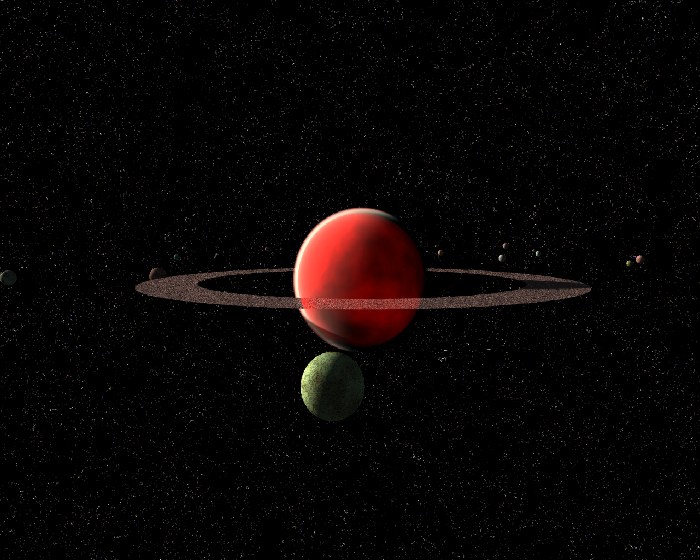
>Supposedly a gas giant with it's moons.
>
>This uses the new moons macro.
The cloud patterns on the gas giant are rather weird. All the gas giants
in our solar system either have cloud bands or are very plain.
Similarly, the texture of the ring looks weird. The texture of Saturn's
rings runs around the ring (like grooves on a record).
There are far too many moons in similar orbits. Their gravity would
interfere with each other each time they passed, making the situation
very unstable.
The dark side of moons and planet wouldn't be illuminated. There's not
much ambient lighting in space.
The Sun seems to be extremely close. The nearby moon and the planet are
illuminated from such a different angle that the light source must be
not far off the edge of the edge of the ring.
--
Mike Williams
Gentleman of Leisure
Post a reply to this message
|
|
| |
| |
|
|
|
|
| |
| |
|
|
Hi Tracers!
David Fontaine schrieb:
> Bryan Valencia wrote:
> >
> > Supposedly a gas giant with it's moons.
>
> I like the texture on the moon but the planet looks a bit strange; don't
> gas giants typically have swirly horizontal bands and more elliptical
> spots? Though I'm not quite sure how to do that procedurally, maybe
> with black hole warps. If it's just to look nice though it certainly
> still looks nice. :)
It must be a very massive "superjovian" which has, due to gravity
compression,
its own internal heat source, producing surface patterns by convection
which
look similar to the granulation on the Sun's surface! Also, such a massive
gas giant
should glow faintly from its own inner heat, and this glow would be visible
on the night
side - what about some reddish ambient light?
Yes, and there are far too many large moons too close to each other as well
as to the planet,
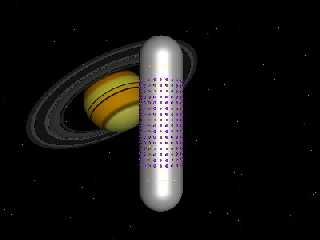
and the ring is way too simply structured! As an example for a more
realistic planetary ring,
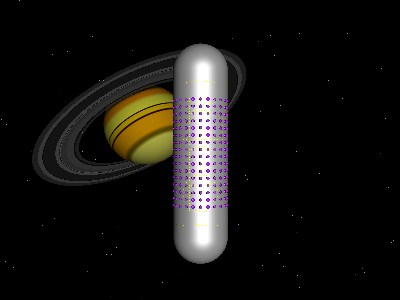
I attached one of my preliminary spaceship renderings...
See you in Khyberspace -
http://www.geocities.com/electricafghan/index-e.html
Afghanistan Chronicle: http://www.ndh.net/home/bleimann/
Yadgar
Post a reply to this message
Attachments:
Download 'colship012.jpg' (15 KB)
Preview of image 'colship012.jpg'
|
|
| |
| |
|
|
|
|
| |
| |
|
|
Bryan Valencia <bry### [at] 209software com> wrote in news:3C06C301.D53974C@
209software.com:
> Supposedly a gas giant with it's moons.
You might want to use some NASA pics for reference if you're trying to
create a realistic scene. What you've got now looks toonish because of the
number of moons, the density of the starfield, and the high level of
ambient light.
Here's a few examples of what planets look like in real photos:
http://nssdc.gsfc.nasa.gov/image/planetary/earth/near_earth_moon.jpg
http://nssdc.gsfc.nasa.gov/image/planetary/earth/gal_earth_moon.jpg
http://www.solarviews.com/r/nep/neptri.gif
http://www.etsimo.uniovi.es/solar/b/nep/trinep3.jpg com> wrote in news:3C06C301.D53974C@
209software.com:
> Supposedly a gas giant with it's moons.
You might want to use some NASA pics for reference if you're trying to
create a realistic scene. What you've got now looks toonish because of the
number of moons, the density of the starfield, and the high level of
ambient light.
Here's a few examples of what planets look like in real photos:
http://nssdc.gsfc.nasa.gov/image/planetary/earth/near_earth_moon.jpg
http://nssdc.gsfc.nasa.gov/image/planetary/earth/gal_earth_moon.jpg
http://www.solarviews.com/r/nep/neptri.gif
http://www.etsimo.uniovi.es/solar/b/nep/trinep3.jpg
Post a reply to this message
|
|
| |
| |
|
|
|
|
| |
| |
|
|
Yadgar wrote:
>
> It must be a very massive "superjovian" which has, due to gravity
> compression,
> its own internal heat source, producing surface patterns by convection
> which
> look similar to the granulation on the Sun's surface! Also, such a massive
> gas giant
> should glow faintly from its own inner heat, and this glow would be visible
> on the night side
Interesting. :)
--
David Fontaine <dav### [at] faricynet> ICQ 55354965
My raytracing gallery: http://davidf.faricy.net/
Post a reply to this message
|
|
| |
| |
|
|
|
|
| |
| |
|
|
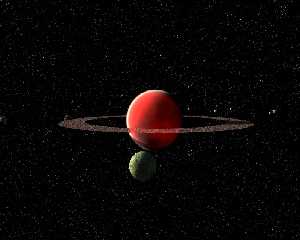
Thanks for all the responses.
As to the oddness of the gas giant - I want this one to look really alien, so I
abandoned the bands and vortices look. I wouldn't mind a way to make the surface look
"hazier" though.
Coridon Henshaw wrote:
> Bryan Valencia <bry### [at] 209softwarecom> wrote in news:3C06C301.D53974C@
> 209software.com:
>
> > Supposedly a gas giant with it's moons.
>
> You might want to use some NASA pics for reference if you're trying to
> create a realistic scene. What you've got now looks toonish because of the
> number of moons, the density of the starfield, and the high level of
> ambient light.
>
> Here's a few examples of what planets look like in real photos:
>
> http://nssdc.gsfc.nasa.gov/image/planetary/earth/near_earth_moon.jpg
> http://nssdc.gsfc.nasa.gov/image/planetary/earth/gal_earth_moon.jpg
> http://www.solarviews.com/r/nep/neptri.gif
> http://www.etsimo.uniovi.es/solar/b/nep/trinep3.jpg
Post a reply to this message
|
|
| |
| |
|
|
|
|
| |
| |
|
|
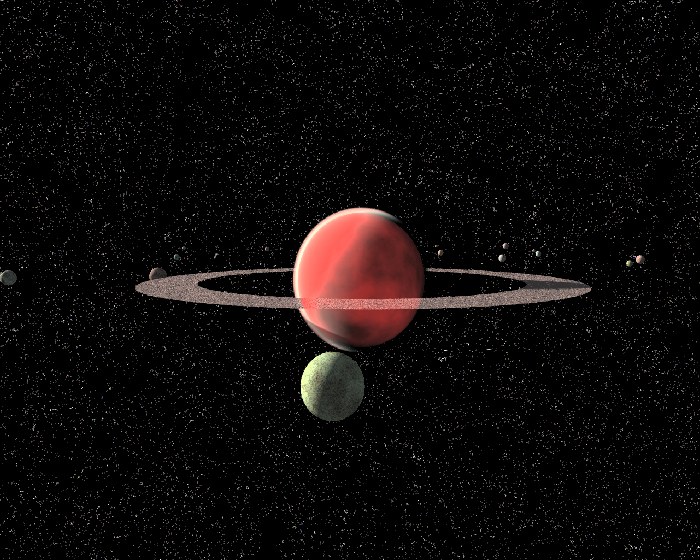
like THIS?
Post a reply to this message
Attachments:
Download 'moonsdemo.jpg' (96 KB)
Preview of image 'moonsdemo.jpg'
|
|
| |
| |
|
|
|
|
| |
| |
|
|
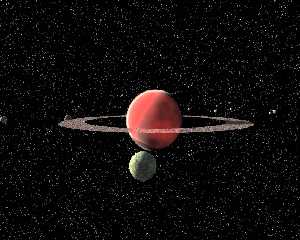
Bryan Valencia wrote:
> like THIS?
>
> ---------------------
-------------------------------------------------------------------------
-------------------------------------------------------------------------
-------------------------------------------------------------------------
-------------------------------------------------------------------------
-------------------------------------------------------------------------
-------------------------------------------------------------------------
-------------------------------------------------------------------------
-------------------------------------------------------------------------
-------------------------------------------------------------------------
-------------------------------------------------------------------------
-------------------------------------------------------------------------
-------------------------------------------------------------------------
--
> [Image]
Post a reply to this message
Attachments:
Download 'moonsdemo.jpg' (144 KB)
Preview of image 'moonsdemo.jpg'
|
|
| |
| |
|
|
|
|
| |
| |
|
|
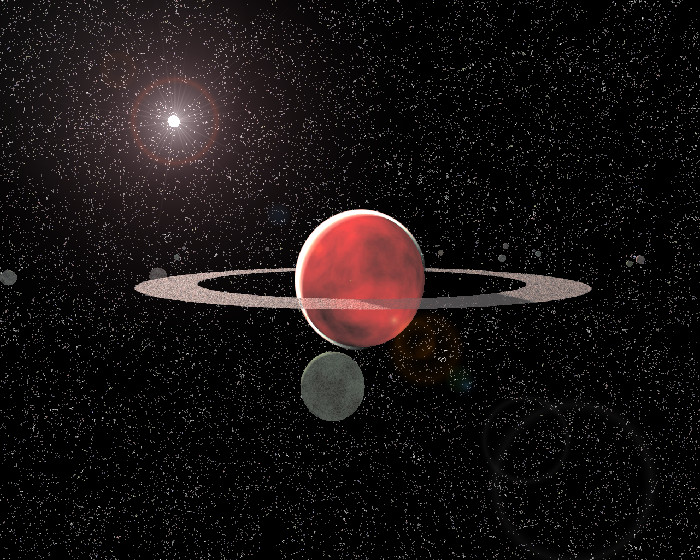
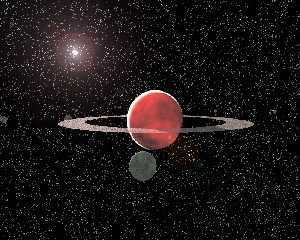
It's amazing what a little lens flare from Photoimpact can do.
Bryan Valencia wrote:
> Bryan Valencia wrote:
>
> > like THIS?
> >
> > -------------------
-------------------------------------------------------------------------
-------------------------------------------------------------------------
-------------------------------------------------------------------------
-------------------------------------------------------------------------
-------------------------------------------------------------------------
-------------------------------------------------------------------------
-------------------------------------------------------------------------
-------------------------------------------------------------------------
-------------------------------------------------------------------------
-------------------------------------------------------------------------
-------------------------------------------------------------------------
-------------------------------------------------------------------------
----
> > [Image]
>
> ---------------------
-------------------------------------------------------------------------
-------------------------------------------------------------------------
-------------------------------------------------------------------------
-------------------------------------------------------------------------
-------------------------------------------------------------------------
-------------------------------------------------------------------------
-------------------------------------------------------------------------
-------------------------------------------------------------------------
-------------------------------------------------------------------------
-------------------------------------------------------------------------
-------------------------------------------------------------------------
-------------------------------------------------------------------------
--
> [Image]
Post a reply to this message
Attachments:
Download 'moonsdemo.jpg' (197 KB)
Preview of image 'moonsdemo.jpg'
|
|
| |
| |
|
|
|
|
| |
| |
|
|
Bryan Valencia schrieb:
> It's amazing what a little lens flare from Photoimpact can do.
>
For massive glowing gas giants in close orbits around their stars
check also out:
http://www.jtwinc.com/Extrasolar/mainframes.html
- you'll find dozens of gorgeous space art illustrations,
obviously made with a raytracer, though John Whatmough
is not willing to divulge what software he used... ;-).
Still, I think the ambient level of the rings is far too high -
the planet's night side glows, but this glow is by no means
bright enough to light the shaded parts of the rings so much!
See you in Khyberspace - http://www.geocities.com/electricafghan/index-e.html
Afghanistan Chronicle: http://www.ndh.net/home/bleimann/
Yadgar
Now playing: We Agree (Yes)
Post a reply to this message
|
|
| |
| |
|
|
|
|
| |
| |
|
|
Actually the images have been coming out way too dark, but here are the
problems I have been encountering...
The light is behind, and the planet with atmosphere shows a nice
crescent like I want, BUT all the moons are way to dark.
So I upped the ambient and then used Auto Brightness and Contrast in
Photoimpact, which make it at least viewable, but the moons are far too
bright on the dark sides.
The Stars Include file is biting me here because I have to readjust it
for each trace whenever I change resolution. Either AA wipes them out
completely, or it looks like God got into the Silly String cabinet.
I will attach the source if anyone thinks they can make it a little more
realistic... I can't seem to balance it all... OH! If balancing it
means making it take 43 weeks to render, forget it, I still have a lot
to add to the scene.
>
>Still, I think the ambient level of the rings is far too high -
>the planet's night side glows, but this glow is by no means
>bright enough to light the shaded parts of the rings so much!
>
>See you in Khyberspace - http://www.geocities.com/electricafghan/index-e.html
>Afghanistan Chronicle: http://www.ndh.net/home/bleimann/
>
>Yadgar
>
>Now playing: We Agree (Yes)
>
>
Post a reply to this message
|
|
| |
| |
|
|
|
|
| |