|
|
|
|
|
|
| |
| |
|
|
|
|
| |
| |
|
|
I looked outside a little while ago, and observed that the sky was blue.

But when I asked POV-Ray to do some radiosity with a blue sky, the
entire scene came out blue. Which, logically speaking, isn't surprising.
If the sky is blue, clearly it's emitting blue light, which would result
in everything being illuminated blue.

And yet, when I look outside, the world is /not/ tinged blue. So... WTH?
Post a reply to this message
|
|
| |
| |
|
|
|
|
| |
| |
|
|
Invisible <voi### [at] dev null> wrote:
> And yet, when I look outside, the world is /not/ tinged blue. So... WTH?
Your visual cortex is good at correcting for it. Also, the sun casts a lot more
light than the sky, so in direct sunlight the effect is muted. And of course,
cloud cover will hide blue sky-light and replace it with diffuse sunlight.
On a cloudless day, I think the blue tinge to shadows is quite obvious. null> wrote:
> And yet, when I look outside, the world is /not/ tinged blue. So... WTH?
Your visual cortex is good at correcting for it. Also, the sun casts a lot more
light than the sky, so in direct sunlight the effect is muted. And of course,
cloud cover will hide blue sky-light and replace it with diffuse sunlight.
On a cloudless day, I think the blue tinge to shadows is quite obvious.
Post a reply to this message
|
|
| |
| |
|
|
|
|
| |
| |
|
|
Le 15/06/2012 14:13, Invisible nous fit lire :
> I looked outside a little while ago, and observed that the sky was blue.
>
> But when I asked POV-Ray to do some radiosity with a blue sky, the
> entire scene came out blue. Which, logically speaking, isn't surprising.
> If the sky is blue, clearly it's emitting blue light, which would result
> in everything being illuminated blue.
>
> And yet, when I look outside, the world is /not/ tinged blue. So... WTH?

If the sky is "blue", why do you see a yellow sun ?
What happened to the sky at night so that the moon is white ?

IIRC, the blue of the sky is due to the variant IOR (vs void) of the
atmosphere for the "white" light: the blue is turned more toward the
earth (well, sooner: it might explains a bit the redish-moon eclipse).

It's not like the sky is rgb(0,0,1) (or even rgb(0,0.8,1)) but rather
more alike hsl(240, ??, 1000000) (outside the traditional rgb cube)

or in povray term, more like blue with a very high transmit colour of
white, maybe with a subtle tinct of blue inside... (which cannot be
expressed so far in the current SDL)

Strictly speaking, the sky does not emit light. It's a dispersing media
at best. Faint media, of large dimensions.


Also, do not forget the capability of the eyes to accomodate to various
intensity of light. The white-balance done with camera is needed in
professional production: the light is not always the same.
Post a reply to this message
|
|
| |
| |
|
|
|
|
| |
| |
|
|
Am 15.06.2012 14:52, schrieb Le_Forgeron:

> IIRC, the blue of the sky is due to the variant IOR (vs void) of the
> atmosphere for the "white" light: the blue is turned more toward the
> earth (well, sooner: it might explains a bit the redish-moon eclipse).

Not really; the dispersion (wavelength-dependency of IOR) of the
atmosphere in the visible light spectrum is rather low. But the gases in
the atmosphere scatter a certain portion of the sunlight's photons, and
at the blue end of the visible spectrum this portion is bigger than at
the red end.
Post a reply to this message
|
|
| |
| |
|
|
|
|
| |
| |
|
|
Le 2012-06-15 08:13, Invisible a écrit :
> I looked outside a little while ago, and observed that the sky was blue.
>
> But when I asked POV-Ray to do some radiosity with a blue sky, the
> entire scene came out blue. Which, logically speaking, isn't surprising.
> If the sky is blue, clearly it's emitting blue light, which would result
> in everything being illuminated blue.
>
> And yet, when I look outside, the world is /not/ tinged blue. So... WTH?

Because there's usually a light_source{ <0,0,0> color Yellow*6500 } in
the scene.

Look at shadows on snow or on a beach, they'll be blue.

http://www.free-desktop-backgrounds.net/free-desktop-wallpapers-backgrounds/free-hd-desktop-wallpapers-backgrounds/122079702.jpg

http://www.amandapair.com/wp-content/uploads/2009/09/shadows-in-sand.jpg


--
/*Francois Labreque*/#local a=x+y;#local b=x+a;#local c=a+b;#macro P(F//
/*    flabreque    */L)polygon{5,F,F+z,L+z,L,F pigment{rgb 9}}#end union
/*        @        */{P(0,a)P(a,b)P(b,c)P(2*a,2*b)P(2*b,b+c)P(b+c,<2,3>)
/*   gmail.com     */}camera{orthographic location<6,1.25,-6>look_at a }
Post a reply to this message
|
|
| |
| |
|
|
|
|
| |
| |
|
|
Le_Forgeron <jgr### [at] freefr> wrote:
> If the sky is "blue", why do you see a yellow sun ?

  The sun is not yellow. It's white.

--
                                                          - Warp
Post a reply to this message
|
|
| |
| |
|
|
|
|
| |
| |
|
|
Invisible <voi### [at] devnull> wrote:
> And yet, when I look outside, the world is /not/ tinged blue. So... WTH?

  Actually it is. Consider this rendering, for example:

http://www.ignorancia.org/uploads/images/rocky-desert/rocky-desert-09-sbtf.jpg

  Everything's tinted blue. Does it look unrealistic? No.

--
                                                          - Warp
Post a reply to this message
|
|
| |
| |
|
|
|
|
| |
| |
|
|
On 15/06/2012 04:14 PM, Warp wrote:

>    The sun is not yellow. It's white.

I had always assumed that the actual sunlight is white, and the Earth's
atmosphere scatters the blue end of the spectrum more than the red, thus
resulting in a sky that looks blue and a sun that looks comparatively
yellow.

Then again, on some evenings, the sky actually appears to show a (very
unsaturated) rainbow gradient, with a discernible green band...
Post a reply to this message
|
|
| |
| |
|
|
|
|
| |
| |
|
|
>> And yet, when I look outside, the world is /not/ tinged blue. So... WTH?
>
> Because there's usually a light_source{ <0,0,0> color Yellow*6500 } in
> the scene.

So I just need to turn up the Sun a bit higher and make it more yellow?

> Look at shadows on snow or on a beach, they'll be blue.
>
>
http://www.free-desktop-backgrounds.net/free-desktop-wallpapers-backgrounds/free-hd-desktop-wallpapers-backgrounds/122079702.jpg
>
> http://www.amandapair.com/wp-content/uploads/2009/09/shadows-in-sand.jpg

Those are some neat images. They both look like the Sun is quite low in
the sky though; and we all know that when that happens, you can get
strange colours happening.
Post a reply to this message
|
|
| |
| |
|
|
|
|
| |
| |
|
|
On 15/06/2012 04:28 PM, Warp wrote:
> Invisible<voi### [at] devnull>  wrote:
>> And yet, when I look outside, the world is /not/ tinged blue. So... WTH?
>
>    Actually it is. Consider this rendering, for example:
>
> http://www.ignorancia.org/uploads/images/rocky-desert/rocky-desert-09-sbtf.jpg
>
>    Everything's tinted blue. Does it look unrealistic? No.

Uh... doesn't actually look all that blue to me.
Post a reply to this message
|
|
| |
| |
|
|
|
|
| |
| |
|
|
Le 15/06/2012 17:14, Warp nous fit lire :
>   The sun is not yellow. It's white.

Well, Superman said it's a yellow star it get its powers from. Who are
we to challenge him ?

Astronomically, the sun is in the yellow star category (strictly, it's a
yellow dwarf, G2V). A white dwarf is far more 'hot' (but they cool down
with time).

But I will concede that the sun is rather a white one in that yellow
category, and the yellow we see is due to Rayleigh scattering (which is
also the cause of daylight blue sky and other colours at dawn...)
Post a reply to this message
|
|
| |
| |
|
|
|
|
| |
| |
|
|
Orchid Win7 v1 <voi### [at] devnull> wrote:
> On 15/06/2012 04:28 PM, Warp wrote:
> > Invisible<voi### [at] devnull>  wrote:
> >> And yet, when I look outside, the world is /not/ tinged blue. So... WTH?
> >
> >    Actually it is. Consider this rendering, for example:
> >
> > http://www.ignorancia.org/uploads/images/rocky-desert/rocky-desert-09-sbtf.jpg
> >
> >    Everything's tinted blue. Does it look unrealistic? No.

> Uh... doesn't actually look all that blue to me.

  Significantly bluer than if the sky weren't.

--
                                                          - Warp
Post a reply to this message
|
|
| |
| |
|
|
|
|
| |
| |
|
|
Am 15.06.2012 17:14, schrieb Warp:
> Le_Forgeron<jgr### [at] freefr>  wrote:
>> If the sky is "blue", why do you see a yellow sun ?
>
>    The sun is not yellow. It's white.

That depends on the color space.

In sRGB (whitepoint = D65 = ~6500K), the sun is a pale yellow.

In Wide Gamut RGB (Whitepoint = D50 = ~5000K), the sun is actually a
pale blue.

If you use a color space with the equal-energy point (E) as whitepoint,
the sun is even a pale green.


That's both for the sun's /actual/ color (without atmospheric effects,
i.e. as seen from space) of ~5900K, as well as the sun's apparent color
on earth at daytime of ~5500K.
Post a reply to this message
|
|
| |
| |
|
|
|
|
| |
| |
|
|
On 6/15/2012 8:14 AM, Warp wrote:
> Le_Forgeron<jgr### [at] freefr>  wrote:
>> If the sky is "blue", why do you see a yellow sun ?
>
>    The sun is not yellow. It's white.
>
Umm. Actually, this page says, if it was a "blackbody", it would be
closest to, "It looks peach pinkish, not yellow, doesn't it?"

http://casa.colorado.edu/~ajsh/colour/Tspectrum.html

So, still not "yellow", but damn sure not "white".

But, still a damn site more confusing than any exist "chart" I have ever
seen, with respect to star colors. In general, once it scatters in the
atmosphere, the light we get ends up closer to what we would call white,
with a pale bluish tint, hence the bluish tint on some of the newer,
"closer to real", light bulbs.
Post a reply to this message
|
|
| |
| |
|
|
|
|
| |
| |
|
|
On 6/15/2012 10:48 AM, clipka wrote:
> Am 15.06.2012 17:14, schrieb Warp:
>> Le_Forgeron<jgr### [at] freefr> wrote:
>>> If the sky is "blue", why do you see a yellow sun ?
>>
>> The sun is not yellow. It's white.
>
> That depends on the color space.
>
> In sRGB (whitepoint = D65 = ~6500K), the sun is a pale yellow.
>
> In Wide Gamut RGB (Whitepoint = D50 = ~5000K), the sun is actually a
> pale blue.
>
> If you use a color space with the equal-energy point (E) as whitepoint,
> the sun is even a pale green.
>
>
> That's both for the sun's /actual/ color (without atmospheric effects,
> i.e. as seen from space) of ~5900K, as well as the sun's apparent color
> on earth at daytime of ~5500K.
Umm. So which color space is this one:
http://www.vendian.org/mncharity/dir3/starcolor/ lol

Though, it appears to be the D65, but with the color actually being
"slightly off" that value, enough that it gets more.. peach colored.
Post a reply to this message
|
|
| |
| |
|
|
|
|
| |
| |
|
|
On 6/15/2012 8:28 AM, Warp wrote:
> Invisible<voi### [at] devnull>  wrote:
>> And yet, when I look outside, the world is /not/ tinged blue. So... WTH?
>
>    Actually it is. Consider this rendering, for example:
>
> http://www.ignorancia.org/uploads/images/rocky-desert/rocky-desert-09-sbtf.jpg
>
>    Everything's tinted blue. Does it look unrealistic? No.
>
Uh.. Think you need to adjust your display. That looks completely normal
to me.
Post a reply to this message
|
|
| |
| |
|
|
|
|
| |
| |
|
|
Am 15.06.2012 19:48, schrieb clipka:
> Am 15.06.2012 17:14, schrieb Warp:
>> Le_Forgeron<jgr### [at] freefr> wrote:
>>> If the sky is "blue", why do you see a yellow sun ?
>>
>> The sun is not yellow. It's white.
>
> That depends on the color space.
>
> In sRGB (whitepoint = D65 = ~6500K), the sun is a pale yellow.
>
> In Wide Gamut RGB (Whitepoint = D50 = ~5000K), the sun is actually a
> pale blue.
>
> If you use a color space with the equal-energy point (E) as whitepoint,
> the sun is even a pale green.
>

This makes actually not much sense as all RGB-color-spaces are device
dependent. So when you use e.g. WideGamut RGB or Adobe RGB as a
*viewing* color space with a sRGB device you are obviously doing
something very wrong.


> That's both for the sun's /actual/ color (without atmospheric effects,
> i.e. as seen from space) of ~5900K, as well as the sun's apparent color
> on earth at daytime of ~5500K.

Close ;)

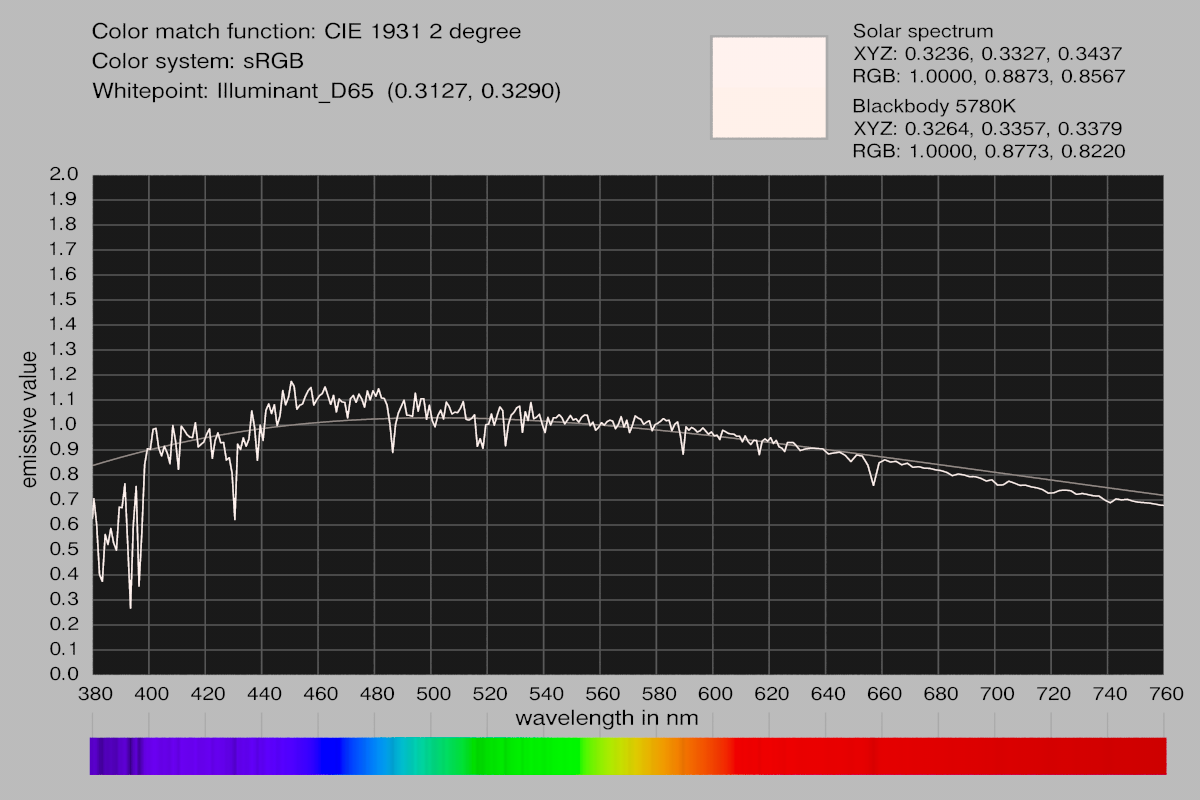
See attachment, the output from test_sun.pov (a POV-Ray scene file I've
written for lightsys IV - at www.ignorancia.org) that compares the
actual spectral data with the blackbody radiation. I think there is also
an espd*.inc file for the sun filtered by earth atmosphere, for people
who want to play around with it.

I've just noticed (quite surprised) that the file is from April 2003,
doesn't time fly by...

-Ive
Post a reply to this message
Attachments:
Download 'test_sun.png' (176 KB)
Preview of image 'test_sun.png'
|
|
| |
| |
|
|
|
|
| |
| |
|
|
Am 16.06.2012 11:24, schrieb Ive:
> Am 15.06.2012 19:48, schrieb clipka:
>> Am 15.06.2012 17:14, schrieb Warp:
>>> Le_Forgeron<jgr### [at] freefr> wrote:
>>>> If the sky is "blue", why do you see a yellow sun ?
>>>
>>> The sun is not yellow. It's white.
>>
>> That depends on the color space.
>>
>> In sRGB (whitepoint = D65 = ~6500K), the sun is a pale yellow.
>>
>> In Wide Gamut RGB (Whitepoint = D50 = ~5000K), the sun is actually a
>> pale blue.
>>
>> If you use a color space with the equal-energy point (E) as whitepoint,
>> the sun is even a pale green.
>
> This makes actually not much sense as all RGB-color-spaces are device
> dependent. So when you use e.g. WideGamut RGB or Adobe RGB as a
> *viewing* color space with a sRGB device you are obviously doing
> something very wrong.

You should know better (or I'm misunderstanding you).

sRGB is not a device-dependent color space.
WideGamut RGB is not a device-dependent color space.
Adobe RGB is not a device-dependent color space.

My EIZO S2402W's color space is device-dependent, yes.

The panel of an individual EIZO CG245W has its own device-dependent
color space, but the EIZO CG245W as a finished product can be calibrated
to various different standard or non-standard color profiles (with some
limitations imposed by the panel's gamut of course).

There are device-dependent color spaces, and there are
device-independent color spaces. The standard color spaces are,
obviously, device-independent.

But I'm sure I'm not telling you anything new.
Post a reply to this message
|
|
| |
| |
|
|
|
|
| |
| |
|
|
Patrick Elliott <kag### [at] gmailcom> wrote:
> On 6/15/2012 8:28 AM, Warp wrote:
> > Invisible<voi### [at] devnull>  wrote:
> >> And yet, when I look outside, the world is /not/ tinged blue. So... WTH?
> >
> >    Actually it is. Consider this rendering, for example:
> >
> > http://www.ignorancia.org/uploads/images/rocky-desert/rocky-desert-09-sbtf.jpg
> >
> >    Everything's tinted blue. Does it look unrealistic? No.
> >
> Uh.. Think you need to adjust your display. That looks completely normal
> to me.

  Agreed, it looks normal. In other words, having a bluish tint (especially
in the shadows).

  Change the color of the sky to gray and re-render.

--
                                                          - Warp
Post a reply to this message
|
|
| |
| |
|
|
|
|
| |
| |
|
|
Warp <war### [at] tagpovrayorg> wrote:
> Le_Forgeron <jgr### [at] freefr> wrote:
> > If the sky is "blue", why do you see a yellow sun ?

>   The sun is not yellow. It's white.

  To elaborate: The color yellow is something like rgb <1, 1, 0>.
The color white is rgb <1, 1, 1>. If you take colors between those two,
at which point does the yellow change to white?

  The Sun does certainly not look like rgb <1, 1, 0>. If it did, then
every blue object would look black.

  The Sun might not emit a light that's exactly <1, 1, 1>, but it's pretty
damn close to it. Hence it's way whiter than yellow. Saying that the sun is
yellow is extremely misleading.

  Also the *apparent* color of the Sun is certainly white to our eyes
(because it's so damn bright).

--
                                                          - Warp
Post a reply to this message
|
|
| |
| |
|
|
|
|
| |
| |
|
|
Am 16.06.2012 13:09, schrieb Warp:

>    Also the *apparent* color of the Sun is certainly white to our eyes
> (because it's so damn bright).

That's not true either - in fact, the apparent color of the sun is "weird".

(Kids, remember: Do *not* look straight into the sun!)
Post a reply to this message
|
|
| |
| |
|
|
|
|
| |
| |
|
|
Am 16.06.2012 11:58, schrieb clipka:
> Am 16.06.2012 11:24, schrieb Ive:
>> Am 15.06.2012 19:48, schrieb clipka:
>>> Am 15.06.2012 17:14, schrieb Warp:
>>>> Le_Forgeron<jgr### [at] freefr> wrote:
>>>>> If the sky is "blue", why do you see a yellow sun ?
>>>>
>>>> The sun is not yellow. It's white.
>>>
>>> That depends on the color space.
>>>
>>> In sRGB (whitepoint = D65 = ~6500K), the sun is a pale yellow.
>>>
>>> In Wide Gamut RGB (Whitepoint = D50 = ~5000K), the sun is actually a
>>> pale blue.
>>>
>>> If you use a color space with the equal-energy point (E) as whitepoint,
>>> the sun is even a pale green.
>>
>> This makes actually not much sense as all RGB-color-spaces are device
>> dependent. So when you use e.g. WideGamut RGB or Adobe RGB as a
>> *viewing* color space with a sRGB device you are obviously doing
>> something very wrong.
>
> You should know better

I do ;)

> (or I'm misunderstanding you).

So lets try to clarify.

> sRGB is not a device-dependent color space.
> WideGamut RGB is not a device-dependent color space.
> Adobe RGB is not a device-dependent color space.

As I translate "not device-dependent" into "device-intependent" those 3
statements are plain wrong.

Again: all RGB-color-spaces are device-dependent because they are
defined by chromaticity primaries, whitepoint and transfer function.
None of them is able to express all possible colors - or better all
colors an average human can see and distinguish.
You might have been confused as e.g. WideGamut is usually only used (and
called) as an intermediate working color space but such *working* color
spaces are also called virtual color devices.
On the other side there are device-intependent color spaces like CIE xyz
or L*a*b and it's derived Lch color space. Those are indeed able to to
express all possible colors.

At least this is the terminology I've learned long ago.

As a side-note, Microsoft is in favor of using scRGB and - by allowing
for negative color component values - making this also a
device-independent color space and as far I can tell from the beta it
seems this is even a build-in Windows 8 feature.


> My EIZO S2402W's color space is device-dependent, yes.
>
> The panel of an individual EIZO CG245W has its own device-dependent
> color space, but the EIZO CG245W as a finished product can be calibrated
> to various different standard or non-standard color profiles (with some
> limitations imposed by the panel's gamut of course).
>

I own only the CG243W and its own gamut is large enough for Adobe RGB.
Viewing some neon-style images there is really fun.
The problem when using such a wider gamut is that color banding becomes
also much more obvious. Therefor I did recently (after being tired of
walking around in Skyrim) replace my gaming-graphics-card with something
serious that allows for 10bit output via display-port and the EIZO panel
is also able to reproduce 10bit without interpolation.
And - quite to my surprise - this actually works.

> There are device-dependent color spaces, and there are
> device-independent color spaces. The standard color spaces are,
> obviously, device-independent.

Well, see above, you've got the definition of device-independent wrong.


-Ive
Post a reply to this message
|
|
| |
| |
|
|
|
|
| |
| |
|
|
Am 16.06.2012 13:09, schrieb Warp:
> Warp<war### [at] tagpovrayorg>  wrote:
>> Le_Forgeron<jgr### [at] freefr>  wrote:
>>> If the sky is "blue", why do you see a yellow sun ?
>
>>    The sun is not yellow. It's white.
>
>    To elaborate: The color yellow is something like rgb<1, 1, 0>.
> The color white is rgb<1, 1, 1>. If you take colors between those two,
> at which point does the yellow change to white?
>
>    The Sun does certainly not look like rgb<1, 1, 0>. If it did, then
> every blue object would look black.
>
>    The Sun might not emit a light that's exactly<1, 1, 1>, but it's pretty
> damn close to it. Hence it's way whiter than yellow. Saying that the sun is
> yellow is extremely misleading.
>
>    Also the *apparent* color of the Sun is certainly white to our eyes
> (because it's so damn bright).
>

Hmm, actually it is the other way round. We call this color white (some
call it a even a non-color) *because* it is the damn bright apparent
color of the sun. Somewhen during evolution this has been proven to be
useful. If the earth would circle Betelgeuse we would most likely see
red as the "white" and neutral color.

-Ive
Post a reply to this message
|
|
| |
| |
|
|
|
|
| |
| |
|
|
Ive <ive### [at] lilysoftorg> wrote:
> Hmm, actually it is the other way round. We call this color white (some
> call it a even a non-color) *because* it is the damn bright apparent
> color of the sun.

  That sounds like a circular argument to me.

  Of course the meaning of the word "white" is a matter of definition,
and we define it in terms of what we can see.

  The Sun emits electromagnetic radiation in a much wider range of
frequencies than what we can see. Its highest irradiance is at what
we call visible light (and we have evolved to see that range because
that's the range where the sunlight is strongest).

  If you compare the entire spectrum of solar irradiance, the visible light
portion has relatively little change with respect to the rest. There is,
of course, a measureable difference between eg. yellow frequencies and
blue frequencies, but my point is that "the sun is yellow" would imply
that the sun does not emit blue frequencies at all, or only very negligible
amounts. That's, of course, not the case.

  "The sun is yellow" only in the sense that the highest amount of irradiance
is around the yellow frequencies. However, it's not yellow in the sense that
it wouldn't emit anything else in a significant proportion.

  This would be a very relevant question: "If the sun is yellow, how come
blue objects do not look black?"

--
                                                          - Warp
Post a reply to this message
|
|
| |
| |
|
|
|
|
| |
| |
|
|
On 6/15/2012 5:13, Invisible wrote:
> And yet, when I look outside, the world is /not/ tinged blue. So... WTH?

In addition to the other answers, the sky isn't blue. It's only blue far
away from where the sun is.

--
Darren New, San Diego CA, USA (PST)
   "Oh no! We're out of code juice!"
   "Don't panic. There's beans and filters
    in the cabinet."
Post a reply to this message
|
|
| |
| |
|
|
|
|
| |
| |
|
|
On 16/06/2012 6:09 PM, Darren New wrote:
>
> In addition to the other answers, the sky isn't blue.

True, it looks Octarine to me. ;-)

--
Regards
     Stephen
Post a reply to this message
|
|
| |
| |
|
|
|
|
| |
| |
|
|
On 6/15/2012 5:52, Le_Forgeron wrote:
> IIRC, the blue of the sky is due to the variant IOR (vs void) of the
> atmosphere for the "white" light: the blue is turned more toward the
> earth (well, sooner: it might explains a bit the redish-moon eclipse).

The sky is blue because the dust and other particles in the sky reflect blue
light better than red light, because blue light is smaller than those
particles and red light is larger.

So, when the sun is high (with little atmosphere between it and you), the
sky is close to white near the sun, because the light doesn't get scattered
much. The light that *does* get scattered winds up going behind you,
bouncing off some dust, and returning to you to make the part of the sky
behind you look lit up, preferentially blue.

When the sun is close to the horizon, the light is going through a lot of
atmosphere, to the point where there's enough to reflect the blue light back
towards the people who are still experiencing noon, and all you see is the
red light that didn't get scattered. Hence, ruddy sunsets.

--
Darren New, San Diego CA, USA (PST)
   "Oh no! We're out of code juice!"
   "Don't panic. There's beans and filters
    in the cabinet."
Post a reply to this message
|
|
| |
| |
|
|
|
|
| |
| |
|
|
On 6/15/2012 7:13 AM, Invisible wrote:
> I looked outside a little while ago, and observed that the sky was blue.
>
> But when I asked POV-Ray to do some radiosity with a blue sky, the
> entire scene came out blue. Which, logically speaking, isn't surprising.
> If the sky is blue, clearly it's emitting blue light, which would result
> in everything being illuminated blue.
>
> And yet, when I look outside, the world is /not/ tinged blue. So... WTH?

The blue that you see in the sky is scattered out of some of the
sunlight that hits the ground, making direct sunlight a little less
blue.  Things that are in direct sunlight get that plus the blue from
all over the sky, resulting in white.

On the other hand:

One day while stationed in Germany I got onto the roof of one of our
buildings to take a picture of the squadron's personnel while they were
all lined up.  The sun was up, but it was behind the trees (and it was
mid-winter so it wasn't all that high to begin with), so the squadron
was lit only by the scatter from the blue sky.  The light all looked
normal to me, but when I looked at the photographs later on they were
all tinged with blue.  I'd have to say that my eyes adjusted to the blue
and gave my brain the adjusted view.

Regards,
John
Post a reply to this message
|
|
| |
| |
|
|
|
|
| |
|
|