|
|
|
|
|
|
| |
| |
|
|
|
|
| |
| |
|
|
Not completely off-topic, since it could be used as render-fodder.

http://www.jpl.nasa.gov/spaceimages/details.php?id=PIA15482

--
Tim Cook
http://empyrean.sjcook.com
http://www.lifemax.net/TimCook
Post a reply to this message
|
|
| |
| |
|
|
|
|
| |
| |
|
|
Em 17/03/2012 20:18, Tim Cook escreveu:
> Not completely off-topic, since it could be used as render-fodder.
>
> http://www.jpl.nasa.gov/spaceimages/details.php?id=PIA15482

a 300MB image, woah. :)
Post a reply to this message
|
|
| |
| |
|
|
|
|
| |
| |
|
|
Am 18.03.2012 00:18, schrieb Tim Cook:
> Not completely off-topic, since it could be used as render-fodder.
>
> http://www.jpl.nasa.gov/spaceimages/details.php?id=PIA15482

Thanks for sharing the link.
Post a reply to this message
|
|
| |
| |
|
|
|
|
| |
| |
|
|
On 2012-03-17 19:50, nemesis wrote:
> a 300MB image, woah. :)

What?  The full-size Blue Marble image of Earth is a few GB, isn't it?
Never did get back to playing with that...not as much point with Google
Earth available to do a lot more, though.

--
Tim Cook
http://empyrean.sjcook.com
http://www.lifemax.net/TimCook
Post a reply to this message
|
|
| |
| |
|
|
|
|
| |
| |
|
|
Em 17/03/2012 22:07, Tim Cook escreveu:
> On 2012-03-17 19:50, nemesis wrote:
>> a 300MB image, woah. :)
>
> What? The full-size Blue Marble image of Earth is a few GB, isn't it?
> Never did get back to playing with that...not as much point with Google
> Earth available to do a lot more, though.

damn, I'm still living in the 90's... :p
Post a reply to this message
|
|
| |
| |
|
|
|
|
| |
| |
|
|
On 2012-03-17 20:11, nemesis wrote:
>> What? The full-size Blue Marble image of Earth is a few GB, isn't it?
>> Never did get back to playing with that...not as much point with Google
>> Earth available to do a lot more, though.
>
> damn, I'm still living in the 90's... :p

Caveat:  the full-size, raw Blue Marble image was split into two
26400x26400(?) parts, one for each hemisphere, but even then most
programs wouldn't load it, even if you had the memory...it's been a few
years since I looked into that, though, and I now have a 64-bit machine
with quite a bit more RAM than I did.

^_^

--
Tim Cook
http://empyrean.sjcook.com
http://www.lifemax.net/TimCook
Post a reply to this message
|
|
| |
| |
|
|
|
|
| |
| |
|
|
Le 18/03/2012 01:50, nemesis a écrit :
> Em 17/03/2012 20:18, Tim Cook escreveu:
>> Not completely off-topic, since it could be used as render-fodder.
>>
>> http://www.jpl.nasa.gov/spaceimages/details.php?id=PIA15482
>
> a 300MB image, woah. :)
>

They use equirectangular projection to map the sphere on a rectangle.

It's probably ok to use map_type 1 of povray to put it back on a sphere.

Notice that they remapped rgb to 3 infrareds: 22, 12 and 3.4 microns.


(Equirectangular is a family: x = lambda.cos(phi_1), y = phi
lambda & phi are longitude & latitude)

plate carrée is usual, with phi_1 as 0, and a picture ratio of 2:1
Indeed, if unstretched, the picture ratio is 2.cos(phi_1), so you can
always get back to a know phi_1 with a simple unidirectional scale.
Post a reply to this message
|
|
| |
| |
|
|
|
|
| |
| |
|
|
On 22/03/2012 8:07 AM, Le_Forgeron wrote:
> Le 18/03/2012 01:50, nemesis a écrit :
>> >  Em 17/03/2012 20:18, Tim Cook escreveu:
>>> >>  Not completely off-topic, since it could be used as render-fodder.
>>> >>
>>> >>  http://www.jpl.nasa.gov/spaceimages/details.php?id=PIA15482
>> >
>> >  a 300MB image, woah.:)
>> >
> They use equirectangular projection to map the sphere on a rectangle.

Drat! I cannot get onto the jpl.nasa site but I did manage to find it on
the nasa site at a lower resolution.
http://www.nasa.gov/mission_pages/WISE/multimedia/pia15482.html
Also a Mollweide projection (I think)
http://www.nasa.gov/mission_pages/WISE/multimedia/pia15481.html
And an annotated one.
http://wise.ssl.berkeley.edu/gallery_images/WISE2012-003-A-annotated.jpg


--
Regards
     Stephen
Post a reply to this message
|
|
| |
| |
|
|
|
|
| |
| |
|
|
Am 22.03.2012 09:55, schrieb Stephen:

> Also a Mollweide projection (I think)
> http://www.nasa.gov/mission_pages/WISE/multimedia/pia15481.html

They call it Aitoff.
Post a reply to this message
|
|
| |
| |
|
|
|
|
| |
| |
|
|
Le 22/03/2012 18:41, clipka nous fit lire :
> Am 22.03.2012 09:55, schrieb Stephen:
>
>> Also a Mollweide projection (I think)
>> http://www.nasa.gov/mission_pages/WISE/multimedia/pia15481.html
>
> They call it Aitoff.

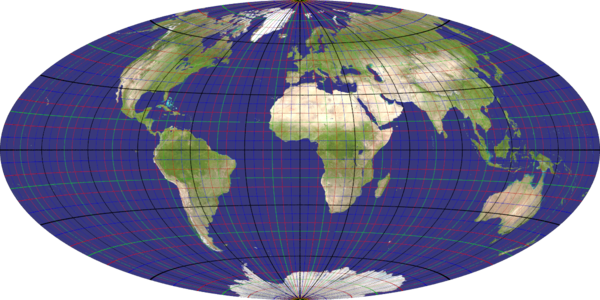
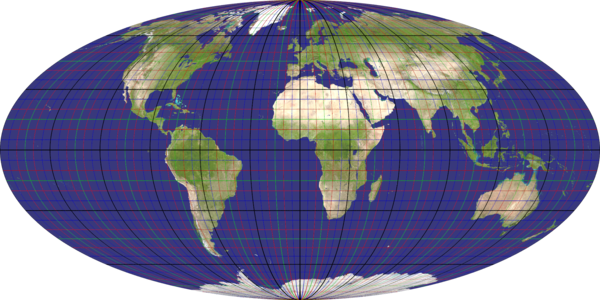
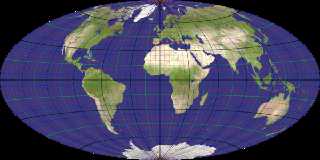
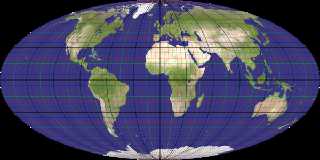
the difference might be subtle. And is it Aitoff or Hammer-Aitoff ?

(clue: mollweide & hammer-aitoff are equal-area projections)
Post a reply to this message
Attachments:
Download 'leforgeroncamera_aitoff_hammer.png' (286 KB)
Download 'leforgeroncamera_mollweide.png' (272 KB)
Preview of image 'leforgeroncamera_aitoff_hammer.png'
Preview of image 'leforgeroncamera_mollweide.png'
|
|
| |
| |
|
|
|
|
| |
| |
|
|
On 22/03/2012 5:41 PM, clipka wrote:
> Am 22.03.2012 09:55, schrieb Stephen:
>
>> Also a Mollweide projection (I think)
>> http://www.nasa.gov/mission_pages/WISE/multimedia/pia15481.html
>
> They call it Aitoff.

Thanks and I take my ait off to you. :-)

--
Regards
     Stephen
Post a reply to this message
|
|
| |
| |
|
|
|
|
| |
| |
|
|
Am 22.03.2012 19:11, schrieb Le_Forgeron:

>>> Also a Mollweide projection (I think)
>>> http://www.nasa.gov/mission_pages/WISE/multimedia/pia15481.html
>>
>> They call it Aitoff.
>
> the difference might be subtle. And is it Aitoff or Hammer-Aitoff ?

They call it Aitoff, so I guess it's Aitoff.


We definitely need custom-projection warps and cameras. You know, with
functions defining the projection.
Post a reply to this message
|
|
| |
| |
|
|
|
|
| |
| |
|
|
Am 22.03.2012 19:58, schrieb Stephen:
> On 22/03/2012 5:41 PM, clipka wrote:
>> Am 22.03.2012 09:55, schrieb Stephen:
>>
>>> Also a Mollweide projection (I think)
>>> http://www.nasa.gov/mission_pages/WISE/multimedia/pia15481.html
>>
>> They call it Aitoff.
>
> Thanks and I take my ait off to you. :-)

Why? Because I read the text? I had never heard of this Aitoff thing
before myself ;-)
Post a reply to this message
|
|
| |
| |
|
|
|
|
| |
| |
|
|
On 23/03/2012 4:14 PM, clipka wrote:
> Am 22.03.2012 19:58, schrieb Stephen:
>> On 22/03/2012 5:41 PM, clipka wrote:
>>> Am 22.03.2012 09:55, schrieb Stephen:
>>>
>>>> Also a Mollweide projection (I think)
>>>> http://www.nasa.gov/mission_pages/WISE/multimedia/pia15481.html
>>>
>>> They call it Aitoff.
>>
>> Thanks and I take my ait off to you. :-)
>
> Why? Because I read the text? I had never heard of this Aitoff thing
> before myself ;-)

It was a joke, albeit a poor one.

--
Regards
     Stephen
Post a reply to this message
|
|
| |
| |
|
|
|
|
| |
| |
|
|
Le 23/03/2012 17:12, clipka nous fit lire :
> They call it Aitoff, so I guess it's Aitoff.
>

The true formula for Aitoff is painfull to generate a map (camera); at
least, I get confused by sinc-function enhanced formula (see english
wikipedia), as of course to make a camera, we are going from x,y to
spherical coordinate (and of course, that is not provided by the
documentation, and I did not intend to use a solver)


>
> We definitely need custom-projection warps and cameras. You know, with
> functions defining the projection.

For custom-camera, you would need a way to output 2 vectors (origin,
direction) from the inputs of 4 vectors (location, up, right,
direction), 2 doubles between 0 and 1, and whatever you do with them as
hard-coded/SDL-coded formulas (including other SDL data and hard-coded
values).(you might see it as a function of 2 doubles which must provides
2 3D-vectors)

Some formula are easy in one direction and nightmare/impossible in
opposite (camera vs projection).

Did you say projection warps ? I would have thought about projection
map_type.  (from a 3D point, some others data (assume origin & other ?),
provide a couple of doubles : integer part can be used to isolate the
"once" (0.x,0.y) and the part after the dot is the coordinate on
map/picture (scale to 0 to 1 in both direction)
Post a reply to this message
|
|
| |
| |
|
|
|
|
| |
| |
|
|
Am 23.03.2012 19:22, schrieb Le_Forgeron:

>> We definitely need custom-projection warps and cameras. You know, with
>> functions defining the projection.
>
> For custom-camera, you would need a way to output 2 vectors (origin,
> direction) from the inputs of 4 vectors (location, up, right,
> direction), 2 doubles between 0 and 1, and whatever you do with them as
> hard-coded/SDL-coded formulas (including other SDL data and hard-coded
> values).(you might see it as a function of 2 doubles which must provides
> 2 3D-vectors)

Not really.

The location, up, right & direction vectors just orient the camera;
that's a simple matrix operation that is independent of the projection
formula.

For a truly generic projection we'd need six funcions, each taking two
numbers (X and Y coordinate in resulting image): Ray origin X,Y,Z and
ray direction X,Y,Z.

For any cartographic projection, two functions would suffice: From two
screen coordinates (X,Y) we'd have to compute two spherical coordinates
(phi and theta).

> Did you say projection warps ? I would have thought about projection
> map_type.  (from a 3D point, some others data (assume origin&  other ?),
> provide a couple of doubles : integer part can be used to isolate the
> "once" (0.x,0.y) and the part after the dot is the coordinate on
> map/picture (scale to 0 to 1 in both direction)

Map types can only be used with input images; implementing the stuff as
a custom warp instead would allow to do the same operations on other
patterns as well.
Post a reply to this message
|
|
| |
| |
|
|
|
|
| |
| |
|
|
Le 24/03/2012 02:45, clipka nous fit lire :
> Am 23.03.2012 19:22, schrieb Le_Forgeron:
>
>>> We definitely need custom-projection warps and cameras. You know, with
>>> functions defining the projection.
>>
>> For custom-camera, you would need a way to output 2 vectors (origin,
>> direction) from the inputs of 4 vectors (location, up, right,
>> direction), 2 doubles between 0 and 1, and whatever you do with them as
>> hard-coded/SDL-coded formulas (including other SDL data and hard-coded
>> values).(you might see it as a function of 2 doubles which must provides
>> 2 3D-vectors)
>
> Not really.
>
> The location, up, right & direction vectors just orient the camera;
> that's a simple matrix operation that is independent of the projection
> formula.
>
> For a truly generic projection we'd need six funcions, each taking two
> numbers (X and Y coordinate in resulting image): Ray origin X,Y,Z and
> ray direction X,Y,Z.
>
> For any cartographic projection, two functions would suffice: From two
> screen coordinates (X,Y) we'd have to compute two spherical coordinates
> (phi and theta).
>

Unless you are always mapping from below (center of the planet), I
prefer for an absolute custom camera to be able to set the origin and
direction of each ray (well, each pixel ray, as well as AA sub-rays).
It seems more natural to thing of the camera as a flying satellite
(well, rather a parallel set of raster satellites using their own single
"laser beam"). Probably something along a mathematical-function(s) based
"mesh camera" (without a mesh)

[so far, I have no intent to implement that fully custom camera. yet ?]

It could also allow for easy (easier ?) setting for stereographic render
(half left-picture for left eye, half right-part for right eye)
(not sure about naming that stereographic)

Simulating the eye(s ?) of bee or fly could also be done (once someone
found the formula)

>> Did you say projection warps ? I would have thought about projection
>> map_type.  (from a 3D point, some others data (assume origin&  other ?),
>> provide a couple of doubles : integer part can be used to isolate the
>> "once" (0.x,0.y) and the part after the dot is the coordinate on
>> map/picture (scale to 0 to 1 in both direction)
>
> Map types can only be used with input images; implementing the stuff as
> a custom warp instead would allow to do the same operations on other
> patterns as well.

Oh, nice thought. I would never have added a warp in a pigment/image_map
to change its type. Nor using a classical pattern.

maybe it would be "safer" to drop map_type and push the usage of warp
(doing it one way) for image_map.

About using other pattern, it might be more troublesome, as some are
really 3D and cannot be limited to a plane. (and other are using more
than just the position).
Post a reply to this message
|
|
| |
| |
|
|
|
|
| |
|
|