|
|
|
|
|
|
| |
| |
|
|
|
|
| |
| |
|
|
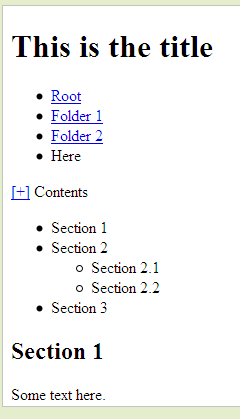
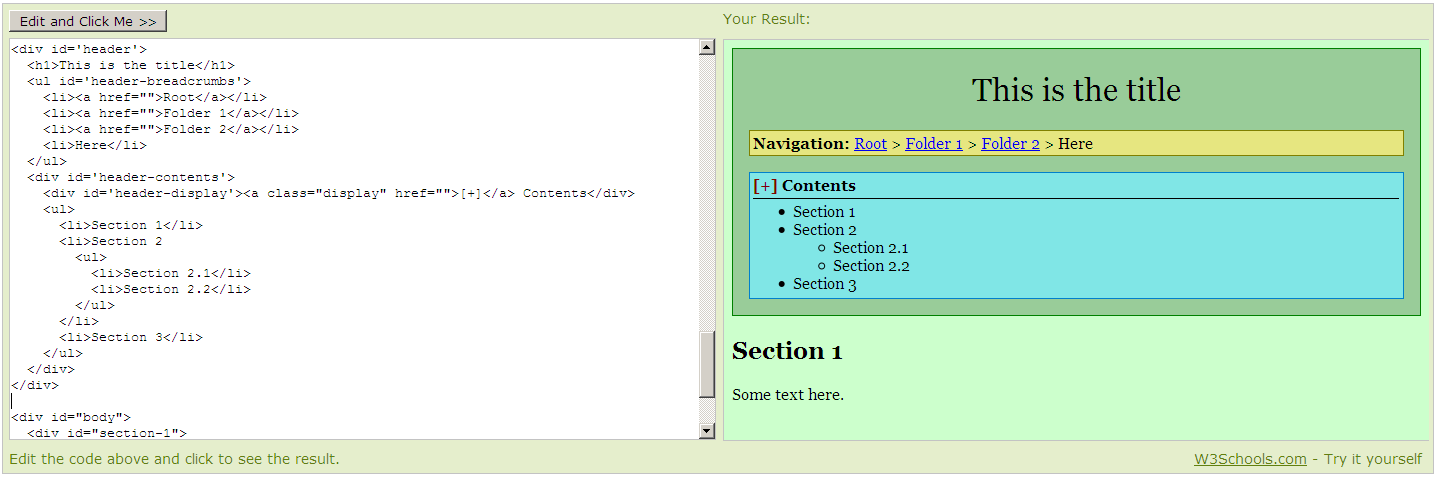
So check it out. Take a bland, normal looking web page (first
attachment), and then go mental with CSS (second attachment). Makes
quite a difference, eh?

Yeah, I know, there's hardly anything ground-breaking in here. But if
you look at my old website, it's all very HTML 2.0. I used CSS to make
the background green instead of white, but that's about it. All the
other formatting is just the browser's defaults. But with a little
imagination, it seems you can make a page look significantly more
interesting.

(I got bored before I got as far as styling the body text and so forth...)
Post a reply to this message
Attachments:
Download 'css0.png' (6 KB)
Download 'css1.png' (38 KB)
Preview of image 'css0.png'
Preview of image 'css1.png'
|
|
| |
| |
|
|
|
|
| |
| |
|
|
On 21/09/2010 01:50 PM, Invisible wrote:

> Yeah, I know, there's hardly anything ground-breaking in here.

I'm particularly pleased with how I managed to insert chevrons *between*
the links, but not before or after them. That look some figuring out.

(The trick is to do :before {content: " > ";} and then do
:first-child:before {content: "Navigation: ";}. You can even put
additional styling in there; I've put "Navigation" in bold, for example.)

Irritatingly, what you *cannot* do is content: " → ". This is
extremely frustrating, and currently I cannot find any way around this flaw.

> But if
> you look at my old website, it's all very HTML 2.0. I used CSS to make
> the background green instead of white, but that's about it.

http://www.orphi.me.uk/

Amusingly, if you click on the validator icons, the CSS validator has
moved to another URL so it doesn't work, and the HTML validator no
longer accepts my pages (which validated perfectly when I tested it a
few years ago). Nice how what were perfectly valid pages a year or two
ago are now no longer considered valid, eh? :-P
Post a reply to this message
|
|
| |
| |
|
|
|
|
| |
| |
|
|
And lo On Tue, 21 Sep 2010 13:57:13 +0100, Invisible <voi### [at] dev null> did
spake thusly:
> On 21/09/2010 01:50 PM, Invisible wrote:
>
>> Yeah, I know, there's hardly anything ground-breaking in here.
>
> I'm particularly pleased with how I managed to insert chevrons *between*
> the links, but not before or after them. That look some figuring out.
>
> (The trick is to do :before {content: " > ";} and then do
> :first-child:before {content: "Navigation: ";}. You can even put
> additional styling in there; I've put "Navigation" in bold, for example.)
>
> Irritatingly, what you *cannot* do is content: " → ". This is
> extremely frustrating, and currently I cannot find any way around this
> flaw.
content: "\2192" use the escaped hex value.
--
Phil Cook
--
I once tried to be apathetic, but I just couldn't be bothered
http://flipc.blogspot.com null> did
spake thusly:
> On 21/09/2010 01:50 PM, Invisible wrote:
>
>> Yeah, I know, there's hardly anything ground-breaking in here.
>
> I'm particularly pleased with how I managed to insert chevrons *between*
> the links, but not before or after them. That look some figuring out.
>
> (The trick is to do :before {content: " > ";} and then do
> :first-child:before {content: "Navigation: ";}. You can even put
> additional styling in there; I've put "Navigation" in bold, for example.)
>
> Irritatingly, what you *cannot* do is content: " → ". This is
> extremely frustrating, and currently I cannot find any way around this
> flaw.
content: "\2192" use the escaped hex value.
--
Phil Cook
--
I once tried to be apathetic, but I just couldn't be bothered
http://flipc.blogspot.com
Post a reply to this message
|
|
| |
| |
|
|
|
|
| |
| |
|
|
>> Irritatingly, what you *cannot* do is content: " → ". This is
>> extremely frustrating, and currently I cannot find any way around this
>> flaw.
>
> content: "\2192"

Oh God, you *are* kidding me, right?? o_O
Post a reply to this message
|
|
| |
| |
|
|
|
|
| |
| |
|
|
Le 21/09/2010 16:19, Invisible a écrit :
>>> Irritatingly, what you *cannot* do is content: " → ". This is
>>> extremely frustrating, and currently I cannot find any way around this
>>> flaw.
>>
>> content: "\2192"
>
> Oh God, you *are* kidding me, right?? o_O

content: is not reparsed by the engine, so no entities would be
substituted, but that should not stop you to encode the right char.

Give it a try.
(U+2192 is unicode for → )
Of course, your font must support it...
Post a reply to this message
|
|
| |
| |
|
|
|
|
| |
| |
|
|
>>> content: "\2192"
>>
>> Oh God, you *are* kidding me, right?? o_O
>
> content: is not reparsed by the engine, so no entities would be
> substituted, but that should not stop you to encode the right char.

Yeah. I already discovered that you can't use it to insert any new tags
either. (I guess if you could, it would be a macro expansion engine...)

> Give it a try. (U+2192 is unicode for→ )

Cool. So now I have to memorise character codes. Yay. :-(

> Of course, your font must support it...

Yeah, well, that's always entertaining. ;-)

(The again, I've installed a pack of MathML fonts, so it's usually OK.)
Post a reply to this message
|
|
| |
| |
|
|
|
|
| |
| |
|
|
OK, wanna see something weird?

   line-height: 100%;

You'd think this sets the line height to its default value. You'd be
wrong. As best as I can tell, the default hight (for Firefox) is 120%.
And, as far as I can tell from the W3C spec, this default value is
allowed to vary arbitrarily for each browser.

Yay, that's useful! :-/
Post a reply to this message
|
|
| |
| |
|
|
|
|
| |
| |
|
|
Invisible escreveu:
> On 21/09/2010 01:50 PM, Invisible wrote:
>
>> Yeah, I know, there's hardly anything ground-breaking in here.
>
> I'm particularly pleased with how I managed to insert chevrons *between*
> the links, but not before or after them. That look some figuring out.
>
> (The trick is to do :before {content: " > ";} and then do
> :first-child:before {content: "Navigation: ";}. You can even put
> additional styling in there; I've put "Navigation" in bold, for example.)

I was thinking about how you managed that one.
Guess I'm missing latest CSS goodies, cause I've not heard of "content:"
before...

--
a game sig: http://tinyurl.com/d3rxz9
Post a reply to this message
|
|
| |
| |
|
|
|
|
| |
| |
|
|
>> I'm particularly pleased with how I managed to insert chevrons
>> *between* the links, but not before or after them. That look some
>> figuring out.
>
> I was thinking about how you managed that one.

I was beginning to think it wouldn't be possible. I could put one in
front of *every* link, or after *every* link, but not *between* links
only. It took some tweaking to get it to work. (There is a :first-child
selector, but no :last-child selector, crucially enough...)

> Guess I'm missing latest CSS goodies, cause I've not heard of "content:"
> before...

I read about the "content:" property way, waaaaaay back in 1998 or so.
The idea is that, in combination with the ":before" and ":after"
psuedo-element selectors and the automatic counters, you're supposed to
be able to do things like automatically number section headings, like
TeX does.

Of course, reading about this, I was very excited, and immediately went
to try it out. But, as it turns out, neither Netscape nor IE took any
notice of these properties at all. I promptly forgot all about them,
since they don't work.

(In a similar vein, it's supposed to be possible to add drop shadows to
text and so on. That didn't work either.)

Fast forward 10 years, and it seems these funky features are actually
*implemented* now. (I didn't bother to check whether IE supports it -
mainly since I don't give a damn.)

I have no idea whether the drop shadows work now. I don't even remember
the property names...

--
http://blog.orphi.me.uk/
http://www.zazzle.com/MathematicalOrchid*
Post a reply to this message
|
|
| |
| |
|
|
|
|
| |
| |
|
|
Le 21/09/2010 21:21, Orchid XP v8 nous fit lire :

> I have no idea whether the drop shadows work now. I don't even remember
> the property names...
>
It does... for some browsers.
And round corners too... also for some.
Post a reply to this message
|
|
| |
| |
|
|
|
|
| |
| |
|
|
>> I have no idea whether the drop shadows work now. I don't even remember
>> the property names...
>>
> It does... for some browsers.
> And round corners too... also for some.

Woo! Yay for standards and cross-platform interoperability. :-S

--
http://blog.orphi.me.uk/
http://www.zazzle.com/MathematicalOrchid*
Post a reply to this message
|
|
| |
| |
|
|
|
|
| |
| |
|
|
Orchid XP v8 escreveu:
>>> I'm particularly pleased with how I managed to insert chevrons
>>> *between* the links, but not before or after them. That look some
>>> figuring out.
>>
>> I was thinking about how you managed that one.
>
>> Guess I'm missing latest CSS goodies, cause I've not heard of "content:"
>> before...
>
> I read about the "content:" property way, waaaaaay back in 1998 or so.

damn, I'm truly behind the times... :p

ok, I'm just unaware of the complete spec... I've got the box model
pretty worked out though... :)

> Of course, reading about this, I was very excited, and immediately went
> to try it out. But, as it turns out, neither Netscape nor IE took any
> notice of these properties at all. I promptly forgot all about them,
> since they don't work.
>
> (In a similar vein, it's supposed to be possible to add drop shadows to
> text and so on. That didn't work either.)

weirdly enough, I'm aware of latest CSS goodies like drop shadows,
transitions, gradients, border-radius and so on.  Since they are still
experimental, web browsers tend to have them available only via prefixes
such as -moz-border-radius or -webkit-border-radius... won't cause any
problem to browsers unaware of them because html-related techs were
build around the idea to simply ignore tags and properties they don't
understand.

Imagine if they used a static type system like in haskell:  "This page
can't be shown:  a type mismatch has occurred!" :)

> Fast forward 10 years, and it seems these funky features are actually
> *implemented* now. (I didn't bother to check whether IE supports it -
> mainly since I don't give a damn.)

yeah, what percentage of your 2 blog readers would possibly be using IE?...

--
a game sig: http://tinyurl.com/d3rxz9
Post a reply to this message
|
|
| |
| |
|
|
|
|
| |
| |
|
|
>> I read about the "content:" property way, waaaaaay back in 1998 or so.
>
> damn, I'm truly behind the times... :p
>
> ok, I'm just unaware of the complete spec... I've got the box model
> pretty worked out though... :)

When I was at uni, I'd sit and read the spec from cover to cover. (Even
though most of it doesn't actually make sense.) I learned loads of cool
stuff... and then discovered that most of it has no relationship to reality.

>> (In a similar vein, it's supposed to be possible to add drop shadows
>> to text and so on. That didn't work either.)
>
> weirdly enough, I'm aware of latest CSS goodies like drop shadows,
> transitions, gradients, border-radius and so on. Since they are still
> experimental, web browsers tend to have them available only via prefixes
> such as -moz-border-radius or -webkit-border-radius... won't cause any
> problem to browsers unaware of them because html-related techs were
> build around the idea to simply ignore tags and properties they don't
> understand.

So some of these actually work now?

> Imagine if they used a static type system like in haskell: "This page
> can't be shown: a type mismatch has occurred!" :)

Yeah, whatever. It's perfectly possible to avoid this in Haskell (or
just about any other Turing-complete language). It isn't even especially
difficult. :-P

>> Fast forward 10 years, and it seems these funky features are actually
>> *implemented* now. (I didn't bother to check whether IE supports it -
>> mainly since I don't give a damn.)
>
> yeah, what percentage of your 2 blog readers would possibly be using IE?...

Maybe if enough web pages are broken in IE, people will start asking why
MS produces such a defective product. (But I doubt it...)
Post a reply to this message
|
|
| |
| |
|
|
|
|
| |
| |
|
|
And lo On Wed, 22 Sep 2010 09:03:40 +0100, Invisible <voi### [at] devnull> did
spake thusly:

>> yeah, what percentage of your 2 blog readers would possibly be using
>> IE?...

Ow!

> Maybe if enough web pages are broken in IE, people will start asking why
> MS produces such a defective product. (But I doubt it...)

Nah they'd just wonder why you can't write a proper web site like everyone
else.

--
Phil Cook

--
I once tried to be apathetic, but I just couldn't be bothered
http://flipc.blogspot.com
Post a reply to this message
|
|
| |
| |
|
|
|
|
| |
| |
|
|
And lo On Tue, 21 Sep 2010 17:18:09 +0100, nemesis
<nam### [at] gmailcom> did spake thusly:

> Invisible escreveu:
>> On 21/09/2010 01:50 PM, Invisible wrote:
>>
>>> Yeah, I know, there's hardly anything ground-breaking in here.
>>  I'm particularly pleased with how I managed to insert chevrons
>> *between* the links, but not before or after them. That look some
>> figuring out.
>>  (The trick is to do :before {content: " > ";} and then do
>> :first-child:before {content: "Navigation: ";}. You can even put
>> additional styling in there; I've put "Navigation" in bold, for
>> example.)
>
> I was thinking about how you managed that one.
> Guess I'm missing latest CSS goodies, cause I've not heard of "content:"
> before...

As Invisible says it's one of those old ones that never got used because
certain well-used browsers never implemented it. It also takes an attr()
so you can pull an attribute from the element and present it. So you could
have every <acronym> element end with the title attribute for instance. It
gets even better with CSS3 as that allows styling by type of link so you
can do things like:

a[href$='.pdf']:after { content: " (PDF)"; }

and every pdf link will add that content to the end of the link
automatically.

I mean it's only taken, what, 12+ years to get to this level :-)

--
Phil Cook

--
I once tried to be apathetic, but I just couldn't be bothered
http://flipc.blogspot.com
Post a reply to this message
|
|
| |
| |
|
|
|
|
| |
| |
|
|
On 22/09/2010 10:12 AM, Phil Cook v2 wrote:

> As Invisible says it's one of those old ones that never got used because
> certain well-used browsers never implemented it.

Or rather, "no browsers on Earth actually implemented it at all".

> I mean it's only taken, what, 12+ years to get to this level :-)

I'm still waiting for the day when you can take an ordinary <table>
element with no special markup, and style is so that each row as an
alternating background colour. :-P

(Currently the only way to do this is to assign different style classes
to each row.)
Post a reply to this message
|
|
| |
| |
|
|
|
|
| |
| |
|
|
And lo On Wed, 22 Sep 2010 10:37:00 +0100, Invisible <voi### [at] devnull> did
spake thusly:

> On 22/09/2010 10:12 AM, Phil Cook v2 wrote:
>
>> As Invisible says it's one of those old ones that never got used because
>> certain well-used browsers never implemented it.
>
> Or rather, "no browsers on Earth actually implemented it at all".
>
>> I mean it's only taken, what, 12+ years to get to this level :-)
>
> I'm still waiting for the day when you can take an ordinary <table>
> element with no special markup, and style is so that each row as an
> alternating background colour. :-P
>
> (Currently the only way to do this is to assign different style classes
> to each row.)

Off the top of my head I don't know which browsers support :nth-child(),
but I'm betting the latest releases of IE don't. Tum te tum oh yes what a
surprise it doesn't; the latest versions of Firefox do though so you can
use it if you want.

--
Phil Cook

--
I once tried to be apathetic, but I just couldn't be bothered
http://flipc.blogspot.com
Post a reply to this message
|
|
| |
| |
|
|
|
|
| |
| |
|
|
>> I'm still waiting for the day when you can take an ordinary <table>
>> element with no special markup, and style is so that each row as an
>> alternating background colour. :-P
>>
>> (Currently the only way to do this is to assign different style
>> classes to each row.)
>
> Off the top of my head I don't know which browsers support :nth-child(),
> but I'm betting the latest releases of IE don't. Tum te tum oh yes what
> a surprise it doesn't; the latest versions of Firefox do though so you
> can use it if you want.

I hadn't even heard about :nth-child. (What, still no :last-child yet?)
That still doesn't help me style a table with some arbitrary number of
rows, where I want the odd rows blue and the even rows yellow.
Post a reply to this message
|
|
| |
| |
|
|
|
|
| |
| |
|
|
And lo On Wed, 22 Sep 2010 11:00:07 +0100, Invisible <voi### [at] devnull> did
spake thusly:

>>> I'm still waiting for the day when you can take an ordinary <table>
>>> element with no special markup, and style is so that each row as an
>>> alternating background colour. :-P
>>>
>>> (Currently the only way to do this is to assign different style
>>> classes to each row.)
>>
>> Off the top of my head I don't know which browsers support :nth-child(),
>> but I'm betting the latest releases of IE don't. Tum te tum oh yes what
>> a surprise it doesn't; the latest versions of Firefox do though so you
>> can use it if you want.
>
> I hadn't even heard about :nth-child. (What, still no :last-child yet?)
> That still doesn't help me style a table with some arbitrary number of
> rows, where I want the odd rows blue and the even rows yellow.

We're cross-threading here so I'll just repeat tr:nth-child(odd){} Oh and
nth-last-child() will select elements backwards, but besides there is a
:last-child. All hail CSS3.

--
Phil Cook

--
I once tried to be apathetic, but I just couldn't be bothered
http://flipc.blogspot.com
Post a reply to this message
|
|
| |
| |
|
|
|
|
| |
| |
|
|
>> I hadn't even heard about :nth-child. (What, still no :last-child
>> yet?) That still doesn't help me style a table with some arbitrary
>> number of rows, where I want the odd rows blue and the even rows yellow.
>
> We're cross-threading here so I'll just repeat tr:nth-child(odd){} Oh
> and nth-last-child() will select elements backwards, but besides there
> is a :last-child. All hail CSS3.

And, uh, how many years will it be before any browser anywhere starts to
implement CSS3?
Post a reply to this message
|
|
| |
| |
|
|
|
|
| |
| |
|
|
On 21/09/2010 03:27 PM, Le_Forgeron wrote:
> Le 21/09/2010 16:19, Invisible a écrit :
>>>> Irritatingly, what you *cannot* do is content: "→ ". This is
>>>> extremely frustrating, and currently I cannot find any way around this
>>>> flaw.
>>>
>>> content: "\2192"
>>
>> Oh God, you *are* kidding me, right?? o_O
>
> content: is not reparsed by the engine, so no entities would be
> substituted, but that should not stop you to encode the right char.

It's even weirder than that: If the CSS is a seperate file (like it
normally is), this doesn't work. But if it's inline inside the HTML
file, then it *does* work. (!)

Presumably because the character stream inside the <style> element in
the document head has entities expanded during parsing.
Post a reply to this message
|
|
| |
| |
|
|
|
|
| |
| |
|
|
Invisible escreveu:
>>> I hadn't even heard about :nth-child. (What, still no :last-child
>>> yet?) That still doesn't help me style a table with some arbitrary
>>> number of rows, where I want the odd rows blue and the even rows yellow.
>>
>> We're cross-threading here so I'll just repeat tr:nth-child(odd){} Oh
>> and nth-last-child() will select elements backwards, but besides there
>> is a :last-child. All hail CSS3.
>
> And, uh, how many years will it be before any browser anywhere starts to
> implement CSS3?

meanwhile, I'd output <tr class="odd"> and style that with ".odd {}"

--
a game sig: http://tinyurl.com/d3rxz9
Post a reply to this message
|
|
| |
| |
|
|
|
|
| |
| |
|
|
And lo On Wed, 22 Sep 2010 11:37:21 +0100, Invisible <voi### [at] devnull> did
spake thusly:

>>> I hadn't even heard about :nth-child. (What, still no :last-child
>>> yet?) That still doesn't help me style a table with some arbitrary
>>> number of rows, where I want the odd rows blue and the even rows
>>> yellow.
>>
>> We're cross-threading here so I'll just repeat tr:nth-child(odd){} Oh
>> and nth-last-child() will select elements backwards, but besides there
>> is a :last-child. All hail CSS3.
>
> And, uh, how many years will it be before any browser anywhere starts to
> implement CSS3?

Works in my copy of FireFox, Opera and Chrome.

--
Phil Cook

--
I once tried to be apathetic, but I just couldn't be bothered
http://flipc.blogspot.com
Post a reply to this message
|
|
| |
| |
|
|
|
|
| |
|
|