|
|
|
|
|
|
| |
| |
|
|
|
|
| |
| |
|
|
OK, so this is what I have. I'm still debugging it, but it should more
or less work now.

It's an 8-bit processor. All data paths are 8 bits wide. There are three
general-purpose registers, named X, Y and Z. They're all 8 bits wide.
Since the address bus is also 8-bit, the processor is limited to a
piffling 256 bytes of addressible memory (unless you go implement
banking). There are 17 valid opcodes (plus more which may or may not
produce predictable results.)

All instructions are exactly 2 bytes long. The first byte is an opcode,
and the second is a memory address (which may or may not actually be
used for anything). It's merely simpler to design if all instructions
use an identical addressing mode. Similarly, all instructions are
exactly 6 clock cycles long, even if some of them could actually be done
faster.

There are basically 4 instructions:

- Unconditional load.
- Conditional load.
- Save.
- Math-op.

A conditional load does exactly the same thing is an unconditional load
*if* the last math-op produced a result exactly equal to zero. Otherwise
an unconditional load does nothing at all.

Either way, a load copies the contents of the specified memory register
into one of the internal registers. Since the target register can be the
Program Counter, an unconditional load instruction can be used to
perform an unconditional jump (to an absolute address). Similarly, a
conditional load can perform a conditional jump.

A save instruction does the reverse: it copies the contents of the
specified register (including the PC) to the specified memory address.

There are 5 possible math-ops. They all take X and Y as their operands,
and store their result in Z. (They also set or clear the "zero flag"
that the conditional load instruction tests.) The available operations
are bit-wise AND, OR, XOR, binary addition and binary subtraction.

Currently math-ops generate several flags, but it is impossible to
access any of them except the zero flag. In particular, this means that
16-bit addition would be spine-tinglingly difficult to implement in
software. What I probably need to do is utilise some of the unused bits
in the opcode to select what condition the conditional load instruction
tests. (Which means *another* binary decoder in the control matrix...)

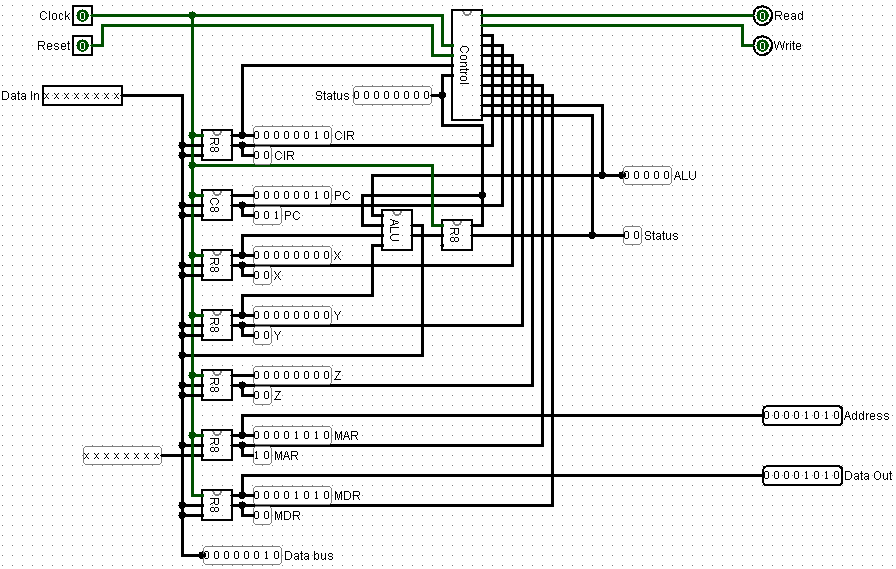
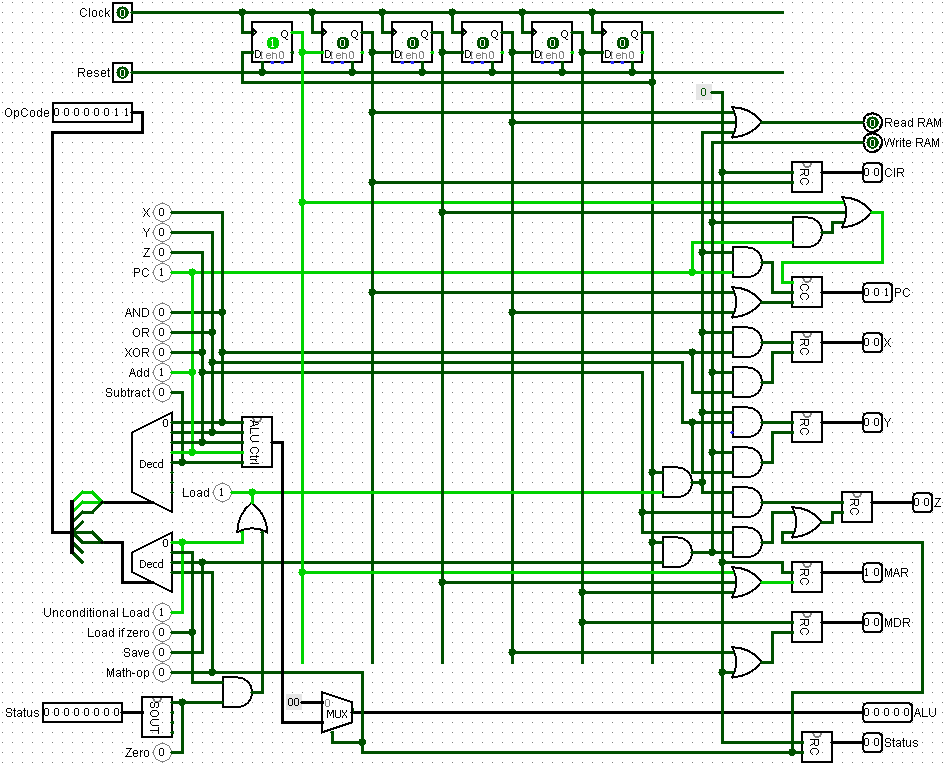
As you can see, the CPU itself is quite simple; just a bunch of
registers attached to a single common data bus. The complexity comes
from the maze of control busses eminating from the control matrix. And
when you look inside the control matrix itself... woah. OK, that's
pretty complicated! o_O

Now, if I can just figure out a reasonable way of getting Logisim to
test the damned thing...
Post a reply to this message
Attachments:
Download 'processor.png' (13 KB)
Download 'control matrix.png' (23 KB)
Preview of image 'processor.png'
Preview of image 'control matrix.png'
|
|
| |
| |
|
|
|
|
| |
| |
|
|
and you say you're a retard... o_O
Post a reply to this message
|
|
| |
| |
|
|
|
|
| |
| |
|
|
nemesis wrote:
> and you say you're a retard... o_O

Well, I _did_ just spend several weeks building a simulated model of a
trivially simple computer when I could just, uh, use a real one...

When you think about the amount of _useful_ stuff I could have done with
that much time and energy, you start to understand why I feel
unfulfilled with my life. :-(

--
http://blog.orphi.me.uk/
http://www.zazzle.com/MathematicalOrchid*
Post a reply to this message
|
|
| |
| |
|
|
|
|
| |
| |
|
|
Orchid XP v8 <voi### [at] dev null> wrote:
> nemesis wrote:
> > and you say you're a retard... o_O
>
> Well, I _did_ just spend several weeks building a simulated model of a
> trivially simple computer when I could just, uh, use a real one...
>
> When you think about the amount of _useful_ stuff I could have done with
> that much time and energy, you start to understand why I feel
> unfulfilled with my life. :-(
is learning not useful? null> wrote:
> nemesis wrote:
> > and you say you're a retard... o_O
>
> Well, I _did_ just spend several weeks building a simulated model of a
> trivially simple computer when I could just, uh, use a real one...
>
> When you think about the amount of _useful_ stuff I could have done with
> that much time and energy, you start to understand why I feel
> unfulfilled with my life. :-(
is learning not useful?
Post a reply to this message
|
|
| |
| |
|
|
|
|
| |
| |
|
|
Am 10.06.10 22:46, schrieb nemesis:
> Orchid XP v8<voi### [at] devnull>  wrote:
>> nemesis wrote:
>>> and you say you're a retard... o_O
>>
>> Well, I _did_ just spend several weeks building a simulated model of a
>> trivially simple computer when I could just, uh, use a real one...
>>
>> When you think about the amount of _useful_ stuff I could have done with
>> that much time and energy, you start to understand why I feel
>> unfulfilled with my life. :-(
>
> is learning not useful?

Learning aside: Hobbies were invented for fun, not for "productive time
management". ;-)
Post a reply to this message
|
|
| |
| |
|
|
|
|
| |
| |
|
|
Tim Nikias wrote:

> Learning aside: Hobbies were invented for fun, not for "productive time
> management". ;-)

They were also invented for bragging rights.  Only a vanishingly small
portion of the human race can claim to know how computers really work at
the component level.

Regards,
John
Post a reply to this message
|
|
| |
| |
|
|
|
|
| |
| |
|
|
nemesis wrote:

> is learning not useful?

Depends on your point of view.

On the one hand, knowing stuff always holds the possibility that one day
it'll somehow be useful.

On the other hand, what possible purpose could there be to knowing how
to build an RS Flip-Flop from two NOR latches? I mean, unless I actually
get hired by an IC design firm (which will never, ever happen), it's
useless knowledge. It has no practical use of any kind. Hell, even
learning to use regular expressions is theoretically more useful!

http://xkcd.com/208/
Post a reply to this message
|
|
| |
| |
|
|
|
|
| |
| |
|
|
Tim Nikias wrote:

> Learning aside: Hobbies were invented for fun, not for "productive time
> management". ;-)

Sure. But spending weeks wiring together little black blobs in order to
make a few LEDs flash in a pattern with hypothetically means something?
Most people wouldn't regard that as "fun".
Post a reply to this message
|
|
| |
| |
|
|
|
|
| |
| |
|
|
John VanSickle wrote:

> They were also invented for bragging rights.  Only a vanishingly small
> portion of the human race can claim to know how computers really work at
> the component level.

And an even smaller portion of the human race *care* how computers work.

Most people's reaction would be "you poor autistic weirdo, you should
seek professional help".

The only minor consolation is that without losers like me, we wouldn't
*have* computers in the first place...


...still trying to convince myself this makes up for it...
Post a reply to this message
|
|
| |
| |
|
|
|
|
| |
| |
|
|
>> is learning not useful?
>
> Depends on your point of view.
>
> On the one hand, knowing stuff always holds the possibility that one day
> it'll somehow be useful.

But if you spend your whole life learning, you'll run out of time to do
anything useful with it :-)

> On the other hand, what possible purpose could there be to knowing how to
> build an RS Flip-Flop from two NOR latches?

Those skills will be a useful base to learn more complex things, and also to
use as part of more complex projects.

See how your knowledge of transistors helped you when you were first wiring
up your logic gate? Ermm.. hang on... :-)

Well your skill of wiring up logic gates might one day help with something
else.  If you want a real life example then on the LCDs we design here along
one edge of the glass it is pretty much just a huge chain of logic gates
that clock the display data into the DACs for each column of pixels, then
each row is clocked active in turn to connect the output of each DAC to
every pixel in that row.  Somebody has to design that, more people need to
understand it in great detail, and even more people need to roughly
understand how it works.  I'm sure there are a huge number of jobs where
knowing the details of logic gates it a requirement.
Post a reply to this message
|
|
| |
| |
|
|
|
|
| |
| |
|
|
>> On the one hand, knowing stuff always holds the possibility that one
>> day it'll somehow be useful.
>
> But if you spend your whole life learning, you'll run out of time to do
> anything useful with it :-)

Thanks. Like I don't have enough anxiety to worry about already...

> I'm sure there are a
> huge number of jobs where knowing the details of logic gates it a
> requirement.

And, since I'm never going to do any of these jobs, it doesn't really
matter.

Much as I'd love to spend all day nerding out over logic design, the
fact of the matter is that I seem to be doomed to spend the rest of my
life rebooting people's computers for them every time Word crashes. A
trained monkey could do that.
Post a reply to this message
|
|
| |
| |
|
|
|
|
| |
| |
|
|
> Much as I'd love to spend all day nerding out over logic design,

Get a qualification or training in electronics and apply for some jobs then.
Don't expect someone to phone you up one day and say they saw your posts
about building a CPU and want to employ you.  If you really want to do it
then it's possible, but you have to put in some effort.
Post a reply to this message
|
|
| |
| |
|
|
|
|
| |
| |
|
|
scott wrote:
>> Much as I'd love to spend all day nerding out over logic design,
>
> Get a qualification or training in electronics and apply for some jobs
> then. Don't expect someone to phone you up one day and say they saw your
> posts about building a CPU and want to employ you.  If you really want
> to do it then it's possible, but you have to put in some effort.

I don't think knowing how to throw a few 7400s together qualifies you as
a logic designer. Hell, there are kids out there who have spent years
playing with FPGAs and doing real qualifications and stuff who have
produced things actually worth having. Why hire me when you can hire one
of those kids?

My knowledge of logic design is insufficient for me to work as a logic
designer. My knowledge of computer programming is insufficient to work
as a programmer. (Everybody wants C. Nobody wants Haskell - and even
those that do also want you to write device drivers - in C.) My
knowledge of mathematics is insufficient to work as a mathematician. My
knowledge and more importantly skill level in music is vastly
insufficient for me to work as a musician. I could go on... but
basically it seems that all that's left for me is to sit and rot fixing
people's wetware issues - and I can't even seem to find anybody to hire
me for that.
Post a reply to this message
|
|
| |
| |
|
|
|
|
| |
| |
|
|
> I don't think knowing how to throw a few 7400s together qualifies you as
> a logic designer. Hell, there are kids out there who have spent years
> playing with FPGAs and doing real qualifications and stuff who have
> produced things actually worth having. Why hire me when you can hire one
> of those kids?

Like I said, get a training or qualification if you are really interested.
Post a reply to this message
|
|
| |
| |
|
|
|
|
| |
| |
|
|
>> Learning aside: Hobbies were invented for fun, not for "productive
>> time management". ;-)
>
> Sure. But spending weeks wiring together little black blobs in order to
> make a few LEDs flash in a pattern with hypothetically means something?
> Most people wouldn't regard that as "fun".

Well, but what some people call fun is beyond me, so why bother if "most
people" consider it fun? The only thing important is if YOU're having
fun doing it. If so, mission accomplished. :-)
Post a reply to this message
|
|
| |
| |
|
|
|
|
| |
| |
|
|
scott wrote:
>> I don't think knowing how to throw a few 7400s together qualifies you
>> as a logic designer.
>
> Like I said, get a training or qualification if you are really interested.

And like I said, every geek on the planet wants to get paid to develop
mathematical algorithms or design cutting-edge chips or build
next-generation game engines or... The trouble is, there are a tiny
handful of such jobs in the entire world, and therefore you are almost
guaranteed to never be hired.

Normal people don't get paid to do cool stuff. We have to put up with
doing boring stuff, just like everybody else.
Post a reply to this message
|
|
| |
| |
|
|
|
|
| |
| |
|
|
Tim Nikias wrote:
>>> Learning aside: Hobbies were invented for fun, not for "productive
>>> time management". ;-)
>>
>> Sure. But spending weeks wiring together little black blobs in order to
>> make a few LEDs flash in a pattern with hypothetically means something?
>> Most people wouldn't regard that as "fun".
>
> Well, but what some people call fun is beyond me, so why bother if "most
> people" consider it fun? The only thing important is if YOU're having
> fun doing it. If so, mission accomplished. :-)

Sure. It would just be nice if the entire human race _didn't_ regard me
as a total loser, that's all...
Post a reply to this message
|
|
| |
| |
|
|
|
|
| |
| |
|
|
>> Like I said, get a training or qualification if you are really
>> interested.
>
> And like I said, every geek on the planet wants to get paid to develop
> mathematical algorithms or design cutting-edge chips or build
> next-generation game engines or... The trouble is, there are a tiny
> handful of such jobs in the entire world, and therefore you are almost
> guaranteed to never be hired.

You *vastly* underestimate how many jobs require those skills.  Sure, most
are not as glamorous as designing the next GPU for the PlayStation 4, but if
you want to do digital circuit design for a job there are plenty of
opportunities in a vast range of industries.  If you were degree qualified I
could point you to an opening we have at the moment.
Post a reply to this message
|
|
| |
| |
|
|
|
|
| |
| |
|
|
>> And like I said, every geek on the planet wants to get paid to develop
>> mathematical algorithms or design cutting-edge chips or build
>> next-generation game engines or... The trouble is, there are a tiny
>> handful of such jobs in the entire world, and therefore you are almost
>> guaranteed to never be hired.
>
> You *vastly* underestimate how many jobs require those skills.

Really? Well let's see now...

The Motion Picture Experts Group might need to know the difference
between a Type-I and Type-II Discrete Cosine Transform, but most people
only *implement* MPEG standards, not design them.

Most companies do not design ICs. They purchase them off the shelf and
assemble them. (Indeed, I was under the impression that the number of
companies world-wide who actually have IC fabrication plants is very
small - although admittedly you don't need to actually have a fab to
design new ICs.)

In fact, most companies do not write software either; they purchase it.
Some of it can be customised to the point that it's almost like
developing a new product, but more usually it's a case of installing the
software and configuration a few options and templates and stuff. It
certainly doesn't call for a C programmer.

And game engines... Well, that's probably way, way less exciting than it
sounds anyway. ;-)

> Sure,
> most are not as glamorous as designing the next GPU for the PlayStation
> 4,

Actually, I imagine most jobs are way less exciting than they sound. ;-)

> but if you want to do digital circuit design for a job there are
> plenty of opportunities in a vast range of industries.

Seriously... Doing what? Everything seems to be made of off-the-shelf
parts (which, by definition, already exist). What's to design?

> If you were
> degree qualified I could point you to an opening we have at the moment.

Really? Are you ser- oh, wait, you work in Germany, don't you?
Post a reply to this message
|
|
| |
| |
|
|
|
|
| |
| |
|
|
On 11/06/2010 11:32 AM, Invisible wrote:
> Tim Nikias wrote:
>>>> Learning aside: Hobbies were invented for fun, not for "productive
>>>> time management". ;-)
>>>
>>> Sure. But spending weeks wiring together little black blobs in order to
>>> make a few LEDs flash in a pattern with hypothetically means something?
>>> Most people wouldn't regard that as "fun".
>>
>> Well, but what some people call fun is beyond me, so why bother if
>> "most people" consider it fun? The only thing important is if YOU're
>> having fun doing it. If so, mission accomplished. :-)
>
> Sure. It would just be nice if the entire human race _didn't_ regard me
> as a total loser, that's all...

It's not the entire human race it is mostly you.

--

Best Regards,
	Stephen
Post a reply to this message
|
|
| |
| |
|
|
|
|
| |
| |
|
|
>> but if you want to do digital circuit design for a job there are plenty
>> of opportunities in a vast range of industries.
>
> Seriously... Doing what? Everything seems to be made of off-the-shelf
> parts (which, by definition, already exist). What's to design?

I guarantee you that if you open up any phone/monitor/TV/camera there will
be at least one custom IC that is not an off-the-shelf part.  It's not just
IC makers that design ICs, any company that has a relatively high-tec
product does it.  For example we design our own driver and controller ICs
for LCD panels, I know Canon designs their DIGIC image processing IC, I
imagine all other camera and display makers do similar.  For TVs and
monitors I also assume they design controller ICs, because often there is no
off-the-shelf part to exactly fit your product.  What about specialist
electronic test equipment?  Presumably FPGAs will need to be designed for
that.  How about network cards and routers, someone needs to design the
chipsets for those which are always being improved.  What about when
Logitech develop a new mouse technology, I doubt they can just pick up an IC
from RS that does the job.  What about the thousands of companies that offer
FPGA and ASIC design services - who are they doing work for?  Who is working
for them?

>> If you were degree qualified I could point you to an opening we have at
>> the moment.
>
> Really? Are you ser- oh, wait, you work in Germany, don't you?

Yes, but this job is at our Oxford lab.
Post a reply to this message
|
|
| |
| |
|
|
|
|
| |
| |
|
|
Am 11.06.2010 10:12, schrieb Invisible:

> And an even smaller portion of the human race *care* how computers work.
>
> Most people's reaction would be "you poor autistic weirdo, you should
> seek professional help".

Nope. While most people don't /care/ how computers work, my experience
is that many of them still tend to be impressed when people know.
Post a reply to this message
|
|
| |
| |
|
|
|
|
| |
| |
|
|
On 6/11/2010 3:10 AM, Invisible wrote:

> Sure. But spending weeks wiring together little black blobs in order to
> make a few LEDs flash in a pattern with hypothetically means something?
> Most people wouldn't regard that as "fun".

In the same way I don't regard watching people beat eachother to the
ground over a small, oddly shaped, brown ball as fun.

But, what you're doing sounds fun to me. :)


--
~Mike
Post a reply to this message
|
|
| |
| |
|
|
|
|
| |
| |
|
|
On 6/11/2010 5:32 AM, Invisible wrote:

> Sure. It would just be nice if the entire human race _didn't_ regard me
> as a total loser, that's all...

There is a not insignificant portion of the human race that is aware of
your existence that does not regard you as a loser in the least.

There is a massive proportion of the human race that is not even aware
of your existence. This segment does not count, as they cannot possibly
form an opinion of you.

--
~Mike
Post a reply to this message
|
|
| |
| |
|
|
|
|
| |
| |
|
|
Am 11.06.2010 11:27, schrieb Invisible:

>> Get a qualification or training in electronics and apply for some jobs
>> then. Don't expect someone to phone you up one day and say they saw
>> your posts about building a CPU and want to employ you. If you really
>> want to do it then it's possible, but you have to put in some effort.
>
> I don't think knowing how to throw a few 7400s together qualifies you as
> a logic designer. Hell, there are kids out there who have spent years
> playing with FPGAs and doing real qualifications and stuff who have
> produced things actually worth having. Why hire me when you can hire one
> of those kids?

(1) That's where the "get a qualification or training" suggestion kicks in.

(2) You just named another point why toying around with 7400s may not be
wasted time after all: FPGAs are essentially nothing but a bunch of
(N)AND and (N)OR gates, plus a few flip-flops, that you can "wire up"
programmatically. Once you have toyed around with 7400s and the like,
going for FGPAs is a piece of cake. All you need is a dev tool (some
FPGA manufacturers give you at least some trial version for free) and a
dev kit (which you can solder together yourself in some cases; that's
what I did), and there you go.

> My knowledge of logic design is insufficient for me to work as a logic
> designer.

At present, maybe. If you keep going (and possibly do some qualification
on it), things could look different soon.
Post a reply to this message
|
|
| |
| |
|
|
|
|
| |
| |
|
|
Invisible <voi### [at] devnull> wrote:
> nemesis wrote:
>
> > is learning not useful?
>
> Depends on your point of view.
>
> On the one hand, knowing stuff always holds the possibility that one day
> it'll somehow be useful.
>
> On the other hand, what possible purpose could there be to knowing how
> to build an RS Flip-Flop from two NOR latches? I mean, unless I actually
> get hired by an IC design firm (which will never, ever happen), it's
> useless knowledge. It has no practical use of any kind. Hell, even
> learning to use regular expressions is theoretically more useful!

how about it being a practical intro to general chip design?

> http://xkcd.com/208/

regexes are definitely useful. :)
Post a reply to this message
|
|
| |
| |
|
|
|
|
| |
| |
|
|
"scott" <sco### [at] scottcom> wrote:
> >> is learning not useful?
> > On the other hand, what possible purpose could there be to knowing how to
> > build an RS Flip-Flop from two NOR latches?
>
> Those skills will be a useful base to learn more complex things, and also to
> use as part of more complex projects.

plus, if there's ever Armageddon, Andy will be King by getting networks back
online made out of 8-bit chips.  He'll get all woman bowing to his supreme
intelect bringing back Farmville and Facebook (8-bit renditions).

Of course, there's first the little problem of getting electricity back and
molding his own sylicon devices out of sand...
Post a reply to this message
|
|
| |
| |
|
|
|
|
| |
| |
|
|
clipka wrote:
>> And an even smaller portion of the human race *care* how computers work.
>
> Nope. While most people don't /care/ how computers work, my experience
> is that many of them still tend to be impressed when people know.

Rly?

Clearly I'm going to the wrong sort of parties...
Post a reply to this message
|
|
| |
| |
|
|
|
|
| |
| |
|
|
nemesis wrote:

> plus, if there's ever Armageddon, Andy will be King by getting networks back
> online made out of 8-bit chips.  He'll get all woman bowing to his supreme
> intelect

Dude, why the *** would women are about...

> bringing back Farmville and Facebook (8-bit renditions).

...oh, I see. Actually, you may have something there!

> Of course, there's first the little problem of getting electricity back and
> molding his own sylicon devices out of sand...

Who needs electricity when there's water pressure? ;-)
Post a reply to this message
|
|
| |
| |
|
|
|
|
| |
| |
|
|
>> On the other hand, what possible purpose could there be to knowing how
>> to build an RS Flip-Flop from two NOR latches?
>
> how about it being a practical intro to general chip design?

...which isn't useful unless you happen to design chips for a living,
with approximately 0.0% of the population does.

>> http://xkcd.com/208/
>
> regexes are definitely useful. :)

.......

...no, I'm not even going to say it. :-P
Post a reply to this message
|
|
| |
| |
|
|
|
|
| |
| |
|
|
On 6/11/2010 6:11 AM, Invisible wrote:

> Seriously... Doing what? Everything seems to be made of off-the-shelf
> parts (which, by definition, already exist). What's to design?

Have you ever opened an electronic gadget and peered inside? That PCB
isn't off the shelf. It may have off the shelf components on it, but
someone, somewhere had to design it. There may even be a customized chip
on it.

For example, my Wacom Intuos3 (RIP) was waterlogged, so it was an
opportunity to look inside. They have a chip on the board with their
logo. Probably some customized DSP to translate the signals generated by
the stylus and tablet grid.

These sorts of things need design all of the time. I work for a company
in the construction industry. We produce software for a niche market.
I've worked for an industrial equipment manufacturer (a sister company)
those machines need electrical design, and software to make them work,
some of that software is actually rather involving mathematically, and a
portion of it requires an understanding of calculus to really get a grip
on how to properly set the tuning parameters.

Somebody needs to design the drives that control the motors. They may
even want to produce a custom CPU for those drives because an
off-the-shelf CPU may not fit their needs exactly. Someone needs to
design the IO controller so each solenoid on the machine can be
controlled by the host system, someone needs to design the embedded
computer to command the system. Heck, we have engineers that design the
electrical systems for the machines. They also do the mechanical design
of the machine.

There are plenty of opportunities to apply your skills. Look at the
machinery at your company's lab, look at the analysis equipment. There
are people who design these things, and are always looking for ways to
improve the design, implement new features and cut costs.

--
~Mike
Post a reply to this message
|
|
| |
| |
|
|
|
|
| |
| |
|
|
>>> but if you want to do digital circuit design for a job there are
>>> plenty of opportunities in a vast range of industries.
>>
>> Seriously... Doing what? Everything seems to be made of off-the-shelf
>> parts (which, by definition, already exist). What's to design?
>
> I guarantee you that if you open up any phone/monitor/TV/camera there
> will be at least one custom IC that is not an off-the-shelf part.

Phones I can believe. (They have to be as tiny as possible, after all.
And battery performance is critical.) But other stuff? I'd be a little
surprised if, say, my LCD TV at home has any nonstandard components in
it. (Other than the LCD panel itself of course.)

> It's
> not just IC makers that design ICs, any company that has a relatively
> high-tec product does it.

 From what I understand, any device that has more than about three
buttons on it probably contains a microprocessor. (That includes my
washing machine, and my toaster.) But it'll be a Z80, straight off the
shelf. Bolt it in there with a standard low-voltage power supply and
write some firmware. No call for any custom ICs there. (Aren't ASICs
prohibitively expensive to make anyway?)

> For example we design our own driver and
> controller ICs for LCD panels, I know Canon designs their DIGIC image
> processing IC, I imagine all other camera and display makers do
> similar.

I'm no expect, but I would have thought an LCD driver is more an
exercise in analogue rather than digital electronics.

It actually surprises me that somebody can make money just designing new
LCDs. To the untrained eye, they all appear to be identical, except for
size and resolution. Not sure why you'd ever need to design a new one...

> What about specialist electronic test equipment?

This exists?

> How about network cards and
> routers, someone needs to design the chipsets for those which are always
> being improved.

I was under the impression that a router is simply a board with an
off-the-shelf microprocessor, off-the-shelf RAM and a bunch of
off-the-shelf NIC driver chips. Somebody needs to design the PCB, the
power supply, and write the OS (which is usually performance and
security critical), but I don't see much requirement for any chip design.

> What about the thousands of companies that offer FPGA and ASIC
> design services - who are they doing work for?  Who is working for them?

It's news to me that anybody is in this line of work. I have no idea who
their clients would be.

>>> If you were degree qualified I could point you to an opening we have
>>> at the moment.
>>
>> Really? Are you ser- oh, wait, you work in Germany, don't you?
>
> Yes, but this job is at our Oxford lab.

Mmm, that's not bad...
Post a reply to this message
|
|
| |
| |
|
|
|
|
| |
| |
|
|
Mike Raiford wrote:
> On 6/11/2010 6:11 AM, Invisible wrote:
>
>> Seriously... Doing what? Everything seems to be made of off-the-shelf
>> parts (which, by definition, already exist). What's to design?
>
> Have you ever opened an electronic gadget and peered inside? That PCB
> isn't off the shelf.

Sure. But that isn't logic design. That's designing a PCB - an entirely
different task.

> There may even be a customized chip on it.

Only if it's a ROM, PROM or EPROM. :-P

> For example, my Wacom Intuos3 (RIP) was waterlogged, so it was an
> opportunity to look inside. They have a chip on the board with their
> logo. Probably some customized DSP to translate the signals generated by
> the stylus and tablet grid.

I found a picture online of the motherboard for a C64. There was a chip
with the Commodore logo on it... but it was a bulk standard 6510.

> These sorts of things need design all of the time. I work for a company
> in the construction industry. We produce software for a niche market.
> I've worked for an industrial equipment manufacturer (a sister company)
> those machines need electrical design, and software to make them work,
> some of that software is actually rather involving mathematically, and a
> portion of it requires an understanding of calculus to really get a grip
> on how to properly set the tuning parameters.

And how many people in the entire world need to work on this software?
3? 17? 25?

> Somebody needs to design the drives that control the motors. They may
> even want to produce a custom CPU for those drives because an
> off-the-shelf CPU may not fit their needs exactly.

Given the vast profusion of extremely low-cost off-the-shelf
microcontrollers in existence, this seems highly implausible.

> Someone needs to
> design the IO controller so each solenoid on the machine can be
> controlled by the host system

Again, this sounds like a question of analogue rather than digital
electronics.

> There are plenty of opportunities to apply your skills. Look at the
> machinery at your company's lab, look at the analysis equipment. There
> are people who design these things, and are always looking for ways to
> improve the design, implement new features and cut costs.

Have you ever been in a real lab? ;-)

We have a special machine. It's only purpose is to shake things. But it
must shake in a precisely-controlled, completely repeatable mannar. So
basically it's an electric motor plus a cam, and it costs £££. It's like
a license to print money!

(I could make the same thing for about £5 with parts from Maplin. But
then it wouldn't be 100% repeatable, so that's no good. But then, hell,
you could just pick it up with shake it by hand. £0. But not repeatable...)

The most high-tech thing we have is the mass spectrometers - and that's
about physical engineering, not fancy electronics. The next thing on the
list is the autosamplers - but they use a Z80 CPU to control a couple of
stepper motors. That's it. Somebody wrote the software, somebody
designed the mechanics, but no IC design involved.
Post a reply to this message
|
|
| |
| |
|
|
|
|
| |
| |
|
|
Am 11.06.10 12:32, schrieb Invisible:
> Tim Nikias wrote:
>>>> Learning aside: Hobbies were invented for fun, not for "productive
>>>> time management". ;-)
>>>
>>> Sure. But spending weeks wiring together little black blobs in order to
>>> make a few LEDs flash in a pattern with hypothetically means something?
>>> Most people wouldn't regard that as "fun".
>>
>> Well, but what some people call fun is beyond me, so why bother if
>> "most people" consider it fun? The only thing important is if YOU're
>> having fun doing it. If so, mission accomplished. :-)
>
> Sure. It would just be nice if the entire human race _didn't_ regard me
> as a total loser, that's all...

I don't. You gotta learn to let go of how other people see you. Here on
the newsgroups, building a CPU is the kind of thing you expect Povers to
do (whilst waiting for their 4 month renders to finish), so no worries
there.

As for other people: You can always find people who do other stuff than
you and thus show no interest in what you do. Do they count? Nope. After
all, I don't understand much about medicine nor do I want to study it,
but I'm sure happy there are doctors around.
Post a reply to this message
|
|
| |
| |
|
|
|
|
| |
| |
|
|
> Phones I can believe. (They have to be as tiny as possible, after all. And
> battery performance is critical.) But other stuff? I'd be a little
> surprised if, say, my LCD TV at home has any nonstandard components in it.
> (Other than the LCD panel itself of course.)

What, you think Sony just happened to find the "Convert 60 Hz 1080p signal
into 240 Hz" IC in the RS catalogue whilst their competitors couldn't?

> From what I understand, any device that has more than about three buttons
> on it probably contains a microprocessor. (That includes my washing
> machine, and my toaster.) But it'll be a Z80, straight off the shelf. Bolt
> it in there with a standard low-voltage power supply and write some
> firmware. No call for any custom ICs there.

That works fine for simple things, like the controller on your microwave or
a keyboard, but anything that needs to deal with higher bandwidth or do more
complex tasks in a special way would benefit from a custom IC.

> (Aren't ASICs prohibitively expensive to make anyway?)

Not if you're planning to use it high volume products.

> I'm no expect, but I would have thought an LCD driver is more an exercise
> in analogue rather than digital electronics.

It's mostly digital, but then any high speed digital design becomes an
exercise in analogue electronics when you have to start taking into account
the capacitance and resistance of the tracks :-)

> It actually surprises me that somebody can make money just designing new
> LCDs. To the untrained eye, they all appear to be identical, except for
> size and resolution. Not sure why you'd ever need to design a new one...

In addition to size and resolution, in case you didn't notice the colour,
viewing angle, brightness, power consumption and thickness has also been
improving, and still is.  Hence new ones still need to be designed.

>> What about specialist electronic test equipment?
>
> This exists?

Just because some things are not sold doesn't mean they don't exist.  We
have a lab full of stuff designed by us for only us to use.  The guy who I
work with used to work in a department of Siemens specially dedicated to
designing test equipment for internal use.  I would imagine most electronics
design companies have departments like this.

> I was under the impression that a router is simply a board with an
> off-the-shelf microprocessor, off-the-shelf RAM and a bunch of
> off-the-shelf NIC driver chips.

So what happens when a new network standard comes along (eg 802.11n),
someone needs to design an IC for that, and it's not just one company that
designs an IC and everyone else buys it, there are loads of chipsets
designed with slightly different characteristics.

And still the person who designs the *board* needs to be someone who has a
deep understanding of all the ICs, even if they didn't design them
themselves.  Board design isn't just a case of joining up the wires as it
says on the datasheet.

>> What about the thousands of companies that offer FPGA and ASIC design
>> services - who are they doing work for?  Who is working for them?
>
> It's news to me that anybody is in this line of work. I have no idea who
> their clients would be.

Google "FPGA design service", I get 1.2 million results.

> Mmm, that's not bad...

Until you get some form of qualification though, you're going to fail at the
first hurdle for most jobs.
Post a reply to this message
|
|
| |
| |
|
|
|
|
| |
| |
|
|
> For example, my Wacom Intuos3 (RIP) was waterlogged, so it was an
> opportunity to look inside. They have a chip on the board with their logo.
> Probably some customized DSP to translate the signals generated by the
> stylus and tablet grid.

Oh yeh that's a good one.  We have a lot of contact (no pun intended) with
touch panel companies, they are all offering their custom ICs to process the
touch panel signals into easily usable form.  They will even license their
designs to us to include with our ICs to reduce costs.
Post a reply to this message
|
|
| |
| |
|
|
|
|
| |
| |
|
|
On 11/06/2010 2:10 PM, Invisible wrote:
> ...which isn't useful unless you happen to design chips for a living,
> with approximately 0.0% of the population does.

Tisk, Tisk. Using 1 decimal place means that 25 thousand people in
England could design chips for a living and not show up in your figures. :-P

--

Best Regards,
	Stephen
Post a reply to this message
|
|
| |
| |
|
|
|
|
| |
| |
|
|
Stephen <mca### [at] aolDOTcom> wrote:
> On 11/06/2010 11:32 AM, Invisible wrote:
> > Sure. It would just be nice if the entire human race _didn't_ regard me
> > as a total loser, that's all...
>
> It's not the entire human race it is mostly you.

despite feeling like a loser, he also puts a lot of self-importance on hiw own,
to be known by the entire human race as such... :)
Post a reply to this message
|
|
| |
| |
|
|
|
|
| |
| |
|
|
Tim Nikias wrote:

> As for other people: You can always find people who do other stuff than
> you and thus show no interest in what you do. Do they count? Nope. After
> all, I don't understand much about medicine nor do I want to study it,
> but I'm sure happy there are doctors around.

Ironic how society values doctors, but computer programmers are seen as
losers who can't handle real life...
Post a reply to this message
|
|
| |
| |
|
|
|
|
| |
| |
|
|
>> ...which isn't useful unless you happen to design chips for a living,
>> with approximately 0.0% of the population does.
>
> Tisk, Tisk. Using 1 decimal place means that 25 thousand people in England
> could design chips for a living and not show up in your figures. :-P

Also I don't think anyone doing anything as specific as "digital IC design"
takes up more than 0.05% of the population, it's simply too narrow a
classification.  Most of the people I know that do this also do other
electrical stuff, hence their job title is "electrical engineer" and not "IC
designer".
Post a reply to this message
|
|
| |
| |
|
|
|
|
| |
| |
|
|
scott wrote:

> Oh yeh that's a good one.  We have a lot of contact (no pun intended)
> with touch panel companies, they are all offering their custom ICs to
> process the touch panel signals into easily usable form.  They will even
> license their designs to us to include with our ICs to reduce costs.

Maybe it's just the part of the world I live in, but I thought touch
screen technology was still very rare?
Post a reply to this message
|
|
| |
| |
|
|
|
|
| |
| |
|
|
>> ...which isn't useful unless you happen to design chips for a living,
>> with approximately 0.0% of the population does.
>
> Tisk, Tisk. Using 1 decimal place means that 25 thousand people in
> England could design chips for a living and not show up in your figures.
> :-P

Yes.

It also means that until the number gets about 10x larger, there is no
possibility of getting such a job, because all the places will be filled.
Post a reply to this message
|
|
| |
| |
|
|
|
|
| |
| |
|
|
scott wrote:
>> Phones I can believe. (They have to be as tiny as possible, after all.
>> And battery performance is critical.) But other stuff? I'd be a little
>> surprised if, say, my LCD TV at home has any nonstandard components in
>> it. (Other than the LCD panel itself of course.)
>
> What, you think Sony just happened to find the "Convert 60 Hz 1080p
> signal into 240 Hz" IC in the RS catalogue whilst their competitors
> couldn't?

I presumed they were using an off-the-shelf DSP chip with a custom image
processing program.

>> From what I understand, any device that has more than about three
>> buttons on it probably contains a microprocessor. (That includes my
>> washing machine, and my toaster.) But it'll be a Z80, straight off the
>> shelf. Bolt it in there with a standard low-voltage power supply and
>> write some firmware. No call for any custom ICs there.
>
> That works fine for simple things, like the controller on your microwave
> or a keyboard, but anything that needs to deal with higher bandwidth or
> do more complex tasks in a special way would benefit from a custom IC.

Really? There aren't higher-speed CPU or DSP chips you can use?

>> (Aren't ASICs prohibitively expensive to make anyway?)
>
> Not if you're planning to use it high volume products.

Mmm, I suppose it's all design and setup cost...

>> I'm no expect, but I would have thought an LCD driver is more an
>> exercise in analogue rather than digital electronics.
>
> It's mostly digital, but then any high speed digital design becomes an
> exercise in analogue electronics when you have to start taking into
> account the capacitance and resistance of the tracks :-)

AKA "why don't we have 4 GHz RAM yet?"

>> It actually surprises me that somebody can make money just designing
>> new LCDs. To the untrained eye, they all appear to be identical,
>> except for size and resolution. Not sure why you'd ever need to design
>> a new one...
>
> In addition to size and resolution, in case you didn't notice the
> colour, viewing angle, brightness, power consumption and thickness has
> also been improving, and still is.  Hence new ones still need to be
> designed.

I wouldn't notice power consumption, brightness and thickness I haven't
seen any noticable difference, but colour and viewing angle I'll grant
you...

>>> What about specialist electronic test equipment?
>>
>> This exists?
>
> Just because some things are not sold doesn't mean they don't exist.  We
> have a lab full of stuff designed by us for only us to use.  The guy who
> I work with used to work in a department of Siemens specially dedicated
> to designing test equipment for internal use.  I would imagine most
> electronics design companies have departments like this.

I'd be surprised if a company would pay somebody full-time just to make
stuff that they only use to make sure their real products work. Still, I
guess stranger things have happened...

>> I was under the impression that a router is simply a board with an
>> off-the-shelf microprocessor, off-the-shelf RAM and a bunch of
>> off-the-shelf NIC driver chips.
>
> So what happens when a new network standard comes along (eg 802.11n),
> someone needs to design an IC for that, and it's not just one company
> that designs an IC and everyone else buys it, there are loads of
> chipsets designed with slightly different characteristics.

I suppose. But there can't be all that many companies who produce NIC
drivers. And I wouldn't have thought there's enough work there to pay
somebody full-time. (A new network standard comes out, what, every 7
years or so?)

> And still the person who designs the *board* needs to be someone who has
> a deep understanding of all the ICs, even if they didn't design them
> themselves.  Board design isn't just a case of joining up the wires as
> it says on the datasheet.

Oh. Maybe that's why my boards never work! ;-)

>>> What about the thousands of companies that offer FPGA and ASIC design
>>> services - who are they doing work for?  Who is working for them?
>>
>> It's news to me that anybody is in this line of work. I have no idea
>> who their clients would be.
>
> Google "FPGA design service", I get 1.2 million results.

Doesn't mean anybody's doing it for money. Wanna take a guess how many
Google hits there are for "stamp collecting"? ;-)

>> Mmm, that's not bad...
>
> Until you get some form of qualification though, you're going to fail at
> the first hurdle for most jobs.

Yeah, figures.

Out of curiosity, what's the job?
Post a reply to this message
|
|
| |
| |
|
|
|
|
| |
| |
|
|
> Maybe it's just the part of the world I live in, but I thought touch
> screen technology was still very rare?

http://en.wikipedia.org/wiki/List_of_best-selling_mobile_phones
http://news.cnet.com/8301-13506_3-10389847-17.html

Put together the sales of all iPhones, iPods and clones and that's a huge
number of touch screens.

The Nintendo DS has a touch screen, and has sold 130m units according to
wikipedia.

Sales of portable navigation systems like TomTom have exploded in the last
few years, they all have touch screens.

Most LCDs put into cars for navigation also have touch screens.

LCDs sold to the industrial segment usually have touch screens (eg for use
to control machinery or to put into ATMs or POS machines etc).
Post a reply to this message
|
|
| |
| |
|
|
|
|
| |
| |
|
|
>> Maybe it's just the part of the world I live in, but I thought touch
>> screen technology was still very rare?
>
> http://en.wikipedia.org/wiki/List_of_best-selling_mobile_phones
> http://news.cnet.com/8301-13506_3-10389847-17.html
>
> Put together the sales of all iPhones, iPods and clones and that's a
> huge number of touch screens.

I wasn't aware that the iPhone has a touch-screen. (I hadn't really
thought about it...) I've never seen an iPod, so I wouldn't know
anything about that. And since I never see any mobile phones [other than
the one I own], I wasn't aware that any of them have touch-screens yet.
(My initial reaction is that that would get dirty quite fast and/or stop
working extremely quickly... Presumably the product developers have
thought of that.)

> The Nintendo DS has a touch screen, and has sold 130m units according to
> wikipedia.

Hmm, I didn't know that. But, again, I've never really seen a DS up
close, so...

> Sales of portable navigation systems like TomTom have exploded in the
> last few years, they all have touch screens.

I know that _my_ TomTom has a touch screen. I wasn't aware that that
sort of thing is popular though.

> Most LCDs put into cars for navigation also have touch screens.

They put LCDs into cars now? :-P

> LCDs sold to the industrial segment usually have touch screens (eg for
> use to control machinery or to put into ATMs or POS machines etc).

Most ATMs I've seen still have those ancient green phosphor screens.
(Well, no, some of them are LCD - especially the ones in shopping
centers and stuff.) It would probably be easier to operate them if they
were touch-screen; sometimes you can't tell what damned button lines up
with which command!
Post a reply to this message
|
|
| |
| |
|
|
|
|
| |
| |
|
|
On 11/06/2010 3:22 PM, Invisible wrote:
>>> ...which isn't useful unless you happen to design chips for a living,
>>> with approximately 0.0% of the population does.
>>
>> Tisk, Tisk. Using 1 decimal place means that 25 thousand people in
>> England could design chips for a living and not show up in your
>> figures. :-P
>
> Yes.
>
> It also means that until the number gets about 10x larger, there is no
> possibility of getting such a job, because all the places will be filled.

You're not asking for much for no effort, are you?

Do you remember a year or so back, you agreed to be less negative in
your outlook. It really is destructive.

--

Best Regards,
	Stephen
Post a reply to this message
|
|
| |
| |
|
|
|
|
| |
| |
|
|
On 11/06/2010 3:17 PM, scott wrote:
>>> ...which isn't useful unless you happen to design chips for a living,
>>> with approximately 0.0% of the population does.
>>
>> Tisk, Tisk. Using 1 decimal place means that 25 thousand people in
>> England could design chips for a living and not show up in your
>> figures. :-P
>
> Also I don't think anyone doing anything as specific as "digital IC
> design" takes up more than 0.05% of the population, it's simply too
> narrow a classification. Most of the people I know that do this also do
> other electrical stuff, hence their job title is "electrical engineer"
> and not "IC designer".
>
>

It is a niche market.

--

Best Regards,
	Stephen
Post a reply to this message
|
|
| |
| |
|
|
|
|
| |
| |
|
|
>> What, you think Sony just happened to find the "Convert 60 Hz 1080p
>> signal into 240 Hz" IC in the RS catalogue whilst their competitors
>> couldn't?
>
> I presumed they were using an off-the-shelf DSP chip with a custom image
> processing program.

Presumably none are fast or flexible enough within reasonable cost.  Same
reason why Canon has its Digic IC and doesn't just an off-the-shelf IC.

> Really? There aren't higher-speed CPU or DSP chips you can use?

Probably an overkill (in terms of size, power and cost) if you only want it
to do a specific task very well.  You don't want a dual core x86 CPU (with
associated heatsink and fans) inside your HD camcorder just to compress
MPEG4 video in real time, or inside your TV to calculate in between frames
:-)

> I wouldn't notice power consumption, brightness and thickness I haven't
> seen any noticable difference,

Brightness and power consumption are linked, usually brightness is kept
roughly constant now and power consumption is reduced.  You must have seen
the new LCD TVs that are only 10 or 15 mm thick?  5 years ago that would
have been impossible.

> I'd be surprised if a company would pay somebody full-time just to make
> stuff that they only use to make sure their real products work.

Err why would you be surprised?  It's a necessary activity to be able to
test your own products!

> Out of curiosity, what's the job?

The electrical version of what I do.  You would like the FPGA/VHDL stuff,
but it would also involve analogue stuff (EMC issues mainly), talking to
customers and travelling abroad, so you definitely wouldn't like it :-)
There would probably also be opportunity to do some research on electronics
on glass for various display-related stuff, I've seen quite a few patent
applications about digital circuits come out from that group (eg how to do
effects based on the previous frame without needing the RAM to store a whole
frame, novel layouts for bidirectional shift registers, allowing certain
parts of the circuits to be powered down during certain times, that kind of
thing).
Post a reply to this message
|
|
| |
| |
|
|
|
|
| |
| |
|
|
Stephen wrote:

> Do you remember a year or so back, you agreed to be less negative in
> your outlook. It really is destructive.

I've spent months looking for a job as a system administrator. Almost
all companies who own more than 6 computers require such a person, and
yet I can find almost nothing to apply for. So excuse me if I seem a
little pessimistic about the probabilities of landing a job in a highly
specialised field that only a tiny number of companies operate in...
Post a reply to this message
|
|
| |
| |
|
|
|
|
| |
| |
|
|
>> Really? There aren't higher-speed CPU or DSP chips you can use?
>
> Probably an overkill (in terms of size, power and cost) if you only want
> it to do a specific task very well.  You don't want a dual core x86 CPU
> (with associated heatsink and fans) inside your HD camcorder just to
> compress MPEG4 video in real time, or inside your TV to calculate in
> between frames :-)

x86 is inefficient anyway. ;-) The only reason to use it is backwards
compatbility - which isn't a consideration when designing a new product.

I'd be surprised if there aren't already off-the-shelf parts you can buy
for MPEG4 decoding. Surely there are for MPEG1...

>> I wouldn't notice power consumption, brightness and thickness I
>> haven't seen any noticable difference,
>
> Brightness and power consumption are linked, usually brightness is kept
> roughly constant now and power consumption is reduced.  You must have
> seen the new LCD TVs that are only 10 or 15 mm thick?  5 years ago that
> would have been impossible.

Presumably that's why until a few years ago nobody sold LCD TVs in the
first place then?

>> I'd be surprised if a company would pay somebody full-time just to
>> make stuff that they only use to make sure their real products work.
>
> Err why would you be surprised?  It's a necessary activity to be able to
> test your own products!

Sure. But how often do you need to design new test equipment?

>> Out of curiosity, what's the job?
>
> The electrical version of what I do.  You would like the FPGA/VHDL
> stuff, but it would also involve analogue stuff (EMC issues mainly),
> talking to customers and travelling abroad, so you definitely wouldn't
> like it :-)

Ah, OK. So even if I had the qualifications I wouldn't be applying for
this. ;-)

Sometimes it seems like there isn't a job in existence where you can
avoid having customers shout at you...
Post a reply to this message
|
|
| |
| |
|
|
|
|
| |