|
|
|
|
|
|
| |
| |
|
|
|
|
| |
| |
|
|
I found this:

http://www.all8.com/tools/bpm.htm

That's quite nice, but a cursory inspection of the JavaScript code
reveals how it works: In effect, the first keypress starts a timer. The
displayed BPM is simply the time elapsed between the first and most
recent keypress divided by the total number of presses.

In other words, if the first keypress is slightly out of time, it throws
the whole measurement off. Given that it usually takes a few moments to
get into the rhythm, the *first* keypress is the one *least likely* to
be precisely in time.

Now I'm wondering if I can come up with something a little more
accurate. (Although, obviously, accuracy is ultimately determined by how
good your coordination and sense of rhythm are!)


I had a play with this yesterday. I took my rock and roll collection and
measured the speed of 34 tracks.

Of course, BPM is slightly subjective in that it varies according to
what you deem a "beat" to be. For example, taking a waltz such as Hey
Paula, if you count the 1/2/3/4 beats you get approximately 75 BPM. If
you count the 1/2/3 beats inbetween as well, you get about 240 BPM.
(Roughly 3x faster - shockingly enough.)

Even for songs in 4/4 time (i.e., the vast majority of the tracks), you
usually have a choice of several BPM ratings, all multiples of 2 of each
other. I took my timings based on the speed of the "slow" steps you'd
most "naturall" dance to the music.

Using this measurement, I got speeds of around about 70 - 80 BPM for
most tracks. A few were as slow as 65 BPM, a couple were in the 90 to 95
BPM range.

And just *one* track registered at a frankly silly 135 BPM. (!!)

Arguably all those values ought to be multiplied by 2, since the "fast"
dance steps are twice the speed of the "slow" ones, and more closely
match the most obvious drum beats. That gives us most tracks being
somewhere between 120 BPM and 180 BPM, with one outlier at 270 BPM.

The outlier was Lonnie Donegan singing Cumberland Gap, by the way. I
literally can't move my feet that fast. I bet Debbie can...
Post a reply to this message
|
|
| |
| |
|
|
|
|
| |
| |
|
|
> Now I'm wondering if I can come up with something a little more accurate.
> (Although, obviously, accuracy is ultimately determined by how good your
> coordination and sense of rhythm are!)

Oh, I thought this was going to be about how you wrote a Haskell program to
read from the line-in on your sound card in real time and display the BPM to
insance accuracy... ;-)
Post a reply to this message
|
|
| |
| |
|
|
|
|
| |
| |
|
|
scott wrote:
>> Now I'm wondering if I can come up with something a little more
>> accurate. (Although, obviously, accuracy is ultimately determined by
>> how good your coordination and sense of rhythm are!)
>
> Oh, I thought this was going to be about how you wrote a Haskell program
> to read from the line-in on your sound card in real time and display the
> BPM to insance accuracy... ;-)

Now come on, WHY would I do that?


...the sound is after all coming *from* my PC. ;-) The logical thing to
do with be to decode the Vorbis files back into WAV files and analyse
the resulting spectrum. Although this is far, far less trivial than
you'd imagine. (E.g., WinAmp can't reliably decide what the beat rate is
either, mainly because it can't "hear" the beats reliably.)

I was going to sit and write some elaborate Haskell thing using a GTK
front-end. But seeing how easy it is to do this with JavaScript and
HTML, it's quite obvious that this is the best way to proceed.
Post a reply to this message
|
|
| |
| |
|
|
|
|
| |
| |
|
|
> ...the sound is after all coming *from* my PC. ;-)

Oh I mistakenly thought I read somewhere that you had your collection on
real CDs.  Anyway, the difference is just one parameter in an API call.

> The logical thing to do with be to decode the Vorbis files back into WAV
> files and analyse the resulting spectrum.

Would be more flexible to just read the mixed output from the soundcard,
that way your program would calculate the BPM of whatever music your
computer happened to be playing.  You wouldn't have to worry about decoding
various formats either then.

> Although this is far, far less trivial than you'd imagine. (E.g., WinAmp
> can't reliably decide what the beat rate is either, mainly because it
> can't "hear" the beats reliably.)

Yeh I guess you'd need a good algorithm for detecting beats - presumably
some kind of autocorrelation function on certain parts of the spectrum, easy
to do both in one shot with FFTs), seems right up your street :-)
Post a reply to this message
|
|
| |
| |
|
|
|
|
| |
| |
|
|
scott wrote:
>> ...the sound is after all coming *from* my PC. ;-)
>
> Oh I mistakenly thought I read somewhere that you had your collection on
> real CDs.

I did. Right before I transcoded them...

>> The logical thing to do with be to decode the Vorbis files back into
>> WAV files and analyse the resulting spectrum.
>
> Would be more flexible to just read the mixed output from the soundcard,
> that way your program would calculate the BPM of whatever music your
> computer happened to be playing.

Only problem is that first I'd have to find out what the necessary API
calls are. This is highly likely to be quite intractibly difficult.

> You wouldn't have to worry about decoding various formats either then.

It's easy enough to decode Vorbis (or just use the original rip files).
That way I only have to worry about WAV. (This is more complicated than
it sounds!)

>> Although this is far, far less trivial than you'd imagine. (E.g.,
>> WinAmp can't reliably decide what the beat rate is either, mainly
>> because it can't "hear" the beats reliably.)
>
> Yeh I guess you'd need a good algorithm for detecting beats - presumably
> some kind of autocorrelation function on certain parts of the spectrum,
> easy to do both in one shot with FFTs), seems right up your street :-)

The thing that seems to throw WinAmp is that most drumbeats are fairly
complicated, with double beats, fills and breaks, and so on.

Really, the human brain is far, far better at beat detection than any
computer. Hell, I can even tap out the beat during a break where there
is no audible beat at all! The computer has no hope of coping with that.

It then becomes a question of statistics. Just how accurately can you
decide where the beats are, assuming all the tap signals contain a
certain amount of jitter?
Post a reply to this message
|
|
| |
| |
|
|
|
|
| |
| |
|
|
> Only problem is that first I'd have to find out what the necessary API
> calls are. This is highly likely to be quite intractibly difficult.

It's not *that* hard to use the Windows wave API to repeatedly get a buffer
full of samples, there are plenty of tutorials around and of course the
reference information from MS:

http://msdn.microsoft.com/en-us/library/aa909811.aspx

I managed two functions that easily fit on a single page to choose and open
a device for recording.  However I switched to using ASIO drivers as the
performance was much better.  No idea how difficult it is to use the ASIO
driver directly as someone had helpfully written a very simple-to-use .net
wrapper for it :-)

> That way I only have to worry about WAV. (This is more complicated than it
> sounds!)

I thought WAV was quite easy to decode, isn't the data just stored
byte-by-byte after some header?

> The thing that seems to throw WinAmp is that most drumbeats are fairly
> complicated, with double beats, fills and breaks, and so on.

Yeh, I can see how you would easily get an output was a multiple of the
actual BPM.  But even with that information you could figure out the exact
BPM yourself (or fix your software to automatically multiply the BPM to be
in a certain range).

> Really, the human brain is far, far better at beat detection than any
> computer. Hell, I can even tap out the beat during a break where there is
> no audible beat at all! The computer has no hope of coping with that.

Depends how you wrote the program, for example if it couldn't find any beat
within a reasonable certainty it would continue on with the previous
estimate.

> It then becomes a question of statistics. Just how accurately can you
> decide where the beats are, assuming all the tap signals contain a certain
> amount of jitter?

That's easy, the hard bit is figuring out if the person missed a tap, or
pressed one too many times.  This would give quite a large error (as opposed
to simply pressing all the taps half a second out).
Post a reply to this message
|
|
| |
| |
|
|
|
|
| |
| |
|
|
scott wrote:
>> Only problem is that first I'd have to find out what the necessary API
>> calls are. This is highly likely to be quite intractibly difficult.
>
> It's not *that* hard to use the Windows wave API

O RLY?

Is this the same Windows API that takes a dozen API calls just to open a
plain ordinary window on screen and put a button in it?

>> That way I only have to worry about WAV. (This is more complicated
>> than it sounds!)
>
> I thought WAV was quite easy to decode, isn't the data just stored
> byte-by-byte after some header?

Yeah. The hard part is figuring out where the header ends.

(It's a RIFF file, which is an extension of the old Amiga IFF format. Or
rather, it's IFF but with all the 4-byte quantities written the wrong
way around.)

> Yeh, I can see how you would easily get an output was a multiple of the
> actual BPM.

Actually, BPM is an inherantly ambiguous measurement anyway, since it
varies according to what you consider to be a "beat".

> But even with that information you could figure out the
> exact BPM yourself (or fix your software to automatically multiply the
> BPM to be in a certain range).

That would mean that unusually fast or slow tracks would get measured
wrong. But hey... ;-)

>> It then becomes a question of statistics. Just how accurately can you
>> decide where the beats are, assuming all the tap signals contain a
>> certain amount of jitter?
>
> That's easy, the hard bit is figuring out if the person missed a tap, or
> pressed one too many times.  This would give quite a large error (as
> opposed to simply pressing all the taps half a second out).

I'm thinking you could probably do this by looking at the taps and
rejecting any which vastly deviate from the others. But we'll see...

Initial testing indicates that I can tap with a standard deviation of
around about 20 ms, which isn't too bad. Interestingly, the SD is much
lower for fast tracks than slow ones. In all cases, I'm getting about +-
5% jitter.
Post a reply to this message
|
|
| |
| |
|
|
|
|
| |
| |
|
|
scott wrote:
>> Only problem is that first I'd have to find out what the necessary API
>> calls are. This is highly likely to be quite intractibly difficult.
>
> It's not *that* hard to use the Windows wave API to repeatedly get a
> buffer full of samples,

Hey, at least he didn't say it's obviously impossible. :-)

> I thought WAV was quite easy to decode, isn't the data just stored
> byte-by-byte after some header?

Yes. But the headers tell you important stuff like sample size and samples
per second and such.

--
Darren New, San Diego CA, USA (PST)
    Eiffel - The language that lets you specify exactly
    that the code does what you think it does, even if
    it doesn't do what you wanted.
Post a reply to this message
|
|
| |
| |
|
|
|
|
| |
| |
|
|
Invisible wrote:

> Now I'm wondering if I can come up with something a little more
> accurate. (Although, obviously, accuracy is ultimately determined by how
> good your coordination and sense of rhythm are!)

See attached. Press any key rhythmically to send "taps". The reset
button... uh... resets the stats.

It works by recording the amount of time between consecutive taps. As it
happens, taking the arithmetic mean of these numbers produces an
identical result to just taking the duration between first and last tap
and dividing by the number of taps. However, by storing the actual
times, I can also take the standard deviation.

(There's probably some way to compute the SD incrimentally. But, as it
happens, even after several hundred taps, there's no noticable problem
recomputing all the stats from scratch. Firefox uses about 0.5% CPU
while doing this. Which is impressive for a trivial scripting language.
I guess computers are just really, really fast these days!)

In my experiments, the error is always about +/- 4% or so. For fast
tracks there's less timing jitter, but greater timing precision is
required to get an accurate BPM reading, so the error is still about 4%.
(The "error" I'm quoting is just the size of one standard deviation.
ASSUMING A NORMAL DISTRIBUTION, this equates to 68% certainty.)

My next idea is to try generating a series of perfectly-spaced beats and
optimise for the best possible fit to all the taps...
Post a reply to this message
Attachments:
Download 'us-ascii' (4 KB)
|
|
| |
| |
|
|
|
|
| |
| |
|
|
> Hey, at least he didn't say it's obviously impossible. :-)

No - just ludicrously difficult. ;-)

>> I thought WAV was quite easy to decode, isn't the data just stored
>> byte-by-byte after some header?
>
> Yes. But the headers tell you important stuff like sample size and
> samples per second and such.

I might be mistaken, but I think it also specifies byte-order and
whether the samples are signed or unsigned - pretty damned important
info, that! ;-)

Still, I would also guess that, say, CDex is going to write identical
WAV files for every track ripped. So I can probably just go measure how
many bytes the header is, and skip that...
Post a reply to this message
|
|
| |
| |
|
|
|
|
| |
| |
|
|
>> Hey, at least he didn't say it's obviously impossible. :-)
>
> No - just ludicrously difficult. ;-)

Funny how it took me about 30 mins of research and coding to come up with a
working program, when previously I didn't know a single thing about it.  It
didn't require any skills beyond being able to set up a struct and calling
windows API functions.  In my book ludicrously difficult is when I think and
work on something for *weeks* or *months* and cannot get anywhere close to a
working program.

> Still, I would also guess that, say, CDex is going to write identical WAV
> files for every track ripped. So I can probably just go measure how many
> bytes the header is, and skip that...

IIRC that's exactly what I did at some point previously.  I guessed/knew the
samples were in 16bit stereo format, so just took 4 bytes at a time from the
file and experimented with the order until the result wasn't white noise!
Post a reply to this message
|
|
| |
| |
|
|
|
|
| |
| |
|
|
> See attached. Press any key rhythmically to send "taps". The reset
> button... uh... resets the stats.

If I press buttons too fast I get a negative maximum BPM :-)
Post a reply to this message
|
|
| |
| |
|
|
|
|
| |
| |
|
|
>>> Hey, at least he didn't say it's obviously impossible. :-)
>>
>> No - just ludicrously difficult. ;-)
>
> Funny how it took me about 30 mins of research and coding to come up
> with a working program, when previously I didn't know a single thing
> about it.  It didn't require any skills beyond being able to set up a
> struct and calling windows API functions.

So I'm guessing you know an awful lot more about C than I do.

>> Still, I would also guess that, say, CDex is going to write identical
>> WAV files for every track ripped. So I can probably just go measure
>> how many bytes the header is, and skip that...
>
> IIRC that's exactly what I did at some point previously.  I guessed/knew
> the samples were in 16bit stereo format, so just took 4 bytes at a time
> from the file and experimented with the order until the result wasn't
> white noise!

I suppose you could just open the file in a hex editor and look for the
chunk names.

Oh, wait - you'd need a hex editor to do that...
Post a reply to this message
|
|
| |
| |
|
|
|
|
| |
| |
|
|
scott wrote:
>> See attached. Press any key rhythmically to send "taps". The reset
>> button... uh... resets the stats.
>
> If I press buttons too fast I get a negative maximum BPM :-)

Really? That's impressive. You're a special guy! :-D

No, the minimum and maximum values are derived by taking the mean and
adding/subtracting the SD. If the SD is sufficiently large, it should be
possible to make the minimum value negative. (I.e., if the error ratio
is greater than 100%.) Not sure how you'd make the maximum go negative,
but it's probably possible somehow...
Post a reply to this message
|
|
| |
| |
|
|
|
|
| |
| |
|
|
>> Funny how it took me about 30 mins of research and coding to come up with
>> a working program, when previously I didn't know a single thing about it.
>> It didn't require any skills beyond being able to set up a struct and
>> calling windows API functions.
>
> So I'm guessing you know an awful lot more about C than I do.

What's C got to do with it?  You can call DLL functions from lots of
different languages.  So long as your language allows you to set up a block
of data with the common data types it shouldn't be at all tricky.
Post a reply to this message
|
|
| |
| |
|
|
|
|
| |
| |
|
|
scott wrote:
>>> Funny how it took me about 30 mins of research and coding to come up
>>> with a working program, when previously I didn't know a single thing
>>> about it. It didn't require any skills beyond being able to set up a
>>> struct and calling windows API functions.
>>
>> So I'm guessing you know an awful lot more about C than I do.
>
> What's C got to do with it?  You can call DLL functions from lots of
> different languages.

Sure. So long as you have the necessary magic numbers for the specific
functions you want to access, and you know how to do the pointer
manipulation to make it happen. It's not exactly trivial though.

(Unless, of course, you're working with a language which actually has
built-in support for calling DLLs. Then presumably it *is* trivial.)

> So long as your language allows you to set up a
> block of data with the common data types it shouldn't be at all tricky.

Heh, right.

I still think recording a few keypresses and doing some statistics on
them is way, way simpler.
Post a reply to this message
|
|
| |
| |
|
|
|
|
| |
| |
|
|
> No, the minimum and maximum values are derived by taking the mean and
> adding/subtracting the SD. If the SD is sufficiently large, it should be
> possible to make the minimum value negative. (I.e., if the error ratio is
> greater than 100%.) Not sure how you'd make the maximum go negative, but
> it's probably possible somehow...

How are you calculating the maximum BPM?  I guess you are calculating some
minimum beat time using the mean and SD and then inverting it?  Maybe the
minimum beat time is negative if the SD is too big compared to the mean?
Post a reply to this message
|
|
| |
| |
|
|
|
|
| |
| |
|
|
scott wrote:
>> No, the minimum and maximum values are derived by taking the mean and
>> adding/subtracting the SD. If the SD is sufficiently large, it should
>> be possible to make the minimum value negative. (I.e., if the error
>> ratio is greater than 100%.) Not sure how you'd make the maximum go
>> negative, but it's probably possible somehow...
>
> How are you calculating the maximum BPM?  I guess you are calculating
> some minimum beat time using the mean and SD and then inverting it?
> Maybe the minimum beat time is negative if the SD is too big compared to
> the mean?

Minimum = mean - SD
Maximum = mean + SD

(But remember that it takes the mean and SD over the beat period, and
then takes the reciprocol of that to compute the BPM value.)

So, yes, as I asserted, if SD > mean than one of the figures comes out
negative.
Post a reply to this message
|
|
| |
| |
|
|
|
|
| |
| |
|
|
> I still think recording a few keypresses and doing some statistics on
> them is way, way simpler.

Since when do you take the simpler solution? :-)
Post a reply to this message
|
|
| |
| |
|
|
|
|
| |
| |
|
|
scott wrote:
>> I still think recording a few keypresses and doing some statistics on
>> them is way, way simpler.
>
> Since when do you take the simpler solution? :-)

What you trying to say? :-P
Post a reply to this message
|
|
| |
| |
|
|
|
|
| |
| |
|
|
>>> I still think recording a few keypresses and doing some statistics on
>>> them is way, way simpler.
>>
>> Since when do you take the simpler solution? :-)
>
> What you trying to say? :-P

That you often seem up for a challenge :-D
Post a reply to this message
|
|
| |
| |
|
|
|
|
| |
| |
|
|
>> What you trying to say? :-P
>
> That you often seem up for a challenge :-D

I enjoy challenges that I have some hope of beating. Trying to do
something impossible isn't a challenge, it's a guaranteed defeat. Losing
isn't fun.
Post a reply to this message
|
|
| |
| |
|
|
|
|
| |
| |
|
|
On 6/7/2010 9:50 AM, Darren New wrote:

>
> Hey, at least he didn't say it's obviously impossible. :-)
>

LOL

--
~Mike
Post a reply to this message
|
|
| |
| |
|
|
|
|
| |
| |
|
|
On 6/8/2010 1:51 AM, scott wrote:

> Funny how it took me about 30 mins of research and coding to come up
> with a working program, when previously I didn't know a single thing
> about it. It didn't require any skills beyond being able to set up a
> struct and calling windows API functions. In my book ludicrously
> difficult is when I think and work on something for *weeks* or *months*
> and cannot get anywhere close to a working program.

Nah, somewhat difficult is dealing with OLE objects on the clipboard,
but that's mainly because of the special memory allocator requirements,
serialization and marshaling requirements.

Rather difficult is writing an Dispatch interface with no framework.

Ludicrously difficult is programming in machine code for a processor
that doesn't yet exist's micro-ops. ;)

--
~Mike
Post a reply to this message
|
|
| |
| |
|
|
|
|
| |
| |
|
|
On 6/8/2010 3:03 AM, Invisible wrote:

> Oh, wait - you'd need a hex editor to do that...

I hear there's a nice one coming out ... some time. Written by a member
of this newsgroup, too!


--
~Mike
Post a reply to this message
|
|
| |
| |
|
|
|
|
| |
| |
|
|
>> Oh, wait - you'd need a hex editor to do that...
>
> I hear there's a nice one coming out ... some time. Written by a member
> of this newsgroup, too!

Yeah, there is. Just as soon as I finish writing it. :-P
Post a reply to this message
|
|
| |
| |
|
|
|
|
| |
| |
|
|
> Ludicrously difficult is programming in machine code for a processor
> that doesn't yet exist's micro-ops. ;)

That depends on how complex the processor is, now doesn't it? ;-)
Post a reply to this message
|
|
| |
| |
|
|
|
|
| |
| |
|
|
On 6/8/2010 3:31 AM, Invisible wrote:
>
> (Unless, of course, you're working with a language which actually has
> built-in support for calling DLLs. Then presumably it *is* trivial.)
>

Any language that uses the pascal calling convention or allows the use
of the pascal calling convention has built in support for calling at
least the system DLL's (results may vary with others, especially C++
dlls that use name mangling and thiscall calling convention. But, if you
can emit machine code, you're golden. ;) Just load ECX or RCX with the
target's address push the arguments on the stack (in the proper order)
and you're golden. ;)

>> So long as your language allows you to set up a block of data with the
>> common data types it shouldn't be at all tricky.
>
> Heh, right.
>
> I still think recording a few keypresses and doing some statistics on
> them is way, way simpler.


--
~Mike
Post a reply to this message
|
|
| |
| |
|
|
|
|
| |
| |
|
|
>> (Unless, of course, you're working with a language which actually has
>> built-in support for calling DLLs. Then presumably it *is* trivial.)
>
> Any language that uses the pascal calling convention or allows the use
> of the pascal calling convention has built in support for calling at
> least the system DLL's.

Dude, that's like saying...

> But, if you can emit machine code, you're golden. ;)

...oh god.

Hey, you know there are people who solved the Project Euler problems
using only assembly, right? :-P
Post a reply to this message
|
|
| |
| |
|
|
|
|
| |
| |
|
|
On 6/8/2010 7:41 AM, Invisible wrote:

> Hey, you know there are people who solved the Project Euler problems
> using only assembly, right? :-P

I'm sure there are... Say! That sounds like a really fun challenge!

--
~Mike
Post a reply to this message
|
|
| |
| |
|
|
|
|
| |
| |
|
|
On 6/8/2010 7:29 AM, Invisible wrote:
>>> Oh, wait - you'd need a hex editor to do that...
>>
>> I hear there's a nice one coming out ... some time. Written by a
>> member of this newsgroup, too!
>
> Yeah, there is. Just as soon as I finish writing it. :-P

You're writing one, to? Et tu, Andy?

--
~Mike
Post a reply to this message
|
|
| |
| |
|
|
|
|
| |
| |
|
|
On 6/8/2010 7:30 AM, Invisible wrote:
>> Ludicrously difficult is programming in machine code for a processor
>> that doesn't yet exist's micro-ops. ;)
>
> That depends on how complex the processor is, now doesn't it? ;-)

I suppose, but it makes debugging a royal PITA either way ;)

--
~Mike
Post a reply to this message
|
|
| |
| |
|
|
|
|
| |
| |
|
|
>>>> Oh, wait - you'd need a hex editor to do that...
>>>
>>> I hear there's a nice one coming out ... some time. Written by a
>>> member of this newsgroup, too!
>>
>> Yeah, there is. Just as soon as I finish writing it. :-P
>
> You're writing one, to? Et tu, Andy?

I had a go at writing one, and eventually gave up.
Post a reply to this message
|
|
| |
| |
|
|
|
|
| |
| |
|
|
>>> Ludicrously difficult is programming in machine code for a processor
>>> that doesn't yet exist's micro-ops. ;)
>>
>> That depends on how complex the processor is, now doesn't it? ;-)
>
> I suppose, but it makes debugging a royal PITA either way ;)

Again, depends how complex. ;-)
Post a reply to this message
|
|
| |
| |
|
|
|
|
| |
| |
|
|
On 6/8/2010 8:16 AM, Invisible wrote:

> Again, depends how complex. ;-)

OK, How about this one. Coding x86 Machine Language with no assembler.
That's difficult ;)

--
~Mike
Post a reply to this message
|
|
| |
| |
|
|
|
|
| |
| |
|
|
Mike Raiford wrote:
> On 6/8/2010 8:16 AM, Invisible wrote:
>
>> Again, depends how complex. ;-)
>
> OK, How about this one. Coding x86 Machine Language with no assembler.
> That's difficult ;)

Hell yes. But that's because the x86 system has become ridiculously
over-complicated with decades' worth of backwards-compatibility crap.
(E.g., real-mode exists, even though most desktops spend less than 0.01%
percent of their time running in this mode.)
Post a reply to this message
|
|
| |
| |
|
|
|
|
| |
| |
|
|
Mike Raiford <"m[raiford]!at"@gmail.com> wrote:
> On 6/8/2010 8:16 AM, Invisible wrote:
>
> > Again, depends how complex. ;-)
>
> OK, How about this one. Coding x86 Machine Language with no assembler.
> That's difficult ;)

At least you only need 3 keys on your keyboard ;-)

http://homepages.strath.ac.uk/~cjbs17/computing/binary.html
Post a reply to this message
|
|
| |
| |
|
|
|
|
| |
| |
|
|
Invisible wrote:

> That's quite nice, but a cursory inspection of the JavaScript code
> reveals how it works: In effect, the first keypress starts a timer. The
> displayed BPM is simply the time elapsed between the first and most
> recent keypress divided by the total number of presses.
>
> Now I'm wondering if I can come up with something a little more
> accurate. (Although, obviously, accuracy is ultimately determined by how
> good your coordination and sense of rhythm are!)

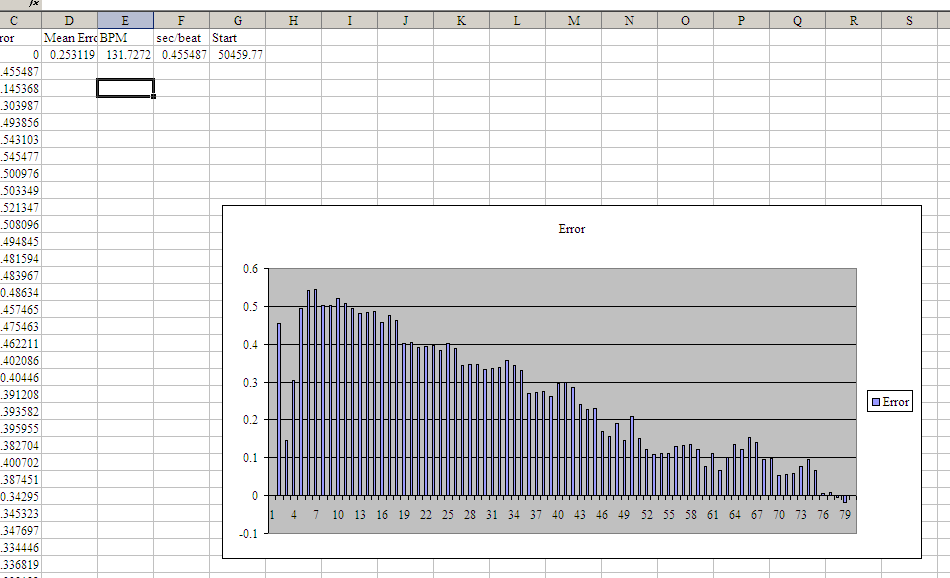
Take a look at the attachments.

The first one shows the normal prediction method - take the duration of
time between the first and last tap, divide by the number of taps. This
gives you the beat period (i.e., seconds/beat). The BPM figure is just
the reciprocol of this (with some conversion of units).

As you can see, if you compare the predicted beat times to the actual
taps entered, there's quite a lot of error. But, more seriously, the
error shows a pronounced linear trend. In other words, the BPM figure is
wrong, causing the taps and the prediction to gradually change their
phase relationship.

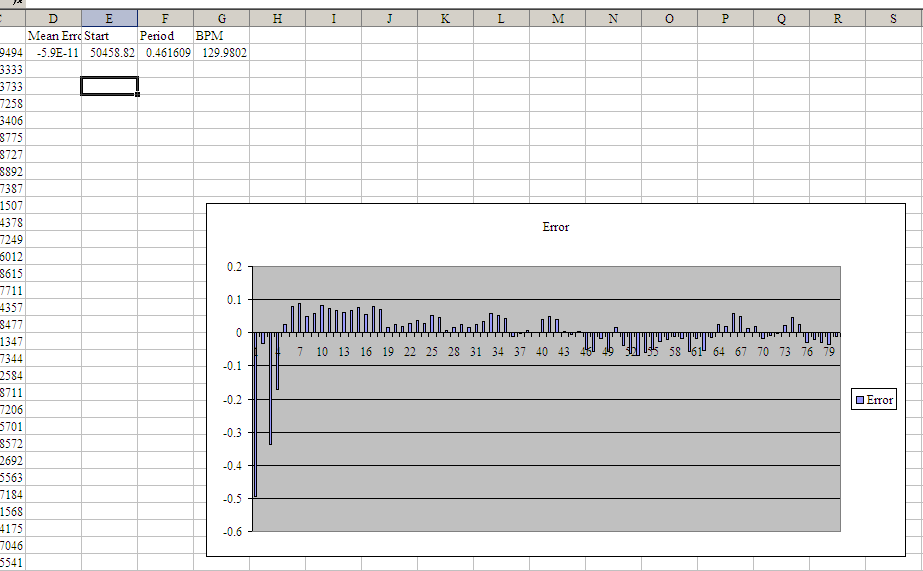
Now take a look at the second attachment. This is produced using a
propper linear regression. (Simple least squares, apparently.) Here the
algorithm has quite rightly detected that the first few taps are
horribly out of time, while the remaining ones fit neatly onto a regular
beat grid at 129.98 BPM (verses the 131.72 BPM detected by the other
method).

I notice there's still a slight linear trend to the errors, so maybe the
true BPM figure is actually lower still.

What the first method is doing is basically setting the prediction error
of the first and last tap to exactly zero, and linearly interpolating
between. This works horribly if the first and/or last taps are
particularly out of time. It's basically using 2 data points to detect
the right BPM figure.

On the other hand, I'm not sure, but I'd guess that *least squares*
linear regression probably assigns a large penalty to points with large
errors. In other words, out-of-time points are especially significant.
Obviously what *I* want is for out-of-time points to be especially
*insignificant*. I want to maximise the number of points with low
errors, not minimise the total error size.

Also, I have no idea how to compute a confidence value for the
regression predictions, other than by using the statistics of the tap
time-deltas as an estimate...
Post a reply to this message
Attachments:
Download 'bpm1.png' (25 KB)
Download 'bpm2.png' (21 KB)
Preview of image 'bpm1.png'
Preview of image 'bpm2.png'
|
|
| |
| |
|
|
|
|
| |
| |
|
|
Invisible wrote:
> Now take a look at the second attachment. This is produced using a
> propper linear regression. (Simple least squares, apparently.)

In solomn truth, both the simple and fancy algorithms tend to produce
very similar results, given the same data. Regression fit produces
smaller error values by getting the phase alignment correct, but they
both report roughly the same BPM reading.

Also, they are both equally perplexed by missing / additional beat
signals, so I need to go figure that out...
Post a reply to this message
|
|
| |
| |
|
|
|
|
| |
| |
|
|
> Also, they are both equally perplexed by missing / additional beat
> signals, so I need to go figure that out...

With your array of times-between-beats, calculate the mean and sd of the
whole array, then remove any entries that are outside of the mean +/- N*sd
before you do your BPM calculation.  You can choose N based on the results,
but I guess around 1 should work.
Post a reply to this message
|
|
| |
| |
|
|
|
|
| |
| |
|
|
scott wrote:
>> Also, they are both equally perplexed by missing / additional beat
>> signals, so I need to go figure that out...
>
> With your array of times-between-beats, calculate the mean and sd of the
> whole array, then remove any entries that are outside of the mean +/-
> N*sd before you do your BPM calculation.  You can choose N based on the
> results, but I guess around 1 should work.

Yes, that's more or less my plan. I just haven't coded it yet.
Post a reply to this message
|
|
| |
| |
|
|
|
|
| |
| |
|
|
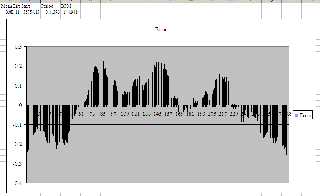
I had expected the taps to be approximately correct, but jittered either
side of the correct points by a roughly normal distribution. However,
this is not what I observe.

Take a look at the first attachment. There's an obvious U-shapred trend
in the error graph, and I have no idea why. It appears very, very
frequently though. But aside from that, the errors look much more like a
random walk than a normal distrubition. The timing error in each tap
appears to be highly correlated with its neighbors.

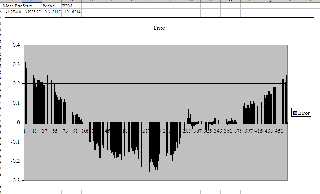
The second attachment shows a similar pattern (although the U-shapred
trend is now inverted). Note the difference in tempo between the two
examples.

I hypothesize that what actually happens is that my tapping is actually
running off an internal mental clock, which is being adjusted by a
feedback loop that keeps it reasonably in-phase with the actual
drumbeat. Hence the random-walk variations.

Of course, it's possible that the music I'm tapping to actually contains
subtle tempo variations. Or that some of these patterns are prediction
errors. I think what I need to do is perform a tapping experiment with a
timing source of known tempo, so I can get genuine error measurements.
(Currently it's tricky to reperate human tapping errors from computer
prediction errors.)
Post a reply to this message
Attachments:
Download 'bpm1.png' (14 KB)
Download 'bpm2.png' (16 KB)
Preview of image 'bpm1.png'
Preview of image 'bpm2.png'
|
|
| |
| |
|
|
|
|
| |
| |
|
|
Invisible wrote:

> I think what I need to do is perform a tapping experiment with a
> timing source of known tempo, so I can get genuine error measurements.

Heh, this is more difficult than you'd imagine.

I wrote a small program that basically does

   Get wall time.
   Save wall time to file.
   Print something to stdout.
   Wait X seconds.
   Repeat.

The amount of time is computed from the requested BPM. Only trouble is,
when I analysed the resulting data, I discovered that the program is
ticking too slowly. (E.g., I request 135 BPM, but I get 128 BPM.)

So then I tried having a thread that just does

   Send signal.
   Wait X seconds.
   Repeat.

and another thread that waits to receive a signal, and then does all the
other stuff. But noooo, the timing accuracy has increased, but it's
still ticking too slowly.

Thing is, what I want to do isn't "wait until X seconds from now", it's
"wait until time X". But there isn't a function to do that. If there
was, I could take the wall time now, compute the correct time for all
future clock ticks, and schedule the thread to run at those times. But
there isn't.

So I started digging through the library source code. Oh, this is fun:
Internally the "wait X seconds" function is implemented using a "wait
until time X" function. But it's private, so I can't call it. Thanks,
guys...

Next plan: Write out a WAV file containing sonic pulses with the correct
timing. Because, let's face it, there isn't much that can go wrong here.
Post a reply to this message
|
|
| |
| |
|
|
|
|
| |
| |
|
|
On 6/9/2010 5:18 AM, Invisible wrote:


> I hypothesize that what actually happens is that my tapping is actually
> running off an internal mental clock, which is being adjusted by a
> feedback loop that keeps it reasonably in-phase with the actual
> drumbeat. Hence the random-walk variations.

Am I the only one who thought PLL when I read this?


--
~Mike
Post a reply to this message
|
|
| |
| |
|
|
|
|
| |
| |
|
|
>> I hypothesize that what actually happens is that my tapping is actually
>> running off an internal mental clock, which is being adjusted by a
>> feedback loop that keeps it reasonably in-phase with the actual
>> drumbeat. Hence the random-walk variations.
>
> Am I the only one who thought PLL when I read this?

No, that's pretty much what I was thinking when I wrote it...
Post a reply to this message
|
|
| |
| |
|
|
|
|
| |
| |
|
|
> and another thread that waits to receive a signal, and then does all the
> other stuff. But noooo, the timing accuracy has increased, but it's still
> ticking too slowly.

If you can call API functions, call QueryPerformanceCounter from
Kernel32.dll.  It is pretty much the ultimate in terms of useful timing
accuracy and resolution under windows.  It only takes one parameter (a
pointer to a 64-bit signed integer) so should be easy to set up if you don't
have the header.
Post a reply to this message
|
|
| |
| |
|
|
|
|
| |
| |
|
|
>>> I hypothesize that what actually happens is that my tapping is actually
>>> running off an internal mental clock, which is being adjusted by a
>>> feedback loop that keeps it reasonably in-phase with the actual
>>> drumbeat. Hence the random-walk variations.
>>
>> Am I the only one who thought PLL when I read this?
>
> No, that's pretty much what I was thinking when I wrote it...

I also thought about it when I suggested to write code to find the BPM
automatically.
Post a reply to this message
|
|
| |
| |
|
|
|
|
| |
| |
|
|
scott wrote:
>> and another thread that waits to receive a signal, and then does all
>> the other stuff. But noooo, the timing accuracy has increased, but
>> it's still ticking too slowly.
>
> If you can call API functions, call QueryPerformanceCounter from
> Kernel32.dll.  It is pretty much the ultimate in terms of useful timing
> accuracy and resolution under windows.  It only takes one parameter (a
> pointer to a 64-bit signed integer) so should be easy to set up if you
> don't have the header.

http://msdn.microsoft.com/en-us/library/ms644904%28VS.85%29.aspx

"Retrieves the current value of the high-resolution performance counter."

 From what little documentation there is, it seems this allows me to
measure wall-time, really accurately. Which isn't the problem - the
problem is scheduling a thread to run when I actually want it to run.
Post a reply to this message
|
|
| |
| |
|
|
|
|
| |
| |
|
|
Mike Raiford wrote:

> Ludicrously difficult is programming in machine code for a processor
> that doesn't yet exist's micro-ops. ;)

If it makes you feel any better...

http://en.wikipedia.org/wiki/6502#Bugs_and_quirks

Note also that the 6502 doesn't have any microcode. It just uses a PLA
as the control matrix - much like the processor that I'm designing. ;-)
Post a reply to this message
|
|
| |
| |
|
|
|
|
| |
| |
|
|
>> Ludicrously difficult is programming in machine code for a processor that
>> doesn't yet exist's micro-ops. ;)
>
> If it makes you feel any better...
>
> http://en.wikipedia.org/wiki/6502#Bugs_and_quirks
>
> Note also that the 6502 doesn't have any microcode. It just uses a PLA as
> the control matrix - much like the processor that I'm designing. ;-)

FWIW when Acorn designed the original ARM processor, one person designed and
simulated it on a 6502 before starting actual hardware design.  IIRC it only
took a very small number of people in total (like 5 or 6) to design the
hardware implementation.

According to wikipedia over 10 billion ARM cores have been built, I bet they
never imagined that when they were sat at their 6502's designing it back in
the 80s :-)
Post a reply to this message
|
|
| |
| |
|
|
|
|
| |