|
|
|
|
|
|
| |
| |
|
|
|
|
| |
| |
|
|
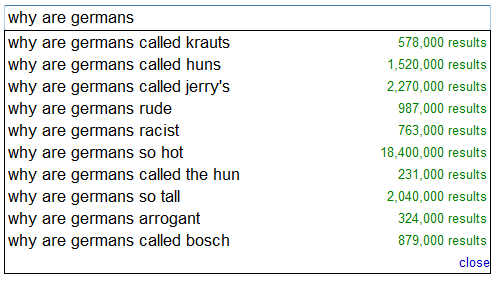
http://imgur.com/jVNQH.gif

Yeah, that's about right. :-)

--
   Darren New, San Diego CA, USA (PST)
   I ordered stamps from Zazzle that read "Place Stamp Here".
Post a reply to this message
|
|
| |
| |
|
|
|
|
| |
| |
|
|
> http://imgur.com/jVNQH.gif
>
> Yeah, that's about right. :-)

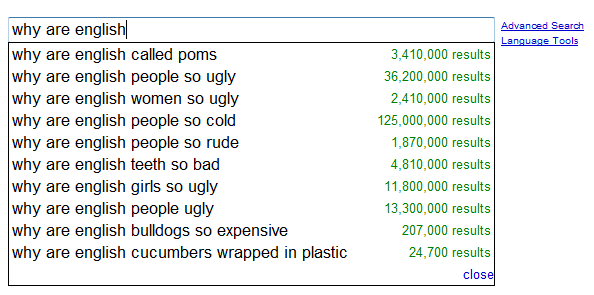
Also amusing to try other nationalities - I have no comment about the
difference between English and German girls ;-)
Post a reply to this message
|
|
| |
| |
|
|
|
|
| |
| |
|
|
scott wrote:

> Also amusing to try other nationalities - I have no comment about the
> difference between English and German girls ;-)

German girls are more passionate / agressive?

I mean, if we're talking about stereotypes...
Post a reply to this message
|
|
| |
| |
|
|
|
|
| |
| |
|
|
Darren New wrote:
> http://imgur.com/jVNQH.gif
>
> Yeah, that's about right. :-)

OMG that's hillarious!

-Mike
Post a reply to this message
|
|
| |
| |
|
|
|
|
| |
| |
|
|
scott wrote:
>
> Also amusing to try other nationalities - I have no comment about the
> difference between English and German girls ;-)
>

Two suggestions to "why are canadians "

Why are canadians so nice
Why are canadians so funny

lol.. that's great. I always knew our neighbors to the north were nice
and funny :)


--
~Mike
Post a reply to this message
|
|
| |
| |
|
|
|
|
| |
| |
|
|
scott schrieb:
>> http://imgur.com/jVNQH.gif
>>
>> Yeah, that's about right. :-)
>
> Also amusing to try other nationalities - I have no comment about the
> difference between English and German girls ;-)

Hmm - strange enough, Google doesn't give me any suggestions anlong
these lines... and yes, I have set it to "don't filter search results" :-)
Post a reply to this message
|
|
| |
| |
|
|
|
|
| |
| |
|
|
>> Also amusing to try other nationalities - I have no comment about the
>> difference between English and German girls ;-)
>
> Hmm - strange enough, Google doesn't give me any suggestions anlong these
> lines... and yes, I have set it to "don't filter search results" :-)

I got this...
Post a reply to this message
Attachments:
Download 'german.png' (17 KB)
Download 'english.png' (21 KB)
Preview of image 'german.png'
Preview of image 'english.png'
|
|
| |
| |
|
|
|
|
| |
| |
|
|
scott <sco### [at] scott com> wrote:
> I got this...
Seems like Finnish people do not suffer from so many stereotypes. The only
one Google is giving me is "why are Finnish... kids so smart".
Odd stereotype, I must say.
--
- Warp com> wrote:
> I got this...
Seems like Finnish people do not suffer from so many stereotypes. The only
one Google is giving me is "why are Finnish... kids so smart".
Odd stereotype, I must say.
--
- Warp
Post a reply to this message
|
|
| |
| |
|
|
|
|
| |
| |
|
|
Warp wrote:

>   Seems like Finnish people do not suffer from so many stereotypes. The only
> one Google is giving me is "why are Finnish... kids so smart".
>
>   Odd stereotype, I must say.

I've often wondered why *all* the genius programmers are always Finnish
or Sweedish or Polish or... any European nationallity except English.

Maybe because England is such a tiny country?
Post a reply to this message
|
|
| |
| |
|
|
|
|
| |
| |
|
|
Invisible <voi### [at] devnull> wrote:
> Warp wrote:

> >   Seems like Finnish people do not suffer from so many stereotypes. The only
> > one Google is giving me is "why are Finnish... kids so smart".
> >
> >   Odd stereotype, I must say.

> I've often wondered why *all* the genius programmers are always Finnish
> or Sweedish or Polish or... any European nationallity except English.

  I don't think that's true. For instance, surprisingly many game companies
are, in fact, British.

  Anyways, one could come up with tons of cum hoc ergo propter hoc reasons
why some countries seem to produce more programmers and software companies
than others. Maybe it's the education system, culture, economic model,
national identity, secularism, work morale (think of Japan, for instance),
or numerous other reasons.

--
                                                          - Warp
Post a reply to this message
|
|
| |
| |
|
|
|
|
| |
| |
|
|
>> I've often wondered why *all* the genius programmers are always Finnish
>> or Sweedish or Polish or... any European nationallity except English.
>
>   I don't think that's true. For instance, surprisingly many game companies
> are, in fact, British.

Certainly back in the Amiga days, all the really visionary software
seemed to be written by people with names you can't pronounce.

OctaMED lets you play 8 sounds at once even though the hardware only
supports 4. Who wrote that? One Finnish guy, single-handedly.

Somebody replaces the standard system requesters with something much
more ergonomic. Who wrote that? Hungarian guy.

AMOS is a BASIC dialect with comprehensive multimedia support. Who came
up with that? French guy.

(Mind you, it's rival Blitz Basic was designed by a New Zeland company.)

Pegger intercepts OS calls to turn any program that supports IFF ILBM
files into one that supports JPEG files. (Back when JPEG was still
brand-new.) Who did that? A German company.

>   Anyways, one could come up with tons of cum hoc ergo propter hoc reasons
> why some countries seem to produce more programmers and software companies
> than others. Maybe it's the education system, culture, economic model,
> national identity, secularism, work morale (think of Japan, for instance),
> or numerous other reasons.

Unfortunately, in the UK it seems to currently be "trendy" to be stupid.
It's decidedly uncool to know stuff, especially about mathematics and
science. I wonder if there are countries where people actually take
pride in mathematical skill?
Post a reply to this message
|
|
| |
| |
|
|
|
|
| |
| |
|
|
Invisible <voi### [at] devnull> wrote:
> Unfortunately, in the UK it seems to currently be "trendy" to be stupid.
> It's decidedly uncool to know stuff, especially about mathematics and
> science. I wonder if there are countries where people actually take
> pride in mathematical skill?

  I think that the US is currently growing a generation of people who can't
understand the basic concepts behind programming, and this might bite their
economy in a few decades.

  You see, at some parts of the US there's this odd trend that students
should not be taught basic math skills. Instead, they are taught some
"intuitive" hand-waving which might or might not help them solve some
mathematical problems via intuitive "deduction", but without really
understanding the basic mechanics.

  I assume you have been taught the classical way of multiplying two
numbers on paper, so-called the "long multiplication" method (see
http://en.wikipedia.org/wiki/Multiplication_algorithm#Long_multiplication).
It might not be the most efficient way of multiplying things, but it's
easy to learn and gets the job done.

  However, for some reason many school books and teachers in the US hate
long multiplication so much that they don't even *mention* it, much less
teach it. Instead, they prefer teaching some "intuitive" rules of thumb
which can be used in a few cases, and the more complicated cases are
dismissed with a "just use a calculator". These rules of thumb are simple
and easy for a few cases, but for other cases they end up being so
complicated that nobody even bothers.

  The long multiplication algorithm has one good feature: It allows you to
calculate *any* multiplication using the exact same principles. The
difficulty doesn't raise depending on the input numbers (only the amount
of writing needed).

  However, these people are taught to be lazy. They are basically said
"if you can't calculate with some easy rules of thumb, just give up and
use a calculator, nobody *really* needs to know how to multiply any two
numbers".

  The same is true for other mathematical operations, such as division
and square root.

  They are missing the point. By teaching lazy rules of thumb, they are
failing to teach a higher concept: Algorithmical thinking. You can't
program a computer with just "rules of thumb".

--
                                                          - Warp
Post a reply to this message
|
|
| |
| |
|
|
|
|
| |
| |
|
|
>> Unfortunately, in the UK it seems to currently be "trendy" to be stupid.
>> It's decidedly uncool to know stuff, especially about mathematics and
>> science. I wonder if there are countries where people actually take
>> pride in mathematical skill?
>
>   I think that the US is currently growing a generation of people who can't
> understand the basic concepts behind programming, and this might bite their
> economy in a few decades.
>
>   You see, at some parts of the US there's this odd trend that students
> should not be taught basic math skills. Instead, they are taught some
> "intuitive" hand-waving which might or might not help them solve some
> mathematical problems via intuitive "deduction", but without really
> understanding the basic mechanics.

>   However, these people are taught to be lazy. They are basically said
> "if you can't calculate with some easy rules of thumb, just give up and
> use a calculator, nobody *really* needs to know how to multiply any two
> numbers".

Well, I suppose you could argue that, in the real world, if you want to
do a nontrivial calculation and you actually need an exact answer,
you'll use some sort of computation device.

Then again, how many people grow up to be carpenters? But they still
teach woodwork??

>   The same is true for other mathematical operations, such as division
> and square root.

Out of curiosity... how the hell *do* you actually calculate the square
root of something? I've always wondered.

[Of course, usually the number you're looking at will be a square
number, and it's just a matter of guessing what it's the square of. But
if you for some reason needed to approximate, say, the square root of
500, where the hell do you start?]

>   They are missing the point. By teaching lazy rules of thumb, they are
> failing to teach a higher concept: Algorithmical thinking. You can't
> program a computer with just "rules of thumb".

Well, most people won't ever need to be computer programmers. It _is_ a
minority occupation. Indeed, most professions don't really involve
higher mathematics in any way.

But for those few that do... hmm, this could be a problem.
Post a reply to this message
|
|
| |
| |
|
|
|
|
| |
| |
|
|
Invisible <voi### [at] devnull> wrote:
> Well, I suppose you could argue that, in the real world, if you want to
> do a nontrivial calculation and you actually need an exact answer,
> you'll use some sort of computation device.

  But that's not the point. "Just use a calculator" is not didactic, it
doesn't teach anything, and will only make people lazy. This will bite
back in the future, when people won't become programmers because they
lack the proper education and way of thinking.

> >   The same is true for other mathematical operations, such as division
> > and square root.

> Out of curiosity... how the hell *do* you actually calculate the square
> root of something? I've always wondered.

  Your lack of google skills don't surprise me. Slightly more surprising is
that someone of your age hasn't been taught that at school.

http://en.wikipedia.org/wiki/Methods_of_computing_square_roots#Digit_by_digit_calculation

> >   They are missing the point. By teaching lazy rules of thumb, they are
> > failing to teach a higher concept: Algorithmical thinking. You can't
> > program a computer with just "rules of thumb".

> Well, most people won't ever need to be computer programmers. It _is_ a
> minority occupation. Indeed, most professions don't really involve
> higher mathematics in any way.

  Then you wonder why some countries are more proficient than others.
It's probably a common trait in the more proficient countries that the
schooling system is *not* driven by a "only very few people will ever
need these skills, thus we'll just skip teaching them" ideology.

--
                                                          - Warp
Post a reply to this message
|
|
| |
| |
|
|
|
|
| |
| |
|
|
>> Well, I suppose you could argue that, in the real world, if you want to
>> do a nontrivial calculation and you actually need an exact answer,
>> you'll use some sort of computation device.
>
>   But that's not the point. "Just use a calculator" is not didactic, it
> doesn't teach anything, and will only make people lazy. This will bite
> back in the future, when people won't become programmers because they
> lack the proper education and way of thinking.

Which is why schools are supposed to teach people this stuff. Indeed,
schools teach a whole bunch of stuff like woodwork, chemistry, and a
bunch of other things that only a tiny handful of people will ever use.

I think you could successfully argue that even if nobody in the class
ever needs to use algebra for anything, learning to do algebra teaches
you logical thinking, which is probably quite relevant to daily life.

>> Out of curiosity... how the hell *do* you actually calculate the square
>> root of something? I've always wondered.
>
>   Your lack of google skills don't surprise me. Slightly more surprising is
> that someone of your age hasn't been taught that at school.

Remember that I went to a school for mentally retarded people. They
didn't even teach us what a square root *is*, never mind how to compute
one. (For that matter, they didn't teach us what a square is in the
first place - other than that it's like a rectangle, but with equal
sides.) The only "mathematics" we did was filling out page after page
after page of long division problems. Because, after all, mathematics is
all *about* long division, right?

>> Well, most people won't ever need to be computer programmers. It _is_ a
>> minority occupation. Indeed, most professions don't really involve
>> higher mathematics in any way.
>
>   Then you wonder why some countries are more proficient than others.

Heh, point taken...
Post a reply to this message
|
|
| |
| |
|
|
|
|
| |
| |
|
|
On Thu, 24 Sep 2009 10:01:24 +0200, Warp <war### [at] tagpovrayorg> wrote:
>   Seems like Finnish people do not suffer from so many stereotypes. The
> only one Google is giving me is "why are Finnish... kids so smart".
>
>   Odd stereotype, I must say.

http://fe79.myftp.org/misc/google_se.png

Too bad our kids are so stupid...


--
FE
Post a reply to this message
|
|
| |
| |
|
|
|
|
| |
| |
|
|
On 09/24/09 05:17, Invisible wrote:
> Well, I suppose you could argue that, in the real world, if you want to
> do a nontrivial calculation and you actually need an exact answer,
> you'll use some sort of computation device.

	And who'll build that computation device?

--
If you think nobody cares, try missing a couple of payments.
Post a reply to this message
|
|
| |
| |
|
|
|
|
| |
| |
|
|
Darren New <dne### [at] sanrrcom> wrote:
> http://imgur.com/jVNQH.gif
>
> Yeah, that's about right. :-)

That's pretty funny.  Here's one of my favorites:

http://google.com/trends?q=sex%2C+news&ctab=0&geo=all&date=mtd&sort=0

I guess there are just some things you don't google at work.

 - Ricky
Post a reply to this message
|
|
| |
| |
|
|
|
|
| |
| |
|
|
On 24-9-2009 12:24, Warp wrote:
> Invisible <voi### [at] devnull> wrote:
>> Well, I suppose you could argue that, in the real world, if you want to
>> do a nontrivial calculation and you actually need an exact answer,
>> you'll use some sort of computation device.
>
>   But that's not the point. "Just use a calculator" is not didactic, it
> doesn't teach anything, and will only make people lazy. This will bite
> back in the future, when people won't become programmers because they
> lack the proper education and way of thinking.

agreed, see below.

>>>   The same is true for other mathematical operations, such as division
>>> and square root.
>
>> Out of curiosity... how the hell *do* you actually calculate the square
>> root of something? I've always wondered.
>
>   Your lack of google skills don't surprise me. Slightly more surprising is
> that someone of your age hasn't been taught that at school.

I have recently discussed this with a couple of people at the places I
work. It seems teaching doing a square root by hand was removed from the
basic training about 40-50 years ago. It wasn't in my training anywhere,
though I do know it after having sort of derived it myself. (That is of
course why it is a particular favourite of mine).
I am now teaching digital technology to first years electronic
engineering at an applied university (whatever that is in English). One
of my colleagues that is a few years older and is teaching VHDL and that
sort of stuff actually did not know it. Someone from my department in
the hospital did know and he is about the same age. I wouldn't be
surprised if the only reason he learned it was that his teacher liked it
and not that it was in the official end terms. (BTW I am 47 and they are
begin-mid 50s).

More disturbingly: I noticed that some of my students did not know long
division. I haven't asked for long multiplication (yet). It seems to
have dropped from the program for the same reasons as you mention for
the US. The teachers don't understand it and don't see why an innocent
kid needs to know such a overly complicated algorithm if they can use a
pocket calculator. To get things in perspective: the majority of people
training for teacher fail the end test for our 12 year olds in maths.

One of the first courses at this university is in basic maths. Which is
simply trying to get them at the level of the end terms of the school
they have just finished (actually even less than that). We do start with
addition, subtraction, long multiplications and divisions, and fractions...

>
http://en.wikipedia.org/wiki/Methods_of_computing_square_roots#Digit_by_digit_calculation

>>>   They are missing the point. By teaching lazy rules of thumb, they are
>>> failing to teach a higher concept: Algorithmical thinking. You can't
>>> program a computer with just "rules of thumb".
>
>> Well, most people won't ever need to be computer programmers. It _is_ a
>> minority occupation. Indeed, most professions don't really involve
>> higher mathematics in any way.
>
>   Then you wonder why some countries are more proficient than others.
> It's probably a common trait in the more proficient countries that the
> schooling system is *not* driven by a "only very few people will ever
> need these skills, thus we'll just skip teaching them" ideology.

The common fear with those in teaching maths, physics and chemistry in
the Netherlands  is that we will be with the countries at the bottom in
a few years/decades. We are still doing OK but when the current
generation retires we are left with an incompetent mathophobe group of
teachers.
 From my personal experience I know that also the writing skills are far
below what was thought in my days.

OTOH, every generation will say so.
Post a reply to this message
|
|
| |
| |
|
|
|
|
| |
| |
|
|
On 09/24/09 14:14, andrel wrote:
>> Your lack of google skills don't surprise me. Slightly more surprising is
>> that someone of your age hasn't been taught that at school.
>
> I have recently discussed this with a couple of people at the places I
> work. It seems teaching doing a square root by hand was removed from the
> basic training about 40-50 years ago. It wasn't in my training anywhere,

	I doubt it was ever in basic training universally. Probably only in
some countries. I know folks much older who know about it - seeing it at
some point in their lives, but never were formally taught it.

	In my text book (7th or 8th grade), it was there in one of those
special "fun" sections, and it's possible that the teacher even made us
do a few problems using it, but it wasn't required to know, and I never
memorized it.

> More disturbingly: I noticed that some of my students did not know long
> division. I haven't asked for long multiplication (yet). It seems to
> have dropped from the program for the same reasons as you mention for
> the US. The teachers don't understand it and don't see why an innocent

	That's *really* bad. Long division is not something that can be
replaced with calculators. You use it for algebraic expressions as well.
Unless, of course, it's degraded to the point where you don't need
algebra and you just let Maple do everything.

	I know a lot of people criticize some of the "new math". I'm not that
certain in either direction. I find long multiplication and long
division to be good for computing stuff fast, but gives virtually *no*
insight into anything. The techniques in "new math" actually give you a
fundamental understanding of what's going on, and has more "right" to be
called mathematics. But it's likely not practical to do it that way each
time.

	If I had kids, I'd try to make sure they learn both. I consider either
approach alone to be seriously flawed.

	Reminds me of a bunch of math graduate students I've known. Fairly slow
at doing integrals, etc. But a physics student or a good engineering
student is much faster at doing them. It's because the math students are
not concerned with calculations (for the most part) - but the others are.

	In any case, my advisor in grad school had a no-calculators policy for
exams. And this was for engineering courses, where you have to calculate
stuff with real numbers, and not just symbolically. I always felt that
if I were a professor, I'd do likewise for exams. I wonder how long
before such professors are shunned by their own colleagues.

> One of the first courses at this university is in basic maths. Which is
> simply trying to get them at the level of the end terms of the school
> they have just finished (actually even less than that). We do start with
> addition, subtraction, long multiplications and divisions, and fractions...

	I often wonder. A lot of people (including myself sometimes) feel that,
say, mathematics education is degrading over time. In my undergrad
institution, a few decades ago, the lowest math class was introductory
calculus. As the years went by, they needed to put a remedial precalc
course that was strictly not for credit. Then as time went by, they
converted that to a proper course with credits, and put a remedial
algebra course for no credits. Now that course is offered for credit.

	Likewise, some of the things they often teach in the first year of
graduate school here in mathematics is often taught in the 4th year of
undergrad in universities in other countries (I just saw one where it's
taught in the 3rd year of undergrad).

	Is the math education at high school etc degrading, requiring all these
remedial courses?

	Possibly.

	Another explanation is that as a percentage (and of course, in absolute
numbers) of the population, more and more students are getting educated
and graduating high school, and the education system is having trouble
keeping up. Put another way, the percentage of people age 18 in this
country who have a "solid" background in mathematics may have actually
stayed the same (not gone worse) - it's just that the percentage
graduating and moving on to university is higher (and not just because
standards have gone down).

	I used to be firmly in the first camp, but I really don't have the
data, and it wouldn't surprise me if the second reason is the bigger one.

> The common fear with those in teaching maths, physics and chemistry in
> the Netherlands is that we will be with the countries at the bottom in a
> few years/decades. We are still doing OK but when the current generation
> retires we are left with an incompetent mathophobe group of teachers.
>  From my personal experience I know that also the writing skills are far
> below what was thought in my days.
>
> OTOH, every generation will say so.

	I wonder how much of this really matters.

	Take a number of east European countries. And Russia. When it comes to
mathematics, they used to (and probably still do) beat, say, the US
handily. Not just the brilliant ones, but also the average high
school/university graduate.

	In many technical areas (except perhaps engineering), the US has been
consistently behind those and other countries for most of the 20th century.

	Yet it doesn't hurt the country much.

	I think what matters is maintaining a fairly good average (not just of
students, but the whole population). I don't really know, but I suspect
those countries tended to be elitist. Only the really good got to go to
universities, whereas the rest went to simple trade schools. And that
results in an overall lower average. An elite group of a few brilliant
people cannot impact the country as much as a huge group of above
average folks.

	I think the UK used to be like that and they probably changed it some
decades ago. I've met a bunch of older people from there who couldn't
get into university to become an engineer, but in terms of their
abilities and grades, had they lived in the US, they would have.

--
If you think nobody cares, try missing a couple of payments.
Post a reply to this message
|
|
| |
| |
|
|
|
|
| |
| |
|
|
Neeum Zawan <m.n### [at] ieeeorg> wrote:
>  Reminds me of a bunch of math graduate students I've known. Fairly slow
> at doing integrals, etc. But a physics student or a good engineering
> student is much faster at doing them. It's because the math students are
> not concerned with calculations (for the most part) - but the others are.

From my PDE's textbook:

"...Our efforts will be largely devoted to proving mathematically the existence
of solutions. ... This may seem like wasted or misguided effort, but in fact
mathematicians are like theologians: we regard existence as the prime attribute
of what we study.  But unlike theologians, we need not always rely upon faith
alone."

>  In any case, my advisor in grad school had a no-calculators policy for
> exams. And this was for engineering courses, where you have to calculate
> stuff with real numbers, and not just symbolically. I always felt that
> if I were a professor, I'd do likewise for exams. I wonder how long
> before such professors are shunned by their own colleagues.

The professors I thought the most highly of were the ones who basically said,
"Open book, open notes, calculators allowed--but it won't help."  I really do
think estimation is an undervalued skill though.  The ability to stand there,
figure out orders of magnitude in your head, and come up with some quick
approximations can save a lot of time blindly pursuing totally inappropriate
methods.  That sounds obvious, but it's really remarkable how completely some
people lack basic problem-solving and analysis skills.

>  I often wonder. A lot of people (including myself sometimes) feel that,
> say, mathematics education is degrading over time. In my undergrad
> institution, a few decades ago, the lowest math class was introductory
> calculus. As the years went by, they needed to put a remedial precalc
> course that was strictly not for credit. Then as time went by, they
> converted that to a proper course with credits, and put a remedial
> algebra course for no credits. Now that course is offered for credit.

Maybe some people need a more remedial course, so they add a remedial course,
just to get everyone up to speed.  Suddenly, the bottom rung of the ladder isn't
the bottom anymore, so all the people who were struggling in precalc move up a
step.  And if you're not falling off the bottom, why worry?  People just expand
to fit the container, in a sense.

>  Likewise, some of the things they often teach in the first year of
> graduate school here in mathematics is often taught in the 4th year of
> undergrad in universities in other countries (I just saw one where it's
> taught in the 3rd year of undergrad).

"it" being what?  Just curious...

>  Another explanation is that as a percentage (and of course, in absolute
> numbers) of the population, more and more students are getting educated
> and graduating high school, and the education system is having trouble
> keeping up. Put another way, the percentage of people age 18 in this
> country who have a "solid" background in mathematics may have actually
> stayed the same (not gone worse) - it's just that the percentage
> graduating and moving on to university is higher (and not just because
> standards have gone down).

This actually seems plausible.  Still, they choose their program, so to allow
more people through, the standards must be relaxed.  As I said above, relaxed
standards in turn reduce effort put forth by students, compounding the problem.
Just a guess, of course.

>  I think what matters is maintaining a fairly good average (not just of
> students, but the whole population).

Let's hear it for mediocrity!

 - Ricky
Post a reply to this message
|
|
| |
| |
|
|
|
|
| |
| |
|
|
> I have recently discussed this with a couple of people at the places I
> work. It seems teaching doing a square root by hand was removed from the
> basic training about 40-50 years ago.

I think this was the case in the UK too, my maths teacher mentioned it as
something they had to do "in the old days", but it certainly wasn't on the
curriculum.  Of course long multiplication and long division were, also
later on in school we had to do long division with algebraic expressions...
fun!

> To get things in perspective: the majority of people training for teacher
> fail the end test for our 12 year olds in maths.

"Those that can't do, teach, and those that can't teach... teach gym."

> One of the first courses at this university is in basic maths. Which is
> simply trying to get them at the level of the end terms of the school they
> have just finished (actually even less than that). We do start with
> addition, subtraction, long multiplications and divisions, and
> fractions...

Hmm at my University they send us a booklet over the summer holiday before
we started, basically telling us we should know all of this and to learn the
rest before you come.  It was more to just fill in the gaps between the
different curriculums at different schools, but mostly we had covered it
all.

> From my personal experience I know that also the writing skills are far
> below what was thought in my days.

What makes it worse in the UK is that every year the media congratulates
everyone with record pass rates for school exams.  You simply have to
compare a maths exam paper (or even text book) with one from 20 years ago to
realise how massively easier it is today.  Stuff that was in my A-level test
(taken when you're 18) was the same stuff in my dad's O-level test (when
you're 16).
Post a reply to this message
|
|
| |
| |
|
|
|
|
| |
| |
|
|
"triple_r" <nomail@nomail> wrote:
> I really do
> think estimation is an undervalued skill though.  The ability to stand there,
> figure out orders of magnitude in your head, and come up with some quick
> approximations can save a lot of time blindly pursuing totally inappropriate
> methods.  That sounds obvious, but it's really remarkable how completely some
> people lack basic problem-solving and analysis skills.

My physics course at university included a weekly 'workshop' slot in the
teaching. Among other things, this focused on estimating order-of-magnitude
answers to complicated yet unspecific problems, using nothing but basic physics
formulae from memory, sensible guesses for data and paper & pencil for
calculation. Questions like 'how much water might be vaporised if an asteroid
hit the ocean?'

In hindsight, it was probably one of the most valuable skills I was taught in
that degree programme.
Post a reply to this message
|
|
| |
| |
|
|
|
|
| |
| |
|
|
scott wrote:

> I think this was the case in the UK too, my maths teacher mentioned it
> as something they had to do "in the old days", but it certainly wasn't
> on the curriculum.  Of course long multiplication and long division
> were, also later on in school we had to do long division with algebraic
> expressions... fun!

I envy schools where they actually *teach* algebra.

Everything I know about algebra is what little I've been able to figure
out for myself and scrape out of library books.

> "Those that can't do, teach, and those that can't teach... teach gym."

Incidentally, our gym teacher was the most terrifying guy in the school.
Very fair, but... DO NOT get caught doing bad stuff! My God, the horror...

> What makes it worse in the UK is that every year the media congratulates
> everyone with record pass rates for school exams.

What happens is that every single year, the pass rate either goes up, or
it goes down. It is a statistical fact that it is almost impossible for
the pass rate to remain exactly the same.

If it goes up, even slightly, even by a statistically insignificant
amount, the media starts screaming about "exams are getting too easy".
Not, you know, that students are getting brighter or working harder or
new teaching methods or anything like that. No, exams are getting easier.

If it goes down, even by a statistically insignificant amount, the media
shrieks "schools are failing our children". Not, you know, that the
exams are getting harder, or that this was just a random fluctuation,
but that schools are failing us.

No matter what happens, the media will yell and shout about the terrible
moral decay of either failing schools or watered down exams. There is
apparently nothing the education system can do about this.

> You simply have to
> compare a maths exam paper (or even text book) with one from 20 years
> ago to realise how massively easier it is today.

I haven't had the opportunity to try that, so I really couldn't say.

When I did my exams, I didn't think they were especially easy. And I was
entered for the lower grades. (E.g., I got a B in science, and B is the
highest possible mark for the paper I took.)
Post a reply to this message
|
|
| |
| |
|
|
|
|
| |
| |
|
|
> Everything I know about algebra is what little I've been able to figure
> out for myself and scrape out of library books.

Do a maths evening class?  You should sail through the GCSE, the A-level
might take a little bit of work to fill in the gaps of your knowledge.  For
even further the Open University probably offer something.

> What happens is that every single year, the pass rate either goes up, or
> it goes down.

There is a strong upward trend though in the results:

http://2.bp.blogspot.com/_mJmwQtPmusk/Rt8ZqfEnvyI/AAAAAAAAA2U/TIGBotspDds/s400/gcse-scores--ns-2007.jpg

> I haven't had the opportunity to try that, so I really couldn't say.

Maybe one of your parents has an old text book from school? I also got my
dad's A level physics text book, and it went in to so much more detail about
*everything* that we did in A level physics, if I wanted to read further
about anything in school I used his books.

> When I did my exams, I didn't think they were especially easy.

I'm not talking about individuals, I'm talking about the entire population.
When something stupid like 40% gets an A grade, how is anyone meant to tell
the difference between the hard working kids and the really clever ones?
They introduced the A* grade at GCSE, but the % of people getting A* has
been steadily rising.  How are Universities meant to choose the best
students when more and more are applying with the highest possible grades?
Post a reply to this message
|
|
| |
| |
|
|
|
|
| |
| |
|
|
>> Everything I know about algebra is what little I've been able to
>> figure out for myself and scrape out of library books.
>
> Do a maths evening class?  You should sail through the GCSE, the A-level
> might take a little bit of work to fill in the gaps of your knowledge.
> For even further the Open University probably offer something.

My mum suggested I do a maths A-level. Personally, I'm not sure where
I'd find the money or the time. Nice idea though...

>> What happens is that every single year, the pass rate either goes up,
>> or it goes down.
>
> There is a strong upward trend though in the results:

Is this a fact, or just hype? It's hard to tell just by listening to the
news. (If you believed them, bird flu is a deadly world-wide pandemic
which is killing everything in sight...)

>
http://2.bp.blogspot.com/_mJmwQtPmusk/Rt8ZqfEnvyI/AAAAAAAAA2U/TIGBotspDds/s400/gcse-scores--ns-2007.jpg


This isn't grades, it's point scores. You can get a higher GSCE point
score by taking more subjects.

>> I haven't had the opportunity to try that, so I really couldn't say.
>
> Maybe one of your parents has an old text book from school? I also got
> my dad's A level physics text book, and it went in to so much more
> detail about *everything* that we did in A level physics, if I wanted to
> read further about anything in school I used his books.

I have my mum's O-level maths books. (Plural.) And her logarithm tables.
(They're very brown and crumbly.) The books talk about a lot of stuff I
either already know or don't understand. I guess because I don't know
the stuff that's supposed to come *before* an O-level. The books talk a
lot about trigonometry and triangle rules; damn, at my school, maths
classes didn't even mention triangles!

> When something stupid like 40% gets an A grade

It's that high??
Post a reply to this message
|
|
| |
| |
|
|
|
|
| |
| |
|
|
> Is this a fact, or just hype? It's hard to tell just by listening to the
> news. (If you believed them, bird flu is a deadly world-wide pandemic
> which is killing everything in sight...)

Or that HIV had just been cured because 51 got HIV who took the vaccine
compared to 74 otherwise.

Anyway, I'm sure you can actually look up the real GCSE pass rates rather
than simply reading the text of news reports.  The bbc site has a graph on
this page:

http://news.bbc.co.uk/2/hi/uk_news/education/4202327.stm

>> When something stupid like 40% gets an A grade
>
> It's that high??

I was just making that bit up, after checking it's actually 20%.
Post a reply to this message
|
|
| |
| |
|
|
|
|
| |
| |
|
|
>> Is this a fact, or just hype? It's hard to tell just by listening to
>> the news. (If you believed them, bird flu is a deadly world-wide
>> pandemic which is killing everything in sight...)
>
> Or that HIV had just been cured because 51 got HIV who took the vaccine
> compared to 74 otherwise.

Or that, yes.

> Anyway, I'm sure you can actually look up the real GCSE pass rates
> rather than simply reading the text of news reports.

Somewhere somebody probably has all sorts of interesting statistics.
Damned if I know how to find them though...

>>> When something stupid like 40% gets an A grade
>>
>> It's that high??
>
> I was just making that bit up, after checking it's actually 20%.

Hmm, I take your point. That *is* pretty high. I was expecting A grades
to be nearer to 0.02%. (Let's face it, most people are very, very stupid.)
Post a reply to this message
|
|
| |
| |
|
|
|
|
| |
| |
|
|
On 09/24/09 22:57, triple_r wrote:
>>   Likewise, some of the things they often teach in the first year of
>> graduate school here in mathematics is often taught in the 4th year of
>> undergrad in universities in other countries (I just saw one where it's
>> taught in the 3rd year of undergrad).
>
> "it" being what?  Just curious...

	Kinda forgot which one. Best guess was either what is introductory grad
real analysis in the US (measure theory, Fatou's Lemma, etc) - or
introductory grad algebra course.

> This actually seems plausible.  Still, they choose their program, so to allow
> more people through, the standards must be relaxed.  As I said above, relaxed

	And they relax it because allowing more people through (thus far) has
proven to be a good thing. Most engineers in the real world don't use
calculus, for example. Why make that the starting point in university?


--
Would the capacity of a Palaeozoic Hard Dive be measured in Trilobites?
Post a reply to this message
|
|
| |
| |
|
|
|
|
| |
| |
|
|
triple_r wrote:
> people lack basic problem-solving and analysis skills.

My favorite was in some store where the clerk had to use a calculator to
calculate 60% off a $20 item. And then she couldn't figure out whether to
charge us $12 or give us back $12.

--
   Darren New, San Diego CA, USA (PST)
   I ordered stamps from Zazzle that read "Place Stamp Here".
Post a reply to this message
|
|
| |
| |
|
|
|
|
| |
| |
|
|
>> people lack basic problem-solving and analysis skills.
>
> My favorite was in some store where the clerk had to use a calculator to
> calculate 60% off a $20 item. And then she couldn't figure out whether
> to charge us $12 or give us back $12.

Exhibit A: Verizon Math Fail.

--
http://blog.orphi.me.uk/
http://www.zazzle.com/MathematicalOrchid*
Post a reply to this message
|
|
| |
| |
|
|
|
|
| |
| |
|
|
On 25-9-2009 13:20, Invisible wrote:
> Somewhere somebody probably has all sorts of interesting statistics.
> Damned if I know how to find them though...

http://www.ted.com/talks/hans_rosling_shows_the_best_stats_you_ve_ever_seen.html
Post a reply to this message
|
|
| |
| |
|
|
|
|
| |
| |
|
|
On 25-9-2009 1:30, Neeum Zawan wrote:
>     In many technical areas (except perhaps engineering), the US has
> been consistently behind those and other countries for most of the 20th
> century.
>
>     Yet it doesn't hurt the country much.


That is because it is freeloading on other countries investments in
education. For technical areas they have to import most of the PhD
students from countries that still have an adequate education system. Or
they simply import them after graduation. Even the ones that are
homegrown are mainly from asian stock, from families that are not long
enough in the US to have abandoned the idea that you have to study to
get a good job. When they have been in the US for one or two generations
they have found out that in stead of doing something productive or
something that requires you to use your brain, it is easier to study law
or something similar. Then you don't have to worry about getting your
grade and you earn more than when working as a technician or craftsman.

OK, I admit, that is somewhat of a generalization.
Post a reply to this message
|
|
| |
| |
|
|
|
|
| |
| |
|
|
On 09/25/09 13:55, andrel wrote:
> On 25-9-2009 1:30, Neeum Zawan wrote:
>> In many technical areas (except perhaps engineering), the US has been
>> consistently behind those and other countries for most of the 20th
>> century.
>>
>> Yet it doesn't hurt the country much.
>
>
> That is because it is freeloading on other countries investments in
> education. For technical areas they have to import most of the PhD
> students from countries that still have an adequate education system. Or
> they simply import them after graduation. Even the ones that are
> homegrown are mainly from asian stock, from families that are not long
> enough in the US to have abandoned the idea that you have to study to
> get a good job. When they have been in the US for one or two generations
> they have found out that in stead of doing something productive or
> something that requires you to use your brain, it is easier to study law
> or something similar. Then you don't have to worry about getting your
> grade and you earn more than when working as a technician or craftsman.
>
> OK, I admit, that is somewhat of a generalization.

	Yes, but even if true, my point is still mildly valid. Having a top
education system need not be a priority, if you can convince smart
enough people to come here.

	It's likely a mix of both, and I'm inclined to lean more heavily
towards what I said: Have a significantly better average will get you
further. Also helps that the US has a lot of people, so even with a poor
education system the number of outliers will still be significant.

--
Blessed are the censors, for they shall inhibit the earth.
Post a reply to this message
|
|
| |
| |
|
|
|
|
| |
| |
|
|
On 26-9-2009 1:57, Neeum Zawan wrote:
> On 09/25/09 13:55, andrel wrote:
>> On 25-9-2009 1:30, Neeum Zawan wrote:
>>> In many technical areas (except perhaps engineering), the US has been
>>> consistently behind those and other countries for most of the 20th
>>> century.
>>>
>>> Yet it doesn't hurt the country much.
>>
>>
>> That is because it is freeloading on other countries investments in
>> education. For technical areas they have to import most of the PhD
>> students from countries that still have an adequate education system. Or
>> they simply import them after graduation. Even the ones that are
>> homegrown are mainly from asian stock, from families that are not long
>> enough in the US to have abandoned the idea that you have to study to
>> get a good job. When they have been in the US for one or two generations
>> they have found out that in stead of doing something productive or
>> something that requires you to use your brain, it is easier to study law
>> or something similar. Then you don't have to worry about getting your
>> grade and you earn more than when working as a technician or craftsman.
>>
>> OK, I admit, that is somewhat of a generalization.
>
>     Yes, but even if true, my point is still mildly valid. Having a top
> education system need not be a priority, if you can convince smart
> enough people to come here.

True, but not all donor countries might think that is a desirable
situation.
Second, it works as long as the US is the most desirable country for a
scientist to live in. When another country takes that position, the US
has not enough trained people to fill the gap. There is a large
probability that this will create a downward spiral.
To prevent that the US need a couple of big changes:
- reform the education system
- make sure that someone with knowledge or skills earns more than a
lawyer (i.e. fix the juridical system)
- reform the health care system (I am not going to move to the US and
this is a major reason. I am assuming it is for others as well and that
that will increase with time, and that it may become a factor for people
to actually leave the US)
- probably fixing the financial system might help too. The 'extravagant'
lifestyle in the US has been sponsored by foreign countries. When they
stop doing that the US may lack the money to buy the top-researchers
from other countries.

>     It's likely a mix of both, and I'm inclined to lean more heavily
> towards what I said: Have a significantly better average will get you
> further. Also helps that the US has a lot of people, so even with a poor
> education system the number of outliers will still be significant.

The really smart are education resistant, they will learn and understand
in any educational model, but you need more than that 0.1% for a healthy
economy. Besides, you want them in relevant positions. Not solely in the
financial market and other places where they can make a lot of money for
themselves without contributing anything to society.
Post a reply to this message
|
|
| |
| |
|
|
|
|
| |
| |
|
|
On 09/26/09 09:52, andrel wrote:
>> Yes, but even if true, my point is still mildly valid. Having a top
>> education system need not be a priority, if you can convince smart
>> enough people to come here.
>
> True, but not all donor countries might think that is a desirable
> situation.

	Well, they should shape up and try to keep their people around.

	I don't know how it is in your country, but in a lot of countries -
including industrialized ones - the flexibility to change your career
path is not that great. In some places, if you start one program, and
halfway through university you want to switch, the system makes it hard
for you. Over here, it's trivial. I know lots of people who go to grad
school in areas quite different from their undergrad. And you can change
your path at just about any point within your undergrad.

	And then there are lots who have trouble getting into university
whereas they wouldn't have over here.

	I knew an exchange student from Germany. In his university, they more
or less have a quota: Only the top n% of students at the end of the
first year will be allowed to stay.

	The rest weren't completely discarded, and they got to go to other
institutions, but they couldn't quite study what they wanted. Under
those circumstances, I can easily see people going to another country to
study if they could afford it.

> Second, it works as long as the US is the most desirable country for a
> scientist to live in. When another country takes that position, the US
> has not enough trained people to fill the gap. There is a large

	Perhaps.

> To prevent that the US need a couple of big changes:
> - reform the education system

	Perhaps a bit overstated. There are always really good schools and
colleges. The bad news focuses more on the average ones. The good ones
may be expensive, though.

> - make sure that someone with knowledge or skills earns more than a
> lawyer (i.e. fix the juridical system)

	Never gonna happen.<G>

> - reform the health care system (I am not going to move to the US and
> this is a major reason. I am assuming it is for others as well and that
> that will increase with time, and that it may become a factor for people
> to actually leave the US)

	Well, when I wrote "perhaps" above, I was going to point out that in
many regards, the US isn't the most desirable country. It's good mostly for:

- Money
- A lot of a certain kind of freedom. Over here the society is really
flexible. They may think foreigners act weird, but it rarely bothers
them. They're flexible in many other ways. My advisor and his wife were
from Belgium. He came to the university here with short term goals -
perhaps would spend 2-3 years and then return. His wife knew no English.
She was so happy how she was treated as a foreigner that she insisted on
staying. And she really liked the ease with which you can do stuff.
Once, while on a sabbatical in Switzerland, she tried to get a
membership at a gym. The amount of paperwork they wanted from her as a
nonresident was ridiculous, and I think she gave up. Just to go to a
gym. Of course, perhaps that wouldn't be a problem in all European
countries, but it's a common complaint I hear from them when they come
here.

	But in most other categories (like health care), other industrialized
countries do better.

	Also, the US seems to be really good at marketing. It may not fool you
Europeans, but it probably does fool all the smart people in third world
countries who want to come here (with the exception of those the US has
screwed - although even lots of those guys come).

> - probably fixing the financial system might help too. The 'extravagant'
> lifestyle in the US has been sponsored by foreign countries. When they
> stop doing that the US may lack the money to buy the top-researchers
> from other countries.

	Possible.

> The really smart are education resistant, they will learn and understand
> in any educational model, but you need more than that 0.1% for a healthy

	That's the mentality I reject. I'd rather phrase it as "there will
always be really smart people who learn regardless of the model".

	I'll also say that some people who would have turned out to be
brilliant had there been a model that catered to them won't because they
went through an easier model. That's perhaps the flaw of the US system
(pre-university at least): People who perhaps could be smart/brilliant
just aren't challenged enough and they don't develop the skills early
enough.


--
He who slings mud generally loses ground.
Post a reply to this message
|
|
| |
| |
|
|
|
|
| |
| |
|
|
andrel wrote:
> - make sure that someone with knowledge or skills earns more than a
> lawyer (i.e. fix the juridical system)

What makes you think lawyers don't have knowledge and skills?  Admittedly,
it's "stamp collecting" knowledge rather than "fact finding" knowledge, but
it's still a whole bunch of study as well as a fairly brutal test at the end.

--
   Darren New, San Diego CA, USA (PST)
   I ordered stamps from Zazzle that read "Place Stamp Here".
Post a reply to this message
|
|
| |
| |
|
|
|
|
| |
| |
|
|
Out of curiosity, I have a question. In the USA, there's a stereotype that
immigrants with few skills can still get jobs, even if they're low-paying.
Indeed, such a stereotype is mocked in movies like Men in Black, when they
find some typical ethnic stuff on the street and one of them shouts "He took
a cab!"  I.e., there's always cab-driving jobs, burger flipping jobs,
restaurant jobs, etc. At least, that's the stereotype?

Do other european countries have this, either as a stereotype or a fact?
Would it be reasonable for a chinese person with awful French to immigrate
to France and find work to do? How about a Spanish person (i.e., from within
europe)?

Just curious.

--
   Darren New, San Diego CA, USA (PST)
   I ordered stamps from Zazzle that read "Place Stamp Here".
Post a reply to this message
|
|
| |
| |
|
|
|
|
| |
| |
|
|
On Sat, 26 Sep 2009 10:48:33 -0700, Darren New <dne### [at] sanrrcom> wrote:

>Do other european countries have this, either as a stereotype or a fact?
>Would it be reasonable for a chinese person with awful French to immigrate
>to France and find work to do?


In London's China Town there are a lot of people, in low level jobs, who only
speak Cantonese.

--

Regards
     Stephen
Post a reply to this message
|
|
| |
| |
|
|
|
|
| |
| |
|
|
On 26-9-2009 19:43, Darren New wrote:
> andrel wrote:
>> - make sure that someone with knowledge or skills earns more than a
>> lawyer (i.e. fix the juridical system)
>
> What makes you think lawyers don't have knowledge and skills?
> Admittedly, it's "stamp collecting" knowledge rather than "fact finding"
> knowledge, but it's still a whole bunch of study as well as a fairly
> brutal test at the end.

In case it was not clear, I was mocking a bit. But I was also a bit
serious. I could do a lengthy explanation, but perhaps it is enough to
say that I think most of the best earning lawyers belong in ship B of
the Golgafrincham Ark Fleet. Many of them have a good set of brains that
might have been more productive elsewhere, but then they would not earn
as much. There are also lawyers that are important to society but these
earn not nearly as much.
Second, my own experience with the study of law and its students. In the
Netherlands these law students are the ones that are most visible to the
general public and the main reason students are associated with lazy,
drinking, right wing party goers. There are students that study it
because they are interested in it, but a large proportion simply does it
to get a job in whatever the old boys network provides (and until about
the 80s, women often did it to find a husband). There may be a 'brutal'
test at the end, but in physics we studied a lot more and still the
percentage that graduates is way lower than in law.

Somebody once said: 'why would I study hard to be a physicist for 5
years, while I can also do law and be the manager of a group of
physicist, earn more, and have 4 years of partying at uni instead?'
In the US you might add to that: why would I study hard to be a doctor,
while I can also do law and sue them?

Ok, this lacks some some subtleties, and yes, IANAL.
Post a reply to this message
|
|
| |
| |
|
|
|
|
| |
| |
|
|
andrel wrote:
> Ok, this lacks some some subtleties, and yes, IANAL.

No doubt there are careers that take more study than lawyering does and
which are of a bigger general benefit to people, yes.  I just wouldn't say
they're "without knowledge or skills". Indeed, in the US, I'm not sure you
can graduate from undergraduate college and actually be a lawyer without
additional study. Maybe you can, but I don't know anyone who didn't go back
to school for it.

--
   Darren New, San Diego CA, USA (PST)
   I ordered stamps from Zazzle that read "Place Stamp Here".
Post a reply to this message
|
|
| |
| |
|
|
|
|
| |
| |
|
|
On 26-9-2009 21:04, Darren New wrote:
> andrel wrote:
>> Ok, this lacks some some subtleties, and yes, IANAL.
>
> No doubt there are careers that take more study than lawyering does and
> which are of a bigger general benefit to people, yes.

And earn significantly less money, which was sort of the point.

> I just wouldn't
> say they're "without knowledge or skills". Indeed, in the US, I'm not
> sure you can graduate from undergraduate college and actually be a
> lawyer without additional study. Maybe you can, but I don't know anyone
> who didn't go back to school for it.

I know what you mean. I am just simply a bit annoyed that there are so
much jobs that earn more than a real craftsman. In general I lament the
loss of skills that is going on here right now. Which makes me sad. At
the same time having to witness some very skilled craftsmen that really
know their materials to get laid off or pestered into a desk job makes
me angry. Add to that that the persons that did it made more money,
didn't know anything about what these craftsmen were doing and simply
decided that anything they made could be bought on the internet. Then
you know why I will make some unflattering remarks about some people for
the coming years.
Post a reply to this message
|
|
| |
| |
|
|
|
|
| |
| |
|
|
On 09/26/09 13:46, andrel wrote:
> the 80s, women often did it to find a husband). There may be a 'brutal'
> test at the end, but in physics we studied a lot more and still the
> percentage that graduates is way lower than in law.

	The reason there are more lawyers than physicists is that society needs
more lawyers than they do physicists.

> Somebody once said: 'why would I study hard to be a physicist for 5
> years, while I can also do law and be the manager of a group of
> physicist, earn more, and have 4 years of partying at uni instead?'
> In the US you might add to that: why would I study hard to be a doctor,
> while I can also do law and sue them?

	Lawyers managing physicists? How'd that happen. What kind of job do the
physicists have?

	BTW, over here law school is graduate school, and you need to have some
degree prior to entering law school. It's fairly competitive (although I
won't try to equate it to physics in any way). And while they perhaps do
party (don't really know), law school is fairly demanding here.

--
Light travels faster than sound. This is why some people appear bright
until you hear them speak.
Post a reply to this message
|
|
| |
| |
|
|
|
|
| |
| |
|
|
Fredrik Eriksson wrote:
> http://fe79.myftp.org/misc/google_se.png
>
> Too bad our kids are so stupid...

I have to wonder just what, exactly, those results mean.

Are there really 35,000,000 web sites that ask the question, "Why are
Swedish people so good looking?"

Or is it that there are 35,000,000 web sites use each of those words
somewhere on their page?

Or is it inflated to boost someone's ego?

...Chambers
Post a reply to this message
|
|
| |
| |
|
|
|
|
| |
| |
|
|
andrel wrote:
>  From my personal experience I know that also the writing skills are far
> below what was thought in my days.

I actually saw an article recently about how writing skills are better
today than they were 20 years ago.  Specifically, the ability of a
writer to adapt their work for their target audience.

Unfortunately, I can't remember where I read it, and google is giving me
too many unrelated links.

...Chambers
Post a reply to this message
|
|
| |
| |
|
|
|
|
| |
| |
|
|
Invisible wrote:
> Somewhere somebody probably has all sorts of interesting statistics.
> Damned if I know how to find them though...

http://www.google.co.uk/intl/en/landing/internetstats/

...Chambers
Post a reply to this message
|
|
| |
| |
|
|
|
|
| |
| |
|
|
"Chambers" <Ben### [at] gmailcom> a écrit dans le message de
news:4abee0c2$1@news.povray.org...
>I actually saw an article recently about how writing skills are better
>today than they were 20 years ago.  Specifically, the ability of a writer
>to adapt their work for their target audience.
> Unfortunately, I can't remember where I read it, and google is giving me
> too many unrelated links.

It's about the Standford Study of Writing
http://www.wired.com/techbiz/people/magazine/17-09/st_thompson
http://ssw.stanford.edu/
The obvious criticism of the study is that it's based on the writings of
Standford students, who are not the most illiterate bunch. The writing
skills of Standford students may be better, but what does it say on the
writing skills of the rest of the population? What rings true, however, is
that people write more, and that just having more venues to write (even if
it's just inane Youtube/4chan/fark comments) is better than not writing at
all.

G.
Post a reply to this message
|
|
| |
| |
|
|
|
|
| |
| |
|
|
Gilles Tran wrote:
> It's about the Standford Study of Writing
> http://www.wired.com/techbiz/people/magazine/17-09/st_thompson
> http://ssw.stanford.edu/
> The obvious criticism of the study is that it's based on the writings of
> Standford students, who are not the most illiterate bunch. The writing
> skills of Standford students may be better, but what does it say on the
> writing skills of the rest of the population? What rings true, however,
> is that people write more, and that just having more venues to write
> (even if it's just inane Youtube/4chan/fark comments) is better than not
> writing at all.

Thanks, that's exactly the one I was thinking of :)

...Chambers
Post a reply to this message
|
|
| |
| |
|
|
|
|
| |
|
|