|
|
|
|
|
|
| |
| |
|
|
|
|
| |
| |
|
|
http://boards.polycount.net/showthread.php?t=65805

--
http://blog.orphi.me.uk/
http://www.zazzle.com/MathematicalOrchid*
Post a reply to this message
|
|
| |
| |
|
|
|
|
| |
| |
|
|
Orchid XP v8 <voi### [at] dev null> wrote:
> http://boards.polycount.net/showthread.php?t=65805
It's a pitty that you need a top-of-the-line gaming computer monster which
costs an arm and a leg if you want to play the game at full quality.
I bought the game, and my 3.4GHz P4 with a Radeon HD 3850 can only run it
acceptably at medium (or perhaps slightly above that if you don't mind having
about 10FPS refresh rate at points) settings. Still looks quite good (better
than eg. HL2), but not that good.
--
- Warp null> wrote:
> http://boards.polycount.net/showthread.php?t=65805
It's a pitty that you need a top-of-the-line gaming computer monster which
costs an arm and a leg if you want to play the game at full quality.
I bought the game, and my 3.4GHz P4 with a Radeon HD 3850 can only run it
acceptably at medium (or perhaps slightly above that if you don't mind having
about 10FPS refresh rate at points) settings. Still looks quite good (better
than eg. HL2), but not that good.
--
- Warp
Post a reply to this message
|
|
| |
| |
|
|
|
|
| |
| |
|
|
Orchid XP v8 wrote:
> http://boards.polycount.net/showthread.php?t=65805

I LOLed at the "Now if only they could make it fun" comment. I've played too
many Peter Moleneaux games not to.

--
   Darren New, San Diego CA, USA (PST)
   I ordered stamps from Zazzle that read "Place Stamp Here".
Post a reply to this message
|
|
| |
| |
|
|
|
|
| |
| |
|
|
Orchid XP v8 wrote:
> http://boards.polycount.net/showthread.php?t=65805
>

Those all look like the ToD screenshots that were posted a while back.
The quality is amazing, but how is this particular ToD mod different?

...Chambers
Post a reply to this message
|
|
| |
| |
|
|
|
|
| |
| |
|
|
Orchid XP v8 escreveu:
> http://boards.polycount.net/showthread.php?t=65805

Looks like just regular Crysis with increased texture definition.

These look far more impressive:
http://www2.picturepush.com/photo/a/1673205/img/Crysis/Crysis-2009-05-03-00-02-57-70.png
http://www3.picturepush.com/photo/a/1662311/img/Crysis/Crysis-2009-04-30-20-06-28-60.png
http://img4.abload.de/img/2pblu.jpg

I see more of Crysis as an intense research in interactive CG than as a
game.

Some of the settings are pretty instructive as well:

; Post Processing
r_ColorGrading = 1
r_DepthOfField = 2
r_MotionBlur = 4
r_Flares = 1
r_MotionBlurShutterSpeed = 0.02
r_Coronas = 1
r_MultiGPU=1

; Shaders and Lighting
r_SSAO=1
r_ssao_amount=0.5
r_SSAO_darkening=1.255
r_SSAO_quality=2
r_SSAO_radius=2
r_SSAO_blur 4
r_SSAO_blurriness 1
r_Usepom = 1
r_sunshafts = 1
r_Beams=3
r_BeamsDistFactor = 0.01
r_BeamsMaxSlices=300

;HUMAN EYE
r_EyeAdaptationBase=0.001
r_EyeAdaptationFactor=1
r_EyeAdaptionBase=0.0
r_EyeAdaptionClamp=2.75
r_EyeAdaptionSpeed=0.1
r_HDRBrightOffset=128
r_HDRlevel=0.7525

; Shadows
e_shadows = 1
r_ShadowsMaskResolution=0
e_shadows_on_alpha_blended=1
e_shadows_from_terrain_in_all_lods = 1
e_shadows_cast_view_dist_ratio = 0.8
r_ShadowBlur=3.0
e_shadows_max_texture_size=1024
r_ShadowJittering=1.1
r_SSAO_downscale_ztarget=0

; Object Detail
e_obj_quality=4
ca_useDecals=1
e_decals_allow_game_decals=1
e_decals_life_time_scale=2
i_rejecteffects=1
sys_flash_curve_tess_error=2
e_view_dist_ratio=120
e_max_view_dst_spec_lerp=1
es_DebrisLifetimeScale=1
e_cbuffer_resolution=256
e_dissolve=1
ca_DrawFaceAttachments=1
ca_AttachmentCullingRation=60
e_terrain_occlusion_culling = 1
e_terrain_occlusion_culling_max_dist=200

; Vegetation
e_foliage_wind_activation_dist = 35
es_DebrisLifetimeScale = 1
r_DetailNumLayers = 2
r_VegetationSpritesTexRes = 128
r_DynTexAtlasSpritesMaxSize = 32
r_TexAtlasSize = 2048
e_vegetation_bending = 2
e_vegetation_min_size=0
e_proc_vegetation=1
e_vegetation_use_terrain_color=1
q_shaders=3

; Particles
e_particles_quality=4
e_water_ocean_soft_particles= 1
e_particles_max_emitter_draw_screen = 64
e_particles_object_collisions=1
r_UseSoftParticles = 1
e_particles_thread=1

; Water
r_WaterReflectionsQuality = 4
r_WaterUpdateDistance = 0
r_WaterCaustics=1
r_WaterRefractions=1
r_WaterReflections=1
r_WaterGodRays = 1
e_water_ocean_fft=1
e_water_tesselation_amount = 10
e_water_tesselation_swath_width=10
q_ShaderWater=4
e_phys_ocean_cell = 0.3
r_WaterUpdateFactor = 0

; Misc
e_max_entity_lights = 20
g_battleDust_enable = 1
g_breakage_particles_limit = 250
g_ragdollDistance = 35
g_ragdollMinTime = 15
e_terrain_ao=1
e_terrain_normal_map=1
i_lighteffects = 1

; LODs
e_vegetation_sprites_distance_custom_ratio_min = 1
e_vegetation_sprites_distance_ratio=1.8
e_cull_veg_activation = 90
e_view_dist_ratio_vegetation = 85
e_particles_lod=0.6
es_MaxPhysDist=60
es_MaxPhysDistInvisible=25
e_terrain_lod_ratio=0.6
e_view_dist_ratio_detail=80
e_lod_ratio=10
e_lod_min=0
e_lods=0
e_detail_materials_view_dist_xy=8192
e_detail_materials_view_dist_z=512
r_DetailDistance=20
e_terrain_texture_lod_ratio=0.1
e_view_dist_ratio=200

; FPS Gain commands
r_UseEdgeAA=2
r_TerrainAO_FadeDist=1
r_GeomInstancing=1
e_vegetation_static_instancing=0
e_gsm_lods_num = 5
e_gsm_range = 4
e_gsm_cache = 0
e_ram_maps = 1
e_dissolve = 1

source:
http://www.overclock.net/pc-games/498803-photorealistic-crysis-real-lifesis-mod-discussion-16.html

and more:
http://images.google.com/images?q=crysis+photorealistic+mod

--
a game sig: http://tinyurl.com/d3rxz9
Post a reply to this message
|
|
| |
| |
|
|
|
|
| |
| |
|
|
nemesis <nam### [at] gmailcom> wrote:
> I see more of Crysis as an intense research in interactive CG than as a
> game.

  It's not a bad game either. I have definitely played worse and more boring
games (even modern ones). Maybe not in the same league as eg. HL2 (there is
just something special about that game), but still a good game.

--
                                                          - Warp
Post a reply to this message
|
|
| |
| |
|
|
|
|
| |
| |
|
|
Warp wrote:
> nemesis <nam### [at] gmailcom> wrote:
>> I see more of Crysis as an intense research in interactive CG than as a
>> game.
>
>   It's not a bad game either. I have definitely played worse and more boring
> games (even modern ones). Maybe not in the same league as eg. HL2 (there is
> just something special about that game), but still a good game.

I liked Crysis more than HL2, so I guess it's up to what you want out of
a game.

--
http://blog.orphi.me.uk/
http://www.zazzle.com/MathematicalOrchid*
Post a reply to this message
|
|
| |
| |
|
|
|
|
| |
| |
|
|
I think the thing that makes it most realistic is that the textures don't
seem to repeat. Maybe they do and it's very hard to see. Like, I see some
repetition on the panels with the letters, but nothing on the streaked bits
just above the wheel carriage below the letters up on the left.
Post a reply to this message
|
|
| |
| |
|
|
|
|
| |
| |
|
|
> I think the thing that makes it most realistic is that the textures don't
> seem to repeat. Maybe they do and it's very hard to see. Like, I see some
> repetition on the panels with the letters, but nothing on the streaked
> bits just above the wheel carriage below the letters up on the left.

Also they got the contrast between light and shade areas correct (a lot of
games get this totally wrong), and they use a global illumination system.
Those two things make a big difference to the believability of the scene
IMO.
Post a reply to this message
|
|
| |
| |
|
|
|
|
| |
| |
|
|
scott wrote:

> Also they use a global illumination system.

No, they don't.

According to Wikipedia, they use "occlusion mapping", which is a
comparatively cheap way to fake global illumination. (E.g., it works in
realtime, so if stuff moves around, the lighting changes.)
Post a reply to this message
|
|
| |
| |
|
|
|
|
| |
| |
|
|
>> Also they use a global illumination system.
>
> No, they don't.
>
> According to Wikipedia, they use "occlusion mapping", which is a
> comparatively cheap way to fake global illumination.

Well yes of course it is faked (like almost every other GPU effect), I
wasn't expecting them to have invented a way to do physically correct
per-pixel global illumination in real-time!  I just meant they were at least
attempting to have some GI effect, not simply ignoring it as most games do.
Post a reply to this message
|
|
| |
| |
|
|
|
|
| |
| |
|
|
>>> Also they use a global illumination system.
>>
>> No, they don't.
>>
>> According to Wikipedia, they use "occlusion mapping", which is a
>> comparatively cheap way to fake global illumination.
>
> Well yes of course it is faked (like almost every other GPU effect), I
> wasn't expecting them to have invented a way to do physically correct
> per-pixel global illumination in real-time!  I just meant they were at
> least attempting to have some GI effect, not simply ignoring it as most
> games do.

Most games just precompute GI. (Usually at too low resolution...)
Post a reply to this message
|
|
| |
| |
|
|
|
|
| |
| |
|
|
> Most games just precompute GI. (Usually at too low resolution...)

This is fine if nothing moves or changes colour in your game.
Post a reply to this message
|
|
| |
| |
|
|
|
|
| |
| |
|
|
>> Most games just precompute GI. (Usually at too low resolution...)
>
> This is fine if nothing moves or changes colour in your game.

...which doesn't work too well in a game that lets you flatten buildings
if you feel like it. ;-)

Hell, even in TF2, you see light shining through doorways when the door
is shut. Looks kinda weird until the door opens at the start of the
round. You'd think that just for doors you could compute two versions of
the light map... but then, just how much of the light map is affected
when you shut one door? Indeed.
Post a reply to this message
|
|
| |
| |
|
|
|
|
| |
| |
|
|
this is an insanely amazing Crysis mod shot too:

http://www1.picturepush.com/photo/a/1578869/1024/Crysis/crysis64-2009-04-11-19-45-23-44.png
Post a reply to this message
|
|
| |
| |
|
|
|
|
| |
| |
|
|
scott escreveu:
>> Most games just precompute GI. (Usually at too low resolution...)
>
> This is fine if nothing moves or changes colour in your game.

http://www.youtube.com/watch?v=FqeXuO2AlEE

http://www.crytek.com/fileadmin/user_upload/inside/presentations/2009/Light_Propagation_Volumes.pdf

A GPU implementation of instant radiosity presented at this year's
SIGRAPH.  Yeah, objects move around and affect GI.  be very afraid...

Of course, that's only in the triangle mesh-world, not in the world of
perfect sphere surfaces...

--
a game sig: http://tinyurl.com/d3rxz9
Post a reply to this message
|
|
| |
| |
|
|
|
|
| |
| |
|
|
nemesis wrote:
> this is an insanely amazing Crysis mod shot too:

What's insane about it?
Post a reply to this message
|
|
| |
| |
|
|
|
|
| |
| |
|
|
Invisible wrote:
> nemesis wrote:
>> this is an insanely amazing Crysis mod shot too:
>
> What's insane about it?

DOF, sun pouring in from behind high-definition tree foliage, dust from
the ground, and some glass thing just in front of you showing some
(fake) refraction and dispersion.
Post a reply to this message
|
|
| |
| |
|
|
|
|
| |
| |
|
|
>>> this is an insanely amazing Crysis mod shot too:
>>
>> What's insane about it?
>
> DOF, sun pouring in from behind high-definition tree foliage, dust from
> the ground, and some glass thing just in front of you showing some
> (fake) refraction and dispersion.

...all of which I'm pretty much sure were in the original Crysis game.
Not saying it isn't impressive, but I'm not sure what this mod adds.
Post a reply to this message
|
|
| |
| |
|
|
|
|
| |
| |
|
|
Invisible wrote:
>>>> this is an insanely amazing Crysis mod shot too:
>>>
>>> What's insane about it?
>>
>> DOF, sun pouring in from behind high-definition tree foliage, dust
>> from the ground, and some glass thing just in front of you showing
>> some (fake) refraction and dispersion.
>
> ...all of which I'm pretty much sure were in the original Crysis game.
> Not saying it isn't impressive, but I'm not sure what this mod adds.

oh

still impressive though... :D

BTW, saw the link to instant radiosity in Cryengine 3?

http://www.youtube.com/watch?v=FqeXuO2AlEE
http://www.crytek.com/fileadmin/user_upload/inside/presentations/2009/Light_Propagation_Volumes.pdf
Post a reply to this message
|
|
| |
| |
|
|
|
|
| |
| |
|
|
Orchid XP v8 wrote:
> I liked Crysis more than HL2, so I guess it's up to what you want out of
> a game.

Same here; I'm about halfway through Ep1, and I just haven't picked it
up in more than a week.

...Chambers
Post a reply to this message
|
|
| |
| |
|
|
|
|
| |
| |
|
|
> A GPU implementation of instant radiosity presented at this year's
> SIGRAPH.  Yeah, objects move around and affect GI.  be very afraid...

Yes I think dynamic GI is getting more and more realistic on the GPU, it
makes a huge visual difference that is often hard to pin down (ie it just
"looks better" but it's not massively obvious like adding reflections).

> Of course, that's only in the triangle mesh-world, not in the world of
> perfect sphere surfaces...

I don't understand the fascination with perfect mathematically described
surfaces, they are inflexible and slow to render.  If you use sub-divided
triangle meshes you can make the output perfectly smooth all the time and of
course do whatever transformations you like very easily by just transforming
every vertex.  AFAIK all film-quality 3D animation is done with triangle
mesh based renderers, and we can probably assume they have worked out the
best way to get photo-realistic quality.  And the huge benefit for games
(rather than offline rendering) is that it's very simple to reduce the
triangle count to keep real-time animation.
Post a reply to this message
|
|
| |
| |
|
|
|
|
| |
| |
|
|
> this is an insanely amazing Crysis mod shot too:
>
>
http://www1.picturepush.com/photo/a/1578869/1024/Crysis/crysis64-2009-04-11-19-45-23-44.png

Imagine how long that would take to render in POV, media, DOF, refraction!
And I don't think the result would be *that* different (maybe the refraction
would look slightly different, but a normal person probably couldn't tell
which one was correct, especially during animation).
Post a reply to this message
|
|
| |
| |
|
|
|
|
| |
| |
|
|
>> I liked Crysis more than HL2, so I guess it's up to what you want out
>> of a game.
>
> Same here; I'm about halfway through Ep1, and I just haven't picked it
> up in more than a week.

HL2 was technically astonishing. (Remember, at the time the only other
game I'd played was HL1. Oh, and Quake II.) But it wasn't all that much
fun to actually play.

HL2:EP1 added even better graphics, but wasn't greatly more fun to play.
(God I hate zombies!)

HL2:EP2 was graphically better still, but - far more importantly - it
was *fun*! I actually played it more than once. (Didn't do that with HL2
or HL2:EP1.) The final battle is absurdly difficult, but other than
that, it's really rather entertaining.
Post a reply to this message
|
|
| |
| |
|
|
|
|
| |
| |
|
|
scott wrote:

> I don't understand the fascination with perfect mathematically described
> surfaces, they are inflexible and slow to render.

Really? I was under the impression that splines can describe any
possible surface. Triangles, on the other hand, can only give a crude
approximation to curves.
Post a reply to this message
|
|
| |
| |
|
|
|
|
| |
| |
|
|
scott wrote:
>> this is an insanely amazing Crysis mod shot too:
>>
>>
http://www1.picturepush.com/photo/a/1578869/1024/Crysis/crysis64-2009-04-11-19-45-23-44.png

>>
>
> Imagine how long that would take to render in POV, media, DOF,
> refraction! And I don't think the result would be *that* different
> (maybe the refraction would look slightly different, but a normal person
> probably couldn't tell which one was correct, especially during animation).

It wouldn't have all those glitches that games have though. (Like grass
that rotates as you run past it, or "mist" that has sharp edges where it
intersects things.)
Post a reply to this message
|
|
| |
| |
|
|
|
|
| |
| |
|
|
On Thu, 24 Sep 2009 09:25:52 +0100, Invisible wrote:

> I was under the impression that splines can describe any possible
> surface.

"When the only tool you have is a hammer, everything looks like a nail."

In my current sleep-deprived state, that seems a relevant quote.  It may
not after I go to bed, sleep, wake up, shower, and come back up here in
the morning.  But right now it seems relevant.

Jim ZZZZzzzzzzzzzzzzzzzzzzzzzzzz.................
Post a reply to this message
|
|
| |
| |
|
|
|
|
| |
| |
|
|
>> I don't understand the fascination with perfect mathematically described
>> surfaces, they are inflexible and slow to render.
>
> Really? I was under the impression that splines can describe any possible
> surface.

How do you render a splined surface directly?  Even POV converts them to
triangles first!

> Triangles, on the other hand, can only give a crude approximation to
> curves.

In practice display devices are made of pixels, so using triangles you can
always get exactly the same output as using the true curve.  Have you ever
seen any "crude approximations" to curves in film CG?
Post a reply to this message
|
|
| |
| |
|
|
|
|
| |
| |
|
|
>> Really? I was under the impression that splines can describe any
>> possible surface.
>
> How do you render a splined surface directly?  Even POV converts them to
> triangles first!

It's news to me that POV supports splines in the first place.

>> Triangles, on the other hand, can only give a crude approximation to
>> curves.
>
> In practice display devices are made of pixels, so using triangles you
> can always get exactly the same output as using the true curve.

Only if you have the original curve to hand.

> Have you ever seen any "crude approximations" to curves in film CG?

Have you ever seen any curved surfaces in computer games?

If you *insist* on using triangles, you're going to need a hell of a lot
of them to fake the appearence of a good curve. That means you either
need a triangle mesh of absurd dimensions, or you need to generate the
triangles on the fly.

What all known computer games do is use a static, very low resolution
triangle mesh and then smother it with lashes of low-level trickery to
give a vague semblance of curvature.
Post a reply to this message
|
|
| |
| |
|
|
|
|
| |
| |
|
|
>> Imagine how long that would take to render in POV, media, DOF,
>> refraction! And I don't think the result would be *that* different (maybe
>> the refraction would look slightly different, but a normal person
>> probably couldn't tell which one was correct, especially during
>> animation).
>
> It wouldn't have all those glitches that games have though. (Like grass
> that rotates as you run past it, or "mist" that has sharp edges where it
> intersects things.)

I don't think modern games have those glitches anymore, the grass is true 3D
geometry not just billboards, and the mist billboards usually compare depths
of existing pixels to avoid the hard edges with geometry.  Some games even
have true 3D volume textures and rendering for smoke and mist, I don't know
if Crysis uses this or just cheats with multiple billboards.  Maybe the
glitches you mention are on a game from 5 years ago or on a very badly
written modern one.
Post a reply to this message
|
|
| |
| |
|
|
|
|
| |
| |
|
|
> It's news to me that POV supports splines in the first place.

It does bezier patches which are the closest you are going to get to
describing "any curved surface" mathematically.

> Only if you have the original curve to hand.

What if you designed the curve by seeing how it turned out after
sub-divison?  Blender works like this, you can edit the vertices of a very
rough triangle mesh and see how the perfectly smooth surface reacts in real
time.  You are then defining the "original curve" by the crude mesh.

> If you *insist* on using triangles, you're going to need a hell of a lot
> of them to fake the appearence of a good curve. That means you either need
> a triangle mesh of absurd dimensions, or you need to generate the
> triangles on the fly.

Exactly.  This is what all film-quality renderers do.

> What all known computer games do is use a static, very low resolution
> triangle mesh and then smother it with lashes of low-level trickery to
> give a vague semblance of curvature.

Of course, because that method gets the highest quality output in realtime.
And it's very easy to have two (or more) versions of a mesh at different
resolutions, eg for stills rendering, close-up real-time rendering, far away
rendering etc.  When you have a mathematical surface rendered directly it's
very difficult to speed it up!
Post a reply to this message
|
|
| |
| |
|
|
|
|
| |
| |
|
|
scott wrote:
>>> Imagine how long that would take to render in POV, media, DOF,
>>> refraction! And I don't think the result would be *that* different
>>> (maybe the refraction would look slightly different, but a normal
>>> person probably couldn't tell which one was correct, especially
>>> during animation).
>>
>> It wouldn't have all those glitches that games have though. (Like
>> grass that rotates as you run past it, or "mist" that has sharp edges
>> where it intersects things.)
>
> I don't think modern games have those glitches anymore, the grass is
> true 3D geometry not just billboards, and the mist billboards usually
> compare depths of existing pixels to avoid the hard edges with
> geometry.  Some games even have true 3D volume textures and rendering
> for smoke and mist, I don't know if Crysis uses this or just cheats with
> multiple billboards.  Maybe the glitches you mention are on a game from
> 5 years ago or on a very badly written modern one.

HalfLife 2: Episode 2 has mist in one section. Looks really
impressive... until it intersects something.

Mind you, POV-Ray has the exact same problem, until you turn the
settings up so high that it takes 82+ hours to render a single frame...
Post a reply to this message
|
|
| |
| |
|
|
|
|
| |
| |
|
|
Ever heard of subdivision surfaces, Andrew?  You can get a perfectly
round sphere out of a plain cube cage by specifying up to 5 iterations.
  This is the norm in the industry, and there's also NURBS.

Pixar got its own gig with REYES in Renderman, basically an automatic
triangulator breaking down every geometry on screen into triangles until
they are less than one pixel wide in the final resolution.  It probably
breaks them down by subdivision as well, since one of the well-known
algorithms has the name of one of Pixar founding fathers...

No one designs multibillion triangle meshes by carefully moving them one
by one.

BTW:
http://www.3d-coat.com/v3_voxel_sculpting.html
Post a reply to this message
|
|
| |
| |
|
|
|
|
| |
| |
|
|
nemesis wrote:
> Ever heard of subdivision surfaces, Andrew?  You can get a perfectly
> round sphere out of a plain cube cage by specifying up to 5 iterations.

Yes. But the resulting surface can only be controlled by the 8 original
cube corners. That's not much control.

> No one designs multibillion triangle meshes by carefully moving them one
> by one.

And yet, in all known editors, moving triangle corners around one at a
time is the only available editing operation...
Post a reply to this message
|
|
| |
| |
|
|
|
|
| |
| |
|
|
Invisible wrote:
> nemesis wrote:
>> Ever heard of subdivision surfaces, Andrew?  You can get a perfectly
>> round sphere out of a plain cube cage by specifying up to 5 iterations.
>
> Yes. But the resulting surface can only be controlled by the 8 original
> cube corners. That's not much control.

If you need refinement, you do loop cuts over the control cage and extrude.

>> No one designs multibillion triangle meshes by carefully moving them
>> one by one.
>
> And yet, in all known editors, moving triangle corners around one at a
> time is the only available editing operation...

You have your head in the 80's.  Do you ever click on the links I provide?
Post a reply to this message
|
|
| |
| |
|
|
|
|
| |
| |
|
|
>>> No one designs multibillion triangle meshes by carefully moving them
>>> one by one.
>>
>> And yet, in all known editors, moving triangle corners around one at a
>> time is the only available editing operation...
>
> You have your head in the 80's.  Do you ever click on the links I provide?

Really?

Everybody says that Wings3D is the best editor going, but all it does is
manipulate triangle meshes, one point at a time. Last time I checked, it
didn't exist in the 80s.
Post a reply to this message
|
|
| |
| |
|
|
|
|
| |
| |
|
|
Invisible wrote:
>>>> No one designs multibillion triangle meshes by carefully moving them
>>>> one by one.
>>>
>>> And yet, in all known editors, moving triangle corners around one at
>>> a time is the only available editing operation...
>>
>> You have your head in the 80's.  Do you ever click on the links I
>> provide?
>
> Really?
>
> Everybody says that Wings3D is the best editor going, but all it does is
> manipulate triangle meshes, one point at a time. Last time I checked, it
> didn't exist in the 80s.

I'm used to Blender, not Wings, but I'm pretty sure they share the same
operations and that means extruding and controlling and selecting
friggin' amounts of vertices at the same time by mean of vertex loops
and rings.  Let alone by sculpting like in the link I provided.

Not knowing how to use such operations doesn't mean they don't exist.
Almost never I've had to move a single vertex alone.
Post a reply to this message
|
|
| |
| |
|
|
|
|
| |
| |
|
|
Invisible wrote:
> scott wrote:
>
>> I don't understand the fascination with perfect mathematically
>> described surfaces, they are inflexible and slow to render.
>
> Really? I was under the impression that splines can describe any
> possible surface. Triangles, on the other hand, can only give a crude
> approximation to curves.

This is not true.  Just like triangles splines can only approximate most
curves, they just give a different approximation.


Back to the initial topic -- the main reason why I like the ability to
support arbitrary surfaces is that isosufraces are such a useful
modeling tool.  Sure you could always tessilate them to triangles, but I
don't think that doing so correctly, quickly, and automatically is that
easy of a problem -- particularly if you want to treat the normals
correctly.

Of course if you have a really nice modeler the added value of
isosurfaces is less, so it makes sense to go with a pure-triangle
approach.  For a text-based editor like Povray, however, I think having
a larger vocabulary of surfaces is extremely handy.
Post a reply to this message
|
|
| |
| |
|
|
|
|
| |
| |
|
|
scott wrote:
> I don't understand the fascination with perfect mathematically described
> surfaces, they are inflexible and slow to render.  If you use
> sub-divided triangle meshes you can make the output perfectly smooth all
> the time and of course do whatever transformations you like very easily
> by just transforming every vertex.

True, as long as you dynamically adjust the subdivision level so that
triangles aren't too large.  Unfortunately, nobody actually does that.
In reality, everyone pre-subdivides the meshes.

Mathematically described surfaces don't have to be subdivided, because
they're rendered at the pixel level.

...Chambers
Post a reply to this message
|
|
| |
| |
|
|
|
|
| |
| |
|
|
>> Ever heard of subdivision surfaces, Andrew?  You can get a perfectly
>> round sphere out of a plain cube cage by specifying up to 5 iterations.
>
> Yes. But the resulting surface can only be controlled by the 8 original
> cube corners. That's not much control.

It's very simple to add in more control points, every time you want more
control you simple add in another point, this leaves you free to have
certain areas with very few control points, and other areas with lots of
control points, yet the result will be perfectly smooth.  For example when
modelling a car the large flat roof might only need a handful of control
points, but something around the wheel-arch might need many more to get the
curvature correct.

Another benefit is that you can instantly switch between the level of
subdivision, so you can have a 10 million triangle mesh for perfectly smooth
rendering, or a 100k mesh for use in a game, both coming from exactly the
same control points.

Watch this for a demo of it working (in BLender);

http://www.youtube.com/watch?v=ckOTl2GcS-E

around 0:47 you can see him editing the control points and the perfectly
smooth surface is following.  This is how you design smooth triangle meshes,
not point by point of the individual triangles!

> And yet, in all known editors, moving triangle corners around one at a
> time is the only available editing operation...

Haha, do you *really* think that people haven't thought of a better way to
edit triangle meshes? LOL
Post a reply to this message
|
|
| |
| |
|
|
|
|
| |
| |
|
|
scott wrote:
>>> Ever heard of subdivision surfaces, Andrew?  You can get a perfectly
>>> round sphere out of a plain cube cage by specifying up to 5 iterations.
>>
>> Yes. But the resulting surface can only be controlled by the 8
>> original cube corners. That's not much control.
>
> It's very simple to add in more control points, every time you want more
> control you simple add in another point, this leaves you free to have
> certain areas with very few control points, and other areas with lots of
> control points, yet the result will be perfectly smooth.  For example
> when modelling a car the large flat roof might only need a handful of
> control points, but something around the wheel-arch might need many more
> to get the curvature correct.
>
> Another benefit is that you can instantly switch between the level of
> subdivision, so you can have a 10 million triangle mesh for perfectly
> smooth rendering, or a 100k mesh for use in a game, both coming from
> exactly the same control points.

No, these are benefits of splines. If you have a surface described by
splines, you can tesselate it to whatever resolution you feel like (or
just render it normally). But if you have a triangle mesh, then you only
have a triangle mesh. If you subdivide it, you now have only the new,
higher-resolution mesh; you have lost the original. Now if you decide
you want to edit it further, you can only do so in its new form. Sure,
you could probably "un-subdivide" it, but no guarantees this won't
completely wreck it.

> Watch this for a demo of it working (in BLender);
>
> http://www.youtube.com/watch?v=ckOTl2GcS-E

I'm guessing I'm going to need audio before any of this makes sense.
Maybe when I get home.

>> And yet, in all known editors, moving triangle corners around one at a
>> time is the only available editing operation...
>
> Haha, do you *really* think that people haven't thought of a better way
> to edit triangle meshes? LOL

The problem is that, fundamentally, it's very hard to manipulate
straight lines in a way that approximates curves. 10 years ago I used a
couple of editors that would let you do things like move several points
at once, or have a "magnet" feature where nearby points were sort of
"pulled" towards where you're clicking, but the basic problem is that
it's almost impossible to make anything good out of straight lines.
(Unless, of course, you're actually *trying* to make something with
straight lines - in which case it's fairly easy.)

For all the wizzy features of those editors of old, even creating an
object as trivial as a banana was impossibly difficult. And, for some
reason, modern editors seem to have drastically fewer tools to help.
(Like I said, basically you can move points one at a time, and maybe
scale / rotate the entire mesh, and sometimes you can increase or
decrease the number of points automatically. That's not a lot to work with.)
Post a reply to this message
|
|
| |
| |
|
|
|
|
| |
| |
|
|
Invisible <voi### [at] devnull> wrote:
> But if you have a triangle mesh, then you only have a triangle mesh.

  I think that the point is that nobody designs models using raw triangle
meshes. Instead, all models are designed using NURBS or other similar
spline-based surfaces which are easy to edit. The triangle mesh you see
in the end result has been automatically generated from those surface
models.

--
                                                          - Warp
Post a reply to this message
|
|
| |
| |
|
|
|
|
| |
| |
|
|
> But if you have a triangle mesh, then you only have a triangle mesh. If
> you subdivide it, you now have only the new, higher-resolution mesh; you
> have lost the original.

No you don't.  After you've seen the Blender video you will see what I mean.
The original data is always kept, and you can still edit it while the
subdivided triangle mesh is updated in real time.

> 10 years ago I used a couple of editors that would let you do things like
> move several points at once, or have a "magnet" feature where nearby
> points were sort of "pulled" towards where you're clicking, but the basic
> problem is that it's almost impossible to make anything good out of
> straight lines.

You use those "basic" tools to edit the original low resolution triangle
mesh.  BTW in most packages you can at least select by vertex, edge or face,
and of course multi-select, then the obvious scale/rotate/move, also you can
extrude from faces and edges plus numerous more functions I haven't used.
The tools are designed *for* people to edit triangle meshes as their job,
once you've learned how it works you can do things quickly.

> For all the wizzy features of those editors of old, even creating an
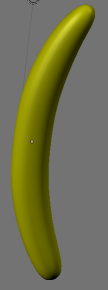
> object as trivial as a banana was impossibly difficult.

It just took me about 1 minute to make a simple banana shape in Blender.
Blender even gives you a box to start with, so I just rotated the top face a
bit, scaled it down and extruded, then repeated 5 or 6 times.  See attached
result - it's not hard, that model has ~2500 triangles and I can easily edit
the original triangle mesh (40 vertices) if I want to change the shape.  If
I was going to do a big render I could knock up the number of triangles with
a click of the mouse, yet the original triangle mesh is still there to be
modified.
Post a reply to this message
Attachments:
Download 'image1.png' (10 KB)
Preview of image 'image1.png'

|
|
| |
| |
|
|
|
|
| |
| |
|
|
Warp wrote:

>   I think that the point is that nobody designs models using raw triangle
> meshes. Instead, all models are designed using NURBS or other similar
> spline-based surfaces which are easy to edit. The triangle mesh you see
> in the end result has been automatically generated from those surface
> models.

That would make a lot more sense, yes...
Post a reply to this message
|
|
| |
| |
|
|
|
|
| |
| |
|
|
scott wrote:

> also you can extrude from faces and edges plus numerous more functions I
> haven't used.

Care to define what "extrude" means?

> The tools are designed *for* people to edit triangle
> meshes as their job, once you've learned how it works you can do things
> quickly.

I've seen people who can take three sheets of paper, freehand scribble a
few lines on each page, drop one page on top of another and create an
instantly recognisable moving picture of Micky Mouse in life-like fluid
motion. That doesn't mean it's "easy".

>> For all the wizzy features of those editors of old, even creating an
>> object as trivial as a banana was impossibly difficult.
>
> It just took me about 1 minute to make a simple banana shape in Blender.
> Blender even gives you a box to start with, so I just rotated the top
> face a bit, scaled it down and extruded, then repeated 5 or 6 times.

I won't pretend I understand what you just said.

(FWIW, I *always* get Wing3D and Blender confused. But isn't Blender the
one that's supposedly impossible to learn due to the weird UI?)

Many, many years ago, AmigaFormat released a full version of Imagine 2.0
on a coverdisk. They ran a series of tutorials on using it. It had a
tool - I forget what it was called - where you start with a sphere, and
by moving the points in each of the 3 axis views, you could change the
profile and cross-section of the mesh. AF did a morphing tutorial where
you were supposed to use this tool to build an organe (so, an oragne
sphere then), a pear, an apple and a banana, and then morph from one to
the other.

(Unfortunately, the morph operation requires both start and finish
object to move the same number of polygons, and just linearly
interpolates them. BAD THING happen if the polygons are in a different
order in each model! But anyway...)

I wasted literally *days* trying to make these objects. They're all
absurdly simple, but I couldn't get them to look anywhere near right. It
was just far too hard.

As far as I could tell, Wings [I think that's the one I tried] doesn't
even offer this much help...
Post a reply to this message
|
|
| |
| |
|
|
|
|
| |
| |
|
|
> Care to define what "extrude" means?

Shifting a face in the direction of its normal, and filling in the gaps
between the shifted face and the other faces that it used to be connected to
(by automatically adding more faces perpendicular to the selected face).

Example in amazing 2D ASCII:

Start with 3 faces:

---.---.---


Extrude the middle face upwards:

   .---.
   |   |
---.   .---


Move the left vertex up a bit:
   .
   |\
   | \
   |  \
   .   .
   |   |
---.   .---

Extrude the top left face:

.--.
|   \
|    \
|     \
.--.   .
   |   |
---.   .---

It's a very useful tool in 3D mesh design.
Post a reply to this message
|
|
| |
| |
|
|
|
|
| |
| |
|
|
scott wrote:
>> Care to define what "extrude" means?
>
> Shifting a face in the direction of its normal, and filling in the gaps
> between the shifted face and the other faces that it used to be
> connected to (by automatically adding more faces perpendicular to the
> selected face).

Ah, I see.

> Example in amazing 2D ASCII:

TMFT alert! ;-)

> It's a very useful tool in 3D mesh design.

I suppose...
Post a reply to this message
|
|
| |
| |
|
|
|
|
| |
| |
|
|
> HalfLife 2: Episode 2 has mist in one section. Looks really impressive...
> until it intersects something.

The quick way to get around that is to compare the depth value of the mist
you are about to render with the depth value behind, the closer they are
together the more transparent you make the mist.  That way there is no
visible hard edge with the existing geometry.  It's a hack of course, but it
looks a million times better than the hard edges, and doesn't draw your
attention immediately to "artifact".  There is an example in the DirectX SDK
on this exact thing where you can toggle between different rendering
methods.

> Mind you, POV-Ray has the exact same problem, until you turn the settings
> up so high that it takes 82+ hours to render a single frame...

But at least you'll be sure it is 100% physically correct, ermmm no hang on
you'll need MCPOV for that, so make it 820+ hours for a single frame :-)
And don't even mention the time needed to tweak all the mist, dof and
lighting parameters to get it looking right...
Post a reply to this message
|
|
| |
| |
|
|
|
|
| |
| |
|
|
Invisible wrote:
> Care to define what "extrude" means?

Go to blender.org and watch the tutorial. Wings3D does the same thing.

It does exactly what you would think it does, given the name.

> (FWIW, I *always* get Wing3D and Blender confused. But isn't Blender the
> one that's supposedly impossible to learn due to the weird UI?)

Yes. Honestly, tho, it's not that hard. I picked it up with a day or two of
practice, got good enough to actually make a little anthropomorphic monster
type walk along, look around, and wave.  It took a few days to get that far,
but it was the first package where I ever managed such a thing.  I'm not
very good at it an I still managed in a couple of days to make something
work, limited more by my artistic skills than the tool.

> As far as I could tell, Wings [I think that's the one I tried] doesn't
> even offer this much help...

I found Wings much harder than blender, but I never went back and tried it
again. I think it has all the same operations as Blender at the basic level,
so I don't know why I found it so hard.

--
   Darren New, San Diego CA, USA (PST)
   I ordered stamps from Zazzle that read "Place Stamp Here".
Post a reply to this message
|
|
| |
| |
|
|
|
|
| |
| |
|
|
>> Care to define what "extrude" means?
>
> It does exactly what you would think it does, given the name.

No, I mean... I don't know what the word "extrude" means.

>> (FWIW, I *always* get Wing3D and Blender confused. But isn't Blender
>> the one that's supposedly impossible to learn due to the weird UI?)
>
> Yes. Honestly, tho, it's not that hard.

I gather they've been working on documenting it / making it was obscure
more recently...

--
http://blog.orphi.me.uk/
http://www.zazzle.com/MathematicalOrchid*
Post a reply to this message
|
|
| |
| |
|
|
|
|
| |