|
|
|
|
|
|
| |
| |
|
|
|
|
| |
| |
|
|
OK, so I've been experimenting with Wolfram's Alpha thingy. Useful if
you happen to want to know how long 10^15 seconds is, if you want a
graph quickly, or if you want to look up the electrical resistence of
silicon. Not much use for anything else.

I did find some interesting information though...

Alpha claims that the current trading price for gold is approximately
£600 "per Troy ounch" (whatever the hell that is). Silver, on the other
hand, is more like £10 / oz t. (...??!) And Platinum is about £744 / oz
t. (I had no idea Platinum was so expensive!)

I tried to get similar data for other substances, but Wolfram's "data
curators" evidently haven't got that far yet. I did find a website
though that claims that the London Metal Exchange has the following prices:

   Sn $14.325 / Kg
   Ni $13.770 / Kg
   Cu $ 4.776 / Kg
   Pd $ 1.530 / Kg
   Zn $ 1.509 / Kg
   Al $ 1.384 / Kg

(Not sure why the LME lists prices in USD, but still...)

This table is completely baffling to me. As everybody knows, Alunimium
is about the most expensive metal you can buy (except for weird stuff
like Titanium, or the "precious metals" like Gold or Silver), and Lead
is about the cheapest metal there is. Except that this table says no
such thing!! o_O

Hmm, I wonder why Iron isn't listed? A rather common metal, after all...
Post a reply to this message
|
|
| |
| |
|
|
|
|
| |
| |
|
|
On Mon, 01 Jun 2009 15:32:36 +0100, Invisible wrote:

> OK, so I've been experimenting with Wolfram's Alpha thingy. Useful if
> you happen to want to know how long 10^15 seconds is, if you want a
> graph quickly, or if you want to look up the electrical resistence of
> silicon. Not much use for anything else.

I've found it to be useful for figuring out caloric information for
recipes.

Jim
Post a reply to this message
|
|
| |
| |
|
|
|
|
| |
| |
|
|
Invisible wrote:
> Alpha claims that the current trading price for gold is approximately
> £600 "per Troy ounch" (whatever the hell that is).

http://www.wolframalpha.com/input/?i=troy+ounce

 > And Platinum is about £744 / oz
> t. (I had no idea Platinum was so expensive!)

Yep.

> (Not sure why the LME lists prices in USD, but still...)

Because it's a metal commodity exchange, and those metals are sold in
dollars. Just like oil, for example.

> This table is completely baffling to me. As everybody knows, Alunimium

> is about the most expensive metal you can buy (except for weird stuff
> like Titanium, or the "precious metals" like Gold or Silver), and Lead

> is about the cheapest metal there is. Except that this table says no
> such thing!! o_O

These are futures markets, not stores. You're not buying the metals. You'
re
buying futures on the metals. That's one reason you'll see funky pricing.


Plus, I don't think Aluminum is that expensive. It used to be expensive
before they figured out how to extract it from common compounds (which is

why the Washington Monument has a cap of aluminum), and it's probably
expensive for its weight and structural properties (you don't build
airplanes out of nickel or tin and it's more expensive than heavier thing
s
like iron and brass), but I don't think it's expensive on an absolute bas
is
or they wouldn't make aluminum foil and aluminum cans from it.

> Hmm, I wonder why Iron isn't listed? A rather common metal, after all..
.

"""
Welcome to the London Metal Exchange
The London Metal Exchange is the world's premier non-ferrous metals marke
t.
"""

--
   Darren New, San Diego CA, USA (PST)
   There's no CD like OCD, there's no CD I knoooow!
Post a reply to this message
|
|
| |
| |
|
|
|
|
| |
| |
|
|
"Invisible" <voi### [at] dev null> wrote in message
news:4a23e686@news.povray.org...
> This table is completely baffling to me.
Dated, but still a good read:
http://minerals.usgs.gov/minerals/pubs/metal_prices/ null> wrote in message
news:4a23e686@news.povray.org...
> This table is completely baffling to me.
Dated, but still a good read:
http://minerals.usgs.gov/minerals/pubs/metal_prices/
Post a reply to this message
|
|
| |
| |
|
|
|
|
| |
| |
|
|
Invisible <voi### [at] devnull> wrote:
> As everybody knows, Alunimium
> is about the most expensive metal you can buy

  As everybody knows? Aluminium is used for almost everything, from
cookware to car and airplane chassis.

--
                                                          - Warp
Post a reply to this message
|
|
| |
| |
|
|
|
|
| |
| |
|
|
Warp wrote:
> Invisible <voi### [at] devnull> wrote:
>> As everybody knows, Alunimium
>> is about the most expensive metal you can buy
>
>   As everybody knows? Aluminium is used for almost everything, from
> cookware to car and airplane chassis.

Last I heard, airplanes aren't exactly "cheap", nor are cars, and
cookware made of alunimium rather than steel is vastly more expensive.
(Ditto for computer cases.)

--
http://blog.orphi.me.uk/
http://www.zazzle.com/MathematicalOrchid*
Post a reply to this message
|
|
| |
| |
|
|
|
|
| |
| |
|
|
Orchid XP v8 <voi### [at] devnull> wrote:
> Last I heard, airplanes aren't exactly "cheap", nor are cars, and
> cookware made of alunimium rather than steel is vastly more expensive.

  That only tells that steel is cheaper than aluminum, not that aluminum
is super-expensive.

--
                                                          - Warp
Post a reply to this message
|
|
| |
| |
|
|
|
|
| |
| |
|
|
On Mon, 01 Jun 2009 20:24:51 +0200, Orchid XP v8 <voi### [at] devnull> wrote:
>
> Last I heard, airplanes aren't exactly "cheap", nor are cars,

Airplanes and cars are expensive, but not primarily because of raw material
costs I think.


> and cookware made of alunimium rather than steel is vastly more
> expensive.

The only reasonably useful aluminium cookware I have seen are frying pans,
and those are always Teflon-coated. Even so, I have not found them to be
more expensive than their cast-iron counterparts. In fact, the cheapest
ones are typically aluminium.


> (Ditto for computer cases.)

The same goes for computer cases; the cheapest ones are aluminium.


--
FE
Post a reply to this message
|
|
| |
| |
|
|
|
|
| |
| |
|
|
Fredrik Eriksson wrote:
> The only reasonably useful aluminium cookware I have seen are frying
> pans, and those are always Teflon-coated.

http://www.vita-mix.com/household/products/neova/

Highly recommended, btw. :-)

Aluminum conducts heat almost as well as copper and is less prone to
corrosion and is lighter, so it's a good choice for cookware.

--
   Darren New, San Diego CA, USA (PST)
   There's no CD like OCD, there's no CD I knoooow!
Post a reply to this message
|
|
| |
| |
|
|
|
|
| |
| |
|
|
On Mon, 01 Jun 2009 23:06:29 +0200, Darren New <dne### [at] sanrrcom> wrote:
>
> http://www.vita-mix.com/household/products/neova/

Yeah, I have seen multi-layer cooking pots, but I would tend to classify
those as steel pots. I will admit, though, that there may be sufficient
aluminium in there to noticeably affect the material cost.

As an aside, I do own several "pure" aluminium pots. They work fine, but
they get ugly with old age.


> Highly recommended, btw. :-)
>
> Aluminum conducts heat almost as well as copper and is less prone to
> corrosion and is lighter, so it's a good choice for cookware.

I prefer iron; cookware that lets you cook *and* work out at the same time.


--
FE
Post a reply to this message
|
|
| |
| |
|
|
|
|
| |
| |
|
|
On Tue, 02 Jun 2009 00:34:39 +0200, Fredrik Eriksson wrote:

>> Highly recommended, btw.
>>
>> Aluminum conducts heat almost as well as copper and is less prone to
>> corrosion and is lighter, so it's a good choice for cookware.
>
> I prefer iron; cookware that lets you cook *and* work out at the same
> time.

You just have to be careful not to put things that are overly acidic into
the container - and remember not to scrub it with a wire brush (had a
friend who was being helpful and didn't know better with our cast iron
skillet....took us about 4 months to re-season the surface.  On the plus
side, bacon for the WIN!)

Jim
Post a reply to this message
|
|
| |
| |
|
|
|
|
| |
| |
|
|
Invisible wrote:
> OK, so I've been experimenting with Wolfram's Alpha thingy. Useful if
> you happen to want to know how long 10^15 seconds is, if you want a
> graph quickly, or if you want to look up the electrical resistence of
> silicon. Not much use for anything else.

I read this in a Facebook comment:

"This search engine is useless!
http://www.wolframalpha.com/input/?i=britney%20spears%20naked"
Post a reply to this message
|
|
| |
| |
|
|
|
|
| |
| |
|
|
Jim Henderson wrote:
> You just have to be careful not to put things that are overly acidic into
> the container

Why? The old Alzheimer's thing?  I think they figured out that was a
procedural error.

--
   Darren New, San Diego CA, USA (PST)
   There's no CD like OCD, there's no CD I knoooow!
Post a reply to this message
|
|
| |
| |
|
|
|
|
| |
| |
|
|
On Mon, 01 Jun 2009 18:34:44 -0700, Darren New wrote:

> Jim Henderson wrote:
>> You just have to be careful not to put things that are overly acidic
>> into the container
>
> Why? The old Alzheimer's thing?  I think they figured out that was a
> procedural error.

Nope, acidic foods can destroy the "seasoning" of cast iron, and if you
then wash it in water, you can cause the pan to oxidize.

But even if you don't use water, stripping the seasoning off the pan can
create a metallic taste in foods cooked in the pan.  As Alton Brown would
say, that's definitely NOT good eats.

Jim
Post a reply to this message
|
|
| |
| |
|
|
|
|
| |
| |
|
|
Jim Henderson wrote:
> Nope, acidic foods can destroy the "seasoning" of cast iron, and if you
> then wash it in water, you can cause the pan to oxidize.

Oh, right, sure. I thought you were talking about the aluminum. My bad.

--
   Darren New, San Diego CA, USA (PST)
   There's no CD like OCD, there's no CD I knoooow!
Post a reply to this message
|
|
| |
| |
|
|
|
|
| |
| |
|
|
On Mon, 01 Jun 2009 19:17:12 -0700, Darren New wrote:

> Jim Henderson wrote:
>> Nope, acidic foods can destroy the "seasoning" of cast iron, and if you
>> then wash it in water, you can cause the pan to oxidize.
>
> Oh, right, sure. I thought you were talking about the aluminum. My bad.

Ah, I see.  I hadn't heard the Alzheimer's thing before.  :-)

Jim
Post a reply to this message
|
|
| |
| |
|
|
|
|
| |
| |
|
|
> This table is completely baffling to me. As everybody knows, Alunimium is
> about the most expensive metal you can buy (except for weird stuff like
> Titanium, or the "precious metals" like Gold or Silver),

Ermm no, a more accurate statement would be that aluminium is about the
cheapest metal you can buy, except for plain old steel.

Also note that if you need a part of a certain strength, you can usually
make it using less mass (although more volume) of aluminium compared to
steel.  That's why aluminium is used in things that need to be light
(planes, cars), but steel is used in things that need to be very small (eg
mobile phones, cameras).
Post a reply to this message
|
|
| |
| |
|
|
|
|
| |
| |
|
|
Darren New wrote:

>
> Aluminum conducts heat almost as well as copper and is less prone to
> corrosion and is lighter, so it's a good choice for cookware.
>

Wasn't aluminum cookware linked to Alzheimer's?

--
~Mike
Post a reply to this message
|
|
| |
| |
|
|
|
|
| |
| |
|
|
Invisible <voi### [at] devnull> wrote:

> Alpha claims that the current trading price for gold is approximately
> £600 "per Troy ounch" (whatever the hell that is). Silver, on the other
> hand, is more like £10 / oz t. (...??!) And Platinum is about £744 / oz
> t. (I had no idea Platinum was so expensive!)
>

Can you guess the cost of saffron per ton?

Stephen
Post a reply to this message
|
|
| |
| |
|
|
|
|
| |
| |
|
|
Stephen wrote:
>
> Can you guess the cost of saffron per ton?
>

I looked it up and was glad to see that it's still significantly less
expensive per weight than gold.  Of course you don't often use gold as
an ingredient in food (not that I ever cook with saffron either come to
think of it.)
Post a reply to this message
|
|
| |
| |
|
|
|
|
| |
| |
|
|
Kevin Wampler wrote:

> I looked it up and was glad to see that it's still significantly less
> expensive per weight than gold.  Of course you don't often use gold as
> an ingredient in food (not that I ever cook with saffron either come to
> think of it.)

Goldschlager.

Oh, and I do have saffron in my spice rack. :D

--
~Mike
Post a reply to this message
|
|
| |
| |
|
|
|
|
| |
| |
|
|
Mike Raiford wrote:
> Darren New wrote:
>
>>
>> Aluminum conducts heat almost as well as copper and is less prone to
>> corrosion and is lighter, so it's a good choice for cookware.
>>
>
> Wasn't aluminum cookware linked to Alzheimer's?

Yes, mistakenly. They found aluminum in the brain tissue of alzheimer's
patients. Then they realized the dyes they used to detect alzheimers had
aluminum in them.

--
   Darren New, San Diego CA, USA (PST)
   There's no CD like OCD, there's no CD I knoooow!
Post a reply to this message
|
|
| |
| |
|
|
|
|
| |
| |
|
|
Mike Raiford wrote:
> Kevin Wampler wrote:
>
>> I looked it up and was glad to see that it's still significantly less
>> expensive per weight than gold.  Of course you don't often use gold as
>> an ingredient in food (not that I ever cook with saffron either come
>> to think of it.)
>
> Goldschlager.

That exact drink was actually the reason that I put the word "often" in
there.  I suspect there's probably a few other dishes where it serves as
essentially a very expensive form of food coloring.


> Oh, and I do have saffron in my spice rack. :D

I've never quite been able to convince myself to buy any.  Someday I'm
sure I'll spring for it, but given that I mostly live on ramen,
crackers, and pb&j it just seems like a bit much right now.
Post a reply to this message
|
|
| |
| |
|
|
|
|
| |
| |
|
|
Invisible wrote:
> OK, so I've been experimenting with Wolfram's Alpha thingy. Useful if
> you happen to want to know how long 10^15 seconds is, if you want a
> graph quickly, or if you want to look up the electrical resistence of
> silicon. Not much use for anything else.
>
> I did find some interesting information though...
>
> Alpha claims that the current trading price for gold is approximately
> £600 "per Troy ounch" (whatever the hell that is). Silver, on the other
> hand, is more like £10 / oz t. (...??!) And Platinum is about £744 / oz
> t. (I had no idea Platinum was so expensive!)

A Troy ounce is 480 grains.  There are 7000 grains in a pound.  This
makes a Troy ounce about 31.1 grams or so.

> I tried to get similar data for other substances, but Wolfram's "data
> curators" evidently haven't got that far yet. I did find a website
> though that claims that the London Metal Exchange has the following prices:
>
>   Sn $14.325 / Kg
>   Ni $13.770 / Kg
>   Cu $ 4.776 / Kg
>   Pd $ 1.530 / Kg
>   Zn $ 1.509 / Kg
>   Al $ 1.384 / Kg

I'm rather surprised to see palladium going for $1.53 for a kilogram,
rather than $240 or so per ounce like it does on other sites, so I'd
have to say that Pd is really supposed to be Pb (AKA lead) above.

Regards,
John
Post a reply to this message
|
|
| |
| |
|
|
|
|
| |
| |
|
|
John VanSickle wrote:

> A Troy ounce is 480 grains.  There are 7000 grains in a pound.  This
> makes a Troy ounce about 31.1 grams or so.

Right. So 31.1 grams of gold is... a pretty tiny volume, I would think.

>> I tried to get similar data for other substances, but Wolfram's "data
>> curators" evidently haven't got that far yet. I did find a website
>> though that claims that the London Metal Exchange has the following
>> prices:
>>
>>   Sn $14.325 / Kg
>>   Ni $13.770 / Kg
>>   Cu $ 4.776 / Kg
>>   Pd $ 1.530 / Kg
>>   Zn $ 1.509 / Kg
>>   Al $ 1.384 / Kg
>
> I'm rather surprised to see palladium going for $1.53 for a kilogram,
> rather than $240 or so per ounce like it does on other sites, so I'd
> have to say that Pd is really supposed to be Pb (AKA lead) above.

Owned.

Again.
Post a reply to this message
|
|
| |
| |
|
|
|
|
| |
| |
|
|
Fredrik Eriksson wrote:
>
> I prefer iron; cookware that lets you cook *and* work out at the same time.
>
>

For anything that needs high, non-localised heat then nothing beats
high-quality iron cookware (take note of Jim Henderson's notes about
seasoning tho'). I've got a cast-iron skillet for steaks and a cast-iron
omelette pan. Neither has ever been washed, just clean with salt, oil
and kitchen paper; they get better as the years roll on.

John (dreaming of the perfect omelette)
--
"Eppur si muove" - Galileo Galilei
Post a reply to this message
|
|
| |
| |
|
|
|
|
| |
| |
|
|
Darren New wrote:

>
> Yes, mistakenly. They found aluminum in the brain tissue of alzheimer's
> patients. Then they realized the dyes they used to detect alzheimers had
> aluminum in them.
>

D'oh!

--
~Mike
Post a reply to this message
|
|
| |
| |
|
|
|
|
| |
| |
|
|
Kevin Wampler wrote:

>> Oh, and I do have saffron in my spice rack. :D
>
> I've never quite been able to convince myself to buy any.  Someday I'm
> sure I'll spring for it, but given that I mostly live on ramen,
> crackers, and pb&j it just seems like a bit much right now.

On occasion I like to do fun things like make saffron rice...

But, yeah... if your diet consists of mostly ramen and pbj, ;)

--
~Mike
Post a reply to this message
|
|
| |
| |
|
|
|
|
| |
| |
|
|
>> Yes, mistakenly. They found aluminum in the brain tissue of
>> alzheimer's patients. Then they realized the dyes they used to detect
>> alzheimers had aluminum in them.
>
> D'oh!

Is this like the thing where they discovered that the police
breathaliser machines were being kept in alcohol to keep them sterile?

--
http://blog.orphi.me.uk/
http://www.zazzle.com/MathematicalOrchid*
Post a reply to this message
|
|
| |
| |
|
|
|
|
| |
| |
|
|
Invisible wrote:
> John VanSickle wrote:
>
>> A Troy ounce is 480 grains.  There are 7000 grains in a pound.  This
>> makes a Troy ounce about 31.1 grams or so.
>
> Right. So 31.1 grams of gold is... a pretty tiny volume, I would think.

Gold's density is around 19.2 g/cm^3, and so a troy ounce of gold is
about 1.6 cm^3, which is about the volume of four and a half American
pennies.  Not a bad way to carry around a few hundred dollars in value.
  Just don't lose it.

Regards,
John
Post a reply to this message
|
|
| |
| |
|
|
|
|
| |
| |
|
|
John VanSickle wrote:
>  so a troy ounce of gold is
> about 1.6 cm^3, which is about the volume of four and a half American
> pennies.

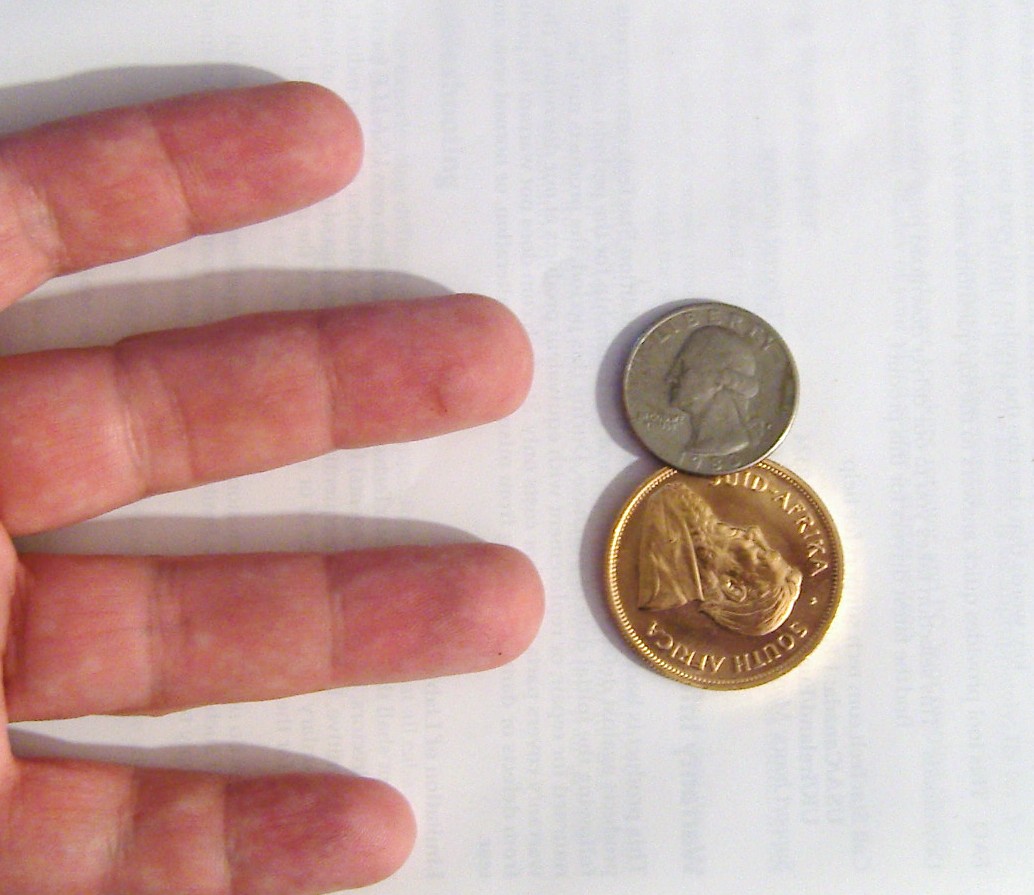
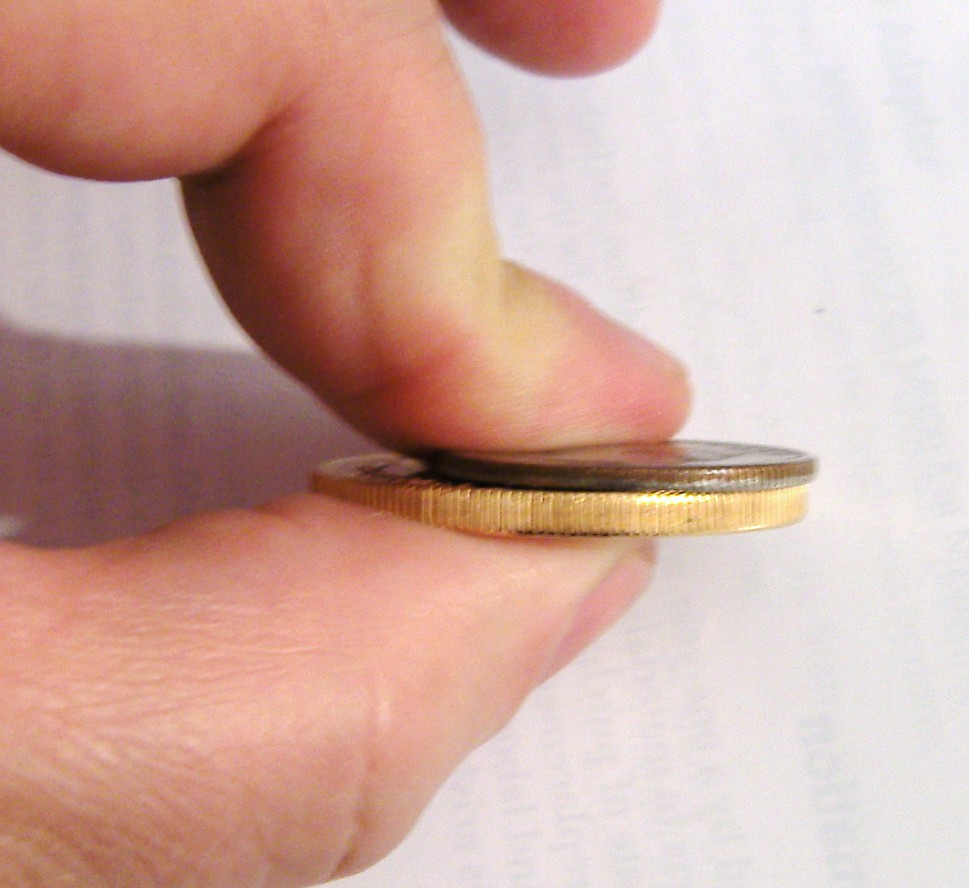
That doesn't sound quite right. Here's an ounce of gold and an American
quarter. It's just over 3 cm in diameter and about 3mm thick.

--
   Darren New, San Diego CA, USA (PST)
   There's no CD like OCD, there's no CD I knoooow!
Post a reply to this message
Attachments:
Download 'sn150175.jpg' (176 KB)
Download 'sn150176.jpg' (156 KB)
Preview of image 'sn150175.jpg'
Preview of image 'sn150176.jpg'
|
|
| |
| |
|
|
|
|
| |
| |
|
|
Darren New wrote:
> John VanSickle wrote:
>>  so a troy ounce of gold is about 1.6 cm^3, which is about the volume
>> of four and a half American pennies.
>
> That doesn't sound quite right. Here's an ounce of gold and an American
> quarter. It's just over 3 cm in diameter and about 3mm thick.

A quarter is not as voluminous as 4.5 American pennies.

In any event, a Troy ounce is about 31.104 grams, and gold is 19.3 grams
per cm^3 (I misremembered it as 19.2 when making my earlier
calculation), giving a volume of 1.611 cm^3 for a Troy ounce of gold.

A coin, 3cm in diameter by 3mm thick, will be about 2.1cm^3.  What's the
alloy content of the coin?

Regards,
John
Post a reply to this message
|
|
| |
| |
|
|
|
|
| |
| |
|
|
John VanSickle wrote:
> Darren New wrote:
>> John VanSickle wrote:
>>>  so a troy ounce of gold is about 1.6 cm^3, which is about the volume
>>> of four and a half American pennies.
>>
>> That doesn't sound quite right. Here's an ounce of gold and an
>> American quarter. It's just over 3 cm in diameter and about 3mm thick.
>
> A quarter is not as voluminous as 4.5 American pennies.
>
> In any event, a Troy ounce is about 31.104 grams, and gold is 19.3 grams
> per cm^3 (I misremembered it as 19.2 when making my earlier
> calculation), giving a volume of 1.611 cm^3 for a Troy ounce of gold.
>
> A coin, 3cm in diameter by 3mm thick, will be about 2.1cm^3.  What's the
> alloy content of the coin?

http://www96.wolframalpha.com/input/?i=1+oz+t+Au
Post a reply to this message
|
|
| |
| |
|
|
|
|
| |
| |
|
|
Invisible wrote:

> http://www96.wolframalpha.com/input/?i=1+oz+t+Au

...so a 1.1 x 1.1 x 1.1 mm block of this stuff costs £664, eh? That's
pretty freakin' expensive, right there!

I'd hate to imagine how much a solid gold ring costs.
Post a reply to this message
|
|
| |
| |
|
|
|
|
| |
| |
|
|
On Fri, 05 Jun 2009 12:32:30 +0100, Invisible wrote:

> I'd hate to imagine how much a solid gold ring costs.

Would weigh a bit too, I think.

Jim
Post a reply to this message
|
|
| |
| |
|
|
|
|
| |
| |
|
|
John VanSickle wrote:
> A coin, 3cm in diameter by 3mm thick, will be about 2.1cm^3.  What's the
> alloy content of the coin?

The one I posted a picture of? It's a bullion coin, so 24k or better.

--
   Darren New, San Diego CA, USA (PST)
   There's no CD like OCD, there's no CD I knoooow!
Post a reply to this message
|
|
| |
| |
|
|
|
|
| |
| |
|
|
Invisible wrote:
> I'd hate to imagine how much a solid gold ring costs.

Gold rings aren't pure gold, or they'd bend very easily.

http://www.bullionjewelry.com/


--
   Darren New, San Diego CA, USA (PST)
   There's no CD like OCD, there's no CD I knoooow!
Post a reply to this message
|
|
| |
| |
|
|
|
|
| |
| |
|
|
>> I'd hate to imagine how much a solid gold ring costs.
>
> Gold rings aren't pure gold, or they'd bend very easily.

Sure. But they'd never ever corrode. ;-)
Post a reply to this message
|
|
| |
| |
|
|
|
|
| |
| |
|
|
Invisible wrote:
>>> I'd hate to imagine how much a solid gold ring costs.
>>
>> Gold rings aren't pure gold, or they'd bend very easily.
>
> Sure. But they'd never ever corrode. ;-)

Um, yes? So?

--
   Darren New, San Diego CA, USA (PST)
   There's no CD like OCD, there's no CD I knoooow!
Post a reply to this message
|
|
| |
| |
|
|
|
|
| |
| |
|
|
Invisible wrote:
>
> ...so a 1.1 x 1.1 x 1.1 mm block of this stuff costs £664, eh? That's
> pretty freakin' expensive, right there!
>

Not sure on your maths there.

A cube 1.1mm in a side has a volume of about 0.001331 cubic cm. A bit
over one thousandth of a cubic cm.

A cube 1.17cm (11.7mm) on a side would have a volume of approximately
1.6 cubic cm.  And that is about right for an ounce of gold.
Post a reply to this message
|
|
| |
| |
|
|
|
|
| |
| |
|
|
Paul Fuller wrote:
> Invisible wrote:
>>
>> ...so a 1.1 x 1.1 x 1.1 mm block of this stuff costs £664, eh? That's
>> pretty freakin' expensive, right there!
>>
>
> Not sure on your maths there.
>
> A cube 1.1mm in a side has a volume of about 0.001331 cubic cm. A bit
> over one thousandth of a cubic cm.
>
> A cube 1.17cm (11.7mm) on a side would have a volume of approximately
> 1.6 cubic cm.  And that is about right for an ounce of gold.

Oh, OK. I misread the unit on the printout. Well that's a rather larger
lump of gold then. ;-)

--
http://blog.orphi.me.uk/
http://www.zazzle.com/MathematicalOrchid*
Post a reply to this message
|
|
| |
| |
|
|
|
|
| |
| |
|
|
John VanSickle wrote:
> What's the alloy content of the coin?

Wolfram was clueless, but wikipedia says it's 91.x% gold, so weighs 1.09 oz.

--
   Darren New, San Diego CA, USA (PST)
   There's no CD like OCD, there's no CD I knoooow!
Post a reply to this message
|
|
| |
| |
|
|
|
|
| |
| |
|
|
>>>> I'd hate to imagine how much a solid gold ring costs.
>>>
>>> Gold rings aren't pure gold, or they'd bend very easily.
>>
>> Sure. But they'd never ever corrode. ;-)
>
> Um, yes? So?

If you're making decorative items, this is a benefit.
Post a reply to this message
|
|
| |
| |
|
|
|
|
| |
| |
|
|
"Darren New" <dne### [at] sanrrcom> wrote in message
news:4a293d30$1@news.povray.org...
> John VanSickle wrote:
>> A coin, 3cm in diameter by 3mm thick, will be about 2.1cm^3.  What's the
>> alloy content of the coin?
>
> The one I posted a picture of? It's a bullion coin, so 24k or better.

     You can't get better than 24 carat. Well, in fact, you can't get 24ct,
it will always be 999.999 fine gold.

      ~Steve~


>
> --
>   Darren New, San Diego CA, USA (PST)
>   There's no CD like OCD, there's no CD I knoooow!
Post a reply to this message
|
|
| |
| |
|
|
|
|
| |
| |
|
|
St. wrote:
>      You can't get better than 24 carat. Well, in fact, you can't get 24ct,
> it will always be 999.999 fine gold.

As I said later, I looked it up and it's about 91% gold. I realized after
I'd written this that bullion *coin* probably isn't close to 24k. :-)

--
   Darren New, San Diego CA, USA (PST)
   There's no CD like OCD, there's no CD I knoooow!
Post a reply to this message
|
|
| |
| |
|
|
|
|
| |
| |
|
|
"Darren New" <dne### [at] sanrrcom> wrote in message
news:4a2d35c6$1@news.povray.org...
> St. wrote:
>>      You can't get better than 24 carat. Well, in fact, you can't get
>> 24ct, it will always be 999.999 fine gold.
>
> As I said later, I looked it up and it's about 91% gold. I realized after
> I'd written this that bullion *coin* probably isn't close to 24k. :-)

 Ah right, well, I didn't read every post in this thread, but it reminds me
of a guy that came to one of my old places of work to sell 150 full gold
sovereigns. He had them in plastic tubes that held ten each, so I picked
them up and was surprised by the weight.

    ~Steve~


>
> --
>   Darren New, San Diego CA, USA (PST)
>   There's no CD like OCD, there's no CD I knoooow!
Post a reply to this message
|
|
| |
| |
|
|
|
|
| |