 |
|
|
|
|
|
| |
| |
|
|
From: Phil Cook v2
Subject: Re: Physics, relativity, quantum, etc.
Date: 20 Jan 2009 11:24:23
Message: <op.un2c6hs4mn4jds@phils>
|
|
|
| |
| |
|
|
And lo On Tue, 20 Jan 2009 01:05:02 -0000, Darren New <dne### [at] san rrcom>
did spake thusly:
>> Unless I'm mistaken, the "graviton" is one of those particles invented
>> by quantum mechanics for the simple reason that "because everything
>> seems
>> to consist of particles, then there must exist a particle for every
>> phenomenon we can see, including gravity".
In one sense, if you arrange the known particles you get gaps similiar to
what occured with the first periodic tables...
> I wouldn't be surprised if that's the case. I never heard of anyone even
> proposing properties of a graviton, let alone finding evidence.
... it has been a while but I recall someone running the theory that if
gravity was a particle (as postulated by the Standard Model) then the
properties it would have to have to function in the way we see it would
match certain criteria (as Warp mentioned spin 2 being one of them) that
so happened to match one of the gaps. Working from another direction
string theory 'created' as a necessary outcome a 'particle' then had spin
2 etc.
--
Phil Cook
--
I once tried to be apathetic, but I just couldn't be bothered
http://flipc.blogspot.com rrcom>
did spake thusly:
>> Unless I'm mistaken, the "graviton" is one of those particles invented
>> by quantum mechanics for the simple reason that "because everything
>> seems
>> to consist of particles, then there must exist a particle for every
>> phenomenon we can see, including gravity".
In one sense, if you arrange the known particles you get gaps similiar to
what occured with the first periodic tables...
> I wouldn't be surprised if that's the case. I never heard of anyone even
> proposing properties of a graviton, let alone finding evidence.
... it has been a while but I recall someone running the theory that if
gravity was a particle (as postulated by the Standard Model) then the
properties it would have to have to function in the way we see it would
match certain criteria (as Warp mentioned spin 2 being one of them) that
so happened to match one of the gaps. Working from another direction
string theory 'created' as a necessary outcome a 'particle' then had spin
2 etc.
--
Phil Cook
--
I once tried to be apathetic, but I just couldn't be bothered
http://flipc.blogspot.com
Post a reply to this message
|
|
| |
| |
|
|
|
|
| |
| |
|
|
Warp wrote:
> Darren New <dne### [at] sanrrcom> wrote:
>>>   Not stopped. Asymptotically slowing down.
>
>> So, the steeper the gravity gradient, the slower he falls? That doesn't make
>> sense? He actually *slows down* as he falls? Nothing ever goes thru the
>> event horizon?
>
>   No, it looks *from the outside*, from the point of view of an external
> observer, like his time is slowing down.

Right. Understand that my confusion is between these two sentences:

"He is slowing down."
"His time is slowing down."

>   Remember that speed and time is always relative to who is observing.

I would think that from the outside observer, his time is slowing down even
while his velocity is increasing.

I find it hard to believe that in falling into a black hole, your velocity
decreases.

>   Actually there are a few things which can be said of gravitons. In other
> words, "if gravitons existed, they must have these properties". For example,
> they would have spin 2.

Yep. Stuff like that. But I think that's because of where it would fall in
the tables.

>   (And no, I haven't the faintest idea what "spin" means. I just read
> wikipedia. :P )

"Spin" is a fascinating concept related to symmetry. A "spin 1/2" particle
means if you turn it 180 degrees, it looks the same. So a "two of diamonds"
playing card would be "spin 1/2" - it looks the same right side up as upside
down. (Discounting, of course, that it's 3D, so has a back that's different
from the front.)

An "ace of spades" has "spin 1" - if you turn it 180 degrees, the spade in
the middle will be pointing down instead of up, so you have to turn it 360
degrees.

And yes, a "spin 2" particle really is as strange as it sounds. You have to
turn it around 720 degrees before it's symmetric again. Don't ask me how
that works out.

That's about all I know about spin, tho, so ...

>> If hawking radiation doesn't exist, then you have no way of seeing what's
>> inside the event horizon, and hence the information on the spin of the
>> particles in there is lost?
>
>   Why is it lost? Just because you can't see it doesn't mean it doesn't
> exist.

It's lost because it cannot influence other particles in the local area. Of
course, that's because the particles outside the horizon are a spacelike
distance from the particles inside the horizon, so maybe you're right. Maybe
it's the equivalent of being outside the cosmological horizon.

>   If something moves to the other side of the cosmological horizon (from
> our perspective), is the information "lost"?

Maybe. I don't know. It can't affect us, but it can affect other things in
the local area. Technically, the particles *could* affect things a spacelike
distance away, which is what all the yadda about "quantum teleportation" is
about.

>> I think that's what I was trying to express. With a sufficiently large black
>> hole, you might not know you crossed the event horizon because the rate of
>> change of curvature is so slow. Of course you know you're in trouble.
>> There's just no "bump" as you cross over.  And if you're in free-fall
>> anyway, what might you notice?
>
>   I think that you would notice everything being warped.

Sure. But would you notice it significantly more one inch inside a
galaxy-size event horizon more than you'd notice it one inch outside a
galaxy-size event horizon?  I don't know, but I don't think that's how it
works - the event horizon, as I understand it, isn't a discontinuity.

--
   Darren New, San Diego CA, USA (PST)
   "Ouch ouch ouch!"
   "What's wrong? Noodles too hot?"
   "No, I have Chopstick Tunnel Syndrome."
Post a reply to this message
|
|
| |
| |
|
|
|
|
| |
| |
|
|
Darren New <dne### [at] sanrrcom> wrote:

> I would think that from the outside observer, his time is slowing down even
> while his velocity is increasing.
>
> I find it hard to believe that in falling into a black hole, your velocity
> decreases.

Cheating a little and looking ahead in my textbook, I find the following
sentence regarding the path of a particle falling radially into a black hole:

2/(3*sqrt(2m)) * ( (r_0)^(2/3) - r^(2/3) ) = tau-tau_0

"Looking at this equation, the mysterious surface r=2m makes no appearance.  The
body falls continuously to r=0 in finite proper (inertial) time, in contrast to
the result seen by an outside observer.  In fact, one can say that the entire
evolution of the physical universe has occurred by the time the body passes the
surface r=2m."

In other words, as seen by an outside observer, you reach the event horizon and
sit.  Forever.  As seen by you, on the other hand, you go speeding right on
through like it's not even there.  The surface only has significance for an
observer far away.

 - Ricky
Post a reply to this message
|
|
| |
| |
|
|
|
|
| |
| |
|
|
Darren New escreveu:
> Warp wrote:
>>   (And no, I haven't the faintest idea what "spin" means. I just read
>> wikipedia. :P )
>
> "Spin" is a fascinating concept related to symmetry. A "spin 1/2"
> particle means if you turn it 180 degrees, it looks the same. So a "two
> of diamonds" playing card would be "spin 1/2" - it looks the same right
> side up as upside down. (Discounting, of course, that it's 3D, so has a
> back that's different from the front.)
>
> An "ace of spades" has "spin 1" - if you turn it 180 degrees, the spade
> in the middle will be pointing down instead of up, so you have to turn
> it 360 degrees.
>
> And yes, a "spin 2" particle really is as strange as it sounds. You have
> to turn it around 720 degrees before it's symmetric again. Don't ask me
> how that works out.

Wonderful explanation.  So far, from my days of chemestry in college,
all I (thought I) knew was that spin 1 was an electron spinning in one
direction and spin -1 in the other direction, whatever it be. :P

>>   If something moves to the other side of the cosmological horizon (from
>> our perspective), is the information "lost"?
>
> Maybe. I don't know. It can't affect us, but it can affect other things
> in the local area. Technically, the particles *could* affect things a
> spacelike distance away, which is what all the yadda about "quantum
> teleportation" is about.

quantum entanglement!  Beam me into a blackhole! :D

>>   I think that you would notice everything being warped.

Including your body! :P
Post a reply to this message
|
|
| |
| |
|
|
|
|
| |
| |
|
|
triple_r wrote:
> In other words, as seen by an outside observer, you reach the event horizon and
> sit.  Forever.

So at what point does the black hole increase in mass? Why would a black
hole ever grow if nothing falls thru the event horizon?

And at what distance do you start slowing down?

If you take the Earth and condense it down to a black hole, then stop a
particle in orbit 100 miles above where the surface used to be, the particle
will accelerate towards the black hole, right? But to avoid crossing the
event horizon, it must logically decelerate, as seen from the POV of someone
in orbit (say).  You wouldn't stop at the original altitude of the surface,
but you would stop before you get to the event horizon, so in this case,
gravity must be causing you to decelerate.  Yes?

--
   Darren New, San Diego CA, USA (PST)
   "Ouch ouch ouch!"
   "What's wrong? Noodles too hot?"
   "No, I have Chopstick Tunnel Syndrome."
Post a reply to this message
|
|
| |
| |
|
|
|
|
| |
| |
|
|
Darren New escreveu:
> triple_r wrote:
>> In other words, as seen by an outside observer, you reach the event
>> horizon and
>> sit.  Forever.
>
> So at what point does the black hole increase in mass? Why would a black
> hole ever grow if nothing falls thru the event horizon?

He's talking about what is seen from an external observer, which is the
same explanation Hawking gave in one of his books.  The observer sees a
kind of after image that seems to ever approach the event horizon
without ever touching it, but in reality the crossing of the EH already
took place and nothing of what happens in the inside is seen...
Post a reply to this message
|
|
| |
| |
|
|
|
|
| |
| |
|
|
nemesis <nam### [at] gmailcom> wrote:
> Darren New escreveu:
> > triple_r wrote:
> >> In other words, as seen by an outside observer, you reach the event
> >> horizon and
> >> sit.  Forever.
> >
> > So at what point does the black hole increase in mass? Why would a black
> > hole ever grow if nothing falls thru the event horizon?

> He's talking about what is seen from an external observer, which is the
> same explanation Hawking gave in one of his books.  The observer sees a
> kind of after image that seems to ever approach the event horizon
> without ever touching it, but in reality the crossing of the EH already
> took place and nothing of what happens in the inside is seen...

  Besides, the mass of a spherical object, as measured from outside the
sphere, is independent of how the mass is distributed. It could be all
in the center or it could be all evenly distributed. From the outside
it would measure the same.

  That's the reason why you can eg. calculate orbits assuming the Earth
is a point, rather than a sphere. (Well, as long as the orbit doesn't
collide with the surface of the Earth, of course.)

--
                                                          - Warp
Post a reply to this message
|
|
| |
| |
|
|
|
|
| |
| |
|
|
nemesis <nam### [at] gmailcom> wrote:
> > Maybe. I don't know. It can't affect us, but it can affect other things
> > in the local area. Technically, the particles *could* affect things a
> > spacelike distance away, which is what all the yadda about "quantum
> > teleportation" is about.

> quantum entanglement!  Beam me into a blackhole! :D

  If quantum teleportation exists, I wonder if it would be theoretically
possible to teleport a particle out of a black hole.

--
                                                          - Warp
Post a reply to this message
|
|
| |
| |
|
|
|
|
| |
| |
|
|
nemesis wrote:
> kind of after image that seems to ever approach the event horizon
> without ever touching it, but in reality the crossing of the EH already
> took place and nothing of what happens in the inside is seen...

Hmmmm.... I'll have to think on it.

--
   Darren New, San Diego CA, USA (PST)
   "Ouch ouch ouch!"
   "What's wrong? Noodles too hot?"
   "No, I have Chopstick Tunnel Syndrome."
Post a reply to this message
|
|
| |
| |
|
|
|
|
| |
| |
|
|
Warp wrote:
>   If quantum teleportation exists, I wonder if it would be theoretically
> possible to teleport a particle out of a black hole.

And therein lies the clash of QED and GR. :-)

--
   Darren New, San Diego CA, USA (PST)
   "Ouch ouch ouch!"
   "What's wrong? Noodles too hot?"
   "No, I have Chopstick Tunnel Syndrome."
Post a reply to this message
|
|
| |
| |
|
|
|
|
| |
| |
|
|
Darren New escreveu:
> nemesis wrote:
>> kind of after image that seems to ever approach the event horizon
>> without ever touching it, but in reality the crossing of the EH
>> already took place and nothing of what happens in the inside is seen...
>
> Hmmmm.... I'll have to think on it.

I think it has something to do with the last photons coming out of the
object entering the EH are severely slowed down by the massive gravity
and only reach you after much more time than normal has passed.
Post a reply to this message
|
|
| |
| |
|
|
|
|
| |
| |
|
|
Warp escreveu:
>   If quantum teleportation exists, I wonder if it would be theoretically
> possible to teleport a particle out of a black hole.

Bah, it all becomes easy when you know we live in a hologram:  just look
at it from a different angle... ;)
Post a reply to this message
|
|
| |
| |
|
|
|
|
| |
| |
|
|
nemesis <nam### [at] gmailcom> wrote:
> I think it has something to do with the last photons coming out of the
> object entering the EH are severely slowed down by the massive gravity
> and only reach you after much more time than normal has passed.

  Photons don't slow down. The speed of light in vacuum is a universal
constant and doesn't change.

  What photons do is that they redshift.

--
                                                          - Warp
Post a reply to this message
|
|
| |
| |
|
|
|
|
| |
| |
|
|
Darren New <dne### [at] sanrrcom> wrote:
> Warp wrote:
> >   If quantum teleportation exists, I wonder if it would be theoretically
> > possible to teleport a particle out of a black hole.

> And therein lies the clash of QED and GR. :-)

  Thinking about it, unless I'm completely mistaken, quantum mechanics
doesn't disagree with the notion that *information* cannot be transported
at superluminal speeds (even if quantum effects can).

  Transporting a particle out of a black hole, which in practice would be
getting information out of the black hole, would require superluminal speed,
so it would violate this basic principle.

--
                                                          - Warp
Post a reply to this message
|
|
| |
| |
|
|
|
|
| |
| |
|
|
nemesis wrote:
> object entering the EH are severely slowed down by the massive gravity

As Warp said. My "have to think about it" would be the "if the occupant of
the spaceship never experiences the crossing, and people outside can never
see/measure it actually happen, does it ever actually happen?"

Kind of a "tree falls in the woods" question if anything.

--
   Darren New, San Diego CA, USA (PST)
   "Ouch ouch ouch!"
   "What's wrong? Noodles too hot?"
   "No, I have Chopstick Tunnel Syndrome."
Post a reply to this message
|
|
| |
| |
|
|
|
|
| |
| |
|
|
Warp wrote:
>   Thinking about it, unless I'm completely mistaken, quantum mechanics
> doesn't disagree with the notion that *information* cannot be transported
> at superluminal speeds (even if quantum effects can).

QM doesn't show that particles cannot be transported at superluminal speeds.
Indeed, you have to take superluminal speeds into account when you're doing
the infinite sums in order to make them come out.

GR says information cannot be transported at superluminal speeds, which is
why Bell's Inequality is of interest.

--
   Darren New, San Diego CA, USA (PST)
   "Ouch ouch ouch!"
   "What's wrong? Noodles too hot?"
   "No, I have Chopstick Tunnel Syndrome."
Post a reply to this message
|
|
| |
| |
|
|
|
|
| |
| |
|
|
Darren New <dne### [at] sanrrcom> wrote:
> Warp wrote:
> >   Thinking about it, unless I'm completely mistaken, quantum mechanics
> > doesn't disagree with the notion that *information* cannot be transported
> > at superluminal speeds (even if quantum effects can).

> QM doesn't show that particles cannot be transported at superluminal speeds.
> Indeed, you have to take superluminal speeds into account when you're doing
> the infinite sums in order to make them come out.

  Unless I'm mistaken (hmm, I'm using that expression a lot), it's a bit
more complicated than that.

  Just because, according to quantum mechanics, a particle can interact
over great distances with no delay doesn't mean that *information* can
be transferred over that distance without the delay (it's one of those QM
weirdnesses that I have no hope of fully understanding). I have the
impression that quantum mechanics doesn't disagree with GR about this
subject.

  For example it was specifically noted in the relatively recent test
result of quantum teleportation that although the particles were (at least
apparently) teleported at superluminal speeds, the technique could still
not be used to transfer information from one place to another at superluminal
speeds. Thus there was no contradiction with GR.

  GR itself doesn't forbid the distance between two points in space growing
faster than c. This is actually what is currently mostly accepted as
happening in the universe, and the cause for the so-called cosmological
horizon (the farthest parts of the Universe are receding from us faster
than c, which means we can *never* get any information about those parts
by any possible means, which in turn means that there's a "horizon" which
effectively completely conceals the rest of the Universe from us). This is
accepted because it actually doesn't break GR equations.

  However, even in this circumstance *information* cannot be transferred at
superluminal speeds between two points in space. In other words, even if
we invented a machine which would create new space between two points so
fast that the two points recede from each other faster than c, this could
not be used to transport anything between the points faster than c.

> GR says information cannot be transported at superluminal speeds, which is
> why Bell's Inequality is of interest.

  I think that the first sentence in the related wikipedia page is the
best summarization of QM I have seen:

"Bell's theorem is a theorem that shows that the predictions of
quantum mechanics (QM) are not intuitive, and touches upon several
fundamental philosophical issues related to modern physics."

--
                                                          - Warp
Post a reply to this message
|
|
| |
| |
|
|
|
|
| |
| |
|
|
Warp wrote:
>   Just because, according to quantum mechanics, a particle can interact
> over great distances with no delay doesn't mean that *information* can
> be transferred over that distance without the delay

I think you're right. Indeed, most recent tests on Bell's Inequality seem to
indicate that the non-local variables indeed do not exist. I didn't at first
understand what you were saying.

But we weren't talking about information. My comment was in response to you
saying that particles can't be transported out of a black hole. That is
essentially what Hawking radiation is. However, since Hawking radiation is
random, information is not leaving the black hole.

In other words, I think we're agreeing with each other.

--
   Darren New, San Diego CA, USA (PST)
   "Ouch ouch ouch!"
   "What's wrong? Noodles too hot?"
   "No, I have Chopstick Tunnel Syndrome."
Post a reply to this message
|
|
| |
| |
|
|
|
|
| |
| |
|
|
Darren New <dne### [at] sanrrcom> wrote:

> And at what distance do you start slowing down?
>
> If you take the Earth and condense it down to a black hole, then stop a
> particle in orbit 100 miles above where the surface used to be, the particle
> will accelerate towards the black hole, right? But to avoid crossing the
> event horizon, it must logically decelerate, as seen from the POV of someone
> in orbit (say).  You wouldn't stop at the original altitude of the surface,
> but you would stop before you get to the event horizon, so in this case,
> gravity must be causing you to decelerate.  Yes?

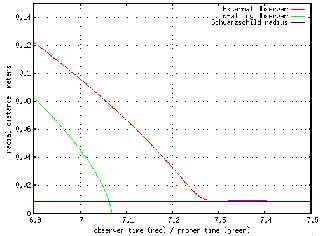
Here's a couple plots to show the scales involved in your question.  For the
earth, the Schwarzschild radius is about 9mm.  If you start from 1m, I've
attached plots showing what an external observer sees and what the dead guy
sees.  (The units of time are meters, so you need to divide that by c to get
time.)  I'm not sure it's correct to think of it as deceleration since that's
really a notion we have from flat space-time.  For this case, space-time is
infinitely warped, so even though it may appear that you decelerate to an
outside observer, in fact you accelerate all the way to the center.  You can
also see here that the event horizon means nothing to the guy passing through
it.

 - Ricky
Post a reply to this message
Attachments:
Download 'rel1.png' (15 KB)
Preview of image 'rel1.png'
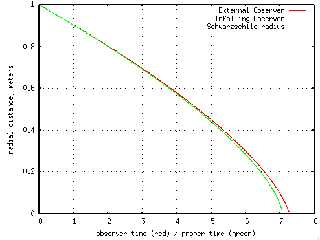
|
|
| |
| |
|
|
|
|
| |
| |
|
|
Sorry.  Web viewer.  Here's the second plot.

 - Ricky
Post a reply to this message
Attachments:
Download 'rel2.png' (15 KB)
Preview of image 'rel2.png'
|
|
| |
| |
|
|
|
|
| |
| |
|
|
Warp <war### [at] tagpovrayorg> wrote:
> > With a big enough black hole, you'll never know when you cross the event
> > horizon.
>
>   I have heard this, I have a very hard time understanding how it would be
> possible.
>
>   Space is *really* warped near the event horizon. The closer you get to
> it, the more warped it is. If you were to look out of your spacecraft as
> it's falling, the universe would look really weird. The closer you are
> to the event horizon, the weirder.
>
>   And after you cross the event horizon... Who knows. But you certainly
> would *not* see the universe in any normal way, if at all. You probably
> wouldn't be able to measure anything of the universe at all (because,
> if the GR equations are right, *all* geodesics inside the event horizon
> point directly towards the center).

Hm... I never thought about this in detail. I always imagined the event horizon
as nothing more than a theoretical construct, still a good deal away from the
singularity at its center - the distance beyond which a "fixed" outside
observer cannot see anything anymore. I also imagined that a non-fixed observer
in free fall towards the black hole would percieve the event horizon to be a bit
closer to the singularity, because after all light would only have to reach him,
not be able to zoom off to infinity...

.... but then again, if the light from inside the event horizon could still reach
a free-falling observer outside it, then what would stop the light from zooming
off from *there* to infinity?

So from this, and hearing that it would actually take an eternity (as seen from
an outside observer) to *reach* the event horizon, it sounds logical to me that
in fact the event horizon *is* the singularity...

.... whoa! so we have infinitely small spots the size of planets or larger... now
*that* is what I call weird...

.... and it makes me imagine that it is actually impossible to fall *into* a
black hole: If you'd take that trip, you'd experience it as being torn to
pieces by tidal forces, and in the next moment evaporating as hawking radiation
- seeing that the rest of the universe has aged some few gazillions of years...
Post a reply to this message
|
|
| |
| |
|
|
|
|
| |
| |
|
|
clipka wrote:
> So from this, and hearing that it would actually take an eternity (as seen from
> an outside observer) to *reach* the event horizon,

This still doesn't make sense to me, I fear.

You give one particle that is constantly emitting photons in all directions
a push due south towards the singularity. You have an observer due north of
the singularity looking south.  The observer due north will continue to see
photons coming off the particle indefinitely?

> it sounds logical to me that
> in fact the event horizon *is* the singularity...

But it's not.

> If you'd take that trip, you'd experience it as being torn to
> pieces by tidal forces,

Tidal forces are a difference in gravity gradient between head and feet.
It's not an absolute number. A sufficiently small pebble would experience
very little tidal effect regardless of how close to the primary it orbits. :-)

--
   Darren New, San Diego CA, USA (PST)
   "Ouch ouch ouch!"
   "What's wrong? Noodles too hot?"
   "No, I have Chopstick Tunnel Syndrome."
Post a reply to this message
|
|
| |
| |
|
|
|
|
| |
| |
|
|
Warp <war### [at] tagpovrayorg> wrote:
>   (But as I said in my original post, I don't think it would be possible to
> observe the object indefinitely from the outside. It just stops sending
> photons at some point.)

Strictly speaking I guess it doesn't - the probability of it sending photons
just decreases asymptotically to zero...


>   (Btw, that image might not be totally correct, as it seems to lack
> red-shifting of the light closer to the event horizon...)

No red-shifting necessary, because before it gets out of the gravitational well
- experiencing redshift - it gets into it first, experiencing a corresponding
ammount of blueshift.
Post a reply to this message
|
|
| |
| |
|
|
|
|
| |
| |
|
|
Darren New wrote:
>> it sounds logical to me that
>> in fact the event horizon *is* the singularity...
>
> But it's not.

By which I mean:
  "singularity" has a specific meaning in mathematics, and the event horizon
doesn't meet that definition, while the "center" of the black hole does.

Take the graph of tan(x). At pi/2, there's a singularity. At 0, it just goes
thru a 45-degree slope (and a point of inflection). That's kind of the
difference.

--
   Darren New, San Diego CA, USA (PST)
   "Ouch ouch ouch!"
   "What's wrong? Noodles too hot?"
   "No, I have Chopstick Tunnel Syndrome."
Post a reply to this message
|
|
| |
| |
|
|
|
|
| |
| |
|
|
Darren New escreveu:
>> If you'd take that trip, you'd experience it as being torn to
>> pieces by tidal forces,
>
> Tidal forces are a difference in gravity gradient between head and feet.
> It's not an absolute number. A sufficiently small pebble would
> experience very little tidal effect regardless of how close to the
> primary it orbits. :-)

hah!  Thanks for the tip!  I'll roll up into fetal position when nearing
a black hole... :)

Anyway, trying to understand something that until now has not been
observed and is only but a prediction from a math model that may be
incomplete -- which is how many scientists see the singularities of GR
equations -- seems a bit off.  Some scientists are suggesting that
blackholes are in fact stars made out of dark matter and energy.

http://www.newscientist.com/article/mg18925423.600-three-cosmic-enigmas-one-audacious-answer.html

whoa, head spins...
Post a reply to this message
|
|
| |
| |
|
|
|
|
| |
| |
|
|
Darren New <dne### [at] sanrrcom> wrote:
> "Spin" is a fascinating concept related to symmetry. A "spin 1/2" particle
> means if you turn it 180 degrees, it looks the same. So a "two of diamonds"
> playing card would be "spin 1/2" - it looks the same right side up as upside
> down. (Discounting, of course, that it's 3D, so has a back that's different
> from the front.)

IIRC it's just the other way round - so you have to turn quite a lot of
subatomic particles around twice to get them look the same again...?


> It's lost because it cannot influence other particles in the local area. Of
> course, that's because the particles outside the horizon are a spacelike
> distance from the particles inside the horizon, so maybe you're right. Maybe
> it's the equivalent of being outside the cosmological horizon.

Does there exist such a thing? It doesn't have this "one way ticket" thing to it
like black holes do.

AIUI the cosmological horizon is just the distance we can see *now*. Everything
beyond will become visible to us over time. Theoretically speaking.
Post a reply to this message
|
|
| |
| |
|
|
|
|
| |
| |
|
|
clipka wrote:
> IIRC it's just the other way round - so you have to turn quite a lot of
> subatomic particles around twice to get them look the same again...?

It's possible I got that wrong.  Indeed, it's possible I don't know anything
at all about the subject that I think I do. :-)  Were this an actual
scientific forum, I'd have shut up a long time ago.

>> It's lost because it cannot influence other particles in the local area. Of
>> course, that's because the particles outside the horizon are a spacelike
>> distance from the particles inside the horizon, so maybe you're right. Maybe
>> it's the equivalent of being outside the cosmological horizon.
>
> Does there exist such a thing? It doesn't have this "one way ticket" thing to it
> like black holes do.

I'm not sure what you speak of.

> AIUI the cosmological horizon is just the distance we can see *now*. Everything
> beyond will become visible to us over time. Theoretically speaking.

Oh, the event horizon. No, I think it's caused by space itself expanding,
due to the big bang sort of thing.  If it all collapses again, that's a
different question.

--
   Darren New, San Diego CA, USA (PST)
   "Ouch ouch ouch!"
   "What's wrong? Noodles too hot?"
   "No, I have Chopstick Tunnel Syndrome."
Post a reply to this message
|
|
| |
| |
|
|
|
|
| |
| |
|
|
nemesis wrote:
> hah!  Thanks for the tip!  I'll roll up into fetal position when nearing
> a black hole... :)

You're not kidding. Larry Niven actually did a sci-fi story about that.

> equations -- seems a bit off.  Some scientists are suggesting that
> blackholes are in fact stars made out of dark matter and energy.

Dude. Scroll up to the first post in this conversation. :-)

--
   Darren New, San Diego CA, USA (PST)
   "Ouch ouch ouch!"
   "What's wrong? Noodles too hot?"
   "No, I have Chopstick Tunnel Syndrome."
Post a reply to this message
|
|
| |
| |
|
|
|
|
| |
| |
|
|
Darren New escreveu:
> Dude. Scroll up to the first post in this conversation. :-)

oh, crap!  So that's where this tab got open... :P
Post a reply to this message
|
|
| |
| |
|
|
|
|
| |
| |
|
|
Darren New <dne### [at] sanrrcom> wrote:
> If you take the Earth and condense it down to a black hole, then stop a
> particle in orbit 100 miles above where the surface used to be, the particle
> will accelerate towards the black hole, right? But to avoid crossing the
> event horizon, it must logically decelerate, as seen from the POV of someone
> in orbit (say).  You wouldn't stop at the original altitude of the surface,
> but you would stop before you get to the event horizon, so in this case,
> gravity must be causing you to decelerate.  Yes?

Depends on definition if speed, but as it is usually specified based on the
observer's timeframe: Yes. Gravitation near a black hole is so strong that -
from an observer's POV - through time delation and the warping of space it
causes "that poor old sod over there" to slow to a halt.

From that poor old sod's perspective, gravitation near a black hole is so strong
that it keeps speeding him up - his feet much stronger than his head (if he
plunges in feet first) - until he is ripped to isolated subatomic particles.

Paradoxically, while this happens, I think that he will at the same time see his
feet slow down to a standstill, just as an outside observer would. So maybe he's
not torn apart after all..!?!

(In a similarly paradoxical fashion, the particles at his head can still easily
influence those at his feet - but the influence of the feet particles on the
head particles will drastically diminish (remember them sending out less
photons?)

This actually shows that gravitation is a quite strange beast in the zoo of
forces: The influence of gravitation does *not* diminish while closing in on a
black hole.

So either gravitation cannot be a "normal" QM-style force (else the object would
send out fewer and fewer gravitons as its own timeframe slows down with respect
to an outside observer) - or the object's e=mc^2 increases towards infinity as
it comes close to the event horizon, but why should it? After all, we have seen
that from an outsider's point of view the object actually slows to a halt.

Hum... sounds to me like bad news for the people at the LHC - and speaks for the
"gravitation = spacetime geometry" view of GR.
Post a reply to this message
|
|
| |
| |
|
|
|
|
| |
| |
|
|
nemesis <nam### [at] gmailcom> wrote:
> Darren New escreveu:
> > nemesis wrote:
> >> kind of after image that seems to ever approach the event horizon
> >> without ever touching it, but in reality the crossing of the EH
> >> already took place and nothing of what happens in the inside is seen...
> >
> > Hmmmm.... I'll have to think on it.
>
> I think it has something to do with the last photons coming out of the
> object entering the EH are severely slowed down by the massive gravity
> and only reach you after much more time than normal has passed.

Yeah - interestingly, the distance between a point near the EH and a point far
away is shorter when moving towards the EH than when moving away from it on the
very same route...
Post a reply to this message
|
|
| |
| |
|
|
|
|
| |
| |
|
|
"clipka" <nomail@nomail> wrote:
> So from this, and hearing that it would actually take an eternity (as seen from
> an outside observer) to *reach* the event horizon, it sounds logical to me that
> in fact the event horizon *is* the singularity...

Again, from the book since I probably can't state it any better:

"In this case, we will find that while the surface r=2m has some unusual
properties, the singularity is due to the choice of coordinates, and so is a
*coordinate singularity*.  Simply put, by using a different set of coordinates
we can write the metric in such a way that the singularity at r=2m is removed.
However, we will see that the point r=0 is due to infinite curvature and cannot
be removed by a change in the coordinates."

I may be guilty of having implied that the curvature is infinite at the event
horizon, but it looks like only the redshift to an outside observer is.  Kinda
learning this as I go, so you'll have to forgive me.

I know most of this is focused on general relativity, but here's a nifty program
for exploring special relativity:

http://realtimerelativity.org/

 - Ricky
Post a reply to this message
|
|
| |
| |
|
|
|
|
| |
| |
|
|
triple_r wrote:
> I may be guilty of having implied that the curvature is infinite at the event
> horizon, but it looks like only the redshift to an outside observer is.  Kinda
> learning this as I go, so you'll have to forgive me.

Ha! You're teaching me as you go! :-)

--
   Darren New, San Diego CA, USA (PST)
   "Ouch ouch ouch!"
   "What's wrong? Noodles too hot?"
   "No, I have Chopstick Tunnel Syndrome."
Post a reply to this message
|
|
| |
| |
|
|
|
|
| |
| |
|
|
Darren New <dne### [at] sanrrcom> wrote:
> You give one particle that is constantly emitting photons in all directions
> a push due south towards the singularity. You have an observer due north of
> the singularity looking south.  The observer due north will continue to see
> photons coming off the particle indefinitely?

Yes - they'll just seem to come at ever longer intervals (and with an ever
stronger redshift).

Of course, there is only a limited number of photons the particle can emit
before hitting the EH. However, from the observer's point of view, the very
last such photon will arrive at (roughly) infinite time after the second to
last.

Roughly, if that last photon is emitted a finite time before the particle passes
the EH.

Exactly, if the last photon is emitted at the very moment the particle passes
the EH.


>
> > it sounds logical to me that
> > in fact the event horizon *is* the singularity...
>
> But it's not.

Sure? Were you there and had a look? Do you grok the formulae? I don't ;)

>
> > If you'd take that trip, you'd experience it as being torn to
> > pieces by tidal forces,
>
> Tidal forces are a difference in gravity gradient between head and feet.
> It's not an absolute number. A sufficiently small pebble would experience
> very little tidal effect regardless of how close to the primary it orbits. :-

No, tidal forces are a difference in gravitational *force* - which (possibly
very simply speaking, as I'm not perfectly familiar with the terms) *is* the
gravity gradient. And they don't jsut rip apart your head and feet

If it was just your feet being pulled away from your head, you would be torn in
two because the force would pull on the whole chain of electromagnetic forces
tying your feet to your head, and some "weakest link" will give way.

This is not the case for tidal forces due to a gravity gradient: These will pull
on each link in the chain of electromagnetic forces separately - each link
subject to its own little gradient.

This will allow you to sustain a lot more gradient between your head and your
feet, possibly even without much adverse effect. But when it will ultimately
rip the skin off your feet, it will just as well rip apart the grains of sand
in your shoes.

Oh, and BTW, once you hit the EH, I guess there'll probably be no floating
around... with so much mass in so little space, there'll probably be not enough
room to swing a cat...

.... but then again, that place may be quite crowded already even outside the EH.
Post a reply to this message
|
|
| |
| |
|
|
|
|
| |
| |
|
|
Darren New <dne### [at] sanrrcom> wrote:
> Ha! You're teaching me as you go! :-)

If it helps, I'm trying to be pretty conservative in the insight I offer.  Hey -
it could be worse.  I could have written a book on the subject like this guy
did.  Now he probably knows and understands exactly what he's doing, but there
are errors left and right.  I followed the derivation, then plotted the
equations.  Then plotted them again.  And again.  Then derived it myself and
figured out that, indeed, he had a blatant sign error (one of many
errors/typos).  Perhaps I should have waited for the second edition.  Anyway,
didn't your mom tell you not to trust newsgroup physics debates?

 - Ricky
Post a reply to this message
|
|
| |
| |
|
|
|
|
| |
| |
|
|
Darren New <dne### [at] sanrrcom> wrote:
> Darren New wrote:
> >> it sounds logical to me that
> >> in fact the event horizon *is* the singularity...
> >
> > But it's not.
>
> By which I mean:
>   "singularity" has a specific meaning in mathematics, and the event horizon
> doesn't meet that definition, while the "center" of the black hole does.
>
> Take the graph of tan(x). At pi/2, there's a singularity. At 0, it just goes
> thru a 45-degree slope (and a point of inflection). That's kind of the
> difference.

Well, from an outsider's perspective - given that everything falling into the
black hole comes to a standstill at the EH... doesn't this qualify for a
singularity?

Okay, granted, from the poor victim's POV the singularity is still a few yards
away...


BTW, I've looked at the illustration with the "bent" ray by now, and the
illustration of what somebody falling into a black hole would see, and am now
coming to yet another conclusion:

I think that as a person closes in to the event horizon, (a) from his
perspective the *universe* will begin to collapse to a singularity (although
not a point, but rather a line), and (b) the event horizon will appear to
recede - until he hits the singularity, which in this sense is again identical
to the event horizon.

What happens then? Well - I guess that poor sod just falls through.
Back into the universe - which by then has aged by an infinite amount of time.
The only thing the poor guy suffered will be that he'll be turned around by 180
degrees when emerging from the singularity...

From an observer's point of view, the guy should thus appear at the other side
of the EH (and again take infinite time to get out of it).


You remember the famous greek thought experiment about Achilleus trying to catch
up with a turtle, and being unable to - because whenever he reaches the point
where the turtle was, the turtle will have crawled yet another bit ahead?

I guess we have a similar paradoxon here: An outside observer will see things
from the greek philosophers' point of view, in which a person heading for the
EH will never reach it. The poor victim, however, sees things from the classic
everyday perspective we know: He can just run past the turtle, no problem.
Post a reply to this message
|
|
| |
| |
|
|
|
|
| |
| |
|
|
Darren New <dne### [at] sanrrcom> wrote:
> It's possible I got that wrong.  Indeed, it's possible I don't know anything
> at all about the subject that I think I do. :-)  Were this an actual
> scientific forum, I'd have shut up a long time ago.

Well, same with me - but that's the fun part about it: Nobody *expects* us to
know what we're talking about, so we can let our imagination run wild ;)

> > AIUI the cosmological horizon is just the distance we can see *now*. Everything
> > beyond will become visible to us over time. Theoretically speaking.
>
> Oh, the event horizon. No, I think it's caused by space itself expanding,
> due to the big bang sort of thing.  If it all collapses again, that's a
> different question.

But if it all collapses again, then we couldn't have such an event horizon,
right? After all, it would all "boil down" (literally ;)) to a single point
again, where all the stuff will be able to interact once more...

(Then again, currently scientists claim we'll all be ripped to pieces one day by
the ever-faster expanding space within us all... hmmm... "the space within us" -
sounds a bit hippie-ish ;)
Post a reply to this message
|
|
| |
| |
|
|
|
|
| |
| |
|
|
triple_r wrote:
> didn't your mom tell you not to trust newsgroup physics debates?

Definitely.  I'll try not to fall into any singularities before checking
with an actual knowledgeable physicist. :-)

--
   Darren New, San Diego CA, USA (PST)
   "Ouch ouch ouch!"
   "What's wrong? Noodles too hot?"
   "No, I have Chopstick Tunnel Syndrome."
Post a reply to this message
|
|
| |
| |
|
|
|
|
| |
| |
|
|
"triple_r" <nomail@nomail> wrote:
> "In this case, we will find that while the surface r=2m has some unusual
> properties, the singularity is due to the choice of coordinates, and so is a
> *coordinate singularity*.  Simply put, by using a different set of coordinates
> we can write the metric in such a way that the singularity at r=2m is removed.
> However, we will see that the point r=0 is due to infinite curvature and cannot
> be removed by a change in the coordinates."

Hm... yeah, maybe that's a mathematical way to describe what I'm currently
pondering: If we choose the falling victim's co-ordinates (location, time,
speed and all) a reference frame instead of that of a "fixed" outside observer,
we move the singularity from r=2m towards r=0 - from the Schwartzschild-Radius
(the "classic" EH) towards the "classic" singularity...

So I'd say the EH is the projection of the singularity into the reference frame
of an observer...

> I may be guilty of having implied that the curvature is infinite at the event
> horizon, but it looks like only the redshift to an outside observer is.  Kinda
> learning this as I go, so you'll have to forgive me.

Not a problem at all - as it seems, we're all in that same boat here ;)
Post a reply to this message
|
|
| |
| |
|
|
|
|
| |
| |
|
|
clipka escreveu:
> Darren New <dne### [at] sanrrcom> wrote:
> I think that as a person closes in to the event horizon, (a) from his
> perspective the *universe* will begin to collapse to a singularity (although
> not a point, but rather a line), and (b) the event horizon will appear to
> recede - until he hits the singularity, which in this sense is again identical
> to the event horizon.

Will he or any matter draw into the blackhole ever hit the singularity?
  Does the singularity or blackholes even exist or are merely the point
where GR equations break?

We're doing no better than ancient philosophers trying to split the
matter and thinking about its outcome without a shred of evidence or
measurements... which is the point of the GM guy in the article this
thread links to:

"We start with effects actually seen in the lab, which I think gives it
more credibility than black holes"

evidence.

> What happens then? Well - I guess that poor sod just falls through.
> Back into the universe - which by then has aged by an infinite amount of time.
> The only thing the poor guy suffered will be that he'll be turned around by 180
> degrees when emerging from the singularity...
>
> From an observer's point of view, the guy should thus appear at the other side
> of the EH (and again take infinite time to get out of it).

If we assume blackholes exist, without much evidence so far, how about
going even further in the imagination?  What if our 4D space-time isn't
but a section of higher dimensional spaces, like a julia fractal section
rendered in povray?  Perhaps the blackhole is then just a curve along
this surface and the poor fellow ends up in another region of
space-time.  The original outside observer will never see him again,
unless he goes all the way back through the worm hole...

> You remember the famous greek thought experiment about Achilleus trying to catch
> up with a turtle, and being unable to - because whenever he reaches the point
> where the turtle was, the turtle will have crawled yet another bit ahead?
>
> I guess we have a similar paradoxon here: An outside observer will see things
> from the greek philosophers' point of view, in which a person heading for the
> EH will never reach it. The poor victim, however, sees things from the classic
> everyday perspective we know: He can just run past the turtle, no problem.

Those greeks philosophers were just full of marijuana.  And pasta.  They
were first possibly the first thinkers of mankind to think too much on
far too abstract subjects rather than more mundane and practical
matters... :P
Post a reply to this message
|
|
| |
| |
|
|
|
|
| |
| |
|
|
clipka escreveu:
> Darren New <dne### [at] sanrrcom> wrote:
>> It's possible I got that wrong.  Indeed, it's possible I don't know anything
>> at all about the subject that I think I do. :-)  Were this an actual
>> scientific forum, I'd have shut up a long time ago.
>
> Well, same with me - but that's the fun part about it: Nobody *expects* us to
> know what we're talking about, so we can let our imagination run wild ;)

Don't worry, you guys!  Even scientists let their imaginations run wild
too...

This was a very interesting thread, despite being a very difficult and
misunderstood subject among laymen.  But I'm actually amazed by how few
were drawn to it.  I thought most geeks love space talk and povray is
full of geeks after all! :D

>>> AIUI the cosmological horizon is just the distance we can see *now*. Everything
>>> beyond will become visible to us over time. Theoretically speaking.
>> Oh, the event horizon. No, I think it's caused by space itself expanding,
>> due to the big bang sort of thing.  If it all collapses again, that's a
>> different question.
>
> But if it all collapses again, then we couldn't have such an event horizon,
> right? After all, it would all "boil down" (literally ;)) to a single point
> again, where all the stuff will be able to interact once more...

Since we're speculating, if space is really expanding, do you think in
absolute terms we're now much larger than dinosaurs back in their day?
Of course, fossils won't tell, cause they expanded ever since too. ;)

> (Then again, currently scientists claim we'll all be ripped to pieces one day by
> the ever-faster expanding space within us all... hmmm... "the space within us" -
> sounds a bit hippie-ish ;)

I don't want to live to see proton decay!  well, not that I would
anyway... :P
Post a reply to this message
|
|
| |
| |
|
|
|
|
| |
| |
|
|
Darren New <dne### [at] sanrrcom> wrote:
> Ha! You're teaching me as you go! :-)

Scratch that.  It could be  LOT worse.  I could be this guy (worth at listen at
about 31:00):

http://www.thisamericanlife.org/Radio_Episode.aspx?episode=293

Also interesting/entertaining:

http://insti.physics.sunysb.edu/~siegel/quack.html
http://math.ucr.edu/home/baez/crackpot.html

 - Ricky
Post a reply to this message
|
|
| |
| |
|
|
|
|
| |
| |
|
|
clipka escreveu:
> nemesis <nam### [at] gmailcom> wrote:
>> Darren New escreveu:
>>> nemesis wrote:
>>>> kind of after image that seems to ever approach the event horizon
>>>> without ever touching it, but in reality the crossing of the EH
>>>> already took place and nothing of what happens in the inside is seen...
>>> Hmmmm.... I'll have to think on it.
>> I think it has something to do with the last photons coming out of the
>> object entering the EH are severely slowed down by the massive gravity
>> and only reach you after much more time than normal has passed.
>
> Yeah - interestingly, the distance between a point near the EH and a point far
> away is shorter when moving towards the EH than when moving away from it on the
> very same route...

So that's why light takes a lot more time to reach us and thus the after
image just before the crossing is visible.  OTOH, time and space are two
sides of the same coin, isn't it?
Post a reply to this message
|
|
| |
| |
|
|
|
|
| |
| |
|
|
nemesis wrote:
> "We start with effects actually seen in the lab, which I think gives it
> more credibility than black holes"
>
> evidence.

The effects of what appear to be black holes are seen in astronomy. Just not
in the lab as such.

> If we assume blackholes exist, without much evidence so far,

A fair amount of evidence, actually.

> Perhaps the blackhole is then just a curve along
> this surface and the poor fellow ends up in another region of
> space-time.

Basically, yes. Some types of black hole structures are thought to work that
way. Like, a rotating black hole can be traversed like that without hitting
the singularity, supposedly.

It's all math, tho, with no actual physics evidence beyond what the math
implies. If reality isn't isomorphic to the math after all, it won't work.

--
   Darren New, San Diego CA, USA (PST)
   "Ouch ouch ouch!"
   "What's wrong? Noodles too hot?"
   "No, I have Chopstick Tunnel Syndrome."
Post a reply to this message
|
|
| |
| |
|
|
|
|
| |
| |
|
|
Darren New <dne### [at] sanrrcom> wrote:
> nemesis wrote:
> > "We start with effects actually seen in the lab, which I think gives it
> > more credibility than black holes"
> >
> > evidence.
>
> The effects of what appear to be black holes are seen in astronomy. Just not
> in the lab as such.
>
> > If we assume blackholes exist, without much evidence so far,
>
> A fair amount of evidence, actually.

Yes, but according to the article you linked, QM physicists are giving another
explanation for the same effects without the paradoxes blackholes carry, the
same ones we were avidly discussing about previously:  the "lost information"
and the "after-image" effect of something crossing the EH as seen from an
external observer.  Of course, they are trying to explain it by relying on a
supposed dark matter star that has never been detected before either. :P

Surely the Dark side is very sneaky!

OTOH, will we ever witness such object, blackhole or dark matter star?  Such
humongous gravitational force surely has many objects orbiting it,
"overcrowded" as clipka mentioned, and most of it being gas and stars, so what
is the chance of seeing what isn't supposed to be seen except against a clear
starry background?
Post a reply to this message
|
|
| |
| |
|
|
|
|
| |
| |
|
|
Darren New <dne### [at] sanrrcom> wrote:
> A fair amount of evidence, actually.


Absolutely fascinating:

http://www.eso.org/public/outreach/press-rel/pr-2008/phot-46-08.html

 - Ricky
Post a reply to this message
|
|
| |
| |
|
|
|
|
| |
| |
|
|
triple_r wrote:
> http://www.eso.org/public/outreach/press-rel/pr-2008/phot-46-08.html

Kewl. I was thinking of this one.
http://en.wikipedia.org/wiki/Cygnus_X-1

--
   Darren New, San Diego CA, USA (PST)
   "Ouch ouch ouch!"
   "What's wrong? Noodles too hot?"
   "No, I have Chopstick Tunnel Syndrome."
Post a reply to this message
|
|
| |
| |
|
|
|
|
| |
| |
|
|
Darren New <dne### [at] sanrrcom> wrote:
> triple_r wrote:
> > http://www.eso.org/public/outreach/press-rel/pr-2008/phot-46-08.html
>
> Kewl. I was thinking of this one.
> http://en.wikipedia.org/wiki/Cygnus_X-1

Convincing evidence, but I'm a sucker for the visually spectacular ones:

http://en.wikipedia.org/wiki/Elliptical_Galaxy_M87

 - Ricky
Post a reply to this message
|
|
| |
| |
|
|
|
|
| |
| |
|
|
"triple_r" <nomail@nomail> wrote:
> Darren New <dne### [at] sanrrcom> wrote:
> > A fair amount of evidence, actually.
>
>
> Absolutely fascinating:
>
> http://www.eso.org/public/outreach/press-rel/pr-2008/phot-46-08.html

Yes.  Look the last video, it's a journey to the center of the galaxy through a
multilayered collection of ever zooming galaxy shots.  It ends with both the
collected frames aquired over 16 years and accelerated by a few million times
and a CG detailing what's going on.

Truth be told, I don't think the video gives the exact scale of the thing.  I
mean, I thought the central blackhole, or whatever it is those stars are
orbitting around, would be much bigger.  Yes, I know it's hyperdense, but even
still...
Post a reply to this message
|
|
| |
| |
|
|
|
|
| |
| |
|
|
> Depends on definition if speed, but as it is usually specified based on
> the
> observer's timeframe: Yes. Gravitation near a black hole is so strong
> that -
> from an observer's POV - through time delation and the warping of space it
> causes "that poor old sod over there" to slow to a halt.

I always thought that it could be possible to go forward in time by some
arbitrary amount just by making a close orbit around a black hole.  The
closer you go, the more time you can jump forward.  So just type in the year
3050 to your ship, it fires you off towards the nearest black hole, and a
few months later you return back towards Earth in the year 3050 +/- a few
months ;-)

Or doesn't it work like that?
Post a reply to this message
|
|
| |
| |
|
|
|
|
| |
|
|







