|
|
|
|
|
|
| |
| |
|
|
|
|
| |
| |
|
|
And so today I spent my morning reading Wikipedia's "list of notable
computer viruses and worms".

All the big names are there - Byte Bandit, Chynoble, Melissa, Code Red,
SQL Slammer, Sobig, Sober, MyDoom, MS Blaster, Klez, Nachi, etc. Plus
there's a few I haven't even heard of. (Obviously most of these are PC
viruses, and it wasn't until the late 90s that I started using that
platform.)

In all the time I've been using computers, I have only seen 2 virus
infections. At uni, I unwhittingly infected a PC with the Happy99 virus.
[At least, I'm pretty sure that's what it was. As far as I know, nothing
further came of this incident.]

Later, my laptop became infected with MS Blaster. This is the only time
a computer that I personally own has become infected with a virus.

I remember being distinctly unimpressed my McAfee's ability to detect
the virus, yet do absolutely nothing to actually remove it. It just
whinged "oh dear, the file cannot be deleted, what shall I do?" In the
end, I had to go delete it myself manually. (IIRC, it was read-only or
something, and that was all that was stopping it.)

Of course, the machine instantly become reinfected. In the end I
reinstalled Windows XP. But as soon as I attempted to access the
Internet to download the patch, the laptop was reinfected and started
rebooting faster than I could download the patch. In the end, I had to
use my mum's old PC (Windows 98) to download the patch so I could
install it.

Melissa, Code Red, SQL Slammer and ILOVEYOU are all legendary names, but
until today I didn't actually know precisely what they did or how they
worked. It's interesting how some of these expoit bugs that were fixed
months ago. Others merely use minimalistic social engineering tricks.

It's surprising how stupid some people are. For example "why did you
open this attachment 12 times??" "Well I wanted to see what was in it!"
I guess most people don't realise that clicking on an attachment is what
infects PCs; they probably think it's something like the common cold
that "just happens" one day.

I've heard legends of boot-block viruses, file infectors and Word macro
viruses - but I've never actually met one in real life. With the
possible exception of the latter, I would imagine these are all pretty
rare now.

Anybody else here have any interesting virus experiences?

--
http://blog.orphi.me.uk/
http://www.zazzle.com/MathematicalOrchid*
Post a reply to this message
|
|
| |
| |
|
|
|
|
| |
| |
|
|
Invisible wrote:

> I've heard legends of boot-block viruses, file infectors and Word macro
> viruses - but I've never actually met one in real life. With the
> possible exception of the latter, I would imagine these are all pretty
> rare now.

Never encountered a boot-block virus. Had a Word document that contained
a virus at once. Of course, that was averted by the whole "This file has
a macro in it, do you want to run that macro" dialog. Uhh, no ... I
wasn't expecting any macros. I met the ILOVEYOU virus. It filled up my
entire inbox. Oh what fun that was. Of course, I knew the e-mails were
bogus when one of the first 10 was from the CEO. I downloaded the
script, and opened it in a text editor, just to see what it contained.

> Anybody else here have any interesting virus experiences?

The most interesting was the Worm that was infecting computers via file
shares. I had stored a few executables on the network share after
building them, then ran them (moments after the build completed, about
the time it took for me to go grab a drink from the fridge) They didn't
work ... Rebuild and execute again ... Didn't work ... Hmm... Build the
Debug versions (local to my machine) and they worked flawlessly. Hmmm.
Suddenly my boss shows up at my cubicle (He was also head of IT at the
time) says "Don't touch a thing" and yanks the network cord out of the
back of my machine. He then instructs me to open our virus software,
download the latest update and do a full system scan. My system had been
affected by the files I built moments before. All because someone
attached a dodgy laptop to the LAN and logged in, reconnecting
themselves to all of the file shares on the server, and infecting every
single writable executable on the file share. That virus was
particularly virulent. The writability hole was plugged on the shares I
used so that devs were the only ones with write privileges, but it would
appear from time to time (probably from the same individual, I dunno)
and totally cripple the network.
Post a reply to this message
|
|
| |
| |
|
|
|
|
| |
| |
|
|
Mike Raiford wrote:

> I met the ILOVEYOU virus. It filled up my
> entire inbox. Oh what fun that was. Of course, I knew the e-mails were
> bogus when one of the first 10 was from the CEO. I downloaded the
> script, and opened it in a text editor, just to see what it contained.

Anything interesting?

> The most interesting was the Worm that was infecting computers via file
> shares. I had stored a few executables on the network share after
> building them, then ran them (moments after the build completed, about
> the time it took for me to go grab a drink from the fridge) They didn't
> work ... Rebuild and execute again ... Didn't work ... Hmm... Build the
> Debug versions (local to my machine) and they worked flawlessly. Hmmm.
> Suddenly my boss shows up at my cubicle (He was also head of IT at the
> time) says "Don't touch a thing" and yanks the network cord out of the
> back of my machine. He then instructs me to open our virus software,
> download the latest update and do a full system scan. My system had been
> affected by the files I built moments before. All because someone
> attached a dodgy laptop to the LAN and logged in, reconnecting
> themselves to all of the file shares on the server, and infecting every
> single writable executable on the file share. That virus was
> particularly virulent. The writability hole was plugged on the shares I
> used so that devs were the only ones with write privileges, but it would
> appear from time to time (probably from the same individual, I dunno)
> and totally cripple the network.

Wow. o_O

Sounds like almost as much fun as that time I accidentally configured
our email server as an open relay. Needless to say, on Monday morning
the server was nonfunctional. I forget what I was actually *trying* to
do... but I missed out the step where you configure some setting or
other that requires authentication or something, essentially yielding an
open-relay configuration.

Oops. x_x

An a final thought... How many users would see a macro popup and decide
to press "no"? It seems to me that lots of applications generate far too
many popups (e.g., endless "are you sure?" messages where there is
actually no danger), and users tend to just blindly click Yes to get rid
of these irritations.

--
http://blog.orphi.me.uk/
http://www.zazzle.com/MathematicalOrchid*
Post a reply to this message
|
|
| |
| |
|
|
|
|
| |
| |
|
|
Invisible <voi### [at] dev null> wrote:
> In the end I reinstalled Windows XP.
The (newbie) answer to all problems.
--
- Warp null> wrote:
> In the end I reinstalled Windows XP.
The (newbie) answer to all problems.
--
- Warp
Post a reply to this message
|
|
| |
| |
|
|
|
|
| |
| |
|
|
>> In the end I reinstalled Windows XP.
>
>   The (newbie) answer to all problems.

Well, if your PC reboots every 20 seconds, what else can you
realistically do? There isn't sufficient time to install any tools or
run any kind of diagnostics.

--
http://blog.orphi.me.uk/
http://www.zazzle.com/MathematicalOrchid*
Post a reply to this message
|
|
| |
| |
|
|
|
|
| |
| |
|
|
"Invisible" <voi### [at] devnull> a écrit dans le message de news:
48970aa6$1@news.povray.org...
> Well, if your PC reboots every 20 seconds, what else can you realistically
> do? There isn't sufficient time to install any tools or run any kind of
> diagnostics.

??? If you were able to find and download the patch from your mum's PC then
you could also find instructions on the internet about 1) how to stop the
rebooting before it happened and 2) to get rid of the worm without
reinstalling.

G.
Post a reply to this message
|
|
| |
| |
|
|
|
|
| |
| |
|
|
>> Well, if your PC reboots every 20 seconds, what else can you realistically
>> do? There isn't sufficient time to install any tools or run any kind of
>> diagnostics.
>
> ??? If you were able to find and download the patch from your mum's PC then
> you could also find instructions on the internet about 1) how to stop the
> rebooting before it happened and 2) to get rid of the worm without
> reinstalling.

Well by the time I got that far I'd already reinstalled twice.

Reinstalling is probably simpler than following a tricky sequence of
registry edits and hoping that you don't accidentally break your PC and
that all traces of the virus are actually gone...

--
http://blog.orphi.me.uk/
http://www.zazzle.com/MathematicalOrchid*
Post a reply to this message
|
|
| |
| |
|
|
|
|
| |
| |
|
|
On Mon, 04 Aug 2008 14:02:40 +0100, Invisible <voi### [at] devnull> wrote:


>Anybody else here have any interesting virus experiences?

I was banging my head against the wall, working to figure out why our web page kept
crashing, when Code Red was announced.  That was quite a fun-filled few days.
Post a reply to this message
|
|
| |
| |
|
|
|
|
| |
| |
|
|
"Invisible" <voi### [at] devnull> a écrit dans le message de news:
489713b0@news.povray.org...
> Reinstalling is probably simpler than following a tricky sequence of
> registry edits and hoping that you don't accidentally break your PC and
> that all traces of the virus are actually gone...

What registry edits? All you had to do to prevent the reboot was to go to
the command line and type "shutdown -a" (or go the control panel and perform
a similar task). It took a couple of seconds and the trick was explained on
every AV site.

G.
Post a reply to this message
|
|
| |
| |
|
|
|
|
| |
| |
|
|
>> Reinstalling is probably simpler than following a tricky sequence of
>> registry edits and hoping that you don't accidentally break your PC and
>> that all traces of the virus are actually gone...
>
> What registry edits? All you had to do to prevent the reboot was to go to
> the command line and type "shutdown -a" (or go the control panel and perform
> a similar task). It took a couple of seconds and the trick was explained on
> every AV site.

That stops the machine rebooting, but it still doesn't remove the virus.

Personally, I just assumed that "fatal system error" means that there's
no way to prevent the system from being rebooted. I don't recall the
McAfee site containing any instructions on how to prevent this, or even
suggestion that it is *possible* to prevent this. Oh dear, I must be a
really stupid n00b for not knowing something so "obvious". Get off my case!

--
http://blog.orphi.me.uk/
http://www.zazzle.com/MathematicalOrchid*
Post a reply to this message
|
|
| |
| |
|
|
|
|
| |
| |
|
|
Invisible wrote:

>
> Anything interesting?
>

Not particularly. It was actually rather poorly written iirc, used CDO,
I believe to read the address book and propagate itself.
Post a reply to this message
|
|
| |
| |
|
|
|
|
| |
| |
|
|
"Invisible" <voi### [at] devnull> a écrit dans le message de news:
48971da1$1@news.povray.org...

> That stops the machine rebooting, but it still doesn't remove the virus.

The point is that it gave you plenty of time to install whatever blaster
removal tool you had downloaded from the AV makers.

>Oh dear, I must be a really stupid n00b for not knowing something so
>"obvious". Get off my case!

The noobishness is not about not knowing something. It's about not imagining
that there are other people out there with the same problem and possibly
solutions that work, all of this a Google search away. To be fair, it took
me a while to get this, as I'm old enough to be from a generation where it
was much more difficult to learn things on the fly...

G
Post a reply to this message
|
|
| |
| |
|
|
|
|
| |
| |
|
|
Invisible wrote:
> Anybody else here have any interesting virus experiences?

I remember the fire drills going on when the Morris Worm got out, and
the Christmas Tree whatever-it-was. It was lots of fun not having
internet access for a few days.

Almost as much fun as when they blow up a train tank car full of acid in
the same tunnel that most of the east-west fibers run through in the
USA. That one took a couple weeks to fix.

--
Darren New / San Diego, CA, USA (PST)
  Ever notice how people in a zombie movie never already know how to
  kill zombies? Ask 100 random people in America how to kill someone
  who has reanimated from the dead in a secret viral weapons lab,
  and how many do you think already know you need a head-shot?
Post a reply to this message
|
|
| |
| |
|
|
|
|
| |
| |
|
|
"Invisible" <voi### [at] devnull> wrote in message
news:48971da1$1@news.povray.org...

> Oh dear, I must be a really stupid n00b for not knowing something so
> "obvious". Get off my case!

    LOL! N00b!  ;)

    Just kidding mate, but there are internet cafe's too. Been there, done
that with my '98 machine... :/

    (Hey, quick thought: how about going to an internet cafe to maybe meet
someone? You know, you could give them some *specialist* info if they seem
to be having a problem?)

      ~Steve~

>
> --
> http://blog.orphi.me.uk/
> http://www.zazzle.com/MathematicalOrchid*
Post a reply to this message
|
|
| |
| |
|
|
|
|
| |
| |
|
|
On Mon, 04 Aug 2008 14:02:40 +0100, Invisible wrote:

> Anybody else here have any interesting virus experiences?

I used to have a collection for testing purposes.  Ran into a weird one
with (I think it was) Yale/Alameda on a network.  Yale tried to write to
the boot sector, but with a networked drive, it couldn't do that
(redirector = no access to the drive's boot sector), but it had no error
handling for that situation.

If one was running WordPerfect 5.1 (this was the early 90's) on a machine
infected with this virus, the code would jump into a section of WP that
caused it to start writing huge temp files to the networked drive,
eventually bringing all users logged into that account down.

(We used a guest account for most of the students, was easier than
managing separate accounts for everyone and we had no need to do so -
every student saved their work to a diskette).

This situation was completely reproducible every time.

Jim
Post a reply to this message
|
|
| |
| |
|
|
|
|
| |
| |
|
|
I'm wondering: How many virus/worm infections could have been prevented
by the simple use of a firewall software (such as eg. ZoneAlarm)?

  And more wondering: Why do people use Windows without a firewall software?
Even many who *know* these things and are not total n00bs.

  "I never run untrusted programs nor open dubious emails" doesn't help
when a worm exploits a security hole in the system which allows it to
infect it remotely without the user doing anything. And this is something
which a firewall software will usually prevent.

  (Another very important aspect of the firewall software is that, in the
case the system *does* get infected, it will stop the virus/worm/malware
from connecting to the internet behind the scenes, without the user knowing.
This is something a hardware firewall won't do, which is why a software
firewall in Windows is so important.)

--
                                                          - Warp
Post a reply to this message
|
|
| |
| |
|
|
|
|
| |
| |
|
|
Gilles Tran wrote:

>> Oh dear, I must be a really stupid n00b for not knowing something so
>> "obvious". Get off my case!
>
> The noobishness is not about not knowing something. It's about not imagining
> that there are other people out there with the same problem and possibly
> solutions that work, all of this a Google search away.

Yeah. I'm sure a few hours after MS Blaster came out there was published
info on the Internet on how to fix it. :-P

For what it's worth, I *did* check McAfee's website. (Since that was the
AV product I was actually using.) It just said "get the latest virus
defs. The virus will then be removed." This didn't actually occur. It
*detected* the virus, but refused to remove it. Really helpful, that was...

--
http://blog.orphi.me.uk/
http://www.zazzle.com/MathematicalOrchid*
Post a reply to this message
|
|
| |
| |
|
|
|
|
| |
| |
|
|
Warp wrote:
>   And more wondering: Why do people use Windows without a firewall software?

NAT tends to do a really good job here too. I think most cable modems at
least are, by now, NATted.

> from connecting to the internet behind the scenes, without the user knowing.

Sadly, there are so many programs that connect out without telling the
user they'll be doing so, it's another case of yes/no overload, methinks.

--
Darren New / San Diego, CA, USA (PST)
  Ever notice how people in a zombie movie never already know how to
  kill zombies? Ask 100 random people in America how to kill someone
  who has reanimated from the dead in a secret viral weapons lab,
  and how many do you think already know you need a head-shot?
Post a reply to this message
|
|
| |
| |
|
|
|
|
| |
| |
|
|
Mike Raiford wrote:

>> Anybody else here have any interesting virus experiences?

     I have never seen a virus on a computer. Been lucky I guess :)
I was the local greek that every one who ask for help on their computers
  in our naborhood. Every time a new virus came out everyone thought
they had it. The problems where mostly from loading games and programs
that were incompatible with the operating system. I was always getting
virus update from them. One day I got an e-mail that said there is a
virus name Such-n-Such(can remember) and if you have this exe file on
your computer you need to delete it. Of course it was on my computer. NO!
I didn't delete it. A little research showed that the file was very
important to the operating system. Lucky none of our gang delete it.
Post a reply to this message
|
|
| |
| |
|
|
|
|
| |
| |
|
|
>>   And more wondering: Why do people use Windows without a firewall
>> software?
>
> NAT tends to do a really good job here too.

Yeah, that too.

Just being behind a NAT device means that random people in the Internet
can't just connect to your PC and start frobbing random ports which host
insecure services. [Insert comment about the number of services M$ has
enabled by default when Windoze installs.]

That's not to say there is no place for antivirus and/or personal
firewalls though! We still have spam email containing malware, and
websites using browser bugs to install dodgy stuff...

> Sadly, there are so many programs that connect out without telling the
> user they'll be doing so, it's another case of yes/no overload, methinks.

Well sadly yes. OTOH, many personal firewalls seem to have a list of
"trusted" applications that they don't prompt for. Who compiles this
list and how the product decides whether a given item is on that list is
another matter. (I really hope it isn't just by process image name...!)

--
http://blog.orphi.me.uk/
http://www.zazzle.com/MathematicalOrchid*
Post a reply to this message
|
|
| |
| |
|
|
|
|
| |
| |
|
|
Leroy Whetstone wrote:

>     I have never seen a virus on a computer. Been lucky I guess :)

Lucky or just sensible. ;-)

My dad's PC seems to periodically become infected by... *something* or
other. Usually just trojans and browser hooks. I don't know what the
heck he does that I don't, but I've never had any similar problems...

> I was the local greek that every one who ask for help on their computers
> in our naborhood. Every time a new virus came out everyone thought they
> had it.

Ah yes, I've seen this so often. "Ooo, my computer is doing something
wierd. Is it a virus?"

Also, does it make you chuckle when you see those emails warning you
that "omgz, this nuu virus will eraz0rs your memory and make your
monitor expl0d3!!1!eleven"? ;-)

> One day I got an e-mail that said there is a virus
> name Such-n-Such(can remember) and if you have this exe file on your
> computer you need to delete it. Of course it was on my computer. NO!
> I didn't delete it. A little research showed that the file was very
> important to the operating system. Lucky none of our gang delete it.

Perhaps you refer to

http://www.f-secure.com/hoaxes/jdbgmgr.shtml

--
http://blog.orphi.me.uk/
http://www.zazzle.com/MathematicalOrchid*
Post a reply to this message
|
|
| |
| |
|
|
|
|
| |
| |
|
|
Thats interesting. Very few people had access to the Internet outside of
universities, military, government and gov't contractors when the "Morris
Worm" struck. I believe I had Compuserve at the time and found the news very
interesting but remained utterly unaffected by it, the only actual Internet
access we Compuserve subscribers had at the time I think, was limited to
metered email. That was, what, 1987, 1988?


--
H²
Post a reply to this message
|
|
| |
| |
|
|
|
|
| |
| |
|
|
Halbert wrote:
> That was, what, 1987, 1988?

Both of those, yes.

http://en.wikipedia.org/wiki/Christmas_virus
http://en.wikipedia.org/wiki/Morris_worm

Netscape used to be the security hole poster child, too, until Microsoft
took that distinction away from them. :-)

--
Darren New / San Diego, CA, USA (PST)
  Ever notice how people in a zombie movie never already know how to
  kill zombies? Ask 100 random people in America how to kill someone
  who has reanimated from the dead in a secret viral weapons lab,
  and how many do you think already know you need a head-shot?
Post a reply to this message
|
|
| |
| |
|
|
|
|
| |
| |
|
|
Invisible wrote:
> Anybody else here have any interesting virus experiences?

Want a scary thought?

While remotely cleaning a friend's computer, I found a trojan that was using
two dozen different methods to start up on boot. The global and per-user
Run registry key, Start on the start menu, an ActiveX object that
initialized on boot, a shell extension loaded by explorer, and...

...it *changed the file association of .exe files*. Instead of running "%1",
it ran trojan.exe "%1". The trojan started the real program after doing its
nasty stuff, so the user didn't notice.
Post a reply to this message
|
|
| |
| |
|
|
|
|
| |
| |
|
|
Orchid XP v8 wrote:
> how the product decides whether a given item is on that list is
> another matter. (I really hope it isn't just by process image name...!)

Some crappy old firewalls actually compared process image name.

This tool pretends to be IE and attempts connecting to the 'net. If it
succeeds, and your firewall doesn't give any warning about it, it sucks.

http://www.grc.com/lt/leaktest.htm
Post a reply to this message
|
|
| |
| |
|
|
|
|
| |
| |
|
|
>> Anything interesting?
>
> Not particularly. It was actually rather poorly written iirc, used CDO,
> I believe to read the address book and propagate itself.

Heh. I can easily imagine a virus not being the aphex of coding
technology. ;-) I've seen a number of virus descriptions that talk about
broken payloads or things not working right...

Actually, I've occasionally thought about trying to *write* a virus,
just to see if I can do it... But that's illegal. And besides, I'm sure
Haskell isn't the best way to do it either. :-P

--
http://blog.orphi.me.uk/
http://www.zazzle.com/MathematicalOrchid*
Post a reply to this message
|
|
| |
| |
|
|
|
|
| |
| |
|
|
Invisible wrote:
> Actually, I've occasionally thought about trying to *write* a virus,
> just to see if I can do it... But that's illegal. And besides, I'm sure
> Haskell isn't the best way to do it either. :-P
>

No, not illegal and not a bad learning experience. Propagating a virus
into the wild, though, is _definitely_ illegal.

John
Post a reply to this message
|
|
| |
| |
|
|
|
|
| |
| |
|
|
>> Actually, I've occasionally thought about trying to *write* a virus,
>> just to see if I can do it... But that's illegal. And besides, I'm
>> sure Haskell isn't the best way to do it either. :-P
>
> No, not illegal and not a bad learning experience. Propagating a virus
> into the wild, though, is _definitely_ illegal.

Sure. And owning a gun is illegal, but owning all of the components
necessary to assemble a gun isn't. But good luck explaining to the
people raiding your house why you have all these components. ;-)

--
http://blog.orphi.me.uk/
http://www.zazzle.com/MathematicalOrchid*
Post a reply to this message
|
|
| |
| |
|
|
|
|
| |
| |
|
|
"Orchid XP v8" <voi### [at] devnull> wrote in message
news:48975170$1@news.povray.org...

> My dad's PC seems to periodically become infected by... *something* or
> other. Usually just trojans and browser hooks. I don't know what the heck
> he does that I don't, but I've never had any similar problems...

      I don't have problems now, (thankfully!) but I did on my original 98
machine, (which was then later changed to XP). (Which is STILL sat beside me
on the floor doing nothing!)

     Anyway, I clicked on a virus email the other day to see what would
happen, and AVG kicked in big time (immediately) and quarantined it.

       If you can't find me after this, please send a search party, I'm
hungry an i yo%  nee;; £$* ==-0_ irt^+"..,,''

         ~2&8*ds~   ;)
Post a reply to this message
|
|
| |
| |
|
|
|
|
| |
| |
|
|
X5O!P%@AP[4\PZX54(P^)7CC)7}$EICAR-STANDARD-ANTIVIRUS-TEST-FILE!$H+H*

--
http://blog.orphi.me.uk/
http://www.zazzle.com/MathematicalOrchid*
Post a reply to this message
|
|
| |
| |
|
|
|
|
| |
| |
|
|
"Orchid XP v8" <voi### [at] devnull> wrote in message
news:4898b163$1@news.povray.org...


> X5O!P%@AP[4\PZX54(P^)7CC)7}$EICAR-STANDARD-ANTIVIRUS-TEST-FILE!$H+H*

   LOL, I'm guessing that actually means something, whereas mine didn't.
Thanks for the laugh mate, I needed it.  :)

    AND I'M NOT CLICKING ON IT!!  :op


     ~Steve~


>
> --
> http://blog.orphi.me.uk/
> http://www.zazzle.com/MathematicalOrchid*
Post a reply to this message
|
|
| |
| |
|
|
|
|
| |
| |
|
|
On Tue, 05 Aug 2008 21:44:18 +0100, St. wrote:

> "Orchid XP v8" <voi### [at] devnull> wrote in message
> news:4898b163$1@news.povray.org...
>
>
>> X5O!P%@AP[4\PZX54(P^)7CC)7}$EICAR-STANDARD-ANTIVIRUS-TEST-FILE!$H+H*
>
>    LOL, I'm guessing that actually means something, whereas mine didn't.
> Thanks for the laugh mate, I needed it.  :)

http://en.wikipedia.org/wiki/Eicar_test_file

:-)

Jim
Post a reply to this message
|
|
| |
| |
|
|
|
|
| |
| |
|
|
"Jim Henderson" <nos### [at] nospamcom> wrote in message
news:4898be73@news.povray.org...
> On Tue, 05 Aug 2008 21:44:18 +0100, St. wrote:
>
>> "Orchid XP v8" <voi### [at] devnull> wrote in message
>> news:4898b163$1@news.povray.org...
>>
>>
>>> X5O!P%@AP[4\PZX54(P^)7CC)7}$EICAR-STANDARD-ANTIVIRUS-TEST-FILE!$H+H*
>>
>>    LOL, I'm guessing that actually means something, whereas mine didn't.
>> Thanks for the laugh mate, I needed it.  :)
>
> http://en.wikipedia.org/wiki/Eicar_test_file

   Haha, thanks Jim, I didn't know that existed. You guys are great.


>
> :-)

    :-)

   ~Steve~


>
> Jim
Post a reply to this message
|
|
| |
| |
|
|
|
|
| |
| |
|
|
On Tue, 05 Aug 2008 22:46:56 +0100, St. wrote:

>    Haha, thanks Jim, I didn't know that existed. You guys are great.

Hehe, GIYF. ;-)  But I had seen it before, just didn't know what the
contents actually were.  There's also a standard file for testing UCE as
well - used for testing SpamAssassin installations to make sure it's
working.  I'd never heard of that one before.

Jim
Post a reply to this message
|
|
| |
| |
|
|
|
|
| |
| |
|
|
>> http://en.wikipedia.org/wiki/Eicar_test_file
>
>    Haha, thanks Jim, I didn't know that existed. You guys are great.

Well it's a lot safer than "keeping a collection of real viruses for
test purposes". ;-)

--
http://blog.orphi.me.uk/
http://www.zazzle.com/MathematicalOrchid*
Post a reply to this message
|
|
| |
| |
|
|
|
|
| |
| |
|
|
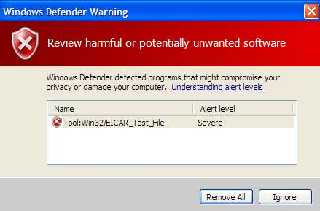
Orchid XP v8 wrote:
> X5O!P%@AP[4\PZX54(P^)7CC)7}$EICAR-STANDARD-ANTIVIRUS-TEST-FILE!$H+H*
>

I'm impressed! Defender actually picked this up. Who knew it had virus
definitions ...
Post a reply to this message
Attachments:
Download 'defender.jpg' (17 KB)
Preview of image 'defender.jpg'
|
|
| |
| |
|
|
|
|
| |
| |
|
|
Mike Raiford wrote:

> I'm impressed! Defender actually picked this up. Who knew it had virus
> definitions ...

LOL @ threat level.

--
http://blog.orphi.me.uk/
http://www.zazzle.com/MathematicalOrchid*
Post a reply to this message
|
|
| |
| |
|
|
|
|
| |
| |
|
|
On Wed, 06 Aug 2008 08:59:31 +0100, Invisible wrote:

>>> http://en.wikipedia.org/wiki/Eicar_test_file
>>
>>    Haha, thanks Jim, I didn't know that existed. You guys are great.
>
> Well it's a lot safer than "keeping a collection of real viruses for
> test purposes". ;-)

Depends on what you want to test.  I was using it to test virus
interaction with software; the Eicar test file isn't particularly useful
for that.

But that's another thing that virtualization is great for - sandboxing
for that sort of testing.

Jim
Post a reply to this message
|
|
| |
| |
|
|
|
|
| |
| |
|
|
"Invisible" <voi### [at] devnull> wrote in message
news:4896fdf4$1@news.povray.org...
>
> All the big names are there - Byte Bandit, Chynoble, Melissa, Code Red,
> SQL Slammer, Sobig, Sober, MyDoom, MS Blaster, Klez, Nachi, etc. Plus
> there's a few I haven't even heard of. (Obviously most of these are PC
> viruses, and it wasn't until the late 90s that I started using that
> platform.)

The interesting (and unfortunate) thing about SQL Slammer is that the patch
that closed the exploit had been released a couple of months before the worm
appeared. The reason is was so widespread is that most organisations hadn't
bothered applying any service packs
Post a reply to this message
|
|
| |
| |
|
|
|
|
| |
| |
|
|
Gail Shaw wrote:

> The interesting (and unfortunate) thing about SQL Slammer is that the patch
> that closed the exploit had been released a couple of months before the worm
> appeared. The reason is was so widespread is that most organisations hadn't
> bothered applying any service packs

Indeed. Some of these things use a hole that was patched a week or two
ago, but some hit really "old" holes that were fixed ages ago.

OTOH, throwing an update onto a home PC is one thing. I guess you have
to be a tad more careful when it's a production-grade server we're
talking about...

(I don't know how SQL Slammer works, but wouldn't you have to have SQL
access exposed to the Internet for it to propogate?)

Ah well, at least I know why I keep getting all those strange entries in
my web logs... Apparently they're trying to exploit a bug in ISS. ;-)

--
http://blog.orphi.me.uk/
http://www.zazzle.com/MathematicalOrchid*
Post a reply to this message
|
|
| |
| |
|
|
|
|
| |
| |
|
|
Orchid XP v8 wrote:
> Gail Shaw wrote:
>
>> The interesting (and unfortunate) thing about SQL Slammer is that the
>> patch that closed the exploit had been released a couple of months before
>> the worm appeared. The reason is was so widespread is that most
>> organisations hadn't bothered applying any service packs
>
> Indeed. Some of these things use a hole that was patched a week or two
> ago, but some hit really "old" holes that were fixed ages ago.

I heard of a really interesting one. Microsoft found a security bug (or was
responsibly and privately notified of it by another company/individual). As
usual, on Patch Tuesday they released an update fixing it, along with other
updates.

Some motivated hacker *reverse-engineered the update*. He compared the
relevant DLL before and after the update, basically. And figured out what
the vulnerability was.

And proceeded to pwn unpatched machines.
Post a reply to this message
|
|
| |
| |
|
|
|
|
| |
| |
|
|
>> Well it's a lot safer than "keeping a collection of real viruses for
>> test purposes". ;-)
>
> Depends on what you want to test.  I was using it to test virus
> interaction with software; the Eicar test file isn't particularly useful
> for that.

Surely this is going to vary arbitrarily for each individual virus?

--
http://blog.orphi.me.uk/
http://www.zazzle.com/MathematicalOrchid*
Post a reply to this message
|
|
| |
| |
|
|
|
|
| |
| |
|
|
Nicolas Alvarez wrote:

> Some motivated hacker *reverse-engineered the update*. He compared the
> relevant DLL before and after the update, basically. And figured out what
> the vulnerability was.
>
> And proceeded to pwn unpatched machines.

I'm told this is standard practice now... ;-)

--
http://blog.orphi.me.uk/
http://www.zazzle.com/MathematicalOrchid*
Post a reply to this message
|
|
| |
| |
|
|
|
|
| |
| |
|
|
On Thu, 07 Aug 2008 08:56:40 +0100, Invisible wrote:

>>> Well it's a lot safer than "keeping a collection of real viruses for
>>> test purposes". ;-)
>>
>> Depends on what you want to test.  I was using it to test virus
>> interaction with software; the Eicar test file isn't particularly
>> useful for that.
>
> Surely this is going to vary arbitrarily for each individual virus?

Not necessarily.  In my example of running WordPerfect from a networked
drive, the problem was reproducible every time.  Infect machine, start up
WP, start doing work, WP starts creating massive temporary files on the
network drive until the space is used up.

Similarly, we had write-protected boot diskettes for the machines, but
the lab assistants would re-enable write by taping over the hole (3.5"
diskettes, we'd remove the write protect tabs on the boot diskettes) so
the diskette would get infected.  Warm boot infected machine with write
protected diskette, you'd get a "write error" on boot every time.  The
virus was actually coded to intercept a warm boot and keep itself in
memory while actually rebooting the machine, then would try to write
itself out to the boot diskette in order to spread.

Really strange to get a write protect error before DOS seemingly started
up.

Jim
Post a reply to this message
|
|
| |
| |
|
|
|
|
| |