 |
|
|
|
|
|
| |
| |
|
|
|
|
| |
| |
|
|
andrel wrote:

> The Amiga was the de facto standard for television quality broadcasting,
> as many have also mentioned.

Really? De facto? I mean, I know it was used by a few people, but I
didn't think it had reached the level of "standard". (But obviously, I
don't work in TV.)

--
http://blog.orphi.me.uk/
http://www.zazzle.com/MathematicalOrchid*
Post a reply to this message
|
|
| |
| |
|
|
|
|
| |
| |
|
|
Chambers wrote:

> Every Amiga XXX had the exact same performance characteristics.

In a way, this ended up being the Amiga's doom; as soon as you modify an
Amiga in any way, lots of software breaks (most especially games). Don't
get me wrong, the software that follows the rules works just fine - but
why ask the OS to do something when you already "know" what the hardware is?

--
http://blog.orphi.me.uk/
http://www.zazzle.com/MathematicalOrchid*
Post a reply to this message
|
|
| |
| |
|
|
|
|
| |
| |
|
|
>> OK, well that's pretty weird. I wonder why they suddenly changed it to
>> 48 kHz then...?
>
> Well don't forget, that there was nothing widespread before DVD that
> recorded films in a digital format.  For some reason 48 kHz was pretty
> standard in the music recording industry, even after CD came along with
> it's lower sampler rate.  I guess in the film industry they stuck with
> 48 kHz (as films were obviously never put onto CDs), but then when DVD
> came along it made sense to have a 48 kHz soundtrack if everything was
> recorded at 48 kHz anyway.

Well CDs use the obscure rate of 44.1 kHz. Not 44 kHz, but 44.1 kHz.
Apparently this is due to some historical reasoning that I forget now. I
guess DVD uses 48 kHz for a similar reason...

--
http://blog.orphi.me.uk/
http://www.zazzle.com/MathematicalOrchid*
Post a reply to this message
|
|
| |
| |
|
|
|
|
| |
| |
|
|
Nicolas Alvarez wrote:

> I can see banding in grayscale POV-Ray renders. I checked with an image
> editor and there is no color level skipped. So I see the difference between
> rgb(42,42,42) and rgb(43,43,43).

Hooookay then... Apparently I'm blind. :-P

(Now my laptop? That only has 12-bit display with hardware dithering. Do
you have ANY IDEA how ANNOYING that is??)

--
http://blog.orphi.me.uk/
http://www.zazzle.com/MathematicalOrchid*
Post a reply to this message
|
|
| |
| |
|
|
|
|
| |
| |
|
|
>> Mmm, interesting. I never had any problems with it.
>
> Oops, my bad. I was thinking of "Extreme 3D," by Macromedia. That's the
> one. It's horrible. I don't think I've ever crashed a program so many
> times!

Ah, OK. Not heard of that one...

>> Now Imagine 3D was another matter. You had to add objects to the scene
>> in a certain order (!!) in order for them to reflect. As in, the
>> reflective objects had to be added last. Any object added after the
>> reflective one would cast no reflections. God only knows what happens
>> if you want recursive reflections...
>
> I'm glad there are so many choices these days. I don't ever want to
> resort to using faked raytracing effects, unless of course, I'm making a
> video game or something.

Oh, don't get me wrong. Imagine 3D was quite a nice program. Just don't
expect reflection or refraction to work properly! Everything else works
though...

>> Actually, if anybody knows of a good freeware software synthesizer and
>> sequencer that's easy to set up (ideally zero-install) and runs on
>> Windoze, I'd be interested. Sometimes when you're using a strange PC,
>> it's nice to be able to just throw out a few bars of music using only
>> what you have on your USB stick...
>
> Have you tried searching for browser-based apps in that category? It's a
> slim chance you'll find one, but it's worth trying.

Yeah, or maybe I just need to sit down and write something in Java... ;-)

[I'd use Haskell, but I can't get the bindings for libSDL to work. At
least, not on Windoze. Works fine on Linux...]

--
http://blog.orphi.me.uk/
http://www.zazzle.com/MathematicalOrchid*
Post a reply to this message
|
|
| |
| |
|
|
|
|
| |
| |
|
|
> Well CDs use the obscure rate of 44.1 kHz. Not 44 kHz, but 44.1 kHz.
> Apparently this is due to some historical reasoning that I forget now.

I suspect it has to do with syncing with pre-existing video signals.

> I guess DVD uses 48 kHz for a similar reason...

48 kHz was already standard in recording studios on DAT tapes, and I assume
it was also used for movie sound.  So that is why DVD used 48 kHz, but where
that frequency came from in the first place I don't know.  48 kHz is quite a
nice round number, so I guess they just made it up.
Post a reply to this message
|
|
| |
| |
|
|
|
|
| |
| |
|
|
Nicolas Alvarez wrote:

> (in my opinion, the CLI *still* has plus points; but you're wrong about that
> specific feature)

...such as being able to design your own particle system? ;-)

--
http://blog.orphi.me.uk/
http://www.zazzle.com/MathematicalOrchid*
Post a reply to this message
|
|
| |
| |
|
|
|
|
| |
| |
|
|
scott wrote:
>> Of course, using a point-and-click interface, it's not possible to do
>> POV-Ray style tricks like positioning a sphere exactly at the end of a
>> cylinder...
>
> Of course it is.
>
> You've never really used a modeller have you?

OK, I rephrase: Real3D didn't have this feature. :-P

(BTW... Do you know of any real modellers that do? I realise
theoretically somebody could make such a thing, but do you know of any
real programs that do this?)

--
http://blog.orphi.me.uk/
http://www.zazzle.com/MathematicalOrchid*
Post a reply to this message
|
|
| |
| |
|
|
|
|
| |
| |
|
|
>> I can see banding in grayscale POV-Ray renders. I checked with an image
>> editor and there is no color level skipped. So I see the difference
>> between
>> rgb(42,42,42) and rgb(43,43,43).
>
> Hooookay then... Apparently I'm blind. :-P

It's easier to see the difference on brighter monitors in darker rooms.
Post a reply to this message
|
|
| |
| |
|
|
|
|
| |
| |
|
|
scott wrote:

> Oh I loved flashback, I think it was one of the first games that I
> actually spent a long continuous amount of time playing until I finished
> it.  But I got stuck right at the end (I think I said that before in
> here and someone told me what I missed).

Amiga Format gave away a coverdisk containing almost all of level 1 of
Flashback. After spending a week completing it, it was perfectly clear
that I had to own this game.

My dad eventually purchased the ECS version. I've never played the AGA
version, but it seems some of the cut sequences were much longer and
more detailed.

Unfortunately, attempting to play the ECS version on an AGA machine
results in the audio and video getting out of sync. (Apparently it's
timed according to how fast the graphics can be drawn, so on a more
powerful machine, the graphics draws faster and gets ahead of the
music.) Bit of a pity. Oh, and it doesn't run on my Amiga with its
updated ROM either...

That was a damned fine game. I adored the graphics of the opening level,
although many of the other levels were much less graphically
interesting. The final level was just awesome.

I don't suppose you even have the game any more, but where did you get
stuck?

--
http://blog.orphi.me.uk/
http://www.zazzle.com/MathematicalOrchid*
Post a reply to this message
|
|
| |
| |
|
|
|
|
| |
| |
|
|
>> Well CDs use the obscure rate of 44.1 kHz. Not 44 kHz, but 44.1 kHz.
>> Apparently this is due to some historical reasoning that I forget now.
>
> I suspect it has to do with syncing with pre-existing video signals.

I think you're right.

>> I guess DVD uses 48 kHz for a similar reason...
>
> 48 kHz was already standard in recording studios on DAT tapes, and I
> assume it was also used for movie sound.  So that is why DVD used 48
> kHz, but where that frequency came from in the first place I don't
> know.  48 kHz is quite a nice round number, so I guess they just made it
> up.

Seems plausible at least.

--
http://blog.orphi.me.uk/
http://www.zazzle.com/MathematicalOrchid*
Post a reply to this message
|
|
| |
| |
|
|
|
|
| |
| |
|
|
> (BTW... Do you know of any real modellers that do? I realise theoretically
> somebody could make such a thing, but do you know of any real programs
> that do this?)

http://en.wikipedia.org/wiki/Parametric_feature_based_modeler

The property you're after is "paremetric modelling", where instead of only
being able to assign numerical dimensions, you can apply rules and formulae
based on any other dimensions.  Commonly you can do things like "make sure
this face remains parallel to this one", or "make this radius half of this
dimension" etc.  Then of course when you change one thing, everything else
updates.
Post a reply to this message
|
|
| |
| |
|
|
|
|
| |
| |
|
|
>> (BTW... Do you know of any real modellers that do? I realise
>> theoretically somebody could make such a thing, but do you know of any
>> real programs that do this?)
>
> http://en.wikipedia.org/wiki/Parametric_feature_based_modeler
>
> The property you're after is "paremetric modelling", where instead of
> only being able to assign numerical dimensions, you can apply rules and
> formulae based on any other dimensions.  Commonly you can do things like
> "make sure this face remains parallel to this one", or "make this radius
> half of this dimension" etc.  Then of course when you change one thing,
> everything else updates.

I see...

The examples given seem to indicate that this is only a feature of
extremely high-end CAD products though.

--
http://blog.orphi.me.uk/
http://www.zazzle.com/MathematicalOrchid*
Post a reply to this message
|
|
| |
| |
|
|
|
|
| |
| |
|
|
> The examples given seem to indicate that this is only a feature of
> extremely high-end CAD products though.

There was a really good free CAD package called ProDesktop, but they stopped
releasing it a few years back which was a real shame.  Maybe you can somehow
find a copy of it.

A google for "free parametric cad" brings up some candidates, the first one
called "Varkon" looks ok.
Post a reply to this message
|
|
| |
| |
|
|
|
|
| |
| |
|
|
> Amiga Format gave away a coverdisk containing almost all of level 1 of
> Flashback. After spending a week completing it, it was perfectly clear
> that I had to own this game.

Yeh ditto here.

> Unfortunately, attempting to play the ECS version on an AGA machine
> results in the audio and video getting out of sync. (Apparently it's timed
> according to how fast the graphics can be drawn, so on a more powerful
> machine, the graphics draws faster and gets ahead of the music.) Bit of a
> pity. Oh, and it doesn't run on my Amiga with its updated ROM either...

Also ditto here, I had just got one of the new Acorns where they bumped up
the clock to 12 MHz from 8 MHz, but everything else was the same.  I wonder
why timing was so hard back then - I mean surely they could have had
something a little more sophisticated to make sure that things remained
synced.

> I don't suppose you even have the game any more, but where did you get
> stuck?

On the last level, I don't remember how far I got through it, but I vaguely
remember several doors that were blocking my progress and I just couldn't
find anything to give me any clues what to do next.  I spent *days* going
back to it and literally covering every part of the walls and floors I had
access to, still nothing so I gave up.  IIRC somebody here (maybe you) told
me what I was missing a while back...
Post a reply to this message
|
|
| |
| |
|
|
|
|
| |
| |
|
|
scott wrote:

> Also ditto here, I had just got one of the new Acorns where they bumped
> up the clock to 12 MHz from 8 MHz, but everything else was the same.  I
> wonder why timing was so hard back then - I mean surely they could have
> had something a little more sophisticated to make sure that things
> remained synced.

Sloppy programming.

The music stays synchronised because it uses one of the hardware timers.
The graphcs don't because it relies on the CPU drawing them at a
specific speed.

Flashback also made the disk drive spin continuously to detect when a
disk was inserted - completely unecessary and probably deterimental to
the drive mechanisms.

> On the last level, I don't remember how far I got through it, but I
> vaguely remember several doors that were blocking my progress and I just
> couldn't find anything to give me any clues what to do next.  I spent
> *days* going back to it and literally covering every part of the walls
> and floors I had access to, still nothing so I gave up.  IIRC somebody
> here (maybe you) told me what I was missing a while back...

Heh. I wonder if I could get an emulator working and play Flashback? ;-)

--
http://blog.orphi.me.uk/
http://www.zazzle.com/MathematicalOrchid*
Post a reply to this message
|
|
| |
| |
|
|
|
|
| |
| |
|
|
And lo on Tue, 22 Jul 2008 15:15:33 +0100, Gilles Tran
<gil### [at] agroparistech fr> did spake, saying:
> On the version I got with Vista
As I've not had opportunity to play with WMM on Vista do you know if
they've fixed that rotate bug whereby a full-frame 640x480 movie is
rotated 90° into a full-frame 640x480 movie? IOW stretched.
--
Phil Cook
--
I once tried to be apathetic, but I just couldn't be bothered
http://flipc.blogspot.com fr> did spake, saying:
> On the version I got with Vista
As I've not had opportunity to play with WMM on Vista do you know if
they've fixed that rotate bug whereby a full-frame 640x480 movie is
rotated 90° into a full-frame 640x480 movie? IOW stretched.
--
Phil Cook
--
I once tried to be apathetic, but I just couldn't be bothered
http://flipc.blogspot.com
Post a reply to this message
|
|
| |
| |
|
|
|
|
| |
| |
|
|
And lo on Wed, 23 Jul 2008 08:50:07 +0100, scott <sco### [at] scottcom> did
spake, saying:

>> The real point is more that on a PC, just switching from one window to
>> another always seemed to take forever, whereas on an Amiga it was
>> instantaneous unless the machine was under heavy load.
>
> Yeh, I remember my friend had a 33 MHz PC, and just closing a window it
> took several seconds for his desktop wallpaper to repaint itself, slowly
> scanning down the screen line-by-line.

Another obvious case of False Memory Syndrome.

> They also ported some really cool vector art package that was originally
> written for the Acorn (I think it was called Artworks on the Acorn and
> Xara on the PC).  At some computer show I went to they had both packages
> running on a latest Acorn and PC at the time, and of course the Acorn
> was something like 8x faster at drawing complex shapes with lots of
> graduated fills and transparency.  It had fininshed drawing the entire
> picture, while the PC was still drawing the background fills.

Ah but was the Artworks-derived Xara for the PC really comparable to
Artworks on the Acorn or is it just another Blender to Paint comparison?

;-)

--
Phil Cook

--
I once tried to be apathetic, but I just couldn't be bothered
http://flipc.blogspot.com
Post a reply to this message
|
|
| |
| |
|
|
|
|
| |
| |
|
|
On Wed, 23 Jul 2008 10:08:44 +0200, Invisible <voi### [at] devnull> wrote:
> Well CDs use the obscure rate of 44.1 kHz. Not 44 kHz, but 44.1 kHz.
> Apparently this is due to some historical reasoning that I forget now.

http://en.wikipedia.org/wiki/Red_Book_(audio_CD_standard)#Technical_details
http://en.wikipedia.org/wiki/PCM_adaptor#How_a_PCM_adaptor_works


--
FE
Post a reply to this message
|
|
| |
| |
|
|
|
|
| |
| |
|
|
Sabrina Kilian wrote:

> In effect, the computer doesn't boost the blue channel, it uses a damned
> "nonlinear colourspace transformations".

My point is still that you can't reover what isn't there any more.

--
http://blog.orphi.me.uk/
http://www.zazzle.com/MathematicalOrchid*
Post a reply to this message
|
|
| |
| |
|
|
|
|
| |
| |
|
|
>> Well CDs use the obscure rate of 44.1 kHz. Not 44 kHz, but 44.1 kHz.
>> Apparently this is due to some historical reasoning that I forget now.
>
> http://en.wikipedia.org/wiki/Red_Book_(audio_CD_standard)#Technical_details
> http://en.wikipedia.org/wiki/PCM_adaptor#How_a_PCM_adaptor_works

...so it's derived from old PAL video timings? :-D

(Kinda like the way many old 8-bit home computers have different CPU
speed depending on whether it's PAL or NTSC...)

--
http://blog.orphi.me.uk/
http://www.zazzle.com/MathematicalOrchid*
Post a reply to this message
|
|
| |
| |
|
|
|
|
| |
| |
|
|
On 23-Jul-08 10:02, Invisible wrote:
> andrel wrote:
>
>> The Amiga was the de facto standard for television quality
>> broadcasting, as many have also mentioned.
>
> Really? De facto? I mean, I know it was used by a few people, but I
> didn't think it had reached the level of "standard". (But obviously, I
> don't work in TV.)

At that time no other machine came close to broadcast quality nor was
there hardware genlock support on another machine (at least for an
affordable prize), so anybody who did anything with TV used one. Just as
the Mac was the standard for DTP and (I think) the Atari for MIDI.
Post a reply to this message
|
|
| |
| |
|
|
|
|
| |
| |
|
|
Orchid XP v8 <voi### [at] devnull> wrote:
> (Kinda like the way many old 8-bit home computers have different CPU
> speed depending on whether it's PAL or NTSC...)

  Not CPU speed, screen refresh rate.

  The screen refresh rate in PAL areas is 50 FPS because the frequency
of the alternate current from the wall socket is 50 Hz. In NTSC areas
the frequency is 60 Hz, and thus the screen refresh rate is 60 FPS.

--
                                                          - Warp
Post a reply to this message
|
|
| |
| |
|
|
|
|
| |
| |
|
|
>> Really? De facto? I mean, I know it was used by a few people, but I
>> didn't think it had reached the level of "standard". (But obviously, I
>> don't work in TV.)
>
> At that time no other machine came close to broadcast quality nor was
> there hardware genlock support on another machine (at least for an
> affordable prize), so anybody who did anything with TV used one. Just as
> the Mac was the standard for DTP and (I think) the Atari for MIDI.

Heh. Well OK. Personally my Amiga was my introduction to MIDI. ;-)

As an aside: It's amazing how music suddenly sounds "professional" when
played using a sequencer, so that by definition it has perfect timing.

--
http://blog.orphi.me.uk/
http://www.zazzle.com/MathematicalOrchid*
Post a reply to this message
|
|
| |
| |
|
|
|
|
| |
| |
|
|
>> (Kinda like the way many old 8-bit home computers have different CPU
>> speed depending on whether it's PAL or NTSC...)
>
>   Not CPU speed, screen refresh rate.

http://en.wikipedia.org/wiki/C64

"CPU: MOS Technology 6510 @ 1.02 MHz (NTSC) / 0.985 MHz (PAL)"

>   The screen refresh rate in PAL areas is 50 FPS because the frequency
> of the alternate current from the wall socket is 50 Hz. In NTSC areas
> the frequency is 60 Hz, and thus the screen refresh rate is 60 FPS.

I'm guessing the variance is due to the need of the video subsystem to
access the framebuffer at a specific rate, hence the RAM data bus needs
to be an integral multiple of the scanrate or something...

--
http://blog.orphi.me.uk/
http://www.zazzle.com/MathematicalOrchid*
Post a reply to this message
|
|
| |
| |
|
|
|
|
| |
| |
|
|
Orchid XP v8 wrote:

> And then there was AMOS (AMiga OS). I forget how many different editions
> were produced - AMOS, Easy AMOS, AMOS Professional, etc. In spite of the
> name, it wasn't actually an OS at all. It was a a programming language.
>
> When you buy AMOS Professional, what you get is
>
> - An interpretter for the AMOS language.
> - An extensive IDE.
> - A set of multimedia tools inclusing almost everything but the kitchen
> sink, *all* written in AMOS itself.
> - No less than *seven disks* stacked full of multimedia files and demo
> programs.
>
> Technically, AMOS is just another dialect of BASIC. It doesn't have line
> numbers, does have GOTO and GOSUB, and has procedures and functions,
> uses "$" and "#" to distinguish variable datatypes, and IIRC has local
> variables if you want them. The core language is no more powerful than
> that.
>
> However, it has VERY strong multimedia capabilities. If you imagine the
> most feature-encrusted lump of software possible, AMOS was like that,
> but with bells on.

...so basically, AMOS was a programming language that utterly *sucked*,
together with an absolutely kick-arse set of multimedia tools and with
killer easy of use. Kind of like VB I guess...

At the time, BASIC was the most powerful programming language I knew.
And boy did I love AMOS! Never got a huge amount *done* with it, but I
spent countless hours tinkering. Looking back on it, it truly was the
most feature-encrusted lump of lead imaginable! Occasionally it would
even malfunction slightly - nearly unheard of for commercial software.
(In fairness, it worked better once I got a harddrive.)

I do still sometimes miss the flexibility of just being able to say
"PLOT 7, 3, 11" and write a pixel to the screen. It's *way* more
complicated than that these days. Kinda puts you off writing anything
graphical...

--
http://blog.orphi.me.uk/
http://www.zazzle.com/MathematicalOrchid*
Post a reply to this message
|
|
| |
| |
|
|
|
|
| |
| |
|
|
On 23-Jul-08 21:26, Orchid XP v8 wrote:
>>> Really? De facto? I mean, I know it was used by a few people, but I
>>> didn't think it had reached the level of "standard". (But obviously,
>>> I don't work in TV.)
>>
>> At that time no other machine came close to broadcast quality nor was
>> there hardware genlock support on another machine (at least for an
>> affordable prize), so anybody who did anything with TV used one. Just
>> as the Mac was the standard for DTP and (I think) the Atari for MIDI.
>
> Heh. Well OK. Personally my Amiga was my introduction to MIDI. ;-)

Yes, but you are not a professional musician.

> As an aside: It's amazing how music suddenly sounds "professional" when
> played using a sequencer, so that by definition it has perfect timing.

See, that's what I mean, professionals never use perfect timing. ;)
Post a reply to this message
|
|
| |
| |
|
|
|
|
| |
| |
|
|
Phil Cook wrote:
> And lo on Wed, 23 Jul 2008 08:50:07 +0100, scott <sco### [at] scottcom> did
> spake, saying:
>
>>> The real point is more that on a PC, just switching from one window to
>>> another always seemed to take forever, whereas on an Amiga it was
>>> instantaneous unless the machine was under heavy load.
>>
>> Yeh, I remember my friend had a 33 MHz PC, and just closing a window it
>> took several seconds for his desktop wallpaper to repaint itself, slowly
>> scanning down the screen line-by-line.
>
> Another obvious case of False Memory Syndrome.

I definitely remember Windows 98 slowly redrawing the desktop as if it was
raytracing the damned wallpaper, while the hard disk made horrible
insane-seeking noises.

But I'm sure that was due to using more RAM than I should on a low-on-RAM
machine.
Post a reply to this message
|
|
| |
| |
|
|
|
|
| |
| |
|
|
>> The Amiga was the de facto standard for television quality broadcasting,
>> as many have also mentioned.
>
> Really? De facto? I mean, I know it was used by a few people, but I didn't
> think it had reached the level of "standard". (But obviously, I don't work
> in TV.)

http://en.wikipedia.org/wiki/Video_Toaster
Post a reply to this message
|
|
| |
| |
|
|
|
|
| |
| |
|
|
Orchid XP v8 wrote:
> Sabrina Kilian wrote:
>
>> In effect, the computer doesn't boost the blue channel, it uses a
>> damned "nonlinear colourspace transformations".
>
> My point is still that you can't reover what isn't there any more.
>

Right, but the information is still there, and so it is recoverable.
Post a reply to this message
|
|
| |
| |
|
|
|
|
| |
| |
|
|
> Ah but was the Artworks-derived Xara for the PC really comparable to
> Artworks on the Acorn or is it just another Blender to Paint comparison?

Well the GUI was pretty much identical, and I assume the backend rendering
code was following similar algorithms, maybe even sharing a lot of the
code - I don't know.
Post a reply to this message
|
|
| |
| |
|
|
|
|
| |
| |
|
|
>> My point is still that you can't reover what isn't there any more.
>>
>
> Right, but the information is still there, and so it is recoverable.

Heh. Next thing you'll be telling me that you can take a photograph that
has faded to a plain yellow sheet of paper and somehow "recover" the
image that used to be on it. :-P

--
http://blog.orphi.me.uk/
http://www.zazzle.com/MathematicalOrchid*
Post a reply to this message
|
|
| |
| |
|
|
|
|
| |
| |
|
|
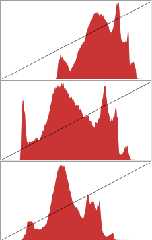
> My point is still that you can't reover what isn't there any more.

Of course, but there is still plenty of information there in that photo,
even in the blue channel.  Attached is the histogram plot for the colour
channels (R top, B bottom), looks like plenty of mid-level blue still there
to me, in fact all pixels have a fair amount of blue in them.

If I just shift the blues a bit brighter, and the reds a bit darker, I get a
pretty good output, but of course as Sabrina said you can do much more funky
transforms to get near perfect looking results.  If you know how the colours
shift during ageing, you simply tell the software one colour that you know
should be white, and it will fix the rest.  Actually Paint Shop Pro has a
"fade correction" option, and it works very well on this photo.
Post a reply to this message
Attachments:
Download 'image4.png' (15 KB)
Preview of image 'image4.png'
|
|
| |
| |
|
|
|
|
| |
| |
|
|
scott wrote:
>> My point is still that you can't reover what isn't there any more.
>
> Of course, but there is still plenty of information there in that photo,
> even in the blue channel.  Attached is the histogram plot for the colour
> channels (R top, B bottom), looks like plenty of mid-level blue still
> there to me, in fact all pixels have a fair amount of blue in them.
>
> If I just shift the blues a bit brighter, and the reds a bit darker, I
> get a pretty good output.

All I know is that when I take a dark image and try to make it brighter,
it comes out hopelessly noisy.

--
http://blog.orphi.me.uk/
http://www.zazzle.com/MathematicalOrchid*
Post a reply to this message
|
|
| |
| |
|
|
|
|
| |
| |
|
|
Invisible wrote:
>>> My point is still that you can't reover what isn't there any more.
>>>
>>
>> Right, but the information is still there, and so it is recoverable.
>
> Heh. Next thing you'll be telling me that you can take a photograph that
> has faded to a plain yellow sheet of paper and somehow "recover" the
> image that used to be on it. :-P
>

I have seen a originally black&white photograph (from somewhere of 20th
century beginning, 1920 oslt), which got just scanned and printed with
color printer - and it actually did got some colors. You could see the
color on persons face as well as she was wearing a blue dress. That was
something that really amazed me.

--
Eero "Aero" Ahonen
    http://www.zbxt.net
       aer### [at] removethiszbxtnetinvalid
Post a reply to this message
|
|
| |
| |
|
|
|
|
| |
| |
|
|
> All I know is that when I take a dark image and try to make it brighter,
> it comes out hopelessly noisy.

That is probably because you took it with a camera that is already
hopelessly noisy, of course brightening it digitally is just going to
amplify the noise too.

Try playing about with a better photo, (googling "photo" is a start!),
darken it by a factor of 4, then lighten it back to its original.  Hardly
any noise visible.
Post a reply to this message
|
|
| |
| |
|
|
|
|
| |
| |
|
|
>> All I know is that when I take a dark image and try to make it
>> brighter, it comes out hopelessly noisy.
>
> That is probably because you took it with a camera that is already
> hopelessly noisy, of course brightening it digitally is just going to
> amplify the noise too.

Well, my camera *is* quite noisy. (More precisely: my camera takes very
dark pictures unless used in insanely bright lighting conditions, or on
a very long exposure.) I quickly learned that there is really no point
attempting to take the beer-like shots it takes and make then viewable.
All you get is signal noise.

But then, isn't film inherantly noisy too? And especially a scanned
image, complete with dust and a rough surface...

> Try playing about with a better photo, (googling "photo" is a start!),
> darken it by a factor of 4, then lighten it back to its original.
> Hardly any noise visible.

Heh, not even DCT artifacts? :-P

--
http://blog.orphi.me.uk/
http://www.zazzle.com/MathematicalOrchid*
Post a reply to this message
|
|
| |
| |
|
|
|
|
| |
| |
|
|
> But then, isn't film inherantly noisy too?

Not really, not in the way digital image sensors are.

> Heh, not even DCT artifacts? :-P

No, just some banding in the sky due to you effectively losing the last 2
least significant bits of data.

BTW, on a lot of digital cameras now you can save your images in "raw"
format, which is usually 12-bit per channel.  That way you can make your
colour/contrast/brightness adjustments and still have the full 8-bit output
possible without any loss of a bit or two.
Post a reply to this message
|
|
| |
| |
|
|
|
|
| |
| |
|
|
>> But then, isn't film inherantly noisy too?
>
> Not really, not in the way digital image sensors are.

Really? I thought film was well-known for being grainy at low light
levels...

>> Heh, not even DCT artifacts? :-P
>
> No, just some banding in the sky due to you effectively losing the last
> 2 least significant bits of data.

I'll have to try it at some point I guess.

> BTW, on a lot of digital cameras now you can save your images in "raw"
> format, which is usually 12-bit per channel.

My camera isn't that expensive.

(Kinda amusing how not denying access to data is a "feature", eh?)

--
http://blog.orphi.me.uk/
http://www.zazzle.com/MathematicalOrchid*
Post a reply to this message
|
|
| |
| |
|
|
|
|
| |
| |
|
|
> Really? I thought film was well-known for being grainy at low light
> levels...

Yes, but a cheap film camera with ISO100 loaded will display orders of
magnitude less noise compared to even a moderately priced digital camera.

> (Kinda amusing how not denying access to data is a "feature", eh?)

But the data never exists as a whole in the first place in cheap cameras.
The demosaic/compression chip will work on groups of lines at a time and
spurt them out to the file-write buffer.  If you tried to simply pass the
raw data through you'd need a much bigger buffer and possibly faster
file-writing electronics (unless you're happy to wait 3x-6x longer for each
write).

Also they would need to include some RAW conversion software with the
camera, which needs writing.
Post a reply to this message
|
|
| |
| |
|
|
|
|
| |
| |
|
|
"scott" <sco### [at] scottcom> a écrit dans le message de news:
48884e9a$1@news.povray.org...
>
> But the data never exists as a whole in the first place in cheap cameras.

Actually it does exist, at least in Canon cameras. There's even a hack to
get the RAW data instead of the JPEG.
http://www.oyonale.com/blog/2008/03/hacking-cheap-canon-camera.html

>Also they would need to include some RAW conversion software with the
>camera, which needs writing.

I guess that Canon wrote RAW converters for its SLR models. Also, they
bundle a mountainload of crappy, useless "utilities" with the camera anyway,
so it's not like they're lacking developers. Really, this is a case study of
hardware being deliberately crippled through software for marketing reasons.

G.
Post a reply to this message
|
|
| |
| |
|
|
|
|
| |
| |
|
|
And lo on Thu, 24 Jul 2008 10:21:19 +0100, Invisible <voi### [at] devnull> did
spake, saying:

>>> But then, isn't film inherantly noisy too?
>>  Not really, not in the way digital image sensors are.
>
> Really? I thought film was well-known for being grainy at low light
> levels...

Depends on the film, if I take a good photo using ISO200 film at 1/60th of
a second I can can get the same exposure with the less grainy ISO100 by
shooting at 1/30th or even ISO50 for 1/15th. Of course leaving the shutter
open that long may not be what I want so I could switch to ISO400 for
1/120th.

The larger the ISO the larger the grains in the film that react to light
so the grainier it gets. Digital cameras don't have grains though, they
have fixed-sized sensors. So to emulate the sensitivity they just up the
gain and well you know what happens when you do that for tiny sensors.

--
Phil Cook

--
I once tried to be apathetic, but I just couldn't be bothered
http://flipc.blogspot.com
Post a reply to this message
|
|
| |
| |
|
|
|
|
| |
| |
|
|
On Thu, 24 Jul 2008 08:57:40 +0100, Invisible wrote:

>>> My point is still that you can't reover what isn't there any more.
>>>
>>>
>> Right, but the information is still there, and so it is recoverable.
>
> Heh. Next thing you'll be telling me that you can take a photograph that
> has faded to a plain yellow sheet of paper and somehow "recover" the
> image that used to be on it. :-P

Even more impressively, they've been able to colour films that were
originally shot in B&W.

http://en.wikipedia.org/wiki/Film_colorization

Jim
Post a reply to this message
|
|
| |
| |
|
|
|
|
| |
| |
|
|
On Thu, 24 Jul 2008 10:21:19 +0100, Invisible wrote:

>>> But then, isn't film inherantly noisy too?
>>
>> Not really, not in the way digital image sensors are.
>
> Really? I thought film was well-known for being grainy at low light
> levels...

Depends on the film speed and camera characteristics.

>>> Heh, not even DCT artifacts? :-P
>>
>> No, just some banding in the sky due to you effectively losing the last
>> 2 least significant bits of data.
>
> I'll have to try it at some point I guess.
>
>> BTW, on a lot of digital cameras now you can save your images in "raw"
>> format, which is usually 12-bit per channel.
>
> My camera isn't that expensive.
>
> (Kinda amusing how not denying access to data is a "feature", eh?)

You're not the first to make this observation.  For some cameras, there's
actually alternate firmware you get get that enables this on low-end
cameras that don't expose RAW data to the end user.

Jim
Post a reply to this message
|
|
| |
| |
|
|
|
|
| |
| |
|
|
Jim Henderson wrote:

> Even more impressively, they've been able to colour films that were
> originally shot in B&W.
>
> http://en.wikipedia.org/wiki/Film_colorization

Yeah, but only with human intervention. You don't just press a button
and out pops an image with colours that correctly match the original.

--
http://blog.orphi.me.uk/
http://www.zazzle.com/MathematicalOrchid*
Post a reply to this message
|
|
| |
| |
|
|
|
|
| |
| |
|
|
>> But the data never exists as a whole in the first place in cheap cameras.
>
> Actually it does exist, at least in Canon cameras.

That's because they probably use the same hardware in lots of different
cameras. Again it's all about cost, cheaper to use an existing solution that
is slightly more than they need, rather than to develop a new one.

> Really, this is a case study of hardware being deliberately crippled
> through software for marketing reasons.

It's not marketing reasons, it's purely financial reasons, to make maximum
profit.  Say it costs Canon $100 to make each camera, whether crippled or
not.  You have two options:

Option 1: Sell just one model for $150 and make $50 profit on each camera

Option 2: Sell a crippled version for $125 and a non-crippled one for $200.
If you choose those two prices correctly, you will make more profit.

Companies realise that option 2 is likely to make them much more profit, you
get sales from all the people who couldn't afford $150 before, plus you get
sales from people who think that because it's $200 it must be better than a
$150 camera from another company, and obviously it's better than your $125
you are selling.
Post a reply to this message
|
|
| |
| |
|
|
|
|
| |
| |
|
|
On Thu, 24 Jul 2008 16:13:21 +0100, Invisible wrote:

> Jim Henderson wrote:
>
>> Even more impressively, they've been able to colour films that were
>> originally shot in B&W.
>>
>> http://en.wikipedia.org/wiki/Film_colorization
>
> Yeah, but only with human intervention. You don't just press a button
> and out pops an image with colours that correctly match the original.

As the original is B&W, that doesn't make sense...

But colourization technology has advanced somewhat since the earliest
films (and in all honesty, the earliest colourized films that I saw were
pretty crap anyways).

But even with colour correction in cameras, the best results usually
involve human intervention.

Jim
Post a reply to this message
|
|
| |
| |
|
|
|
|
| |
| |
|
|
>> Yeah, but only with human intervention. You don't just press a button
>> and out pops an image with colours that correctly match the original.
>
> As the original is B&W, that doesn't make sense...

I meant you can't just give a machine a BW picture of a tree and have it
automatically know to turn it green. That's impossible. You must have a
human there, and they must know what the hell the colours are supposed
to be.

--
http://blog.orphi.me.uk/
http://www.zazzle.com/MathematicalOrchid*
Post a reply to this message
|
|
| |
| |
|
|
|
|
| |
| |
|
|
"scott" <sco### [at] scottcom> a écrit dans le message de news:
48889cb8@news.povray.org...
> Companies realise that option 2 is likely to make them much more profit,
> you get sales from all the people who couldn't afford $150 before, plus
> you get sales from people who think that because it's $200 it must be
> better than a $150 camera from another company, and obviously it's better
> than your $125 you are selling.

Some of the crippled features only exist in uncrippled form in the high-end,
much more expensive SLRs, that have specific hardware features (namely the
abiility to have different and much better lenses and the SRL system itself)
that cater to different people. Both lines of products do not compete with
each other: they're different markets (with a small line of "bridge" cameras
filling the gap). If Canon had left RAW support in the point-and-shoot
digicams, that would not have prevented power users to buy SLRs.

In the end it surely comes down to money and I'm pretty sure that they ran
simulations about this, but the true rationale still looks like real
marketing to me: Canon judged that a digicam belongs to a market segment
that doesn't need (or even understand) RAW support and other fancy high-end
features, so they took those features off of the list to keep their product
lines neatly separated.

G.
Post a reply to this message
|
|
| |
| |
|
|
|
|
| |
| |
|
|
On Thu, 24 Jul 2008 18:29:54 +0200, Gilles Tran wrote:

> If Canon had left RAW support in the
> point-and-shoot digicams, that would not have prevented power users to
> buy SLRs.

It isn't so much that they didn't leave the support in, they disabled it
specifically in the lower-end cameras.  At least according to what I've
read.

Jim
Post a reply to this message
|
|
| |
| |
|
|
|
|
| |






