 |
|
|
|
|
|
| |
| |
|
|
|
|
| |
| |
|
|
andrel wrote:

> It is not only the number of colours, There was also the hardware to
> animate them at 25 frames per second.

Or, indeed, 576 scanlines per frame. ;-)

--
http://blog.orphi.me.uk/
http://www.zazzle.com/MathematicalOrchid*
Post a reply to this message
|
|
| |
| |
|
|
|
|
| |
| |
|
|
On 22-Jul-08 13:54, John VanSickle wrote:
> Invisible wrote:
>
>> Unfortunately, then the Amiga's hardware stood still for 20 years.
>> While it was once a shining example of hardware far ahead of its time,
>> it has long since been left in the dust. I don't really understand how
>> it happened, but Commodore ended up in all sorts of financial trouble.
>> Commodore was good it making great hardware, but hopeless at marketing
>> it.
>
> The management at Commodore should take all of the blame for the fall of
> Commodore.  Developing killer new technology should have been top
> priority.  Hindsight being 20-20, they should have designed the OS with
> the highest possible degree of resource management (IE, not assume that
> all graphics would be 8-bit forever), and then opened up the hardware
> architecture and allowed clones.
>
> As it was, some of the later CEOs did nothing more than collect their
> salaries.

The Amiga was the de facto standard for television quality broadcasting,
as many have also mentioned. What they should have done was pair up with
one of the groups that were defining HDTV and force a new TV standard.
That should have gotten rid of the deadlock that nobody was buying HDTV
sets because there was no broadcasting. Just make the displays first for
computers in that format. Create movies in that format that can be
played on that machine. Then build a settop box that can receive
broadcasts. I still think we could have had HDTV 10 years ago in this
way with a logical path to internet connectivity. Today, TV standards
are still a mess and not ready for the 21rst century.
Post a reply to this message
|
|
| |
| |
|
|
|
|
| |
| |
|
|
That was a compelling monologue. You brought us from the pits of
computational hardship all the way to the clear mountaintops of current
home computing. Good job!

Invisible wrote:
> Then there were ground-breaking AF coverdisks like Imagine 2, Real3D,

Ugh, not Real3D! That was my *first* introduction to 3D graphics, and
let me tell you I was *not* impressed. Back in '97-'98 it had no
raytracing support, and the other features were all very disappointing.
'Refraction' was simply an environment map applied to the inside of an
object... no attempt was made to distort pre-rendered objects behind the
refractive one. And then there was the problem of surfaces shadowing
themselves. Strange, dark-gray lines running along a surface when you
want it to be smooth can really piss you off, especially when it takes
so long for the program to compute and render the image in the first place.

> - Sophisticated image processing software such as The GIMP can be
> obtained *for free*!
>
> - 3D graphics rendering requires nothing more than a copy of POV-Ray.
> Again, where Imagine 4 retailed for £800, POV-Ray is *free*.
>
> - Complex sound editing software such as Audacity is *free*.

Thank goodness for the open-source movement!

> In fact, it seems that only high-end, professional audio and video tools
> actually cost money any more. (I'm thinking... Cubase, Cakewalk,
> Photoshop, Renderman, and so forth.)

Since you mention Cakewalk in your list of commercial apps, let me
mention JazzWare as a free alternative to it. ModPlugTracker is another
one, though it's quite different.

Sam
Post a reply to this message
|
|
| |
| |
|
|
|
|
| |
| |
|
|
stbenge wrote:
> That was a compelling monologue. You brought us from the pits of
> computational hardship all the way to the clear mountaintops of current
> home computing. Good job!

Why thank you! I'm glad somebody enjoyed me slacking off for the entire
morning as much as I did. ;-)

> Invisible wrote:
>> Then there were ground-breaking AF coverdisks like Imagine 2, Real3D,
>
> Ugh, not Real3D! That was my *first* introduction to 3D graphics, and
> let me tell you I was *not* impressed. Back in '97-'98 it had no
> raytracing support, and the other features were all very disappointing.
> 'Refraction' was simply an environment map applied to the inside of an
> object... no attempt was made to distort pre-rendered objects behind the
> refractive one. And then there was the problem of surfaces shadowing
> themselves. Strange, dark-gray lines running along a surface when you
> want it to be smooth can really piss you off, especially when it takes
> so long for the program to compute and render the image in the first place.

Mmm, interesting. I never had any problems with it. I still have the
coverdisk laying around somewhere I think. And the little manual they
gave away with it. (Written by Amiga Format, not Real Software Inc.) It
was my first introduction to ray tracing and CSG. (And basically
modelling without triangles.)

Of course, using a point-and-click interface, it's not possible to do
POV-Ray style tricks like positioning a sphere exactly at the end of a
cylinder... the CLI has plus points! ;-)

Unfortunately I can't find it anywhere online, but Real3D had a rather
nice set of glassware showing off the refraction capabilities.

Now Imagine 3D was another matter. You had to add objects to the scene
in a certain order (!!) in order for them to reflect. As in, the
reflective objects had to be added last. Any object added after the
reflective one would cast no reflections. God only knows what happens if
you want recursive reflections...

> Thank goodness for the open-source movement!

Yeah - I'm still puzzled by all that. The Amiga had a strong "shareware"
scene, but I'm puzzled by this sudden new craze of giving away
fully-supported commercial-grade software (sometimes that *was*
commercial!) for free. It suddenly seems to be the "trendy" thing to do,
and I'm not really sure how that happened.

Not that I'm complaining about it mind you!

>> In fact, it seems that only high-end, professional audio and video
>> tools actually cost money any more. (I'm thinking... Cubase, Cakewalk,
>> Photoshop, Renderman, and so forth.)
>
> Since you mention Cakewalk in your list of commercial apps, let me
> mention JazzWare as a free alternative to it. ModPlugTracker is another
> one, though it's quite different.

I already own Cubase, but thanks. ;-)

Actually, if anybody knows of a good freeware software synthesizer and
sequencer that's easy to set up (ideally zero-install) and runs on
Windoze, I'd be interested. Sometimes when you're using a strange PC,
it's nice to be able to just throw out a few bars of music using only
what you have on your USB stick...

--
http://blog.orphi.me.uk/
http://www.zazzle.com/MathematicalOrchid*
Post a reply to this message
|
|
| |
| |
|
|
|
|
| |
| |
|
|
Orchid XP v8 wrote:
>> Invisible wrote:
>>> Then there were ground-breaking AF coverdisks like Imagine 2, Real3D,
>>
>> Ugh, not Real3D!
>
> Mmm, interesting. I never had any problems with it.

Oops, my bad. I was thinking of "Extreme 3D," by Macromedia. That's the
one. It's horrible. I don't think I've ever crashed a program so many times!

> Now Imagine 3D was another matter. You had to add objects to the scene
> in a certain order (!!) in order for them to reflect. As in, the
> reflective objects had to be added last. Any object added after the
> reflective one would cast no reflections. God only knows what happens if
> you want recursive reflections...

I'm glad there are so many choices these days. I don't ever want to
resort to using faked raytracing effects, unless of course, I'm making a
video game or something.

>> Thank goodness for the open-source movement!
>
> Yeah - I'm still puzzled by all that. The Amiga had a strong "shareware"
> scene, but I'm puzzled by this sudden new craze of giving away
> fully-supported commercial-grade software (sometimes that *was*
> commercial!) for free. It suddenly seems to be the "trendy" thing to do,
> and I'm not really sure how that happened.
>
> Not that I'm complaining about it mind you!

When the result is something like what Blender has become, who can
complain? Oh yeah, those people who hate Blender's interface; they
complain. I don't think it's that horrible...

> Actually, if anybody knows of a good freeware software synthesizer and
> sequencer that's easy to set up (ideally zero-install) and runs on
> Windoze, I'd be interested. Sometimes when you're using a strange PC,
> it's nice to be able to just throw out a few bars of music using only
> what you have on your USB stick...

Have you tried searching for browser-based apps in that category? It's a
slim chance you'll find one, but it's worth trying.

Sam
Post a reply to this message
|
|
| |
| |
|
|
|
|
| |
| |
|
|
At some point in prehistory, you may all recall the level of hysteria
around a revolutionary technology known as "multimedia". For several
years, suddenly everything was multimedia-this and multimedia-that. I'm
not sure exactly why, but after a while everybody sort of forgot about
it and went back to their normal lives. But anyway, the Amiga at one
point had several "multimedia construction kits".

One well-known one was Scala. This started out as a simple (but
"powerful") video titling system, to be used with a genlock device.
(Look that up if you don't know what it means.) It later evolved into a
complete system where you could script sounds and animations together to
produce interactive multimedia applications. (Or just do more
complicated video editing, if you desire.)

I recall there was a Scala coverdisk, but I couldn't figure out how to
make it do anything Oh well!


Then there was a program called Vista. (No! Wait! Come back!!) This was,
quite simply, a fractal landscape generator and renderer. You import a
"DEM" (Digital Elevation Map) and Vista adds some fractal noise to
generate a landscape. Vista will then either output this as a polygon
mesh the size of a small planet, or it will render it for you itself.

The native renderer wasn't fantastic, but it was OK. The images
certainly were nothing like "photorealistic", but in later versions of
the software, they started to come moderately close. Indeed, the last
few versions even had trees and other vegetation, and streams running
down the valleys, etc. (The trees were, of course, fractally generated
once again.)

Again, there was a coverdisk containing an early version. While the
graphics it produced weren't sensational, they were fairly fast (e.g.,
10 minutes to render a vast complex landscape), and it was quite fun to
"explore" the islands you created. (The program could *build* DEMs as
well as import real ones, IIRC. But that was disabled in the coverdisk.
Well they gotta make you buy the real thing somehow!)

(Unfortunately, I don't have any images to show you. Suffice it to say
that only later versions featured polygon smoothing, and I don't think
any version had texture mapping or radiosity.)


And then there was AMOS (AMiga OS). I forget how many different editions
were produced - AMOS, Easy AMOS, AMOS Professional, etc. In spite of the
name, it wasn't actually an OS at all. It was a a programming language.

When you buy AMOS Professional, what you get is

- An interpretter for the AMOS language.
- An extensive IDE.
- A set of multimedia tools inclusing almost everything but the kitchen
sink, *all* written in AMOS itself.
- No less than *seven disks* stacked full of multimedia files and demo
programs.

Technically, AMOS is just another dialect of BASIC. It doesn't have line
numbers, does have GOTO and GOSUB, and has procedures and functions,
uses "$" and "#" to distinguish variable datatypes, and IIRC has local
variables if you want them. The core language is no more powerful than that.

However, it has VERY strong multimedia capabilities. If you imagine the
most feature-encrusted lump of software possible, AMOS was like that,
but with bells on.

Want to load a Protracker module and put it on looping play? Two
commands. Want to load an IFF image and cycle the colour map? Two
commands. Want to create 3 independent framebuffers and overlay them?
That's 3 commands. Want to load an animation and play it until the user
presses a mouse key? That's one command.

The thing comes with a paperback manual the size of a Linux bible. (!!!)
One time I did sit down and count the number of commands in the command
index. I checked twice; 809 unique commands, not including the multiple
syntaxes for each command. (!)

There was an entire seperate sublanguage called AMAL (ANimAtion
Language) just for moving sprites around the screen. There was a tool
for capturing and editing mouse movements to make a flight path, and
AMAL could then animate one or more sprites along that path. AMOS also
implements "software sprites", a trick that allows the 8 hardware
sprites to be multiplexed into two-dozen apparently independent elements
onscreen. Automatically.

(Alternatively, BLOBs (BLitter OBjects) do the same thing, with a
different set of restrictions, using the Amiga's specialised BLITER
(BLock Image TransfER) hardware.)

There was also a sprite editor, supporting sprite animations and so
forth. Both the path editor and sprite editor were written in AMOS.

There was also another completely seperate language called... actually,
do you know, I can't even remember! But basically, there was a large,
complex GUI painter tool (written in AMOS), and you could attach short
scripts in this UI sublanguage to every possible mouse event on the GUI.
You paint your GUI, save it, and code your application to load it and
attach scripts to it (by putting the scripts into strings). The scripts
could change visual elements (e.g., make a button change colour when you
click it) and invoke AMOS procedures and so forth.

The vast library of software that came with it included a sprite editor
and animator, a fairly sophisticated sample editor, a GUI painter, an
animation path capture and edit tool, a "resource editor" (you could put
program strings into a file to enable easy localisation), and probably
several other things I've forgotten.

They also apparently ran a competition for users to submit interesting
AMOS programs, and AMOS Professional comes with several disks full of
the results. There was several fractal generators (L-system and
Mandelbrot/Julia), parallax scrolling demos, infinite ball trails... One
natty little program loaded a song and played it, showing some animated
VU meters. (There was a function to get the current intensity of any
channel. Unfortunately, this is just the note on/note off signals, not
actual audio loudness...)

Another even more snazzy program drew a set of disco lights and made
them flash to the rhythem of the music. I immediately took the code
apart to see how it managed to work so well... I discovered that the
colours of the lights were actually *completely random*, and their
apparent synchronisation with the music was completely psychological!
It's amazing what the human brain can do, eh?

There were also at least 3 complete computer games written in AMOS.

- There was a standard "fly a space ship through a cave without getting
killed" thing. (But half way through, the ship rotates and the direction
of scrolling changes. And the levels are actually very large!)

- There was a straight-fowards Tetris clone. (But with some neat
graphical touches. In particular, the screen showed several hundred
colours using Copper trickery that AMOS could do for you automatically.
And as you played the game, these colours slowly scrolled, looking
something like a sunset in the background.) There was even a savable
high-score table!

- There was a board game called Quatro. I forget how you play it, but it
featured an AI that was actually quite hard to beat!

There might even have been more games than this, I can't remember.

AMOS was explicitly designed to allow 3rd party "extensions" to be
written. (In fact the user manual contains detailed step-by-step
descriptions of all the main AMOS data structures involved.) My dad
purchased a few of these:

- CRAFT (Colours, Requesters, Animations, Fractals, Text) added commands
for automatically generating colour blends (think FractInt's palette
editor) and colour-cycling multiple subranges simultaneously. It also
added the ability to invoke AmigaDOS requestors with arbitrary text. But
most of all, it added built-in commands for rendering Mandelbrot/Julia
fractals. (And, obviously, very much faster than interpretted AMOS
code!) There were also some string-processing commands added.

- TOME (which we never actually owned) was ment to provide a tile-based
level editor and commands to make it trivial to build platform-style
computer games.

- IntOS added the ability to use the Amiga's native Intuition UI system
rather than AMOS's own system. (AMOS was very nice, but it basically
took over the whole machine for itself while running, and wouldn't play
nice with other applications.)

Later the makers releated AMOS The Compiler, which my dad bought. It
came with a selection of compute-intensive demos, which all sped up
drastically when compiled. It also ment you could give your AMOS
programs to people who don't have AMOS. (But the program will basically
hog the whole machine while it's running.)


In the other corner was Blitz Basic. I never really used this very much,
but I did try out an AF coverdisk containing a stripped down version.
While AMOS liked to control the machine itself, Blitz had an explicit
command to completely disable the OS and hit the metal directly. (Hell
only knows what would happen on a modified Amiga!)

As the name somewhat implies, Blitz was designed to be *fast*. There was
a Doom clone written in Blitz at one time. It was called Gloom.

http://www.mobygames.com/game/amiga/gloom/screenshots/gameShotId,71050/

As you can see, the graphics utterly sucked. I actually bought this
game, and was very dissapointed by it. The Amiga Format review praised
the game for being a technical milestone, but basically had nothing else
positive to say about it. I think it got a rating of about 49% overall.
For comparison, the excellent Flashback got 97%.

http://www.mobygames.com/game/dos/flashback-the-quest-for-identity/screenshots/gameShotId,74063/
http://www.mobygames.com/game/dos/flashback-the-quest-for-identity/screenshots/gameShotId,2983/
http://www.mobygames.com/game/jaguar/flashback-the-quest-for-identity/screenshots/gameShotId,27498/
http://www.mobygames.com/game/snes/flashback-the-quest-for-identity/screenshots/gameShotId,117925/

On a blurry old TV, those shots look pretty amazing. And the character
animation is rotoscoped - the first time an Amiga game had had this. The
resulting movement is increadibly fluid and life-like even to this day!

[Yes, I know none of those are Amiga shots. They don't have any. Trust
me, it looked more or less the same.]

The later Universe game was similar:

http://www.mobygames.com/game/amiga/universe/screenshots/gameShotId,32843/
http://www.mobygames.com/game/amiga/universe/screenshots/gameShotId,32844/

Looks horribly dithered now, but on my dad's old TV it really looked
like half a million colours. I was astounded that it could look so
real... how times have changed, eh? (I only played a short demo from a
coverdisk.)


And then there was The Settlers.

http://www.mobygames.com/game/dos/serf-city-life-is-feudal/screenshots/gameShotId,74247/
http://www.mobygames.com/game/dos/serf-city-life-is-feudal/screenshots/gameShotId,147479/

(Again, the Amiga shots don't show any actual gameplay, but this is more
or less what it looked like.)

Man, you could spend *hours* playing that game! It was rated Gold by
Amiga Format, and rightly so. There have since been several PC versions,
which me and my dad still play. (Although sadly since going to a
dual-core PC, none of them function for me any more... It was becoming
quite buggy and unreliable anyway.) I still dream that some day I'll
write my own game along these lines...


More nostalgia as I think of it!

--
http://blog.orphi.me.uk/
http://www.zazzle.com/MathematicalOrchid*
Post a reply to this message
|
|
| |
| |
|
|
|
|
| |
| |
|
|
Orchid XP v8 wrote:
>>> OK, that's just absurd. The sofa and the rug are *exactly* the same
>>> colour. How the hell can the machine tell them apart? Additionally, how
>>> on earth can it tell what colour they were originally? That's
>>> impossible...
>>
>> Except it clearly isn't impossible, because it was done.
>
> Well yeah, OK, I rephrase: It defies explanation.
>
>> Adjusting the white balance of the photo involves picking out
>> something that actually is/was white (like the white on the baby's
>> shirt).  That gives the computer a reference to make the adjustments
>> from.  When photos age, they tend to age consistently and the colours
>> adjust with consistency.  The computer basically is doing an "undo" on
>> the age effect applied by real life.
>
> But surely no scanner on Earth has sufficient resolution that you can
> amplify a signal by many orders of magnitude and not be swamped by
> noise? The photo posted contains almost no blue whatsoever, so you'd
> have to apply a ridiculous amount of gain to that channel...
>

The picture is an older, sorta analogue media, it does not fade it's
colors the same way a bitmap would if bitmaps actually faded. It is so
predictable, in fact, that baring strange papers and processing, it is
very easy to correct for. Just treat the picture as if the lighting it
was shot with was different from normal daylight of around 5500 K.

In effect, the computer doesn't boost the blue channel, it uses a damned
"nonlinear colourspace transformations".
Post a reply to this message
|
|
| |
| |
|
|
|
|
| |
| |
|
|
Gilles Tran wrote:
> On the version I got with Vista controlling the transitions is just done
> by pulling them with the mouse and zooming in the timeline for more
> precise control.

If I understand correctly what you're describing... Same in XP, FWIW.
Post a reply to this message
|
|
| |
| |
|
|
|
|
| |
| |
|
|
Invisible wrote:
> Yep. There's only so much that human senses can perceive. ;-)

I can see banding in grayscale POV-Ray renders. I checked with an image
editor and there is no color level skipped. So I see the difference between
rgb(42,42,42) and rgb(43,43,43).
Post a reply to this message
|
|
| |
| |
|
|
|
|
| |
| |
|
|
Invisible wrote:
> Now there's interesting. Do you have a reference for that? Last I heard,
> DVD audio typically has lossy compression applied to it...

It does, so what. It's 48kHz anyway. MP3 is usually 44.1kHz, DVDs use 48kHz
MP2 audio.
Post a reply to this message
|
|
| |
| |
|
|
|
|
| |
| |
|
|
Orchid XP v8 wrote:
> Of course, using a point-and-click interface, it's not possible to do
> POV-Ray style tricks like positioning a sphere exactly at the end of a
> cylinder... the CLI has plus points! ;-)

Of course that's possible with a point-and-click interface. I never used any
remotely-decent modeller, but I'm sure Google SketchUp lets you do that.

(in my opinion, the CLI *still* has plus points; but you're wrong about that
specific feature)
Post a reply to this message
|
|
| |
| |
|
|
|
|
| |
| |
|
|
Mike Raiford wrote:
> Invisible wrote:
>
>> With enough preprocessing, an AGA Amiga can basically display 24-bit
>> graphics. It just has to be encoded cleaverly. Recall that at this
>> point in history, PCs were still lumbering around with EGA or maybe,
>> if you're lucky, VGA. Ooo, 16 colours. Wow. :-P
>
> What? Back in 1990 I had a PC with a VGA and it could display 256 (out
> of 262,144) colors at 320x200. It was a Paradise card, so it could
> actually do 256 at 640x480, 16 at 800x600. Of course, sound was


It was only 91 or 92 and I had some card with an Oak chip that could do
24bit SVGA up to 1024x768.  It didn't actually have enough memory for
that, so you *had* to go with a lower bit depth at that resolution, but
still :)

And it had all those fancy bit-blitting modes, as well.  I read through
the specs once, and was astounded at all the things they thought to add in.

Of course, my Sound Blaster was the one that had two OPL chips for
better synthesis.

And my CPU was a measly little 486sx... When I finally upgraded to an
FPU, I was astounded to see POV-Ray trace the RSOCP with double digit PPS :)

Anyway, I think the only real problem with performance in PCs is the
non-standardization.  Every Amiga XXX had the exact same performance
characteristics.  Every PC was different, and had different bottlenecks.
  As a result, some programs would run well on one PC and not another,
and other programs would be the exact opposite.  Just like today ;)

...Chambers
Post a reply to this message
|
|
| |
| |
|
|
|
|
| |
| |
|
|
> Well... it looks fine to me, that's all I'm saying. ;-)

But "fine" is nowhere near what you see in real life.  While there is still
an obvious gap between real life and what you can reproduce, there will no
doubt be improvements in the future.

> OK, well that's pretty weird. I wonder why they suddenly changed it to 48
> kHz then...?

Well don't forget, that there was nothing widespread before DVD that
recorded films in a digital format.  For some reason 48 kHz was pretty
standard in the music recording industry, even after CD came along with it's
lower sampler rate.  I guess in the film industry they stuck with 48 kHz (as
films were obviously never put onto CDs), but then when DVD came along it
made sense to have a 48 kHz soundtrack if everything was recorded at 48 kHz
anyway.
Post a reply to this message
|
|
| |
| |
|
|
|
|
| |
| |
|
|
> Of course, using a point-and-click interface, it's not possible to do
> POV-Ray style tricks like positioning a sphere exactly at the end of a
> cylinder...

Of course it is.  You can even tell it that the sphere is referenced to that
point on the cylinder, and to make the radii equal.  So when you change the
cylinder length or radius, the sphere changes position and radius to match.

You've never really used a modeller have you?
Post a reply to this message
|
|
| |
| |
|
|
|
|
| |
| |
|
|
> For comparison, the excellent Flashback got 97%.

Oh I loved flashback, I think it was one of the first games that I actually
spent a long continuous amount of time playing until I finished it.  But I
got stuck right at the end (I think I said that before in here and someone
told me what I missed).
Post a reply to this message
|
|
| |
| |
|
|
|
|
| |
| |
|
|
> The real point is more that on a PC, just switching from one window to
> another always seemed to take forever, whereas on an Amiga it was
> instantaneous unless the machine was under heavy load.

Yeh, I remember my friend had a 33 MHz PC, and just closing a window it took
several seconds for his desktop wallpaper to repaint itself, slowly scanning
down the screen line-by-line.  I think the difference was, that Windows was
always designed to use the hard disc as additional RAM, whereas the Acorn
was specifically designed not to do this.  Of course it meant you sometimes
had to quit applications if you ran out of RAM, but it also meant that you
never got slowed down by the OS thrashing the hard disc.  In fact, if you
didn't want anything extra loaded at startup, the hard disc wouldn't be
accessed at all.

They also ported some really cool vector art package that was originally
written for the Acorn (I think it was called Artworks on the Acorn and Xara
on the PC).  At some computer show I went to they had both packages running
on a latest Acorn and PC at the time, and of course the Acorn was something
like 8x faster at drawing complex shapes with lots of graduated fills and
transparency.  It had fininshed drawing the entire picture, while the PC was
still drawing the background fills.
Post a reply to this message
|
|
| |
| |
|
|
|
|
| |
| |
|
|
andrel wrote:

> The Amiga was the de facto standard for television quality broadcasting,
> as many have also mentioned.

Really? De facto? I mean, I know it was used by a few people, but I
didn't think it had reached the level of "standard". (But obviously, I
don't work in TV.)

--
http://blog.orphi.me.uk/
http://www.zazzle.com/MathematicalOrchid*
Post a reply to this message
|
|
| |
| |
|
|
|
|
| |
| |
|
|
Chambers wrote:

> Every Amiga XXX had the exact same performance characteristics.

In a way, this ended up being the Amiga's doom; as soon as you modify an
Amiga in any way, lots of software breaks (most especially games). Don't
get me wrong, the software that follows the rules works just fine - but
why ask the OS to do something when you already "know" what the hardware is?

--
http://blog.orphi.me.uk/
http://www.zazzle.com/MathematicalOrchid*
Post a reply to this message
|
|
| |
| |
|
|
|
|
| |
| |
|
|
>> OK, well that's pretty weird. I wonder why they suddenly changed it to
>> 48 kHz then...?
>
> Well don't forget, that there was nothing widespread before DVD that
> recorded films in a digital format.  For some reason 48 kHz was pretty
> standard in the music recording industry, even after CD came along with
> it's lower sampler rate.  I guess in the film industry they stuck with
> 48 kHz (as films were obviously never put onto CDs), but then when DVD
> came along it made sense to have a 48 kHz soundtrack if everything was
> recorded at 48 kHz anyway.

Well CDs use the obscure rate of 44.1 kHz. Not 44 kHz, but 44.1 kHz.
Apparently this is due to some historical reasoning that I forget now. I
guess DVD uses 48 kHz for a similar reason...

--
http://blog.orphi.me.uk/
http://www.zazzle.com/MathematicalOrchid*
Post a reply to this message
|
|
| |
| |
|
|
|
|
| |
| |
|
|
Nicolas Alvarez wrote:

> I can see banding in grayscale POV-Ray renders. I checked with an image
> editor and there is no color level skipped. So I see the difference between
> rgb(42,42,42) and rgb(43,43,43).

Hooookay then... Apparently I'm blind. :-P

(Now my laptop? That only has 12-bit display with hardware dithering. Do
you have ANY IDEA how ANNOYING that is??)

--
http://blog.orphi.me.uk/
http://www.zazzle.com/MathematicalOrchid*
Post a reply to this message
|
|
| |
| |
|
|
|
|
| |
| |
|
|
>> Mmm, interesting. I never had any problems with it.
>
> Oops, my bad. I was thinking of "Extreme 3D," by Macromedia. That's the
> one. It's horrible. I don't think I've ever crashed a program so many
> times!

Ah, OK. Not heard of that one...

>> Now Imagine 3D was another matter. You had to add objects to the scene
>> in a certain order (!!) in order for them to reflect. As in, the
>> reflective objects had to be added last. Any object added after the
>> reflective one would cast no reflections. God only knows what happens
>> if you want recursive reflections...
>
> I'm glad there are so many choices these days. I don't ever want to
> resort to using faked raytracing effects, unless of course, I'm making a
> video game or something.

Oh, don't get me wrong. Imagine 3D was quite a nice program. Just don't
expect reflection or refraction to work properly! Everything else works
though...

>> Actually, if anybody knows of a good freeware software synthesizer and
>> sequencer that's easy to set up (ideally zero-install) and runs on
>> Windoze, I'd be interested. Sometimes when you're using a strange PC,
>> it's nice to be able to just throw out a few bars of music using only
>> what you have on your USB stick...
>
> Have you tried searching for browser-based apps in that category? It's a
> slim chance you'll find one, but it's worth trying.

Yeah, or maybe I just need to sit down and write something in Java... ;-)

[I'd use Haskell, but I can't get the bindings for libSDL to work. At
least, not on Windoze. Works fine on Linux...]

--
http://blog.orphi.me.uk/
http://www.zazzle.com/MathematicalOrchid*
Post a reply to this message
|
|
| |
| |
|
|
|
|
| |
| |
|
|
> Well CDs use the obscure rate of 44.1 kHz. Not 44 kHz, but 44.1 kHz.
> Apparently this is due to some historical reasoning that I forget now.

I suspect it has to do with syncing with pre-existing video signals.

> I guess DVD uses 48 kHz for a similar reason...

48 kHz was already standard in recording studios on DAT tapes, and I assume
it was also used for movie sound.  So that is why DVD used 48 kHz, but where
that frequency came from in the first place I don't know.  48 kHz is quite a
nice round number, so I guess they just made it up.
Post a reply to this message
|
|
| |
| |
|
|
|
|
| |
| |
|
|
Nicolas Alvarez wrote:

> (in my opinion, the CLI *still* has plus points; but you're wrong about that
> specific feature)

...such as being able to design your own particle system? ;-)

--
http://blog.orphi.me.uk/
http://www.zazzle.com/MathematicalOrchid*
Post a reply to this message
|
|
| |
| |
|
|
|
|
| |
| |
|
|
scott wrote:
>> Of course, using a point-and-click interface, it's not possible to do
>> POV-Ray style tricks like positioning a sphere exactly at the end of a
>> cylinder...
>
> Of course it is.
>
> You've never really used a modeller have you?

OK, I rephrase: Real3D didn't have this feature. :-P

(BTW... Do you know of any real modellers that do? I realise
theoretically somebody could make such a thing, but do you know of any
real programs that do this?)

--
http://blog.orphi.me.uk/
http://www.zazzle.com/MathematicalOrchid*
Post a reply to this message
|
|
| |
| |
|
|
|
|
| |
| |
|
|
>> I can see banding in grayscale POV-Ray renders. I checked with an image
>> editor and there is no color level skipped. So I see the difference
>> between
>> rgb(42,42,42) and rgb(43,43,43).
>
> Hooookay then... Apparently I'm blind. :-P

It's easier to see the difference on brighter monitors in darker rooms.
Post a reply to this message
|
|
| |
| |
|
|
|
|
| |
| |
|
|
scott wrote:

> Oh I loved flashback, I think it was one of the first games that I
> actually spent a long continuous amount of time playing until I finished
> it.  But I got stuck right at the end (I think I said that before in
> here and someone told me what I missed).

Amiga Format gave away a coverdisk containing almost all of level 1 of
Flashback. After spending a week completing it, it was perfectly clear
that I had to own this game.

My dad eventually purchased the ECS version. I've never played the AGA
version, but it seems some of the cut sequences were much longer and
more detailed.

Unfortunately, attempting to play the ECS version on an AGA machine
results in the audio and video getting out of sync. (Apparently it's
timed according to how fast the graphics can be drawn, so on a more
powerful machine, the graphics draws faster and gets ahead of the
music.) Bit of a pity. Oh, and it doesn't run on my Amiga with its
updated ROM either...

That was a damned fine game. I adored the graphics of the opening level,
although many of the other levels were much less graphically
interesting. The final level was just awesome.

I don't suppose you even have the game any more, but where did you get
stuck?

--
http://blog.orphi.me.uk/
http://www.zazzle.com/MathematicalOrchid*
Post a reply to this message
|
|
| |
| |
|
|
|
|
| |
| |
|
|
>> Well CDs use the obscure rate of 44.1 kHz. Not 44 kHz, but 44.1 kHz.
>> Apparently this is due to some historical reasoning that I forget now.
>
> I suspect it has to do with syncing with pre-existing video signals.

I think you're right.

>> I guess DVD uses 48 kHz for a similar reason...
>
> 48 kHz was already standard in recording studios on DAT tapes, and I
> assume it was also used for movie sound.  So that is why DVD used 48
> kHz, but where that frequency came from in the first place I don't
> know.  48 kHz is quite a nice round number, so I guess they just made it
> up.

Seems plausible at least.

--
http://blog.orphi.me.uk/
http://www.zazzle.com/MathematicalOrchid*
Post a reply to this message
|
|
| |
| |
|
|
|
|
| |
| |
|
|
> (BTW... Do you know of any real modellers that do? I realise theoretically
> somebody could make such a thing, but do you know of any real programs
> that do this?)

http://en.wikipedia.org/wiki/Parametric_feature_based_modeler

The property you're after is "paremetric modelling", where instead of only
being able to assign numerical dimensions, you can apply rules and formulae
based on any other dimensions.  Commonly you can do things like "make sure
this face remains parallel to this one", or "make this radius half of this
dimension" etc.  Then of course when you change one thing, everything else
updates.
Post a reply to this message
|
|
| |
| |
|
|
|
|
| |
| |
|
|
>> (BTW... Do you know of any real modellers that do? I realise
>> theoretically somebody could make such a thing, but do you know of any
>> real programs that do this?)
>
> http://en.wikipedia.org/wiki/Parametric_feature_based_modeler
>
> The property you're after is "paremetric modelling", where instead of
> only being able to assign numerical dimensions, you can apply rules and
> formulae based on any other dimensions.  Commonly you can do things like
> "make sure this face remains parallel to this one", or "make this radius
> half of this dimension" etc.  Then of course when you change one thing,
> everything else updates.

I see...

The examples given seem to indicate that this is only a feature of
extremely high-end CAD products though.

--
http://blog.orphi.me.uk/
http://www.zazzle.com/MathematicalOrchid*
Post a reply to this message
|
|
| |
| |
|
|
|
|
| |
| |
|
|
> The examples given seem to indicate that this is only a feature of
> extremely high-end CAD products though.

There was a really good free CAD package called ProDesktop, but they stopped
releasing it a few years back which was a real shame.  Maybe you can somehow
find a copy of it.

A google for "free parametric cad" brings up some candidates, the first one
called "Varkon" looks ok.
Post a reply to this message
|
|
| |
| |
|
|
|
|
| |
| |
|
|
> Amiga Format gave away a coverdisk containing almost all of level 1 of
> Flashback. After spending a week completing it, it was perfectly clear
> that I had to own this game.

Yeh ditto here.

> Unfortunately, attempting to play the ECS version on an AGA machine
> results in the audio and video getting out of sync. (Apparently it's timed
> according to how fast the graphics can be drawn, so on a more powerful
> machine, the graphics draws faster and gets ahead of the music.) Bit of a
> pity. Oh, and it doesn't run on my Amiga with its updated ROM either...

Also ditto here, I had just got one of the new Acorns where they bumped up
the clock to 12 MHz from 8 MHz, but everything else was the same.  I wonder
why timing was so hard back then - I mean surely they could have had
something a little more sophisticated to make sure that things remained
synced.

> I don't suppose you even have the game any more, but where did you get
> stuck?

On the last level, I don't remember how far I got through it, but I vaguely
remember several doors that were blocking my progress and I just couldn't
find anything to give me any clues what to do next.  I spent *days* going
back to it and literally covering every part of the walls and floors I had
access to, still nothing so I gave up.  IIRC somebody here (maybe you) told
me what I was missing a while back...
Post a reply to this message
|
|
| |
| |
|
|
|
|
| |
| |
|
|
scott wrote:

> Also ditto here, I had just got one of the new Acorns where they bumped
> up the clock to 12 MHz from 8 MHz, but everything else was the same.  I
> wonder why timing was so hard back then - I mean surely they could have
> had something a little more sophisticated to make sure that things
> remained synced.

Sloppy programming.

The music stays synchronised because it uses one of the hardware timers.
The graphcs don't because it relies on the CPU drawing them at a
specific speed.

Flashback also made the disk drive spin continuously to detect when a
disk was inserted - completely unecessary and probably deterimental to
the drive mechanisms.

> On the last level, I don't remember how far I got through it, but I
> vaguely remember several doors that were blocking my progress and I just
> couldn't find anything to give me any clues what to do next.  I spent
> *days* going back to it and literally covering every part of the walls
> and floors I had access to, still nothing so I gave up.  IIRC somebody
> here (maybe you) told me what I was missing a while back...

Heh. I wonder if I could get an emulator working and play Flashback? ;-)

--
http://blog.orphi.me.uk/
http://www.zazzle.com/MathematicalOrchid*
Post a reply to this message
|
|
| |
| |
|
|
|
|
| |
| |
|
|
And lo on Tue, 22 Jul 2008 15:15:33 +0100, Gilles Tran
<gil### [at] agroparistech fr> did spake, saying:
> On the version I got with Vista
As I've not had opportunity to play with WMM on Vista do you know if
they've fixed that rotate bug whereby a full-frame 640x480 movie is
rotated 90° into a full-frame 640x480 movie? IOW stretched.
--
Phil Cook
--
I once tried to be apathetic, but I just couldn't be bothered
http://flipc.blogspot.com fr> did spake, saying:
> On the version I got with Vista
As I've not had opportunity to play with WMM on Vista do you know if
they've fixed that rotate bug whereby a full-frame 640x480 movie is
rotated 90° into a full-frame 640x480 movie? IOW stretched.
--
Phil Cook
--
I once tried to be apathetic, but I just couldn't be bothered
http://flipc.blogspot.com
Post a reply to this message
|
|
| |
| |
|
|
|
|
| |
| |
|
|
And lo on Wed, 23 Jul 2008 08:50:07 +0100, scott <sco### [at] scottcom> did
spake, saying:

>> The real point is more that on a PC, just switching from one window to
>> another always seemed to take forever, whereas on an Amiga it was
>> instantaneous unless the machine was under heavy load.
>
> Yeh, I remember my friend had a 33 MHz PC, and just closing a window it
> took several seconds for his desktop wallpaper to repaint itself, slowly
> scanning down the screen line-by-line.

Another obvious case of False Memory Syndrome.

> They also ported some really cool vector art package that was originally
> written for the Acorn (I think it was called Artworks on the Acorn and
> Xara on the PC).  At some computer show I went to they had both packages
> running on a latest Acorn and PC at the time, and of course the Acorn
> was something like 8x faster at drawing complex shapes with lots of
> graduated fills and transparency.  It had fininshed drawing the entire
> picture, while the PC was still drawing the background fills.

Ah but was the Artworks-derived Xara for the PC really comparable to
Artworks on the Acorn or is it just another Blender to Paint comparison?

;-)

--
Phil Cook

--
I once tried to be apathetic, but I just couldn't be bothered
http://flipc.blogspot.com
Post a reply to this message
|
|
| |
| |
|
|
|
|
| |
| |
|
|
On Wed, 23 Jul 2008 10:08:44 +0200, Invisible <voi### [at] devnull> wrote:
> Well CDs use the obscure rate of 44.1 kHz. Not 44 kHz, but 44.1 kHz.
> Apparently this is due to some historical reasoning that I forget now.

http://en.wikipedia.org/wiki/Red_Book_(audio_CD_standard)#Technical_details
http://en.wikipedia.org/wiki/PCM_adaptor#How_a_PCM_adaptor_works


--
FE
Post a reply to this message
|
|
| |
| |
|
|
|
|
| |
| |
|
|
Sabrina Kilian wrote:

> In effect, the computer doesn't boost the blue channel, it uses a damned
> "nonlinear colourspace transformations".

My point is still that you can't reover what isn't there any more.

--
http://blog.orphi.me.uk/
http://www.zazzle.com/MathematicalOrchid*
Post a reply to this message
|
|
| |
| |
|
|
|
|
| |
| |
|
|
>> Well CDs use the obscure rate of 44.1 kHz. Not 44 kHz, but 44.1 kHz.
>> Apparently this is due to some historical reasoning that I forget now.
>
> http://en.wikipedia.org/wiki/Red_Book_(audio_CD_standard)#Technical_details
> http://en.wikipedia.org/wiki/PCM_adaptor#How_a_PCM_adaptor_works

...so it's derived from old PAL video timings? :-D

(Kinda like the way many old 8-bit home computers have different CPU
speed depending on whether it's PAL or NTSC...)

--
http://blog.orphi.me.uk/
http://www.zazzle.com/MathematicalOrchid*
Post a reply to this message
|
|
| |
| |
|
|
|
|
| |
| |
|
|
On 23-Jul-08 10:02, Invisible wrote:
> andrel wrote:
>
>> The Amiga was the de facto standard for television quality
>> broadcasting, as many have also mentioned.
>
> Really? De facto? I mean, I know it was used by a few people, but I
> didn't think it had reached the level of "standard". (But obviously, I
> don't work in TV.)

At that time no other machine came close to broadcast quality nor was
there hardware genlock support on another machine (at least for an
affordable prize), so anybody who did anything with TV used one. Just as
the Mac was the standard for DTP and (I think) the Atari for MIDI.
Post a reply to this message
|
|
| |
| |
|
|
|
|
| |
| |
|
|
Orchid XP v8 <voi### [at] devnull> wrote:
> (Kinda like the way many old 8-bit home computers have different CPU
> speed depending on whether it's PAL or NTSC...)

  Not CPU speed, screen refresh rate.

  The screen refresh rate in PAL areas is 50 FPS because the frequency
of the alternate current from the wall socket is 50 Hz. In NTSC areas
the frequency is 60 Hz, and thus the screen refresh rate is 60 FPS.

--
                                                          - Warp
Post a reply to this message
|
|
| |
| |
|
|
|
|
| |
| |
|
|
>> Really? De facto? I mean, I know it was used by a few people, but I
>> didn't think it had reached the level of "standard". (But obviously, I
>> don't work in TV.)
>
> At that time no other machine came close to broadcast quality nor was
> there hardware genlock support on another machine (at least for an
> affordable prize), so anybody who did anything with TV used one. Just as
> the Mac was the standard for DTP and (I think) the Atari for MIDI.

Heh. Well OK. Personally my Amiga was my introduction to MIDI. ;-)

As an aside: It's amazing how music suddenly sounds "professional" when
played using a sequencer, so that by definition it has perfect timing.

--
http://blog.orphi.me.uk/
http://www.zazzle.com/MathematicalOrchid*
Post a reply to this message
|
|
| |
| |
|
|
|
|
| |
| |
|
|
>> (Kinda like the way many old 8-bit home computers have different CPU
>> speed depending on whether it's PAL or NTSC...)
>
>   Not CPU speed, screen refresh rate.

http://en.wikipedia.org/wiki/C64

"CPU: MOS Technology 6510 @ 1.02 MHz (NTSC) / 0.985 MHz (PAL)"

>   The screen refresh rate in PAL areas is 50 FPS because the frequency
> of the alternate current from the wall socket is 50 Hz. In NTSC areas
> the frequency is 60 Hz, and thus the screen refresh rate is 60 FPS.

I'm guessing the variance is due to the need of the video subsystem to
access the framebuffer at a specific rate, hence the RAM data bus needs
to be an integral multiple of the scanrate or something...

--
http://blog.orphi.me.uk/
http://www.zazzle.com/MathematicalOrchid*
Post a reply to this message
|
|
| |
| |
|
|
|
|
| |
| |
|
|
Orchid XP v8 wrote:

> And then there was AMOS (AMiga OS). I forget how many different editions
> were produced - AMOS, Easy AMOS, AMOS Professional, etc. In spite of the
> name, it wasn't actually an OS at all. It was a a programming language.
>
> When you buy AMOS Professional, what you get is
>
> - An interpretter for the AMOS language.
> - An extensive IDE.
> - A set of multimedia tools inclusing almost everything but the kitchen
> sink, *all* written in AMOS itself.
> - No less than *seven disks* stacked full of multimedia files and demo
> programs.
>
> Technically, AMOS is just another dialect of BASIC. It doesn't have line
> numbers, does have GOTO and GOSUB, and has procedures and functions,
> uses "$" and "#" to distinguish variable datatypes, and IIRC has local
> variables if you want them. The core language is no more powerful than
> that.
>
> However, it has VERY strong multimedia capabilities. If you imagine the
> most feature-encrusted lump of software possible, AMOS was like that,
> but with bells on.

...so basically, AMOS was a programming language that utterly *sucked*,
together with an absolutely kick-arse set of multimedia tools and with
killer easy of use. Kind of like VB I guess...

At the time, BASIC was the most powerful programming language I knew.
And boy did I love AMOS! Never got a huge amount *done* with it, but I
spent countless hours tinkering. Looking back on it, it truly was the
most feature-encrusted lump of lead imaginable! Occasionally it would
even malfunction slightly - nearly unheard of for commercial software.
(In fairness, it worked better once I got a harddrive.)

I do still sometimes miss the flexibility of just being able to say
"PLOT 7, 3, 11" and write a pixel to the screen. It's *way* more
complicated than that these days. Kinda puts you off writing anything
graphical...

--
http://blog.orphi.me.uk/
http://www.zazzle.com/MathematicalOrchid*
Post a reply to this message
|
|
| |
| |
|
|
|
|
| |
| |
|
|
On 23-Jul-08 21:26, Orchid XP v8 wrote:
>>> Really? De facto? I mean, I know it was used by a few people, but I
>>> didn't think it had reached the level of "standard". (But obviously,
>>> I don't work in TV.)
>>
>> At that time no other machine came close to broadcast quality nor was
>> there hardware genlock support on another machine (at least for an
>> affordable prize), so anybody who did anything with TV used one. Just
>> as the Mac was the standard for DTP and (I think) the Atari for MIDI.
>
> Heh. Well OK. Personally my Amiga was my introduction to MIDI. ;-)

Yes, but you are not a professional musician.

> As an aside: It's amazing how music suddenly sounds "professional" when
> played using a sequencer, so that by definition it has perfect timing.

See, that's what I mean, professionals never use perfect timing. ;)
Post a reply to this message
|
|
| |
| |
|
|
|
|
| |
| |
|
|
Phil Cook wrote:
> And lo on Wed, 23 Jul 2008 08:50:07 +0100, scott <sco### [at] scottcom> did
> spake, saying:
>
>>> The real point is more that on a PC, just switching from one window to
>>> another always seemed to take forever, whereas on an Amiga it was
>>> instantaneous unless the machine was under heavy load.
>>
>> Yeh, I remember my friend had a 33 MHz PC, and just closing a window it
>> took several seconds for his desktop wallpaper to repaint itself, slowly
>> scanning down the screen line-by-line.
>
> Another obvious case of False Memory Syndrome.

I definitely remember Windows 98 slowly redrawing the desktop as if it was
raytracing the damned wallpaper, while the hard disk made horrible
insane-seeking noises.

But I'm sure that was due to using more RAM than I should on a low-on-RAM
machine.
Post a reply to this message
|
|
| |
| |
|
|
|
|
| |
| |
|
|
>> The Amiga was the de facto standard for television quality broadcasting,
>> as many have also mentioned.
>
> Really? De facto? I mean, I know it was used by a few people, but I didn't
> think it had reached the level of "standard". (But obviously, I don't work
> in TV.)

http://en.wikipedia.org/wiki/Video_Toaster
Post a reply to this message
|
|
| |
| |
|
|
|
|
| |
| |
|
|
Orchid XP v8 wrote:
> Sabrina Kilian wrote:
>
>> In effect, the computer doesn't boost the blue channel, it uses a
>> damned "nonlinear colourspace transformations".
>
> My point is still that you can't reover what isn't there any more.
>

Right, but the information is still there, and so it is recoverable.
Post a reply to this message
|
|
| |
| |
|
|
|
|
| |
| |
|
|
> Ah but was the Artworks-derived Xara for the PC really comparable to
> Artworks on the Acorn or is it just another Blender to Paint comparison?

Well the GUI was pretty much identical, and I assume the backend rendering
code was following similar algorithms, maybe even sharing a lot of the
code - I don't know.
Post a reply to this message
|
|
| |
| |
|
|
|
|
| |
| |
|
|
>> My point is still that you can't reover what isn't there any more.
>>
>
> Right, but the information is still there, and so it is recoverable.

Heh. Next thing you'll be telling me that you can take a photograph that
has faded to a plain yellow sheet of paper and somehow "recover" the
image that used to be on it. :-P

--
http://blog.orphi.me.uk/
http://www.zazzle.com/MathematicalOrchid*
Post a reply to this message
|
|
| |
| |
|
|
|
|
| |
| |
|
|
> My point is still that you can't reover what isn't there any more.

Of course, but there is still plenty of information there in that photo,
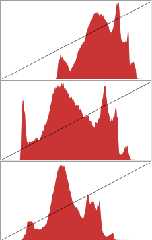
even in the blue channel.  Attached is the histogram plot for the colour
channels (R top, B bottom), looks like plenty of mid-level blue still there
to me, in fact all pixels have a fair amount of blue in them.

If I just shift the blues a bit brighter, and the reds a bit darker, I get a
pretty good output, but of course as Sabrina said you can do much more funky
transforms to get near perfect looking results.  If you know how the colours
shift during ageing, you simply tell the software one colour that you know
should be white, and it will fix the rest.  Actually Paint Shop Pro has a
"fade correction" option, and it works very well on this photo.
Post a reply to this message
Attachments:
Download 'image4.png' (15 KB)
Preview of image 'image4.png'
|
|
| |
| |
|
|
|
|
| |
| |
|
|
scott wrote:
>> My point is still that you can't reover what isn't there any more.
>
> Of course, but there is still plenty of information there in that photo,
> even in the blue channel.  Attached is the histogram plot for the colour
> channels (R top, B bottom), looks like plenty of mid-level blue still
> there to me, in fact all pixels have a fair amount of blue in them.
>
> If I just shift the blues a bit brighter, and the reds a bit darker, I
> get a pretty good output.

All I know is that when I take a dark image and try to make it brighter,
it comes out hopelessly noisy.

--
http://blog.orphi.me.uk/
http://www.zazzle.com/MathematicalOrchid*
Post a reply to this message
|
|
| |
| |
|
|
|
|
| |
|
|






