|
|
|
|
|
|
| |
| |
|
|
|
|
| |
| |
|
|
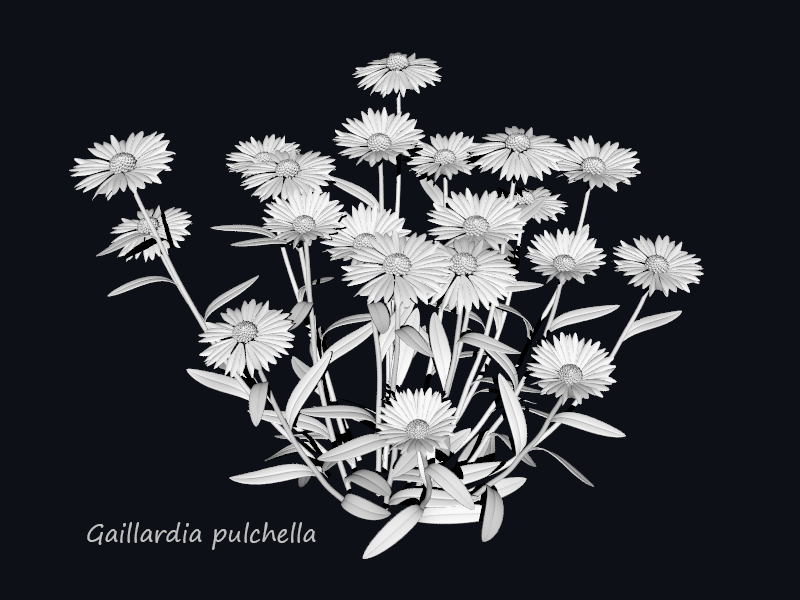
Here I want to share my small collection of plants obtained from
L-Studio: http://algorithmicbotany.org/virtual_laboratory/

The reason I started using L-studo is because of difficulties in
producing such detailed and complicated objects by native POV methods.

I will fill it out from time to time as creating new species.

Some of them has no color due to bug in L-studio export module.
Btw, now I am looking for methods of coloring automation, based, say on
normals, mesh density or similar.

Have anyone ideas about such methods ?

Download: https://github.com/syanenko/pov-plants
--
YB
Post a reply to this message
Attachments:
Download 'gaillardia_pulchella.png' (261 KB)
Preview of image 'gaillardia_pulchella.png'
|
|
| |
| |
|
|
|
|
| |
| |
|
|
Op 20-2-2023 om 15:34 schreef yesbird:
> Here I want to share my small collection of plants obtained from
> L-Studio: http://algorithmicbotany.org/virtual_laboratory/
>
> The reason I started using L-studo is because of difficulties in
> producing such detailed and complicated objects by native POV methods.
>
> I will fill it out from time to time as creating new species.
>
> Some of them has no color due to bug in L-studio export module.
> Btw, now I am looking for methods of coloring automation, based, say on
> normals, mesh density or similar.
>
> Have anyone ideas about such methods ?
>
> Download: https://github.com/syanenko/pov-plants
> --
> YB

At first approximation (I would need to see one of the models more in
detail) I guess that each element has its own geometry: stem, branch,
leaf, flower petals, etc. Normally, each geometry can get its own
texturing, maybe even uv_mapped if L-Studio supports that feature. Using
Poseray could be your friend then for what you want to do.
Alternatively, you may need a modelling program first, but that is
another matter.

--
Thomas
Post a reply to this message
|
|
| |
| |
|
|
|
|
| |
| |
|
|
I guess that each element has its own geometry: stem, branch,
> leaf, flower petals, etc.
Unfortunately, no, after export to OBJ, I have a list of
triangles, without grouping. I can colorize it manually in Z-Brush
and sometimes it's fun, but in most cases too boring :)

Despite the L-Studio export problem, I find auto-colorization task
interesting from an algorithmic perspective.

Ideally, I would like to have an auto-colorization method for meshes
with subsequent manual color correction and detalization.
--
YB
Post a reply to this message
|
|
| |
| |
|
|
|
|
| |
| |
|
|
Got a closer look at /Gaillardia_pulchella/. I opened the corresponding
plant.obj file into Silo (my modeller) and must say that texturing the
plant would not be impossible but a lot of work manually.

"group0 - group208" for instance, represent one complete flower,
starting with the leaves, then the flower s.s., finally the stem
(group208). Forgive me if I mention things you probably know quite well
but I am kind of thinking aloud here. ;-)

A couple of options present themselves:
1) create the different colours: stem, leaves, petals, heart.
2) select together all the groupxxxx representing one element, for
instance leaves, and assign the leaf colour.
3) repeat procedure for each plant element group.

alternatively, you could group together all similar elements (if you can
recognise them easily) and colour the group in the same manner as above.

Frankly, I do not see any other method to do this at the moment.

--
Thomas
Post a reply to this message
|
|
| |
| |
|
|
|
|
| |
| |
|
|
Just wanted to add: the meshes are very fine and well-built. I have seen
far, far worse for some proprietary ones...

--
Thomas
Post a reply to this message
|
|
| |
| |
|
|
|
|
| |
| |
|
|
On 20/02/2023 19:45, Thomas de Groot wrote:
> Just wanted to add: the meshes are very fine and well-built. I have seen
> far, far worse for some proprietary ones...

Agree with you - this is the reason why I don't leave L-studio.
Despite it being a little bit raw, it's potential is huge and it is FREE.
--
YB
Post a reply to this message
|
|
| |
| |
|
|
|
|
| |
| |
|
|
Thanks, Thomas, you give me a good idea about reducing manual work,
analysis of groups and regrouping can help to do it.

May be I will write script to assign different materials to groups
and then merge them. I need to know more about OBJ format for that.

But autocolorizing still interesting to me. For example, what if I want
to highlight edges or peaks of the complex mesh with selected color ?
Will try to dig into this problem ...
--
YB
Post a reply to this message
|
|
| |
| |
|
|
|
|
| |
| |
|
|
As you can see here groups are not exactly reflects plant's structure.
--
YB
Post a reply to this message
Attachments:
Download 'iso.png' (540 KB)
Preview of image 'iso.png'

|
|
| |
| |
|
|
|
|
| |
| |
|
|
yesbird <sya### [at] gmail com> wrote:
> Some of them has no color due to bug in L-studio export module.
> Btw, now I am looking for methods of coloring automation, based, say on
> normals, mesh density or similar.
>
> Have anyone ideas about such methods ?
What i would be tempted to do is use the software to create the plant, and then
dissect it into its component pieces.
Then you could have a reasonably manageable assortment of stems, leaves, flower
centers, flower petals, etc that you could store as objects in an array.
Then you could just write a macro to choose random parts and reassemble the
plant.
Once you had all of the pieces, it would probably be fairly straightforward to
fit a standard texture or a uv-map to each part type. Always try to break down
a complex task into a series of smaller, simpler tasks. com> wrote:
> Some of them has no color due to bug in L-studio export module.
> Btw, now I am looking for methods of coloring automation, based, say on
> normals, mesh density or similar.
>
> Have anyone ideas about such methods ?
What i would be tempted to do is use the software to create the plant, and then
dissect it into its component pieces.
Then you could have a reasonably manageable assortment of stems, leaves, flower
centers, flower petals, etc that you could store as objects in an array.
Then you could just write a macro to choose random parts and reassemble the
plant.
Once you had all of the pieces, it would probably be fairly straightforward to
fit a standard texture or a uv-map to each part type. Always try to break down
a complex task into a series of smaller, simpler tasks.
Post a reply to this message
|
|
| |
| |
|
|
|
|
| |
| |
|
|
> What i would be tempted to do is use the software to create the plant, and then
> dissect it into its component pieces.
You are right - this is the main task, unfortunately I have no access to
sources of LS to make export properly and do grouping by plant parts,
so some manual work should be done, I'm only trying to minimize it.
--
YB
Post a reply to this message
|
|
| |
| |
|
|
|
|
| |
| |
|
|
Op 20/02/2023 om 18:32 schreef yesbird:
> As you can see here groups are not exactly reflects plant's structure.
> --
> YB

Indeed, and I am afraid that each different plant (I do not mean within
the /Gaillardia_pulchella/ bunch) may show a different grouping
arrangement which would need a different approach in the worst case.
However, this petal grouping reduces work somewhat ;-]

--
Thomas
Post a reply to this message
|
|
| |
| |
|
|
|
|
| |
| |
|
|
Op 20/02/2023 om 18:21 schreef yesbird:
> Thanks, Thomas, you give me a good idea about reducing manual work,
> analysis of groups and regrouping can help to do it.
>
> May be I will write script to assign different materials to groups
> and then merge them. I need to know more about OBJ format for that.
>
Are there other formats than OBJ you could export to? Sometimes that may
help circumvent the problem.

> But autocolorizing still interesting to me. For example, what if I want
> to highlight edges or peaks of the complex mesh with selected color ?
> Will try to dig into this problem ...
>
That would be interesting to try but...

Each mesh is a single closed (?) unit and ideally you would need some
way to recognise those 'peaks' of 'edges'. In a well-behaved model those
would be already textured in the MTL corresponding file or - in more
elaborate models - uv_mapped on the mesh. Again, can be done at some
pain, but with the help of a modeller afaik. I have done that kind of
work at great pain for some downloaded models I wanted absolutely to
tweak in my favour, and it took me days and sometimes weeks to achieve
properly. Inflammation of your arm and neck joints, and muscle pain may
be your unlooked for reward too... :-/

--
Thomas
Post a reply to this message
|
|
| |
| |
|
|
|
|
| |
| |
|
|
Inflammation of your arm and neck joints, and muscle pain may
> be your unlooked for reward too... :-/
This is exactly what I want avoid, when talking about algorithmic
methods... )))
--
YB
Post a reply to this message
|
|
| |
| |
|
|
|
|
| |
| |
|
|
> Indeed, and I am afraid that each different plant (I do not mean within
> the /Gaillardia_pulchella/ bunch) may show a different grouping
> arrangement which would need a different approach in the worst case.
> However, this petal grouping reduces work somewhat ;-]
Last night I found optimal solution for growing plants:
https://github.com/wdiestel/arbaro
This is implementation of ideas in attached paper, works fine, but
written in Java (I hate it). It has a simpler plant structure
description, than L-systems.

Now I'm looking for this editor, but still can't find it:
http://povray.tashcorp.net/tutorials/qd_povtree/
--
YB
Post a reply to this message
Attachments:
Download 'p119-weber.pdf' (2163 KB)
|
|
| |
| |
|
|
|
|
| |
| |
|
|
On 21/02/2023 13:28, yesbird wrote:
>> Indeed, and I am afraid that each different plant (I do not mean within
>> the /Gaillardia_pulchella/ bunch) may show a different grouping
>> arrangement which would need a different approach in the worst case.
>> However, this petal grouping reduces work somewhat ;-]
> Last night I found optimal solution for growing plants:
> https://github.com/wdiestel/arbaro
> This is implementation of ideas in attached paper, works fine, but
> written in Java (I hate it). It has a simpler plant structure
> description, than L-systems.
>
> Now I'm looking for this editor, but still can't find it:
> http://povray.tashcorp.net/tutorials/qd_povtree/
> --
> YB
>

There is also <http://ngplant.org/>

With some explanations and example here :
<http://louisbel.free.fr/macros/ngplant/ngplant.html>


--
Kurtz le pirate
Compagnie de la Banquise
Post a reply to this message
|
|
| |
| |
|
|
|
|
| |
| |
|
|
Op 21-2-2023 om 13:28 schreef yesbird:
>> Indeed, and I am afraid that each different plant (I do not mean
>> within the /Gaillardia_pulchella/ bunch) may show a different grouping
>> arrangement which would need a different approach in the worst case.
>> However, this petal grouping reduces work somewhat ;-]
> Last night I found optimal solution for growing plants:
> https://github.com/wdiestel/arbaro
> This is implementation of ideas in attached paper, works fine, but
> written in Java (I hate it). It has a simpler plant structure
> description, than L-systems.
>
I use Arbaro once in a while. Didn't Friedrich Lohmueller provide a
small collection of trees he made with it?

> Now I'm looking for this editor, but still can't find it:
> http://povray.tashcorp.net/tutorials/qd_povtree/
>
As said elsewhere, I shall look in my archive tomorrow.

--
Thomas
Post a reply to this message
|
|
| |
| |
|
|
|
|
| |
| |
|
|
Op 21-2-2023 om 13:17 schreef yesbird:
> Inflammation of your arm and neck joints, and muscle pain may
>> be your unlooked for reward too... :-/
> This is exactly what I want avoid, when talking about algorithmic
> methods... )))
>


Of course. :-)

--
Thomas
Post a reply to this message
|
|
| |
| |
|
|
|
|
| |
| |
|
|
On 21/02/2023 19:03, kurtz le pirate wrote:
> There is also <http://ngplant.org/>
> With some explanations and example here :
> <http://louisbel.free.fr/macros/ngplant/ngplant.html>
Thanks a lot, will play with it this night.
--
YB
Post a reply to this message
|
|
| |
| |
|
|
|
|
| |
| |
|
|
On 21/02/2023 19:07, Thomas de Groot wrote:
> I use Arbaro once in a while. Didn't Friedrich Lohmueller provide a
> small collection of trees he made with it?
Yes, exactly, this is the way I came to it:
https://povlab.online/povtutorial/plants/plants_00e.html

The great advantage of Arbaro is the ability to include native and
custom POV objects in constructions it produces. Now I am teaching it to
grow flowers.

> As said elsewhere, I shall look in my archive tomorrow.
Ooo, thanks in advance.
--
YB
Post a reply to this message
|
|
| |
| |
|
|
|
|
| |