|
|
|
|
|
|
| |
| |
|
|
|
|
| |
| |
|
|
Looking for sources of objects for visualization with my new
project: https://mathview.yesbird.online/
I found this interesting resource: https://www.mathcurve.com/
and want to share it with you.
--
YB
Post a reply to this message
|
|
| |
| |
|
|
|
|
| |
| |
|
|
yesbird <sya### [at] gmail com> wrote:
> Looking for sources of objects for visualization with my new
> project: https://mathview.yesbird.online/
> I found this interesting resource: https://www.mathcurve.com/
> and want to share it with you.
> --
> YB
I took a quick look. Thank god that I had the french translator or I couldn't
understand anything. My french is Baaaaaad. com> wrote:
> Looking for sources of objects for visualization with my new
> project: https://mathview.yesbird.online/
> I found this interesting resource: https://www.mathcurve.com/
> and want to share it with you.
> --
> YB
I took a quick look. Thank god that I had the french translator or I couldn't
understand anything. My french is Baaaaaad.
Post a reply to this message
|
|
| |
| |
|
|
|
|
| |
| |
|
|
On 28/03/2025 22:21, Leroy wrote:
> I took a quick look. Thank god that I had the french translator or I couldn't
> understand anything. My french is Baaaaaad.
>

Chrome suggests translation on opening the page, or you can right-click,
then select "Translate to English" at any time.

Btw, mathematics is the best universal language :).
--
YB
Post a reply to this message
|
|
| |
| |
|
|
|
|
| |
| |
|
|
yesbird <sya### [at] gmailcom> wrote:

> I found this interesting resource: https://www.mathcurve.com/
> and want to share it with you.


There are a lot of these sites, and that is an old one - I've visited it many
times!
Also check out the Geometry Junkyard.

I've long thought that POV-Ray ought to, as a raytracer, have an extensive
library of SHAPES.

We have some inbuilt functions that are curiosities - but we ought to have stuff
that we can expand on and build things with.
Implicit, procedural patterns.
Algorithms.
Regular arrangements / spacings in and on other shapes.
Methods for covering surfaces with (addressable) tilings.

That sort of thing.

- BW
Post a reply to this message
|
|
| |
| |
|
|
From: yesbird
Subject: Re: Encyclopedia of Remarkable Mathematical Forms
Date: 28 Mar 2025 16:52:24
Message: <67e70c08@news.povray.org>
|
|
|
| |
| |
|
|
On 28/03/2025 23:05, Bald Eagle wrote:
> ...
> That sort of thing.
>
> - BW
>

You are right - there are a lot of similar sites, but not many of them
are well organized and filled enough, lack of structure, good search
system and quality of information makes them almost unusable.

Wolfram alpha works best of all for me, but sometimes it's difficult to
find something even there.

I guess POV-Ray has a large set of entities and powerful enough SDL, but
the last is very specific and stands too far from most popular
languages. I have a difficulties switching from C++/Javascript
to it and this is the only problem I have using it.
--
YB
Post a reply to this message
|
|
| |
| |
|
|
From: Ilya Razmanov
Subject: Re: Encyclopedia of Remarkable Mathematical Forms
Date: 29 Mar 2025 01:58:07
Message: <67e78bef$1@news.povray.org>
|
|
|
| |
| |
|
|
On 28.03.2025 22:36, yesbird wrote:
> Btw, mathematics is the best universal language :).

Yep, it's universally incomprehensible.

--
Ilyich the Toad
https://dnyarri.github.io/
Post a reply to this message
|
|
| |
| |
|
|
From: kurtz le pirate
Subject: Re: Encyclopedia of Remarkable Mathematical Forms
Date: 29 Mar 2025 05:44:42
Message: <67e7c10a@news.povray.org>
|
|
|
| |
| |
|
|
On 28/03/2025 20:21, Leroy wrote:
> yesbird <sya### [at] gmailcom> wrote:
>> Looking for sources of objects for visualization with my new
>> project: https://mathview.yesbird.online/
>> I found this interesting resource: https://www.mathcurve.com/
>> and want to share it with you.
>> --
>> YB
>
> I took a quick look. Thank god that I had the french translator or I couldn't
> understand anything. My french is Baaaaaad.
>


A large part of this site is also in English
For exemple :  <https://www.mathcurve.com/courbes3d.gb/courbes3d.shtml>


--
kurtz le pirate
compagnie de la banquise
Post a reply to this message
|
|
| |
| |
|
|
|
|
| |
| |
|
|
On 29/03/2025 08:58, Ilya Razmanov wrote:
> Yep, it's universally incomprehensible.
>
AI can help to start this journey:

https://www.wolframalpha.com/
https://chatgpt.com/g/g-0S5FXLyFN-wolfram

Good luck :)
--
YB
Post a reply to this message
|
|
| |
| |
|
|
|
|
| |
| |
|
|
On 29/03/2025 20:23, yesbird wrote:
> AI can help to start this journey:
>
> https://www.wolframalpha.com/
> https://chatgpt.com/g/g-0S5FXLyFN-wolfram
>

Better use together with a 'human' version:
https://mathworld.wolfram.com/
--
YB
Post a reply to this message
|
|
| |
| |
|
|
From: kurtz le pirate
Subject: Re: Encyclopedia of Remarkable Mathematical Forms
Date: 29 Mar 2025 14:16:15
Message: <67e838ef@news.povray.org>
|
|
|
| |
| |
|
|
On 29/03/2025 18:23, yesbird wrote:

> https://chatgpt.com/g/g-0S5FXLyFN-wolfram

Yep, chatgpt is universally incomprehensible.


--
kurtz le pirate
compagnie de la banquise
Post a reply to this message
|
|
| |
| |
|
|
|
|
| |
| |
|
|
On 29/03/2025 21:16, kurtz le pirate wrote:
> Yep, chatgpt is universally incomprehensible.
>

)))
I had the same opinion, until start to use it and get results
much faster than with StackOverflow.
--
YB
Post a reply to this message
|
|
| |
| |
|
|
|
|
| |
| |
|
|
yesbird <sya### [at] gmailcom> wrote:

> I found this interesting resource: https://www.mathcurve.com/
> and want to share it with you.
> --
> YB

Here is one more site to brush up your French:

https://www.aesculier.fr/

Droj
Post a reply to this message
|
|
| |
| |
|
|
From: yesbird
Subject: Re: Encyclopedia of Remarkable Mathematical Forms
Date: 1 Apr 2025 21:07:00
Message: <67ec8db4@news.povray.org>
|
|
|
| |
| |
|
|
On 01/04/2025 19:09, Droj wrote:
> Here is one more site to brush up your French:
>
> https://www.aesculier.fr/
>
> Droj
>

Thanks, I guess it's time to start learning the language of Descartes...

This part is the most interesting and very close to what I am doing now:
https://www.aesculier.fr/fichiersPovray/sextiques/sextiques.html
but unfortunately there are no parametric forms.

Btw, here is a good set of knots (English):
http://www.mi.sanu.ac.rs/vismath/taylorapril2011/Taylor.pdf
--
YB
Post a reply to this message
|
|
| |
| |
|
|
|
|
| |
| |
|
|
yesbird wrote:

> This part is the most interesting and very close to what I am doing now:
> https://www.aesculier.fr/fichiersPovray/sextiques/sextiques.html
> but unfortunately there are no parametric forms.


Very nice.  :)
I think most everyone at some point discovers these beautiful surfaces and just
_needs_ to do ... something with them.
I very much like that the circles and lines have been included in the renders.
And the regular solids!  :D

Why do you need a parametric?  Are you trying to create a mesh to decrease
render time?

> Btw, here is a good set of knots (English):
> http://www.mi.sanu.ac.rs/vismath/taylorapril2011/Taylor.pdf
> --
> YB

(will check this out later)

- BW
Post a reply to this message
|
|
| |
| |
|
|
|
|
| |
| |
|
|
On 02/04/2025 13:34, Bald Eagle wrote:
> I think most everyone at some point discovers these beautiful surfaces and just
> _needs_ to do ... something with them.

Exactly, and in my case it was at the age of eight, when I opened the
math textbook of my uncle. I was enchanted by the beauty and elegance of
curves and surfaces and later I was graduated with a Bachelor of Science
in computer graphics.

> Why do you need a parametric?  Are you trying to create a mesh to decrease
> render time?

Yes, my latest project - online editor for math surfaces and curves
assumes equations in parametric forms. MathView now in stable beta stage
and ready to be filled with a content, I am already have a large list
of candidates to this collection, fortunately they are free :).

The source of inspiration was:
https://virtualmathmuseum.org/

but I was confused by UI and quality, so decided to write my own with
modern tools, high quality and performance. You can try it here:
https://mathview.yesbird.online/

Although it's not completed yet, I will be glad to get any kind of
response, including suggestions, criticism and new ideas.

Btw, as proofing and reference tool I am using
https://www.wolframalpha.com/
and found it very useful, but having some oddities.
--
YB
Post a reply to this message
|
|
| |
| |
|
|
|
|
| |
| |
|
|
yesbird wrote:

> > Why do you need a parametric?  Are you trying to create a mesh to decrease
> > render time?
>
> Yes, my latest project - online editor for math surfaces and curves
> assumes equations in parametric forms. MathView now in stable beta stage
> and ready to be filled with a content, I am already have a large list
> of candidates to this collection, fortunately they are free :).

Hmmm.
Parameterizing is usually difficult - if not impossible for complex implicit
equations.
I'd try a variety of software packages / approaches:  Maple, etc.

Also just try to search and see what you can find.
Sometimes I find very recent solutions to projects/problems that I put to the
side only a year or two before.
Also post what you're trying to do on StackExchange/Overflow, etc. and see if
any of the people over there have any ideas, references, or solutions.
Track down anyone who has ever played with these things and see if they have any
ideas. (Jos Leys, Paul Nylander, Etienne Ghys, math professors, etc)

And then maybe just try some crazy stuff - just to see what happens.
Express everything in terms of complex numbers, or invert them through a unit
sphere and see what pops out the other end.
See if there's some 4th dimensional way to approach it.  <x, y, z, w>
Sometimes you can do what seems to make things more complex, but get a result
that is easier to process in that other "space".
So if you're able to do something like that, you might be able to parameterize
the transformed equation, and then transform it back.


One thing that you CAN do in order to speed things up is take advantage of the
symmetry of these surfaces and only calculate a part of it - then just transform
the result to cover the other areas.
So, for those surfaces that have a dodecahedron nested inside, that means there
are parts of it to match each of its 20 vertices.  So if you calculated only one
and "copied" the rest, that's 1/20th of the calculation needed.

- BW
Post a reply to this message
|
|
| |
| |
|
|
|
|
| |
| |
|
|
Since you have MatLab:

https://www.researchgate.net/publication/318476279_Algorithm_976_Bertini_real_Numerical_Decomposition_of_Real_Algebraic
_Curves_and_Surfaces/download?_tp=eyJjb250ZXh0Ijp7ImZpcnN0UGFnZSI6Il9kaXJlY3QiLCJwYWdlIjoiX2RpcmVjdCJ9fQ

https://www.researchgate.net/publication/4278665_Interactive_Ray_Tracing_of_Arbitrary_Implicits_with_SIMD_Interval_Arit
hmetic/download?_tp=eyJjb250ZXh0Ijp7ImZpcnN0UGFnZSI6Il9kaXJlY3QiLCJwYWdlIjoiX2RpcmVjdCJ9fQ

Bezier patches and Bernstein polynomials!  :)
https://cad-conference.net/files/CAD24/CAD24_334-338.pdf
Post a reply to this message
|
|
| |
| |
|
|
|
|
| |
| |
|
|
On 02/04/2025 22:30, Bald Eagle wrote:

>> Parameterizing is usually difficult - if not impossible for complex implicit
>> equations.
>> I'd try a variety of software packages / approaches:  Maple, etc.
>>

Thanks for advice, as I said in my previous post, there are a lot of
'ready-to-use' solutions, for example, suggested by Wolfram Alpha,
and I am happy with them.


>> Since you have MatLab:
>>
>>
https://www.researchgate.net/publication/318476279_Algorithm_976_Bertini_real_Numerical_Decomposition_of_Real_Algebraic
>>
_Curves_and_Surfaces/download?_tp=eyJjb250ZXh0Ijp7ImZpcnN0UGFnZSI6Il9kaXJlY3QiLCJwYWdlIjoiX2RpcmVjdCJ9fQ
>>
>>
https://www.researchgate.net/publication/4278665_Interactive_Ray_Tracing_of_Arbitrary_Implicits_with_SIMD_Interval_Arit
>>
hmetic/download?_tp=eyJjb250ZXh0Ijp7ImZpcnN0UGFnZSI6Il9kaXJlY3QiLCJwYWdlIjoiX2RpcmVjdCJ9fQ
>>
>> Bezier patches and Bernstein polynomials!  :)
>> https://cad-conference.net/files/CAD24/CAD24_334-338.pdf

Yes, I have, but MathView is based on WebGL, has no relation to
ray tracing, but in general this stuff is interesting.
--
YB
Post a reply to this message
|
|
| |
| |
|
|
From: yesbird
Subject: Re: Encyclopedia of Remarkable Mathematical Forms
Date: 2 Apr 2025 21:55:15
Message: <67edea83@news.povray.org>
|
|
|
| |
| |
|
|
On 03/04/2025 04:27, yesbird wrote:
>
> Thanks for advice, as I said in my previous post, there are a lot of
> 'ready-to-use' solutions ...
>

And Povray is no exception :).
In attachment is MathView vision of this canonical example:

// --------------------------------------- parametric surface -------------
#declare a = 1.0;                       // conical spiral
#declare b = 8;
#declare c = 0.2;
#declare n = 5;
parametric{
  function { a*(1-0.5*v/pi)*sin(n*v+0.5*pi)*(1-cos(u))
             + c*sin(n*v+0.5*pi) }
  function { b*0.5*v/pi + a*(1-0.5*v/pi)*sin(u) }
  function { a*(1-0.5*v/pi)*cos(n*v+0.5*pi)*(1-cos(u))
             + c*cos(n*v+0.5*pi) }
   <0,0>,<2*pi,2*pi>  // start, end of (u,v)
   contained_by {box {<-1,-1,-1>*2*pi,<1,b/3,1>*2*pi}}
   max_gradient 8  // better but slower: 10
   accuracy 0.01 // better but slower: 0.001 or smaller
   precompute 10 x,y,z
   texture{ pigment{ color rgb<1,1,1>}
            finish { phong 0.5}}
   scale 0.125
   rotate <0, 90, 0>
} // end of parametric
----------------------------------------------------
--
YB
Post a reply to this message
Attachments:
Download 'test_surf.png' (464 KB)
Preview of image 'test_surf.png'
|
|
| |
| |
|
|
From: William F Pokorny
Subject: Re: Encyclopedia of Remarkable Mathematical Forms
Date: 3 Apr 2025 00:19:41
Message: <67ee0c5d$1@news.povray.org>
|
|
|
| |
| |
|
|
On 4/2/25 21:55, yesbird wrote:
> And Povray is no exception 🙂.
> In attachment is MathView vision of this canonical example:
>
> // --------------------------------------- parametric surface -------------
> #declare a = 1.0;                       // conical spiral

Thanks for posting code. Below is a variation which runs quite a bit
faster with POV-Ray for those with tiny machines like mine.

The key is the change to max_gradient. Tutorials, examples and our
documentation have always treated / considered the parametric{}
max_gradient in the same way as that used for the isosurface{}. However,
they are different implementations.

The max_gradient for the parametric should often be <1.0 and it can
sometimes be <<1.0. I "think" I suggested a default max_gradient of 0.1
for our source code would be better, but I've not made the change as yet
  in my yuqk fork. (A few example parametric{}s do need 1.0 or a little
more).

Somewhere there is a forum thread and I have data and notes, but not
finding any of it in a quick search. Anyhow, my changes for the the
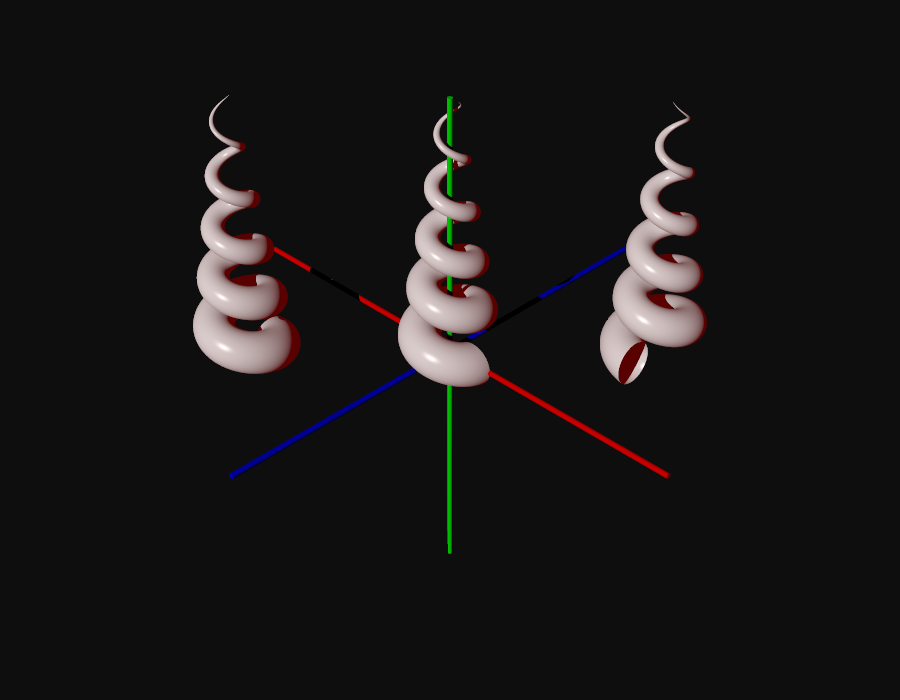
attached image:

// ------------------------------ parametric surface -------------
#declare a = 1.0;   // conical spiral
#declare b = 12;    // 8
#declare c = 0.4;   // 0.2
#declare n = 5;
#declare Para00 = parametric{
   function { a*(1-0.5*v/pi)*sin(n*v+0.5*pi)*(1-cos(u))
              + c*sin(n*v+0.5*pi) }
   function { b*0.5*v/pi + a*(1-0.5*v/pi)*sin(u) }
   function { a*(1-0.5*v/pi)*cos(n*v+0.5*pi)*(1-cos(u))
              + c*cos(n*v+0.5*pi) }
    <0,0>,<2*pi,2*pi>  // start, end of (u,v)
// contained_by {box {<-1,-1,-1>*2*pi,<1,b/3,1>*2*pi}}
    contained_by {box {<-1,-0.2,-1>*tau,<1,b/3,1>*tau}}
// max_gradient 8
    max_gradient 0.1
// accuracy 0.01
    accuracy 0.0005
    precompute 18 x,y,z
} // end of parametric

...

     union {
         object { Para00 }
         object { Para00 rotate y*+90 translate +<1,0,1>*tau}
         object { Para00 rotate y*-90 translate -<1,0,1>*tau }
         texture{
             pigment{ color rgb<1,1,1>}
             finish { emission <0.1,0,0> phong 0.5}
         }
         scale 1/b
     }

Bill P.
Post a reply to this message
Attachments:
Download 'ybspiral.png' (68 KB)
Preview of image 'ybspiral.png'
|
|
| |
| |
|
|
|
|
| |
| |
|
|
William F Pokorny <ano### [at] anonymousorg> wrote:

> The max_gradient for the parametric should often be <1.0 and it can
> sometimes be <<1.0. I "think" I suggested a default max_gradient of 0.1
> for our source code would be better, but I've not made the change as yet
>   in my yuqk fork. (A few example parametric{}s do need 1.0 or a little
> more).
>
> Somewhere there is a forum thread and I have data and notes, but not
> finding any of it in a quick search.

As breadcrumbed in the last epic Cousin Ricky elliptical torus thread -
May 2020 in povray.general:

https://news.povray.org/povray.general/thread/%3C5eafeab9%241%40news.povray.org%3E/?ttop=445355&toff=350
Post a reply to this message
|
|
| |
| |
|
|
From: William F Pokorny
Subject: Re: Encyclopedia of Remarkable Mathematical Forms
Date: 3 Apr 2025 08:11:37
Message: <67ee7af9$1@news.povray.org>
|
|
|
| |
| |
|
|
On 4/3/25 06:54, Bald Eagle wrote:
> As breadcrumbed in the last epic Cousin Ricky elliptical torus thread -
> May 2020 in povray.general:

Thank you Bill W!

I'll go spend a little time on yuqk's parametric{} documentation - and
look again at the updates I was pondering back then.

Another ball long ago dropped...

Bill P.
Post a reply to this message
|
|
| |
| |
|
|
|
|
| |
| |
|
|
When I was making my tori last night, I was trying to capture that pinkish color
that you have there.

Of course that's the part you snipped out . . .

What's the special sauce?

- BW
Post a reply to this message
|
|
| |
| |
|
|
|
|
| |
| |
|
|
yesbird wrote:

> >> Since you have MatLab:
> >>
> >>
https://www.researchgate.net/publication/318476279_Algorithm_976_Bertini_real_Numerical_Decomposition_of_Real_Alge
braic
> >>
_Curves_and_Surfaces/download?_tp=eyJjb250ZXh0Ijp7ImZpcnN0UGFnZSI6Il9kaXJlY3QiLCJwYWdlIjoiX2RpcmVjdCJ9fQ
> >>
> >>
https://www.researchgate.net/publication/4278665_Interactive_Ray_Tracing_of_Arbitrary_Implicits_with_SIMD_Interval
_Arit
> >>
hmetic/download?_tp=eyJjb250ZXh0Ijp7ImZpcnN0UGFnZSI6Il9kaXJlY3QiLCJwYWdlIjoiX2RpcmVjdCJ9fQ
> >>
> >> Bezier patches and Bernstein polynomials!  :)
> >> https://cad-conference.net/files/CAD24/CAD24_334-338.pdf
>
> Yes, I have, but MathView is based on WebGL, has no relation to
> ray tracing, but in general this stuff is interesting.
> --
> YB

Well, what I was suggesting, is that since you wanted to use parametric
equations, maybe you could find a way to parameterize things like the Barth
Sextic.

That's all.   :)
Post a reply to this message
|
|
| |
| |
|
|
|
|
| |
| |
|
|
yesbird wrote:

>
> Yes, my latest project - online editor for math surfaces and curves
> assumes equations in parametric forms. MathView now in stable beta stage
> and ready to be filled with a content, I am already have a large list
> of candidates to this collection, fortunately they are free :).
>

Have a look at: http://3d-meier.de/tut3/Seite0.html
Lots of parametric equations but it is in German - not the equations :))
I used a whole bunch of them together with meshmaker.inc

Should you need help let me know.

> https://mathview.yesbird.online/

Nice work!

>
> Although it's not completed yet, I will be glad to get any kind of
> response, including suggestions, criticism and new ideas.
>
Just have a look at the screenshot.

Regards
Droj
Post a reply to this message
Attachments:
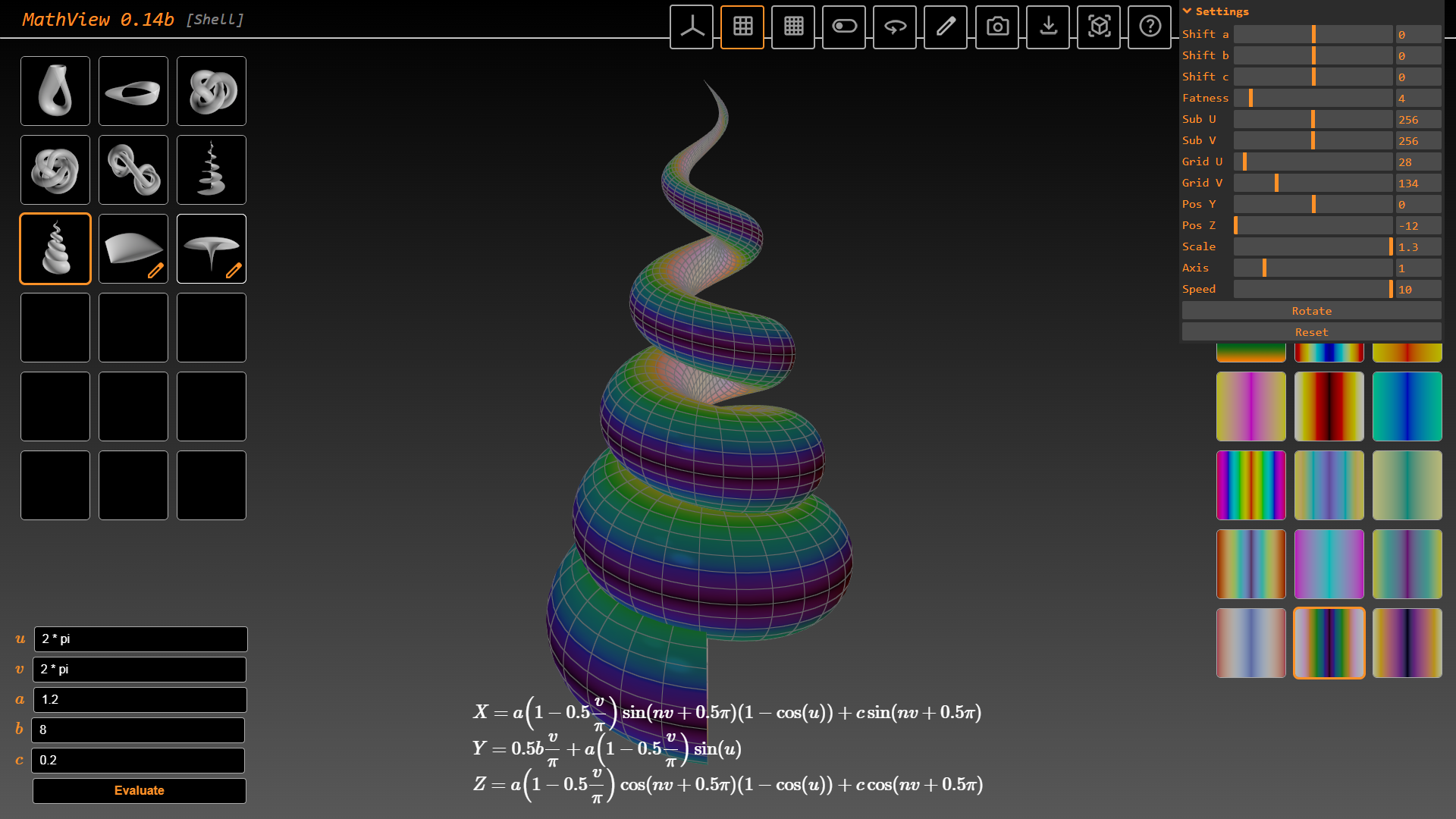
Download 'mathview.png' (3066 KB)
Preview of image 'mathview.png'

|
|
| |
| |
|
|
From: yesbird
Subject: Re: Encyclopedia of Remarkable Mathematical Forms
Date: 3 Apr 2025 15:39:46
Message: <67eee402@news.povray.org>
|
|
|
| |
| |
|
|
On 03/04/2025 21:22, Droj wrote:
> Have a look at: http://3d-meier.de/tut3/Seite0.html
> Lots of parametric equations but it is in German - not the equations :))
> I used a whole bunch of them together with meshmaker.inc
>
> Should you need help let me know.

Oooo - this is a real royal gift !
Many thanks - this is the end of my quest, now I can concentrate on
further development.

>
>> https://mathview.yesbird.online/
>
> Nice work!
> ...
> Just have a look at the screenshot.
>

Some things still need to be implemented, especially in XR mode.
Feedback you sent is very important - what resolution do you have ?
Design assumes 1920x1080, but maybe I should do something with this.
--
YB
Post a reply to this message
|
|
| |
| |
|
|
|
|
| |
| |
|
|
yesbird wrote:
>
> Oooo - this is a real royal gift !
> Many thanks - this is the end of my quest, now I can concentrate on
> further development.

You are more than welcome.

>
> Some things still need to be implemented, especially in XR mode.
> Feedback you sent is very important - what resolution do you have ?
> Design assumes 1920x1080, but maybe I should do something with this.
> --
> YB

Resolution is 1360x768
I use an old LG TV as monitor.

Droj
Post a reply to this message
|
|
| |
| |
|
|
From: William F Pokorny
Subject: Re: Encyclopedia of Remarkable Mathematical Forms
Date: 3 Apr 2025 21:07:09
Message: <67ef30bd@news.povray.org>
|
|
|
| |
| |
|
|
On 4/3/25 11:37, Bald Eagle wrote:
> When I was making my tori last night, I was trying to capture that pinkish color
> that you have there.
>
> Of course that's the part you snipped out . . .
>
> What's the special sauce?

The trick was, at least partly, there in my post:

...
union {
     ...
     texture{
         pigment{ color rgb<1,1,1>}
         finish { emission <0.1,0,0> phong 0.5}  // <--- Here, emission
     }
     ...
}

However, you must also run with a v3.8 or later(*) release and set the
version to 3.8 with a #version directive or ini / command line flag like
+mv3.8.

V3.8 is needed because, with it, the default finish{}'s ambient value is
always zero.

A better answer requires more, if I get back to that work, the detail
should be in its own thread. For now, see the asides below.

(*) Lying. Radiosity sets ambient to zero in earlier versions - and
users could always set it to zero.

---

Aside 1: Relatively late in the overall v3.8 development cycle, the
ambient default value was changed from <0.1,0.1,0.1> to <0,0,0>, mostly
based on the argument v3.7 and v3.8 renders of old scenes looked washed
out due the gamma handling changes. These changes made the old ambient
grey far too strong - because it wasn't, itself, gamma adjusted.

For me, the best reason for the v3.8 ambient <0,0,0> default, over - for
example - a new srgb-space, gamma corrected one, is that any non-zero,
grey value has always worked against per feature color support in
POV-Ray.

---

Aside 2: With respect to quality renders, I believe we under-utilize the
per feature / aspect, color functionality already in POV-Ray(*).
Further, that with 'minor-ish' modifications, expanded, per feature,
color functionality can be added /exploited.

(*) We often use single values for 3D color vector specifications. Or we
think of and treat density{} as a single value proposition, when it's
effectively a pigment{}.

Some years ago ('povr named fork' days), I merged existing, but
variously named and, sometimes, mostly forgotten color control
capabilities in POV-Ray under a single new 'amplify' color multiplier
keyword. I went on to extended 'amplify' to additional features in
today's yuqk fork.

Going to stop here. I find - and oddly enjoy - that so much with our
POV-Ray play requires books to describe well! :-)

Bill P.
Post a reply to this message
|
|
| |
| |
|
|
|
|
| |
| |
|
|
William F Pokorny <ano### [at] anonymousorg> wrote:

>      texture{
>          pigment{ color rgb<1,1,1>}
>          finish { emission <0.1,0,0> phong 0.5}  // <--- Here, emission
>      }

Ah.  I'll have to play with that method a bit.
When I get home, I usually have all manner of things to attend to (or neglect ;)
) and I don't have the energy/creativity level to fully conceive of
experimenting in certain ways.

I also had some difficulty getting the rich, saturated colors that they show in
Fig 10:
https://www.sciencedirect.com/science/article/pii/S0898122114005252#f000030

I tried using the normal map method developed here:

https://news.povray.org/povray.binaries.images/message/%3Cweb.5da7f3c944e99bc863814b380%40news.povray.org%3E/#%3Cweb.5d
a7f3c944e99bc863814b380%40news.povray.org%3E

But everything was pretty washed out.

They might be using a completely different method / pattern for their coloring
function - which is interesting in itself.

- BW
Post a reply to this message
|
|
| |
| |
|
|
|
|
| |
| |
|
|
Hopefully you've also discovered:

http://xahlee.info/

?
Post a reply to this message
|
|
| |
| |
|
|
|
|
| |
| |
|
|
On 04/04/2025 16:32, Bald Eagle wrote:
> Hopefully you've also discovered:
>
> http://xahlee.info/
>
> ?
>
Thanks, but comparing to:
https://virtualmathmuseum.org/

it's second-hand )
--
YB
Post a reply to this message
|
|
| |
| |
|
|
|
|
| |
| |
|
|
yesbird wrote:

> > http://xahlee.info/
> >
> > ?
> >
> Thanks, but comparing to:
> https://virtualmathmuseum.org/
>
> it's second-hand )
> --
> YB

Yes, second hand is right.

Take a look at:

https://www.frassek.org/

Might give some inspiration and offers parametric equations, too.

Droj
Post a reply to this message
|
|
| |
| |
|
|
|
|
| |
| |
|
|
On 05/04/2025 15:33, Droj wrote:
> Take a look at:
>
> https://www.frassek.org/
>
> Might give some inspiration and offers parametric equations, too.
>
> Droj
>

Many thanks, Droj !

This is really valuable information for me.
I will explore it more deeply, but right now I am enjoying these
two different approaches to shells modelling:
https://www.frassek.org/3d-mathe/meeresschnecken-muscheln/

Also I like accurate and beautiful design as well-thinked
organization of the site in general.

It's very pleasant to work with such resources.
--
YB
Post a reply to this message
|
|
| |
| |
|
|
|
|
| |