|
|
|
|
|
|
| |
| |
|
|
|
|
| |
| |
|
|
I tried to generate some wood pattern last year. But for the purpose of control
the curve, I typed very much code and number(not only the picture shows).

So I decided to write a (java) program. Using mouse to control some basic curve
of the annual rings. Than output a few .pov file to draw the picture(pattern).
But still not finish. Take the advantage of write an appropriate size program I
can practice my coding skill, too.

Because it is prototype, I will release it and take this to make a change...
Maybe will be early next year.
Post a reply to this message
Attachments:
Download 'show tree function 3 post.png' (680 KB)
Preview of image 'show tree function 3 post.png'
|
|
| |
| |
|
|
|
|
| |
| |
|
|
I wrote a curve editor first(video), but need to improve and extend. I feel it
is very challenge to me to develop a good and complete component program.

It's the current situation...
Post a reply to this message
Attachments:
Download 'video.mp4.dat' (319 KB)
|
|
| |
| |
|
|
|
|
| |
| |
|
|
Because this is such a (suitable size) program that I can develop by myself(one
person)
Post a reply to this message
|
|
| |
| |
|
|
|
|
| |
| |
|
|
"And" <49341109@ntnu.edu.tw> wrote:
> Because this is such a (suitable size) program that I can develop by myself(one
> person)

Hey - this is looking quite promising already.  :)

Are you using Bezier splines?  What are you going to be using the curve for?
Controlling the color_map of the wood pigment pattern? The geometry of the wood?
 Both?

Maybe you can look at Ed Hynan's EPspline lathe/sor editor program for some
inspiration.

It's really nice that you're writing it in Java - will we be able to try this
out by running the applet in a web browser?


My wood pigment patterns have always been fairly simplistic, and I'm sure I can
learn a lot of things that I should have been doing for a long time now, just by
seeing the progress of your development renders and relevant scene code.


- Bill
Post a reply to this message
|
|
| |
| |
|
|
|
|
| |
| |
|
|
"Bald Eagle" <cre### [at] netscape net> wrote:
>
> Hey - this is looking quite promising already. :)
>
Oh thanks.
> Are you using Bezier splines? What are you going to be using the curve for?
> Controlling the color_map of the wood pigment pattern? The geometry of the wood?
> Both?
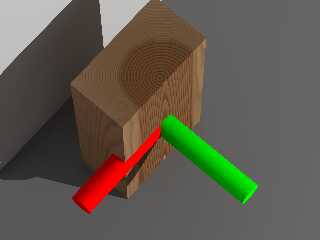
I choose a beautiful picture, so not very clear what it is.
I upload another picture.
I implement it with Bezier spline, but don't allow user to edit the tangent
handle point, instead it generate the tangent handle points automatically, for
maintain every part of the curve is smooth.
Control the shape of annual ring. instead of perfect circle. Like ... this photo
on gallery:
https://www.istockphoto.com/photo/wood-texture-gm175444922-20420677
I start the wood pattern with perfect concentric circles and constant grow
rate(interval of two ring), but it is too inflexible, I want some variety, so I
rewrite it with segmented curve. I don't have too much idea for the color_map
now.
>
> Maybe you can look at Ed Hynan's EPspline lathe/sor editor program for some
> inspiration.
>
> It's really nice that you're writing it in Java - will we be able to try this
> out by running the applet in a web browser?
I never thought that, maybe it can transfer to applet after finish, but I focus
on the program itself currently.
>
>
> My wood pigment patterns have always been fairly simplistic, and I'm sure I can
> learn a lot of things that I should have been doing for a long time now, just by
> seeing the progress of your development renders and relevant scene code.
>
>
> - Bill
Ha ha... that sky render is too big and need too much experiment to improve, I
cannot develop it in this stage. It is far from an one person work.
Post a reply to this message
Attachments:
Download 'show tree function test8 1.png' (456 KB)
Preview of image 'show tree function test8 1.png'
|
|
| |
| |
|
|
|
|
| |
| |
|
|
Il 01/11/2021 07:38, And ha scritto:
 > "Bald Eagle" <cre### [at] netscapenet> wrote:
 >>
 >> Hey - this is looking quite promising already.  :)
 >>

Very promising, indeed. It will be a useful tool.

Paolo
Post a reply to this message
|
|
| |
| |
|
|
|
|
| |
| |
|
|
Paolo Gibellini <p.g### [at] gmailcom> wrote:
> Il 01/11/2021 07:38, And ha scritto:
>  > "Bald Eagle" <cre### [at] netscapenet> wrote:
>  >>
>  >> Hey - this is looking quite promising already.  :)
>  >>
>
> Very promising, indeed. It will be a useful tool.
>
> Paolo

Thank you.

I also need to work hard.
Post a reply to this message
|
|
| |
| |
|
|
|
|
| |
| |
|
|
On 11/1/2021 2:38 AM, And wrote:
> "Bald Eagle" <cre### [at] netscapenet> wrote:
>>
>> Hey - this is looking quite promising already.  :)
>>
>
> Oh thanks.

How is it with animations? The thing I hate about the built-in wood
textures is that they distort wildly when I change the angle of camera
to wood.

dik
Post a reply to this message
|
|
| |
| |
|
|
|
|
| |
| |
|
|
Dick Balaska <dic### [at] buckosoftcom> wrote:
> On 11/1/2021 2:38 AM, And wrote:
> > "Bald Eagle" <cre### [at] netscapenet> wrote:
> >>
> >> Hey - this is looking quite promising already.  :)
> >>
> >
> > Oh thanks.
>
> How is it with animations? The thing I hate about the built-in wood
> textures is that they distort wildly when I change the angle of camera
> to wood.
>
> dik

Can you upload a short animation video? I never encounter this situation when I
use the built-in wood texture.
Post a reply to this message
|
|
| |
| |
|
|
|
|
| |
| |
|
|
Slow-pace develop but arrive a step.
Post a reply to this message
Attachments:
Download 'rect coor video.mp4.dat' (535 KB)
|
|
| |
| |
|
|
|
|
| |
| |
|
|
with polar-coordinate.
Post a reply to this message
Attachments:
Download 'polar coor video.mp4.dat' (805 KB)
|
|
| |
| |
|
|
|
|
| |
| |
|
|
I will post some pictures in the following days. Not very high grade,but
has reached a stage.
Post a reply to this message
|
|
| |
| |
|
|
|
|
| |
| |
|
|
"And" <49341109@ntnu.edu.tw> wrote:
> I will post some pictures in the following days. Not very high grade,but
> has reached a stage.

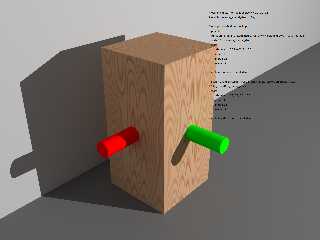
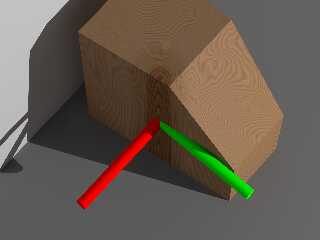
The basic idea here..
Post a reply to this message
Attachments:
Download 'show tree function.png' (736 KB)
Preview of image 'show tree function.png'
|
|
| |
| |
|
|
|
|
| |
| |
|
|
And the program look.

Not very finish. But it can run, and can output file.(.pov and several .inc)

Does not contain any color_map edit or design yet. I still code them in Pov-ray
and seek a solution for the(more complex) combine.
Post a reply to this message
Attachments:
Download 'program manipulate.mp4.dat' (4394 KB)
|
|
| |
| |
|
|
|
|
| |
| |
|
|
Op 9-5-2022 om 15:49 schreef And:
> And the program look.
>
> Not very finish. But it can run, and can output file.(.pov and several .inc)
>
> Does not contain any color_map edit or design yet. I still code them in Pov-ray
> and seek a solution for the(more complex) combine.


Really impressive indeed. I am following this development with interest.

--
Thomas
Post a reply to this message
|
|
| |
| |
|
|
|
|
| |
| |
|
|
Thomas de Groot <tho### [at] degrootorg> wrote:
> Op 9-5-2022 om 15:49 schreef And:
> > And the program look.
> >
> > Not very finish. But it can run, and can output file.(.pov and several .inc)
> >
> > Does not contain any color_map edit or design yet. I still code them in Pov-ray
> > and seek a solution for the(more complex) combine.
>
>
> Really impressive indeed. I am following this development with interest.
>
> --
> Thomas

Thank you.

It needs several improve. Some are very basic but don't complete yet.
I will release it here for tests when it is ok(and at least when I learn how to
compile a java project to a executable program, but I should need several
months).
Post a reply to this message
|
|
| |
| |
|
|
|
|
| |
| |
|
|
See again this picture.
https://www.pinterest.com/pin/451415562633095644/

with annotate:
https://www.britannica.com/science/growth-ring-plant-anatomy
Post a reply to this message
|
|
| |
| |
|
|
|
|
| |
| |
|
|
"And" <49341109@ntnu.edu.tw> wrote:
> "And" <49341109@ntnu.edu.tw> wrote:
> > I will post some pictures in the following days. Not very high grade,but
> > has reached a stage.
>
> The basic idea here..

All of these results are awesome !
Post a reply to this message
|
|
| |
| |
|
|
|
|
| |
| |
|
|
"Mr" <m******r******at_hotmail_dot_fr> wrote:
> "And" <49341109@ntnu.edu.tw> wrote:
> > "And" <49341109@ntnu.edu.tw> wrote:
> > > I will post some pictures in the following days. Not very high grade,but
> > > has reached a stage.
> >
> > The basic idea here..
>
> All of these results are awesome !


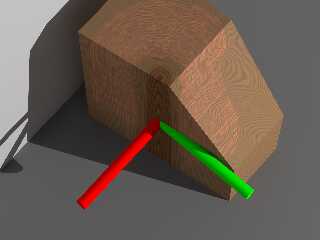
Thanks. I'm trying to generate small speckles.

It is an emphasis, too.

And I'm thinking how composite this to the base color. I use "average" in this
picture. But this method is fail to more requirements. Sometimes speckles should
darker than the base color. the method cannot control it well.
Post a reply to this message
Attachments:
Download 'show tree function test bumps t y15 - y60.png' (900 KB)
Preview of image 'show tree function test bumps t y15 - y60.png'
|
|
| |
| |
|
|
|
|
| |
| |
|
|
"And" <49341109@ntnu.edu.tw> wrote:

> Thanks. I'm trying to generate small speckles.
>
> It is an emphasis, too.
>
> And I'm thinking how composite this to the base color. I use "average" in this
> picture. But this method is fail to more requirements. Sometimes speckles should
> darker than the base color. the method cannot control it well.

I think that this is going to be another advanced-granite texture odyssey.

You will probably need to use functions, and some way to introduce noise, in
order to randomize those color variations in the growth rings.

If you're going to tackle that, I'd probably start by making a list of common
features of real wood, and think about how to implement each of those, and where
they need to be in a hierarchy.

Different growth ring thicknesses. (one ring vs another)
Variable growth ring thickness (change in thickness along any given ring)
Asymmetric growth ring thickness. (a bent or curved branch will be thick on one
side and thin on the other)
Alternating light-dark / thick-thin growth rings
Darkening along a localized group of rings due to mold/fungus, etc.
Holes due to boring insects
"checking" (cracks) due to splitting when cut wood is rapidly dried
a more granular texture for the rings to represent the fibrous nature of the
wood.
SSLT

Diagrams or photos of wood would likely help you envision the types of functions
that would control each of those attributes, and suggest ways to combine them
into a final overall texture/material.
There are all of the different ways to cut wood to get different grain patterns
and expansion/contraction behaviour.

Then there's the fun of formulating pigment/texture maps for all of the
different species...  ;)
Post a reply to this message
|
|
| |
| |
|
|
|
|
| |
| |
|
|
"Bald Eagle" <cre### [at] netscapenet> wrote:
> "And" <49341109@ntnu.edu.tw> wrote:
>
> > Thanks. I'm trying to generate small speckles.
> >
> > It is an emphasis, too.
> >
> > And I'm thinking how composite this to the base color. I use "average" in this
> > picture. But this method is fail to more requirements. Sometimes speckles should
> > darker than the base color. the method cannot control it well.
>
> I think that this is going to be another advanced-granite texture odyssey.
>
> You will probably need to use functions, and some way to introduce noise, in
> order to randomize those color variations in the growth rings.
>

I always use functions, till the pigment composite.


> If you're going to tackle that, I'd probably start by making a list of common
> features of real wood, and think about how to implement each of those, and where
> they need to be in a hierarchy.

Yes, I'm dealing with it.

>
> Different growth ring thicknesses. (one ring vs another)

It has done, notice the program manipulate video 0:12 ~ 0:29, it control the
radial growth speed vs year.
Than program output the year_vs_r function using select(r - r0, , ...),
than composite them to time_function(x, y, z) with angular distortion.

> Variable growth ring thickness (change in thickness along any given ring)

This is a good idea, I think I should add it.

> Asymmetric growth ring thickness. (a bent or curved branch will be thick on one
> side and thin on the other)

Not uniform ring thickness I wonder how to implement. Basically, if it can
implement in POV-Ray, than it can do in principle. My Java program can output
some data and it can be numerous like the attachment.
Post a reply to this message
Attachments:
Download 'style.png' (87 KB)
Preview of image 'style.png'
|
|
| |
| |
|
|
|
|
| |
| |
|
|
"Bald Eagle" <cre### [at] netscapenet> wrote:

> Alternating light-dark / thick-thin growth rings

I'm not sure. Is this the previous item I reply but I interpret your meaning
wrong?


> Darkening along a localized group of rings due to mold/fungus, etc.

I think it shoud contain this, too. But wait until I solve every situation I
encounter.


> Holes due to boring insects
> "checking" (cracks) due to splitting when cut wood is rapidly dried

Are you a professional person? Maybe we can discuss it. I don't know so much
about it.


> a more granular texture for the rings to represent the fibrous nature of the
> wood.

It will be competent, I'm thinking how to do this, too.


> SSLT

I'm not make efforts for the POV-Ray render. I only do the texture in POV-Ray
than I want to output the (maybe UV-map) image to another program. It can form
the pigment, ... at least.


>
> Diagrams or photos of wood would likely help you envision the types of functions
> that would control each of those attributes, and suggest ways to combine them
> into a final overall texture/material.


> There are all of the different ways to cut wood to get different grain patterns
> and expansion/contraction behaviour.

I need realize this, too.


>
> Then there's the fun of formulating pigment/texture maps for all of the
> different species...  ;)

My living country don't have much ... oak, pine ..., which species I see in the
book. (Not the same)
I'm not very familiar with these.
Post a reply to this message
|
|
| |
| |
|
|
|
|
| |
| |
|
|
"And" <49341109@ntnu.edu.tw> wrote:

> > Asymmetric growth ring thickness. (a bent or curved branch will be thick on one
> > side and thin on the other)
>
> Not uniform ring thickness I wonder how to implement. Basically, if it can
> implement in POV-Ray, than it can do in principle. My Java program can output
> some data and it can be numerous like the attachment.

You could just an angle value to multiply the radius or thickness by.
use atan2, and make sure the output of the function varies from 0 to 1 from one
side of the unit circle to the other.  then multioply by some amount of bend and
then add 1, to get a range from 1 to N.

If you know how to do things like geometric inversion, you could use that to
distort the cylinder like a torus is distorted into a Dupin cylide.

There may be other ways as well.
Post a reply to this message
|
|
| |
| |
|
|
|
|
| |
| |
|
|
"And" <49341109@ntnu.edu.tw> wrote:
> "Bald Eagle" <cre### [at] netscapenet> wrote:
>
> > Alternating light-dark / thick-thin growth rings
>
> I'm not sure. Is this the previous item I reply but I interpret your meaning
> wrong?

I think there are several aspects of tree rings that are all sort of
interrelated.

https://www.theforestacademy.com/tree-knowledge/annual-growth-rings/

When you abrade wood, erode it - like with driftwood, or stain it, you get an
enhancement of the grain.  This is due to the alternating hard/soft regions, and
usually the soft regions are light, and the harder regions are more brown.
Maybe xylem and phloem?


> > Holes due to boring insects
> > "checking" (cracks) due to splitting when cut wood is rapidly dried
>
> Are you a professional person? Maybe we can discuss it. I don't know so much
> about it.

I don't do anything with wood for a living, but I've felled, sawn, and worked
with lots of different wood.  And made plenty of mistakes.

https://blog.spib.org/shakes-checks-and-splits-in-dimension-lumber/

https://thetoolscout.com/how-to-dry-wood-fast-for-woodworking/


> > Then there's the fun of formulating pigment/texture maps for all of the
> > different species...  ;)
>
> My living country don't have much ... oak, pine ..., which species I see in the
> book. (Not the same)
> I'm not very familiar with these.

Thankfully there are now millions of images that you can search to see what any
types of wood look like, and all of the variations and defects, some of whick
are highly sought after - liked spalted wood.
Post a reply to this message
|
|
| |
| |
|
|
|
|
| |
| |
|
|
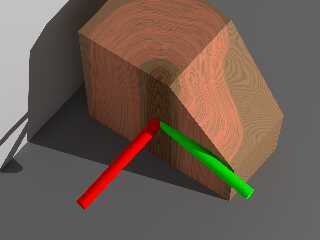
Browse your links roughly. Thank you.
Careless reading because I still effort on existed plane.


This one I cancelled the vertical pattern because it looks artifact.
And I try using several pattern (vs different age) superposition , because I
would like maintain the fiber length at different position.

This one about 0.1m.
Post a reply to this message
Attachments:
Download 'show tree function test several f with bumps l0.10.png' (813 KB)
Preview of image 'show tree function test several f with bumps l0.10.png'
|
|
| |
| |
|
|
|
|
| |
| |
|
|
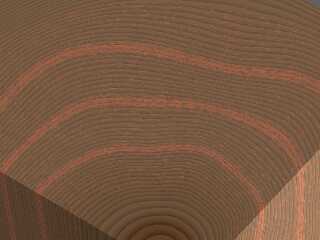
And this one about 0.01m.

With some artifact during the position it shows staggered.
I should think a better method.
Post a reply to this message
Attachments:
Download 'show tree function test several f with bumps l0.01.png' (863 KB)
Preview of image 'show tree function test several f with bumps l0.01.png'

|
|
| |
| |
|
|
|
|
| |
| |
|
|
I'm satisfied with this one, but with heavier coverage it is not so natural.
And variety for the height is a problem (I cancelled the original form, the new
one is list-to-do).

I found pigment_map should be a better method to composite the base color with
the thin fiber. Thus the fiber can be a darker color than the base. I still use
the 'average', but I will rewrite it.


If the output pigment want to maintain the fiber length, wood heart is another
challenge, I have tried some method, but no perfect one.
Post a reply to this message
Attachments:
Download 'show tree function test bumps l0.01 thickness0.07year near.png' (1759 KB)
Preview of image 'show tree function test bumps l0.01 thickness0.07year near.png'
|
|
| |
| |
|
|
|
|
| |
| |
|
|
"Bald Eagle" <cre### [at] netscapenet> wrote:
> "And" <49341109@ntnu.edu.tw> wrote:
> > "Bald Eagle" <cre### [at] netscapenet> wrote:
> When you abrade wood, erode it - like with driftwood, or stain it, you get an
> enhancement of the grain.  This is due to the alternating hard/soft regions, and
> usually the soft regions are light, and the harder regions are more brown.

Thanks for this knowledge.


>
> > > Holes due to boring insects
> > > "checking" (cracks) due to splitting when cut wood is rapidly dried
> >
> > Are you a professional person? Maybe we can discuss it. I don't know so much
> > about it.
>
> I don't do anything with wood for a living, but I've felled, sawn, and worked
> with lots of different wood.  And made plenty of mistakes.

Here is no chance to fell a tree, not to mention I'm living in a city. Such a
thing is secluded to me, so I have respect to the people who can do these
things.


> > > Then there's the fun of formulating pigment/texture maps for all of the
> > > different species...  ;)


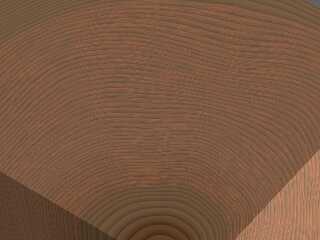
That's right, I will use pigment_map, but this is a picture I rendered, improved
the defect yesterday, and this is a two layered(in fact average of two) pattern
with different fiber length, eliminate some artifact about the coherence.
Post a reply to this message
Attachments:
Download 'show tree function two fiber length 0.017m 0.048m.png' (1763 KB)
Preview of image 'show tree function two fiber length 0.017m 0.048m.png'
|
|
| |
| |
|
|
|
|
| |
| |
|
|
Before continue the pigment_map and color, I tried a incredible detail idea
yesterday that I thought recently. Can be a new target to complete in the
future.

It is the knot.
But I'm willing to develop this feature with not so accurate shape only, I'd
like to implement it with (as much as possible) simple mathematical formula.


https://www.researchgate.net/figure/Longitudinal-section-through-a-tree-trunk-and-branch-Mueller-et-al-2006_fig1_274618
751
Post a reply to this message
Attachments:
Download '2d tree knot test.png' (1405 KB)
Preview of image '2d tree knot test.png'

|
|
| |
| |
|
|
|
|
| |
| |
|
|
Composite pigment_map and functions is more cumbersome than I think. I only
treat preconceived it easy.

The earlywood color and merge effect is not bad, but maybe strange at latewood.
Not know, should look the side cross section,  but for the purpose of trying the
pigment/color_map as quickly, I don't fix that varying function (vs height) yet.

This picture take 18m47s render time, It will slow down when combine more
(layer, concept)s.
And my main method is distinguish the heartwood, inner-sapwood, mid-sapwood,
outer-sapwood..., this one I only detail the mid-sapwood.
Post a reply to this message
Attachments:
Download 'show tree function.png' (830 KB)
Preview of image 'show tree function.png'
|
|
| |
| |
|
|
|
|
| |
| |
|
|
"And" <49341109@ntnu.edu.tw> wrote:

> This picture take 18m47s render time, It will slow down when combine more
> (layer, concept)s.

That seems like a very long time for such a simple render.  I would imagine that
you can get a similar result a lot faster if the troubles were identified and
optimised.  I like to consult Inigo Quilez, and Martijn Steinrucker (Art of
Code), since their approach to computer graphics is very different, and forces
me to consider different approaches and ways to simplify and optimize any
function-based code I'm interested in writing.
TOK always has a way of slicing through a lot of these problems like a laser,
but I think it's very educational to explore a number of approaches before
others offer up solutions of their own.

> And my main method is distinguish the heartwood, inner-sapwood, mid-sapwood,
> outer-sapwood..., this one I only detail the mid-sapwood.

As slow as it is, I think that middle layer is looking great, and your progress
in this project is definitely showing incremental successes!  :)
Post a reply to this message
|
|
| |
| |
|
|
|
|
| |
| |
|
|
"Bald Eagle" <cre### [at] netscapenet> wrote:
> "And" <49341109@ntnu.edu.tw> wrote:
>
> > This picture take 18m47s render time, It will slow down when combine more
> > (layer, concept)s.
>
> That seems like a very long time for such a simple render.  I would imagine that
> you can get a similar result a lot faster if the troubles were identified and
> optimised.  I like to consult Inigo Quilez, and Martijn Steinrucker (Art of
> Code), since their approach to computer graphics is very different, and forces
> me to consider different approaches and ways to simplify and optimize any
> function-based code I'm interested in writing.
Thank you. I never develop my (not chinese)social circle besides news.povray.
Maybe I can try someday.

And, that rendered picture is a 3D one, not a pattern. It turn on radiosity and
rendered using my notebook, so I'm not suspect this situation too much.


> TOK always has a way of slicing through a lot of these problems like a laser,
> but I think it's very educational to explore a number of approaches before
> others offer up solutions of their own.
>
> > And my main method is distinguish the heartwood, inner-sapwood, mid-sapwood,
> > outer-sapwood..., this one I only detail the mid-sapwood.
>
> As slow as it is, I think that middle layer is looking great, and your progress
> in this project is definitely showing incremental successes!  :)

Thanks.
Post a reply to this message
|
|
| |
| |
|
|
|
|
| |
| |
|
|
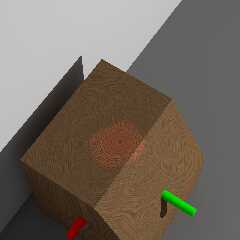
With a very similar setting, whole box, I redraw the shape. There is an artifact
line...,
Now I know it does not finish yet.

My personal purpose is output the UV-map for some mesh 3D model, I modeling them
in Blender now.
Post a reply to this message
Attachments:
Download 'show tree function.png' (1623 KB)
Preview of image 'show tree function.png'
|
|
| |
| |
|
|
|
|
| |
| |
|
|
hi,

"And" <49341109@ntnu.edu.tw> wrote:
> ...
> Now I know it does not finish yet.

do you always do "blocks", or have you put the texture to use yet?  (thinking,
eg, the distribution 'woodbox.pov' scene, or such)


regards, jr.
Post a reply to this message
|
|
| |
| |
|
|
|
|
| |
| |
|
|
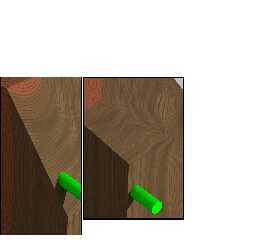
First experiment to apply knot distortion to the base shape.

Very experimental trying. potentiality...?
Post a reply to this message
Attachments:
Download 'tree knot.png' (911 KB)
Preview of image 'tree knot.png'
|
|
| |
| |
|
|
|
|
| |
| |
|
|
"jr" <cre### [at] gmailcom> wrote:
> hi,
>
> "And" <49341109@ntnu.edu.tw> wrote:
> > ...
> > Now I know it does not finish yet.
>
> do you always do "blocks", or have you put the texture to use yet?  (thinking,
> eg, the distribution 'woodbox.pov' scene, or such)
>
>
> regards, jr.

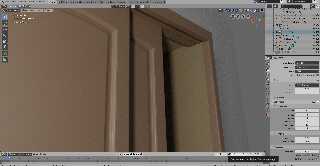
"Now I know it does not finish yet." with this sentence I mean that I cannot
adjust the texture easily. The program outputs the texture result(only shape
distortion detail) --> color apply...to what I want, is semi-automatic.

I did not apply it to 3D models yet. But I know it certainly can apply.
I have tried mesh camera of POV-Ray.

This image is what I want to attach the material. I have made several models,
and I want to sell them on TurboSquid to rescue my poor situation: never
accomplish important things, no income for a long time, ...

I will share the program here in the form of freeware(Not open source), this is
because the program is the first usable one which I develop (To myself
mainly), and it highly dependent on POV-Ray, I know I do not on the step
developing commercial program yet, I need some feedback so.
Post a reply to this message
Attachments:
Download 'wardrope.png' (1837 KB)
Preview of image 'wardrope.png'
|
|
| |
| |
|
|
|
|
| |
| |
|
|
Op 25/05/2022 om 17:32 schreef And:
> First experiment to apply knot distortion to the base shape.
>
> Very experimental trying. potentiality...?

Oh yes! This looks very knot-like, so to speak. You are on the right
track indeed.

--
Thomas
Post a reply to this message
|
|
| |
| |
|
|
|
|
| |
| |
|
|
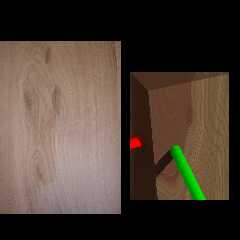
Modify it with rather casual, I need 2-3 weeks to arrange the output .inc files.

The knot is an experimental feature.
In fact, I'm not clear on how these knot pattern form in photographs.
Post a reply to this message
Attachments:
Download 'show tree function.png' (1755 KB)
Preview of image 'show tree function.png'
|
|
| |
| |
|
|
|
|
| |
| |
|
|
"And" <49341109@ntnu.edu.tw> wrote:
> Modify it with rather casual, I need 2-3 weeks to arrange the output .inc files.
>
> The knot is an experimental feature.
> In fact, I'm not clear on how these knot pattern form in photographs.

This is entering crazy good level realm ! :-)
Post a reply to this message
|
|
| |
| |
|
|
|
|
| |
| |
|
|
Op 26/05/2022 om 13:42 schreef And:
> Modify it with rather casual, I need 2-3 weeks to arrange the output .inc files.
>
> The knot is an experimental feature.
> In fact, I'm not clear on how these knot pattern form in photographs.
>
Well, as knots are cross-sections of branches at different angles, you
can consider them identical to the main cross-section of the trunk wood.
Your attempt is very convincing, although - I suppose - your approach to
generate them is different.

--
Thomas
Post a reply to this message
|
|
| |
| |
|
|
|
|
| |
| |
|
|
"Mr" <m******r******at_hotmail_dot_fr> wrote:
>
> This is entering crazy good level realm ! :-)

Thank you.


Thomas de Groot <tho### [at] degrootorg> wrote:
> Op 26/05/2022 om 13:42 schreef And:
> > Modify it with rather casual, I need 2-3 weeks to arrange the output .inc files.
> >
> > The knot is an experimental feature.
> > In fact, I'm not clear on how these knot pattern form in photographs.
> >
> Well, as knots are cross-sections of branches at different angles, you
> can consider them identical to the main cross-section of the trunk wood.
> Your attempt is very convincing, although - I suppose - your approach to
> generate them is different.
>
> --
> Thomas

Different approach...maybe. Totally the concept, it is about... I draw the
standard concentric circles(internal wood pattern) there, but I change the input
coordinate (x, y, z) to (x/factor(..), y/factor(..), z), than it distortion the
original space on x-y plane direction.

The knot is the same. I distortion the pattern shape in a narrow range, (vs r
theta and z)
Post a reply to this message
|
|
| |
| |
|
|
|
|
| |
| |
|
|
"And" <49341109@ntnu.edu.tw> wrote:
> Different approach...maybe. Totally the concept, it is about... I draw the
> standard concentric circles(internal wood pattern) there, but I change the input
> coordinate (x, y, z) to (x/factor(..), y/factor(..), z), than it distortion the
> original space on x-y plane direction.
>
> The knot is the same. I distortion the pattern shape in a narrow range, (vs r
> theta and z)


#declare knot_theta_pos = 0.24*pi;
#declare knot_range = 0.41*pi; // 0.28*pi
#declare knot_h_pos = 1.36;

// simple temp r, not a formal one
#declare f_r_vs_t =
function(var_t, h) {
0.03* var_t
}


// r_of_it means the distant of p to the knot(stem) center line.
// but only approximate.
#declare f_knot_about =
function(var_t, r_of_it) {
select(
    r_of_it - knot_range/2,
    (f_r_vs_t(var_t, 0) +0.001*(cos(r_of_it*2*pi/knot_range) +
1)/2/pow(abs(r_of_it), 1.5)  )/f_r_vs_t(var_t, 0),
    1
)
}

#declare f_knot =
function(x, y, z) {
f_knot_about(time_mockup_function(x, y, z), sqrt(pow(f_theta(x,y) -
knot_theta_pos, 2) + pow((z - knot_h_pos)/f_r(x, y, z), 2)) )
}

// -----------------------------------------
#declare time_mockup_with_knot_function =
function (x, y ,z){
time_mockup_function(
x/f_knot(x, y, z),
y/f_knot(x, y, z),
z
)
}
Post a reply to this message
|
|
| |
| |
|
|
|
|
| |
| |
|
|
"jr" <cre### [at] gmailcom> wrote:
> hi,
>
> "And" <49341109@ntnu.edu.tw> wrote:
> > ...
> > Now I know it does not finish yet.
>
> do you always do "blocks", or have you put the texture to use yet?  (thinking,
> eg, the distribution 'woodbox.pov' scene, or such)
>
>
> regards, jr.


After investigate colors from photo. put them together reluctantly.
I apply this yellow color wood to woodbox.pov, only the container.
Post a reply to this message
Attachments:
Download 'woodbox test.png' (3516 KB)
Preview of image 'woodbox test.png'

|
|
| |
| |
|
|
|
|
| |
| |
|
|
Today I searched some procedural wood texture generator on the web, I never got
( maybe I did not concentrate enough) such a program before.

I found two this time.

https://www.blendernation.com/2019/08/08/timber-a-realistic-procedural-pbr-wood-material/

https://blendermarket.com/products/carvature


At the beginning of design my program, I choosed a simple and feasible compage
for it. After adjusting the result texture attentively, I found it can also
accomplish the level. That tempted me to put it into a commercial, too. But
developing software is such a huge affair, I know I will release it in the form
of freeware( maybe alpha or beta test version) before it have the basic
quality(like open/save, or select colors in the gui program).

I'm looking forward PayPal (for the 3D models selling), it will be a new
experience for me at least.

Before release the program, I must learn to prepare something first, and learn
to  compile it.
Post a reply to this message
|
|
| |
| |
|
|
|
|
| |
| |
|
|
hi,

"And" <49341109@ntnu.edu.tw> wrote:
> ...
> After investigate colors from photo. put them together reluctantly.

glad you did.  the pattern looks sumptuous, in particular I'm impressed by just
how believable the texture looks, the graining on the narrow side of the lid is
... wow.


regards, jr.
Post a reply to this message
|
|
| |
| |
|
|
|
|
| |
| |
|
|
"jr" <cre### [at] gmailcom> wrote:
> hi,
>
> "And" <49341109@ntnu.edu.tw> wrote:
> > ...
> > After investigate colors from photo. put them together reluctantly.
>
> glad you did.  the pattern looks sumptuous, in particular I'm impressed by just
> how believable the texture looks, the graining on the narrow side of the lid is
> ... wow.
>
>
> regards, jr.

Thank you.
I like this admix, too.
Post a reply to this message
|
|
| |
| |
|
|
|
|
| |
| |
|
|
"And" <49341109@ntnu.edu.tw> wrote:
> Thank you.
> I like this admix, too.

I imitate that box color and direct of pattern by this one (But the color is
selected by photos of mine) which the texture is scanned.

https://www.turbosquid.com/3d-models/scanned-objects-3d-model-1694388


There are too many details to imitate, but the color changing at the corner is
catch my eye. I know that proximity pattern discussed in the newsgroups.

http://news.povray.org/povray.binaries.images/thread/%3Cweb.4bda394e8fe449e421619a220%40news.povray.org%3E/
Post a reply to this message
|
|
| |
| |
|
|
|
|
| |
| |
|
|
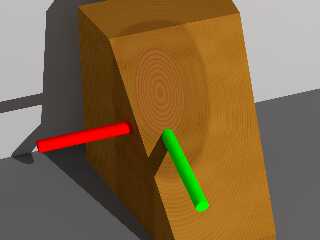
I have completed most of the arrangement of output .inc files.
All effects remains the previous.
In fact, I doubt about the albedo of the (selected) color.

1). I knows that the albedo of many substances are between 0.0.. ~ 0.6...(60%),
the white wall or white paper is just about 60%. The correct value of the albedo
cannot measure from the photograph directly, unless you know the light source
strength.

2). The rendered image shows the current composite of patterns. Include the
fiber and big color block. It takes 20m46s to render.

3). I have fixed and eliminated the discontinuous line on the angle terminal
position.

4). The variance of the pattern is not enough for the z(height) direct. If you
cut this pattern using a cylinder, or just the "rotary peeled" method. The
result pattern will very unnatural.
Post a reply to this message
Attachments:
Download 'show tree function.png' (1013 KB)
Preview of image 'show tree function.png'
|
|
| |
| |
|
|
|
|
| |
| |
|
|
I will release a test version on the following day.
(.jar) Executable jar file

I will describe its limit.
Post a reply to this message
|
|
| |
| |
|
|
|
|
| |
| |
|
|
"And" <49341109@ntnu.edu.tw> wrote:

I didn't read this paper (yet), but it just showed up in my email inbox.
Maybe it will inspire some ideas, serve as an entry to other similar research
papers, and be of some practical use in developing your challenging project.

(I hadn't thought of using L-systems!)

-BW

https://www.academia.edu/keypass/TklERytmOFYyc2ZaWDhzZ2lKd1p2RzlPdVR5SFQ3OC9wZVB0NzAvOFI2bz0tLUdSbDRQT1R4dFpCVEFBV1lRWm
Naamc9PQ==--4e10a79e4ba8dd769635ce68308bdbcc2e9e8f3f/t/jZTSw-QwzUMmQ-CC8f8/resource/work/23491795/3Gmap_L_systems_an_ap
plication_to_the_modelling_of_wood?email_work_card=view-paper&li=0
Post a reply to this message
|
|
| |
| |
|
|
|
|
| |