|
|
|
|
|
|
| |
| |
|
|
|
|
| |
| |
|
|
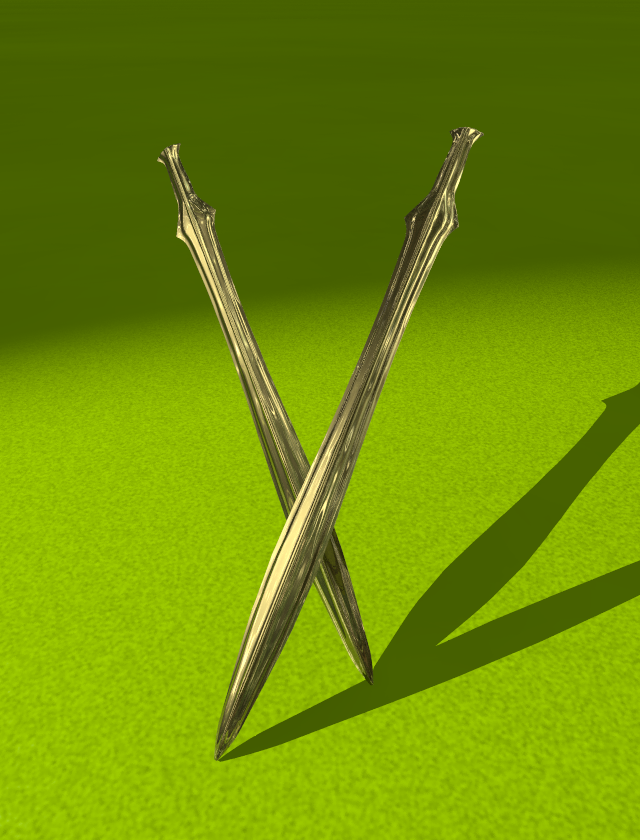
Not yet entirely satisfying but this is a first acceptable model of a
(leaf-shaped) cast-bronze /blade/. Texture based on an example by Tim
Attwood.

I modelled one quarter of the blade which is then mirrored 3x.

The sword's grip will be modelled over the blade, more or less how this
was done at the time.

--
Thomas
Post a reply to this message
Attachments:
Download 'objects_test - bronzeagesword_01.png' (457 KB)
Preview of image 'objects_test - bronzeagesword_01.png'
|
|
| |
| |
|
|
|
|
| |
| |
|
|
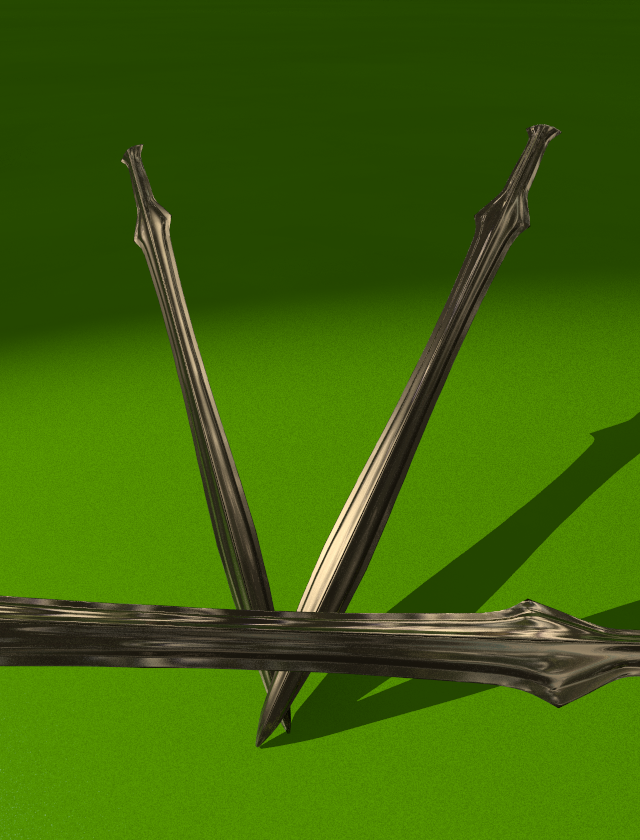
A bit of improvements.

The bronze texture used is given here (for POV versions 3.7 or better 3.8):

//-------------------------------------------------
//from  https://en.wikipedia.org/wiki/Bronze_(color)
#declare P_bronze1 = rgb <205/255, 127/255, 50/255>;  //is: HTML/CSS
#CD7F32 code. see also: https://htmlcolorcodes.com/colors/bronze/
#declare P_bronze2 = rgb <150/255, 116/255, 68/255>;  //is: Hex Color:
#967444. see: https://colorcodes.io/brown/bronze-color-codes/
                                                       //with variations:
#declare P_bronze3 = rgb <87/255, 67/255, 39/255>;    //#574327
#declare P_bronze4 = rgb <227/255, 175/255, 102/255>; //#E3AF66
#declare P_bronze5 = rgb <163/255, 126/255, 73/255>;  //#A37E49
#declare P_bronze6 = rgb <125/255, 96/255, 56/255>;   //#7D6038

#declare P_BlastOff_bronze = rgb <165/255, 113/255, 100/255>;  //Crayola
#declare P_Antique_bronze = srgb <102/255, 93/255, 30/255>;
//My bronze:
#declare P_My_bronze = rgb <242/255, 221/255, 137/255>;

// Based on texture CastMetal by Tim Attwood
#declare CastBronze =
texture {
   pigment {P_bronze4}
   normal {granite bump_size 0.01 scale 0.01}
   finish {
     diffuse  0.01
     brilliance 1
     metallic on
     specular  0.6
     roughness 0.01
     reflection {0.001, 0.6 metallic on }
     conserve_energy
   }
}
//-------------------------------------------------


--
Thomas
Post a reply to this message
Attachments:
Download 'objects_test - bronzeagesword_03.png' (538 KB)
Preview of image 'objects_test - bronzeagesword_03.png'
|
|
| |
| |
|
|
|
|
| |
| |
|
|
On 13/07/2023 17:12, Thomas de Groot wrote:
> A bit of improvements.
>
> The bronze texture used is given here (for POV versions 3.7 or better 3.8):
> snip
>

A small remark for lazy people like me, it's shorter to write
<a,b,c>/255 rather than <a/255, b/255, c/255>...

That said, the geometry is excellent


--
Kurtz le pirate
Compagnie de la Banquise
Post a reply to this message
|
|
| |
| |
|
|
|
|
| |
| |
|
|
Op 14-7-2023 om 09:23 schreef kurtz le pirate:
> On 13/07/2023 17:12, Thomas de Groot wrote:
>> A bit of improvements.
>>
>> The bronze texture used is given here (for POV versions 3.7 or better 3.8):
>> snip
>>
>
> A small remark for lazy people like me, it's shorter to write
> <a,b,c>/255 rather than <a/255, b/255, c/255>...
>
I know. ;-)
However, I seem to remember that Clipka once told us that - especially
when srgb is involved (not here directly, though) - it would be wiser to
write it like I did here. So, being an obedient pupil, I followed
(blindly) his advise. :-)
That said, I happen very often to be lazy too...

> That said, the geometry is excellent
>
Thank you sir! Trying to continue in the same vein.

--
Thomas
Post a reply to this message
|
|
| |
| |
|
|
|
|
| |
| |
|
|
On 2023-07-14 07:34 (-4), Thomas de Groot wrote:
> Op 14-7-2023 om 09:23 schreef kurtz le pirate:
>>
>> A small remark for lazy people like me, it's shorter to write
>> <a,b,c>/255 rather than <a/255, b/255, c/255>...
>>
> I know. ;-)
> However, I seem to remember that Clipka once told us that - especially
> when srgb is involved (not here directly, though) - it would be wiser to
> write it like I did here. So, being an obedient pupil, I followed
> (blindly) his advise. :-)

You remember incorrectly (again).

https://news.povray.org/6065d1ea%241%40news.povray.org
Post a reply to this message
|
|
| |
| |
|
|
|
|
| |
| |
|
|
Op 14-7-2023 om 15:04 schreef Cousin Ricky:
> You remember incorrectly (again).
>
> https://news.povray.org/6065d1ea%241%40news.povray.org
>


WHY am I not surprised?!?  :-)

--
Thomas
Post a reply to this message
|
|
| |
| |
|
|
|
|
| |
| |
|
|
Op 14-7-2023 om 16:12 schreef Thomas de Groot:
> WHY am I not surprised?!?  :-)
>

It all relates to the following discussion:

http://news.povray.org/povray.general/thread/%3Cweb.60649d9bb9b7dccdd98418916e066e29%40news.povray.org%3E/?mtop=433443

Where I probably lost track, not really understanding the matter. Only
flotsam survived on the waves of my memory...

[to self: I need to re-read this...]

--
Thomas
Post a reply to this message
|
|
| |
| |
|
|
|
|
| |
| |
|
|
Cousin Ricky <ric### [at] yahoo com> wrote:
> On 2023-07-14 07:34 (-4), Thomas de Groot wrote:
> > Op 14-7-2023 om 09:23 schreef kurtz le pirate:
> >>
> >> A small remark for lazy people like me, it's shorter to write
> >> <a,b,c>/255 rather than <a/255, b/255, c/255>...
> >>
> > I know. ;-)
> > However, I seem to remember that Clipka once told us that - especially
> > when srgb is involved (not here directly, though) - it would be wiser to
> > write it like I did here. So, being an obedient pupil, I followed
> > (blindly) his advise. :-)
>
> You remember incorrectly (again).
>
> https://news.povray.org/6065d1ea%241%40news.povray.org
Ooooooh. Thomas made a naughty. :O
I'd say that since we're 30+ years in, maybe we ought to have a macro of some
sort with plenty of explanatory documentation IN the macro code.
#macro SRGB (byteTriplet, optional Multiplier)
// Converts a byte value <0-255, 0-255, 0-255> to a
// POV-Ray compliant rgb color vector <0-1, 0-1, 0-1>
// Usage: SRGB (<r, g, b>)
// - or -
// SRGB (<r, g, b>) * Multiplier
// From: Cousin Ricky
// Subject: Re: strange problem with srgb color in light_source
// https://news.povray.org/606cb0f5%40news.povray.org
// Here is the general sequence:
/*
1. An sRGB triplet that comes from a color picker, eyedropper tool, or
published Web source is typically in the range <0,0,0> ...
<255,255,255>. Divide this by 255 to bring it into the range
<0,0,0> ... <1,1,1>. This /must/ be done first thing, and is the
only math that should ever be done at this stage, though it may be
combined with step 2.
*/
#local srgbColorVector = byteTriplet/255;
/*
2. #declare the color with the srgb keyword. The resulting identifier
contains a linear color.
*/
#local RGBcolor = srgb srgbColorVector;
/*
3. Now, do whatever additional math you need on the identifier. You may
do this in a pigment or light_source or wherever.
*/
// ^^^ leave this for outside of the macro
RGBcolor
#end
This, as just a simple prototype.
Something better that takes all the information (filter, transmit, multipliers)
would be nice, and would have sanity checks for out of range values, negative
values, etc.
Maybe I need to go back to the scenes where I was working out the srgb math and
use that to make a documentation infographic, and possibly an animation.
It would be way better to have a nice, fully presented thing in the distribution
that lays out all of the whys and hows, than to have to rehash this topic ever
few years.
Than people can visually and mathematically see what the byte triplet values
are, the in-range nonlinear srgb values are, the in-range linear rgb values, and
how they all relate to one another. Just do a simple animation from <0, 0, 0>
to <255, 255, 255>, and I think that might very well cover it.
Some examples that simultaneously show the incorrect way to convert from srgb to
rgb would likely be helpful as well.
- BW com> wrote:
> On 2023-07-14 07:34 (-4), Thomas de Groot wrote:
> > Op 14-7-2023 om 09:23 schreef kurtz le pirate:
> >>
> >> A small remark for lazy people like me, it's shorter to write
> >> <a,b,c>/255 rather than <a/255, b/255, c/255>...
> >>
> > I know. ;-)
> > However, I seem to remember that Clipka once told us that - especially
> > when srgb is involved (not here directly, though) - it would be wiser to
> > write it like I did here. So, being an obedient pupil, I followed
> > (blindly) his advise. :-)
>
> You remember incorrectly (again).
>
> https://news.povray.org/6065d1ea%241%40news.povray.org
Ooooooh. Thomas made a naughty. :O
I'd say that since we're 30+ years in, maybe we ought to have a macro of some
sort with plenty of explanatory documentation IN the macro code.
#macro SRGB (byteTriplet, optional Multiplier)
// Converts a byte value <0-255, 0-255, 0-255> to a
// POV-Ray compliant rgb color vector <0-1, 0-1, 0-1>
// Usage: SRGB (<r, g, b>)
// - or -
// SRGB (<r, g, b>) * Multiplier
// From: Cousin Ricky
// Subject: Re: strange problem with srgb color in light_source
// https://news.povray.org/606cb0f5%40news.povray.org
// Here is the general sequence:
/*
1. An sRGB triplet that comes from a color picker, eyedropper tool, or
published Web source is typically in the range <0,0,0> ...
<255,255,255>. Divide this by 255 to bring it into the range
<0,0,0> ... <1,1,1>. This /must/ be done first thing, and is the
only math that should ever be done at this stage, though it may be
combined with step 2.
*/
#local srgbColorVector = byteTriplet/255;
/*
2. #declare the color with the srgb keyword. The resulting identifier
contains a linear color.
*/
#local RGBcolor = srgb srgbColorVector;
/*
3. Now, do whatever additional math you need on the identifier. You may
do this in a pigment or light_source or wherever.
*/
// ^^^ leave this for outside of the macro
RGBcolor
#end
This, as just a simple prototype.
Something better that takes all the information (filter, transmit, multipliers)
would be nice, and would have sanity checks for out of range values, negative
values, etc.
Maybe I need to go back to the scenes where I was working out the srgb math and
use that to make a documentation infographic, and possibly an animation.
It would be way better to have a nice, fully presented thing in the distribution
that lays out all of the whys and hows, than to have to rehash this topic ever
few years.
Than people can visually and mathematically see what the byte triplet values
are, the in-range nonlinear srgb values are, the in-range linear rgb values, and
how they all relate to one another. Just do a simple animation from <0, 0, 0>
to <255, 255, 255>, and I think that might very well cover it.
Some examples that simultaneously show the incorrect way to convert from srgb to
rgb would likely be helpful as well.
- BW
Post a reply to this message
|
|
| |
| |
|
|
|
|
| |
| |
|
|
Thomas de Groot <tho### [at] degrootorg> wrote:
> Not yet entirely satisfying but this is a first acceptable model of a
> (leaf-shaped) cast-bronze /blade/. Texture based on an example by Tim
> Attwood.
>
> I modelled one quarter of the blade which is then mirrored 3x.
>
> The sword's grip will be modelled over the blade, more or less how this
> was done at the time.
>
> --
> Thomas

Nice Job! love the model and material.
Miller
Post a reply to this message
|
|
| |
| |
|
|
|
|
| |
| |
|
|
Op 14/07/2023 om 19:42 schreef Bald Eagle:
> Ooooooh.  Thomas made a naughty.   :O
>
Yeaahh.... What did you expect?  ;-)

> I'd say that since we're 30+ years in, maybe we ought to have a macro of some
> sort with plenty of explanatory documentation IN the macro code.
>
That would be a very good idea indeed. I have been wandering around for
some time with the same and slowly started to add comprehensive (?)
comments to those macros or includes I use most often as I generally
forget what or why to do in particular cases from one project to the
other. Re-inventing the wheel each time as it were...

Your example looks very neat. I shall study it some more and take
inspiration from it.

> [snip]
>
> This, as just a simple prototype.
> Something better that takes all the information (filter, transmit, multipliers)
> would be nice, and would have sanity checks for out of range values, negative
> values, etc.
>
> Maybe I need to go back to the scenes where I was working out the srgb math and
> use that to make a documentation infographic, and possibly an animation.
>
> It would be way better to have a nice, fully presented thing in the distribution
> that lays out all of the whys and hows, than to have to rehash this topic ever
> few years.
>
Not that I mind to re-ignite the discussion every few years as I seem to
do ;-) but I fully agree with you on this.

> Than people can visually and mathematically see what the byte triplet values
> are, the in-range nonlinear srgb values are, the in-range linear rgb values, and
> how they all relate to one another.   Just do a simple animation from <0, 0, 0>
> to <255, 255, 255>, and I think that might very well cover it.
> Some examples that simultaneously show the incorrect way to convert from srgb to
> rgb would likely be helpful as well.
>
> - BW
>

--
Thomas
Post a reply to this message
|
|
| |
| |
|
|
|
|
| |
| |
|
|
Op 15-7-2023 om 06:01 schreef Mike Miller:
> Nice Job! love the model and material.
> Miller
>
Thanks Mike. This kind of project is a good opportunity to plunge into
the archaeological background of the subject and revisit my bookshelves
on the period (got some dusting to do too) completed with an internet
search of course.

--
Thomas
Post a reply to this message
|
|
| |
| |
|
|
|
|
| |
| |
|
|
Thomas de Groot <tho### [at] degrootorg> wrote:
> A bit of improvements. [...]

It's looking good, Thomas! I wonder what the purpose of the blade's fluting was?
Actually, I think I know already, but the shape doesn't seem like it was made
for stabbing.

The material is making me wish there were better options for blurry reflections.
(An ancient wish of mine.) We have UberPOV's reflection roughness, but there
doesn't seem to be a way to control the number of samples! If we could specify
just one or two reflection blur samples, we could then use more focal blur and
AA samples to make things look much smoother overall. I'm almost ready to
download the UberPOV source and VisualStudio or whatever I need just so I can
change a few things... but that's a project and a half :/

Anyway, I'm eager to see where this scene leads!

Sam
Post a reply to this message
|
|
| |
| |
|
|
|
|
| |
| |
|
|
Op 17-7-2023 om 01:00 schreef Samuel B.:
> Thomas de Groot <tho### [at] degrootorg> wrote:
>> A bit of improvements. [...]
>
> It's looking good, Thomas! I wonder what the purpose of the blade's fluting was?
> Actually, I think I know already, but the shape doesn't seem like it was made
> for stabbing.
>
I think those swords were not used for stabbing but chopping.

Maybe this will interest you:
https://www.sciencealert.com/scientists-trade-blows-in-a-debate-over-whether-ancient-bronze-swords-were-just-for-show


> The material is making me wish there were better options for blurry reflections.
> (An ancient wish of mine.) We have UberPOV's reflection roughness, but there
> doesn't seem to be a way to control the number of samples! If we could specify
> just one or two reflection blur samples, we could then use more focal blur and
> AA samples to make things look much smoother overall. I'm almost ready to
> download the UberPOV source and VisualStudio or whatever I need just so I can
> change a few things... but that's a project and a half :/
>
> Anyway, I'm eager to see where this scene leads!
>
Wait and see... ;-)

--
Thomas
Post a reply to this message
|
|
| |
| |
|
|
|
|
| |
| |
|
|
Thomas de Groot <tho### [at] degrootorg> wrote:
> Op 17-7-2023 om 01:00 schreef Samuel B.:
> > [...] the shape doesn't seem like it was made for stabbing.
> >
> I think those swords were not used for stabbing but chopping.
>
> Maybe this will interest you:
>
https://www.sciencealert.com/scientists-trade-blows-in-a-debate-over-whether-ancient-bronze-swords-were-just-for-show


Yeah, that is interesting. I wonder why there was any doubt, though. Why make
swords if you weren't going to use them? Were other, better alloys available
during the middle-to-late part of the Bronze Age? (My history knowledge is
somewhat lacking).

Sam
Post a reply to this message
|
|
| |
| |
|
|
|
|
| |
| |
|
|
Op 18-7-2023 om 00:40 schreef Samuel B.:
> Thomas de Groot <tho### [at] degrootorg> wrote:
>> Op 17-7-2023 om 01:00 schreef Samuel B.:
>>> [...] the shape doesn't seem like it was made for stabbing.
>>>
>> I think those swords were not used for stabbing but chopping.
>>
>> Maybe this will interest you:
>>
https://www.sciencealert.com/scientists-trade-blows-in-a-debate-over-whether-ancient-bronze-swords-were-just-for-show
>
>
> Yeah, that is interesting. I wonder why there was any doubt, though. Why make
> swords if you weren't going to use them? Were other, better alloys available
> during the middle-to-late part of the Bronze Age? (My history knowledge is
> somewhat lacking).
>
I think because there still is a lack of knowledge/understanding about
Bronze Age society. There are no accounts or tales; swords are only
known in a funeral rite context, so, what to infer? Obviously, those
telltale marks on the blades had never been studied properly before
(lack of funds and time most probably I guess). Except for variations in
the proportions of the basic alloys locally/regionally or for different
uses, the bronze seems to have been about identical throughout the
period. However, I am no expert on the matter...

--
Thomas
Post a reply to this message
|
|
| |
| |
|
|
|
|
| |
| |
|
|
Thomas de Groot <tho### [at] degrootorg> wrote:
> Op 18-7-2023 om 00:40 schreef Samuel B.:
> > Thomas de Groot <tho### [at] degrootorg> wrote:
> >> Op 17-7-2023 om 01:00 schreef Samuel B.:
> >>> [...] the shape doesn't seem like it was made for stabbing.
> >>>
> >> I think those swords were not used for stabbing but chopping.
> >>
> >> Maybe this will interest you:
> >>
https://www.sciencealert.com/scientists-trade-blows-in-a-debate-over-whether-ancient-bronze-swords-were-just-for-s
how
> >
> >
> > Yeah, that is interesting. I wonder why there was any doubt, though. Why make
> > swords if you weren't going to use them? Were other, better alloys available
> > during the middle-to-late part of the Bronze Age? (My history knowledge is
> > somewhat lacking).
> >
> I think because there still is a lack of knowledge/understanding about
> Bronze Age society. There are no accounts or tales; swords are only
> known in a funeral rite context, so, what to infer? Obviously, those
> telltale marks on the blades had never been studied properly before
> (lack of funds and time most probably I guess). Except for variations in
> the proportions of the basic alloys locally/regionally or for different
> uses, the bronze seems to have been about identical throughout the
> period. However, I am no expert on the matter...
>
> --
> Thomas

Yeah, rigorous studies are always needed, especially when lacking historical
accounts. Based on my initial research, it seems like the swords were bent or
otherwise destroyed, possibly to 'kill' the weapon and return it to its owner,
or keep it or its metals from being used by others. Seems like a waste of
precious material, but then again we humans are often driven by various (maybe
illogical) ideals and weird beliefs ;)

Sam
Post a reply to this message
|
|
| |
| |
|
|
|
|
| |
| |
|
|
Op 18/07/2023 om 23:22 schreef Samuel B.:
> Thomas de Groot <tho### [at] degrootorg> wrote:
>> Op 18-7-2023 om 00:40 schreef Samuel B.:
>>> Thomas de Groot <tho### [at] degrootorg> wrote:
>>>> Op 17-7-2023 om 01:00 schreef Samuel B.:
>>>>> [...] the shape doesn't seem like it was made for stabbing.
>>>>>
>>>> I think those swords were not used for stabbing but chopping.
>>>>
>>>> Maybe this will interest you:
>>>>
https://www.sciencealert.com/scientists-trade-blows-in-a-debate-over-whether-ancient-bronze-swords-were-just-for-s
> how
>>>
>>>
>>> Yeah, that is interesting. I wonder why there was any doubt, though. Why make
>>> swords if you weren't going to use them? Were other, better alloys available
>>> during the middle-to-late part of the Bronze Age? (My history knowledge is
>>> somewhat lacking).
>>>
>> I think because there still is a lack of knowledge/understanding about
>> Bronze Age society. There are no accounts or tales; swords are only
>> known in a funeral rite context, so, what to infer? Obviously, those
>> telltale marks on the blades had never been studied properly before
>> (lack of funds and time most probably I guess). Except for variations in
>> the proportions of the basic alloys locally/regionally or for different
>> uses, the bronze seems to have been about identical throughout the
>> period. However, I am no expert on the matter...
>>
>> --
>> Thomas
>
> Yeah, rigorous studies are always needed, especially when lacking historical
> accounts. Based on my initial research, it seems like the swords were bent or
> otherwise destroyed, possibly to 'kill' the weapon and return it to its owner,
> or keep it or its metals from being used by others. Seems like a waste of
> precious material, but then again we humans are often driven by various (maybe
> illogical) ideals and weird beliefs ;)
>
> Sam
>
It probably made a lot of sense at the time. Rites and beliefs were and
still are the means of knitting together social groups, often in
opposition to other groups unfortunately. That is the fundamental
problem social animals like ourselves are born with. Chimps are not
different in that respect, and herding animals have their own picking
order and hierarchies. Martians, I have been told, have outgrown the
problem (which is why they are extinct)... ;-)

--
Thomas
Post a reply to this message
|
|
| |
| |
|
|
|
|
| |
| |
|
|
Thomas de Groot <tho### [at] degrootorg> wrote:
> Op 18/07/2023 om 23:22 schreef Samuel B.:
> > Thomas de Groot <tho### [at] degrootorg> wrote:
> >> Op 18-7-2023 om 00:40 schreef Samuel B.:
> >>> Thomas de Groot <tho### [at] degrootorg> wrote:
> >>>> Op 17-7-2023 om 01:00 schreef Samuel B.:
> >>>>> [...] the shape doesn't seem like it was made for stabbing.
> >>>>>
> >>>> I think those swords were not used for stabbing but chopping.
> >>>>
> >>>> Maybe this will interest you:
> >>>>
https://www.sciencealert.com/scientists-trade-blows-in-a-debate-over-whether-ancient-bronze-swords-were-just-for
-s
> > how
> >>>
> >>> Yeah, that is interesting. I wonder why there was any doubt, though. [...]
> >>>
> >> I think because there still is a lack of knowledge/understanding about
> >> Bronze Age society. There are no accounts or tales; swords are only
> >> known in a funeral rite context, so, what to infer? [...]
> >>
> > [...] Seems like a waste of precious material, but then again we humans are
often driven by various (maybe illogical) ideals and weird beliefs ;)
> >
> It probably made a lot of sense at the time. Rites and beliefs were and
> still are the means of knitting together social groups, often in
> opposition to other groups unfortunately. That is the fundamental
> problem social animals like ourselves are born with. Chimps are not
> different in that respect, and herding animals have their own picking
> order and hierarchies.

The problem with we humans is that our activities tend to have far-ranging
effects. Yeah, everything we do can be considered 'natural', but we also possess
greater reasoning capabilities, and so we have more responsibility compared to
other creatures... Which would imply a degree of free will, which is a whole
other conversation. (For instance if the principle of cause and effect reigns
supreme, how could there be free will? The best I can figure is that there are
'tiers' of free will, but ultimately only one outcome per 'timeline'. [Each
timeline being like a single lightning strike, and all timelines overlapping to
form a fuzzy probability cloud.])

> Martians, I have been told, have outgrown the problem (which is why they are
extinct)... ;-)

Hmm, I would like to know more regarding how something like that would come
about...

Sam
Post a reply to this message
|
|
| |
| |
|
|
|
|
| |
| |
|
|
Op 21-7-2023 om 00:34 schreef Samuel B.:
> Thomas de Groot <tho### [at] degrootorg> wrote:
>> Op 18/07/2023 om 23:22 schreef Samuel B.:
>>> Thomas de Groot <tho### [at] degrootorg> wrote:
>>>> Op 18-7-2023 om 00:40 schreef Samuel B.:
>>>>> Thomas de Groot <tho### [at] degrootorg> wrote:
>>>>>> Op 17-7-2023 om 01:00 schreef Samuel B.:
>>>>>>> [...] the shape doesn't seem like it was made for stabbing.
>>>>>>>
>>>>>> I think those swords were not used for stabbing but chopping.
>>>>>>
>>>>>> Maybe this will interest you:
>>>>>>
https://www.sciencealert.com/scientists-trade-blows-in-a-debate-over-whether-ancient-bronze-swords-were-just-for
> -s
>>> how
>>>>>
>>>>> Yeah, that is interesting. I wonder why there was any doubt, though. [...]
>>>>>
>>>> I think because there still is a lack of knowledge/understanding about
>>>> Bronze Age society. There are no accounts or tales; swords are only
>>>> known in a funeral rite context, so, what to infer? [...]
>>>>
>>> [...] Seems like a waste of precious material, but then again we humans are
> often driven by various (maybe illogical) ideals and weird beliefs ;)
>>>
>> It probably made a lot of sense at the time. Rites and beliefs were and
>> still are the means of knitting together social groups, often in
>> opposition to other groups unfortunately. That is the fundamental
>> problem social animals like ourselves are born with. Chimps are not
>> different in that respect, and herding animals have their own picking
>> order and hierarchies.
>
> The problem with we humans is that our activities tend to have far-ranging
> effects. Yeah, everything we do can be considered 'natural', but we also possess
> greater reasoning capabilities, and so we have more responsibility compared to
> other creatures... Which would imply a degree of free will, which is a whole
> other conversation. (For instance if the principle of cause and effect reigns
> supreme, how could there be free will? The best I can figure is that there are
> 'tiers' of free will, but ultimately only one outcome per 'timeline'. [Each
> timeline being like a single lightning strike, and all timelines overlapping to
> form a fuzzy probability cloud.])
>
Those are a couple of interesting questions indeed. So, we may assume
that - at some point in human development - the impact of our  so-called
free will(?) governed/controlled by environment, climate, society
interactions, psychology, religion of course, etc decisions, started to
increasingly impact on the natural environment of the planet, from local
to global through human history. We seem not to be well-provided with
enough foresight to be able to properly analyse our actions/decisions at
that scale. Or, changes are going too fast for us to adapt in time, I
don't know. This is food for philosophers and sociologists. We, as small
individuals, cannot do much besides being conscious of what may or seems
to be happening before our eyes and - at least individually - try to act
and live consequently. It is a way of life me and my wife have tried
more or less successfully of course, to  follow for about the last fifty
years... Not that it changed the world around us obviously, but I have
the illusion that every little drop of water finally contributes to fill
the ocean. Naive, I know.

>> Martians, I have been told, have outgrown the problem (which is why they are
extinct)... ;-)
>
> Hmm, I would like to know more regarding how something like that would come
> about...
>
I brought this up half-jokingly, but it would be an interesting exercise
of what-if analysis. I don't feel really up to the task however.

We seem to be drifting slowly away from the initial goal. ;-)

--
Thomas
Post a reply to this message
|
|
| |
| |
|
|
|
|
| |
| |
|
|
Thomas de Groot <tho### [at] degrootorg> wrote:
> Op 21-7-2023 om 00:34 schreef Samuel B.:
> > Thomas de Groot <tho### [at] degrootorg> wrote:
> >> Op 18/07/2023 om 23:22 schreef Samuel B.:
> >>> Thomas de Groot <tho### [at] degrootorg> wrote:
> >>>> Op 18-7-2023 om 00:40 schreef Samuel B.:
> >>>>> Thomas de Groot <tho### [at] degrootorg> wrote:
> >>>>>> Op 17-7-2023 om 01:00 schreef Samuel B.:
> >>>>>>> [...] the shape doesn't seem like it was made for stabbing.
> >>>>>>>
> >>>>>> I think those swords were not used for stabbing but chopping.
> >>>>>>
> >>>>>> Maybe this will interest you:
> >>>>>>
https://www.sciencealert.com/scientists-trade-blows-in-a-debate-over-whether-ancient-bronze-swords-were-just-f
or-show
> >>>>>
> >>>>> Yeah, that is interesting. I wonder why there was any doubt, though. [...]
> >>>>>
> >>>> I think because there still is a lack of knowledge/understanding about
> >>>> Bronze Age society. [...]
> >>>>
> >>> [...] we humans are often driven by various (maybe illogical) ideals and weird
> >>> beliefs ;)
> >>>
> >> It probably made a lot of sense at the time. Rites and beliefs were and
> >> still are the means of knitting together social groups, often in
> >> opposition to other groups unfortunately. That is the fundamental
> >> problem social animals like ourselves are born with. [...]
> >
> > The problem with we humans is that our activities tend to have far-ranging
> > effects. Yeah, everything we do can be considered 'natural', but we also possess
> > greater reasoning capabilities, and so we have more responsibility compared to
> > other creatures... Which would imply a degree of free will, which is a whole
> > other conversation. (For instance if the principle of cause and effect reigns
> > supreme, how could there be free will? The best I can figure is that there are
> > 'tiers' of free will, but ultimately only one outcome per 'timeline'. [Each
> > timeline being like a single lightning strike, and all timelines overlapping to
> > form a fuzzy probability cloud.])
> >
> [...] we may assume  that - at some point in human development - the impact of our
> so-called free will(?) governed/controlled by environment, climate, society
> interactions, psychology, religion of course, etc decisions, started to
> increasingly impact on the natural environment of the planet, from local to global
> through human history.

Yeah. Every action made by anything or anyone has an effect everywhere, and all
effects vary in intensity and complexity. Things effect us, we effect things,
yadayada. But we humans are not only able to make things change at local and
global scales (intentionally or not), but we can also potentially change things
solar-wide and beyond. Such is the place we find ourselves.

> We seem not to be well-provided with enough foresight to be able to properly
> analyse our actions/decisions at that scale.

Not at first, and not as a group, no. At least not without proper leadership
and/or collective goals, I'm guessing. But who's to say what's best?

> Or, changes are going too fast for us to adapt in time, I don't know.

Concerning the biggest issues, adapting in time might simply be /not/ doing what
we have been doing up 'til now. E.g. don't let capitalism run too rampant, don't
let leaders be unaccountable, stop producing plastics, start mining asteroids,
etc. We have things we can do, I think. Or maybe it's too late now? idk.

> This is food for philosophers and sociologists.

Eh, it's for anyone who wants to explore these ideas. More minds on these issues
couldn't hurt. Most ideas will be ignored, anyway.

> We, as small individuals, cannot do much besides being conscious of what may or
> seems to be happening before our eyes and - at least individually - try to act
> and live consequently. [...]

Ain't that the truth, and it seems to be the most positive course of action.
This world is going to do worldish things, and the best we can do it stay along
for the ride (and at least try to control our own selves the best we can).

> >> Martians, I have been told, have outgrown the problem (which is why they are
extinct)... ;-)
> >
> > Hmm, I would like to know more regarding how something like that would come
> > about...
> >
> I brought this up half-jokingly, but it would be an interesting exercise
> of what-if analysis. I don't feel really up to the task however.

I am only left with guesses about what you meant. Something to do with a total
lack of hierarchies resulting in some kind of anarchy?

> We seem to be drifting slowly away from the initial goal. ;-)

Oops, haha :D

Sam
Post a reply to this message
|
|
| |
| |
|
|
|
|
| |
| |
|
|
Op 23-7-2023 om 01:03 schreef Samuel B.:
>>> Hmm, I would like to know more regarding how something like that would come
>>> about...
>>>
>> I brought this up half-jokingly, but it would be an interesting exercise
>> of what-if analysis. I don't feel really up to the task however.
>
> I am only left with guesses about what you meant. Something to do with a total
> lack of hierarchies resulting in some kind of anarchy?
>
Not sure myself :-) I thought about the different scenarios one can come
up with, which determine if a given society or social group may survive
or fail, and what parameters might be critical... Just mumbling away I
am afraid.

>> We seem to be drifting slowly away from the initial goal. ;-)
>
> Oops, haha :D
>
Not to worry... :-)

--
Thomas
Post a reply to this message
|
|
| |
| |
|
|
|
|
| |
|
|