|
|
|
|
|
|
| |
| |
|
|
|
|
| |
| |
|
|
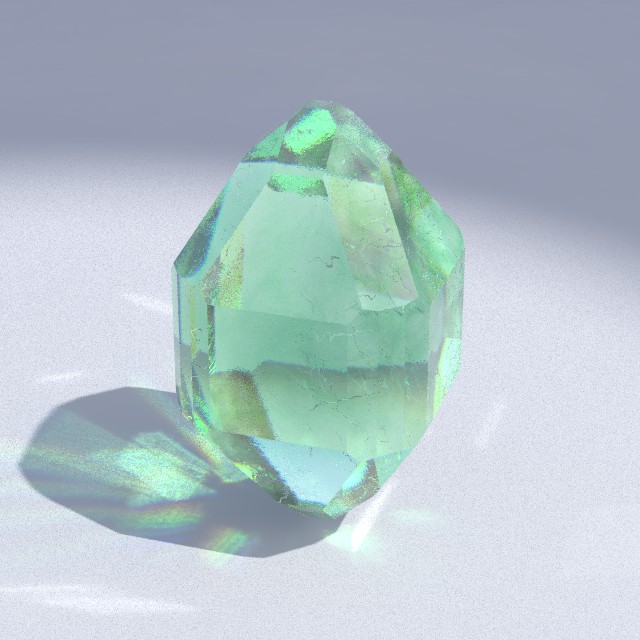
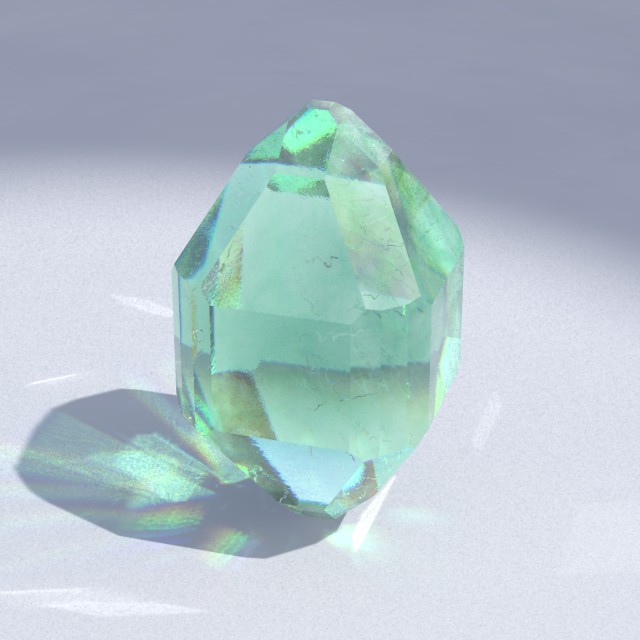
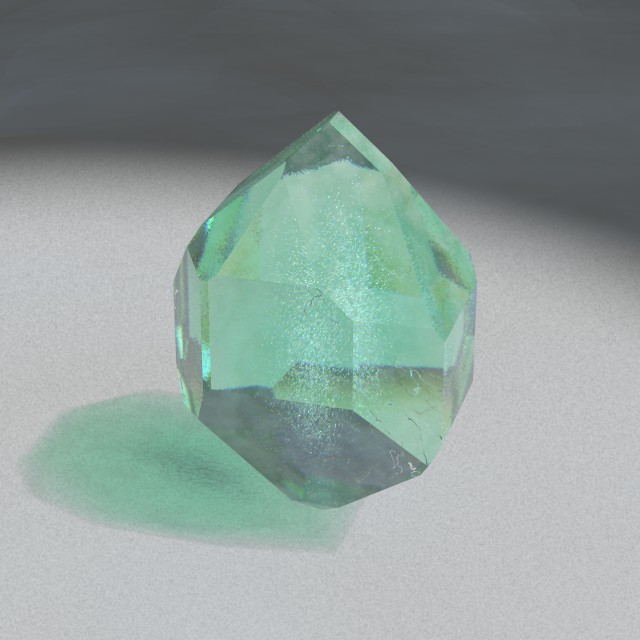
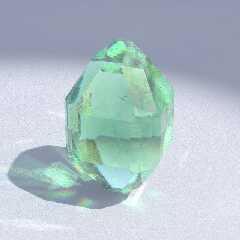
Continuing Sam's investigations on crystal shapes and materials, and
using KrystalShaper as the primary crystal builder.

This is a crystal of apophyllite. The coloured variety is
Fluorapophyllite-(K).

I based the material on the one given by Sam in the "Alum" post in
September last, including Alain's comments. I then added surface normals
from the crystal experiments by Jaime Vives Piqueres, as also a more
'cloudy' aspect using a bit of scattering media, and a density block.
Finally, I added photons. Possibly, the hue should be a tiny bit more
bluish-green...

The environment makes use of a hdri map and a spotlight. The render
makes use of a, non-optimal, stochastic setting, which explains the
grainy aspect. However, I am still experimenting.

--
Thomas
Post a reply to this message
Attachments:
Download 'krystalshaper_apophyllite_004d.jpg' (75 KB)
Preview of image 'krystalshaper_apophyllite_004d.jpg'
|
|
| |
| |
|
|
|
|
| |
| |
|
|
Thomas de Groot <tho### [at] degroot org> wrote:
> Continuing Sam's investigations on crystal shapes and materials, and
> using KrystalShaper as the primary crystal builder.
>
> This is a crystal of apophyllite. The coloured variety is
> Fluorapophyllite-(K).
>
> I based the material on the one given by Sam in the "Alum" post in
> September last, including Alain's comments. I then added surface normals
> from the crystal experiments by Jaime Vives Piqueres, as also a more
> 'cloudy' aspect using a bit of scattering media, and a density block.
> Finally, I added photons. Possibly, the hue should be a tiny bit more
> bluish-green...
>
> The environment makes use of a hdri map and a spotlight. The render
> makes use of a, non-optimal, stochastic setting, which explains the
> grainy aspect. However, I am still experimenting.
>
> --
> Thomas
This looks so promissing! Thanks for sharing! org> wrote:
> Continuing Sam's investigations on crystal shapes and materials, and
> using KrystalShaper as the primary crystal builder.
>
> This is a crystal of apophyllite. The coloured variety is
> Fluorapophyllite-(K).
>
> I based the material on the one given by Sam in the "Alum" post in
> September last, including Alain's comments. I then added surface normals
> from the crystal experiments by Jaime Vives Piqueres, as also a more
> 'cloudy' aspect using a bit of scattering media, and a density block.
> Finally, I added photons. Possibly, the hue should be a tiny bit more
> bluish-green...
>
> The environment makes use of a hdri map and a spotlight. The render
> makes use of a, non-optimal, stochastic setting, which explains the
> grainy aspect. However, I am still experimenting.
>
> --
> Thomas
This looks so promissing! Thanks for sharing!
Post a reply to this message
|
|
| |
| |
|
|
|
|
| |
| |
|
|
Thomas de Groot <tho### [at] degrootorg> wrote:

> The environment makes use of a hdri map and a spotlight. The render
> makes use of a, non-optimal, stochastic setting, which explains the
> grainy aspect. However, I am still experimenting.

I'd like to see a cleaner render - without the really grainy stuff, and a nice
clean, smooth background.  But I like the crystal - it looks pretty cool.   Does
the software export vertice information?
Thinking that maybe any calculation runs can be saved to some sort of include
file.

-BW
Post a reply to this message
|
|
| |
| |
|
|
|
|
| |
| |
|
|
Il 24/10/2021 15:28, Thomas de Groot ha scritto:
 > Continuing Sam's investigations on crystal shapes and materials, and
 > using KrystalShaper as the primary crystal builder.
 >
 > This is a crystal of apophyllite. The coloured variety is
 > Fluorapophyllite-(K).
 >
 > [...]

The crystal is very realistic, and I agree with Bald Eagle, a different
background could increase this realism.

Another thing: the crystal is vertical and gives a strange feeling to be
unaffected by the gravity... have you thought of adding a rock or
something else as a base?


Paolo
Post a reply to this message
|
|
| |
| |
|
|
|
|
| |
| |
|
|
Op 24/10/2021 om 23:04 schreef Bald Eagle:
> Thomas de Groot <tho### [at] degrootorg> wrote:
>
>> The environment makes use of a hdri map and a spotlight. The render
>> makes use of a, non-optimal, stochastic setting, which explains the
>> grainy aspect. However, I am still experimenting.
>
> I'd like to see a cleaner render - without the really grainy stuff, and a nice
> clean, smooth background.  But I like the crystal - it looks pretty cool.   Does
> the software export vertice information?

The software exports a set of intersected planes (which are used here)
/and/ a set of unioned cylinders representing the ribs. Vertice info can
be derived from those last, obviously. I have not looked seriously at
that part of the code.

> Thinking that maybe any calculation runs can be saved to some sort of include
> file.

Oh yes indeed. A lot of streamlining can be made on the code. Not sure
if I want to go all that way though, but I shall post a scene file when
I have cleaned up the whole mess. For the time being I am content with
trying to obtain as 'realistic' a crystal as possible.


--
Thomas
Post a reply to this message
|
|
| |
| |
|
|
|
|
| |
| |
|
|
Op 24/10/2021 om 15:56 schreef Mr:
>
> This looks so promissing! Thanks for sharing!
>
>
Well, yes. It is a change from granites. ;-) But I have /no/ intentions
to turn this into a monster macro!

--
Thomas
Post a reply to this message
|
|
| |
| |
|
|
|
|
| |
| |
|
|
Op 25/10/2021 om 00:08 schreef Paolo Gibellini:
> The crystal is very realistic, and I agree with Bald Eagle, a different
> background could increase this realism.
>
> Another thing: the crystal is vertical and gives a strange feeling to be
> unaffected by the gravity... have you thought of adding a rock or
> something else as a base?
>

Jaime did that indeed (adding a rock) and I probably shall do the same,
possibly all posed on some dark velvet cloth...

--
Thomas
Post a reply to this message
|
|
| |
| |
|
|
|
|
| |
| |
|
|
> The crystal is very realistic, and I agree with Bald Eagle, a different
> background could increase this realism.
>
> Another thing: the crystal is vertical and gives a strange feeling to be
> unaffected by the gravity... have you thought of adding a rock or
> something else as a base?
>
>
> Paolo
>
I understand the image as a very nice technical demonstration of shaping
and texturing gems. A base would hide some of the caustics. I think I
will have a look into this issue. I played a bit with photons too.

Best regards
Michael
Post a reply to this message
|
|
| |
| |
|
|
|
|
| |
| |
|
|
Op 25/10/2021 om 08:47 schreef MichaelJF:
>> The crystal is very realistic, and I agree with Bald Eagle, a
>> different background could increase this realism.
>>
>> Another thing: the crystal is vertical and gives a strange feeling to
>> be unaffected by the gravity... have you thought of adding a rock or
>> something else as a base?
>>
>>
>> Paolo
>>
> I understand the image as a very nice technical demonstration of shaping
> and texturing gems. A base would hide some of the caustics. I think I
> will have a look into this issue. I played a bit with photons too.
>
Correct. My primary purpose was to demonstrate the crystal by itself,
without the - secondary - scene additions.

It is my understanding that part of the caustics would probably remain
visible on a supporting rock. Jaime's images show them iirc.

--
Thomas
Post a reply to this message
|
|
| |
| |
|
|
|
|
| |
| |
|
|
Thomas de Groot <tho### [at] degrootorg> wrote:
> Continuing Sam's investigations on crystal shapes and materials, and
> using KrystalShaper as the primary crystal builder.
>
> This is a crystal of apophyllite. The coloured variety is
> Fluorapophyllite-(K).
> (...)

Hey Thomas, it looks good!

I agree with Bald Eagle that a cleaner render would be nice, but of course that
would drive up the render time, should you wish to increase the number of
samples. I mean, you're using scattering media + caustics, and we all know how
that goes.

How long did this take to render? The file name says 004d, so I really hope it
wasn't 4 days ':/

I'd like to discover a cheap and realistic way to add internal fractures to
mineral renders. Apophyllite is one of those minerals prone to being found in a
fractured state. I have two ideas in mind, but both are rather expensive: 1)
height fields intersecting not only each other, but also the crystal shape
(which is itself an intersection); or 2) isosurfaces. Both can be very, very
slow. Sometimes I wish media had an ior block.

Is there an online POV-Ray render farm anywhere? :P

Apophyllite is one of those minerals I'd love to find. Since it occurs in basalt
vesicles, one might think it'd be everywhere, but finding any mineral-bearing
cavities is already a challenge...

Sam
Post a reply to this message
|
|
| |
| |
|
|
|
|
| |
| |
|
|
Op 27/10/2021 om 01:09 schreef Samuel B.:
> Thomas de Groot <tho### [at] degrootorg> wrote:
>> Continuing Sam's investigations on crystal shapes and materials, and
>> using KrystalShaper as the primary crystal builder.
>>
>> This is a crystal of apophyllite. The coloured variety is
>> Fluorapophyllite-(K).
>> (...)
>
> Hey Thomas, it looks good!
>
Thanks Sam! It turned out rather well indeed. It is a bit out of the way
in terms of colours, but I liked the wikipedia example too much to let
it pass.

> I agree with Bald Eagle that a cleaner render would be nice, but of course that
> would drive up the render time, should you wish to increase the number of
> samples. I mean, you're using scattering media + caustics, and we all know how
> that goes.
>
I was indeed fully aware of the grainy render, and - at this stage - it
was on purpose for experimentation's sake, as otherwise I would loose
way to much time waiting for the render to finish before starting the
next try. As always, a project starts rendering fast and gradually slows
down along the way when better settings and more stuff are added.

> How long did this take to render? The file name says 004d, so I really hope it
> wasn't 4 days ':/
>
Oh no! That is the version number ;-) This render was pretty fast: less
than an hour iirc.

> I'd like to discover a cheap and realistic way to add internal fractures to
> mineral renders. Apophyllite is one of those minerals prone to being found in a
> fractured state. I have two ideas in mind, but both are rather expensive: 1)
> height fields intersecting not only each other, but also the crystal shape
> (which is itself an intersection); or 2) isosurfaces. Both can be very, very
> slow. Sometimes I wish media had an ior block.
>
Ah... yes indeed. I have not considered your first method, but
considered the isosurface one. However, I also cringe at the implied
render time.

Another thing I would like to do is model more asymmetric crystals, like
they occur in nature. The KrystalShaper models are too perfect for our
grubby little hands. :-) Maybe by carefully manipulating the set of
planes in the intersection, or working directly on a mesh2 model
converted back to .obj for instance, and load it up in our favourite
modeller...

> Is there an online POV-Ray render farm anywhere? :P
>
That would be nice.

> Apophyllite is one of those minerals I'd love to find. Since it occurs in basalt
> vesicles, one might think it'd be everywhere, but finding any mineral-bearing
> cavities is already a challenge...
>
Yes, you will need a bit of luck I guess.

--
Thomas
Post a reply to this message
|
|
| |
| |
|
|
|
|
| |
| |
|
|
Am 27.10.2021 um 08:45 schrieb Thomas de Groot:
> Another thing I would like to do is model more asymmetric crystals, like
> they occur in nature. The KrystalShaper models are too perfect for our
> grubby little hands. :-) Maybe by carefully manipulating the set of
> planes in the intersection, or working directly on a mesh2 model
> converted back to .obj for instance, and load it up in our favourite
> modeller...
>
IIRC you're using Silo, but I have no idea if Silo can handle this kind
of plane intersections. Blender can load the WRL data. But as I noticed
these intersecting planes I wondered about the photons. Usually infinite
objects are not recommended as photon targets.

Best regards
Michael
Post a reply to this message
|
|
| |
| |
|
|
|
|
| |
| |
|
|
Op 27-10-2021 om 11:44 schreef MichaelJF:
> IIRC you're using Silo, but I have no idea if Silo can handle this kind
> of plane intersections. Blender can load the WRL data. But as I noticed
> these intersecting planes I wondered about the photons. Usually infinite
> objects are not recommended as photon targets.
>
Correct. I use Silo, which is why I mentioned an .obj version of the wrl
data by Poseray. Silo does not accept wrl data.

In the meantime, I have done a mesh2 version of the wrl data through
Poseray and that works fine. I had forgotten about the possible trouble
of infinite objects when using photons, so I shall use the mesh2
exclusively with them. Thanks for the reminder indeed.

--
Thomas
Post a reply to this message
|
|
| |
| |
|
|
|
|
| |
| |
|
|
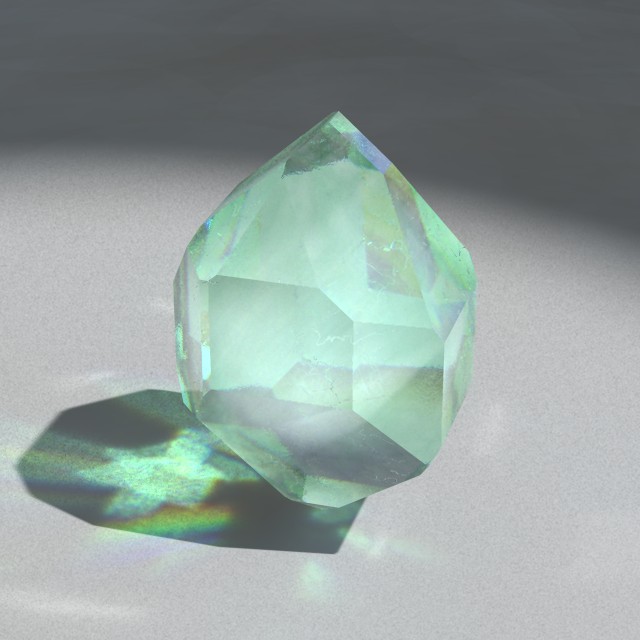
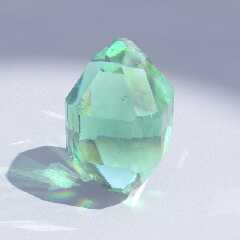
Crystal replaced by a mesh2 version. Less grainy by not using
stochastic. Render time about 27 minutes. Collected photons, about 1 GB.

Additional scene developments pending.

--
Thomas
Post a reply to this message
Attachments:
Download 'krystalshaper_apophyllite_004f.jpg' (54 KB)
Preview of image 'krystalshaper_apophyllite_004f.jpg'
|
|
| |
| |
|
|
|
|
| |
| |
|
|
Thomas de Groot <tho### [at] degrootorg> wrote:
> Crystal replaced by a mesh2 version. Less grainy by not using
> stochastic. Render time about 27 minutes. Collected photons, about 1 GB.
>
> Additional scene developments pending.

It's looking better and a little less noisy now. It also seems a bit more
bluish. Looking online, this mineral has a range of hues spanning between
colorless, pale yellow, and pale/bluish green. All seem to be valid.

>> How long did this take to render? The file name says 004d, so I really hope it
>> wasn't 4 days ':/
>
> Oh no! That is the version number ;-) This render was pretty fast: less
> than an hour iirc.

Thank goodness, lol. That makes more sense.

>> I'd like to discover a cheap and realistic way to add internal fractures to
>> mineral renders. Apophyllite is one of those minerals prone to being found in a
>> fractured state. I have two ideas in mind, but both are rather expensive: 1)
>> height fields intersecting not only each other, but also the crystal shape
>> (which is itself an intersection); or 2) isosurfaces. Both can be very, very
>> slow. Sometimes I wish media had an ior block.
>
> Ah... yes indeed. I have not considered your first method, but
> considered the isosurface one. However, I also cringe at the implied
> render time.

Both methods are going to be slow, yeah. And care must be taken when choosing
the fracture planes for a given mineral. Apophyllite appears to exhibit basal
cleavage, so its fractures tend to be horizontal more often than not.

And then there are clouds... Similar to fractures, the clouds you see in
minerals are often reflective/refractive gas or liquid pockets, and so they
might not easily be replicated with scattering media. (It seems to me that there
was an experimental version of POV-Ray a long time ago which allowed one to
specify the reflectivity of participating media. I wonder what happened to
that?)

> Another thing I would like to do is model more asymmetric crystals, like
> they occur in nature. The KrystalShaper models are too perfect for our
> grubby little hands. :-) Maybe by carefully manipulating the set of
> planes in the intersection, or working directly on a mesh2 model
> converted back to .obj for instance, and load it up in our favourite
> modeller...

Personally, before going that far, I'd just change the distance values of each
crystal face in KrystalShaper, and not even mess with any other program save
POV-Ray. KS is great like that; you can make entirely new minerals if you wish.
And there's always doing what I did: copy the HKL+distance data to POV-readable
arrays. Then you could take it a step further and add some randomization before
the HKL+D data is used to make the intersection.

Besides the symmetry, another thing I noticed about the crystal libraries in KS
is that the secondary and tertiary faces (modifications) tend to be somewhat
exaggerated. My alum render, for instance, was not what you'd consider a typical
specimen; you'd usually only see eight main faces in real life. And the
apophyllite model is the same way: in nature you usually only see cuboids
truncated with a steep pyramid. (The bevel between pyramid faces is atypical.)
None of this is a bad thing, of course, and it helps to show us just how a
mineral can form secondary & tertiary faces.

Sam
Post a reply to this message
|
|
| |
| |
|
|
|
|
| |
| |
|
|
Op 27/10/2021 om 22:44 schreef Samuel B.:
> Thomas de Groot <tho### [at] degrootorg> wrote:
>> Crystal replaced by a mesh2 version. Less grainy by not using
>> stochastic. Render time about 27 minutes. Collected photons, about 1 GB.
>>
>> Additional scene developments pending.
>
> It's looking better and a little less noisy now. It also seems a bit more
> bluish. Looking online, this mineral has a range of hues spanning between
> colorless, pale yellow, and pale/bluish green. All seem to be valid.
>
Yes, in between renders I added a bit more blue.

>>> How long did this take to render? The file name says 004d, so I really hope it
>>> wasn't 4 days ':/
>>
>> Oh no! That is the version number ;-) This render was pretty fast: less
>> than an hour iirc.
>
> Thank goodness, lol. That makes more sense.
>
Yes, it is rather fast.

In my latest experiment, I cranked photon spacing down to 0.001 (for the
examples shown here, this was 0.004) but then POV-Ray stopped along the
parsing way, with an 'out of memory' message. Even 0.004 might be
overkill for all I know; I shall need to investigate.

>>> I'd like to discover a cheap and realistic way to add internal fractures to
>>> mineral renders. Apophyllite is one of those minerals prone to being found in a
>>> fractured state. I have two ideas in mind, but both are rather expensive: 1)
>>> height fields intersecting not only each other, but also the crystal shape
>>> (which is itself an intersection); or 2) isosurfaces. Both can be very, very
>>> slow. Sometimes I wish media had an ior block.
>>
>> Ah... yes indeed. I have not considered your first method, but
>> considered the isosurface one. However, I also cringe at the implied
>> render time.
>
> Both methods are going to be slow, yeah. And care must be taken when choosing
> the fracture planes for a given mineral. Apophyllite appears to exhibit basal
> cleavage, so its fractures tend to be horizontal more often than not.
>
Correct. This needs a good knowledge of crystallography indeed. I am a
layman on this really...

> And then there are clouds... Similar to fractures, the clouds you see in
> minerals are often reflective/refractive gas or liquid pockets, and so they
> might not easily be replicated with scattering media. (It seems to me that there
> was an experimental version of POV-Ray a long time ago which allowed one to
> specify the reflectivity of participating media. I wonder what happened to
> that?)
>
Inclusions, yes. Scattering media is a poor substitute. There are the
little foreign grains that got included, and the fluid inclusions. Those
are really interesting!

[Aside] in a very distant past, my wife did a study on fluid inclusions
in quartz crystals from Greece. She could, by cooling the crystals in
liquid nitrogen and then slow heating, determine the original
temperature of the liquid in which the crystal grew. Original pressure
was somehow derived from other factors. I forgot. [/Aside]

But, those fluid inclusions are difficult to model. I was thinking about
clouds of bubbles in liquid (there are a couple of scene files drifting
around in the pov world; I think I have a couple of those somewhere)
using a gaussian distribution scheme...

>> Another thing I would like to do is model more asymmetric crystals, like
>> they occur in nature. The KrystalShaper models are too perfect for our
>> grubby little hands. :-) Maybe by carefully manipulating the set of
>> planes in the intersection, or working directly on a mesh2 model
>> converted back to .obj for instance, and load it up in our favourite
>> modeller...
>
> Personally, before going that far, I'd just change the distance values of each
> crystal face in KrystalShaper, and not even mess with any other program save
> POV-Ray. KS is great like that; you can make entirely new minerals if you wish.
> And there's always doing what I did: copy the HKL+distance data to POV-readable
> arrays. Then you could take it a step further and add some randomization before
> the HKL+D data is used to make the intersection.
>
Yes, I think you are right there.

> Besides the symmetry, another thing I noticed about the crystal libraries in KS
> is that the secondary and tertiary faces (modifications) tend to be somewhat
> exaggerated. My alum render, for instance, was not what you'd consider a typical
> specimen; you'd usually only see eight main faces in real life. And the
> apophyllite model is the same way: in nature you usually only see cuboids
> truncated with a steep pyramid. (The bevel between pyramid faces is atypical.)
> None of this is a bad thing, of course, and it helps to show us just how a
> mineral can form secondary & tertiary faces.
>
Yes, I have been wondering about that. Not being an expert, I have been
hesitating between the different models proposed.

--
Thomas
Post a reply to this message
|
|
| |
| |
|
|
|
|
| |
| |
|
|
Op 27-10-2021 om 22:44 schreef Samuel B.:
> Thomas de Groot <tho### [at] degrootorg> wrote:
>>> How long did this take to render? The file name says 004d, so I really hope it
>>> wasn't 4 days ':/
>>
>> Oh no! That is the version number ;-) This render was pretty fast: less
>> than an hour iirc.
>
> Thank goodness, lol. That makes more sense.
>
Strange. Somehow, I must have changed something, but now renders take a
much longer time, more in the range of several hours (and photons jumped
to 3Gb). I do not remember what is different. :-/

--
Thomas
Post a reply to this message
|
|
| |
| |
|
|
|
|
| |
| |
|
|
Op 28-10-2021 om 16:38 schreef Thomas de Groot:
> Strange. Somehow, I must have changed something, but now renders take a
> much longer time, more in the range of several hours (and photons jumped
> to 3Gb). I do not remember what is different. :-/
>
Found the culprit! :-)

I had changed 'union' to 'merge' in the mesh2 object. In this particular
case of well-behaving crystal faces, that is unnecessary. The render
speed difference is dramatic indeed.

--
Thomas
Post a reply to this message
|
|
| |
| |
|
|
|
|
| |
| |
|
|
Thomas de Groot <tho### [at] degrootorg> wrote:
> Op 27/10/2021 om 22:44 schreef Samuel B.:
> > Thomas de Groot <tho### [at] degrootorg> wrote:
> >> Ah... yes indeed. I have not considered your first method, but
> >> considered the isosurface one. However, I also cringe at the implied
> >> render time.
> >
> > (...) care must be taken when choosing the fracture planes for a given mineral
(...)
> >
> Correct. This needs a good knowledge of crystallography indeed. I am a
> layman on this really...

It doesn't really take any in-depth knowledge. Just a bit of time reading and
browsing through images of minerals. (Which might be too time-consuming,
depending...)

> > And then there are clouds... Similar to fractures, the clouds you see in
> > minerals are often reflective/refractive gas or liquid pockets, and so they
> > might not easily be replicated with scattering media. (...)
> >
> Inclusions, yes. Scattering media is a poor substitute. There are the
> little foreign grains that got included, and the fluid inclusions. Those
> are really interesting!

Yeah, there are many fascinating inclusions that can occur in minerals. I
remember seeing a photo of some white crystals occasionally found in obsidian.
IIRC, they formed in groups of four tetrahedral crystals meeting at their
corners. Pretty much like the first iteration of a Sierpinski tetrahedron. If I
come across the image again, I'll post it. (Image search isn't turning up
anything relevant, and I originally found it in a book.)

> [Aside] in a very distant past, my wife did a study on fluid inclusions
> in quartz crystals from Greece. She could, by cooling the crystals in
> liquid nitrogen and then slow heating, determine the original
> temperature of the liquid in which the crystal grew. Original pressure
> was somehow derived from other factors. I forgot. [/Aside]

Crazy! I haven't a clue how those environmental factors could possibly be sussed
out. That's hacking, as far as I'm concerned... Physical hacking, not digital,
which is even cooler. She sounds like an awesome woman :)

> But, those fluid inclusions are difficult to model. I was thinking about
> clouds of bubbles in liquid (there are a couple of scene files drifting
> around in the pov world; I think I have a couple of those somewhere)
> using a gaussian distribution scheme...

Inclusions are pretty much the main impediment to making better mineral renders.

And inclusions take on many forms. Not all exhibit crystalline features when
viewed with the naked eye (e.g. light reflecting at certain angles only). Some
do, though. I had (or still have) a Herkimer 'diamond' that apparently has an
inclusion in the shape if a tiny quartz crystal. The bubble really looks like a
tiny, doubly-terminated quartz crystal. I'll have to take a photo of that.

> > Besides the symmetry, another thing I noticed about the crystal libraries in KS
> > is that the secondary and tertiary faces (modifications) tend to be somewhat
> > exaggerated. (...)
> >
> Yes, I have been wondering about that. Not being an expert, I have been
> hesitating between the different models proposed.

Eh, nothing is written in stone. (Haha, except stones.) But there are always
outliers to these things. Depending on the conditions in which a chemical is
grown, modifications may become more or less prominent. You never know.

Sam
Post a reply to this message
|
|
| |
| |
|
|
|
|
| |
| |
|
|
"Samuel B." <stb### [at] hotmailcom> wrote:
> Thomas de Groot <tho### [at] degrootorg> wrote:

> > [Aside] in a very distant past, my wife did a study on fluid inclusions
> > in quartz crystals from Greece. She could, by cooling the crystals in
> > liquid nitrogen and then slow heating, determine the original
> > temperature of the liquid in which the crystal grew. Original pressure
> > was somehow derived from other factors. I forgot. [/Aside]
>
> Crazy! I haven't a clue how those environmental factors could possibly be sussed
> out.

I would imagine that it might have something to do with the phase diagram of the
material.  Freeze the material so that it's solid, and then do a melting-point
test by the usual slow heating.  Maybe there's some specialized
pressure-temperature nomograph that's been developed for this type of thing...
Post a reply to this message
|
|
| |
| |
|
|
|
|
| |
| |
|
|
Op 29-10-2021 om 12:49 schreef Bald Eagle:
> "Samuel B." <stb### [at] hotmailcom> wrote:
>> Thomas de Groot <tho### [at] degrootorg> wrote:
>
>>> [Aside] in a very distant past, my wife did a study on fluid inclusions
>>> in quartz crystals from Greece. She could, by cooling the crystals in
>>> liquid nitrogen and then slow heating, determine the original
>>> temperature of the liquid in which the crystal grew. Original pressure
>>> was somehow derived from other factors. I forgot. [/Aside]
>>
>> Crazy! I haven't a clue how those environmental factors could possibly be sussed
>> out.
>
> I would imagine that it might have something to do with the phase diagram of the
> material.  Freeze the material so that it's solid, and then do a melting-point
> test by the usual slow heating.  Maybe there's some specialized
> pressure-temperature nomograph that's been developed for this type of thing...
>
Yes, I think it was phase changes indeed. All that happened 45 years ago...

--
Thomas
Post a reply to this message
|
|
| |
| |
|
|
|
|
| |
| |
|
|
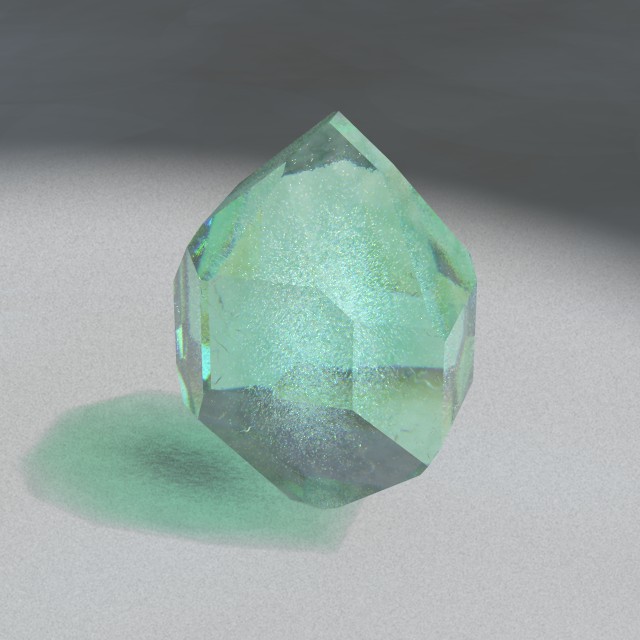
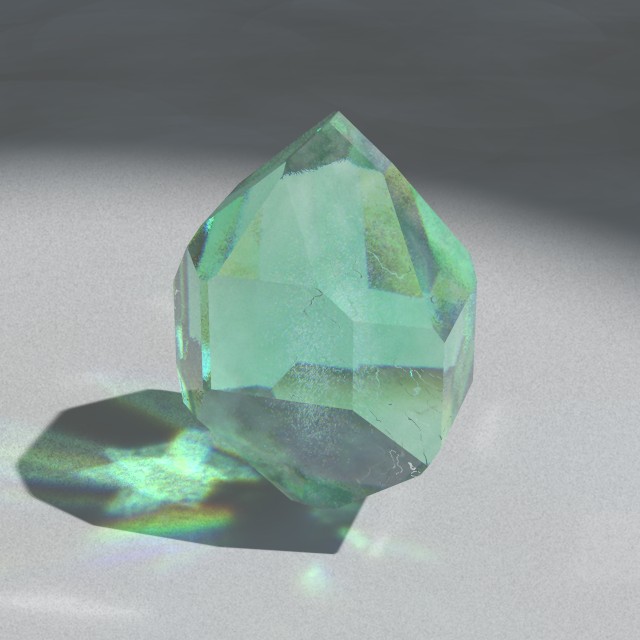
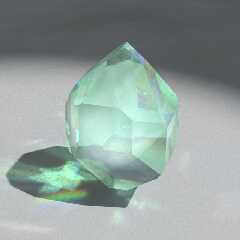
this is a randomised version of the apophyllite crystal. I also changed
the light probe and tweaked the scattering media (which still remains a
second choice), and brought the photon spacing to more natural levels
(0.01).

--
Thomas
Post a reply to this message
Attachments:
Download 'krystalshaper_apophyllite_005c.jpg' (56 KB)
Preview of image 'krystalshaper_apophyllite_005c.jpg'
|
|
| |
| |
|
|
|
|
| |
| |
|
|
Op 29-10-2021 om 02:05 schreef Samuel B.:
> Thomas de Groot <tho### [at] degrootorg> wrote:
>> Correct. This needs a good knowledge of crystallography indeed. I am a
>> layman on this really...
>
> It doesn't really take any in-depth knowledge. Just a bit of time reading and
> browsing through images of minerals. (Which might be too time-consuming,
> depending...)
>
I just browsed through the one (microscopy) crystallography book I still
have. Principal cleavage plane is indicated as (001), meaning the
horizontal plane.

>>> And then there are clouds... Similar to fractures, the clouds you see in
>>> minerals are often reflective/refractive gas or liquid pockets, and so they
>>> might not easily be replicated with scattering media. (...)
>>>
>> Inclusions, yes. Scattering media is a poor substitute. There are the
>> little foreign grains that got included, and the fluid inclusions. Those
>> are really interesting!
>
> Yeah, there are many fascinating inclusions that can occur in minerals. I
> remember seeing a photo of some white crystals occasionally found in obsidian.
> IIRC, they formed in groups of four tetrahedral crystals meeting at their
> corners. Pretty much like the first iteration of a Sierpinski tetrahedron. If I
> come across the image again, I'll post it. (Image search isn't turning up
> anything relevant, and I originally found it in a book.)
>
>> [Aside] in a very distant past, my wife did a study on fluid inclusions
>> in quartz crystals from Greece. She could, by cooling the crystals in
>> liquid nitrogen and then slow heating, determine the original
>> temperature of the liquid in which the crystal grew. Original pressure
>> was somehow derived from other factors. I forgot. [/Aside]
>
> Crazy! I haven't a clue how those environmental factors could possibly be sussed
> out. That's hacking, as far as I'm concerned... Physical hacking, not digital,
> which is even cooler. She sounds like an awesome woman :)
>
Ah! but she is of course! :-) She didn't remain in the Earth science
world however, and switched to French literature (as she is French
herself, that was a natural if not the most easy choice here in NL).

>> But, those fluid inclusions are difficult to model. I was thinking about
>> clouds of bubbles in liquid (there are a couple of scene files drifting
>> around in the pov world; I think I have a couple of those somewhere)
>> using a gaussian distribution scheme...
>
> Inclusions are pretty much the main impediment to making better mineral renders.
>
> And inclusions take on many forms. Not all exhibit crystalline features when
> viewed with the naked eye (e.g. light reflecting at certain angles only). Some
> do, though. I had (or still have) a Herkimer 'diamond' that apparently has an
> inclusion in the shape if a tiny quartz crystal. The bubble really looks like a
> tiny, doubly-terminated quartz crystal. I'll have to take a photo of that.
>
>>> Besides the symmetry, another thing I noticed about the crystal libraries in KS
>>> is that the secondary and tertiary faces (modifications) tend to be somewhat
>>> exaggerated. (...)
>>>
>> Yes, I have been wondering about that. Not being an expert, I have been
>> hesitating between the different models proposed.
>
> Eh, nothing is written in stone. (Haha, except stones.) But there are always
> outliers to these things. Depending on the conditions in which a chemical is
> grown, modifications may become more or less prominent. You never know.
>
I am going to experiment different paths...

--
Thomas
Post a reply to this message
|
|
| |
| |
|
|
|
|
| |
| |
|
|
> >
> > I'd like to discover a cheap and realistic way to add internal fractures to
> > mineral renders. Apophyllite is one of those minerals prone to being
> > found in a fractured state. I have two ideas in mind, but both are
> > rather expensive:
> > 1) height fields intersecting not only each other, but also the crystal
> > shape (which is itself an intersection); or 2) isosurfaces. Both can be
> > very, very slow. Sometimes I wish media had an ior block.
> >
> Ah... yes indeed. I have not considered your first method, but
> considered the isosurface one. However, I also cringe at the implied
> render time.
>

A beautiful crystal, Thomas-- and with those VERY nice caustics.

Long ago, I rendered a "Merry Christmas" image (which I can't find,
unfortunately), that had some objects made of translucent ice, with an ior. I
wanted internal 'cracks' to show up inside the ice-- so IIRC I accomplished that
as part of its 3-D texture, not as actual geometry. It looked decent enough to
fool the eye. Something *kind of* like this pseudo-code example:

pigment{
   gradient x
   pigment_map{
            [0.49 --ice color --]
            [0.49 bumps (?)
                 -- some scale ---
                  pigment_map{
                      [0.3 -- ice color --]
                      [0.3 rgbt <1,1,1,.7] // translucent white
                             }
                  scale 50 // to scale down the size of the warp effect
                  warp {turbulence .2}
                  scale 1/50
            ]
            [0.51 same as 0.49]
            [0.51 -- ice color --]
                 }
         }

The general idea is to have a very thin slice of translucent white (somewhat
broken up) to appear inside the ice-- like a crack or fracture. Perhaps
something similar might work for your crystal.
Post a reply to this message
|
|
| |
| |
|
|
|
|
| |
| |
|
|
Thomas de Groot <tho### [at] degrootorg> wrote:
> this is a randomised version of the apophyllite crystal. I also changed
> the light probe and tweaked the scattering media (which still remains a
> second choice), and brought the photon spacing to more natural levels
> (0.01).

The shape does look more natural. But the scattering media makes it seem a bit
glowy. Maybe some absorbing media would help counteract that?

Sam
Post a reply to this message
|
|
| |
| |
|
|
|
|
| |
| |
|
|
Op 30/10/2021 om 23:48 schreef Kenneth:
>
> A beautiful crystal, Thomas-- and with those VERY nice caustics.
>
Thank you indeed Kenneth.

> Long ago, I rendered a "Merry Christmas" image (which I can't find,
> unfortunately), that had some objects made of translucent ice, with an ior. I
> wanted internal 'cracks' to show up inside the ice-- so IIRC I accomplished that
> as part of its 3-D texture, not as actual geometry. It looked decent enough to
> fool the eye. Something *kind of* like this pseudo-code example:
>
> pigment{
>     gradient x
>     pigment_map{
>              [0.49 --ice color --]
>              [0.49 bumps (?)
>                   -- some scale ---
>                    pigment_map{
>                        [0.3 -- ice color --]
>                        [0.3 rgbt <1,1,1,.7] // translucent white
>                               }
>                    scale 50 // to scale down the size of the warp effect
>                    warp {turbulence .2}
>                    scale 1/50
>              ]
>              [0.51 same as 0.49]
>              [0.51 -- ice color --]
>                   }
>           }
>
> The general idea is to have a very thin slice of translucent white (somewhat
> broken up) to appear inside the ice-- like a crack or fracture. Perhaps
> something similar might work for your crystal.
>

That is an interesting possibility which I shall try. I'll be back!
Thanks for this!

--
Thomas
Post a reply to this message
|
|
| |
| |
|
|
|
|
| |
| |
|
|
Op 31/10/2021 om 02:05 schreef Samuel B.:
> Thomas de Groot <tho### [at] degrootorg> wrote:
>> this is a randomised version of the apophyllite crystal. I also changed
>> the light probe and tweaked the scattering media (which still remains a
>> second choice), and brought the photon spacing to more natural levels
>> (0.01).
>
> The shape does look more natural. But the scattering media makes it seem a bit
> glowy. Maybe some absorbing media would help counteract that?
>
As I said, scattering is bad, and here even more so: it acts as a vulgar
fog inside the crystal ;-)

I am currently experimenting with very tiny air bubbles as inclusions
and distributed in a gaussian way. It looks promising but needs some
more tweaking/thinking.

--
Thomas
Post a reply to this message
|
|
| |
| |
|
|
|
|
| |
| |
|
|
"Kenneth" <kdw### [at] gmailcom> wrote:
>
> Long ago, I rendered a "Merry Christmas" image...
>
> The general idea is to have a very thin slice of translucent white (somewhat
> broken up) to appear inside the ice-- like a crack or fracture. Perhaps
> something similar might work for your crystal.

I found my original scene file from 2007(!), and re-rendered one of the ice
objects. I've attached the render as the code existed then. But looking at my
code, I see that I had used simple textures for the ice cracks, bubbles,
etc-- which are just surface attributes, not 'volumetric' inside the ice. At the
time, I didn't know how to do such interior tricks... which was frustrating.

BTW, this was my actual 'crack' pigment:
pigment{
      marble // marble or wrinkles
      color_map{
           [0.0 rgbt 1]
           [0.487 rgbt 1]
           [0.492 rgbt <1,1,1,.5>]
           [0.508 rgbt <1,1,1,.5>]
           [0.513 rgbt 1]
           [1.0 rgbt 1]
                }
           warp{turbulence 4 lambda .2}
           scale 40
           warp{turbulence .5 lambda .2}
        }

But my main ice material makes use of MEDIA (as does your crystal)-- so these
'surface' pigment patterns, being 3-D of course, could be made into functions
instead, then used as additional densities or density_map(s) for the media
itself... by way of 3 color functions there, like this simplified example...
    media{
    emission <1,0,0> // for the RED channel
    density{function{PIGMENT_FUNCTION(x,y,z).red}}
         }

This way, my cracks and bubbles will show up INSIDE the ice, as I had originally
wanted. And I think that this technique might work for your crystal too. (The
interior 'bubbles' or voids you mentioned could possibly be made with 'media
voids'-- e.g., areas in the pigment/function that have rgb <0,0,0>, which would
produce NO media density there, I think. Just a guess though.)

Without your crystal post here, I would not have thought of revisiting my ice
scene with these changes. Thanks! :-)
Post a reply to this message
Attachments:
Download 'pov_logo_as_ice.jpg' (56 KB)
Preview of image 'pov_logo_as_ice.jpg'

|
|
| |
| |
|
|
|
|
| |
| |
|
|
Op 31/10/2021 om 17:17 schreef Kenneth:
> "Kenneth" <kdw### [at] gmailcom> wrote:
>>
>> Long ago, I rendered a "Merry Christmas" image...
>>
>> The general idea is to have a very thin slice of translucent white (somewhat
>> broken up) to appear inside the ice-- like a crack or fracture. Perhaps
>> something similar might work for your crystal.
>
> I found my original scene file from 2007(!), and re-rendered one of the ice
> objects. I've attached the render as the code existed then. But looking at my
> code, I see that I had used simple textures for the ice cracks, bubbles,
> etc-- which are just surface attributes, not 'volumetric' inside the ice. At the
> time, I didn't know how to do such interior tricks... which was frustrating.
>
> BTW, this was my actual 'crack' pigment:
> pigment{
>        marble // marble or wrinkles
>        color_map{
>             [0.0 rgbt 1]
>             [0.487 rgbt 1]
>             [0.492 rgbt <1,1,1,.5>]
>             [0.508 rgbt <1,1,1,.5>]
>             [0.513 rgbt 1]
>             [1.0 rgbt 1]
>                  }
>             warp{turbulence 4 lambda .2}
>             scale 40
>             warp{turbulence .5 lambda .2}
>          }
>
> But my main ice material makes use of MEDIA (as does your crystal)-- so these
> 'surface' pigment patterns, being 3-D of course, could be made into functions
> instead, then used as additional densities or density_map(s) for the media
> itself... by way of 3 color functions there, like this simplified example...
>      media{
>      emission <1,0,0> // for the RED channel
>      density{function{PIGMENT_FUNCTION(x,y,z).red}}
>           }
>
> This way, my cracks and bubbles will show up INSIDE the ice, as I had originally
> wanted. And I think that this technique might work for your crystal too. (The
> interior 'bubbles' or voids you mentioned could possibly be made with 'media
> voids'-- e.g., areas in the pigment/function that have rgb <0,0,0>, which would
> produce NO media density there, I think. Just a guess though.)
>
> Without your crystal post here, I would not have thought of revisiting my ice
> scene with these changes. Thanks! :-)
>

Thanks for this Kenneth! At first glance, even these 'surface' patterns
look great. I guess that your 'media' variant will work; I shall turn to
that soon, as I have currently a render with 'real' bubbles (spheres,
15000 of them) rendering. It looks good at first glance but the render
time has dropped severely, although not dramatically. I am not yet sure
about those 'media voids'... I shall have to think about that.

I shall make asap a scene file available and post it here. At this
moment, it is in a terrible flux state and hardly readable, even for me. ;-)

--
Thomas
Post a reply to this message
|
|
| |
| |
|
|
|
|
| |
| |
|
|
Op 31/10/2021 om 08:37 schreef Thomas de Groot:
> Op 31/10/2021 om 02:05 schreef Samuel B.:
>> The shape does look more natural. But the scattering media makes it
>> seem a bit
>> glowy. Maybe some absorbing media would help counteract that?
>>

> As I said, scattering is bad, and here even more so: it acts as a vulgar
> fog inside the crystal ;-)
>
> I am currently experimenting with very tiny air bubbles as inclusions
> and distributed in a gaussian way. It looks promising but needs some
> more tweaking/thinking.
>

I didn't answer you fully there, I am afraid. The only media used here
is an absorbing media which takes care of it all (with the ior too of
course). I experimented with the scattering media in addition to the
absorbing one, because Jaime did something like that in his crystal
experiments.

http://www.ignorancia.org/index.php/galleries/latest-images/crystals-and-mushrooms/

However, I did not find it to work as expected.

--
Thomas
Post a reply to this message
|
|
| |
| |
|
|
|
|
| |
| |
|
|
Thomas de Groot <tho### [at] degrootorg> wrote:
>
> I am not yet sure about those 'media voids'... I shall have to think about that.

Yeah, I probably spoke too soon-- such voids would not produce the same visual
effect as your own method of creating voids with actual geometry.
>
> The only media used here
> is an absorbing media which takes care of it all (with the ior too of
> course). I experimented with the scattering media in addition to the
> absorbing one, because Jaime did something like that in his crystal
> experiments.
>
> http://www.ignorancia.org/index.php/galleries/latest-images/crystals-and-mushrooms/
>
> However, I did not find it to work as expected.
>

Also, it occurred to me that any fractures or cleavage planes in a crystal would
need to have some partial reflectivity (if I understand the concept of such
planes). Thin slices of interior media certainly cannot do that. :-(

BTW, thanks for the link to Jaime's crystals; I will take a look at his examples
and code.
Post a reply to this message
|
|
| |
| |
|
|
|
|
| |
| |
|
|
Op 1-11-2021 om 12:26 schreef Kenneth:
> Thomas de Groot <tho### [at] degrootorg> wrote:
>>
>> I am not yet sure about those 'media voids'... I shall have to think about that.
>
> Yeah, I probably spoke too soon-- such voids would not produce the same visual
> effect as your own method of creating voids with actual geometry.

Correct. I am struggling with the concept however, if I would add a
separate media to the voids (even tiny ones). The scene file I consulted
as an example is from Glenn McCarter's Plumbing suite (2003):
http://www.irtc.org/stills/2003-06-30.html (3rd Place) and he happily
does mix them, but I am not really sure he is doing things correctly,
especially now with newer pov versions.

>>
>> The only media used here
>> is an absorbing media which takes care of it all (with the ior too of
>> course). I experimented with the scattering media in addition to the
>> absorbing one, because Jaime did something like that in his crystal
>> experiments.
>>
>> http://www.ignorancia.org/index.php/galleries/latest-images/crystals-and-mushrooms/
>>
>> However, I did not find it to work as expected.
>>
>
> Also, it occurred to me that any fractures or cleavage planes in a crystal would
> need to have some partial reflectivity (if I understand the concept of such
> planes). Thin slices of interior media certainly cannot do that. :-(
>
Yes, there is that too. Still, I want to experiment with it to see what
would happen.

> BTW, thanks for the link to Jaime's crystals; I will take a look at his examples
> and code.
>
>
Jaime's work is often a treasure trove indeed.

--
Thomas
Post a reply to this message
|
|
| |
| |
|
|
|
|
| |
| |
|
|
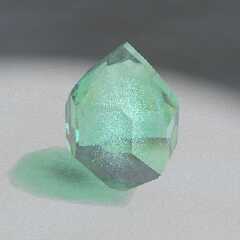
Warning! No photons! :-)

After a good three hours render, this is the crystal with 'fluid'
inclusions added: 15000 little hollow spheres with an ior of 1.0.

Not sure how 'natural' this is looking. I have seen crystals with
concentrations of 'bubbles' more or less like this. Maybe I have
exaggerated a bit; maybe there should be less 'bubbles'...

Personally, I like it but I am interested in your verdicts.

--
Thomas
Post a reply to this message
Attachments:
Download 'krystalshaper_apophyllite_006a.jpg' (64 KB)
Preview of image 'krystalshaper_apophyllite_006a.jpg'
|
|
| |
| |
|
|
|
|
| |
| |
|
|
hi,

Thomas de Groot <tho### [at] degrootorg> wrote:
> ...
> Personally, I like it but I am interested in your verdicts.

very nice, "like".  :-)  I'd be interested to see a version where the "bubbles"
are confined to a smaller volume within, and also "off-centre", a little.


regards, jr.
Post a reply to this message
|
|
| |
| |
|
|
|
|
| |
| |
|
|
Op 2-11-2021 om 12:29 schreef jr:
> hi,
>
> Thomas de Groot <tho### [at] degrootorg> wrote:
>> ...
>> Personally, I like it but I am interested in your verdicts.
>
> very nice, "like".  :-)  I'd be interested to see a version where the "bubbles"
> are confined to a smaller volume within, and also "off-centre", a little.
>
Smaller volume: yes, that would be interesting
off-centre: ok

--
Thomas
Post a reply to this message
|
|
| |
| |
|
|
|
|
| |
| |
|
|
> Thomas de Groot <tho### [at] degrootorg> wrote:
> > ...
> > Personally, I like it but I am interested in your verdicts.

So, to me, it still looks a bit - murky.  Like I'm viewing the render through a
haze or slightly out of focus.

I'm not sure if it's the render settings, the lighting, or the contribution of
the textured ground plane, or what.  I just get the impression that I should be
seeing some crisp(er) edges on the front of the crystal, and instead they are
kind of muddled / blended in with the body of the crystal.

I like the bubbles - I know what you're trying to accomplish there.  Perhaps -
fewer? Slightly more spread out?
This would definitely be a great method for making a realistic ice cube with the
frozen air bubbles inside...

I would be interested in seeing a clean, crisp, clear or opaque version, which
ought to render very quickly, and also - one employing the new granite material!
 :D

This has also got me wanting to see an amethyst, with the clear-to-purple color
gradient.
Post a reply to this message
|
|
| |
| |
|
|
|
|
| |
| |
|
|
Op 02/11/2021 om 21:46 schreef Bald Eagle:
>
>> Thomas de Groot <tho### [at] degrootorg> wrote:
>>> ...
>>> Personally, I like it but I am interested in your verdicts.
>
> So, to me, it still looks a bit - murky.  Like I'm viewing the render through a
> haze or slightly out of focus.
>
> I'm not sure if it's the render settings, the lighting, or the contribution of
> the textured ground plane, or what.  I just get the impression that I should be
> seeing some crisp(er) edges on the front of the crystal, and instead they are
> kind of muddled / blended in with the body of the crystal.
>
I have no idea. I guess it could be the lighting (area light), but the
edges /are/ crisp, you can take my word for this.

I shall soon have a demo scene file ready for you to play with.

> I like the bubbles - I know what you're trying to accomplish there.  Perhaps -
> fewer? Slightly more spread out?

Yes, I think there are too many anyway.

> This would definitely be a great method for making a realistic ice cube with the
> frozen air bubbles inside...
>
Indeed.

> I would be interested in seeing a clean, crisp, clear or opaque version, which
> ought to render very quickly, and also - one employing the new granite material!
>   :D
>
A /granite/ material? What are you talking about? ;-)

I shall provide that asap. Note that the bubbles will be invisible... :-}

> This has also got me wanting to see an amethyst, with the clear-to-purple color
> gradient.
>
Indeed. I think I shall leave that to others after I provide the code.

--
Thomas
Post a reply to this message
|
|
| |
| |
|
|
|
|
| |
| |
|
|
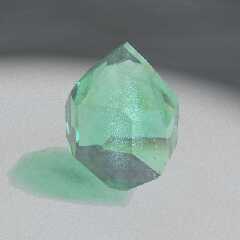
Latest, less inclusions, and slightly more concentrated and de-centered.

The complete set of files can be found now in the p.b.s-f

I added a quartz crystal to the set.

--
Thomas
Post a reply to this message
Attachments:
Download 'krystalshaper_apophyllite_006b.jpg' (59 KB)
Preview of image 'krystalshaper_apophyllite_006b.jpg'
|
|
| |
| |
|
|
|
|
| |
| |
|
|
Thomas de Groot <tho### [at] degrootorg> wrote:
> Latest, less inclusions, and slightly more concentrated and de-centered.

It looks decent!

I've got a bunch of ideas, but I need to find the proper motivation to implement
them :/

Only thing I want to suggest at this point is to maybe situate the light_source
&/ sky_sphere so that it casts a highlight off either an outside or inside
surface.

Sam
Post a reply to this message
|
|
| |
| |
|
|
|
|
| |
| |
|
|
Thomas de Groot <tho### [at] degrootorg> wrote:
> Latest, less inclusions, and slightly more concentrated and de-centered.
>
> The complete set of files can be found now in the p.b.s-f
>
> I added a quartz crystal to the set.
>
I like this. AND the previous render with more bubbles. Beautiful.

BTW, I did not realize that an object with ior could have inclusions (other
objects) with *different* ior's-- I thought such constructs would be an example
of 'variable' ior within an object, which cannot be accomplished in POV-ray,
AFAIU. I had a mistaken notion that the camera ray would 'see' the outer object
surface first, which would then set the ior for the entire union-ed CSG. (Kind
of like the way media operates.) But that's not the case! :-) So I've been
experimenting with this multiple-ior CSG trick, which can produce some visually
interesting results. Thanks for the idea.
Post a reply to this message
|
|
| |
| |
|
|
|
|
| |
| |
|
|
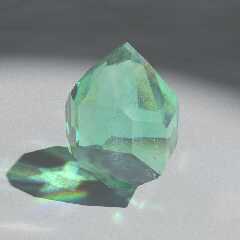
And final, with photons. Render time about 1.5 hours.

--
Thomas
Post a reply to this message
Attachments:
Download 'krystalshaper_apophyllite_006c.jpg' (59 KB)
Preview of image 'krystalshaper_apophyllite_006c.jpg'
|
|
| |
| |
|
|
|
|
| |
| |
|
|
Op 09/11/2021 om 20:02 schreef Kenneth:
> Thomas de Groot <tho### [at] degrootorg> wrote:
>> Latest, less inclusions, and slightly more concentrated and de-centered.
>>
>> The complete set of files can be found now in the p.b.s-f
>>
>> I added a quartz crystal to the set.
>>
> I like this. AND the previous render with more bubbles. Beautiful.
>
> BTW, I did not realize that an object with ior could have inclusions (other
> objects) with *different* ior's-- I thought such constructs would be an example
> of 'variable' ior within an object, which cannot be accomplished in POV-ray,
> AFAIU. I had a mistaken notion that the camera ray would 'see' the outer object
> surface first, which would then set the ior for the entire union-ed CSG. (Kind
> of like the way media operates.) But that's not the case! :-) So I've been
> experimenting with this multiple-ior CSG trick, which can produce some visually
> interesting results. Thanks for the idea.
>
>
To tell the truth, I really do not know /how/ the different ior's are
treated together. Afaik, this is not explained in the wiki pages. To
keep on the safe side, I kept the inclusion's ior at 1.0 which is
cheating of course, but at least I was not confronted to strange
effects. On my ToDo list I have put some ior experiments...

--
Thomas
Post a reply to this message
|
|
| |
| |
|
|
|
|
| |
| |
|
|
Op 06/11/2021 om 01:01 schreef Samuel B.:
> Thomas de Groot <tho### [at] degrootorg> wrote:
>> Latest, less inclusions, and slightly more concentrated and de-centered.
>
> It looks decent!
>
> I've got a bunch of ideas, but I need to find the proper motivation to implement
> them :/
>
> Only thing I want to suggest at this point is to maybe situate the light_source
> &/ sky_sphere so that it casts a highlight off either an outside or inside
> surface.
>
> Sam
>
Yes, I am fairly content. For now, I shall switch to other tasks and sit
back. :-)

--
Thomas
Post a reply to this message
|
|
| |
| |
|
|
|
|
| |
| |
|
|
Thomas de Groot <tho### [at] degrootorg> wrote:
> Op 09/11/2021 om 20:02 schreef Kenneth:
> >
> > BTW, I did not realize that an object with ior could have inclusions (other
> > objects) with *different* ior's-- I thought such constructs would be an example
> > of 'variable' ior within an object, which cannot be accomplished in POV-ray,
> > AFAIU. I had a mistaken notion that the camera ray would 'see' the outer object
> > surface first, (...)
> >
> To tell the truth, I really do not know /how/ the different ior's are
> treated together. Afaik, this is not explained in the wiki pages. To
> keep on the safe side, I kept the inclusion's ior at 1.0 which is
> cheating of course, but at least I was not confronted to strange
> effects.

If I'm not mistaken, a ray evaluates all objects and their iors along its path
and changes its trajectory accordingly. So in a union, it is not really
'cheating' to have objects with an ior of 1 inside. They are treated as air
until the ray moves on. It's a reasonable alternative to using a difference
which - while not requiring objects with different iors - is very slow to trace.

Oh, and a while back, I found out that if you want to pretend that the camera is
inside some volume, say water, and you want to see air bubbles in that volume,
then for the air bubbles you would use the reciprocal of water's ior. So, the
bubbles would have an ior of 1/1.325, iinm.

Sam
Post a reply to this message
|
|
| |
| |
|
|
|
|
| |
| |
|
|
Le 2021-11-10 à 17:06, Samuel B. a écrit :
> Thomas de Groot <tho### [at] degrootorg> wrote:
>> Op 09/11/2021 om 20:02 schreef Kenneth:
>>>
>>> BTW, I did not realize that an object with ior could have inclusions (other
>>> objects) with *different* ior's-- I thought such constructs would be an example
>>> of 'variable' ior within an object, which cannot be accomplished in POV-ray,
>>> AFAIU. I had a mistaken notion that the camera ray would 'see' the outer object
>>> surface first, (...)
>>>
>> To tell the truth, I really do not know /how/ the different ior's are
>> treated together. Afaik, this is not explained in the wiki pages. To
>> keep on the safe side, I kept the inclusion's ior at 1.0 which is
>> cheating of course, but at least I was not confronted to strange
>> effects.
>
> If I'm not mistaken, a ray evaluates all objects and their iors along its path
> and changes its trajectory accordingly. So in a union, it is not really
> 'cheating' to have objects with an ior of 1 inside. They are treated as air
> until the ray moves on. It's a reasonable alternative to using a difference
> which - while not requiring objects with different iors - is very slow to trace.
>
> Oh, and a while back, I found out that if you want to pretend that the camera is
> inside some volume, say water, and you want to see air bubbles in that volume,
> then for the air bubbles you would use the reciprocal of water's ior. So, the
> bubbles would have an ior of 1/1.325, iinm.
>
> Sam
>

If you want to use a difference, then, you should use a blob instead of
100' to 1000's of spheres.
That way, you benefit from the blob's hierarchy and internal bounding
mechanism.
Post a reply to this message
|
|
| |
| |
|
|
|
|
| |
| |
|
|
Alain Martel <kua### [at] videotronca> wrote:
> Le 2021-11-10 à 17:06, Samuel B. a écrit :
> > (...) It's a reasonable alternative to using a difference
> > which - while not requiring objects with different iors - is very slow to trace.
>
> If you want to use a difference, then, you should use a blob instead of
> 100' to 1000's of spheres.
> That way, you benefit from the blob's hierarchy and internal bounding
> mechanism.

Blobs! I completely forgot about that option. And based on some experiments I
made once, I'd say you're probably right about the their higher rendering speed.

Yeah, I can see the benefit to using blobs to make air/fluid inclusions, and
then maybe applying a facets normal with metric 1 and maybe form <1, 0, 0>. This
way the clouds would refract/reflect light at certain angles only, thus giving a
more crystalline appearance. Hmm...

Sam
Post a reply to this message
|
|
| |
| |
|
|
|
|
| |
| |
|
|
Thomas de Groot <tho### [at] degrootorg> wrote:
> "Samuel B." <stb### [at] hotmailcom> wrote:
> > Alain Martel <kua### [at] videotronca> wrote:
> >
> > > > (...) It's a reasonable alternative to using a difference
> > > > which - while not requiring objects with different iors - is very slow to
trace.
> > >
> > > If you want to use a difference, then, you should use a blob instead of
> > > 100' to 1000's of spheres.
> > > That way, you benefit from the blob's hierarchy and internal bounding
> > > mechanism.
> >
> > Blobs! I completely forgot about that option. (...)
>
> Blobs, of course! Completely forgot too. ;-)

Thomas, for some reason your message appeared in my inbox. But not from any real
e-mail address (the name was pretty obvious, but I thought I'd try to reply
anyway). So I suppose if the newsgroups ever go down for good, I'll meet you in
Valhalla! :P

But yeah, blobs seem like a worthy line of investigation :D

Sam
Post a reply to this message
|
|
| |
| |
|
|
|
|
| |
| |
|
|
Op 13/11/2021 om 00:16 schreef Samuel B.:
> Thomas, for some reason your message appeared in my inbox. But not from any real
> e-mail address (the name was pretty obvious, but I thought I'd try to reply
> anyway). So I suppose if the newsgroups ever go down for good, I'll meet you in
> Valhalla! :P
>
Aargh! Did it again! :-(

Sorry Sam, I hit the wrong button in Thunderbird.

> But yeah, blobs seem like a worthy line of investigation :D
>
> Sam
>


--
Thomas
Post a reply to this message
|
|
| |
| |
|
|
|
|
| |
| |
|
|
Op 10-11-2021 om 08:11 schreef Thomas de Groot:

> To tell the truth, I really do not know /how/ the different ior's are
> treated together. Afaik, this is not explained in the wiki pages. To
> keep on the safe side, I kept the inclusion's ior at 1.0 which is
> cheating of course, but at least I was not confronted to strange
> effects. On my ToDo list I have put some ior experiments...
>
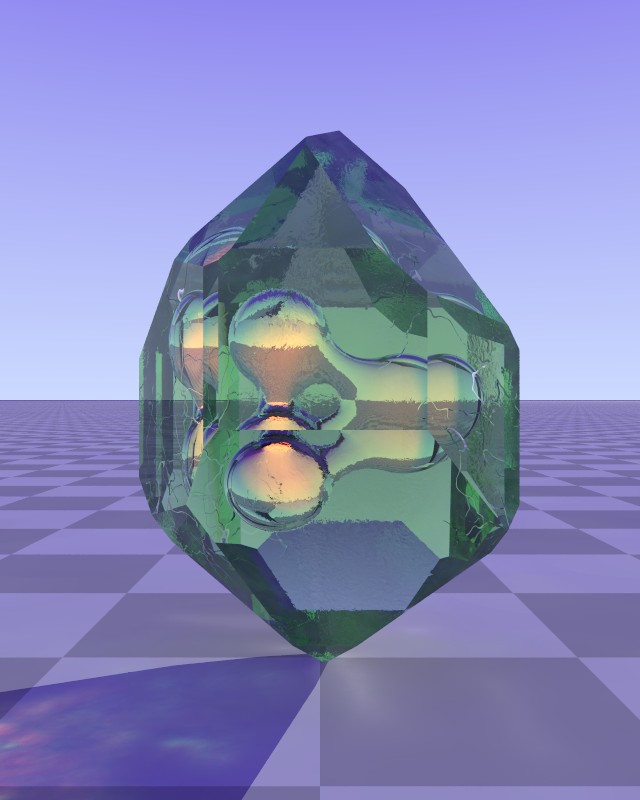
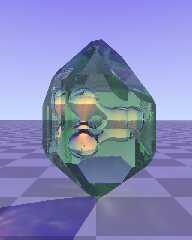
Here it is. I replaced the cloud of inclusions by just one large blob
inclusion with its own ior (salt water) and its own (coloured)
absorption media. Indeed, there is no interaction between the different
media colours (crystal and inclusion) or ior differences. Good to know! :-)

--
Thomas
Post a reply to this message
Attachments:
Download 'nested media_test4.jpg' (62 KB)
Preview of image 'nested media_test4.jpg'
|
|
| |
| |
|
|
|
|
| |
| |
|
|
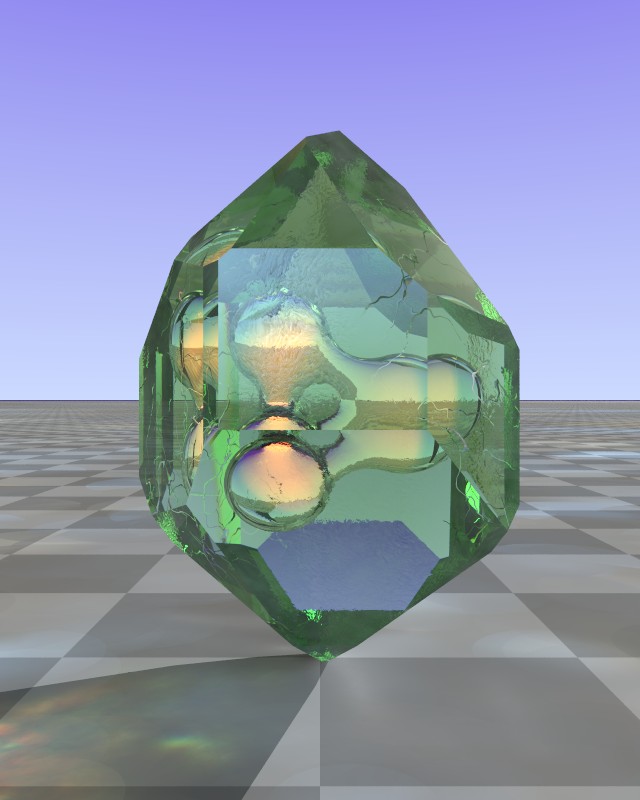
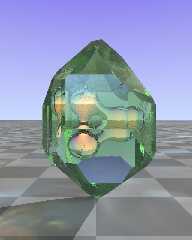
...And using a light probe in addition (with no_image).

--
Thomas
Post a reply to this message
Attachments:
Download 'nested media_test5.jpg' (65 KB)
Preview of image 'nested media_test5.jpg'
|
|
| |
| |
|
|
|
|
| |
|
|