|
|
|
|
|
|
| |
| |
|
|
|
|
| |
| |
|
|
The final version of the Granite_21 macro package can be found in
p.b.scene-files under the same header.

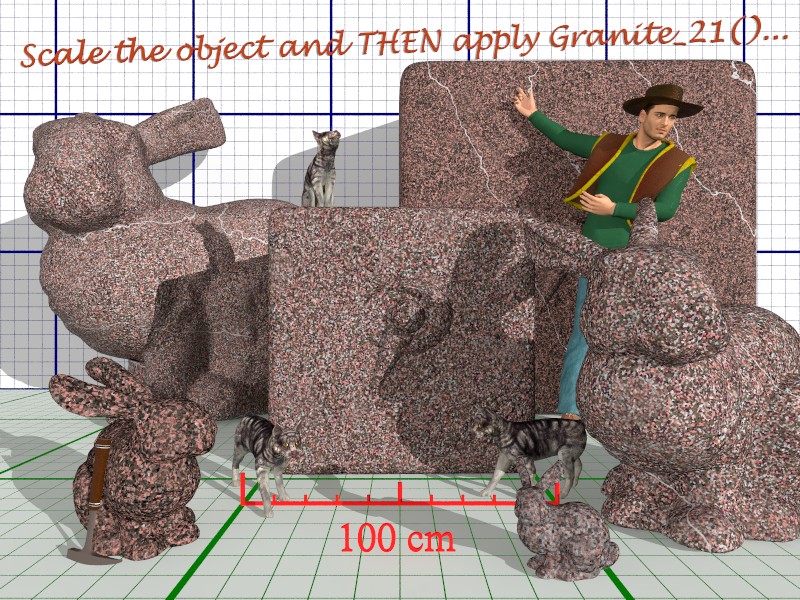
The image here illustrates, from the start, the principal rule of the
macro, written on the wall!

Enjoy!

--
Thomas
Post a reply to this message
Attachments:
Download 'granite_21_dimensions2.jpg' (216 KB)
Preview of image 'granite_21_dimensions2.jpg'
|
|
| |
| |
|
|
|
|
| |
| |
|
|
Alright! Thanks Thomas and Bald Eagle (and anyone else who may have
contributed)! This is a great day in POV-Ray history!

Kind regards,
Dave Blandston
Suggested motto: "With POV-Ray anything is possible, but nothing is easy"
Post a reply to this message
|
|
| |
| |
|
|
|
|
| |
| |
|
|
Thomas de Groot <tho### [at] degroot org> wrote:
> The final version of the Granite_21 macro package can be found in
> p.b.scene-files under the same header.
>
> The image here illustrates, from the start, the principal rule of the
> macro, written on the wall!
Hey, is that a classic Estwing hammer I see? I've got one myself, but it's worn
down. A lot. I probably need to grind it back into shape, but I haven't found
much use for it recently. Estwing used to (and probably still does) have a free
replacement policy, but I never figured it was worth bothering them over.
Not many minerals around here except for granitic rocks, tiny grains of
opalescent quartz, almost-amazonite feldspar and maybe some horneblend. The
latter seems to exhibit some Schillerism when shaped. I think I found some
garnet, too, but it's hard to tell.
What do you plan to use the granite for, if anything?
Sam org> wrote:
> The final version of the Granite_21 macro package can be found in
> p.b.scene-files under the same header.
>
> The image here illustrates, from the start, the principal rule of the
> macro, written on the wall!
Hey, is that a classic Estwing hammer I see? I've got one myself, but it's worn
down. A lot. I probably need to grind it back into shape, but I haven't found
much use for it recently. Estwing used to (and probably still does) have a free
replacement policy, but I never figured it was worth bothering them over.
Not many minerals around here except for granitic rocks, tiny grains of
opalescent quartz, almost-amazonite feldspar and maybe some horneblend. The
latter seems to exhibit some Schillerism when shaped. I think I found some
garnet, too, but it's hard to tell.
What do you plan to use the granite for, if anything?
Sam
Post a reply to this message
|
|
| |
| |
|
|
|
|
| |
| |
|
|
Op 10/09/2021 om 01:26 schreef Samuel B.:
> Thomas de Groot <tho### [at] degrootorg> wrote:
>> The final version of the Granite_21 macro package can be found in
>> p.b.scene-files under the same header.
>>
>> The image here illustrates, from the start, the principal rule of the
>> macro, written on the wall!
>
> Hey, is that a classic Estwing hammer I see? I've got one myself, but it's worn
> down. A lot. I probably need to grind it back into shape, but I haven't found
> much use for it recently. Estwing used to (and probably still does) have a free
> replacement policy, but I never figured it was worth bothering them over.
>
Yes sir, it is! Modelled on my own, old, specimen, which has accompanied
me for the last 55 years or so. Got it for my birthday after I had
revealed to my parents that I intended to be a geologist.

It is also worn down, probably not as much as yours. Its most intensive
use was during my studies when fieldwork was in hardrock countries
almost exclusively. Later, as I switched to softrock specialisation, it
gathered mostly dust. Trowel & spade took over. :-)

However, it is still there, sometimes to be used when a rock passes by.
Never took it on a plane though; you can imagine why...


> Not many minerals around here except for granitic rocks, tiny grains of
> opalescent quartz, almost-amazonite feldspar and maybe some horneblend. The
> latter seems to exhibit some Schillerism when shaped. I think I found some
> garnet, too, but it's hard to tell.
>
The Sierra Nevada, I assume. Fascinating geological history over there.

You did some perfect modelling of jasper and topaz.

Your Europan vacation shot still fills my background screen here, btw.


> What do you plan to use the granite for, if anything?
>
No real plans at the moment. My primary intention was to finally put
Daniel Mecklenburg's code to good use after all those years.

--
Thomas
Post a reply to this message
|
|
| |
| |
|
|
|
|
| |
| |
|
|
Thomas de Groot <tho### [at] degrootorg> wrote:
> Op 10/09/2021 om 01:26 schreef Samuel B.:
> > Hey, is that a classic Estwing hammer I see? (...)
> >
> Yes sir, it is! Modelled on my own, old, specimen, which has accompanied
> me for the last 55 years or so. Got it for my birthday after I had
> revealed to my parents that I intended to be a geologist.
>
> It is also worn down, probably not as much as yours.

You can be the judge of that... I've attached a photo of mine for your viewing
(dis?)pleasure. As you can see, it's fairly worn. Not too bad, but reshaping it
means losing some length from the pick. But the worst part is the condition of
the handle... It needs the for the lacquer to be removed and some oil applied.
I've dug underwater in creeks with the thing, to loosen rocks and get at
gold-bearing clay, so it's no wonder it looks like it does. (One time when I was
doing this - my chin partially underwater - an otter popped its head over some
boulders, saw me, and quickly went the other way, lol.)

> Its most intensive
> use was during my studies when fieldwork was in hardrock countries
> almost exclusively. Later, as I switched to softrock specialisation, it
> gathered mostly dust. Trowel & spade took over. :-)

Yeah, a rock hammer isn't often the best tool for everything, that's for sure.
My other main tool is a long, flat-headed screw driver. Perfect for prying apart
rocks that would otherwise be difficult to budge. (But I've chipped a bunch of
quartz crystal terminations doing that...)

> However, it is still there, sometimes to be used when a rock passes by.
> Never took it on a plane though; you can imagine why...

Tomorrow is one of the reasons why, I'm guessing?

> > Not many minerals around here except for granitic rocks, (...)
> >
> The Sierra Nevada, I assume. Fascinating geological history over there.

Yep! It's just too bad there's not much interesting going on in my immediate
locale. I'd really like to spend some time in some of the more interesting
places, like Fresno Country, Inyo County and even San Diego County, even though
the latter has been heavily prospected. Inyo seems like the best bet for
undiscovered treasures.

> You did some perfect modelling of jasper and topaz.

Oh, that reminds me. I know your specialty is more on the geological side of
things, but a great tool has just become available for free: KrystalShaper (
http://www.jcrystal.com/products/krystalshaper/ ) It provides a catalog of
hundreds of minerals, plus tools to analyze and export geometry. Might be worth
checking out.

> Your Europan vacation shot still fills my background screen here, btw.

Haha, cool. I still want to update that scene with a camping tent, RV or
something.

> > What do you plan to use the granite for, if anything?
> >
> No real plans at the moment. My primary intention was to finally put
> Daniel Mecklenburg's code to good use after all those years.

I'm out of the loop, so I'm not sure what that entails, but I'm looking forward
to seeing it.

Sam
Post a reply to this message
Attachments:
Download 'estwing-98.jpg' (543 KB)
Preview of image 'estwing-98.jpg'

|
|
| |
| |
|
|
|
|
| |
| |
|
|
Op 10/09/2021 om 22:36 schreef Samuel B.:
> Thomas de Groot <tho### [at] degrootorg> wrote:
>> Op 10/09/2021 om 01:26 schreef Samuel B.:
>>> Hey, is that a classic Estwing hammer I see? (...)
>>>
>> Yes sir, it is! Modelled on my own, old, specimen, which has accompanied
>> me for the last 55 years or so. Got it for my birthday after I had
>> revealed to my parents that I intended to be a geologist.
>>
>> It is also worn down, probably not as much as yours.
>
> You can be the judge of that... I've attached a photo of mine for your viewing
> (dis?)pleasure. As you can see, it's fairly worn. Not too bad, but reshaping it
> means losing some length from the pick. But the worst part is the condition of
> the handle... It needs the for the lacquer to be removed and some oil applied.
> I've dug underwater in creeks with the thing, to loosen rocks and get at
> gold-bearing clay, so it's no wonder it looks like it does. (One time when I was
> doing this - my chin partially underwater - an otter popped its head over some
> boulders, saw me, and quickly went the other way, lol.)
>
Well... except for the handle, mine is in the same condition, with some
serious dents in the head additionally (from hitting too many quartzitic
rocks in Scandinavia and the Alps iirc). That handle of yours needs some
refurbishing indeed. As you say, some oil for the leather to absorb.
After a hot field summer in Spain, the leather had started to shrink and
crack, a bit like yours. I used to dip it in a water pool for a couple
of hours... Otherwise, your Estwing still looks pretty operational. I
don't know about reshaping the point. Generally, it doesn't need to be
too sharp (or it looses its sharpness pretty soon anyway).

>> Its most intensive
>> use was during my studies when fieldwork was in hardrock countries
>> almost exclusively. Later, as I switched to softrock specialisation, it
>> gathered mostly dust. Trowel & spade took over. :-)
>  > Yeah, a rock hammer isn't often the best tool for everything, that's
for sure.
> My other main tool is a long, flat-headed screw driver. Perfect for prying apart
> rocks that would otherwise be difficult to budge. (But I've chipped a bunch of
> quartz crystal terminations doing that...)
>
Screwdrivers, chisels, whatever is available. Hardware stores are little
paradises for that ;-)

>> However, it is still there, sometimes to be used when a rock passes by.
>> Never took it on a plane though; you can imagine why...
>
> Tomorrow is one of the reasons why, I'm guessing?
>
Yeah...

>>> Not many minerals around here except for granitic rocks, (...)
>>>
>> The Sierra Nevada, I assume. Fascinating geological history over there.
>
> Yep! It's just too bad there's not much interesting going on in my immediate
> locale. I'd really like to spend some time in some of the more interesting
> places, like Fresno Country, Inyo County and even San Diego County, even though
> the latter has been heavily prospected. Inyo seems like the best bet for
> undiscovered treasures.
>
Not sure but I guess areas on the fringes/just ouside of the granite
outcrops would be more promising, and the metamorph, ancient sedimentary
rocks?

>> You did some perfect modelling of jasper and topaz.
>
> Oh, that reminds me. I know your specialty is more on the geological side of
> things, but a great tool has just become available for free: KrystalShaper (
> http://www.jcrystal.com/products/krystalshaper/ ) It provides a catalog of
> hundreds of minerals, plus tools to analyze and export geometry. Might be worth
> checking out.
>
I shall do that.

>> Your Europan vacation shot still fills my background screen here, btw.
>
> Haha, cool. I still want to update that scene with a camping tent, RV or
> something.
>
>>> What do you plan to use the granite for, if anything?
>>>
>> No real plans at the moment. My primary intention was to finally put
>> Daniel Mecklenburg's code to good use after all those years.
>
> I'm out of the loop, so I'm not sure what that entails, but I'm looking forward
> to seeing it.
>
Sorry, my bad, you are already ;-) What I meant is that the Granite_21
macro is the result of wanting to turn Daniel's code into proper
granites for a number of years.

--
Thomas
Post a reply to this message
|
|
| |
| |
|
|
|
|
| |
| |
|
|
Thomas de Groot <tho### [at] degrootorg> wrote:
> Generally, it doesn't need to be too sharp (or it looses its sharpness pretty
> soon anyway).

That's probably exactly how it should be, since tools that keep an edge are
generally very brittle... a property you might not want in hammer ;)

> Not sure but I guess areas on the fringes/just ouside of the granite
> outcrops would be more promising, and the metamorph, ancient sedimentary
> rocks?

You would be right, since those have always been the most interesting spots,
ime. Once in Fresno county, we found some marble. I've never seen marble with
such large grains. Right next to that we found garnet clusters (grossular,
probably). And then we began finding epidote, more garnets, and very beautiful
smokey quartz near some mines.

In the lower elevations of this general area, almost everything is hydrothermal
and metapmorphic. You'll find shale with fossils, slate a ways off from the
shale, quartz veins running through both, soapstone in one area and serpentine
(an altered form of soapstone iirc) in another. Pyrite, gold, even pure sulphur
in some places. It's crazy.

And there's an area near a river which I suspect might be harboring corundum. In
that place you can find marble outcrops above an area with granite pegmatite (I
might have found a green beryl there as a kid but it's been lost). Since I
figured corundum is sometimes found in marble, and considering the prevalence of
aluminum in the area (micas, soap stone, etc.), I thought that maybe rubies and
whatnot could be possible as well.

Sam
Post a reply to this message
|
|
| |
| |
|
|
|
|
| |
| |
|
|
Op 10-9-2021 om 22:36 schreef Samuel B.:
> Oh, that reminds me. I know your specialty is more on the geological side of
> things, but a great tool has just become available for free: KrystalShaper (
> http://www.jcrystal.com/products/krystalshaper/ ) It provides a catalog of
> hundreds of minerals, plus tools to analyze and export geometry. Might be worth
> checking out.
>
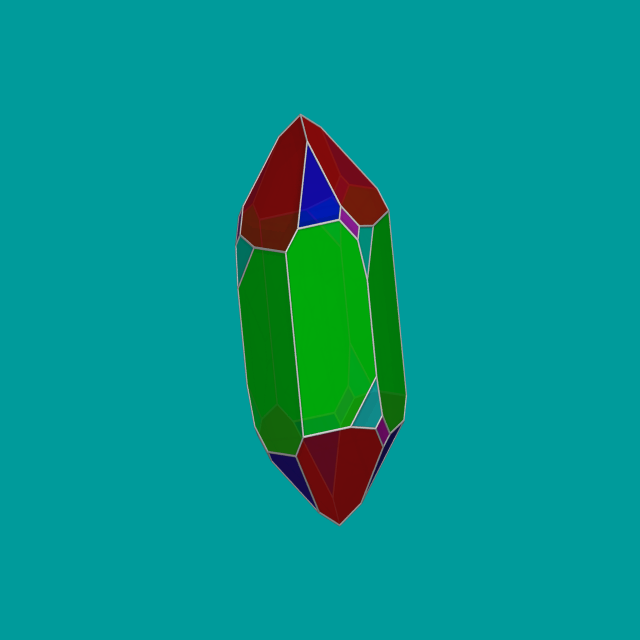
Nice little program indeed! Thanks. Wulff-nets, ha! That was not really
my cup of tea... ;-)

The output could be the basis for crystal renders of quality. Not much
time at the moment, but I keep in mind.

--
Thomas
Post a reply to this message
Attachments:
Download 'quartz.png' (48 KB)
Preview of image 'quartz.png'
|
|
| |
| |
|
|
|
|
| |
| |
|
|
Thomas de Groot <tho### [at] degrootorg> wrote:
> Op 10-9-2021 om 22:36 schreef Samuel B.:
> > Oh, that reminds me. I know your specialty is more on the geological side of
> > things, but a great tool has just become available for free: KrystalShaper (
> > http://www.jcrystal.com/products/krystalshaper/ ) It provides a catalog of
> > hundreds of minerals, plus tools to analyze and export geometry. Might be worth
> > checking out.
> >
> Nice little program indeed! Thanks. Wulff-nets, ha! That was not really
> my cup of tea... ;-)

I don't even know a Wulff net is. But based on its appearance, I'm guessing it's
some sort of mapping between HKL indices and a sphere. Maybe it's a clue to help
me convert HKL values to planes...

> The output could be the basis for crystal renders of quality. Not much
> time at the moment, but I keep in mind.

What's your camera aspect there? The crystal looks stretched vertically.

It is a cool program, I just wish I could figure out my HKL issues so I can do
more with it. (My previous searches didn't turn up much useful info, or maybe I
wasn't comprehending what I saw...)

Sam
Post a reply to this message
|
|
| |
| |
|
|
|
|
| |
| |
|
|
Op 14/09/2021 om 01:14 schreef Samuel B.:
> Thomas de Groot <tho### [at] degrootorg> wrote:
>> Op 10-9-2021 om 22:36 schreef Samuel B.:
>>> Oh, that reminds me. I know your specialty is more on the geological side of
>>> things, but a great tool has just become available for free: KrystalShaper (
>>> http://www.jcrystal.com/products/krystalshaper/ ) It provides a catalog of
>>> hundreds of minerals, plus tools to analyze and export geometry. Might be worth
>>> checking out.
>>>
>> Nice little program indeed! Thanks. Wulff-nets, ha! That was not really
>> my cup of tea... ;-)
>
> I don't even know a Wulff net is. But based on its appearance, I'm guessing it's
> some sort of mapping between HKL indices and a sphere. Maybe it's a clue to help
> me convert HKL values to planes...
>
That is correct. It is/was used in crystallography for mapping mineral
indices and do all sort of exciting things, calculating angles and
intersections. Only, as a freshman, I was not particularly interested in
this branch of geology! Hammering away at overturned, anticlinal rock
sections: /That/ was what life was about! ;-)

But seriously, I do not remember how it worked exactly but it certainly
could be of help to you I guess. I still have a Wulff net somewhere
here, gathering dust.

>> The output could be the basis for crystal renders of quality. Not much
>> time at the moment, but I keep in mind.
>
> What's your camera aspect there? The crystal looks stretched vertically.
>
For the demo image I didn't bother with the scene details; just used the
standard scene code provided by the app.

> It is a cool program, I just wish I could figure out my HKL issues so I can do
> more with it. (My previous searches didn't turn up much useful info, or maybe I
> wasn't comprehending what I saw...)
>
I know what you mean. These are a couple sites which explain the use of
the Wulff net. There are more of course, but these are fairly basic.

http://www.minsocam.org/ammin/AM25/AM25_689.pdf
https://www.doitpoms.ac.uk/tlplib/stereographic/wulff_construct.php

However, to tell the truth, I remain a bit baffled when I see those
things again, after all those years. I am not really sure I understand;
I think you are more familiar with all this.

--
Thomas
Post a reply to this message
|
|
| |
| |
|
|
|
|
| |
| |
|
|
Thomas de Groot <tho### [at] degrootorg> wrote:
> (...)
> Only, as a freshman, I was not particularly interested in
> this branch of geology! Hammering away at overturned, anticlinal rock
> sections: /That/ was what life was about! ;-)

Yeah, being out in the field is wonderful. I know our reasons for being out
there were for different reasons, but I also know the thrill of finding
something interesting and tracking it down. I really miss it.

> Op 14/09/2021 om 01:14 schreef Samuel B.:
> > It is a cool program, I just wish I could figure out my HKL issues so I can do
> > more with it. (My previous searches didn't turn up much useful info, or maybe I
> > wasn't comprehending what I saw...)
> >
> I know what you mean. These are a couple sites which explain the use of
> the Wulff net. There are more of course, but these are fairly basic.
>
> http://www.minsocam.org/ammin/AM25/AM25_689.pdf
> https://www.doitpoms.ac.uk/tlplib/stereographic/wulff_construct.php
>
> However, to tell the truth, I remain a bit baffled when I see those
> things again, after all those years. I am not really sure I understand;
> I think you are more familiar with all this.

No, I don't think I'm any more familiar with these things than you are...
probably less so. Thanks for the links. But I looked at them and to be honest,
the information looks very thick. So thick I'm not actually sure if it would be
any help in my endeavors...


Sam
Post a reply to this message
|
|
| |
| |
|
|
|
|
| |
| |
|
|
Op 16/09/2021 om 01:23 schreef Samuel B.:
> Thomas de Groot <tho### [at] degrootorg> wrote:
>> (...)
>> Only, as a freshman, I was not particularly interested in
>> this branch of geology! Hammering away at overturned, anticlinal rock
>> sections: /That/ was what life was about! ;-)
>
> Yeah, being out in the field is wonderful. I know our reasons for being out
> there were for different reasons, but I also know the thrill of finding
> something interesting and tracking it down. I really miss it.
>
I can understand that.

>> Op 14/09/2021 om 01:14 schreef Samuel B.:
>>> It is a cool program, I just wish I could figure out my HKL issues so I can do
>>> more with it. (My previous searches didn't turn up much useful info, or maybe I
>>> wasn't comprehending what I saw...)
>>>
>> I know what you mean. These are a couple sites which explain the use of
>> the Wulff net. There are more of course, but these are fairly basic.
>>
>> http://www.minsocam.org/ammin/AM25/AM25_689.pdf
>> https://www.doitpoms.ac.uk/tlplib/stereographic/wulff_construct.php
>>
>> However, to tell the truth, I remain a bit baffled when I see those
>> things again, after all those years. I am not really sure I understand;
>> I think you are more familiar with all this.
>
> No, I don't think I'm any more familiar with these things than you are...
> probably less so. Thanks for the links. But I looked at them and to be honest,
> the information looks very thick. So thick I'm not actually sure if it would be
> any help in my endeavors...
>
Yeah... I know what you mean. One of the reasons I didn't get very far
in crystallography. I have some 3D visualisation skills :-) but these
kind of exercises always left me profoundly baffled I confess. Otoh, I
believe they /may/ unlock certain geometrical symmetry problems proper
to certain mineral classes.

--
Thomas
Post a reply to this message
|
|
| |
| |
|
|
|
|
| |
| |
|
|
"Samuel B." <stb### [at] hotmailcom> wrote:

> > Nice little program indeed! Thanks. Wulff-nets, ha! That was not really
> > my cup of tea... ;-)
>
> I don't even know a Wulff net is. But based on its appearance, I'm guessing it's
> some sort of mapping between HKL indices and a sphere. Maybe it's a clue to help
> me convert HKL values to planes...
>

> It is a cool program, I just wish I could figure out my HKL issues so I can do
> more with it. (My previous searches didn't turn up much useful info, or maybe I
> wasn't comprehending what I saw...)


Aren't the HKL values just the vector normals of the planes?
That's what the wikipedia articles suggested on my brief skim.

Would not plane {y, 0} have an hkl index of <0,1,0>?

Not sure what the overall goal is, so not sure what to suggest to test this.

- Bill
Post a reply to this message
|
|
| |
| |
|
|
|
|
| |
| |
|
|
Op 16-9-2021 om 12:28 schreef Bald Eagle:
> "Samuel B." <stb### [at] hotmailcom> wrote:
>
>>> Nice little program indeed! Thanks. Wulff-nets, ha! That was not really
>>> my cup of tea... ;-)
>>
>> I don't even know a Wulff net is. But based on its appearance, I'm guessing it's
>> some sort of mapping between HKL indices and a sphere. Maybe it's a clue to help
>> me convert HKL values to planes...
>>
>
>> It is a cool program, I just wish I could figure out my HKL issues so I can do
>> more with it. (My previous searches didn't turn up much useful info, or maybe I
>> wasn't comprehending what I saw...)
>
>
> Aren't the HKL values just the vector normals of the planes?
> That's what the wikipedia articles suggested on my brief skim.
>
> Would not plane {y, 0} have an hkl index of <0,1,0>?
>
> Not sure what the overall goal is, so not sure what to suggest to test this.
>
If I remember correctly, that is indeed the case I believe.

--
Thomas
Post a reply to this message
|
|
| |
| |
|
|
|
|
| |
| |
|
|
Thomas de Groot <tho### [at] degrootorg> wrote:

> > Aren't the HKL values just the vector normals of the planes?
> > That's what the wikipedia articles suggested on my brief skim.
> >
> > Would not plane {y, 0} have an hkl index of <0,1,0>?
> >
> > Not sure what the overall goal is, so not sure what to suggest to test this.
> >
> If I remember correctly, that is indeed the case I believe.
>
> --
> Thomas

So then, to some degree, the unit cell for the crystal should be some form of
intersection between all of the planes that the hkl indices define. (?)  Does
the file format include any data that would serve as an offset?

Creating the most basic crystal shapes, probably starting with cubic NaCl, might
give a clue as to how to code an implementation of that notational system.
Post a reply to this message
|
|
| |
| |
|
|
|
|
| |
| |
|
|
"Bald Eagle" <cre### [at] netscapenet> wrote:
> "Samuel B." <stb### [at] hotmailcom> wrote:
> Aren't the HKL values just the vector normals of the planes?
> That's what the wikipedia articles suggested on my brief skim.
>
> Would not plane {y, 0} have an hkl index of <0,1,0>?

That's probably the case with simple cubic crystal systems. Other systems, like
hexagonal, monoclinic, etc., are a bit different. I should try to get a cubic
system to work first.

> Not sure what the overall goal is, so not sure what to suggest to test this.

My goal is to simply convert HKL values to normal vectors, and then to build
crystals from those using intersecting planes.

Sam
Post a reply to this message
|
|
| |
| |
|
|
|
|
| |
| |
|
|
"Bald Eagle" <cre### [at] netscapenet> wrote:
> Thomas de Groot <tho### [at] degrootorg> wrote:
>
> > > Aren't the HKL values just the vector normals of the planes?
> > > That's what the wikipedia articles suggested on my brief skim.
> > >
> > > Would not plane {y, 0} have an hkl index of <0,1,0>?
> > >
> > > Not sure what the overall goal is, so not sure what to suggest to test this.
> > >
> > If I remember correctly, that is indeed the case I believe.
> >
> > --
> > Thomas
>
> So then, to some degree, the unit cell for the crystal should be some form of
> intersection between all of the planes that the hkl indices define. (?)

I think the unit cell defines the dimensions and angles. Attached is a
screenshot from KrystalShaper. The thin-lined, skewed box surrounding the
crystal represents the unit cell. In the lower right area of the image you can
see the numbers "4.913 x 4.913 x 5.4045" which are probably the dimensions of
the cell. The numbers "90 90 120" are the angles. But how to convert these to
proper planes? All my attempts have failed. There is probably a basic solution
and I'm just over-complicating things...

> Does the file format include any data that would serve as an offset?

The data files are in some non-human-readable format. I should probably get a
hex editor and take a look.

> Creating the most basic crystal shapes, probably starting with cubic NaCl, might
> give a clue as to how to code an implementation of that notational system.

Yes, I should start with the most basic thing first.

Sam
Post a reply to this message
Attachments:
Download 'krystalshaper-quartz.png' (18 KB)
Preview of image 'krystalshaper-quartz.png'

|
|
| |
| |
|
|
|
|
| |
| |
|
|
"Samuel B." <stb### [at] hotmailcom> wrote:
In the lower right area of the image you can
> see the numbers "4.913 x 4.913 x 5.4045" which are probably the dimensions of
> the cell. The numbers "90 90 120" are the angles. But how to convert these to
> proper planes? All my attempts have failed. There is probably a basic solution
> and I'm just over-complicating things...

I agree that those are the dimensions and angles.
But they are the angles of the unit cell, and ATM I fail to see how you need
them.

What I DO see, is that you have numerical triplets, indicating the hkl indices.
I believe that you can simply use those numbers as the normal vectors for all of
the face planes.  Maybe there's a way to display them with greater precision.
Still not sure about the offset, but maybe once you get the ball rolling, some
light will be shed on that aspect of the data.

Perhaps if there are tables of human readable hkl indices for different crystal
structures, you can compare and contrast and discern a pattern.

And that's all I have before 1st coffee.   :D
Post a reply to this message
|
|
| |
| |
|
|
|
|
| |
| |
|
|
"Bald Eagle" <cre### [at] netscapenet> wrote:
> "Samuel B." <stb### [at] hotmailcom> wrote:
> In the lower right area of the image you can
> > see the numbers "4.913 x 4.913 x 5.4045" which are probably the dimensions of
> > the cell. The numbers "90 90 120" are the angles. But how to convert these to
> > proper planes? All my attempts have failed. There is probably a basic solution
> > and I'm just over-complicating things...
>
> I agree that those are the dimensions and angles.
> But they are the angles of the unit cell, and ATM I fail to see how you need
> them.

I think they merely point to the angles and dimensions one would need when
converting HKL indices into proper plane normals. For a cubic system, this would
be straightforward, but for a hexagonal system, something else is needed. I
tried shearing/skewing & scaling cubic coords to produce proper results, but as
said before, I had no luck.

> What I DO see, is that you have numerical triplets, indicating the hkl indices.
> I believe that you can simply use those numbers as the normal vectors for all of
> the face planes.  Maybe there's a way to display them with greater precision.

There is no greater precision. Attached is an image showing the table of HKL
indices of a basic quartz crystal. When you click on any number field, you'll
find it's just an integer. (Except for the distance values, of course.) If I'm
not mistaken, this is because the HKL system only works for the intended
coordinate spaces (aka unit cells).

> Still not sure about the offset, but maybe once you get the ball rolling, some
> light will be shed on that aspect of the data.

Not sure what you mean. The plane offsets? Those are given by the aforementioned
fourth value, "distance."

> And that's all I have before 1st coffee.   :D

Drink 'em if you've got 'em! ;)

Sam
Post a reply to this message
Attachments:
Download 'krystalshaper-quartz-indices.png' (7 KB)
Preview of image 'krystalshaper-quartz-indices.png'

|
|
| |
| |
|
|
|
|
| |
| |
|
|
Not sure if this might help: http://jcrystal.com/products/winwulff/

I am still thinking how this would help. Fifty five years ago (!) when I
was introduced to the use of a Wulff net, you were given the model of a
crystal with the task to translate its features onto the net,
determining the symmetry planes, the axes of rotation, measuring the
angles between faces, etc. I suppose the difficulty here is to do the
opposite, or am I wrong?

--
Thomas
Post a reply to this message
|
|
| |
| |
|
|
|
|
| |
| |
|
|
"Samuel B." <stb### [at] hotmailcom> wrote:
All my attempts have failed. There is probably a basic solution
> > > and I'm just over-complicating things...

Doesn't seem that way.  Having never done any of this type of work, in my
ignorance, I believe I was initially suggesting an overly simplistic approach.

OK, here's the deal.

from: https://en.wikipedia.org/wiki/Miller_index
.... a family of lattice planes is determined by three integers h, k, and
ℓ, the Miller indices. They are written (hkℓ), and denote the family
of planes orthogonal to hb1 + kb2 +lb3, where bi are the basis of the reciprocal
lattice vectors....

from which I can see that the key part is incorporated by reference at
https://en.wikipedia.org/wiki/Reciprocal_lattice

The reciprocal lattice is the set of all vectors Gm, that are wavevectors of
plane waves in the Fourier series of a spatial function which periodicity is the
same as that of a direct lattice Rn

So:

The guy you want to talk to is Michael Joseph Waters - a postdoctoral researcher
in X-ray crystallography at Northwestern.  Nice guy - we emailed back and forth
a while back.
"NiO is a odd material, it's antiferromagnetic so there are alternating planes
of spin up and spin down electrons. If you learn Miller indices, these are on
(111) planes."
Also:
https://ciderware.blogspot.com/2016/08/getting-isosurfaces-from-data-grid-into.html

Find his contact info here:
https://mtd.mccormick.northwestern.edu/group/

He's likely a busy guy, but he may have some advice on how to approach
unraveling this all.  I'm guessing it might take a 3rd party software package -
or maybe not, if we can use the FFT that I coded up a while back.
Post a reply to this message
|
|
| |
| |
|
|
|
|
| |
| |
|
|
Thomas de Groot <tho### [at] degrootorg> wrote:
> Not sure if this might help: http://jcrystal.com/products/winwulff/
>
> I am still thinking how this would help. Fifty five years ago (!) when I
> was introduced to the use of a Wulff net, you were given the model of a
> crystal with the task to translate its features onto the net,
> determining the symmetry planes, the axes of rotation, measuring the
> angles between faces, etc. I suppose the difficulty here is to do the
> opposite, or am I wrong?

That might help, but I'm not sure. Ideally, I'd like to perform all the
necessary conversions in POV-Ray. I'll check that out and see if it shines a
light on the subject.

Sam
Post a reply to this message
|
|
| |
| |
|
|
|
|
| |
| |
|
|
"Bald Eagle" <cre### [at] netscapenet> wrote:
> "Samuel B." <stb### [at] hotmailcom> wrote:
> > > > All my attempts have failed. There is probably a basic solution
> > > > and I'm just over-complicating things...
>
> Doesn't seem that way.  Having never done any of this type of work, in my
> ignorance, I believe I was initially suggesting an overly simplistic approach.
>
> OK, here's the deal.
>
> from: https://en.wikipedia.org/wiki/Miller_index
> .... a family of lattice planes is determined by three integers h, k, and
> ℓ, the Miller indices. They are written (hkℓ), and denote the family
> of planes orthogonal to hb1 + kb2 +lb3, where bi are the basis of the reciprocal
> lattice vectors....
>
> from which I can see that the key part is incorporated by reference at
> https://en.wikipedia.org/wiki/Reciprocal_lattice
>
> The reciprocal lattice is the set of all vectors Gm, that are wavevectors of
> plane waves in the Fourier series of a spatial function which periodicity is the
> same as that of a direct lattice Rn

Thank for the time you took to research this! It's indeed probable that the
reciprocal lattice is the way forward. I'll read through the articles and try to
glean some useful info from them.

Unfortunately, I've got two things holding me back: my inability to parse
mathematical formulas due to only being self-taught; and my inconsistent mental
energy. Most people suffer from the latter, but it seems I am particularly
affected by such fluctuations :S

> So:
>
> The guy you want to talk to is Michael Joseph Waters - a postdoctoral researcher
> in X-ray crystallography at Northwestern.  Nice guy - we emailed back and forth
> a while back.
> "NiO is a odd material, it's antiferromagnetic so there are alternating planes
> of spin up and spin down electrons. If you learn Miller indices, these are on
> (111) planes."

I'm intrigued by that. What sorts of special properties does Nickle(II) oxide
possess, I wonder?

> Also:
> https://ciderware.blogspot.com/2016/08/getting-isosurfaces-from-data-grid-into.html
>
> Find his contact info here:
> https://mtd.mccormick.northwestern.edu/group/
>
> He's likely a busy guy, but he may have some advice on how to approach
> unraveling this all.  I'm guessing it might take a 3rd party software package -
> or maybe not, if we can use the FFT that I coded up a while back.

FFT=fast Fourier transform? What have you been using it for? (Sorry for being
out of the loop, haha.)

And I'd hate to bother him to pick his brain, but I do know some people like to
talk. Heck, maybe the creator of KrystalShaper would be willing to share the
code he used to convert HKL indices to planes.

Thanks again, and I will be looking into the matter further. I'm betting the
conversions for various crystal symmetries are actually super easy to
implement...

Sam
Post a reply to this message
|
|
| |
| |
|
|
|
|
| |
| |
|
|
"Samuel B." <stb### [at] hotmailcom> wrote:

> Unfortunately, I've got two things holding me back: my inability to parse
> mathematical formulas due to only being self-taught; and my inconsistent mental
> energy. Most people suffer from the latter, but it seems I am particularly
> affected by such fluctuations :S

I'm mostly self-taught as well.  Let me know what you need to know, and I'm
always happy to try to explain.

> I'm intrigued by that. What sorts of special properties does Nickle(II) oxide
> possess, I wonder?

"Exploring the interplay between electronic doping, magnetism, and Ni diffusion
in NiO from first principles."

NiO and NiO solid solutions are typically the first passivating oxides to form
during the corrosion of Ni-rich alloys. Ni diffusion from the alloy interface,
through the oxide, to the exposed surface is the rate-limiting kinetic process
for continued oxidation. From first principles, we calculate the effects of
magnetic order and electronic doping on the minimum energy diffusion pathways.
We elucidate the origin of the diffusion barrier dependencies by assessing
changes in the defect states and chemical bonding along the diffusion paths. Our
work highlights the complexity of diffusion in even structural simply but
strongly correlated oxides with practical recommendations for corrosion
resistance that may be transferable to diffusion-mediated redox processes in
energy storage materials.

> FFT=fast Fourier transform? What have you been using it for? (Sorry for being
> out of the loop, haha.)

http://news.povray.org/povray.binaries.images/thread/%3C58bfe702%241%40news.povray.org%3E/
http://news.povray.org/povray.binaries.images/thread/%3Cweb.58bd5ea376ca50b7c437ac910%40news.povray.org%3E/?ttop=435711
&toff=550

I haven't had much of a chance to really use it for anything.
It was suggested that I might be able to use it for my gear tooth counting
project:

http://news.povray.org/povray.general/thread/%3C59371017%241%40news.povray.org%3E/
http://news.povray.org/povray.binaries.images/thread/%3C593bd19f%40news.povray.org%3E/

> And I'd hate to bother him to pick his brain, but I do know some people like to
> talk. Heck, maybe the creator of KrystalShaper would be willing to share the
> code he used to convert HKL indices to planes.

They are supported by millions of our tax dollars.  If he wants to answer your
email, he will.  If he doesn't, then you made a reasonable request, and you can
try elsewhere.  And really, he seemed very cool and happy to talk about his
research, and explain some of the basics that I was ignorant of.  Politely
asking for some expert assistance with one thing isn't really "bothering."

> Thanks again, and I will be looking into the matter further. I'm betting the
> conversions for various crystal symmetries are actually super easy to
> implement...

Probably.  Hopefully we'll find out.
Post a reply to this message
|
|
| |
| |
|
|
|
|
| |
| |
|
|
"Bald Eagle" <cre### [at] netscapenet> wrote:
> "Samuel B." <stb### [at] hotmailcom> wrote:
>
> > (...) my inability to parse mathematical formulas due to only being self-taught
(...)
>
> I'm mostly self-taught as well.  Let me know what you need to know, and I'm
> always happy to try to explain.

I might just take you up on that. I know the rules of PEMDAS, and I know
functions and their usages in programming languages, but when I see formulas on
Wikipedia or elsewhere I see many symbols representing unfamiliar equations. I
know it's only a matter of searching and finding, but I'm certain these things
are more easily grokked by the formally-trained.

> > I'm intrigued by that. What sorts of special properties does Nickle(II) oxide
> > possess, I wonder?
>
> "Exploring the interplay between electronic doping, magnetism, and Ni diffusion
> in NiO from first principles."
>
> NiO and NiO solid solutions are typically the first passivating oxides to form
> during the corrosion of Ni-rich alloys. Ni diffusion from the alloy interface,
> through the oxide, to the exposed surface is the rate-limiting kinetic process
> for continued oxidation. From first principles, we calculate the effects of
> magnetic order and electronic doping on the minimum energy diffusion pathways.
> We elucidate the origin of the diffusion barrier dependencies by assessing
> changes in the defect states and chemical bonding along the diffusion paths. Our
> work highlights the complexity of diffusion in even structural simply but
> strongly correlated oxides with practical recommendations for corrosion
> resistance that may be transferable to diffusion-mediated redox processes in
> energy storage materials.

Not sure what this means, but am I jumping to conclusions by thinking this means
NiO-rich alloys corrode more easily from the 'sides'? Similar to how a
stratified bedrock can be more easily penetrated by weathering forces attacking
between its layers?

> > FFT=fast Fourier transform? What have you been using it for? (Sorry for being
> > out of the loop, haha.)
>
>
http://news.povray.org/povray.binaries.images/thread/%3C58bfe702%241%40news.povray.org%3E/
>
http://news.povray.org/povray.binaries.images/thread/%3Cweb.58bd5ea376ca50b7c437ac910%40news.povray.org%3E/?ttop=4357
11
> &toff=550
>
> I haven't had much of a chance to really use it for anything.
> It was suggested that I might be able to use it for my gear tooth counting
> project:
>
> http://news.povray.org/povray.general/thread/%3C59371017%241%40news.povray.org%3E/
>
http://news.povray.org/povray.binaries.images/thread/%3C593bd19f%40news.povray.org%3E/

Very interesting!

After reading that I was trying to figure out a better way to count gear teeth,
but was drawing a blank. Somebody in one of those threads mentioned (to heavily
paraphrase) performing a polar-to-cartesian transformation on an image of a gear
and evaluating that (probably by tracing rays horizontally and incrementing a
counter). I wonder how that would work out?

And I think you mentioned possibly using an FFT to approximate 3D geometry using
isosurfaces. I do believe there is some potential there.

> > And I'd hate to bother him to pick his brain, but I do know some people like to
> > talk. Heck, maybe the creator of KrystalShaper would be willing to share the
> > code he used to convert HKL indices to planes.
>
> They are supported by millions of our tax dollars.  If he wants to answer your
> email, he will.  If he doesn't, then you made a reasonable request, and you can
> try elsewhere.  And really, he seemed very cool and happy to talk about his
> research, and explain some of the basics that I was ignorant of.  Politely
> asking for some expert assistance with one thing isn't really "bothering."

I heard that many researchers are willing to share their research. In fact, it's
been said if you can't find a paper for free on sci-hub, then maybe you should
contact the author(s) directly. I love the fact that people are willing to share
their findings, regardless of profit.

Sam
Post a reply to this message
|
|
| |
| |
|
|
|
|
| |
| |
|
|
"Samuel B." <stb### [at] hotmailcom> wrote:

> I might just take you up on that. I know the rules of PEMDAS, and I know
> functions and their usages in programming languages, but when I see formulas on
> Wikipedia or elsewhere I see many symbols representing unfamiliar equations. I
> know it's only a matter of searching and finding, but I'm certain these things
> are more easily grokked by the formally-trained.

Correct on both counts, but I've already done a lot of that searching and
finding, and I've managed to grok a fair amount.  Might as well pull you along
the learning curve with me.  :D


>
> Not sure what this means, but am I jumping to conclusions by thinking this means
> NiO-rich alloys corrode more easily from the 'sides'?

Nope.   If you read it again, it means that an oxide skin/film/crust forms, and
then metallic nickel has to diffuse through that to get oxidized on the surface
of that crust.


If it's published, it's already been paid for.  I had to do some backflips to
find copies of MY OWN research that got published through ACS.  What a scam to
the taxpayer.
Post a reply to this message
|
|
| |
| |
|
|
|
|
| |
| |
|
|
"Bald Eagle" <cre### [at] netscapenet> wrote:
> If it's published, it's already been paid for.  I had to do some backflips to
> find copies of MY OWN research that got published through ACS.  What a scam to
> the taxpayer.

That's messed up! Didn't you have a preprint version on hand? Or were you trying
to obtain a peer-reviewed version?

Sam
Post a reply to this message
|
|
| |
| |
|
|
|
|
| |
| |
|
|
"Samuel B." <stb### [at] hotmailcom> wrote:
> "Bald Eagle" <cre### [at] netscapenet> wrote:
> > If it's published, it's already been paid for.  I had to do some backflips to
> > find copies of MY OWN research that got published through ACS.  What a scam to
> > the taxpayer.
>
> That's messed up! Didn't you have a preprint version on hand? Or were you trying
> to obtain a peer-reviewed version?
>
> Sam

Well, y'know - it's a long story.

But I lost the digital copies I had, and hard copies of nearly everything were
gone too.

But thanks to the interwebs, I got around any of the stupid paywall sites and
got the paper (somewhere) and the supporting information.
https://pubs.acs.org/doi/10.1021/jo0207022

I even found out that it got referenced in Greene & Wuts.  :)

https://www.wiley.com/en-us/Greene%27s+Protective+Groups+in+Organic+Synthesis%2C+5th+Edition-p-9781118057483
Post a reply to this message
|
|
| |
| |
|
|
|
|
| |
| |
|
|
Thomas de Groot <tho### [at] degrootorg> wrote:
> The final version of the Granite_21 macro package can be found in
> p.b.scene-files under the same header.
>
> The image here illustrates, from the start, the principal rule of the
> macro, written on the wall!
>
> Enjoy!
>
> --
> Thomas

Make it part of a DLC
Post a reply to this message
|
|
| |
| |
|
|
|
|
| |
| |
|
|
Op 29/12/2021 om 12:03 schreef Saul F. Luizaga:
> Thomas de Groot <tho### [at] degrootorg> wrote:
>> The final version of the Granite_21 macro package can be found in
>> p.b.scene-files under the same header.
>>
>> The image here illustrates, from the start, the principal rule of the
>> macro, written on the wall!
>>
>> Enjoy!
>>
>> --
>> Thomas
>
> Make it part of a DLC
>

I have no idea about what this entails, frankly.  :-)


--
Thomas
Post a reply to this message
|
|
| |
| |
|
|
|
|
| |
|
|