|
|
|
|
|
|
| |
| |
|
|
|
|
| |
| |
|
|
"Kenneth" <kdw### [at] gmail com> wrote:
> "Kenneth" <kdw### [at] gmailcom> wrote:
> > Ive <ive### [at] lilysoftorg> wrote:
> > > The correct functions would be
> > > [snip]
I don't have my initial experiments on hand, and I may have coded something
equivalent, but I will have to graph what you have to see for sure.
> If I want to *multiply* an RGB color, rgb 0.7*<.3,.5,.7> would be OK to do.
Yes. I do this all the time, and is what clipka mentioned was fine.
> But if I want to multiply an SRGB color, srgb 0.7*<.3,.5,.7> would NOT be the
> correct way to do it,
Right, which is what he was telling me at the time.
> to get the 'expected' color result (if I understand some
> of Clipka's older remarks); I would instead need to use a somewhat different
> multiplication scheme. Is that what these 'multiplication functions' are for--
> the way to properly 'multiply' an SRGB color?
Well, let's say that's the _goal_. My functions are wrong, I'm assuming I've's
are correct.
I _should_ have done what I normally do to self-check, which is convert an rgb
color to srgb, and then use the srgb to rgb conversion to convert it back, and
get the original value.
> Or is srgb 0.7*<.3,.5,.7> perfectly OK by itself?
it is not. When you invoke the srgb keyword, it "moves" you from a linear
interpolation to a non-linear interpolation. And you have to "do the
multiplication" _inside_ of that nonlinear "space". I guess maybe you can see
it as moving by a factor M along the curve, rather than along the line.
> Or am I way off base as to what the functions themselves are meant for?
I think you get the general gist of it, if not the explicit details.
I can't remember what time I worked this out - but It may have been a bit late
and it seemed to be what I was shooting for rather than the technically correct
rgb to srgb conversion and multiplication. But I probably should have stated
that AND provided a proper way for comparison as well.
And to be fair - we've had formula errors lurking in the source for ~25 years
without anyone noticing.... so...
;)
Thanks, Ive, for catching this and pointing it out.
I'll have to go back to it again and not be so lax in double-triple checking,
back-checking, and graphing the results.
I of course would love to hear any commentary you might have on mapping the
lighting and image and pigment curves to each other.... com> wrote:
> "Kenneth" <kdw### [at] gmailcom> wrote:
> > Ive <ive### [at] lilysoftorg> wrote:
> > > The correct functions would be
> > > [snip]
I don't have my initial experiments on hand, and I may have coded something
equivalent, but I will have to graph what you have to see for sure.
> If I want to *multiply* an RGB color, rgb 0.7*<.3,.5,.7> would be OK to do.
Yes. I do this all the time, and is what clipka mentioned was fine.
> But if I want to multiply an SRGB color, srgb 0.7*<.3,.5,.7> would NOT be the
> correct way to do it,
Right, which is what he was telling me at the time.
> to get the 'expected' color result (if I understand some
> of Clipka's older remarks); I would instead need to use a somewhat different
> multiplication scheme. Is that what these 'multiplication functions' are for--
> the way to properly 'multiply' an SRGB color?
Well, let's say that's the _goal_. My functions are wrong, I'm assuming I've's
are correct.
I _should_ have done what I normally do to self-check, which is convert an rgb
color to srgb, and then use the srgb to rgb conversion to convert it back, and
get the original value.
> Or is srgb 0.7*<.3,.5,.7> perfectly OK by itself?
it is not. When you invoke the srgb keyword, it "moves" you from a linear
interpolation to a non-linear interpolation. And you have to "do the
multiplication" _inside_ of that nonlinear "space". I guess maybe you can see
it as moving by a factor M along the curve, rather than along the line.
> Or am I way off base as to what the functions themselves are meant for?
I think you get the general gist of it, if not the explicit details.
I can't remember what time I worked this out - but It may have been a bit late
and it seemed to be what I was shooting for rather than the technically correct
rgb to srgb conversion and multiplication. But I probably should have stated
that AND provided a proper way for comparison as well.
And to be fair - we've had formula errors lurking in the source for ~25 years
without anyone noticing.... so...
;)
Thanks, Ive, for catching this and pointing it out.
I'll have to go back to it again and not be so lax in double-triple checking,
back-checking, and graphing the results.
I of course would love to hear any commentary you might have on mapping the
lighting and image and pigment curves to each other....
Post a reply to this message
|
|
| |
| |
|
|
|
|
| |
| |
|
|
Am 10/28/2020 um 2:03 schrieb Kenneth:
>
> When using assumed_gamma 1.0, and in POV-ray's preview render:
>

When using anything but assumed_gamma 1.0 it makes no sense to use the
srgb keyword anyway.

> If I want to *multiply* an RGB color,  rgb 0.7*<.3,.5,.7> would be OK to do.
>
Sure.

> But if I want to multiply an SRGB color,  srgb 0.7*<.3,.5,.7> would NOT be the
> correct way to do it, to get the 'expected' color result (if I understand some
> of Clipka's older remarks); I would instead need to use a somewhat different
> multiplication scheme. Is that what these 'multiplication functions' are for--
> the way to properly 'multiply' an SRGB color?
>
> Or is   srgb 0.7*<.3,.5,.7>  perfectly OK by itself?
>
No it isn't. When using the keyword "srgb" you just tell POV-Ray that
the following color term is "sRGB gamma encoded".
Multiplying any non linear color value does not only change the
brightness but also the hue - and is therefor plain wrong.

I haven't used POV-Ray in years and never used the srgb keyword in my
whole live (I switched to Adobe RGB a long time ago) so I'm not sure if
it will swallow this syntax but at least you should get the idea...

#declare C = (srgb <.3,.5,.7>) * 0.7;

> Or am I way off base as to what the functions themselves are meant for?
>

Yes, I guess this is what BE meant it for even if he called it
"tone-adjusting" while in fact it is a brightness or intensity adjusting.


...and BTW I just stumbeled over your bold statement

[quote]
simply to get the color I 'visually' expect as
opposed to 'linear' rgb colors that are intrinsically washed-out in an
assumed_gamma 1.0 environment.
[/quote]

I used from the very start (more then 2 decades ago, I guess 3.0 at the
time) assumed_gamma 1.0 (I already had some experience in the field of
image processing) and no image I ever created suffered from a washed-out
look. Some early images of mine did look ugly because my own bad choice
of colors or bad arrangement of objects but these are no gamma related
problems ;)


BTW during the early phase of POV-Ray 3.7 alpha development I had this
on my webpage:

https://www.lilysoft.org/Stuff/gamma.html

thankfully Christoph did make all the described workarounds obsolete as
he improved the image file handling and also implemented an image file
related gamma keyword as I did suggest there, so after the 3.7 release I
removed any direct link from my side.

And BTW-2 your cityscape looks phantastic and things like this are still
the strength of POV-Ray even when it has sadly fallen far behind as a
render engine.


-Ive
Post a reply to this message
|
|
| |
| |
|
|
|
|
| |
| |
|
|
Am 10/28/2020 um 2:43 schrieb Bald Eagle:
>
> And to be fair - we've had formula errors lurking in the source for ~25 years
> without anyone noticing.... so...
>
> ;)
>

I hope you did not get me wrong. I was not criticizing you - having been
a programmer once I know very well how easily it happens, but I think in
former times, mistakes here were quickly spotted. But maybe I'm just
idealizing the past, like old men often do...

To me it was obvious by just looking at the formula that the linear part
of the function is no longer the tangent to the exponential part for any
M <> 1. This did surprise me because you already did switch away from
the official sRGB gamma correction formula that also has a very small
gap and makes no perfect tangent. Something that did annoy me since the
very first draft for sRGB by HP and Microsoft.

>
> Thanks, Ive, for catching this and pointing it out.
> I'll have to go back to it again and not be so lax in double-triple checking,
> back-checking, and graphing the results.

No problem, take your time.

>
> I of course would love to hear any commentary you might have on mapping the
> lighting and image and pigment curves to each other....
>

Well, now I have read through the whole thread. What a mess. There are
so many false statements, combined with completely correct statements
and - as usually - the worst ones: almost true statements.
And then are the things that are simply not relevant anymore (like the
whole discussion with Warp - Clipka expanded the color_map syntax so
that none of the complains is still valid).
So frankly, looking back at the whole thread, I really don't know where
to begin. But if you have any concrete questions, just ask away...

-Ive


-
Post a reply to this message
|
|
| |
| |
|
|
From: Thomas de Groot
Subject: Re: Stock colors and assumed_gamma 1 in POV-Ray 3.6
Date: 28 Oct 2020 03:54:40
Message: <5f9923c0$1@news.povray.org>
|
|
|
| |
| |
|
|
Op 28/10/2020 om 05:03 schreef Ive:
> Am 10/28/2020 um 2:03 schrieb Kenneth:
>>
>> Or is   srgb 0.7*<.3,.5,.7>  perfectly OK by itself?
>>
> No it isn't. When using the keyword "srgb" you just tell POV-Ray that
> the following color term is "sRGB gamma encoded".
> Multiplying any non linear color value does not only change the
> brightness but also the hue - and is therefor plain wrong.
>
> I haven't used POV-Ray in years and never used the srgb keyword in my
> whole live (I switched to Adobe RGB a long time ago) so I'm not sure if
> it will swallow this syntax but at least you should get the idea...
>
> #declare C = (srgb <.3,.5,.7>) * 0.7;
>

Maybe you remember the Bald Eagle / Clipka discussion in
http://news.povray.org/povray.advanced-users/thread/%3C57894ece%241%40news.povray.org%3E/

I digested that at the time in the attached macro. I think (?) this is
(part of) this answer...


--
Thomas
Post a reply to this message
Attachments:
Download 'utf-8' (8 KB)
|
|
| |
| |
|
|
|
|
| |
| |
|
|
Am 10/28/2020 um 8:54 schrieb Thomas de Groot:
>
> Maybe you remember the Bald Eagle / Clipka discussion in
>
http://news.povray.org/povray.advanced-users/thread/%3C57894ece%241%40news.povray.org%3E/

>
I admire your memory. Especially not just remembering it - but also *where*.

But no I don't think I did read this thread, otherwise I would have been
tempted to remark that my silly demo scene "cyndi cubes" demonstrates
the usage of the macros from my file CIE_tools (both part of the
Lightsys package) and these would be much more powerful (e.g. would also
be able to compensate for whitepoint errors) than Clipka's suggestions.

Which reminds me, these files were written back in 2003, long before
Christoph even joint the POV-Ray community and meanwhile he already left
- people come and go and doesn't time fly by?

-Ive
Post a reply to this message
|
|
| |
| |
|
|
|
|
| |
| |
|
|
Ive <ive### [at] lilysoftorg> wrote:

> I hope you did not get me wrong. I was not criticizing you - having been
> a programmer once I know very well how easily it happens, but I think in
> former times, mistakes here were quickly spotted. But maybe I'm just
> idealizing the past, like old men often do...

Nope - it's a simple matter of traffic x expertise.
Traffic here is down, and some of us are not yet at the expertise level in some
of the fields where we can just glance at something and the errors and
misconceptions are painfully obvious.
But some of us old men are stubborn, as we often are, and just keep on throwing
ourselves at that learning curve.   :)

> To me it was obvious by just looking at the formula that the linear part
> of the function is no longer the tangent to the exponential part for any
> M <> 1. This did surprise me because you already did switch away from
> the official sRGB gamma correction formula that also has a very small
> gap and makes no perfect tangent. Something that did annoy me since the
> very first draft for sRGB by HP and Microsoft.

Excellent.  A recondite man of great experience.
(You should drop in more often to watch the sht show  ;) )

The intense friction between the theoreticians and empirical experimentalists
and engineers is likely to be eternal  ;)


> Well, now I have read through the whole thread. What a mess. There are
> so many false statements, combined with completely correct statements
> and - as usually - the worst ones: almost true statements.

Oh yes - those are especially naughty.
If you ever wonder why the world we live in is the way it is....


> But if you have any concrete questions, just ask away...

I'll try, but I might just be providing examples of my present level of
[mis]understanding.
(And I'm ok with spreadsheets or graphs or papers to set me on the right path.)

Hmmm.
Conversion formulas aside, what at any given moment are we working with?

When everything is expressed in pigment {rgb <r, g, b,>} at assumed_gammma 1.0,
everything seems pretty straightforward.

But let's say someone borrows a nice texture that has srgb keywords sprinkled
throughout its declaration.  The color that pigment color values that get
"exposed" to the other elements in the scene are still just - rgb, correct?

Two things which seem pretty unclear are the effect of assumed_gamma srgb,
and/or a light source defined as srgb.  I can conceive the light source as just
being the rgb end result of the srgb conversion formula, like the texture
example, but just checking.
But assumed gamma must affect the whole scene - presumably by doing all of the
color calculations in "srgb color space".  Which with my present understanding,
and peeks into the source code, lead me to speculate that multiplying a pigment
color by a light source color gets a whole lot more complicated.

And reflections.   Metallic reflections.

Does one use srgb for all colors in assumed_gamma srgb scenes or rgb?

What's the proper way to instantiate image_maps that may be encoded by libraries
with in-built gamma handling precorrections?

I guess the concern here with many of my examples / implied questions is the
user trying to do something with srgb, and the software then doing a second
conversion - or the user NOT doing a conversion where needed and winding up not
using the color values needed for consistency with the rest of the scene, or
something getting corrected by the software in the opposite direction because a
user wasn't aware of a required precorrection.

If ANY of that makes any sense.
Post a reply to this message
|
|
| |
| |
|
|
|
|
| |
| |
|
|
"Bald Eagle" <cre### [at] netscapenet> wrote:

>
> Does one use srgb for all colors in assumed_gamma srgb scenes or rgb?
>

Ah! That's *one* thing that I can answer, from my test scene so far: With
assumed_gamma srgb, the color types don't matter. Both rgb and srgb produce the
exact same result-- srgb colors. Exactly exact, not like srgb colors in
2.2-gamma space, with that *slight* difference we saw. I think Cousin Ricky(?)
or JR (?)mentioned it previously, somewhere in this messy thread, which I didn't
'process' at the time.  ;-)
Post a reply to this message
|
|
| |
| |
|
|
|
|
| |
| |
|
|
"Kenneth" <kdw### [at] gmailcom> wrote:
> "Bald Eagle" <cre### [at] netscapenet> wrote:
> ...Exactly exact, not like srgb colors in
> 2.2-gamma space, with that *slight* difference we saw.

Oops, I meant "not like RGB colors in the 'old' 2.2-gamma space..."

But using assumed_gamma srgb is kind of like a more exacting way to get the
old-style assumed_gamma 2.2 look like some of us used to use (and which was
incorrect at the time). Because the effects of *lighting* also change, across
the board. The lighting is no longer 'linear' in the render... which is what
assumed_gamma 1.0 is all about.
Post a reply to this message
|
|
| |
| |
|
|
|
|
| |
| |
|
|
Ive <ive### [at] lilysoftorg> wrote:
> Am 10/28/2020 um 2:03 schrieb Kenneth:
> >
> > Or is   srgb 0.7*<.3,.5,.7>  perfectly OK by itself?
> >
> No it isn't. When using the keyword "srgb" you just tell POV-Ray that
> the following color term is "sRGB gamma encoded".
> Multiplying any non linear color value does not only change the
> brightness but also the hue - and is therefor plain wrong.
>
> ...I'm not sure if
> it will swallow this syntax but at least you should get the idea...
>
> #declare C = (srgb <.3,.5,.7>) * 0.7;

Yes, that's very similar to my rather fuzzy understanding of one of Clipka's
older discussions. I should try that (or similar syntax), and compare it to the
function's use.

Thanks to both you and Bald Eagle for clarifying things. Much appreciated.
>
> ...and BTW I just stumbeled over your bold statement
>
> [quote]
> simply to get the color I 'visually' expect as
> opposed to 'linear' rgb colors that are intrinsically washed-out in an
> assumed_gamma 1.0 environment.
> [/quote]
>
> I used from the very start (more then 2 decades ago, I guess 3.0 at the
> time) assumed_gamma 1.0 (I already had some experience in the field of
> image processing) and no image I ever created suffered from a washed-out
> look. Some early images of mine did look ugly because my own bad choice
> of colors or bad arrangement of objects but these are no gamma related
> problems ;)
>

That was my MAJOR misunderstanding in the old days-- using assumed_gamma 2.2
simply because the rgb colors I chose didn't look like what I expected...Uh,
washed out from using the values that I *thought* were correct. (I was never any
good at trying to 'massage' linear rgb colors to look right in assumed_gamma 1.0
back then; it seemed so counter-intuitive. So assumed_gamma 2.2 seemed like an
'easy fix', ha.) But I had no clue or worry as to how that affected the
lighting; it looked OK to me at the time. Duh. Once srgb colors came along, I
finally had a long-awaited 'eureka' moment about what I had done wrong, and
finally switched to assumed_gamma 1.0. Better late than never! ;-)
>
>
> And BTW-2 your cityscape looks phantastic and things like this are still
> the strength of POV-Ray even when it has sadly fallen far behind as a
> render engine.
>
Thanks! I truly appreciate the comments.
Post a reply to this message
|
|
| |
| |
|
|
|
|
| |
| |
|
|
Thomas de Groot <tho### [at] degrootorg> wrote:

> >
> > I haven't used POV-Ray in years and never used the srgb keyword in my
> > whole live (I switched to Adobe RGB a long time ago) so I'm not sure if
> > it will swallow this syntax but at least you should get the idea...
> >
> > #declare C = (srgb <.3,.5,.7>) * 0.7;
> >
>
> Maybe you remember the Bald Eagle / Clipka discussion in
>
http://news.povray.org/povray.advanced-users/thread/%3C57894ece%241%40news.povray.org%3E/
>
> I digested that at the time in the attached macro. I think (?) this is
> (part of) this answer...
>

Thanks for that! It's probably another discussion that I didn't pay attention to
at the time. :-(
Post a reply to this message
|
|
| |
| |
|
|
|
|
| |
| |
|
|
Am 10/28/2020 um 12:05 schrieb Bald Eagle:
>
> The intense friction between the theoreticians and empirical experimentalists
> and engineers is likely to be eternal  ;)
>
Having been on both sides during my career did work quite well for me ;)

>
> When everything is expressed in pigment {rgb <r, g, b,>} at assumed_gammma 1.0,
> everything seems pretty straightforward.
>
Sure.

> But let's say someone borrows a nice texture that has srgb keywords sprinkled
> throughout its declaration.  The color that pigment color values that get
> "exposed" to the other elements in the scene are still just - rgb, correct?
>
Absolutely. The srgb keyword just tells POV-Ray to consider this color
as beeing encoded with the sRGB gamma transfer function and converts it
immediately to its linear equivalent.
As long one is aware that rgb has to be followed by an linear color
expression everything is fine while on the other hand an expression like
rgb <220, 32, 80>/255 together with assumed_gammma 1.0 cries out to
produce an unwanted result.
In the times before 3.7 it was very hard to work with any kind of image
map with assumed_gammma 1.0 but Christoph did a really great job in
fixing all these issues - and IMHO quite underrate as this was an
endeavor of epic proportions.


> Two things which seem pretty unclear are the effect of assumed_gamma srgb,
> and/or a light source defined as srgb.  I can conceive the light source as just
> being the rgb end result of the srgb conversion formula, like the texture
> example, but just checking.
> But assumed gamma must affect the whole scene - presumably by doing all of the
> color calculations in "srgb color space".  Which with my present understanding,
> and peeks into the source code, lead me to speculate that multiplying a pigment
> color by a light source color gets a whole lot more complicated.
>
assumed_gamma srgb is close to assumed_gamma 2.2 with all its well known
drawbacks: POV-Ray will work internally not in a linear color space
resulting in hue-shifts all over the place.
assumed_gamma srgb is useful when using POV-Ray only as a
"painting-tool" for drawing graphs or the like...


> Does one use srgb for all colors in assumed_gamma srgb scenes or rgb?

This doesn't matter as rgb just takes the value as is and srgb converts
into the target space which means in this case no conversion at all
resulting in the same thing.

>
> What's the proper way to instantiate image_maps that may be encoded by libraries
> with in-built gamma handling precorrections?
>
While I have no idea what exactly you do mean by this let me tell you
this: as long those libraries follow the appropriate image file format
specifications POV-Ray shouldn't have any problems and otherwise these
libraries are crap anyway.


> I guess the concern here with many of my examples / implied questions is the
> user trying to do something with srgb, and the software then doing a second
> conversion - or the user NOT doing a conversion where needed and winding up not
> using the color values needed for consistency with the rest of the scene, or
> something getting corrected by the software in the opposite direction because a
> user wasn't aware of a required precorrection.
>

My point of view here is quite simple: If you aim at any degree for
realism in your renders you'll have to use assumed_gamma 1.0 and make
sure that everything that follows the expression rgb is encoded with a
linear gamma.
This is not my personal opinion, this isn't even an opinion this is a fact.
On the other hand you may not aim for any photo-realism at all then
POV-Ray allows you to do whatever fits your needs.
This great range of freedom also allows you to mess up things in any
wanted or unwanted way - this is the price you have to pay for your freedom.


-Ive
Post a reply to this message
|
|
| |
| |
|
|
|
|
| |
| |
|
|
Ive <ive### [at] lilysoftorg> wrote:
>
> Well, now I have read through the whole thread. What a mess. There are
> so many false statements, combined with completely correct statements
> and - as usually - the worst ones: almost true statements.
> And then are the things that are simply not relevant anymore (like the
> whole discussion with Warp - Clipka expanded the color_map syntax so
> that none of the complains is still valid).

"Science advances by taking two steps forward and one step back."
Or here, maybe it was 1 step forward and two steps back :-P

I sometimes think of the newsgroups as a kind of 'community sketch pad, where
someone starts out by drawing a few basic shapes or blobs (the "idea"), then
others start adding their own doodles, then erasures, then recapitulations of
the 'history of art', then more doodles... until, hopefully at the end, there is
a 'nice final picture' of the original idea. But sometimes its a real mess
getting there, I agree. (And I'm certainly to blame, here.) But the final result
can be... awesome! Too bad that we can't clean up the mess, by deleting all the
extraneous stuff and dead ends. ;-) Ah, but that's the interesting (and messy)
history of how we got to the end result... to be kept in the archives for all
time, ha. :-O
>
> My point of view here is quite simple: If you aim at any degree for
> realism in your renders you'll have to use assumed_gamma 1.0 and make
> sure that everything that follows the expression rgb is encoded with a
> linear gamma.

I'm genuinely curious about image_map use in that context, and how it is handled
by POV-ray internally. You mentioned, I think, that the *linear* contents of the
image's colors/brightness are used for internal computations(?), regardless of
what we 'see' in the render. If I'm correct about that, do you know if radiosity
from an image_map uses the *linear* values to 'shed its light' into the scene?
In other words, are the radiosity patches' 'colors' based on the linear-color
values of the image? Or does radiosity 'radiate' the 2.2-gamma colors, the image
colors that we 'see' in the render? It would seem that there would be a wide
color difference between the two schemes... with perhaps different visual
results than we might imagine or expect, depending on the scheme used. (A rough
analogy would be, using rgb colors vs. srgb colors for an object's pigment.)
Post a reply to this message
|
|
| |
| |
|
|
From: Thomas de Groot
Subject: Re: Stock colors and assumed_gamma 1 in POV-Ray 3.6
Date: 29 Oct 2020 03:27:19
Message: <5f9a6ed7$1@news.povray.org>
|
|
|
| |
| |
|
|
Op 28/10/2020 om 10:33 schreef Ive:
> Am 10/28/2020 um 8:54 schrieb Thomas de Groot:
>>
>> Maybe you remember the Bald Eagle / Clipka discussion in
>>
http://news.povray.org/povray.advanced-users/thread/%3C57894ece%241%40news.povray.org%3E/

>>
> I admire your memory. Especially not just remembering it - but also
> *where*.
>
> But no I don't think I did read this thread, otherwise I would have been
> tempted to remark that my silly demo scene "cyndi cubes" demonstrates
> the usage of the macros from my file CIE_tools (both part of the
> Lightsys package) and these would be much more powerful (e.g. would also
> be able to compensate for whitepoint errors) than Clipka's suggestions.
>
> Which reminds me, these files were written back in 2003, long before
> Christoph even joint the POV-Ray community and meanwhile he already left
> - people come and go and doesn't time fly by?
>

My memory was from something Christoph said and which I noted down as
the words of the oracle. So I just had to look for the oracle and there
it was, with reference et al. ;-)

This whole rgb/srgb business has been a difficult one for me and I just
try to follow the advices of my learned friends. Breaking the rules more
often than not I am afraid.

I am sad about all those people who have left and who had something
tangible to contribute, if only for their amazing scenes. But that is
life I guess...

--
Thomas
Post a reply to this message
|
|
| |
| |
|
|
From: Ive
Subject: Re: Stock colors and assumed_gamma 1 in POV-Ray 3.6
Date: 29 Oct 2020 05:20:15
Message: <5f9a894f@news.povray.org>
|
|
|
| |
| |
|
|
Am 10/29/2020 um 0:40 schrieb Kenneth:
>
> "Science advances by taking two steps forward and one step back."
> Or here, maybe it was 1 step forward and two steps back :-P
>
Well, even in science - at some point - findings turn into knowledge and
facts. No astronomer or cosmologist has any doubt about Newtons laws of
gravity and no - general relativity didn't proof them wrong, it still
includes Newtons laws. By accepting them and using them we are even able
to send probes to the border of the solar system by accelerating them
with sling-shots around Jupiter.


> I sometimes think of the newsgroups as a kind of 'community sketch pad, where
> someone starts out by drawing a few basic shapes or blobs (the "idea"), then
> others start adding their own doodles, then erasures, then recapitulations of
> the 'history of art', then more doodles... until, hopefully at the end, there is
> a 'nice final picture' of the original idea. But sometimes its a real mess
> getting there, I agree. (And I'm certainly to blame, here.) But the final result
> can be... awesome! Too bad that we can't clean up the mess, by deleting all the
> extraneous stuff and dead ends. ;-) Ah, but that's the interesting (and messy)
> history of how we got to the end result... to be kept in the archives for all
> time, ha. :-O

Sure. But then someone (was it you? If so, I'm sorry I do not mean it
personal) turns up with a link to some past discussion that is meanwhile
(since 3.7) completely obsolete and frankly, complaining about a minor
detail that could already be solved within 3.6 (poly_wave as I did
suggest there) appears to me not like an epic battle, more like a boring
minor battle of retreat.
So this NG is like the rest of the net. One has to learn how to assess
and classify the threads written here in the past.

>
> I'm genuinely curious about image_map use in that context, and how it is handled
> by POV-ray internally. You mentioned, I think, that the *linear* contents of the
> image's colors/brightness are used for internal computations(?), regardless of
> what we 'see' in the render. If I'm correct about that, do you know if radiosity
> from an image_map uses the *linear* values to 'shed its light' into the scene?

Since 3.7 (and assumed_gamma 1.0 of course):

Every image that is loaded via image_map is internally converted
automagical into a linear representation. POV follows the rules of image
file format specification and does everything right. In case you KNOW
that the image you intent to load is different you can use the gamma
modifier for image maps and tell POV-Ray what it should assume.
Like e.g. image_map {jpeg "my_image" gamma 1.8} for a jpeg file that was
produced 30 years ago on a Mac.

Every image that is loaded via bump_map is assumed to be already a
linear representation of the bumpiness (as it should be) and will
internally be represented as is. In case you KNOW that your map is gamma
encoded (for whatever reason) you should tell POV-Ray like e.g.
bump_map {jpeg "my_bump" gamma 2.2}.

As POV-Ray has no native support for transparency maps, specularity
maps, roughness maps, metallicity maps (all of them are pretty much
standard in professional PBR rendering and as such are always considered
to be in linear color space as a de facto standard) but can use them
with the help of the pigment_pattern statement one should always add
gamma 1.0 to the image_map expression when the image is *NOT* meant to
be an "image" but a map of some kind.

And radiosity? There is a reason that file file formats like OpenEXR and
Radiance HDR are already per definition encoded in linear color space.
So, to answer your question, of course uses the radiosity calculation
linear values.


A final remark: not using assumed_gamma 1.0 causes hue-shifts that
become more dramatic the more complex the lighting situation is AND it
violates the very basic low of energy conservation. There is no brick
wall that reflects more light than shines on it.
If one has no problem with this two issues I'm absolutely fine with this
but please do not complain about unexpected results.
And if somebody uses assumed_gamma 2.2 and produces a brilliant image
I'm glad for him but this proofs nothing and is no reason to start this
discussion again.


-Ive
Post a reply to this message
|
|
| |
| |
|
|
From: Ash Holsenback
Subject: Re: Stock colors and assumed_gamma 1 in POV-Ray 3.6
Date: 29 Oct 2020 11:42:07
Message: <5f9ae2cf$1@news.povray.org>
|
|
|
| |
| |
|
|
On 10/29/20 5:20 AM, Ive wrote:
<snip>
> A final remark: not using assumed_gamma 1.0 causes hue-shifts that
> become more dramatic the more complex the lighting situation is AND it
> violates the very basic low of energy conservation. There is no brick
> wall that reflects more light than shines on it.
> If one has no problem with this two issues I'm absolutely fine with this
> but please do not complain about unexpected results.
> And if somebody uses assumed_gamma 2.2 and produces a brilliant image
> I'm glad for him but this proofs nothing and is no reason to start this
> discussion again.

lol...thud (thanks btw)
Post a reply to this message
|
|
| |
| |
|
|
|
|
| |
| |
|
|
Ive <ive### [at] lilysoftorg> wrote:

> So, to answer your question, of course uses the radiosity calculation
> linear values.

Thanks; that was one of the 'missing links' in my conception of radiosity use.
>
>
> A final remark: not using assumed_gamma 1.0 causes hue-shifts that
> become more dramatic the more complex the lighting situation is AND it
> violates the very basic low of energy conservation.

Yes, that is how I now understand any *non*-assumed_gamma 1.0 to operate. (And
of course, visual results bear it out.)


> ... And if somebody uses assumed_gamma 2.2 and produces a brilliant image
> I'm glad for him but this proofs nothing and is no reason to start this
> discussion again.
>

Well, in an ideal world, with everyone having perfect recall of all of the
arcane details that make up POV-ray, I would agree. But the trouble with the
newsgroups (and even the highly-detailed reference wiki) is that the true
'nuggets of wisdom' are spread out and not easily referenced. (That's probably
the case with any large collection of facts.) In the newsgroups here, the truly
useful nuggets are contained *somewhere* in x-number of years of posts, and it
sometimes takes real detective work to find them.

I bow down to anyone who can keep *all* of that stuff in memory, for instant
recall!

Thomas here, and Bald Eagle as well AFAIK, have apparently taken the time to
create a compendium of pertinent links to old posts, that they can refer to. I
used to do the same-- until my old Win XP computer failed...and I had stupidly
neglected to back up my years of 'net links. (I've learned my lesson, the hard
way.) For me, it's almost like starting again from ground-zero.

The point is, it's not easy (at least for me) to remember all the do's and
don'ts of POV-ray operation, and especially the 'why'.

One of Clipka's many strengths was that he had infinite patience in answering
the 'same ol' questions' over and over again. Aside from his knowledge and his
willingless to share it, that was the one quality that stood out.
Post a reply to this message
|
|
| |
| |
|
|
From: Thomas de Groot
Subject: Re: Stock colors and assumed_gamma 1 in POV-Ray 3.6
Date: 30 Oct 2020 03:28:18
Message: <5f9bc092@news.povray.org>
|
|
|
| |
| |
|
|
Op 29/10/2020 om 17:22 schreef Kenneth:
> Thomas here, and Bald Eagle as well AFAIK, have apparently taken the time to
> create a compendium of pertinent links to old posts, that they can refer to. I
> used to do the same-- until my old Win XP computer failed...and I had stupidly
> neglected to back up my years of 'net links. (I've learned my lesson, the hard
> way.) For me, it's almost like starting again from ground-zero.
>
>
My compendium of pertinent links is small as I did really start that
quite recently after I lost so much time in tracing back relevant info
(and/or history) I needed for particular projects. The net (and hence
POV-Ray) is great for re-inventing the wheel at regular times :-) No
criticism involved here; it is the nature of the net that stimulates
this I am afraid, and its volatile way of "remembering" and "forgetting"
things. The same goes for all those people who were present during those
early days of POV-Ray and have vanished now, sometimes suddenly,
sometimes gradually, but knowledge has gone with them, if that knowledge
had not been secured one way or another.

I suppose prehistoric man experienced the same phenomenon: one tribe
discovered a novel way of knapping silex tools. They boasted about it in
the neighbourhood but were wiped out by their version of covid-19 before
the knowledge was spread. It certainly is true of his spread from
Africa: it happened several times but only few expansion waves were
successful.

[and now I shut up]

--
Thomas
Post a reply to this message
|
|
| |
| |
|
|
From: Thomas de Groot
Subject: Re: Stock colors and assumed_gamma 1 in POV-Ray 3.6
Date: 30 Oct 2020 04:15:36
Message: <5f9bcba8$1@news.povray.org>
|
|
|
| |
| |
|
|
Let me stick out my neck once again. ;-)

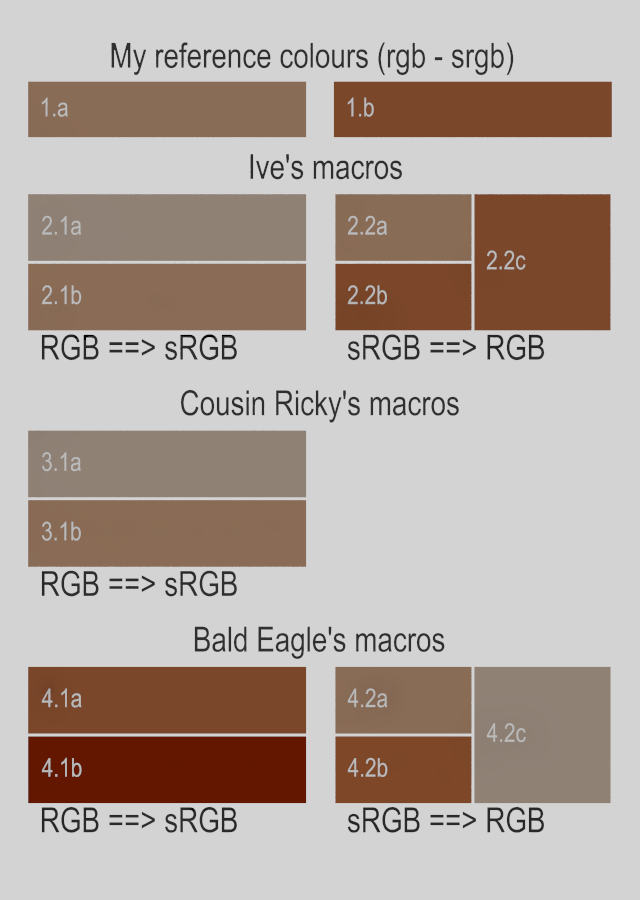
Back in 2014, and following some discussion it appears, I composed this
test scene, without really understanding the matter. What is wrong?

--
Thomas
Post a reply to this message
Attachments:
Download 'utf-8' (6 KB)
|
|
| |
| |
|
|
|
|
| |
| |
|
|
Am 10/30/2020 um 9:15 schrieb Thomas de Groot:
> Let me stick out my neck once again. ;-)
>
> Back in 2014, and following some discussion it appears, I composed this
> test scene, without really understanding the matter. What is wrong?
>

I didn't run it as I do not have Ricky's include file anyway but from
looking at it there is nothing wrong

The first box under "Ive's macros" should be brighter and less saturated
and the second one should be the same as your 1st reference color.
If this is not what you expect you might want to check your expectations
But in case you want *my* boxes to look the same as *your* reference
boxes you should obviously also use "MyColor" for the first box and
sRGB_to_scRGB(MyColor) for the second one as this does exactly the same
as the POV-Ray keyword srgb.

-Ive
Post a reply to this message
|
|
| |
| |
|
|
|
|
| |
| |
|
|
Ive <ive### [at] lilysoftorg> wrote:
>
> I didn't run it as I do not have Ricky's include file anyway but from
> looking at it there is nothing wrong

https://news.povray.org/%3C5513104c%241%40news.povray.org%3E
Post a reply to this message
|
|
| |
| |
|
|
|
|
| |
| |
|
|
Ive <ive### [at] lilysoftorg> wrote:
> Am 10/28/2020 um 12:05 schrieb Bald Eagle:
> >
> > But let's say someone borrows a nice texture that has srgb keywords
> > sprinkled throughout its declaration.  The color that pigment color values
> > that get "exposed" to the other elements in the scene are still just - rgb,
> > correct?
> >
> Absolutely...[snip]
> As long one is aware that rgb has to be followed by an linear color
> expression everything is fine while on the other hand an expression like
> rgb <220, 32, 80>/255 together with assumed_gammma 1.0 cries out to
> produce an unwanted result.

Sorry, I was just re-reading the posts here. Did you mean to say
    srgb <220, 32, 80>/255  there?

I assume from what's been said that  rgb <220, 32, 80>/255 is the same as
rgb <0.8627,0.1255,0.3137> -- simple division in 'linear' rgb space.

Whereas SRGB <220, 32, 80>/255 would be the one that "cries out to produce an
unwanted result".

Correct?

(or perhaps I was reading your comment somewhat out-of-context, and that you did
mean  rgb <220, 32, 80>/255 as *turned into*  SRGB <220, 32, 80>/255, with the
warning.)

Just wanted to make sure :-)
Post a reply to this message
|
|
| |
| |
|
|
From: Thomas de Groot
Subject: Re: Stock colors and assumed_gamma 1 in POV-Ray 3.6
Date: 31 Oct 2020 03:40:40
Message: <5f9d14f8$1@news.povray.org>
|
|
|
| |
| |
|
|
Op 30/10/2020 om 10:25 schreef Ive:
> Am 10/30/2020 um 9:15 schrieb Thomas de Groot:
>> Let me stick out my neck once again. ;-)
>>
>> Back in 2014, and following some discussion it appears, I composed
>> this test scene, without really understanding the matter. What is wrong?
>>
>
> I didn't run it as I do not have Ricky's include file anyway but from
> looking at it there is nothing wrong
>
> The first box under "Ive's macros" should be brighter and less saturated
> and the second one should be the same as your 1st reference color.
> If this is not what you expect you might want to check your expectations
> But in case you want *my* boxes to look the same as *your* reference
> boxes you should obviously also use "MyColor" for the first box and
> sRGB_to_scRGB(MyColor) for the second one as this does exactly the same
> as the POV-Ray keyword srgb.
>

Thanks, yes, I get it. There were a couple of things terribly wrong with
my assumptions at the time. I need to review this again.

--
Thomas
Post a reply to this message
|
|
| |
| |
|
|
|
|
| |
| |
|
|
Am 10/31/2020 um 8:40 schrieb Thomas de Groot:
>>
>> The first box under "Ive's macros" should be brighter and less
>> saturated and the second one should be the same as your 1st reference
>> color.
>> If this is not what you expect you might want to check your expectations
>> But in case you want *my* boxes to look the same as *your* reference
>> boxes you should obviously also use "MyColor" for the first box and
>> sRGB_to_scRGB(MyColor) for the second one as this does exactly the
>> same as the POV-Ray keyword srgb.
>>
>
> Thanks, yes, I get it. There were a couple of things terribly wrong with
> my assumptions at the time. I need to review this again.
>

Oh, just out of curiosity, do you remember where "Ive's macros" are
from? At the time I wrote CIE.inc and added a few other function to
lightsys I did definitely prefer this xyz_2_xyz style. And I think scRGB
wasn't even defined at this time.

-Ive
Post a reply to this message
|
|
| |
| |
|
|
|
|
| |
| |
|
|
Am 10/30/2020 um 23:29 schrieb Kenneth:
> Ive <ive### [at] lilysoftorg> wrote:
>>>
>> As long one is aware that rgb has to be followed by an linear color
>> expression everything is fine while on the other hand an expression like
>> rgb <220, 32, 80>/255 together with assumed_gammma 1.0 cries out to
>> produce an unwanted result.
>
> Sorry, I was just re-reading the posts here. Did you mean to say
>      srgb <220, 32, 80>/255  there?
>
> I assume from what's been said that  rgb <220, 32, 80>/255 is the same as
> rgb <0.8627,0.1255,0.3137> -- simple division in 'linear' rgb space.
>
> Whereas SRGB <220, 32, 80>/255 would be the one that "cries out to produce an
> unwanted result".
>
> Correct?
>

Err, no!
My point is when somebody uses byte values to express a color he usually
got them from a color picker, from the Windows build in color selector,
from an image processing program or somehow directly from an image file.
In all cases these byte values are gamma encoded.
And even he didn't use any of theses apps I'm sure he *thinks* in an
gamma encoded space as otherwise there is no reason to use byte values
instead of floating points.
Therefor  srgb <220, 32, 80>/255  is what he actually wants.
And yes, in this case, the the division by 255 is valid (even when it is
within an non-linear space) because it is NOT a brightness adjustment
(causing hue shifts) but simply converts the byte values to floating
point making them fit into the 0.0 to 1.0 range.

-Ive
Post a reply to this message
|
|
| |
| |
|
|
From: Thomas de Groot
Subject: Re: Stock colors and assumed_gamma 1 in POV-Ray 3.6
Date: 31 Oct 2020 12:41:34
Message: <5f9d93be$1@news.povray.org>
|
|
|
| |
| |
|
|
Op 31/10/2020 om 11:52 schreef Ive:
>
> Oh, just out of curiosity, do you remember where "Ive's macros" are
> from? At the time I wrote CIE.inc and added a few other function to
> lightsys I did definitely prefer this xyz_2_xyz style. And I think scRGB
> wasn't even defined at this time.
>

I am not sure. I wrote this scene in 2014 but I don't remember where I
got the functions from. It must have been from a discussion at the time
in these n.g's - I browsed around but I am unable to find a probable
source; mention is made several times of CIE, so I wonder if I did not
get it from there. Sorry.

--
Thomas
Post a reply to this message
|
|
| |
| |
|
|
From: Thomas de Groot
Subject: Re: Stock colors and assumed_gamma 1 in POV-Ray 3.6
Date: 5 Nov 2020 03:04:33
Message: <5fa3b211$1@news.povray.org>
|
|
|
| |
| |
|
|
Op 31/10/2020 om 11:52 schreef Ive:
> Oh, just out of curiosity, do you remember where "Ive's macros" are
> from? At the time I wrote CIE.inc and added a few other function to
> lightsys I did definitely prefer this xyz_2_xyz style. And I think scRGB
> wasn't even defined at this time.
>

Maybe from an "earlier" version of CIE? and/or Lightsys? That seems the
most logical to me.

In the mean time I reviewed my scene code and added the latest Bald
Eagle macros to the collection (see image and scene file attached). I
added all the macros to the scene file. This is what it represents:

(1a) my reference color in linear color space;
(1b) my reference color in standard color space;

(2.1a) Ive's: conversion rgb->srgb of (1a);
(2.1b) idem but with Clipka's saturation/brightness boost added;
(2.2a) Ive's: conversion back srgb->rgb;
(2.2b) idem from the boosted color;
(2.2c) idem but using (1b);

(3.1a) Cousin Ricky's: conversion rgb->srgb of (1a);
(3.1b) idem but with Clipka's saturation/brightness boost added;

(4.1a) Bald Eagle's: conversion rgb->srgb of (1a);
(4.1b) idem but with Clipka's saturation/brightness boost added;
(4.2a) Bald Eagle's: conversion back srgb->rgb;
(4.2b) idem from the boosted color;
(4.2c) idem but using (1b).

These are macros applied indiscriminately. It seems immediately obvious
that Bald Eagle's macros do not need the saturation/brightness boost,
except probably where 4.2c is concerned.

I leave it to the experts to judge if this little exercise (which I
enjoyed doing btw) is of any real use. ;-)

--
Thomas
Post a reply to this message
Attachments:
Download 'srgb_test.png' (84 KB)
Download 'utf-8' (15 KB)
Preview of image 'srgb_test.png'
|
|
| |
| |
|
|
|
|
| |
| |
|
|
Thomas de Groot <tho### [at] degrootorg> wrote:

>
> In the mean time I reviewed my scene code and added the latest Bald
> Eagle macros to the collection (see image and scene file attached). I
> added all the macros to the scene file. This is what it represents:
>

Thanks for making this all-inclusive demonstration scene, and for posting the
code. Now I need to 'digest' all of the various color-conversion methods and
pitfalls, as well as all of the message posts here.

I am still working on my own demo scene ;-)  It will be a different way of
visualizing the color conversions-- to include rgb-vs-srgb colors in lights as
well.
Post a reply to this message
|
|
| |
| |
|
|
|
|
| |
|
|