|
|
|
|
|
|
| |
| |
|
|
|
|
| |
| |
|
|
Most of my media experience is with emitting media. In an attempt to
better understand scattering media I spent some time looking at our
abyss.pov sample scene. I knew it to have some significant media shadow
artifacts due the media settings. Namely multiple intervals of 3 and
default sampling 3 and recursion 3. Turned out to be a way to look at
assumed_gamma settings and the +ag anti-alias control with respect to
highlights too.

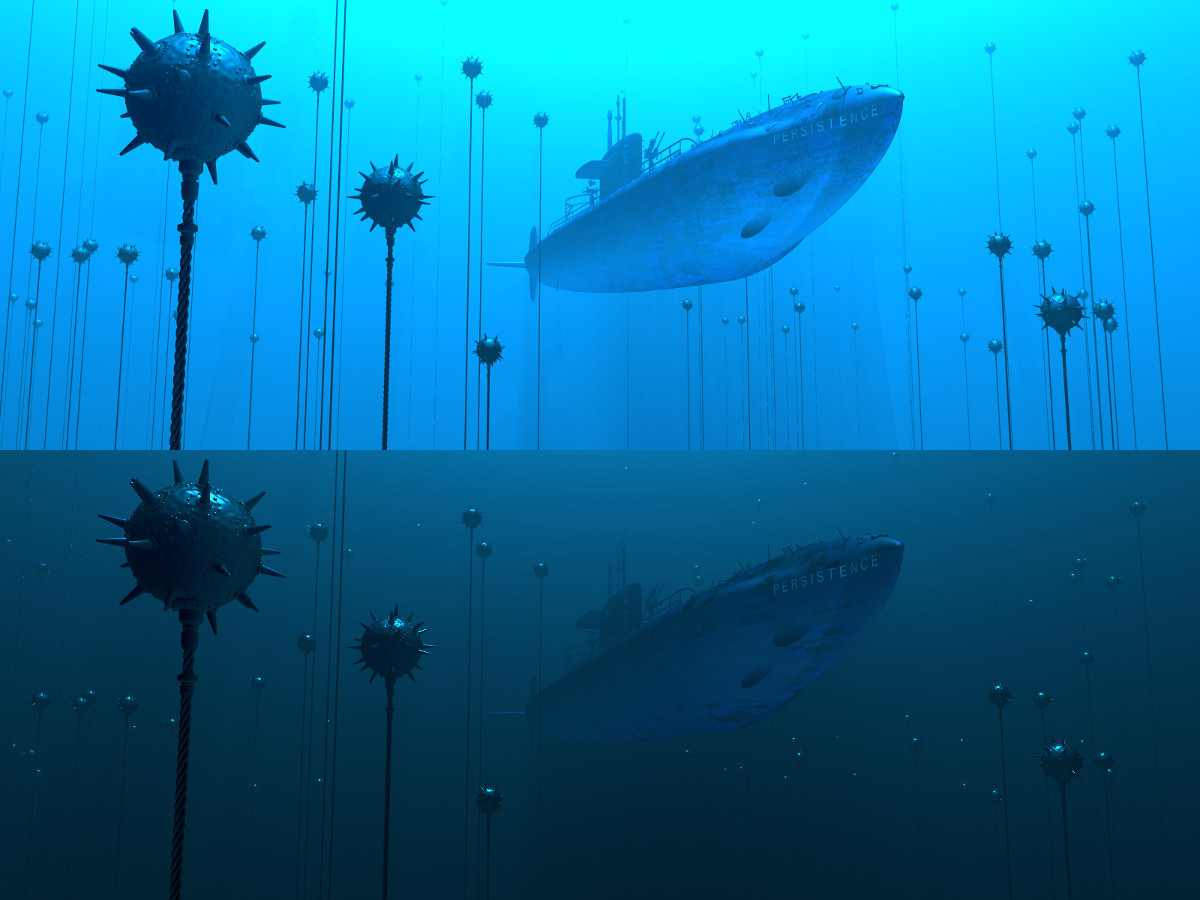
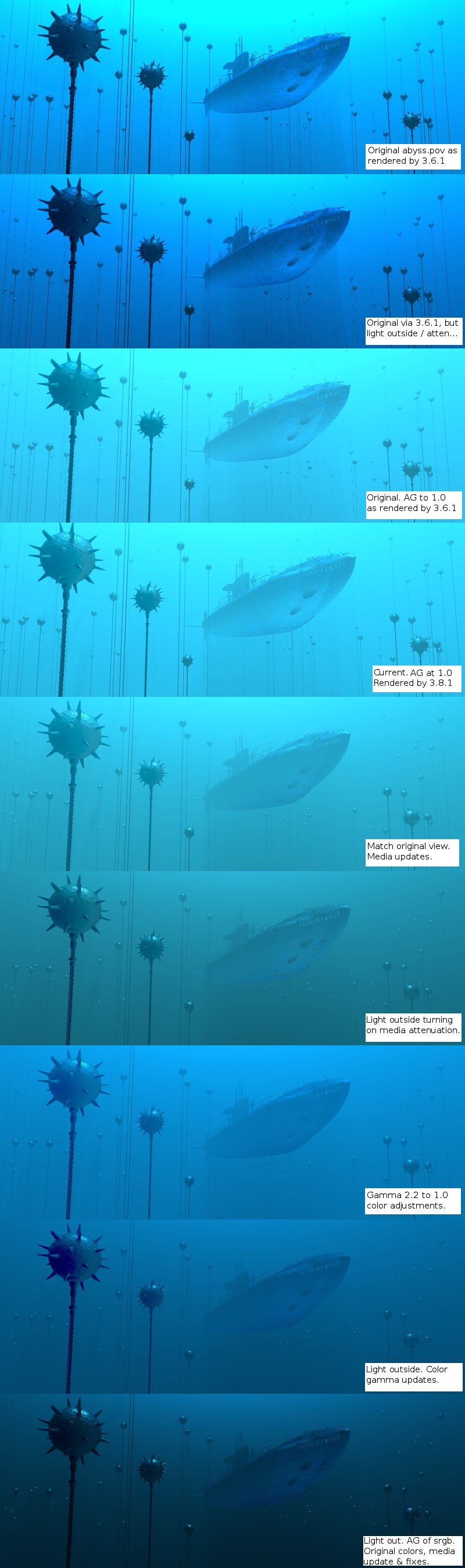
Attached are two images. One is a study comprising 9 images:

1) The original 3.6 abyss.pov as rendered by 3.6.1.
2) (1) but modifying the media container so the light is outside.
3) (1) but changing the assumed_gamma to 1.0. You can get (3) to (1)
easily in external software like gimp by applying a 1/2.2 gamma
correction - except for tiny highlights and AA differences.
4) Is our current 3.7+ scene very like (3) except the camera view changed.
5) Some media corrections and camera view restored base upon (4).
6) (5) but modifying the media container so the light is outside.
7) (5) but gamma adjusting colors for assumed_gamma 1.0.
8) (7) but modifying the media container so the light is outside.
9) For artistic reasons using assumed_gamma srgb +ag4.4 for highlights / AA.

The other image is just comparing (1) to (9) at a larger resolution. I
was thinking about submitting (9) on github as a replacement for our
current abyss.pov sample scene, but I'm unsure? Probably posting my
annotations here is enough for folks to find them on a search.

I expect Gilles knew the path he took to his artistic result. While my
result (9) might better fit scattering media to the scene geometry in a
way avoiding artifacts - it changes the look substantially.

Anyway, adding the very top of bottom of my current updated and
annotated abyss.pov. I'd appreciate any review and especially
corrections to my now somewhat improved understanding of scattering
media behavior and +ag feature use.

Bill P.


Corrections not shown:
- Camera view restored to Gilles original. Added aspect warning check.
- Position of 'Persistence' text correct as top previously clipped.
- Rounded isosurface max gradients up as with some AA / media settings
the current scene tripped max gradient warnings.

// Persistence Of Vision raytracer sample file.
//============================================
// The field, new improved version  October. 2001
// Copyright Gilles Tran 2001
// http://www.oyonale.com
// Simplified version of scene updated and annotated
// for v3.8. Feb 10, 2018.
//--------------------------------------------
// Render with a 2.67 ratio such as 320*120, 640*240,
// 1024*384, 1280*480
//--------------------------------------------
// -w320 -h120
// -w640 -h240 +a0.1
// -w768 -h288 +a0.1
// -w1024 -h384 +a0.1
//
//
// Note. For high quality result suggest adjusted media settings in
// comments at bottom of this file. Also aggressive adaptive
// anti-aliasing with dithering to avoid banding in the output
// image:
//     +a0.1 +am2 +r4 +thfs
//
// Note. Uncomment AreaOK=true below to turn on the area light. This
// will blur the shadow under the submarine but the rendering time
// will be extremely slow. The area light also compensates to some
// degree for any media under-sampling being itself a kind of
// additional sampling.
//
// Note. An 'assumed_gamma srgb' is being used for an artistic final
// result. With media especially, scene development is less
// confusing if done at the usual assumed_gamma of 1.0. At 1,
// densities and adjustments are more aligned with the visual
// result. For assumed_gamma other than 1.0 the visual result is
// distorted relative to the actual media densities and colors.
//
// Note. The srgb assumed_gamma essentially adds a second
// pow(color,2.2) adjustment from the internal color values on top
// of the usual one for the output file and display. POV-Ray's
// internal anti-aliasing works with a default 2.5 gamma in line
// with the usual srgb output. To handle colors - and highlights
// especially - in a manner aligned to the srgb color working space
// use +ag4.4 or similar. It's costly run time wise with deep
// adaptive anti-aliasing.

#version 3.8;

global_settings{ assumed_gamma srgb }

... (bulk of scene omitted some reformatting for posting) ...

//--------------------------------------------
// submarine and media
//--------------------------------------------
union{
   object{Submarine scale 3/4 translate z*-10 translate y*10}

//Original media container was sphere{0,1...
//In the update for the v3.8 release now using a difference so the
//light interacting with the media is outside the container.
//Perhaps intentional, perhaps not, but since v3.5 it has been the
//case with shape contained media the light being outside turns on
//media_attenuation and when inside media_attenuation is off no
//matter the setting on the light itself. When attenuation is off
//this image appears washed out.

   difference {
     // x,z scale by 2 eliminates shadow artifacts at rear of
     // media container.
     sphere{0,1 scale <2,1,2>}
     sphere{<0,1,0>,1/1.5}
     texture{pigment{Clear}}
     scale 410 hollow
     interior{
      media{
           //   Note. Tweaked media over original to not depend on
           //   weak sampling and artifacts for result.
              scattering {5,0.00133 eccentricity 0.90 extinction 1.0}
           //   Note. Original took mostly green out of the
           //   scattered light result by absorption.
           // absorption <255-23,255-171,255-239>*0.0005/255
           // intervals 1
           // method 3
           //   Note. Samples should be chosen with the media range
           //   and the size of the shapes casting shadows in mind.
           //   The old scene samples 9 equivalent worked for the sub
           //   itself, though with significant shadow artifacts, due
           //   the camera to inside media container distance being
           //   about 2000 and the sub length being maybe 700 as
           //   rotated. 2000/700 ~= 3.
           //
           //   Camera to far extent range for updated container ~=
           //   6225. Min rectangular sub extent about 130. 6225 / 130
           //   ~= 48.225. Picked 67 to allow for sub shape.
           // samples 67
           //   Note. Use the settings below for high quality renders.
           //   Need to be aggressive with adaptive sampling to
           //   minimize banding in result. A higher samples setting
           //   necessary to better resolve shadows given dimensions.
           //
           //   Min rectangular mine body extent about 13. 6225 / 13
           //   ~= 480. Picked 667 to allow for round mine body.
           // samples 667
           // aa_level 9
           // aa_threshold 0.05
      }
     }
   }

   scale 4.0
   rotate y*rotSub  translate posSub
Post a reply to this message
Attachments:
Download 'abyssbeforeafter.jpg' (172 KB)
Download 'abyssmediastudy.jpg' (222 KB)
Preview of image 'abyssbeforeafter.jpg'
Preview of image 'abyssmediastudy.jpg'
|
|
| |
| |
|
|
|
|
| |
| |
|
|
That's a fascinating series of tests and code-fix changes you've come up with.
When I used to run the 'abyss.pov' file in v3.6.2 days, I too noticed that it
didn't look 'correct', in some hard-to-grasp way. (Not that the scene itself is
the problem; it's a beauty, regardless of any undelying problems or
media-interaction strangness.) At the time, I attempted to finesse some of the
scene values, but was never happy with my own results.

Over and above your technical/artistic fixes, I'm wondering which render version
Gilles himself would prefer-- the original, or your nicely murky and darker
final render. Of course, he made the scene based on the behavior of POV-Ray at
the time-- warts and all. ;-) But I wonder if an older render represents the
'look' he wanted to achieve-- OR, if that look was based on limitations that he
couldn't work around.

In any case, thanks for taking to time to delve into that complex scene--
especially regarding light/media interaction-- and for coming up with the
proposed fixes. That scene is a real showcase for POV-Ray.
Post a reply to this message
|
|
| |
| |
|
|
|
|
| |
| |
|
|
In your "abyss media study" image, I'm curious about 1) vs. 3).

When Gilles originally wrote the scene in v3.6.x (and posted an image, I
assume), was he rendering it with assumed_gamma 1.0 then, or 2.2? (Those years
were unclear times as far as gamma was concerned!)  Your 1) image *appears* to
show a gamma 2.2, yet the scene file itself (in my original 3.7.0 download)
shows it as 1.0. If he did run it at 1.0, it would match you image 3) rather
than 1)-- unless there was something really wonky about v3.6.x ! I'm wondering
if his scene file may have gotten updated from 2.2 to 1.0 at some time in the
past?
Post a reply to this message
|
|
| |
| |
|
|
|
|
| |
| |
|
|
On 02/21/2018 06:47 AM, Kenneth wrote:
> In your "abyss media study" image, I'm curious about 1) vs. 3).
>
> When Gilles originally wrote the scene in v3.6.x (and posted an image, I
> assume), was he rendering it with assumed_gamma 1.0 then, or 2.2? (Those years
> were unclear times as far as gamma was concerned!) Your 1) image *appears* to
> show a gamma 2.2, yet the scene file itself (in my original 3.7.0 download)
> shows it as 1.0. If he did run it at 1.0, it would match you image 3) rather
> than 1)-- unless there was something really wonky about v3.6.x ! I'm wondering
> if his scene file may have gotten updated from 2.2 to 1.0 at some time in the
> past?
>
>
I have copies of POV-Ray source and distributions going back in time. I
have run-able POV-Ray versions back to v3.5 something (c ?).
What I did for the three v3.6.1 renders was use a version of the scene I
pulled from my copy of v3.6.1 rendering those with a corresponding
v3.6.1 compile. That version of the scene specified no gamma at all
meaning it ran at an assumed_gamma of 2.2.
v3.6.1 supports assumed_gamma 1.0, but the abyss scene (Gilles called
his 2001 version "The Field") is older - with a history going back into
the 1990s. Gilles created the abyss.pov version of "The Field"
especially for distribution with POV-Ray and I first see it in my older
code bases at v3.5.
See too: http://www.oyonale.com/3D.php?lang=en§ion=2001
(Oddly, a couple of the links off the abyss/The Field image page there
are not working for me today and they did a couple weeks back...)
Anyway, the scene was indeed modified by the time it was shipped with
v3.7.0 moving to 'assumed_gamma 1.0' and a changed camera definition -
and by side effect, I'd guess, a changed camera view - but nothing else.
Bill P.
Post a reply to this message
|
|
| |
| |
|
|
|
|
| |
| |
|
|
William F Pokorny <ano### [at] anonymous org> wrote:
>
> What I did for the three v3.6.1 renders was use a version of the scene I
> pulled from my copy of v3.6.1 rendering those with a corresponding
> v3.6.1 compile. That version of the scene specified no gamma at all
> meaning it ran at an assumed_gamma of 2.2.
>
No assumed_gamma at all, wow. (That was before my time-- ha-- as I started using
POV-Ray at v3.6.1, IIRC.)
So what Gilles himself saw when he created the scene was like you image 1). Got
it.
Funny thing: If *I* had created this scene (not likely!), I think I would have
chosen the more greenish color 'tint' of image 5)-- coupled with your nice fixes
in 9) of course. I just happen to like the mysterious more-green-than-blue look,
personal preference. org> wrote:
>
> What I did for the three v3.6.1 renders was use a version of the scene I
> pulled from my copy of v3.6.1 rendering those with a corresponding
> v3.6.1 compile. That version of the scene specified no gamma at all
> meaning it ran at an assumed_gamma of 2.2.
>
No assumed_gamma at all, wow. (That was before my time-- ha-- as I started using
POV-Ray at v3.6.1, IIRC.)
So what Gilles himself saw when he created the scene was like you image 1). Got
it.
Funny thing: If *I* had created this scene (not likely!), I think I would have
chosen the more greenish color 'tint' of image 5)-- coupled with your nice fixes
in 9) of course. I just happen to like the mysterious more-green-than-blue look,
personal preference.
Post a reply to this message
|
|
| |
| |
|
|
|
|
| |
| |
|
|
Am 21.02.2018 um 14:36 schrieb Kenneth:

> So what Gilles himself saw when he created the scene was like you image 1). Got
> it.

Actually, I guess nobody except Gilles knows for sure what he himself
saw. Unless he happened to be using a calibrated display.
Post a reply to this message
|
|
| |
| |
|
|
|
|
| |
| |
|
|
clipka <ano### [at] anonymousorg> wrote:

> Actually, I guess nobody except Gilles knows for sure what he himself
> saw. Unless he happened to be using a calibrated display.


Others preferred a blueish tint too - like in Pixar's "Finding Nemo"
(https://clementsnahs.files.wordpress.com/2015/08/mines4.jpg).

Hopefully Gilles T. got paid for it.


Norbert
Post a reply to this message
|
|
| |
| |
|
|
|
|
| |
| |
|
|
"Norbert Kern" <nor### [at] t-onlinede> wrote:
>
> Others preferred a blueish tint too - like in Pixar's "Finding Nemo"
> (https://clementsnahs.files.wordpress.com/2015/08/mines4.jpg).
>

Ha! So they do.

My humble opinion about *that*: A blue tint is fun and upbeat and not scary--
good for kiddies. A murky green tint is mysterious and foreboding-- like scary
submarine warfare.

;-P
Post a reply to this message
|
|
| |
| |
|
|
|
|
| |
| |
|
|
Am 22.02.2018 um 14:53 schrieb Kenneth:
> "Norbert Kern" <nor### [at] t-onlinede> wrote:
>>
>> Others preferred a blueish tint too - like in Pixar's "Finding Nemo"
>> (https://clementsnahs.files.wordpress.com/2015/08/mines4.jpg).
>>
>
> Ha! So they do.
>
> My humble opinion about *that*: A blue tint is fun and upbeat and not scary--
> good for kiddies. A murky green tint is mysterious and foreboding-- like scary
> submarine warfare.

https://youtu.be/mpsFaLH5BRc
Post a reply to this message
|
|
| |
| |
|
|
|
|
| |
| |
|
|
clipka <ano### [at] anonymousorg> wrote:


>
> https://youtu.be/mpsFaLH5BRc

One of my favorite films, especially the extended "director's cut".
Post a reply to this message
|
|
| |
| |
|
|
|
|
| |
| |
|
|
Am 23.02.2018 um 20:26 schrieb Kenneth:
> clipka <ano### [at] anonymousorg> wrote:
>
>
>>
>> https://youtu.be/mpsFaLH5BRc
>
> One of my favorite films, especially the extended "director's cut".

I see your 208 minutes director's cut and raise you the 309 minutes TV
miniseries.
Post a reply to this message
|
|
| |
| |
|
|
|
|
| |
| |
|
|
clipka <ano### [at] anonymousorg> wrote:
> Am 22.02.2018 um 14:53 schrieb Kenneth:
> > "Norbert Kern" <nor### [at] t-onlinede> wrote:
> >>
> >> Others preferred a blueish tint too - like in Pixar's "Finding Nemo"
> >> (https://clementsnahs.files.wordpress.com/2015/08/mines4.jpg).
> >>
> >
> > Ha! So they do.
> >
> > My humble opinion about *that*: A blue tint is fun and upbeat and not scary--
> > good for kiddies. A murky green tint is mysterious and foreboding-- like scary
> > submarine warfare.
>
> https://youtu.be/mpsFaLH5BRc
I can remember, when I first read the book, written by Lothar Buchheim - it was
around 1980. The letters showed the green blue tint of Gilles image iirc.
By the way, the very first version of Gilles image was held in a dark blue green
tone...
(http://www.oyonale.com/image.php?code=136&mode=info§ion=1993&lang=en).
Norbert
Post a reply to this message
|
|
| |
| |
|
|
|
|
| |
| |
|
|
clipka <ano### [at] anonymousorg> wrote:

>
> I see your 208 minutes director's cut and raise you the 309 minutes TV
> miniseries.

A miniseries?! I didn't know. On German/European television, I assume?

So was it the same 208 minute movie with 101 minutes of commercials? :-P That's
probably what would happen here in the States, and it would then be advertised
as 'a miniseries', ha.
Post a reply to this message
|
|
| |
| |
|
|
|
|
| |
| |
|
|
William F Pokorny <ano### [at] anonymousorg> wrote:
>
> See too: http://www.oyonale.com/3D.php?lang=en§ion=2001
[and http://www.oyonale.com/image.php?code=135&mode=info§ion=2001&lang=en]
>
> (Oddly, a couple of the links off the abyss/The Field image page there
> are not working for me today and they did a couple weeks back...)
>
Thanks for posting this; I hadn't seen that series of image examples. The
various stages in the scene's development are fascinating. Yes, it's too bad
that some of the links to his even earlier experiments are broken. I'd love to
see his very first scene trial.
Post a reply to this message
|
|
| |
| |
|
|
|
|
| |
| |
|
|
Am 24.02.2018 um 21:20 schrieb Kenneth:
> clipka <ano### [at] anonymousorg> wrote:
>
>>
>> I see your 208 minutes director's cut and raise you the 309 minutes TV
>> miniseries.
>
> A miniseries?! I didn't know. On German/European television, I assume?

Curiously enough, the miniseries aired on BBC (with English subtitles)
even before hitting German TV.

> So was it the same 208 minute movie with 101 minutes of commercials? :-P That's
> probably what would happen here in the States, and it would then be advertised
> as 'a miniseries', ha.

Nope - 101 additional minutes of genuine content. Back in those days, we
didn't have any commercial breaks during TV shows anyway, and IIRC the
miniseries was first broadcast on the regional channels, which didn't
even have commercials between shows.

"Das Boot" had been partly funded by two of the German regional radio/TV
institutions, WDR and SDR, and from all I know production had been
geared toward two versions right from the start - the comparatively
short action-heavy cineastic version, and the elaborate 5-hour TV
miniseries attempting to capture the entire U-Boat experience.

I /think/ I heard tell that they even used a dual camera setup, one
camera for the TV shots and one for the cineastic shots. But I might be
confusing that with some other TV/cinema dual production.
Post a reply to this message
|
|
| |
| |
|
|
|
|
| |
| |
|
|
On 18-2-2018 17:01, William F Pokorny wrote:
> Most of my media experience is with emitting media. In an attempt to
> better understand scattering media I spent some time looking at our
> abyss.pov sample scene. I knew it to have some significant media shadow
> artifacts due the media settings. Namely multiple intervals of 3 and
> default sampling 3 and recursion 3. Turned out to be a way to look at
> assumed_gamma settings and the +ag anti-alias control with respect to
> highlights too.
>

After watching again the movie "Das Boot", I remembered your study and
downloaded/rendered your's/Gille's scene. I am getting the shivers all
over again...

Very well done by the way!

--
Thomas
Post a reply to this message
|
|
| |
| |
|
|
|
|
| |
| |
|
|
Thomas de Groot <tho### [at] degrootorg> wrote:
> On 18-2-2018 17:01, William F Pokorny wrote:
> > Most of my media experience is with emitting media. In an attempt to
> > better understand scattering media I spent some time looking at our
> > abyss.pov sample scene.
>
> After watching again the movie "Das Boot", I remembered your study and
> downloaded/rendered your's/Gille's scene. I am getting the shivers all
> over again...
>
> Very well done by the way!

No doubt. I might have missed seeing this before.

The abyss.pov is a great scene to play with. I was trying changes to it July
2017 according to my render dates. I remember looking for underwater whale
pictures to see examples from reality. They were mostly bluish in color, from
lighter to darker... and very clear to my surprise! But I liked the green murky
water idea too, at first. My last render of it was with the blue color instead.
All done using P-R 3.7, which was another reason, to update the scene file.

I was also changing the mines to be of equal scale after realizing Gilles had
used artistic liberty to size and position those for the look he wanted, so I
never got around to remaking the nearby mines to be prominent in the picture.
And I wanted to get a water surface and seabed included, not completely
successful there.

Found a sunken ship photo at http://njscuba.net/z-gear/photo_s03190026.jpg
Maybe a good comparison to the blue abyss renders, except for haze/blur. Unlike
the whale photos you can find on the 'net that are incredibly clear.
I can't decide which way I prefer, although after seeing the photographs being
so blue that does have its merits. Maybe more menacing that way, with the idea
of the sub *clearing* those mines thus far.

Anyway... always loved Gilles artwork. Can't beat that.
Post a reply to this message
Attachments:
Download 'redo_abyss-compare-color.jpg' (59 KB)
Preview of image 'redo_abyss-compare-color.jpg'

|
|
| |
| |
|
|
|
|
| |
| |
|
|
On 13-11-2018 11:49, omniverse wrote:
> Thomas de Groot <tho### [at] degrootorg> wrote:
>> On 18-2-2018 17:01, William F Pokorny wrote:
>>> Most of my media experience is with emitting media. In an attempt to
>>> better understand scattering media I spent some time looking at our
>>> abyss.pov sample scene.
>>
>> After watching again the movie "Das Boot", I remembered your study and
>> downloaded/rendered your's/Gille's scene. I am getting the shivers all
>> over again...
>>
>> Very well done by the way!
>
> No doubt. I might have missed seeing this before.
>
> The abyss.pov is a great scene to play with. I was trying changes to it July
> 2017 according to my render dates. I remember looking for underwater whale
> pictures to see examples from reality. They were mostly bluish in color, from
> lighter to darker... and very clear to my surprise! But I liked the green murky
> water idea too, at first. My last render of it was with the blue color instead.
> All done using P-R 3.7, which was another reason, to update the scene file.
>
> I was also changing the mines to be of equal scale after realizing Gilles had
> used artistic liberty to size and position those for the look he wanted, so I
> never got around to remaking the nearby mines to be prominent in the picture.
> And I wanted to get a water surface and seabed included, not completely
> successful there.
>
> Found a sunken ship photo at http://njscuba.net/z-gear/photo_s03190026.jpg
> Maybe a good comparison to the blue abyss renders, except for haze/blur. Unlike
> the whale photos you can find on the 'net that are incredibly clear.
> I can't decide which way I prefer, although after seeing the photographs being
> so blue that does have its merits. Maybe more menacing that way, with the idea
> of the sub *clearing* those mines thus far.
>
> Anyway... always loved Gilles artwork. Can't beat that.
>

I fully agree with you. Those whale pictures might be taken in very
clear ocean waters: Pacific, Arctic/Antarctic. Other seas/oceans are
more murky, like the North Sea. In Das Boot, the (Atlantic) Ocean is
shown more like in Gille's scene.

--
Thomas
Post a reply to this message
|
|
| |
| |
|
|
|
|
| |
| |
|
|
Thomas de Groot <tho### [at] degrootorg> wrote:
> On 13-11-2018 11:49, omniverse wrote:
> > The abyss.pov is a great scene to play with. I was trying changes to it July
> > 2017 according to my render dates. I remember looking for underwater whale
> > pictures to see examples from reality. They were mostly bluish in color, from
> > lighter to darker... and very clear to my surprise! But I liked the green murky
> > water idea too, at first. My last render of it was with the blue color instead.
> >
>
> I fully agree with you. Those whale pictures might be taken in very
> clear ocean waters: Pacific, Arctic/Antarctic. Other seas/oceans are
> more murky, like the North Sea. In Das Boot, the (Atlantic) Ocean is
> shown more like in Gille's scene.
>
> --
> Thomas

Good point.
After looking at more info about some submarine depths (typically about 200
meters or 600 feet) and light transmission in oceans, the green color makes the
most sense if the location is near shore or shallow waters. Which is probably
where a mine field would be anyhow.
Funny that when I was younger I thought those submarine movies were usually
taking place near deep ocean bottoms, maybe 1000's of feet below the surface...
unless they were going up to use their periscope.

Was a while back when I saw a rerun of the very old TV show Sea Hunt and they
mentioned color change due to depth. Something about 'yellow becomes gray'.
Red end of the spectrum looses its colors, leaving green to blue, and going
deeper only blue is left.
Something about this was discussed many years ago about water renders in POV-Ray
and the blue color and depth, but I didn't remember that. What I said above is
from another look info found on the 'net. I'm not a diver.
;)

Bob
Post a reply to this message
|
|
| |
| |
|
|
|
|
| |
| |
|
|
On 11/13/18 3:56 AM, Thomas de Groot wrote:
> On 18-2-2018 17:01, William F Pokorny wrote:
...
>
> After watching again the movie "Das Boot", I remembered your study and
> downloaded/rendered your's/Gille's scene. I am getting the shivers all
> over again...
>
> Very well done by the way!
>
Thanks!

Your post reminds me I said I'd look at new explicit bounded media
attenuation control in a scene's SDL. I tried, but I don't think I
followed up in that thread with details on my failures...

Bill P.
Post a reply to this message
|
|
| |
| |
|
|
|
|
| |