|
|
|
|
|
|
| |
| |
|
|
|
|
| |
| |
|
|
The colors of stars are recorded as scalar magnitude differences, called
color indexes.  Theoretically, the color of a star can be reconstructed
from a color index by correlating the value to a temperature, then
calculating the black body color.

The second step is easy, as it's already been done in a popular POV-Ray
suite.  :-)  But the first step requires astronomical research.  A few
years ago, I found a curve fit by Cameron Reed of Alma College.
Yesterday, while trying to distract myself from the realization that
almost half my fellow citizens hate my guts, I chanced upon another
formula, by F. J. Ballesteros of Universitat de València.

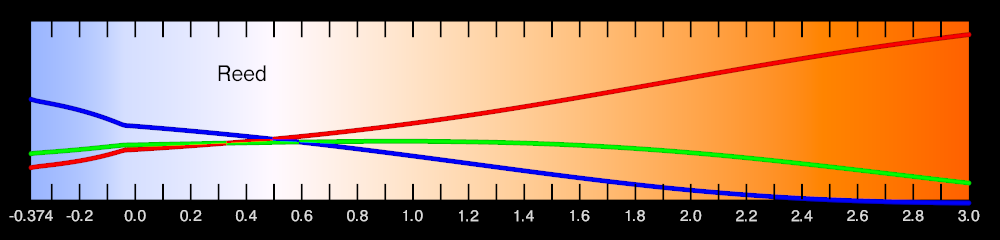
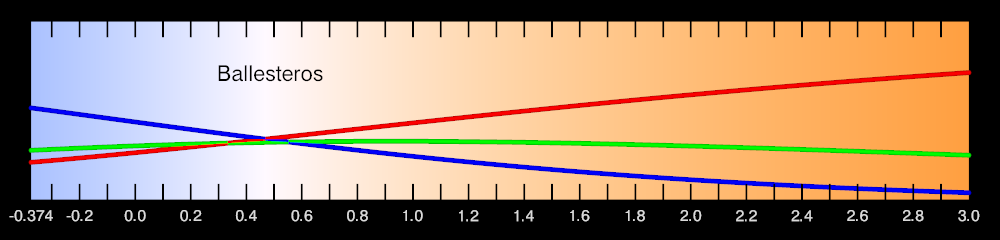
I created a color map derived from each of the formulas.  (The curves
show the sRGB compositions of the derived colors.)  The resulting images
are quite different.  It looks like I'll have to look up a few actual
stars and see which one of these curves matches the stellar data more
closely.
Post a reply to this message
Attachments:
Download 'blackbody_b-v1.png' (37 KB)
Download 'blackbody_b-v2.png' (35 KB)
Preview of image 'blackbody_b-v1.png'
Preview of image 'blackbody_b-v2.png'
|
|
| |
| |
|
|
From: Christian Froeschlin
Subject: Re: Stellar colors: someone is wrong
Date: 10 Nov 2016 19:27:35
Message: <58251077@news.povray.org>
|
|
|
| |
| |
|
|
On 10.11.2016 22:14, Cousin Ricky wrote:

> The colors of stars are recorded as scalar magnitude differences, called
> color indexes.  Theoretically, the color of a star can be reconstructed
> from a color index by correlating the value to a temperature, then
> calculating the black body color.

There is probably no one true answer since color index is based
on broad-band filters with calibration determined empirically. Stars
are not quite perfect blackbodies and observed B-V is not intrinsic B-V
due to extinction effects, so if you calibrate the observed B-V against
temperature / class these effects are likely included in the mapping.

For precise temperature determination a spectrum is better.
But B-V can be determined easily for thousands of stars at once, even
faint ones a thus yields large datasets for statistical analysis.

> Yesterday, while trying to distract myself from the realization that
> almost half my fellow citizens hate my guts

Sorry about that. So crazy.
Post a reply to this message
|
|
| |
| |
|
|
|
|
| |
| |
|
|
Christian Froeschlin <chr### [at] chrfr de> wrote:
> For precise temperature determination a spectrum is better.
> But B-V can be determined easily for thousands of stars at once, even
> faint ones a thus yields large datasets for statistical analysis.
If I had a spectrum, I could go directly to color; I wouldn't need temperature
as a proxy.
However, aside from full spectral data being less available, I'm not sure it
would get me better results for ray tracing purposes, as it would disregard the
interstellar extinction effects.
A direct spectrum would be best if I were doing a portrait of a single star. It
would also get me accurate colors for carbon stars, which, you might remember
from an earlier post, turned out hot pink when I used a B-V-to-temperature
correlation. de> wrote:
> For precise temperature determination a spectrum is better.
> But B-V can be determined easily for thousands of stars at once, even
> faint ones a thus yields large datasets for statistical analysis.
If I had a spectrum, I could go directly to color; I wouldn't need temperature
as a proxy.
However, aside from full spectral data being less available, I'm not sure it
would get me better results for ray tracing purposes, as it would disregard the
interstellar extinction effects.
A direct spectrum would be best if I were doing a portrait of a single star. It
would also get me accurate colors for carbon stars, which, you might remember
from an earlier post, turned out hot pink when I used a B-V-to-temperature
correlation.
Post a reply to this message
|
|
| |
| |
|
|
|
|
| |
| |
|
|
"Cousin Ricky" <rickysttATyahooDOTcom> wrote:
> However, aside from full spectral data being less available, I'm not sure it
> would get me better results for ray tracing purposes, as it would disregard the
> interstellar extinction effects.

On second thought, no it wouldn't.
Post a reply to this message
|
|
| |
| |
|
|
|
|
| |
| |
|
|
"Cousin Ricky" <rickysttATyahooDOTcom> wrote:
> Christian Froeschlin <chr### [at] chrfrde> wrote:
> > For precise temperature determination a spectrum is better.
> > But B-V can be determined easily for thousands of stars at once, even
> > faint ones a thus yields large datasets for statistical analysis.
>
> If I had a spectrum, I could go directly to color; I wouldn't need temperature
> as a proxy.
>
> However, aside from full spectral data being less available, I'm not sure it
> would get me better results for ray tracing purposes, as it would disregard the
> interstellar extinction effects.
>
> A direct spectrum would be best if I were doing a portrait of a single star.  It
> would also get me accurate colors for carbon stars, which, you might remember
> from an earlier post, turned out hot pink when I used a B-V-to-temperature
> correlation.

Star spectrum...Do you mean the black-body radiation?
https://en.wikipedia.org/wiki/Planck%27s_law
Post a reply to this message
|
|
| |
| |
|
|
|
|
| |
| |
|
|
Am 10.11.2016 um 22:14 schrieb Cousin Ricky:

> I created a color map derived from each of the formulas.  (The curves
> show the sRGB compositions of the derived colors.)  The resulting images
> are quite different.  It looks like I'll have to look up a few actual
> stars and see which one of these curves matches the stellar data more
> closely.

The kink near -0.02 in the Reed curves looks pretty suspicious; are you
sure you got the formula right?
Post a reply to this message
|
|
| |
| |
|
|
|
|
| |
| |
|
|
"And" <49341109@ntnu.edu.tw> wrote:
> Star spectrum...Do you mean the black-body radiation?
> https://en.wikipedia.org/wiki/Planck%27s_law

Star spectra are similar to black body radiation, but they are not the same.
Post a reply to this message
|
|
| |
| |
|
|
|
|
| |
| |
|
|
clipka <ano### [at] anonymousorg> wrote:
> Am 10.11.2016 um 22:14 schrieb Cousin Ricky:
>
> > I created a color map derived from each of the formulas.  (The curves
> > show the sRGB compositions of the derived colors.)  The resulting images
> > are quite different.  It looks like I'll have to look up a few actual
> > stars and see which one of these curves matches the stellar data more
> > closely.
>
> The kink near -0.02 in the Reed curves looks pretty suspicious; are you
> sure you got the formula right?

It's actually a two-part formula, and the kink is where the formula cuts over.
The Reed formula is an empirical curve fit.  I don't know about the Ballesteros
formula.
Post a reply to this message
|
|
| |
| |
|
|
|
|
| |
| |
|
|
Cousin Ricky <ric### [at] yahoocom> wrote:
>   It looks like I'll have to look up a few actual
> stars and see which one of these curves matches the stellar data more
> closely.

These are my results for the brightest stars, plus a few dimmer, but colorful
stars:

                      Surface         Reed             Ballesteros
Star           B-V    Temperature     Pred.   Diff.    Pred.   Diff.
----           ---    -----------     -----   -----    -----   -----
Mu Col        -0.28   33000           26417   -6583    15882  -17118
Upsilon Ori   -0.26   33400 ± 200     23387  -10013    15229  -18171
Alpha 1 Cru   -0.24   24000           20918   -3082    14633   -9367
Beta Cru      -0.23   27000 ± 1000    19845   -7155    14354  -12646
Alpha Vir     -0.23   22400           19845   -2555    14354   -8046
Beta Cen      -0.23   25000 ± 2000    19845   -5155    14354  -10646
Alpha Eri     -0.16   15000           14320    -680    12692   -2308
Alpha Leo     -0.11   12460 ± 200     11712    -748    11744    -716
Beta Ori      -0.03   12100 ± 150      9077   -3023    10516   -1584
Alpha CMa      0.00    9940            8908   -1032    10125     185
Alpha Lyr      0.00    9602 ± 180      8908    -694    10125     523
Alpha PsA      0.09    8590            8421    -169     9125     535
Alpha Cyg      0.09    8525 ± 75       8421    -104     9125     600
Alpha Car      0.15    6998            8111    1113     8571    1573
Alpha Aql      0.22    7700 ± 800      7764      64     8011     311
Alpha CMi      0.42    6530 ± 50       6851     321     6776     246
Alpha 1 Cen    0.71    5790            5716     -74     5568    -222
Alpha Aur      0.80    4970 ± 50       5403     433     5281     311
Alpha 2 Cen    0.88    5260            5139    -121     5051    -209
Beta Gem       1.00    4666 ± 95       4768     102     4743      77
Alpha Boo      1.23    4286 ± 30       4130    -156     4251     -35
Alpha Tau      1.54    3910            3402    -508     3734    -176
Alpha Sco      1.83    3400 ± 200      2838    -562     3356     -44
Alpha Ori      1.85    3590            2803    -787     3333    -257
Mu Cep         2.35    3750            2051   -1699     2845    -905

Reed's formula is a better match at bluer than -0.1, although it still isn't
very good.  Both formulas are good up to about 1.0, and Ballesteros' is better
for the reddest stars.

The B-V values were copied directly from the Yale Bright Star Catalogue, 5th
edition; and the temperature data are from Wikipedia, which in turn got its data
from a variety of sources.
Post a reply to this message
|
|
| |
| |
|
|
|
|
| |
| |
|
|
Cousin Ricky <ric### [at] yahoocom> wrote:
> Yesterday, while trying to distract myself from the realization that
> almost half my fellow citizens hate my guts

You have piqued my curiosity! What country do you live in? Why do people who
don't know you hate you? What are you basing this statement on? I'm very
curious! When a population turns against the educated, intelligent members of
it's own society there's a big problem! Whoever you are, whatever country you're
in, I consider you my friend (for what that's worth).

Regards,
Dave Blandston
Post a reply to this message
|
|
| |
| |
|
|
|
|
| |
| |
|
|
On 11/19/2016 8:25 AM, Dave Blandston wrote:
> Cousin Ricky <ric### [at] yahoocom> wrote:
>> Yesterday, while trying to distract myself from the realization that
>> almost half my fellow citizens hate my guts
>
> You have piqued my curiosity! What country do you live in? Why do people who
> don't know you hate you? What are you basing this statement on? I'm very
> curious! When a population turns against the educated, intelligent members of
> it's own society there's a big problem! Whoever you are, whatever country you're
> in, I consider you my friend (for what that's worth).
>
> Regards,
> Dave Blandston
>

could be wrong but i'm guessing the US ... just after the election
waiting for the elevator at my local VA (veterans administration)
hospital this odd-ish fellow with an "i voted" sticker on his jacket
announced that he had voted for trump. i politely said "good for you"
... he persisted (followed me to my appointment) and when i wouldn't
engage him further he shouted ... "you voted for the her didn't you"
Post a reply to this message
|
|
| |
| |
|
|
|
|
| |
| |
|
|
On 11/19/2016 10:05 AM, Jim Holsenback wrote:
>>  ... "you voted for the her didn't you"

oops ... scratch that "the"
Post a reply to this message
|
|
| |
| |
|
|
|
|
| |
| |
|
|
Jim Holsenback <spa### [at] nothanksnet> wrote:
> could be wrong but i'm guessing the US

Hey, what do you know? A veteran AND a POV-Ray aficionado! If you live near
Riverside, California let's get together for a beer or two! (I'm not a veteran,
but chances are that we'll get along very well. I work for the same corrupt
puppet masters.)

I was guessing the same thing based on the timing of the original post. The
break-down in civility and rule of law in America is very concerning.

Regards,
Dave Blandston
Post a reply to this message
|
|
| |
| |
|
|
|
|
| |
| |
|
|
On 11/19/2016 4:06 PM, Dave Blandston wrote:
> Jim Holsenback <spa### [at] nothanksnet> wrote:
>> could be wrong but i'm guessing the US
>
> Hey, what do you know? A veteran AND a POV-Ray aficionado! If you live near
> Riverside, California let's get together for a beer or two! (I'm not a veteran,
> but chances are that we'll get along very well. I work for the same corrupt
> puppet masters.)
>

Oh! No. Not another spook.
The place is hoaching with them. :)

> I was guessing the same thing based on the timing of the original post. The
> break-down in civility and rule of law in America is very concerning.
>

 From the people I've met, he lives in a very nice part of the world. :)


--

Regards
     Stephen
Post a reply to this message
|
|
| |
| |
|
|
|
|
| |