|
|
|
|
|
|
| |
| |
|
|
|
|
| |
| |
|
|
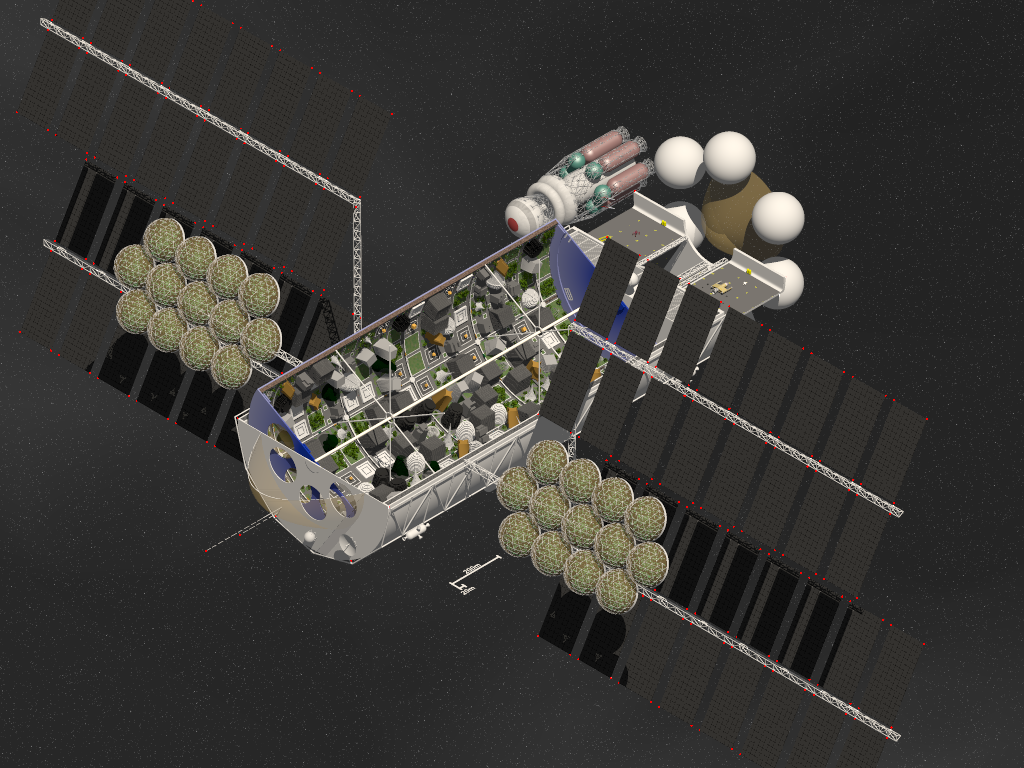
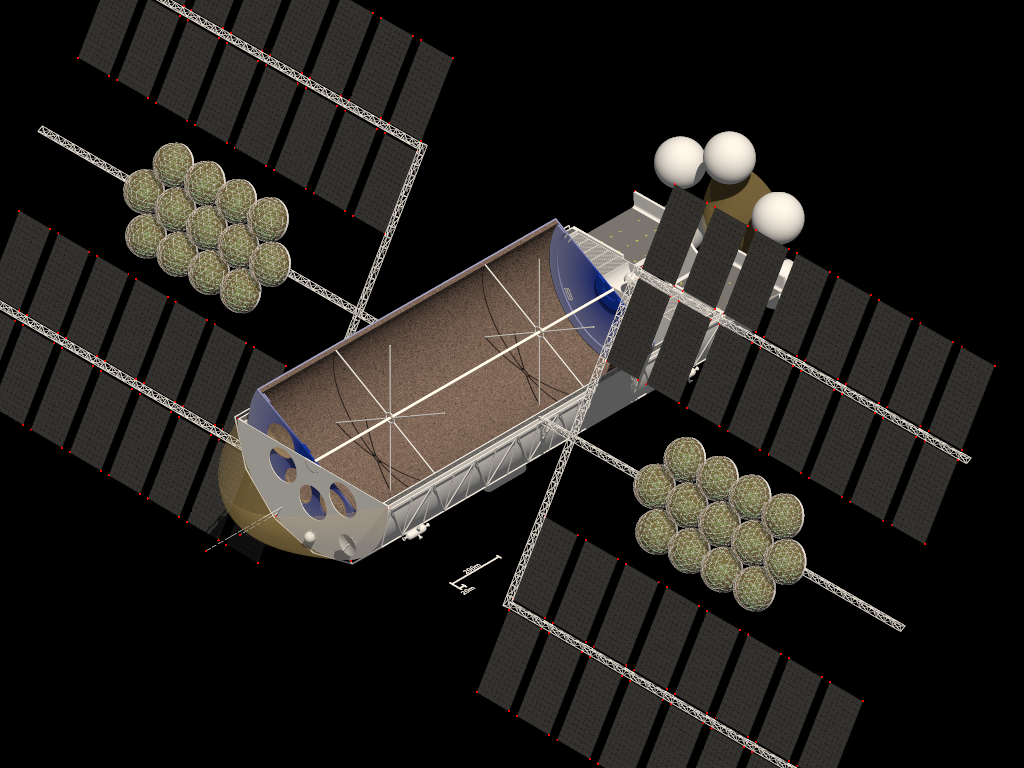
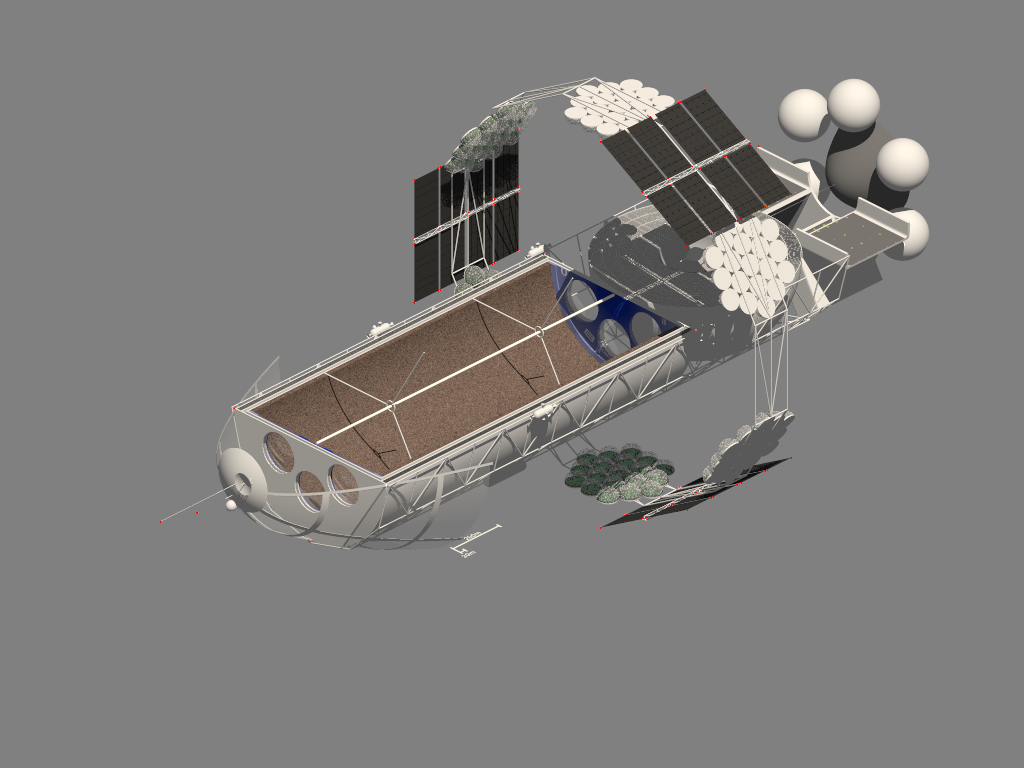
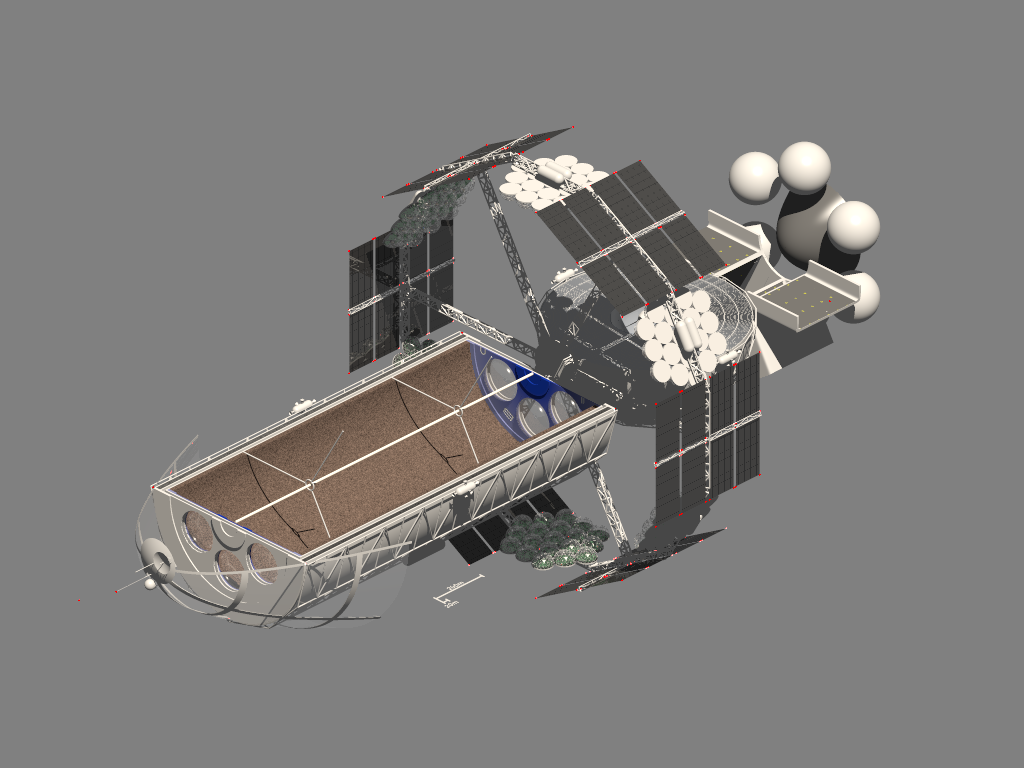
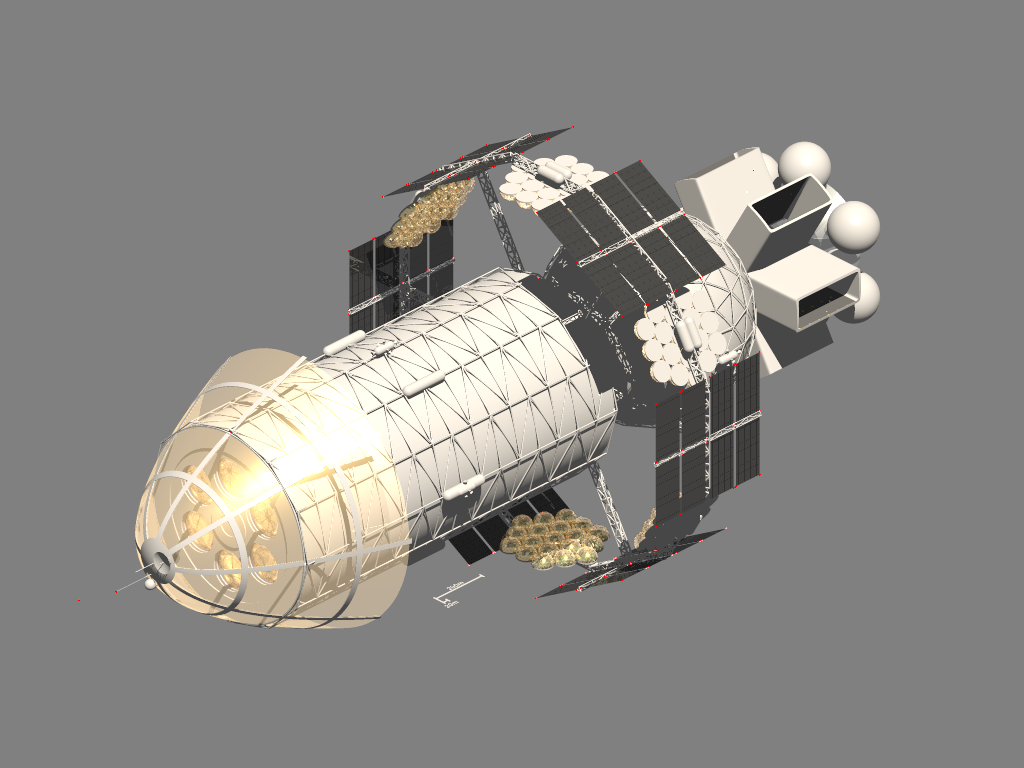
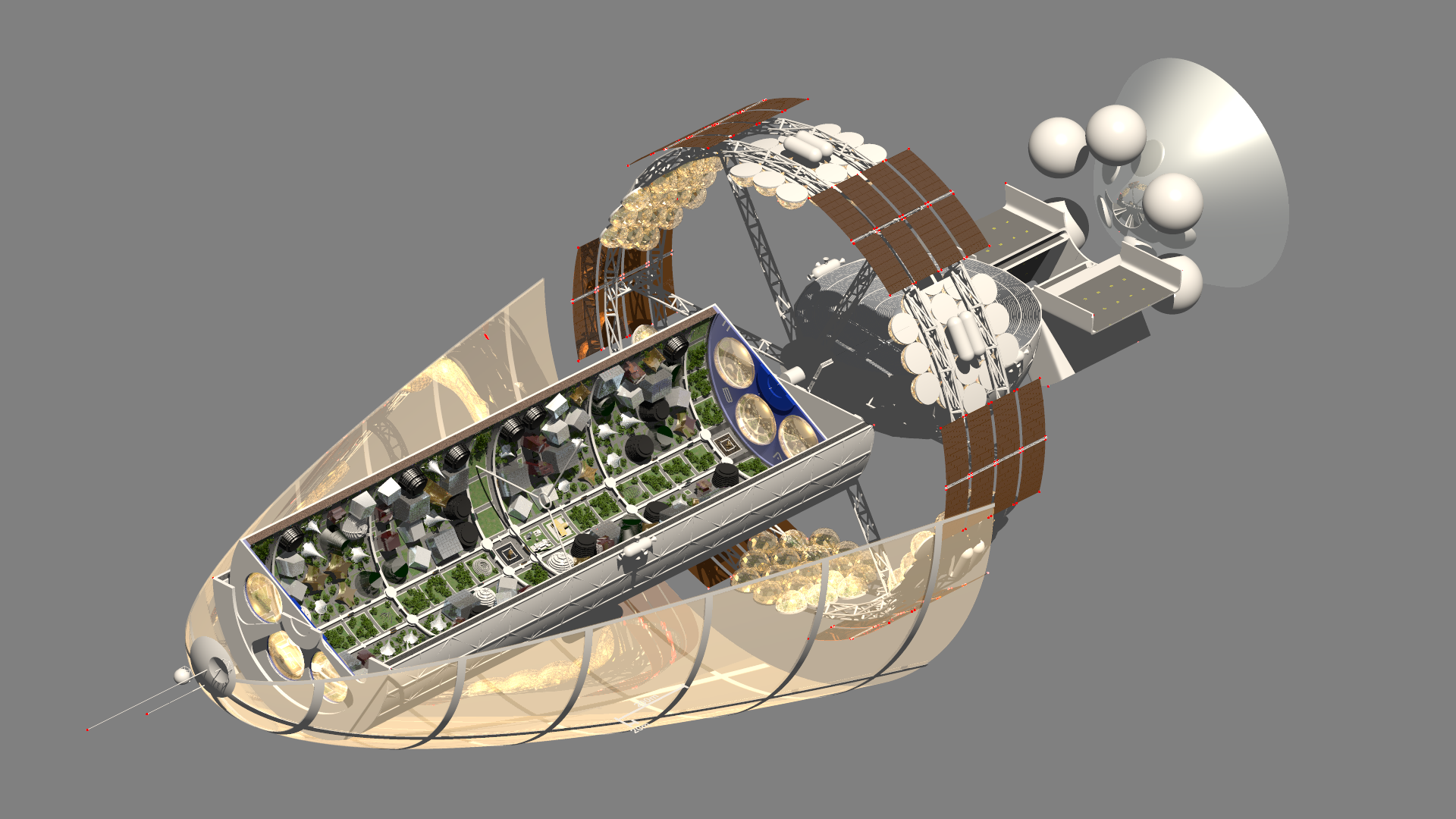
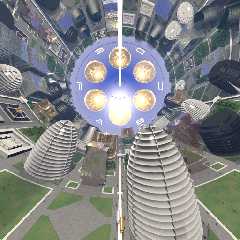
Here's my latest render of a spinner colony for the video game GearHead.

Mike
Post a reply to this message
Attachments:
Download 'gh_scene_spinner_cutaway_interior_10.png' (450 KB)
Preview of image 'gh_scene_spinner_cutaway_interior_10.png'
|
|
| |
| |
|
|
|
|
| |
| |
|
|
On 2/8/2015 6:35 AM, Mike Horvath wrote:
> Here's my latest render of a spinner colony for the video game GearHead.
>
> Mike


Forgot to say that it took nearly a full day to render.

Operating System
	Windows 7 Professional 64-bit SP1
CPU
	AMD A8-5600K	80 °C
	Trinity 32nm Technology
RAM
	8.00GB Dual-Channel DDR3 @ 803MHz (11-11-12-28)
Motherboard
	ASUSTeK COMPUTER INC. A78M-E (FM2+ )	44 °C
Graphics
	ASUS VS247 (1920x1080@60Hz)
	2047MB NVIDIA GeForce GTX 750 Ti (EVGA)	27 °C
Storage
	931GB Western Digital WDC WD10 EZEX-08M2NA0 SATA Disk Device (SATA)	24 °C
	111GB Patriot Blaze SATA Disk Device (SSD)	30 °C
Optical Drives
	ASUS DRW-24B1ST i SATA CdRom Device
Audio
	High Definition Audio Device
Post a reply to this message
|
|
| |
| |
|
|
|
|
| |
| |
|
|
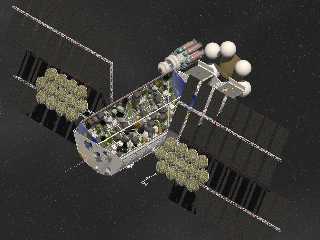
Exterior view. I would welcome some science-y critiques regarding the
structure of the space station. The main things that are bugging me
right now are the positions of the solar panels and agridomes. I think
they are blocking each other with respect to the sun. But I don't know
where I *should* be putting them.
Post a reply to this message
Attachments:
Download 'gh_scene_spinner_cutaway_04.png' (677 KB)
Preview of image 'gh_scene_spinner_cutaway_04.png'
|
|
| |
| |
|
|
|
|
| |
| |
|
|
Le 15-02-09 17:43, Mike Horvath a écrit :
> Exterior view. I would welcome some science-y critiques regarding the
> structure of the space station. The main things that are bugging me
> right now are the positions of the solar panels and agridomes. I think
> they are blocking each other with respect to the sun. But I don't know
> where I *should* be putting them.

The domes are blocking the solar pannels.

I see two solutions:
1 - Place the domes closer to the station's body, maybe in a circle
around it and push the pannels outward beyong the domes.

2 - Keep the current geometry, but rotate the domes or pannels 90°
arount the main axis of the station.

Alain
Post a reply to this message
|
|
| |
| |
|
|
|
|
| |
| |
|
|
Le 10/02/2015 01:06, Alain a écrit :
> Le 15-02-09 17:43, Mike Horvath a écrit :
>> Exterior view. I would welcome some science-y critiques regarding the
>> structure of the space station. The main things that are bugging me
>> right now are the positions of the solar panels and agridomes. I think
>> they are blocking each other with respect to the sun. But I don't know
>> where I *should* be putting them.
>
> The domes are blocking the solar pannels.
>
> I see two solutions:
> 1 - Place the domes closer to the station's body, maybe in a circle
> around it and push the pannels outward beyong the domes.
>
> 2 - Keep the current geometry, but rotate the domes or pannels 90°
> arount the main axis of the station.
>
> Alain
I would vote for second.

Also, think about symmetry and revolution: 4 panels and 2 agridomes,
they should be 60° apart of each other. To balance the torque, agridome
should be 180° of each other and if panels come in two kind, each kind
should be next to each other.   (ABCABC when turning around the axis)

--
Just because nobody complains does not mean all parachutes are perfect.
Post a reply to this message
|
|
| |
| |
|
|
|
|
| |
| |
|
|
On 2/9/2015 7:06 PM, Alain wrote:
> I see two solutions:
> 1 - Place the domes closer to the station's body, maybe in a circle
> around it and push the pannels outward beyong the domes.

This is interesting. This would induce "gravity", but the exposure to
the sun would not be as good since the domes would all face inwards.


> 2 - Keep the current geometry, but rotate the domes or pannels 90°
> arount the main axis of the station.
>
> Alain

Not sure if I understand. You mean at right angles with respect to each
other? I think Le_Forgeron has a better idea in this case.

Except that I think both of you misunderstand. The *entire* station does
not rotate around the central axis. Just the inner shell (currently
colored blue) rotates. The outer shell remains fixed. I don't have a
good explanation why I chose to do it this way.

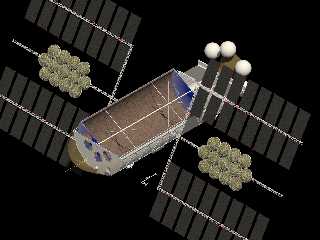
Anyway, I've attached my latest design. The panels and domes are no
longer blocking each other. But I think it is ugly. :(

What do you think?
Post a reply to this message
Attachments:
Download 'gh_scene_spinner_cutaway_05.png' (507 KB)
Preview of image 'gh_scene_spinner_cutaway_05.png'
|
|
| |
| |
|
|
|
|
| |
| |
|
|
Le 10/02/2015 19:11, Mike Horvath a écrit :
> On 2/9/2015 7:06 PM, Alain wrote:
>> I see two solutions:
>> 1 - Place the domes closer to the station's body, maybe in a circle
>> around it and push the pannels outward beyong the domes.
>
> This is interesting. This would induce "gravity", but the exposure to
> the sun would not be as good since the domes would all face inwards.
>
>
>
>
>
>> 2 - Keep the current geometry, but rotate the domes or pannels 90°
>> arount the main axis of the station.
>>
>> Alain
>
> Not sure if I understand. You mean at right angles with respect to each
> other? I think Le_Forgeron has a better idea in this case.
>
> Except that I think both of you misunderstand. The *entire* station does
> not rotate around the central axis. Just the inner shell (currently
> colored blue) rotates. The outer shell remains fixed. I don't have a
> good explanation why I chose to do it this way.
>

Fixed is relative. the outer shell should have a symmetry even if "not
moving". Or unless it is in a gravity field that would define a up and
down (such as in low orbit of a planet).

> Anyway, I've attached my latest design. The panels and domes are no
> longer blocking each other. But I think it is ugly. :(
>

And fragile: the connection of the solar panels are going to have so
much stress that they would break. Or you need to remove that 90° angle

> What do you think?

Assuming the rear is a nuclear pulse engine (detonating small nuclear
balls to get acceleration), the living blue zone is far to near the
engine, and the solar panels & agridome will get separated away from the
central body.

Also, given the kind of scale for the blue rotating cylinder, you should
have a small line of agridomes from the main body to the current group.

Which also mean that the current section of the support might actually
be unrealistic (they are too big in proportion), and the six shaped
stars might also enjoy being a mesh of triangular sections.

In Babylon 5, the central axis is a support for a transportation system
(kind of metro). Presently here, it does not seems to have a purpose and
its length (as a single segment) is unrealistic. Or I get really wrong
about the scale of the spinning colony.

About the solar panels: they are far too perfect on alignment. Can they
be folded independently ?

The length of the support of the agridomes also seems to be unjustified.
What about some agridome in construction or some docking station at the
very end ?

Powerful solar panels but the distance to the users seems huge: the lost
by joule effect might be important. It might be interesting for the
agridome that some solar panels act as mirror to provide more lights (so
they should be orientable to perform such purpose).

Last: how do you protect agridome from strong solar wind ? (in case of
solar eruption) Could the solar panels provide some shielding ?
Post a reply to this message
|
|
| |
| |
|
|
|
|
| |
| |
|
|
On 2/10/2015 3:50 PM, Le_Forgeron wrote:
> Fixed is relative. the outer shell should have a symmetry even if "not
> moving". Or unless it is in a gravity field that would define a up and
> down (such as in low orbit of a planet).

The station was originally meant to stay in orbit around a planet. I'm
just now playing around with the idea of giving it engines and turning
it into a vehicle.


> Assuming the rear is a nuclear pulse engine (detonating small nuclear
> balls to get acceleration), the living blue zone is far to near the
> engine, and the solar panels & agridome will get separated away from the
> central body.

I'm going to expand the area between the habitable cylinder and the
cargo hold and engine a little.


> Also, given the kind of scale for the blue rotating cylinder, you should
> have a small line of agridomes from the main body to the current group.

Not sure what you mean without a sketch.


> Which also mean that the current section of the support might actually
> be unrealistic (they are too big in proportion), and the six shaped
> stars might also enjoy being a mesh of triangular sections.

Not sure what you mean.


> In Babylon 5, the central axis is a support for a transportation system
> (kind of metro). Presently here, it does not seems to have a purpose and
> its length (as a single segment) is unrealistic. Or I get really wrong
> about the scale of the spinning colony.

The central axis is actually the light source. It serves no structural
function.


> About the solar panels: they are far too perfect on alignment. Can they
> be folded independently ?

Not currently. I was looking at pictures of the ISS and it does seem the
solar panels are independently mobile. I would need to calculate the
optimal angle between each panel and the sun and I don't know how to do
that.


> The length of the support of the agridomes also seems to be unjustified.
> What about some agridome in construction or some docking station at the
> very end ?

I have an idea for the domes: create a ring around the station with the
agridomes facing inward. Inside this ring place a parabolic torus that
reflects the sunlight from outside into the agridomes. (I'm probably
going to work on this next.)


> Powerful solar panels but the distance to the users seems huge: the lost
> by joule effect might be important. It might be interesting for the
> agridome that some solar panels act as mirror to provide more lights (so
> they should be orientable to perform such purpose).
>
> Last: how do you protect agridome from strong solar wind ? (in case of
> solar eruption) Could the solar panels provide some shielding ?

I hadn't consider this. Shielding the agridomes would be difficult.
Post a reply to this message
|
|
| |
| |
|
|
|
|
| |
| |
|
|
Mike Horvath <mik### [at] gmail com> wrote:
> On 2/9/2015 7:06 PM, Alain wrote:
> > I see two solutions:
> > 1 - Place the domes closer to the station's body, maybe in a circle
> > around it and push the pannels outward beyong the domes.
>
> This is interesting. This would induce "gravity", but the exposure to
> the sun would not be as good since the domes would all face inwards.
>
>
>
>
>
> > 2 - Keep the current geometry, but rotate the domes or pannels 90°
> > arount the main axis of the station.
> >
> > Alain
>
> Not sure if I understand. You mean at right angles with respect to each
> other? I think Le_Forgeron has a better idea in this case.
>
> Except that I think both of you misunderstand. The *entire* station does
> not rotate around the central axis. Just the inner shell (currently
> colored blue) rotates. The outer shell remains fixed. I don't have a
> good explanation why I chose to do it this way.
>
> Anyway, I've attached my latest design. The panels and domes are no
> longer blocking each other. But I think it is ugly. :(
>
> What do you think?
certain features of your design need attention drawn to i think.
having a non-rotating nacelle over the rotating pseudo-gee habitat can provide
for shielding. figure up to two meters of concrete/regolith/plastic. with the
shielding separate from the hab, you do not have to invest in the angular
momentum. however, your design is a 'long tom'; rotating cylinders on such a
long axis are inherently unstable and will seek to precess to a rotation around
a more stable principle axis, with disastrous results. the instability can be
overcome i think by carefully orchestrated counterweights moving radially from
the axis of rotation, but clearance with your nacelle might be a problem. most
designs that deal with the stability problem just make the cylinder shorter,
more like 'square', diameter=length. 'kalpana one' is such a design; it is near
the size of yours.
if you intend to have near-earth-strength artificial illumination, then
consider the basic efficiency of photon-in (to the solar cell) vs photon-out
(from the lighting). ten percent is ridiculously high i suspect; but that would
mean having ten times the surface area of your hab in solar cell area, just for
lighting alone. usually this problem is solved with natural sunlight and
mirrors. a good example is the o'neill-type cylinders in alexis gilliland's
'rosinante' trilogy (available for kindle). instead of giant whirling plane
mirrors (at ten or twenty gees at the tips) gilliland embeds the habs in vast
conical arrays of small mirrors, each steerable. as a bonus, since the mirrors
are stationary, they can be heavy, and are dichroric mirrors reflecting only
visible light, no heat or u.v. also, since the novels are set in the asteroid
belt, much larger surface areas are needed than can be provided by the mirrors
of the classic o'neill cylinder.
you can hypothesize food plants that thrive in zero gee but that is a big leap
of faith. the classic o'neill cylinder had a ring of 'small' 'farm modules' to
feed the cylinder (the gilliland habs were in the business of agriculture). the
o'neill farms were rotating structures about the size of your spinner. even
stipulating zero gee crops, i am wondering, why the domes instead of flat
coverings (tho they do look cool). radiation protection is another concern; i
have forgotten if o'neill's 'high frontier' addressed it. in a 'current state
of the art' pragmatic cop-out, it might be necessary to move agriculture into
the main hab, send everybody 'underground'. coolness counts, tho, and every
design feature, or bug, can be rationalized away.
i fear my ideas seem limiting and stifling whereas i hope they inspire and help.
there are a lot of divergent ideas out there, and that is a good thing. com> wrote:
> On 2/9/2015 7:06 PM, Alain wrote:
> > I see two solutions:
> > 1 - Place the domes closer to the station's body, maybe in a circle
> > around it and push the pannels outward beyong the domes.
>
> This is interesting. This would induce "gravity", but the exposure to
> the sun would not be as good since the domes would all face inwards.
>
>
>
>
>
> > 2 - Keep the current geometry, but rotate the domes or pannels 90°
> > arount the main axis of the station.
> >
> > Alain
>
> Not sure if I understand. You mean at right angles with respect to each
> other? I think Le_Forgeron has a better idea in this case.
>
> Except that I think both of you misunderstand. The *entire* station does
> not rotate around the central axis. Just the inner shell (currently
> colored blue) rotates. The outer shell remains fixed. I don't have a
> good explanation why I chose to do it this way.
>
> Anyway, I've attached my latest design. The panels and domes are no
> longer blocking each other. But I think it is ugly. :(
>
> What do you think?
certain features of your design need attention drawn to i think.
having a non-rotating nacelle over the rotating pseudo-gee habitat can provide
for shielding. figure up to two meters of concrete/regolith/plastic. with the
shielding separate from the hab, you do not have to invest in the angular
momentum. however, your design is a 'long tom'; rotating cylinders on such a
long axis are inherently unstable and will seek to precess to a rotation around
a more stable principle axis, with disastrous results. the instability can be
overcome i think by carefully orchestrated counterweights moving radially from
the axis of rotation, but clearance with your nacelle might be a problem. most
designs that deal with the stability problem just make the cylinder shorter,
more like 'square', diameter=length. 'kalpana one' is such a design; it is near
the size of yours.
if you intend to have near-earth-strength artificial illumination, then
consider the basic efficiency of photon-in (to the solar cell) vs photon-out
(from the lighting). ten percent is ridiculously high i suspect; but that would
mean having ten times the surface area of your hab in solar cell area, just for
lighting alone. usually this problem is solved with natural sunlight and
mirrors. a good example is the o'neill-type cylinders in alexis gilliland's
'rosinante' trilogy (available for kindle). instead of giant whirling plane
mirrors (at ten or twenty gees at the tips) gilliland embeds the habs in vast
conical arrays of small mirrors, each steerable. as a bonus, since the mirrors
are stationary, they can be heavy, and are dichroric mirrors reflecting only
visible light, no heat or u.v. also, since the novels are set in the asteroid
belt, much larger surface areas are needed than can be provided by the mirrors
of the classic o'neill cylinder.
you can hypothesize food plants that thrive in zero gee but that is a big leap
of faith. the classic o'neill cylinder had a ring of 'small' 'farm modules' to
feed the cylinder (the gilliland habs were in the business of agriculture). the
o'neill farms were rotating structures about the size of your spinner. even
stipulating zero gee crops, i am wondering, why the domes instead of flat
coverings (tho they do look cool). radiation protection is another concern; i
have forgotten if o'neill's 'high frontier' addressed it. in a 'current state
of the art' pragmatic cop-out, it might be necessary to move agriculture into
the main hab, send everybody 'underground'. coolness counts, tho, and every
design feature, or bug, can be rationalized away.
i fear my ideas seem limiting and stifling whereas i hope they inspire and help.
there are a lot of divergent ideas out there, and that is a good thing.
Post a reply to this message
|
|
| |
| |
|
|
|
|
| |
| |
|
|
Le 15-02-10 13:11, Mike Horvath a écrit :
> On 2/9/2015 7:06 PM, Alain wrote:
>> I see two solutions:
>> 1 - Place the domes closer to the station's body, maybe in a circle
>> around it and push the pannels outward beyong the domes.
>
> This is interesting. This would induce "gravity", but the exposure to
> the sun would not be as good since the domes would all face inwards.

I did not mention turning the domes around, just move them around in a
circle pattern keeping the orientation the same.

By the way, you do need at least some gravity for the agridomes. Plants
don't grow correctly without some gravity.
If there is no gravity, you'll probably be limites to unicellular algae,
and the agridomes would be changed into agritanks...

>
>
>
>
>
>> 2 - Keep the current geometry, but rotate the domes or pannels 90°
>> arount the main axis of the station.
>>
>> Alain
>
> Not sure if I understand. You mean at right angles with respect to each
> other? I think Le_Forgeron has a better idea in this case.

Just keep the solar pannels as they are, and place the domes on an arm
going up and down relative to the present image.

>
> Except that I think both of you misunderstand. The *entire* station does
> not rotate around the central axis. Just the inner shell (currently
> colored blue) rotates. The outer shell remains fixed. I don't have a
> good explanation why I chose to do it this way.

I clearly remember that.

>
> Anyway, I've attached my latest design. The panels and domes are no
> longer blocking each other. But I think it is ugly. :(
>
> What do you think?

A third solution made possible by the stationary outer shell:
Have one or more "agri-arm" holding the agridomes or agritanks.
Have one or more "energy arm" holding the solar pannels.
Those two kinds of arms can be set in any non-obstructing pattern.
Post a reply to this message
|
|
| |
| |
|
|
|
|
| |
| |
|
|
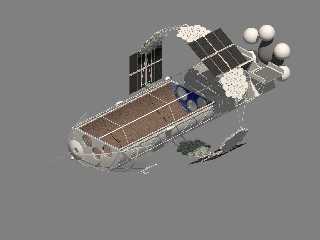
Here's my latest version. Is it better? I think I am heading in the
right direction. I still have to connect the outer solar panel ring to
the ship. Right now it's just floating.
Post a reply to this message
Attachments:
Download 'gh_scene_spinner_cutaway_08.png' (255 KB)
Preview of image 'gh_scene_spinner_cutaway_08.png'
|
|
| |
| |
|
|
|
|
| |
| |
|
|
On 2/10/2015 10:56 PM, green wrote:
> certain features of your design need attention drawn to i think.
>    having a non-rotating nacelle over the rotating pseudo-gee habitat can provide
> for shielding.  figure up to two meters of concrete/regolith/plastic.  with the
> shielding separate from the hab, you do not have to invest in the angular
> momentum.  however, your design is a 'long tom'; rotating cylinders on such a
> long axis are inherently unstable and will seek to precess to a rotation around
> a more stable principle axis, with disastrous results.  the instability can be
> overcome i think by carefully orchestrated counterweights moving radially from
> the axis of rotation, but clearance with your nacelle might be a problem.  most
> designs that deal with the stability problem just make the cylinder shorter,
> more like 'square', diameter=length.  'kalpana one' is such a design; it is near
> the size of yours.

I added a new outer ring for the solar panels and agridomes. They rotate
in the opposite direction as the habitat. But they have very little mass.


>    if you intend to have near-earth-strength artificial illumination, then
> consider the basic efficiency of photon-in (to the solar cell) vs photon-out
> (from the lighting).  ten percent is ridiculously high i suspect; but that would
> mean having ten times the surface area of your hab in solar cell area, just for
> lighting alone.  usually this problem is solved with natural sunlight and
> mirrors.  a good example is the o'neill-type cylinders in alexis gilliland's
> 'rosinante' trilogy (available for kindle).  instead of giant whirling plane
> mirrors (at ten or twenty gees at the tips) gilliland embeds the habs in vast
> conical arrays of small mirrors, each steerable.  as a bonus, since the mirrors
> are stationary, they can be heavy, and are dichroric mirrors reflecting only
> visible light, no heat or u.v.   also, since the novels are set in the asteroid
> belt, much larger surface areas are needed than can be provided by the mirrors
> of the classic o'neill cylinder.

The ship has a regular reactor in addition to the solar panels. It's in
the center of the big sphere that's kind of hard to see now. It's
surrounded by water and fuels maybe. Maybe cargo.


>    you can hypothesize food plants that thrive in zero gee but that is a big leap
> of faith.  the classic o'neill cylinder had a ring of 'small' 'farm modules' to
> feed the cylinder (the gilliland habs were in the business of agriculture).  the
> o'neill farms were rotating structures about the size of your spinner.  even
> stipulating zero gee crops, i am wondering, why the domes instead of flat
> coverings (tho they do look cool).  radiation protection is another concern; i
> have forgotten if o'neill's 'high frontier' addressed it.  in a 'current state
> of the art' pragmatic cop-out, it might be necessary to move agriculture into
> the main hab, send everybody 'underground'.  coolness counts, tho, and every
> design feature, or bug, can be rationalized away.

The agridomes are rotating now, so they should have proper fake gee. I
was thinking the dome shape would resist pressurization better. They're
not well shielded though. I haven't modeled the parabolic torus (a
surface, not a solid) yet to collect light and direct it to the domes.


> i fear my ideas seem limiting and stifling whereas i hope they inspire and help.
>   there are a lot of divergent ideas out there, and that is a good thing.

Thanks for your comments! Keep them coming!
Post a reply to this message
|
|
| |
| |
|
|
|
|
| |
| |
|
|
Le 10/02/2015 22:25, Mike Horvath a écrit :
> On 2/10/2015 3:50 PM, Le_Forgeron wrote:

>> Also, given the kind of scale for the blue rotating cylinder, you should
>> have a small line of agridomes from the main body to the current group.
>
> Not sure what you mean without a sketch.

  instead of --%%%--O--%%%--

the part between % and O could have some extra aligned agridomes

Something like --%%%**O**%%%--

Also, some water-tank(s) could be nearby
>
>
>> Which also mean that the current section of the support might actually
>> be unrealistic (they are too big in proportion), and the six shaped
>> stars might also enjoy being a mesh of triangular sections.
>
> Not sure what you mean.

What is the diameter of the rotating body ? compare it to the
triangulated support used to attach the agridomes and to the section of
the six lines which are making a star around the central axis: if you
were able to make such big lines inside, why is the outer support meshed
of thinner diameter ?


>
>
>> In Babylon 5, the central axis is a support for a transportation system
>> (kind of metro). Presently here, it does not seems to have a purpose and
>> its length (as a single segment) is unrealistic. Or I get really wrong
>> about the scale of the spinning colony.
>
> The central axis is actually the light source. It serves no structural
> function.

Make that central light modular (segments would have to be replaced as
they get broken): small linear section as pavement on the cylinder. at
least 6 sections (but more according to the diameter) to cover the round
perimeter. A small variation of hue and saturation of the white "light"
colour along the axis might be interesting.

--
Just because nobody complains does not mean all parachutes are perfect.
Post a reply to this message
|
|
| |
| |
|
|
|
|
| |
| |
|
|
On 11/02/2015 05:28, Mike Horvath wrote:
> Here's my latest version. Is it better? I think I am heading in the
> right direction. I still have to connect the outer solar panel ring to
> the ship. Right now it's just floating.

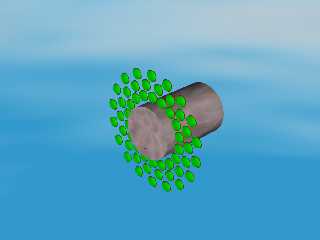
My solution ;-)
And you won't need solar panels you'll need radiators. And they can go
in the shade. :-)


--

Regards
     Stephen
Post a reply to this message
Attachments:
Download 'wax01_0000.png' (174 KB)
Preview of image 'wax01_0000.png'
|
|
| |
| |
|
|
|
|
| |
| |
|
|
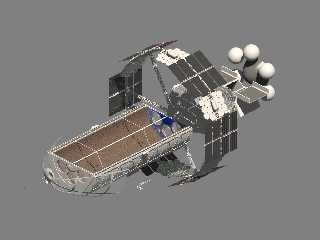
Today's render. I wish the ring better approximated a true circle. But I
would have to rewrite "truss.inc" or find a different way to make
circular trusses.
Post a reply to this message
Attachments:
Download 'gh_scene_spinner_cutaway_11.png' (288 KB)
Preview of image 'gh_scene_spinner_cutaway_11.png'
|
|
| |
| |
|
|
|
|
| |
| |
|
|
On 2/11/2015 4:26 AM, Stephen wrote:
> On 11/02/2015 05:28, Mike Horvath wrote:
>> Here's my latest version. Is it better? I think I am heading in the
>> right direction. I still have to connect the outer solar panel ring to
>> the ship. Right now it's just floating.
>
> My solution ;-)
> And you won't need solar panels you'll need radiators. And they can go
> in the shade. :-)
>
>
I've been wondering about waste heat and how to handle it. I suppose I
could say that the external trusses are for piping water and cooling it.
But cylinders are not very efficient at distributing heat.

Also, I was looking at some pictures of the ISS, and their solar panels
have a coppery sheen to them. How do I mimic that? Here's my current
solar panel texture:

#local solar_panel_texture = texture
{
	#switch (TexQual)
		#case (-1)
			lowqual_pig(Seed)
		#break
		#case (0)
			pigment
			{
				brick gamma_color_adjust(0/4*<1,1,1>), gamma_color_adjust(1/4*<1,1,1>)
				brick_size panel_width/4
				mortar panel_mortar
			}
			translate +y * panel_width/16
			translate +z * panel_width/8
		#break
		#case (1)
		#case (2)
			pigment
			{
				brick gamma_color_adjust(0/4*<1,1,1>), gamma_color_adjust(1/4*<1,1,1>)
				brick_size panel_width/4
				mortar panel_mortar
			}
			finish {Glossy}
			translate +y * panel_width/16
			translate +z * panel_width/8
		#break
	#end
}
Post a reply to this message
|
|
| |
| |
|
|
|
|
| |
| |
|
|
On 2/11/2015 3:46 AM, Le_Forgeron wrote:
> What is the diameter of the rotating body ? compare it to the
> triangulated support used to attach the agridomes and to the section of
> the six lines which are making a star around the central axis: if you
> were able to make such big lines inside, why is the outer support meshed
> of thinner diameter ?

The radius of the habitat is close to 300 meters. The metal rods are 2
meters thick in both cases.


>>> In Babylon 5, the central axis is a support for a transportation system
>>> (kind of metro). Presently here, it does not seems to have a purpose and
>>> its length (as a single segment) is unrealistic. Or I get really wrong
>>> about the scale of the spinning colony.
>>
>> The central axis is actually the light source. It serves no structural
>> function.
>
> Make that central light modular (segments would have to be replaced as
> they get broken): small linear section as pavement on the cylinder. at
> least 6 sections (but more according to the diameter) to cover the round
> perimeter. A small variation of hue and saturation of the white "light"
> colour along the axis might be interesting.
>

Segmenting the light source would create strange shadows on the
interior. Not sure what you mean about the pavement and 6 sections. I
would like to make the light source more yellow, but haven't figured out
how. Here's the LightSys code I use:

#local Lightsys_Scene_Scale	= Meters * 100;			// 1 = 1cm?
#local light_lumens		= 2;					// float
#local light_temp		= Daylight(6100);			// float
#local light_color		= Light_Color(light_temp, light_lumens);
Post a reply to this message
|
|
| |
| |
|
|
|
|
| |
| |
|
|
On 2/11/2015 11:37 PM, Mike Horvath wrote:
> Today's render. I wish the ring better approximated a true circle. But I
> would have to rewrite "truss.inc" or find a different way to make
> circular trusses.

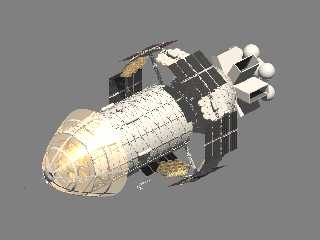
Here is the whole exterior of the ship. It's not as sexy.
Post a reply to this message
Attachments:
Download 'gh_scene_spinner_cutaway_13.png' (273 KB)
Preview of image 'gh_scene_spinner_cutaway_13.png'
|
|
| |
| |
|
|
|
|
| |
| |
|
|
I have been wondering about those six circular windows. While rotating
do they not create a kind of blinking effect?

--
Thomas
Post a reply to this message
|
|
| |
| |
|
|
|
|
| |
| |
|
|
On 12/02/2015 04:59, Mike Horvath wrote:
> Also, I was looking at some pictures of the ISS, and their solar panels
> have a coppery sheen to them. How do I mimic that? Here's my current
> solar panel texture:
>
> #local solar_panel_texture = texture

...
 >              finish {Glossy}

Instead of using a standard "finish" define your own with a reflection
rgb close to one for copper.


   reflection {
     rgb <0.722,0.451,0.200>
     fresnel   0
     falloff   0.000
     exponent  1.000
     metallic  0.500
   }

--

Regards
     Stephen
Post a reply to this message
|
|
| |
| |
|
|
|
|
| |
| |
|
|
Le 15-02-12 00:22, Mike Horvath a écrit :
> On 2/11/2015 3:46 AM, Le_Forgeron wrote:
>> What is the diameter of the rotating body ? compare it to the
>> triangulated support used to attach the agridomes and to the section of
>> the six lines which are making a star around the central axis: if you
>> were able to make such big lines inside, why is the outer support meshed
>> of thinner diameter ?
>
> The radius of the habitat is close to 300 meters. The metal rods are 2
> meters thick in both cases.
>
>
>
>>>> In Babylon 5, the central axis is a support for a transportation system
>>>> (kind of metro). Presently here, it does not seems to have a purpose
>>>> and
>>>> its length (as a single segment) is unrealistic. Or I get really wrong
>>>> about the scale of the spinning colony.
>>>
>>> The central axis is actually the light source. It serves no structural
>>> function.
>>
>> Make that central light modular (segments would have to be replaced as
>> they get broken): small linear section as pavement on the cylinder. at
>> least 6 sections (but more according to the diameter) to cover the round
>> perimeter. A small variation of hue and saturation of the white "light"
>> colour along the axis might be interesting.
>>
>
> Segmenting the light source would create strange shadows on the
> interior. Not sure what you mean about the pavement and 6 sections. I
> would like to make the light source more yellow, but haven't figured out
> how. Here's the LightSys code I use:
>
> #local Lightsys_Scene_Scale    = Meters * 100;            // 1 = 1cm?
> #local light_lumens        = 2;                    // float
> #local light_temp        = Daylight(6100);            // float in kelvin°
> #local light_color        = Light_Color(light_temp, light_lumens);

If you reduce the value for Daylight() somewhat, it will get yellower,
and to a redish tint if you reduce it enough.
Try something like:
#local light_temp        = Daylight(5950);


Alain
Post a reply to this message
|
|
| |
| |
|
|
|
|
| |
| |
|
|
On 2/12/2015 3:28 AM, Thomas de Groot wrote:
> I have been wondering about those six circular windows. While rotating
> do they not create a kind of blinking effect?
>


The effect is probably similar to the one experienced by farmers living
near and under wind power turbines. It is probably annoying. I could
replace the holes in the outer shell with a single cylindrical groove to
remove the effect, but it wouldn't make structural sense.
Post a reply to this message
|
|
| |
| |
|
|
|
|
| |
| |
|
|
On 2/12/2015 6:39 AM, Stephen wrote:
> On 12/02/2015 04:59, Mike Horvath wrote:
>> Also, I was looking at some pictures of the ISS, and their solar panels
>> have a coppery sheen to them. How do I mimic that? Here's my current
>> solar panel texture:
>>
>> #local solar_panel_texture = texture
>
> ...
>  >              finish {Glossy}
>
> Instead of using a standard "finish" define your own with a reflection
> rgb close to one for copper.
>
>
>    reflection {
>      rgb <0.722,0.451,0.200>
>      fresnel   0
>      falloff   0.000
>      exponent  1.000
>      metallic  0.500
>    }
>


I just tried that but didn't notice much of a difference. Maybe because
I am using parallel lights and camera?
Post a reply to this message
|
|
| |
| |
|
|
|
|
| |
| |
|
|
On 2/12/2015 4:02 PM, Alain wrote:
>> Segmenting the light source would create strange shadows on the
>> interior. Not sure what you mean about the pavement and 6 sections. I
>> would like to make the light source more yellow, but haven't figured out
>> how. Here's the LightSys code I use:
>>
>> #local Lightsys_Scene_Scale    = Meters * 100;            // 1 = 1cm?
>> #local light_lumens        = 2;                    // float
>> #local light_temp        = Daylight(6100);            // float in kelvin°
>> #local light_color        = Light_Color(light_temp, light_lumens);
>
> If you reduce the value for Daylight() somewhat, it will get yellower,
> and to a redish tint if you reduce it enough.
> Try something like:
> #local light_temp        = Daylight(5950);
>
>
>
> Alain


Here's the material for the central axis lamp. I would like it to look a
little dimmer and yellower. What should I change?


texture {pigment {gamma_color_adjust(light_color) transmit 1}}
interior
{
	media
	{
		emission gamma_color_adjust(light_color)
		density
		{
			cylindrical
			color_map
			{
				[0 srgb 0]
				[1 srgb 1]
			}
			scale	lamp_radius
			rotate	x * 90
		}
	}
}
Post a reply to this message
|
|
| |
| |
|
|
|
|
| |
| |
|
|
On 13-2-2015 0:07, Mike Horvath wrote:
> On 2/12/2015 3:28 AM, Thomas de Groot wrote:
>> I have been wondering about those six circular windows. While rotating
>> do they not create a kind of blinking effect?
>>
>
>
> The effect is probably similar to the one experienced by farmers living
> near and under wind power turbines. It is probably annoying. I could
> replace the holes in the outer shell with a single cylindrical groove to
> remove the effect, but it wouldn't make structural sense.

If structural sense is the only thing that matters (and not a view to
the outside) why not provide smaller holes set on different circular
paths between inner and outer shells, so that they do not coincide?

--
Thomas
Post a reply to this message
|
|
| |
| |
|
|
|
|
| |
| |
|
|
Am 13.02.2015 um 00:09 schrieb Mike Horvath:

>> Instead of using a standard "finish" define your own with a reflection
>> rgb close to one for copper.
>>
>>
>>    reflection {
>>      rgb <0.722,0.451,0.200>
>>      fresnel   0
>>      falloff   0.000
>>      exponent  1.000
>>      metallic  0.500
>>    }
>>
>
>
> I just tried that but didn't notice much of a difference. Maybe because
> I am using parallel lights and camera?

You need something to reflect.
Post a reply to this message
|
|
| |
| |
|
|
|
|
| |
| |
|
|
On 13/02/2015 11:00, clipka wrote:
> Am 13.02.2015 um 00:09 schrieb Mike Horvath:
>
>>> Instead of using a standard "finish" define your own with a reflection
>>> rgb close to one for copper.
>>>
>>>
>>>    reflection {
>>>      rgb <0.722,0.451,0.200>
>>>      fresnel   0
>>>      falloff   0.000
>>>      exponent  1.000
>>>      metallic  0.500
>>>    }
>>>
>>
>>
>> I just tried that but didn't notice much of a difference. Maybe because
>> I am using parallel lights and camera?
>
> You need something to reflect.
>

Even a simple sky sphere will do.
Here is the one I use to start with.


#declare Shadow_Clouds_Top =
pigment {
   color rgbft <0.196,0.600,0.800,0.000,0.000>
}

#declare Shadow_Clouds_Mid =
pigment {
   bozo
   color_map {
     [0.000 rgbft <0.850,0.850,0.850,0.000,0.000>]
     [0.100 rgbft <0.750,0.750,0.750,0.000,0.000>]
     [0.500 rgbft <1.000,1.000,1.000,0.000,1.000>]
   }

   rotate    <0.0,0.0,90.000>
   rotate    <180.000,0.0,0.0>
   scale     <1.000,6.000,6.000>
   rotate    <-180.000,0.000,-90.000>
   turbulence <0.650,0.650,0.650>
   octaves 6
   lambda 2.000
   omega 0.700
}

#declare Shadow_Clouds_Bot =
pigment {
   bozo
   color_map {
     [0.000 rgbft <0.850,0.850,0.850,0.000,0.000>]
     [0.100 rgbft <0.750,0.750,0.750,0.000,0.000>]
     [0.500 rgbft <1.000,1.000,1.000,0.000,1.000>]
   }

   rotate    <0.0,0.0,90.000>
   rotate    <180.000,0.0,0.0>
   scale     <1.000,6.000,6.000>
   rotate    <-180.000,0.000,-90.000>
   translate <0.000,-0.150,0.000>
   turbulence <0.650,0.650,0.650>
   octaves 6
   lambda 2.000
   omega 0.700
}


#declare SkySphere1 =
sky_sphere {
pigment{ Shadow_Clouds_Top }
pigment{ Shadow_Clouds_Mid }
pigment{ Shadow_Clouds_Bot }

}


--

Regards
     Stephen
Post a reply to this message
|
|
| |
| |
|
|
|
|
| |
| |
|
|
On 2/13/2015 6:21 AM, Stephen wrote:
> Even a simple sky sphere will do.
> Here is the one I use to start with.
>
>
> #declare Shadow_Clouds_Top =
> pigment {
>    color rgbft <0.196,0.600,0.800,0.000,0.000>
> }
>
> #declare Shadow_Clouds_Mid =
> pigment {
>    bozo
>    color_map {
>      [0.000 rgbft <0.850,0.850,0.850,0.000,0.000>]
>      [0.100 rgbft <0.750,0.750,0.750,0.000,0.000>]
>      [0.500 rgbft <1.000,1.000,1.000,0.000,1.000>]
>    }
>
>    rotate    <0.0,0.0,90.000>
>    rotate    <180.000,0.0,0.0>
>    scale     <1.000,6.000,6.000>
>    rotate    <-180.000,0.000,-90.000>
>    turbulence <0.650,0.650,0.650>
>    octaves 6
>    lambda 2.000
>    omega 0.700
> }
>
> #declare Shadow_Clouds_Bot =
> pigment {
>    bozo
>    color_map {
>      [0.000 rgbft <0.850,0.850,0.850,0.000,0.000>]
>      [0.100 rgbft <0.750,0.750,0.750,0.000,0.000>]
>      [0.500 rgbft <1.000,1.000,1.000,0.000,1.000>]
>    }
>
>    rotate    <0.0,0.0,90.000>
>    rotate    <180.000,0.0,0.0>
>    scale     <1.000,6.000,6.000>
>    rotate    <-180.000,0.000,-90.000>
>    translate <0.000,-0.150,0.000>
>    turbulence <0.650,0.650,0.650>
>    octaves 6
>    lambda 2.000
>    omega 0.700
> }
>
>
> #declare SkySphere1 =
> sky_sphere {
> pigment{ Shadow_Clouds_Top }
> pigment{ Shadow_Clouds_Mid }
> pigment{ Shadow_Clouds_Bot }
>
> }
>
>


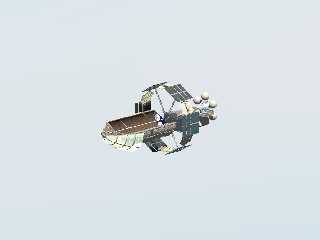
Here's my render with your skysphere. I still don't see any copper tint
to the solar panels. It's not a big deal though.
Post a reply to this message
Attachments:
Download 'gh_scene_spinner_cutaway_15.png' (100 KB)
Preview of image 'gh_scene_spinner_cutaway_15.png'
|
|
| |
| |
|
|
|
|
| |
| |
|
|
On 2/13/2015 3:20 AM, Thomas de Groot wrote:
> On 13-2-2015 0:07, Mike Horvath wrote:
>> On 2/12/2015 3:28 AM, Thomas de Groot wrote:
>>> I have been wondering about those six circular windows. While rotating
>>> do they not create a kind of blinking effect?
>>>
>>
>>
>> The effect is probably similar to the one experienced by farmers living
>> near and under wind power turbines. It is probably annoying. I could
>> replace the holes in the outer shell with a single cylindrical groove to
>> remove the effect, but it wouldn't make structural sense.
>
> If structural sense is the only thing that matters (and not a view to
> the outside) why not provide smaller holes set on different circular
> paths between inner and outer shells, so that they do not coincide?
>

I'm not sure I understand. Having holes of any kind would still produce
blinking I think.
Post a reply to this message
|
|
| |
| |
|
|
|
|
| |
| |
|
|
Le 15-02-12 18:25, Mike Horvath a écrit :
> On 2/12/2015 4:02 PM, Alain wrote:
>>> Segmenting the light source would create strange shadows on the
>>> interior. Not sure what you mean about the pavement and 6 sections. I
>>> would like to make the light source more yellow, but haven't figured out
>>> how. Here's the LightSys code I use:
>>>
>>> #local Lightsys_Scene_Scale    = Meters * 100;            // 1 = 1cm?
>>> #local light_lumens        = 2;                    // float
>>> #local light_temp        = Daylight(6100);            // float in
>>> kelvin°
>>> #local light_color        = Light_Color(light_temp, light_lumens);
>>
>> If you reduce the value for Daylight() somewhat, it will get yellower,
>> and to a redish tint if you reduce it enough.
>> Try something like:
>> #local light_temp        = Daylight(5950);
>>
>>
>>
>> Alain
>
>
> Here's the material for the central axis lamp. I would like it to look a
> little dimmer and yellower. What should I change?
>
>
> texture {pigment {gamma_color_adjust(light_color) transmit 1}}
> interior
> {
>      media
>      {
>          emission gamma_color_adjust(light_color)
>          density
>          {
>              cylindrical
>              color_map
>              {
>                  [0 srgb 0]
>                  [1 srgb 1]
>              }
>              scale    lamp_radius
>              rotate    x * 90
>          }
>      }
> }

If you change:
emission gamma_color_adjust(light_color)

so it becomes this:
emission gamma_color_adjust(light_color)*<0.9, 0.89, 0.75>

it will get dimmer and yellower, a bit on the redish side.
Experiment with that added parameter untill you get something that you like.

You may also lower the value used for the DayLight() macro, it will also
shift the hue toward the red end of the spectrum with a side effect of a
globaly dimmer intensity.
The value is the light's temperature in K°.

If you reduce the value used for "light_lumens", the intensity will be
reduced keeping the same hue.


Alain
Post a reply to this message
|
|
| |
| |
|
|
|
|
| |
| |
|
|
Le 15-02-13 15:43, Mike Horvath a écrit :
> On 2/13/2015 3:20 AM, Thomas de Groot wrote:
>> On 13-2-2015 0:07, Mike Horvath wrote:
>>> On 2/12/2015 3:28 AM, Thomas de Groot wrote:
>>>> I have been wondering about those six circular windows. While rotating
>>>> do they not create a kind of blinking effect?
>>>>
>>>
>>>
>>> The effect is probably similar to the one experienced by farmers living
>>> near and under wind power turbines. It is probably annoying. I could
>>> replace the holes in the outer shell with a single cylindrical groove to
>>> remove the effect, but it wouldn't make structural sense.
>>
>> If structural sense is the only thing that matters (and not a view to
>> the outside) why not provide smaller holes set on different circular
>> paths between inner and outer shells, so that they do not coincide?
>>
>
> I'm not sure I understand. Having holes of any kind would still produce
> blinking I think.

The blinking effect can be reduced if the two openings set don't have
the same number of openings.

Try 6 on the outer shell and 7 for the inner shell.


Alain
Post a reply to this message
|
|
| |
| |
|
|
|
|
| |
| |
|
|
On 13-2-2015 21:43, Mike Horvath wrote:
>
> I'm not sure I understand. Having holes of any kind would still produce
> blinking I think.

Words... difficult...
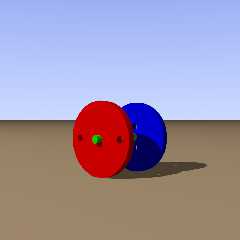
I made a little simplified image to show what I mean.

--
Thomas
Post a reply to this message
Attachments:
Download 'test.png' (67 KB)
Preview of image 'test.png'
|
|
| |
| |
|
|
|
|
| |
| |
|
|
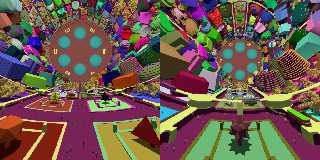
I've been playing around with different scales for the habitat. I prefer
the larger scale (left in the image). But I know there's no way I can
render it with the quality levels turned up higher. I tried a couple
days ago but after 2.5 hours it was still stuck in that stage between
parsing and actually rendering. I can't spare my computer for the week
or however long it would require to render the scene.
Post a reply to this message
Attachments:
Download 'gh_spinner_montage_e.png' (563 KB)
Preview of image 'gh_spinner_montage_e.png'
|
|
| |
| |
|
|
|
|
| |
| |
|
|
Am 15.02.2015 um 04:07 schrieb Mike Horvath:
> I've been playing around with different scales for the habitat. I prefer
> the larger scale (left in the image). But I know there's no way I can
> render it with the quality levels turned up higher. I tried a couple
> days ago but after 2.5 hours it was still stuck in that stage between
> parsing and actually rendering. I can't spare my computer for the week
> or however long it would require to render the scene.

Sounds like you might be hitting the physical memory limits of your
computer, and entering the abyss of swap hell. In that case I'd wager
even a week to be a very optimistic estimate.
Post a reply to this message
|
|
| |
| |
|
|
|
|
| |
| |
|
|
On 12/02/2015 23:09, Mike Horvath wrote:

>
> I just tried that but didn't notice much of a difference. Maybe because
> I am using parallel lights and camera?

I think that the fault is on my part. (Sorry for the delay in replying.)
I don't write my own code I use a modeller and there was a cut and paste
problem in my last post.

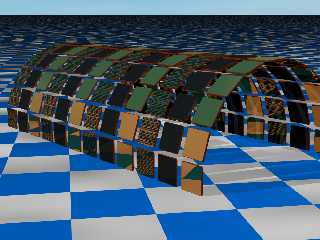
The attached image shows a coloured reflection.

The bands are (R to L) Cu reflection, no colour in reflection and brick
pattern with the mortar having a coloured reflection.

#declare SMcA_BlackCu =
texture {
   pigment {
     color rgbft <0.122,0.122,0.122,0.000,0.000>
   }

   finish {
     ambient     rgb <0.100,0.100,0.100>
     brilliance  1.000
     crand       0.000
     diffuse     0.600
     metallic    1.000
     phong       0.000
     phong_size  40.000
     specular    0.000
     roughness   0.050
     reflection {
       rgb <0.481,0.301,0.133>, rgb <0.722,0.451,0.200>
       fresnel   0
       falloff   0.000
       exponent  1.000
       metallic  0.000
     }
   }

}


--

Regards
     Stephen
Post a reply to this message
Attachments:
Download 'wax03_0000.png' (545 KB)
Preview of image 'wax03_0000.png'
|
|
| |
| |
|
|
|
|
| |
| |
|
|
On 2/16/2015 9:10 AM, Stephen wrote:
> finish {
>      ambient     rgb <0.100,0.100,0.100>
>      brilliance  1.000
>      crand       0.000
>      diffuse     0.600
>      metallic    1.000
>      phong       0.000
>      phong_size  40.000
>      specular    0.000
>      roughness   0.050
>      reflection {
>        rgb <0.481,0.301,0.133>, rgb <0.722,0.451,0.200>
>        fresnel   0
>        falloff   0.000
>        exponent  1.000
>        metallic  0.000
>      }
>    }

That worked! Thanks.
Post a reply to this message
|
|
| |
| |
|
|
|
|
| |
| |
|
|
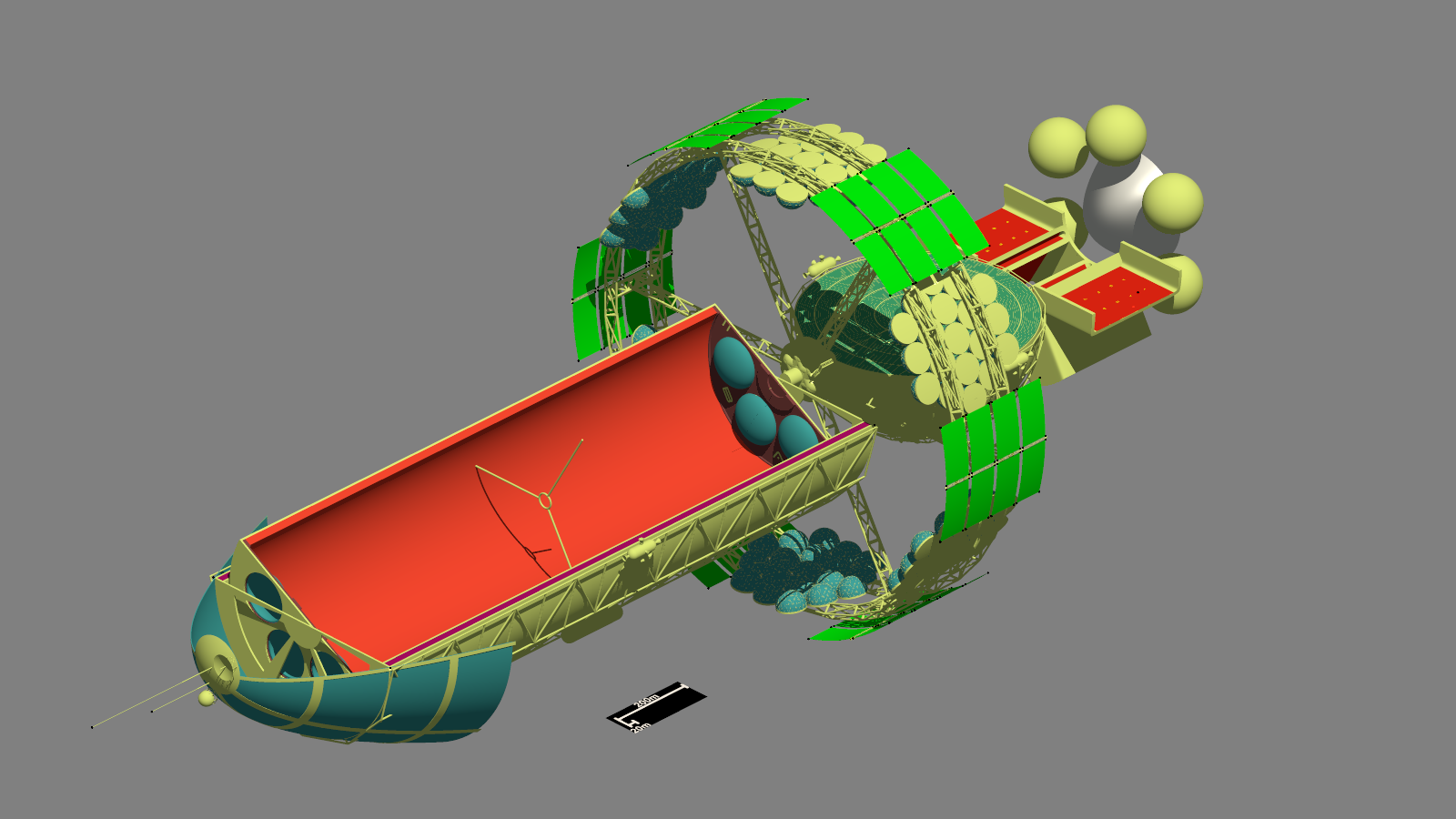
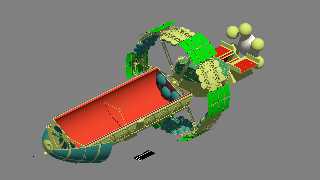
I have curved the solar panels and agridomes. They look a lot more sleek
now.

I am also still working on a solution for the viewport flickering. I've
at least reduced it somewhat by making the spindles in the outer shell
thinner. I don't like how this looks, but maybe adding a few more curves
here and there will make it look better.

Lastly, I'm still trying to figure out how to reflect sunlight onto the
agridomes. I'm considering a paraboloid directly "above" them (from the
standpoint of someone standing inside the agridome), but space is tight.
Post a reply to this message
Attachments:
Download 'gh_scene_spinner_cutaway_16.png' (310 KB)
Preview of image 'gh_scene_spinner_cutaway_16.png'
|
|
| |
| |
|
|
|
|
| |
| |
|
|
On 2/15/2015 7:48 AM, clipka wrote:
> Am 15.02.2015 um 04:07 schrieb Mike Horvath:
>> I've been playing around with different scales for the habitat. I prefer
>> the larger scale (left in the image). But I know there's no way I can
>> render it with the quality levels turned up higher. I tried a couple
>> days ago but after 2.5 hours it was still stuck in that stage between
>> parsing and actually rendering. I can't spare my computer for the week
>> or however long it would require to render the scene.
>
> Sounds like you might be hitting the physical memory limits of your
> computer, and entering the abyss of swap hell. In that case I'd wager
> even a week to be a very optimistic estimate.
>

I was keeping an eye on my physical memory and I don't remember it going
past 4GB (I have 8GB total). My swap file is also on an SSD and I don't
remember much activity (big blinking red light on PC case) there either.
Post a reply to this message
|
|
| |
| |
|
|
|
|
| |
| |
|
|
On 2/14/2015 3:20 AM, Thomas de Groot wrote:
> On 13-2-2015 21:43, Mike Horvath wrote:
>>
>> I'm not sure I understand. Having holes of any kind would still produce
>> blinking I think.
>
> Words... difficult...
> I made a little simplified image to show what I mean.
>


I'm sorry but that picture still doesn't make sense to me.
Post a reply to this message
|
|
| |
| |
|
|
|
|
| |
| |
|
|
On 2/13/2015 8:59 PM, Alain wrote:
>> I'm not sure I understand. Having holes of any kind would still produce
>> blinking I think.
>
> The blinking effect can be reduced if the two openings set don't have
> the same number of openings.
>
> Try 6 on the outer shell and 7 for the inner shell.
>
>
> Alain


That's an idea, and a pretty simple one too. Thanks.
Post a reply to this message
|
|
| |
| |
|
|
|
|
| |
| |
|
|
On 18-2-2015 7:33, Mike Horvath wrote:
> On 2/14/2015 3:20 AM, Thomas de Groot wrote:
>> On 13-2-2015 21:43, Mike Horvath wrote:
>>>
>>> I'm not sure I understand. Having holes of any kind would still produce
>>> blinking I think.
>>
>> Words... difficult...
>> I made a little simplified image to show what I mean.
>>
>
>
> I'm sorry but that picture still doesn't make sense to me.
The holes do not overlap when rotating the (blue) inner hull. This way
you can position the holes in non-overlapping circular paths. Of course,
you loose the view to the outside ;-)

--
Thomas
Post a reply to this message
|
|
| |
| |
|
|
|
|
| |
| |
|
|
Le 18/02/2015 07:32, Mike Horvath a écrit :
> On 2/15/2015 7:48 AM, clipka wrote:
>> Am 15.02.2015 um 04:07 schrieb Mike Horvath:
>>> I've been playing around with different scales for the habitat. I prefer
>>> the larger scale (left in the image). But I know there's no way I can
>>> render it with the quality levels turned up higher. I tried a couple
>>> days ago but after 2.5 hours it was still stuck in that stage between
>>> parsing and actually rendering. I can't spare my computer for the week
>>> or however long it would require to render the scene.
>>
>> Sounds like you might be hitting the physical memory limits of your
>> computer, and entering the abyss of swap hell. In that case I'd wager
>> even a week to be a very optimistic estimate.
>>
>
> I was keeping an eye on my physical memory and I don't remember it going
> past 4GB (I have 8GB total). My swap file is also on an SSD and I don't
> remember much activity (big blinking red light on PC case) there either.

As long as OS is 64 bits, no problem.

Note that Windows 32 bits can manage at best 3.5GB of memory, and that
applications are allowed to have at most 2GB of private memory, IIRC.
(hence probably the comment about linux being better... for 32 bits, but
it 's only a small improvement, as it is 3GB instead of 2GB)

--
Just because nobody complains does not mean all parachutes are perfect.
Post a reply to this message
|
|
| |
| |
|
|
|
|
| |
| |
|
|
Mike Horvath wrote:

> On 2/13/2015 8:59 PM, Alain wrote:
>>> I'm not sure I understand. Having holes of any kind would still
produce
>>> blinking I think.
>>
>> The blinking effect can be reduced if the two openings set don't have
>> the same number of openings.
>>
>> Try 6 on the outer shell and 7 for the inner shell.
>>
>>
>> Alain
>
>
> That's an idea, and a pretty simple one too. Thanks.

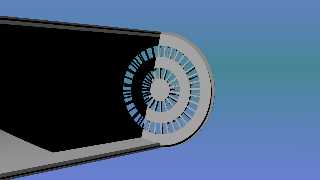
Or you could make it as a "Dauerluft" (venting slot) with different
number of slots.


--

Ger
Post a reply to this message
Attachments:
Download 'spinner001.png' (67 KB)
Preview of image 'spinner001.png'
|
|
| |
| |
|
|
|
|
| |
| |
|
|
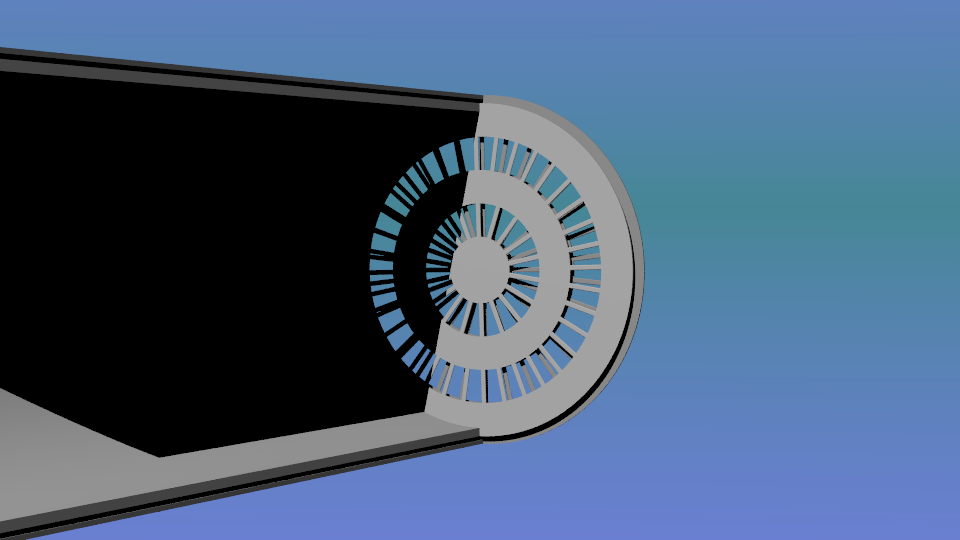
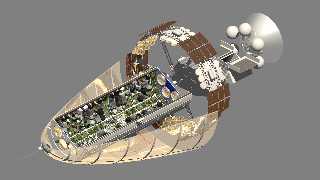
My latest render. I'm satisfied with the inner/outer hull viewport area.

I think now it is time to consider propulsion. A nuclear pulse drive
like Project Orion could work. I would have to model some shock
absorbers, and the pressure pad would need to be flat instead of
parabolic (or not?).

I'm actually not sure what my other options are.
Post a reply to this message
Attachments:
Download 'gh_scene_spinner_cutaway_20.png' (930 KB)
Preview of image 'gh_scene_spinner_cutaway_20.png'
|
|
| |
| |
|
|
|
|
| |
| |
|
|
Le 15-02-18 01:17, Mike Horvath a écrit :
> I have curved the solar panels and agridomes. They look a lot more sleek
> now.
>
> I am also still working on a solution for the viewport flickering. I've
> at least reduced it somewhat by making the spindles in the outer shell
> thinner. I don't like how this looks, but maybe adding a few more curves
> here and there will make it look better.
>
> Lastly, I'm still trying to figure out how to reflect sunlight onto the
> agridomes. I'm considering a paraboloid directly "above" them (from the
> standpoint of someone standing inside the agridome), but space is tight.

To reflect light to the agridomes, a set of flat mirors is probably the
best solution.
You don't realy need to concentrate the light, there is no athmosphere
filtering it.
It's easier to orient flat mirors as needed depending on your
orientation relative to the sun or nearest star.


Alain
Post a reply to this message
|
|
| |
| |
|
|
|
|
| |
| |
|
|
On 2/22/2015 1:39 PM, Alain wrote:
> Le 15-02-18 01:17, Mike Horvath a écrit :
>> I have curved the solar panels and agridomes. They look a lot more sleek
>> now.
>>
>> I am also still working on a solution for the viewport flickering. I've
>> at least reduced it somewhat by making the spindles in the outer shell
>> thinner. I don't like how this looks, but maybe adding a few more curves
>> here and there will make it look better.
>>
>> Lastly, I'm still trying to figure out how to reflect sunlight onto the
>> agridomes. I'm considering a paraboloid directly "above" them (from the
>> standpoint of someone standing inside the agridome), but space is tight.
>
> To reflect light to the agridomes, a set of flat mirors is probably the
> best solution.
> You don't realy need to concentrate the light, there is no athmosphere
> filtering it.
> It's easier to orient flat mirors as needed depending on your
> orientation relative to the sun or nearest star.
>
>
> Alain

I got some very good suggestions in this post:

https://forum.geogebra.org/viewtopic.php?p=139143#p139143

The problems now are that:

1. Should I collect the light from the direction the ship is heading, or
extending from the rotating ring? The ship will not be facing the sun
100% of the time.
2. I'm running out of room to place the mirrors.
Post a reply to this message
|
|
| |
| |
|
|
|
|
| |
| |
|
|
I tried turning on the atmosphere and area light in my latest version of
the spaceship interior, but after 10 hours the render was at 8% and
hadn't reached the slow bits yet. I will try again in 10 years. :(
Post a reply to this message
|
|
| |
| |
|
|
|
|
| |
| |
|
|
Le 24/02/2015 02:45, Mike Horvath a écrit :
> I tried turning on the atmosphere and area light in my latest version of
> the spaceship interior, but after 10 hours the render was at 8% and
> hadn't reached the slow bits yet. I will try again in 10 years. :(

What size of area light (in term of row & column) did you try ?
(did you try a preview with only 2x2 area lights, to get an idea of time
to render ?)
What option (adaptative ? +AM2 or +AM1 ?) are you using to speed up area
lights ?

--
Just because nobody complains does not mean all parachutes are perfect.
Post a reply to this message
|
|
| |
| |
|
|
|
|
| |
| |
|
|
Le 15-02-22 23:20, Mike Horvath a écrit :
> On 2/22/2015 1:39 PM, Alain wrote:
>> Le 15-02-18 01:17, Mike Horvath a écrit :
>>> I have curved the solar panels and agridomes. They look a lot more sleek
>>> now.
>>>
>>> I am also still working on a solution for the viewport flickering. I've
>>> at least reduced it somewhat by making the spindles in the outer shell
>>> thinner. I don't like how this looks, but maybe adding a few more curves
>>> here and there will make it look better.
>>>
>>> Lastly, I'm still trying to figure out how to reflect sunlight onto the
>>> agridomes. I'm considering a paraboloid directly "above" them (from the
>>> standpoint of someone standing inside the agridome), but space is tight.
>>
>> To reflect light to the agridomes, a set of flat mirors is probably the
>> best solution.
>> You don't realy need to concentrate the light, there is no athmosphere
>> filtering it.
>> It's easier to orient flat mirors as needed depending on your
>> orientation relative to the sun or nearest star.
>>
>>
>> Alain
>
> I got some very good suggestions in this post:
>
> https://forum.geogebra.org/viewtopic.php?p=139143#p139143
>
> The problems now are that:
>
> 1. Should I collect the light from the direction the ship is heading, or
> extending from the rotating ring? The ship will not be facing the sun
> 100% of the time.
> 2. I'm running out of room to place the mirrors.

Place the mirrors on pivots, with some actuators, mounted on rails that
run the length of the hull.
That way, you can place the mirrors in the most effecient way.
Post a reply to this message
|
|
| |
| |
|
|
|
|
| |
| |
|
|
On 2/24/2015 5:11 PM, Alain wrote:
>> I got some very good suggestions in this post:
>>
>> https://forum.geogebra.org/viewtopic.php?p=139143#p139143
>>
>> The problems now are that:
>>
>> 1. Should I collect the light from the direction the ship is heading, or
>> extending from the rotating ring? The ship will not be facing the sun
>> 100% of the time.
>> 2. I'm running out of room to place the mirrors.
>
> Place the mirrors on pivots, with some actuators, mounted on rails that
> run the length of the hull.
> That way, you can place the mirrors in the most effecient way.
>

What sort of pivots? Wouldn't that cause the mirrors to point away from
the agridomes? Do you mean tracks of some sort?
Post a reply to this message
|
|
| |
| |
|
|
|
|
| |