|
|
|
|
|
|
| |
| |
|
|
|
|
| |
| |
|
|
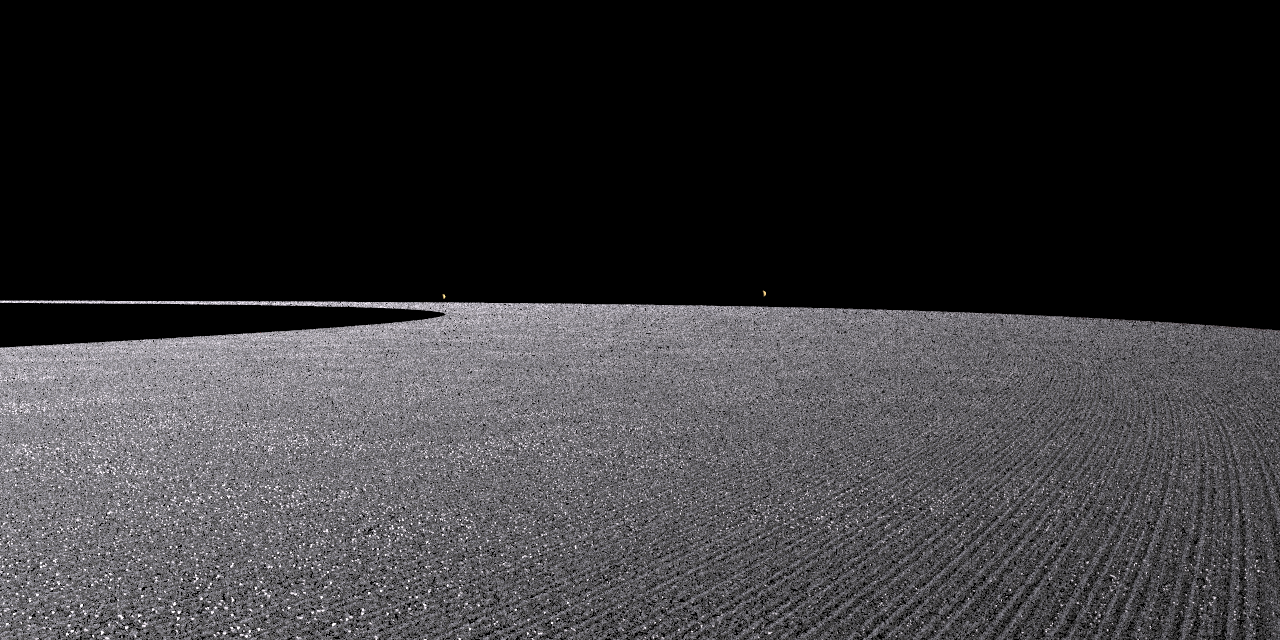
I am starting a new thread with the next stage.

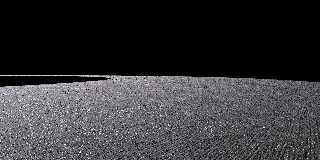
The ring material looks pretty good now. I changed its texture to darker
hues and less specular in the knowledge that space photographs are
always enhanced for public view. The universe is darker than it seems ;-)

Two moons: Titan to the right, Tethys to the left; correct size and
distance; Titan hue is correct (taken from photograph); Tethys hue still
provisional.

--
Thomas
Post a reply to this message
Attachments:
Download 'complex.png' (1084 KB)
Preview of image 'complex.png'
|
|
| |
| |
|
|
|
|
| |
| |
|
|
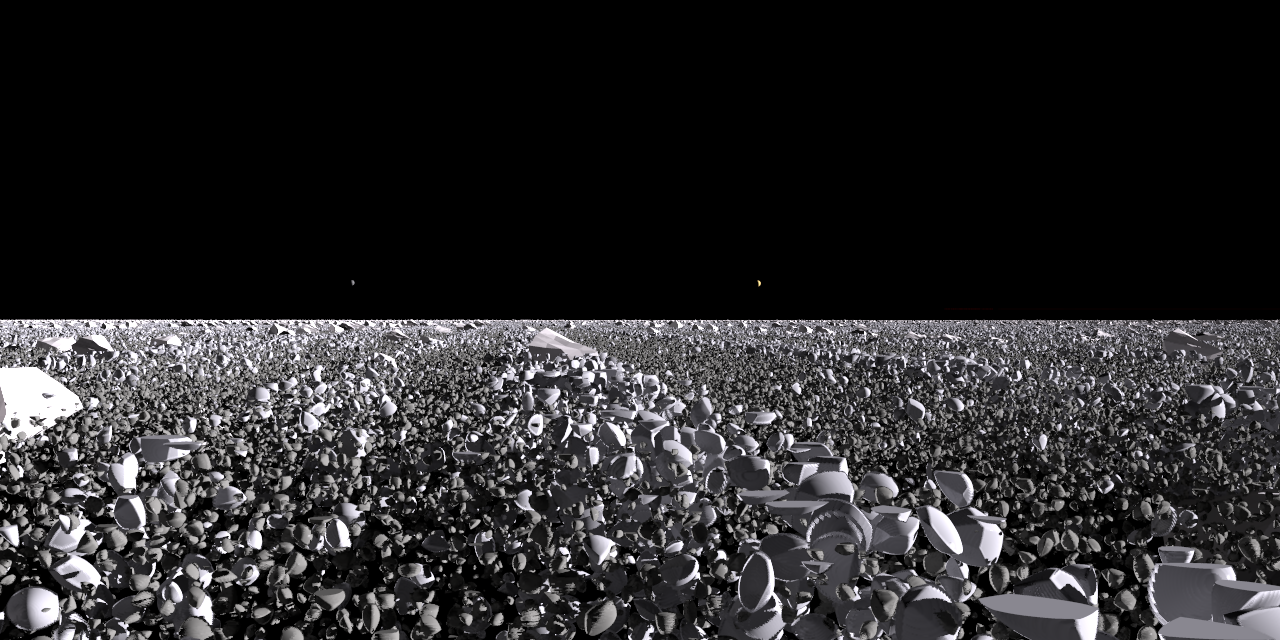
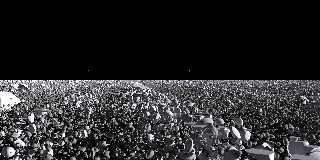
And a view at altitude 10 km. I put Tethys and Titan a little bit higher
than the plane of the ring for artistic reasons.

Note that the ring material is composed of two isosurfaces, one for the
finer fraction (only a crackle function) and one for the coarser
fraction. Additionally 3 million rocks form the coarsest fraction.

Isosurfaces'code:

//----------------------------------------------------------------------
//Isosurface for the finer ring elements (thanks to Christian Froeschlin)
#declare f_particles =
function(x,y,z) {
     0.8
   - f_crackle(400*x, 400*y, 400*z)
   + f_bozo(x*100, y*100, z*100)
   - f_waves(x*100+f_bozo(x*100,0,0), y*10+f_bozo(0,y*10,0),
z*100+f_bozo(0,0,z*100))
}

#declare f_fineparticles =
function(x,y,z) {0.7 - f_crackle(x*800, y*800, z*800)}

intersection {
   union {
     isosurface {
       function {f_particles(x,y,z)}
       contained_by {
         box {<0.00, -0.5*0.01, -117581.00*0.001>, <117581.00*0.001,
0.5*0.01, 117581.00*0.001>}
       }
       accuracy 0.0001
       max_gradient 1000
       texture {
         pigment {srgb <0.96, 0.96, 0.98>*0.75}
         finish {diffuse 0.8 specular 0.2 roughness 0.001}
       }
     }
     isosurface {
       function {f_fineparticles(x,y,z)}
       contained_by {
         box {<0.00, -0.4*0.01, -117581.00*0.001>, <117581.00*0.001,
0.4*0.01, 117581.00*0.001>}
       }
       accuracy 0.0001
       max_gradient 1000
       texture {
         pigment {srgb <0.94, 0.94, 0.90>*0.5}
         finish {diffuse 0.8 specular 0.2 roughness 0.001}
       }
     }
   }
   difference {
     cylinder {<0, -1, 0>, <0, 1, 0>, 117580.00*0.001}
     cylinder {<0, -1.1, 0>, <0, 1.1, 0>, 92000.00*0.001}
   }
   hollow
}


--
Thomas
Post a reply to this message
Attachments:
Download 'complex_08.png' (940 KB)
Preview of image 'complex_08.png'
|
|
| |
| |
|
|
|
|
| |
| |
|
|
Hi Thomas,

a very nice iso_surface indeed. IMO a bit to regular and there are no gaps.
Looking at a picture from Cassini I wonder where the different colors of the
rings come from. There are yellowish parts up to a certain degree of blue. May
be these colors are only due to perspective and reflections of the planet itself
since the rings consists of ice to the main part.

BTW: One of your parts looks a bit like an open mouthed (comic like) shark;-)
Interesting that the iso_surface functions produces such a nice artifact.

Best regards,
Michael
Post a reply to this message
|
|
| |
| |
|
|
|
|
| |
| |
|
|
On 01/13/2015 05:08 PM, MichaelJF wrote:
> BTW: One of your parts looks a bit like an open mouthed (comic like) shark;-)
> Interesting that the iso_surface functions produces such a nice artifact.

I suspect that is an artifact of numerical accuracy.
Post a reply to this message
|
|
| |
| |
|
|
|
|
| |
| |
|
|
On 13-1-2015 22:08, MichaelJF wrote:
>
> Hi Thomas,
>
> a very nice iso_surface indeed. IMO a bit to regular and there are no gaps.
> Looking at a picture from Cassini I wonder where the different colors of the
> rings come from. There are yellowish parts up to a certain degree of blue. May
> be these colors are only due to perspective and reflections of the planet itself
> since the rings consists of ice to the main part.

Thanks Michael. I can work a bit more on the regularity although when
you see the Cassini images, the ring build up seems very regular
overall. Gaps: Note that this is /only/ the B-ring! As I am travelling
towards the Cassini Division (where the 'Mountains' are) the other rings
are irrelevant. However, they are easy to add in the isosurface code
with appropriate difference/union/intersection constructions, or
individual isosurfaces of course as the rings have different densities.

The colours are indeed puzzling. I suppose they point to differences in
composition or dust content in the rings. I have not (yet) added that
but it should be easy to do as an additional semitransparent pigment
over the ring.
.
>
> BTW: One of your parts looks a bit like an open mouthed (comic like) shark;-)
> Interesting that the iso_surface functions produces such a nice artifact.

I noticed too! Partly a perspective effect.

--
Thomas
Post a reply to this message
|
|
| |
| |
|
|
|
|
| |
| |
|
|
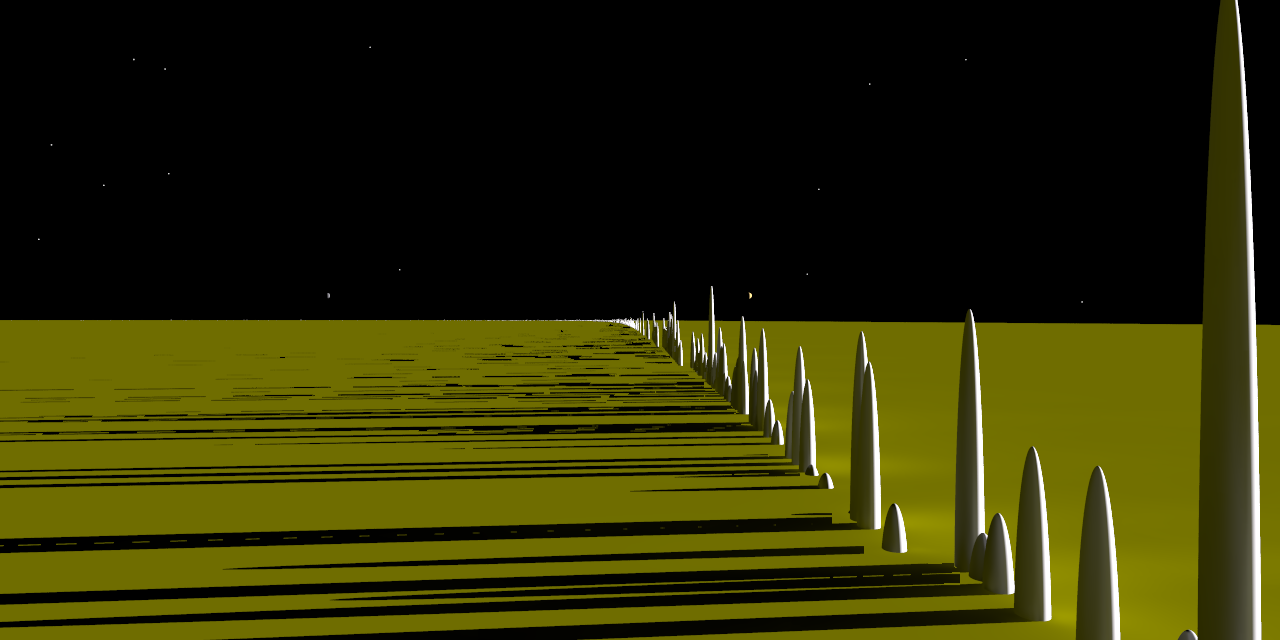
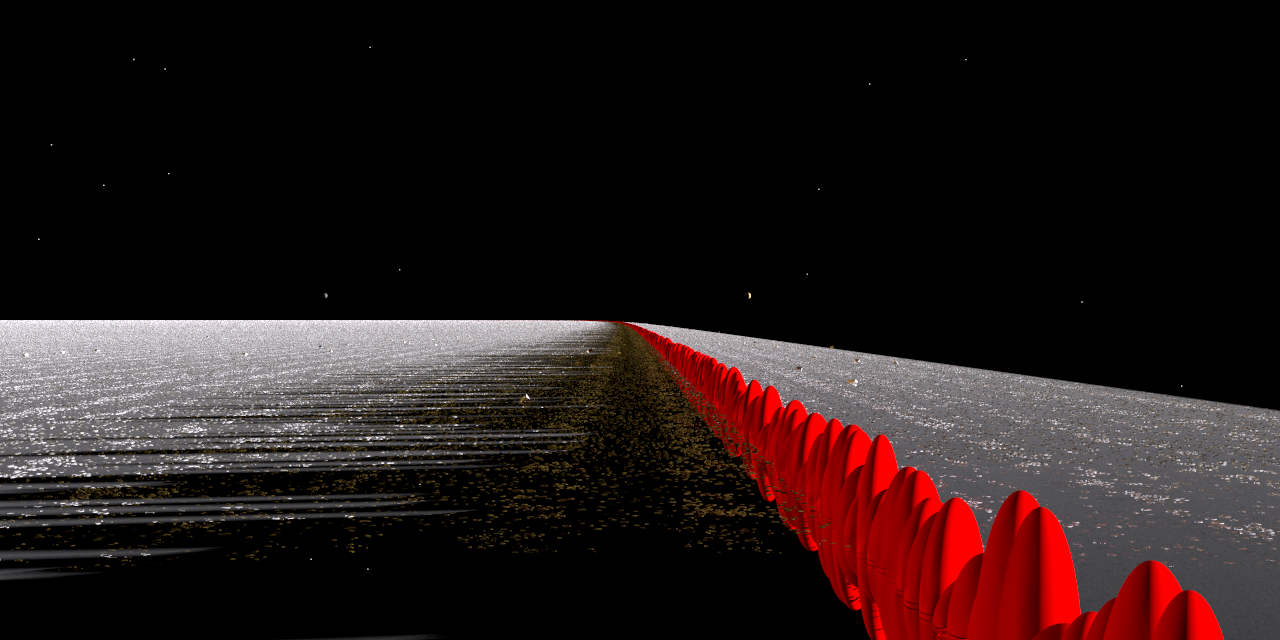
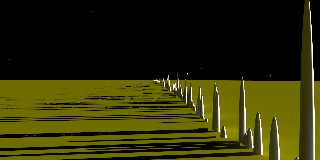
This would be a first view of the Ring 'mountains'. I guess they are
composed of fine material temporarily swept out of their stable orbit by
an invisible shepherd moon. As yet I have not found any scientific
explication on the net. Filled with media they look better but cast no
shadows; with a simple pigment the shadows show imperfections
(supposedly epsilon value limits again).

All dimensions to scale, viewed from an altitude of 5km. Real dimensions
scaled down a thousand times. Yadgar's skysphere in the background and
the usual Tethys and Titan moons.

--
Thomas
Post a reply to this message
Attachments:
Download 'complex.png' (115 KB)
Preview of image 'complex.png'
|
|
| |
| |
|
|
|
|
| |
| |
|
|
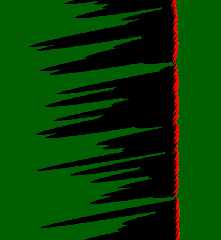
Somehow, this looks more like the real thing...

 From photographs, it is as if the perturbation takes the shape of a
helicoidal flow of the ring material...

--
Thomas
Post a reply to this message
Attachments:
Download 'complex.jpg' (33 KB)
Preview of image 'complex.jpg'
|
|
| |
| |
|
|
|
|
| |
| |
|
|
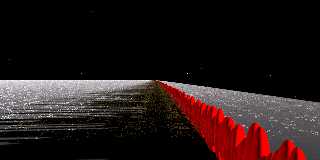
A number of corrections further and some thoughts more.

I have reduced the thickness exaggeration of the ring to 100m instead of
10m or less in reality. This is as far as I can go without breaking up
the render, in particular the media. Accordingly, I have reduced the
sizes of individual ring particles. Saturn reflects on the shadow sides
of the particles.

The A ring is there beyond the Cassini division (not filled in yet) but
is invisible as it is seen on the edge which is also in the shadow.

I am still not sure yet how I am going to fill-in the complex
"propeller" features reaching up to 2.5 to 3km above the ring surface. I
have more of those to build as patches towards the rim, and then we'll see.

Altitude of the camera: 5km above the ring.

--
Thomas
Post a reply to this message
Attachments:
Download 'complex_06.png' (503 KB)
Preview of image 'complex_06.png'
|
|
| |
| |
|
|
|
|
| |
| |
|
|
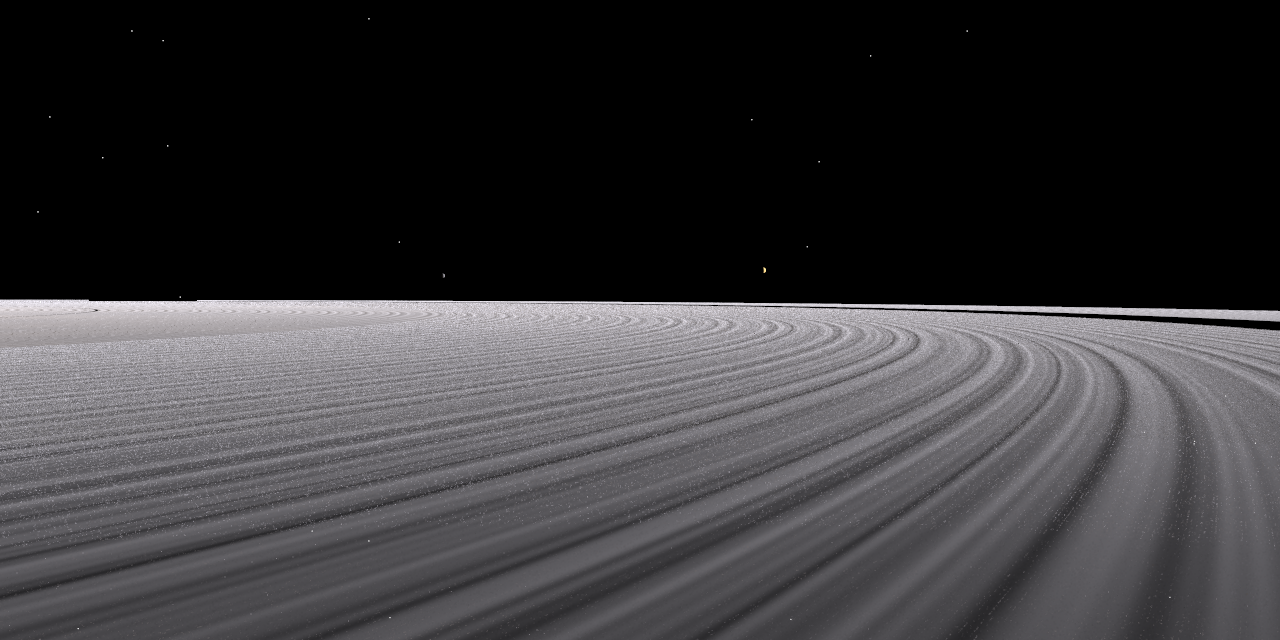
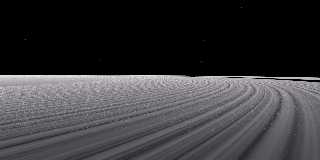
Slow progress, still progress.

Additional rings (A ring beyond the Cassini Division to the right; C
ring and D ring to the left); a wave density in the media to enhance the
ring feature.

I have to see about the ring colours...

--
Thomas
Post a reply to this message
Attachments:
Download 'complex_07.png' (669 KB)
Preview of image 'complex_07.png'
|
|
| |
| |
|
|
From: Thomas de Groot
Subject: Re: Saturn Ring - Second wip / POV version 3.71
Date: 24 Jan 2015 10:40:30
Message: <54c3bcee@news.povray.org>
|
|
|
| |
| |
|
|
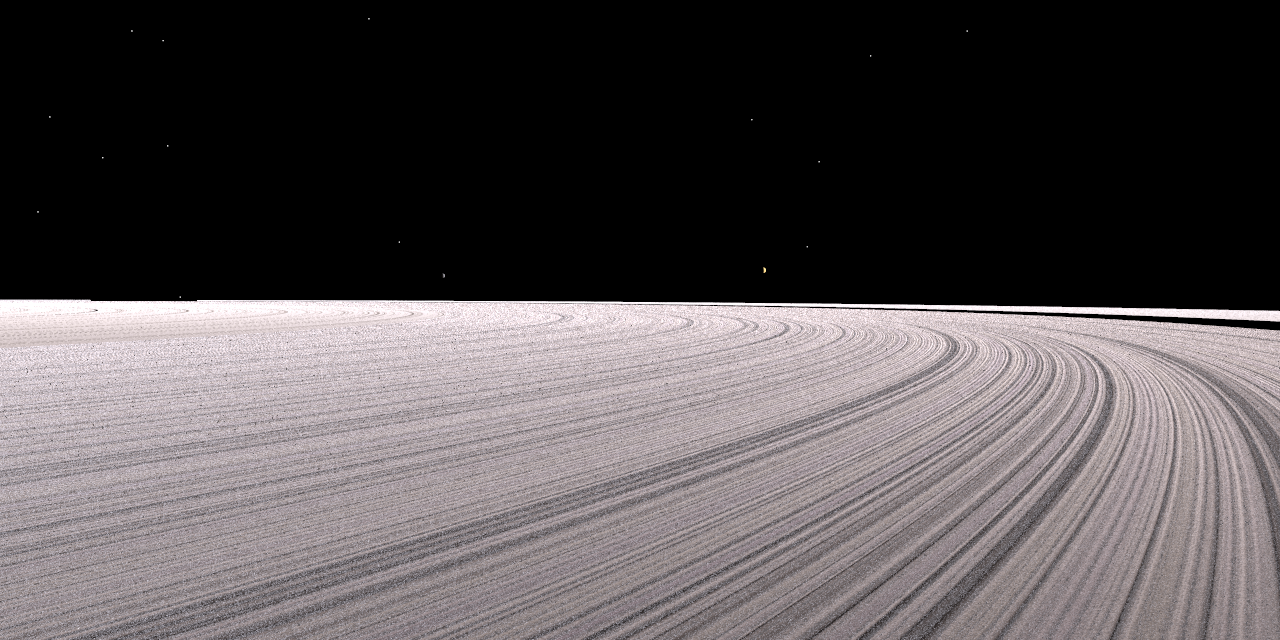
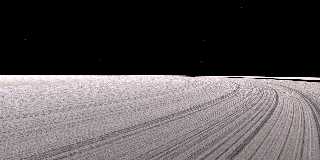
For different reasons, I have decided to use different ring thicknesses
according to the views. Overviews - like this one - uses thicker rings
than close ups. This implies also different ring parameters.

Here, the ring structure is conspicuously determined by the method 3
scattering media with a wave density pattern. This last also uses a
density map with real colours taken from a ring photograph. They are
much subdued here, I guess because the ring particles are of a uniform
texture ans should also bear the same pigment map pattern. Something I
need to test.

My first image using alpha version 3.71, incorporating the new
brilliance code in radiosity and in finish. However, settings are
conservative so nothing really different is visible at present.

I wanted to test the non-linear gradients but was unable to make it
work. From Clipka's note I assumed it should be added to the color or
pigment map blocks but that gives an error, as also added to the pigment
block. I need some guidance here.

--
Thomas
Post a reply to this message
Attachments:
Download 'complex.png' (992 KB)
Preview of image 'complex.png'
|
|
| |
| |
|
|
|
|
| |
| |
|
|
Am 24.01.2015 um 16:40 schrieb Thomas de Groot:

> I wanted to test the non-linear gradients but was unable to make it
> work. From Clipka's note I assumed it should be added to the color or
> pigment map blocks but that gives an error, as also added to the pigment
> block. I need some guidance here.

Usage should be like this (as an example):

     pigment {
       gradient -x translate x*0.75 scale 2
       pigment_map {
         blend_mode MODE
         blend_gamma GAMMA
         [0.333 color srgb <1,0,1>]
         [0.667 color srgb <1,1,1>]
       }
     }

Similar syntax should be used for colour_map.
Post a reply to this message
|
|
| |
| |
|
|
From: Thomas de Groot
Subject: Re: Saturn Ring - Second wip / POV version 3.71
Date: 25 Jan 2015 03:31:10
Message: <54c4a9ce$1@news.povray.org>
|
|
|
| |
| |
|
|
OK Thanks. I shall try that too. Otherwise, no problems up till now.
Changing the backslash to forward slash was pending for my files for a
long time, so the opportunity was timely :-)

--
Thomas
Post a reply to this message
|
|
| |
| |
|
|
From: Thomas de Groot
Subject: Re: Saturn Ring - Second wip problem
Date: 27 Jan 2015 03:48:35
Message: <54c750e3@news.povray.org>
|
|
|
| |
| |
|
|
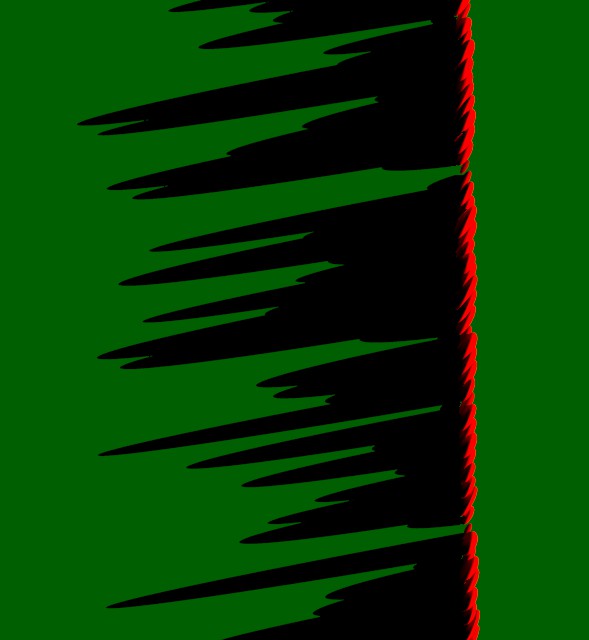
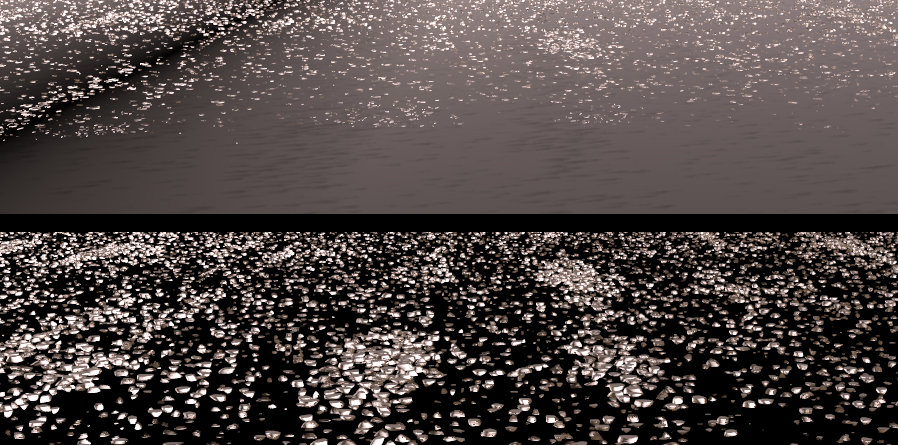
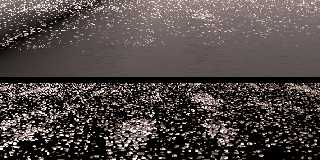
I have a problem showing up in the close up view of the ring.

-The upper half of the image shows the ring's isosurfaces with the media.
- The lower half shows the same but without the media.

In the upper half the isosurfaces are cut off in the area closest to the
camera.

Any idea?

--
Thomas
Post a reply to this message
Attachments:
Download 'complex_.png' (544 KB)
Preview of image 'complex_.png'
|
|
| |
| |
|
|
|
|
| |
| |
|
|
Once you have got these rings worked out to you satisfaction. You could
try modelling this ring system. ;-)

http://www.bbc.co.uk/news/science-environment-31001936


--

Regards
     Stephen
Post a reply to this message
|
|
| |
| |
|
|
|
|
| |
| |
|
|
On 27-1-2015 17:01, Stephen wrote:
> Once you have got these rings worked out to you satisfaction. You could
> try modelling this ring system. ;-)

Indeed. Could give interesting views.

But first our own neighbourhood :-)


--
Thomas
Post a reply to this message
|
|
| |
| |
|
|
|
|
| |