|
|
|
|
|
|
| |
| |
|
|
From: Thomas de Groot
Subject: Proof of concept: The wind in the reeds
Date: 16 Sep 2014 10:24:28
Message: <5418481c@news.povray.org>
|
|
|
| |
| |
|
|
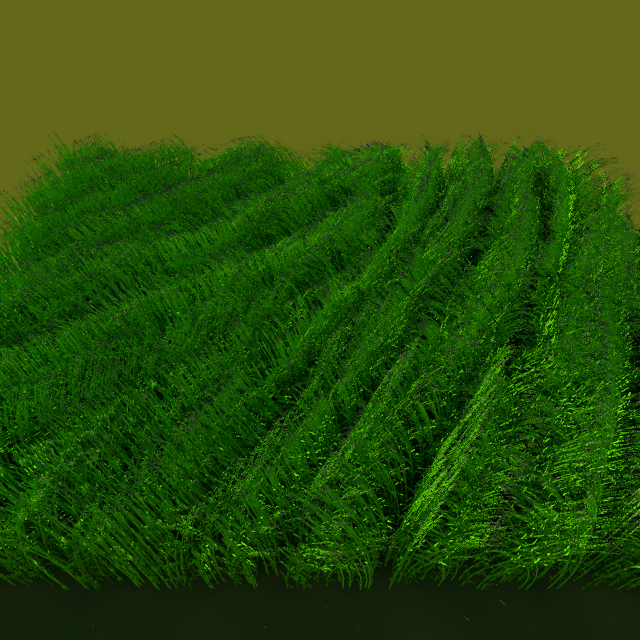
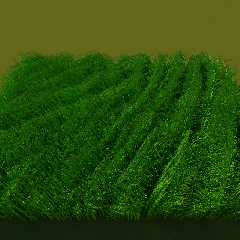
Well, I am interested in modelling wind patterns over a reed field, or a
corn field. What I seem to observe are turbulent wave patterns moving
the stalks back and forward while going over the field.

This is a first approximation. I am not really satisfied yet with the
pattern. What I did is:

1) Make an image_map with a more or less turbulent ripple pattern.
2) Make a height_field based on that image_map.
3) Build a reed stalk with Inverse Kinematic properties (macro with Bend
parameter).
4) Select random locations on the height_field;
4a) calculate the vertical angle between the normal at that location and
a horizontal plane (using: VAngleD(V1,V2));
4b) calculate the horizontal angle between (arbitrarily) the +z-axis
direction (direction of primary bending of the reed stalks) and the
normal of the random location point (using: VRotationD(V1,V2,axis)).
5a) bend the stalk with a proportion of the vertical angle (4a);
5b) orient the bended stalk by rotating through the horizontal angle (4b);
5c) place the reed stalks at the random locations on a flat surface.

The image shows 15000 reed stalks. About 4.5 minutes render time.

suggestions are more than welcome of course.

Thomas
Post a reply to this message
Attachments:
Download 'hf_pattern_testing.png' (574 KB)
Preview of image 'hf_pattern_testing.png'
|
|
| |
| |
|
|
|
|
| |
| |
|
|
> What I seem to observe are turbulent wave patterns moving
> the stalks back and forward....
> I am not really satisfied yet with the pattern.

I think the back part might be why you don't like it.
I don't think the wind would make them curve in opposing directions like that.
I'd say that maybe rather than "height", you use the image map as a force-map.
Better yet would be to use the ripple pattern as "real wind" and translate the
infinite pattern through the stationary reed field.
I'm not sharp enough at the moment to suggest exactly how to do that.
maybe grayscale eval_pigment?
Only bend the reed between 0 and the maximum wind deflection.
     Maybe in the advanced version let them spring back less than zero with an
initial absence of wind, with some sort of rapid decay back to zero.
Introduce a random rotation or sideways bend, in the event you'll at some point
animate this.

Very nice so far.  I haven't yet tried my hand with any of the plant macros or
plotting a gazillion objects.
(I'll post my tc-rtc WIP on TINA-CHeP soon...)


>What I did is:
>
> 1) Make an image_map with a more or less turbulent ripple pattern.
> 2) Make a height_field based on that image_map.
> 3) Build a reed stalk with Inverse Kinematic properties (macro with Bend
> parameter).
> 4) Select random locations on the height_field;
See above.

> 4a) calculate the vertical angle between the normal at that location and
> a horizontal plane (using: VAngleD(V1,V2));
Use the magnitude of the ripple pattern to directly increase the BEND

> 4b) calculate the horizontal angle between (arbitrarily) the +z-axis
> direction (direction of primary bending of the reed stalks) and the
> normal of the random location point (using: VRotationD(V1,V2,axis)).
Use some arbitrarily determined vector as your (wind) directional vector.
That way you can have it increase and decrease, and change directions like real
wind does, again with an eye toward possible future animation.

> 5a) bend the stalk with a proportion of the vertical angle (4a);
> 5b) orient the bended stalk by rotating through the horizontal angle (4b);
> 5c) place the reed stalks at the random locations on a flat surface.
>
> The image shows 15000 reed stalks. About 4.5 minutes render time.
>
> suggestions are more than welcome of course.
>
> Thomas
Post a reply to this message
|
|
| |
| |
|
|
|
|
| |
| |
|
|
Thomas de Groot <tho### [at] degroot org> wrote:
> Well, I am interested in modelling wind patterns over a reed field, or a
> corn field. What I seem to observe are turbulent wave patterns moving
> the stalks back and forward while going over the field.
>
> This is a first approximation. I am not really satisfied yet with the
> pattern. What I did is:
>
> 1) Make an image_map with a more or less turbulent ripple pattern.
> 2) Make a height_field based on that image_map.
> 3) Build a reed stalk with Inverse Kinematic properties (macro with Bend
> parameter).
> 4) Select random locations on the height_field;
> 4a) calculate the vertical angle between the normal at that location and
> a horizontal plane (using: VAngleD(V1,V2));
> 4b) calculate the horizontal angle between (arbitrarily) the +z-axis
> direction (direction of primary bending of the reed stalks) and the
> normal of the random location point (using: VRotationD(V1,V2,axis)).
> 5a) bend the stalk with a proportion of the vertical angle (4a);
> 5b) orient the bended stalk by rotating through the horizontal angle (4b);
> 5c) place the reed stalks at the random locations on a flat surface.
>
> The image shows 15000 reed stalks. About 4.5 minutes render time.
>
> suggestions are more than welcome of course.
>
> Thomas
Unfortunatelly I'm not familiar with the macros you use. But your stalks seems
to form a parting, like with hair, close to the right third. The most stalks to
the left of this point are bended to the left the others to the right. So I
wonder about the direction of the wind. I would propose a more simple approach
here. Bend them all in the same direction (with a slight random deviation, due
to the differences in the individual strenght of the stalks). May be you can
model the ground level too, having deeper stalks more straight and bend higher
ones more since they are more influenced by the wind.
Only some short thoughts about the matter,
Best regards,
Micahel org> wrote:
> Well, I am interested in modelling wind patterns over a reed field, or a
> corn field. What I seem to observe are turbulent wave patterns moving
> the stalks back and forward while going over the field.
>
> This is a first approximation. I am not really satisfied yet with the
> pattern. What I did is:
>
> 1) Make an image_map with a more or less turbulent ripple pattern.
> 2) Make a height_field based on that image_map.
> 3) Build a reed stalk with Inverse Kinematic properties (macro with Bend
> parameter).
> 4) Select random locations on the height_field;
> 4a) calculate the vertical angle between the normal at that location and
> a horizontal plane (using: VAngleD(V1,V2));
> 4b) calculate the horizontal angle between (arbitrarily) the +z-axis
> direction (direction of primary bending of the reed stalks) and the
> normal of the random location point (using: VRotationD(V1,V2,axis)).
> 5a) bend the stalk with a proportion of the vertical angle (4a);
> 5b) orient the bended stalk by rotating through the horizontal angle (4b);
> 5c) place the reed stalks at the random locations on a flat surface.
>
> The image shows 15000 reed stalks. About 4.5 minutes render time.
>
> suggestions are more than welcome of course.
>
> Thomas
Unfortunatelly I'm not familiar with the macros you use. But your stalks seems
to form a parting, like with hair, close to the right third. The most stalks to
the left of this point are bended to the left the others to the right. So I
wonder about the direction of the wind. I would propose a more simple approach
here. Bend them all in the same direction (with a slight random deviation, due
to the differences in the individual strenght of the stalks). May be you can
model the ground level too, having deeper stalks more straight and bend higher
ones more since they are more influenced by the wind.
Only some short thoughts about the matter,
Best regards,
Micahel
Post a reply to this message
|
|
| |
| |
|
|
|
|
| |
| |
|
|
Am 16.09.2014 16:24, schrieb Thomas de Groot:
> Well, I am interested in modelling wind patterns over a reed field, or a
> corn field. What I seem to observe are turbulent wave patterns moving
> the stalks back and forward while going over the field.

Looks quite promising for a start.

> suggestions are more than welcome of course.

Sure.

It seems to me that you're bending any given reed with a constant radius
along the whole length of the stalk; I suspect that the stalk should
bend most strongly at the base, because of (a) the wind acting not only
on the tip of the stalk, but also on lower portions, so that the wind
force affecting the bending of any given point increases downward along
the stalk, (b) the stalk acting as a lever, further amplifying the
bending force exerted on any given point on the stalk based on how far
it is from the tip, and (c) the wind force acting upon a near-vertical
portion of the stalk being stronger than that acting upon a
near-horizontal portion.

The reeds should bend in a single direction only (albeit at different
amplitudes) - the primary direction of the wind.

As for the waves, I guess they are not from turbulences already present
in the wind, but rather from upright reeds "shadowing" those further
downwind causing them to rise again, while themselves being exposed to
the wind and beginning to move downward; this effect might be initiated
and amplified by the individual reeds also resonating in the wind due to
(c).
Post a reply to this message
|
|
| |
| |
|
|
|
|
| |
| |
|
|
Le 14-09-16 14:39, clipka a écrit :
> Am 16.09.2014 16:24, schrieb Thomas de Groot:
>> Well, I am interested in modelling wind patterns over a reed field, or a
>> corn field. What I seem to observe are turbulent wave patterns moving
>> the stalks back and forward while going over the field.
>
> Looks quite promising for a start.
>
>> suggestions are more than welcome of course.
>
> Sure.
>
> It seems to me that you're bending any given reed with a constant radius
> along the whole length of the stalk; I suspect that the stalk should
> bend most strongly at the base, because of (a) the wind acting not only
> on the tip of the stalk, but also on lower portions, so that the wind
> force affecting the bending of any given point increases downward along
> the stalk, (b) the stalk acting as a lever, further amplifying the
> bending force exerted on any given point on the stalk based on how far
> it is from the tip, and (c) the wind force acting upon a near-vertical
> portion of the stalk being stronger than that acting upon a
> near-horizontal portion.
>
> The reeds should bend in a single direction only (albeit at different
> amplitudes) - the primary direction of the wind.
>
> As for the waves, I guess they are not from turbulences already present
> in the wind, but rather from upright reeds "shadowing" those further
> downwind causing them to rise again, while themselves being exposed to
> the wind and beginning to move downward; this effect might be initiated
> and amplified by the individual reeds also resonating in the wind due to
> (c).
>

In a field, the wind can't affect the stalks near the base because the
other stalks up wind will shield those downwind. So, the wind only
affect the top part as soon as you are a few meters from the wind facing
edge.

The stalks tend to be slightly broader near the base, making them stiffer.

In most cases, there is some sort of flowering or grapes of seeds near
the top, increasing the surface exposed to wind and adding some height
neat the tips.

This combine in making the stalks bend in a smooth way with the maximum
curvature somewhere near mid height.


Alain
Post a reply to this message
|
|
| |
| |
|
|
|
|
| |
| |
|
|
> I suspect that the stalk should
> bend most strongly at the base, because of (a) the wind acting not only
> on the tip of the stalk, but also on lower portions, so that the wind
> force affecting the bending of any given point increases downward along
> the stalk,

I would say that it decreases as you approach the ground.  See Alain's comments,
although I would say that the maximum force/curvature would be near the top.
There is the shielding effect, the tapering effect, the higher surface area due
to flowering, and also the laminar flow issues.

> (b) the stalk acting as a lever, further amplifying the
> bending force exerted on any given point on the stalk based on how far
> it is from the tip

True, but it's all to easy to "reason in reverse" and come up with exactly the
opposite conclusion.   Can't tell you how many times I've done that.  :\

>(c) the wind force acting upon a near-vertical
> portion of the stalk being stronger than that acting upon a
> near-horizontal portion.

?  Not sure what you meant by that.

>
> The reeds should bend in a single direction only (albeit at different
> amplitudes) - the primary direction of the wind.

True, but often there is some asymmetry to the stalk - they might be elliptic in
cross-section, and sometimes IIRC they are almost tear-shaped, with a thin rigid
rib at the thinnest portion.  Depending upon the orientation of that and the
direction of the wind, that could give rise to a twisting effect.
I suppose searching for some IRL video would be in order.

> As for the waves, I guess they are not from turbulences already present
> in the wind, but rather from upright reeds "shadowing" those further
> downwind causing them to rise again, while themselves being exposed to
> the wind and beginning to move downward; this effect might be initiated
> and amplified by the individual reeds also resonating in the wind due to
> (c).

I'm not quite sure exactly what the waves are a result of, but anyone who's done
and has studied long-range ballistics knows that wind speed and direction can be
all over the place between you and what you're looking at 400 yards away.
What's going on where you are, what's going on at where you're looking, and
what's going on at various places in between can vary and even be in complete
opposition.
Consider a tornado, where on one side the air is moving North, and on the other
side it's moving South.  Ditto East & West.
The same kind of thing can happen in vertical strata as well.

I think Thomas needs funding to study the issue....    ;)
Post a reply to this message
|
|
| |
| |
|
|
From: Thomas de Groot
Subject: Re: Proof of concept: The wind in the reeds
Date: 17 Sep 2014 03:52:30
Message: <54193dbe@news.povray.org>
|
|
|
| |
| |
|
|
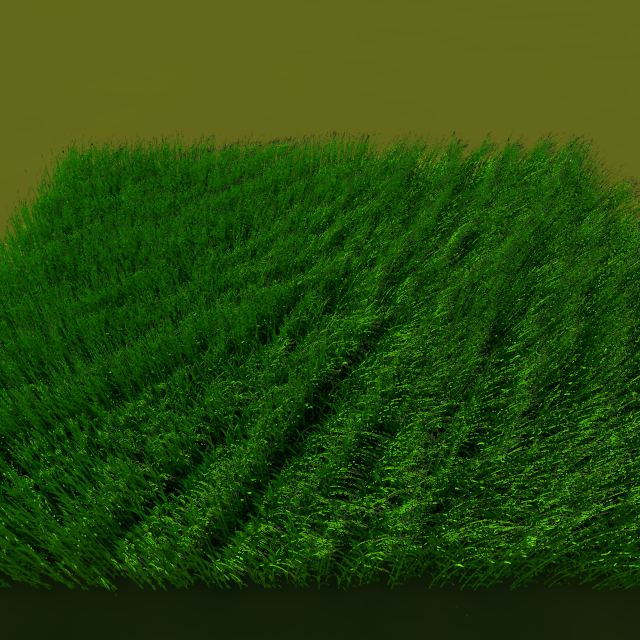
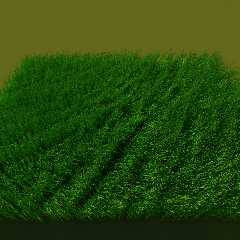
That back bending is simply unrealistic. Just changing the bending
direction already improves things. What I did was add 180 degrees to all
negative rotations.

Thanks for all the suggestions.

@ Bald Eagle: I do indeed use the image_map as a kind of force map,
through the height_field stage and then using the properties of the
normals. Basically, I think that is identical to what you suggest? The
rate of bending is proportional to the normal: pointing upward => no
bending; increased bending with increasing normal angle towards the
horizontal.

@ MichaelJF: Yes, that parting was killing the effect and came from my
concept of rebounding of the stalks. In any case, this was far to strong
here. I presently dropped this effect for the time being.

@ clipka: the bending angle is uniform over the whole length as a first
approximation. In reality, I expect bending to increase towards the top,
due to the different effects already mentioned by Alain and Bald Eagle.
Most important in my view are the thickness/rigidity of the stalks
towards the base and the damping effect of surrounding stalks. The
former is easy to implement, the latter is more difficult, especially if
one also wants to consider collision effects. At present, I do not know
how to tread that path.

Something I still believe not right is the wave length of the effect. I
think it should be larger.

Also note in the present image that all stalks start from the same
initial orientation/scale. I need to introduce more randomness /and/ add
different types of stalks.

Thomas
Post a reply to this message
Attachments:
Download 'hf_pattern_testing.png' (576 KB)
Preview of image 'hf_pattern_testing.png'
|
|
| |
| |
|
|
From: Paolo Gibellini
Subject: Re: Proof of concept: The wind in the reeds
Date: 17 Sep 2014 05:35:33
Message: <541955e5@news.povray.org>
|
|
|
| |
| |
|
|
Thomas de Groot wrote on 16/09/2014 16.24:
> Well, I am interested in modelling wind patterns over a reed field, or a
> corn field. What I seem to observe are turbulent wave patterns moving
> the stalks back and forward while going over the field.
>

It looks promising and somehow organic (why it remembers me the seaweed
salad?).
A nice technique,
;-)
Paolo
Post a reply to this message
|
|
| |
| |
|
|
From: Thomas de Groot
Subject: Re: Proof of concept: The wind in the reeds
Date: 17 Sep 2014 07:30:45
Message: <541970e5@news.povray.org>
|
|
|
| |
| |
|
|
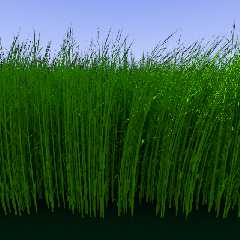
Thanks Paolo.

As a bonus, this image with randomisation of scale and initial vertical
rotation. Also, bending diminishes downwards.

Thomas
Post a reply to this message
Attachments:
Download 'hf_pattern_testing.png' (449 KB)
Preview of image 'hf_pattern_testing.png'
|
|
| |
| |
|
|
|
|
| |
| |
|
|
Am 17.09.2014 13:30, schrieb Thomas de Groot:
> Thanks Paolo.
>
> As a bonus, this image with randomisation of scale and initial vertical
> rotation. Also, bending diminishes downwards.

I concede that it looks good this way.
Post a reply to this message
|
|
| |
| |
|
|
|
|
| |
| |
|
|
Thomas de Groot <tho### [at] degrootorg> wrote:
> That back bending is simply unrealistic. Just changing the bending
> direction already improves things. What I did was add 180 degrees to all
> negative rotations.
>
> Thanks for all the suggestions.
>
> @ Bald Eagle: I do indeed use the image_map as a kind of force map,
> through the height_field stage and then using the properties of the
> normals. Basically, I think that is identical to what you suggest? The
> rate of bending is proportional to the normal: pointing upward => no
> bending; increased bending with increasing normal angle towards the
> horizontal.
>
> @ MichaelJF: Yes, that parting was killing the effect and came from my
> concept of rebounding of the stalks. In any case, this was far to strong
> here. I presently dropped this effect for the time being.
>
> @ clipka: the bending angle is uniform over the whole length as a first
> approximation. In reality, I expect bending to increase towards the top,
> due to the different effects already mentioned by Alain and Bald Eagle.
> Most important in my view are the thickness/rigidity of the stalks
> towards the base and the damping effect of surrounding stalks. The
> former is easy to implement, the latter is more difficult, especially if
> one also wants to consider collision effects. At present, I do not know
> how to tread that path.
>
> Something I still believe not right is the wave length of the effect. I
> think it should be larger.
>
> Also note in the present image that all stalks start from the same
> initial orientation/scale. I need to introduce more randomness /and/ add
> different types of stalks.
>
> Thomas

Looks very much better in my eyes. In fact I'm working on a somewhat similiar
issue at the moment. That is why I came up with suggestions to control the
bending and length of the straws depending on the position (and the normal
provided by the trace()-command). I'm trying to give a certain model a special
hair-style. (Stephen will recognize the source of my inspiration most likely.) I
admit, there is room to improvement...

Best regards,
Michael
Post a reply to this message
Attachments:
Download 'mudmaid_veryfirstwip.jpg' (11 KB)
Preview of image 'mudmaid_veryfirstwip.jpg'

|
|
| |
| |
|
|
From: Jörg 'Yadgar' Bleimann
Subject: Re: Proof of concept: The wind in the reeds
Date: 17 Sep 2014 19:42:36
Message: <541a1c6c$1@news.povray.org>
|
|
|
| |
| |
|
|
Hi(gh)!

On 17.09.2014 13:30, Thomas de Groot wrote:
> Thanks Paolo.
>
> As a bonus, this image with randomisation of scale and initial vertical
> rotation. Also, bending diminishes downwards.
>
> Thomas

And they do not intersect each other? That in fact would be stunning!

See you in Khyberspace!

Yadgar

Now playing: Hearts (Jon Anderson)
Post a reply to this message
|
|
| |
| |
|
|
|
|
| |
| |
|
|
Thomas de Groot <tho### [at] degrootorg> wrote:
> Well, I am interested in modelling wind patterns over a reed field, or a
> corn field. What I seem to observe are turbulent wave patterns moving
> the stalks back and forward while going over the field.
>
> This is a first approximation. I am not really satisfied yet with the
> pattern. What I did is:
>
> 1) Make an image_map with a more or less turbulent ripple pattern.
> 2) Make a height_field based on that image_map.
> 3) Build a reed stalk with Inverse Kinematic properties (macro with Bend
> parameter).
> 4) Select random locations on the height_field;
> 4a) calculate the vertical angle between the normal at that location and
> a horizontal plane (using: VAngleD(V1,V2));
> 4b) calculate the horizontal angle between (arbitrarily) the +z-axis
> direction (direction of primary bending of the reed stalks) and the
> normal of the random location point (using: VRotationD(V1,V2,axis)).
> 5a) bend the stalk with a proportion of the vertical angle (4a);
> 5b) orient the bended stalk by rotating through the horizontal angle (4b);
> 5c) place the reed stalks at the random locations on a flat surface.
>
> The image shows 15000 reed stalks. About 4.5 minutes render time.
>
> suggestions are more than welcome of course.
>
> Thomas

Wow, like a painting.

What are the povray objects you use?
Post a reply to this message
|
|
| |
| |
|
|
From: Thomas de Groot
Subject: Re: Proof of concept: The wind in the reeds
Date: 18 Sep 2014 03:25:57
Message: <541a8905@news.povray.org>
|
|
|
| |
| |
|
|
On 17-9-2014 22:34, MichaelJF wrote:
> Looks very much better in my eyes. In fact I'm working on a somewhat similiar
> issue at the moment. That is why I came up with suggestions to control the
> bending and length of the straws depending on the position (and the normal
> provided by the trace()-command). I'm trying to give a certain model a special
> hair-style. (Stephen will recognize the source of my inspiration most likely.) I
> admit, there is room to improvement...

Ah yes, I can see the similarities indeed. Interesting hair model!

There is great potential in using the normal. In my case length control
does not make really sense, derived from the normal - except if I were
using /another/ image_map for controlling reed height in determined
areas; evalpig would be my friend in that case.

Thomas
Post a reply to this message
|
|
| |
| |
|
|
From: Thomas de Groot
Subject: Re: Proof of concept: The wind in the reeds
Date: 18 Sep 2014 03:28:40
Message: <541a89a8@news.povray.org>
|
|
|
| |
| |
|
|
On 18-9-2014 1:43, Jörg 'Yadgar' Bleimann wrote:
> And they do not intersect each other? That in fact would be stunning!

Alas! There is no collision control available. However, intersections
are probably only visible to the really discerning eye ;-)

Thomas
Post a reply to this message
|
|
| |
| |
|
|
From: Thomas de Groot
Subject: Re: Proof of concept: The wind in the reeds
Date: 18 Sep 2014 03:34:11
Message: <541a8af3@news.povray.org>
|
|
|
| |
| |
|
|
On 18-9-2014 7:25, And wrote:
> Wow, like a painting.
>
> What are the povray objects you use?
>

Thanks. Mesh2 objects, modelled in Silo. This one still has a couple of
small issues that need correction. When finished, I shall upload
everything to p.b.s-f.

Thomas
Post a reply to this message
|
|
| |
| |
|
|
|
|
| |
| |
|
|
Hi Thomas,

This is looking really great, I pobably am missing some step but how exactly can
you bend a mesh2 object in pov?

Thanks

Sean
Post a reply to this message
|
|
| |
| |
|
|
|
|
| |
| |
|
|
On 18-9-2014 10:08, s.day wrote:
> Hi Thomas,
>
> This is looking really great, I pobably am missing some step but how exactly can
> you bend a mesh2 object in pov?
>

I shall upload the model soon, when I have finished some corrections.

In the mean time, you need to build the model following inverse
kinematic principles. This means that the model subdivided in discrete
elements and articulated at their juncture, but not in a haphazardly
way. Here follows the construction of the reed stalk as I use it. You
can already study its inner workings:

#macro Reed(Bend)

//random rotation for the whole stalk:
#local Rot = RRand(-180, 180, R);

//construction of the Inverse kinematic stalk:
#local Bend1 = Bend+((2*Bend)/10);
#local Plume =
union {
   object {ReedMesh_03_ik_Reed01_plume_ material{Reed01_plume_} hollow
translate -10.40*y rotate Rot*y rotate Bend1*x translate (10.40-10.18)*y }
   object {ReedMesh_03_ik_Reed01_11_  material{Reed01_11_} hollow
translate -10.18*y rotate Rot*y}
}

#local Bend2 = Bend+(Bend/10);
#local Top =
union {
   object {Plume rotate Bend2*x translate (10.18-9.86)*y}
   object {ReedMesh_03_ik_Reed01_10_  material{Reed01_10_} hollow
translate -9.86*y rotate Rot*y}
}

#local Stem9 =
union {
   object {Top rotate Bend*x translate (9.86-9.54)*y}
   object{ReedMesh_03_ik_Reed01_9_  material{Reed01_9_} hollow translate
-9.54*y rotate Rot*y}
}

#local Bend = Bend-(Bend/20);
#local Stem8 =
union {
   object {Stem9 rotate Bend*x translate (9.54-9.165)*y}
   object{ReedMesh_03_ik_Reed01_8_  material{Reed01_8_} hollow translate
-9.165*y rotate Rot*y}
}

#local Bend = Bend-(Bend/20);
#local Stem7 =
union {
   object {Stem8 rotate Bend*x translate (9.165-8.79)*y}
   object{ReedMesh_03_ik_Reed01_7_  material{Reed01_7_} hollow translate
-8.79*y rotate Rot*y}
}

#local Bend = Bend-(Bend/20);
#local Stem6 =
union {
   object {Stem7 rotate Bend*x translate (8.79-7.72)*y}
   object{ReedMesh_03_ik_Reed01_6_  material{Reed01_6_} hollow translate
-7.72*y rotate Rot*y}
}

#local Bend = Bend-(Bend/20);
#local Stem5 =
union {
   object {Stem6 rotate Bend*x translate (7.72-6.20)*y}
   object{ReedMesh_03_ik_Reed01_5_  material{Reed01_5_} hollow translate
-6.20*y rotate Rot*y}
}

#local Bend = Bend-(Bend/20);
#local Stem4 =
union {
   object {Stem5 rotate Bend*x translate (6.20-4.65)*y}
   object{ReedMesh_03_ik_Reed01_4_  material{Reed01_4_} hollow translate
-4.65*y rotate Rot*y}
}

#local Bend = Bend-(Bend/20);
#local Stem3 =
union {
   object {Stem4 rotate Bend*x translate (4.65-3.10)*y}
   object{ReedMesh_03_ik_Reed01_3_  material{Reed01_3_} hollow translate
-3.10*y rotate Rot*y}
}

#local Bend = Bend-(Bend/20);
#local Stem2 =
union {
   object {Stem3 rotate Bend*x translate (3.10-1.55)*y}
   object{ReedMesh_03_ik_Reed01_2_  material{Reed01_2_} hollow translate
-1.55*y rotate Rot*y}
}

#local Bend = Bend-(Bend/20);
#declare ReedMesh_03 =
union {
   object {Stem2 rotate Bend*x translate 1.55*y}
   object{ReedMesh_03_ik_Reed01_1_  material{Reed01_1_} hollow rotate Rot*y}
}

#end  //macro

As you can see, the construction starts at the top of the stalk and
gradually incorporates adjacent elements until the base is reached. Note
that /only/ rotations can be used as transformations inside the IK
model. All other transformations must be applied to the /complete/ model
or not at all. Note also that /all/ internal rotations of the model are
applied *at the origin*.

Thomas
Post a reply to this message
|
|
| |
| |
|
|
|
|
| |
| |
|
|
Thomas de Groot <tho### [at] degrootorg> wrote:
> I shall upload the model soon, when I have finished some corrections.
>
> In the mean time, you need to build the model following inverse
> kinematic principles. This means that the model subdivided in discrete
> elements and articulated at their juncture, but not in a haphazardly
> way. Here follows the construction of the reed stalk as I use it. You
> can already study its inner workings:
>

Thanks Thomas,

I hadn't thought about having separate sections, I thought you were somehow
bending the acutal mesh (doh!).

Sean
Post a reply to this message
|
|
| |
| |
|
|
From: Thomas de Groot
Subject: Re: Proof of concept: The wind in the reeds
Date: 19 Sep 2014 08:19:18
Message: <541c1f46@news.povray.org>
|
|
|
| |
| |
|
|
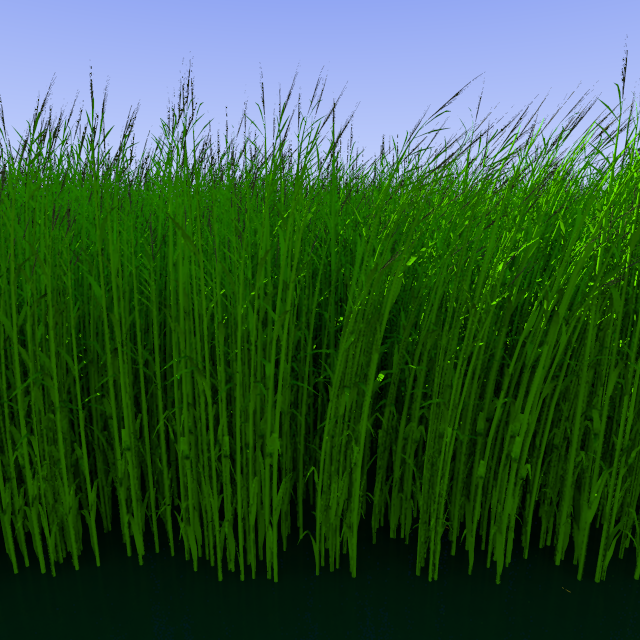
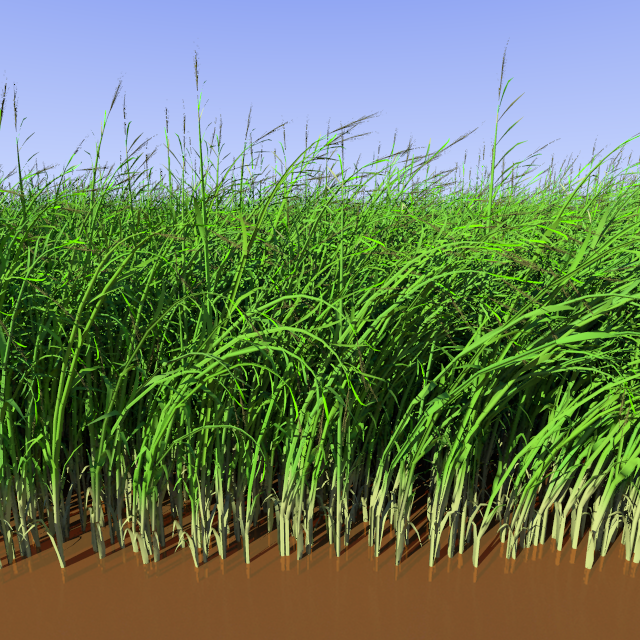
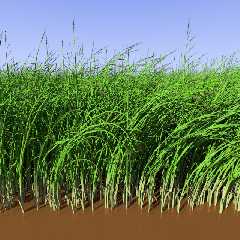
I have attached my code and the used reed stalk, in p.b.s-f.

Explore and enjoy!

Thomas
Post a reply to this message
Attachments:
Download 'wind_pattern.png' (662 KB)
Preview of image 'wind_pattern.png'
|
|
| |
| |
|
|
|
|
| |
| |
|
|
"s.day" <s.d### [at] uelacuk> wrote:
> Hi Thomas,
>
> This is looking really great, I pobably am missing some step but how exactly can
> you bend a mesh2 object in pov?
>
> Thanks
>
> Sean

If you have a proper inside vector you can bend mesh2 objects with the approach
by Chris Colefax. In this case, mesh2 objects can be handled like other CSG
objects (spheres, boxes and so on). I have done this with my snails
(http://www.tc-rtc.co.uk/imagenewdisplay/stills/index345.html) which consists of
a mesh2 object and a blob with thousands of components. In fact I did not
understood Chris's parameters and wrote an own approach, but very similiar to
Chris, since I judged it easier to implement it by myself than to understand his
parametrisations.

@Thomas: The Mud Maid at the "Lost Gardens of Heligan" (I spend my holydays this
year very close to this garden) is a sculpture consisting of mud, clay, cement,
gras, ivy and moss and she is laying at the left side of her body to the ground,
so no much grass at the left side if standing;-)

Best regards,
Michael
Post a reply to this message
|
|
| |
| |
|
|
|
|
| |
| |
|
|
On 20-9-2014 19:51, MichaelJF wrote:
> If you have a proper inside vector you can bend mesh2 objects with the approach
> by Chris Colefax. In this case, mesh2 objects can be handled like other CSG
> objects (spheres, boxes and so on). I have done this with my snails
> (http://www.tc-rtc.co.uk/imagenewdisplay/stills/index345.html) which consists of
> a mesh2 object and a blob with thousands of components. In fact I did not
> understood Chris's parameters and wrote an own approach, but very similiar to
> Chris, since I judged it easier to implement it by myself than to understand his
> parametrisations.

Not sure, but I think that /bending/ an object will be much slower to
render, especially if there are 15000 of them ;-)

>
> @Thomas: The Mud Maid at the "Lost Gardens of Heligan" (I spend my holydays this
> year very close to this garden) is a sculpture consisting of mud, clay, cement,
> gras, ivy and moss and she is laying at the left side of her body to the ground,
> so no much grass at the left side if standing;-)

Ah yes, the Lost Gardens! I unfortunately missed those when I stayed in
Penzance many years ago. Only much later I heard about them. I hope
/your/ Mud Maid will make it here or perhaps at the TC-RTC.

Thomas
Post a reply to this message
|
|
| |
| |
|
|
|
|
| |
| |
|
|
Thomas de Groot <tho### [at] degrootorg> wrote:
>
> Not sure, but I think that /bending/ an object will be much slower to
> render, especially if there are 15000 of them ;-)

Yes, indeed, the rendering time is heavily increased with this approach. The
only option to reduce it a little bit is to give proper bounding boxes
(bounded_by) since bounding with csg-differences or -intersections are not
implemented as one would expect in POV. But I think this would be a very hard
job, and so I can understand, that this issue has not been addressed so far.

>
> >
> > @Thomas: The Mud Maid at the "Lost Gardens of Heligan" (I spend my holydays this
> > year very close to this garden) is a sculpture consisting of mud, clay, cement,
> > gras, ivy and moss and she is laying at the left side of her body to the ground,
> > so no much grass at the left side if standing;-)
>
> Ah yes, the Lost Gardens! I unfortunately missed those when I stayed in
> Penzance many years ago. Only much later I heard about them. I hope
> /your/ Mud Maid will make it here or perhaps at the TC-RTC.
>
> Thomas

I really hope that this WIP will make it to the contest. At the moment I have no
idea to link my imagined image to the topic. May be the Men-An-Tol as a stargate
at the background, just to keep it cornish.


Best regards,
Michael
Post a reply to this message
|
|
| |
| |
|
|
|
|
| |
| |
|
|
Thomas de Groot wrote on 19/09/2014 14.18:
> I have attached my code and the used reed stalk, in p.b.s-f.
>
> Explore and enjoy!
>
> Thomas
>
This one is very credible! It needs only some animals, now.
Are you starting a new image for the POV-Ray Hall of Fame?
Paolo
Post a reply to this message
|
|
| |
| |
|
|
|
|
| |
| |
|
|
On 22-9-2014 9:19, Paolo Gibellini wrote:
> This one is very credible! It needs only some animals, now.
> Are you starting a new image for the POV-Ray Hall of Fame?
> Paolo

Thanks Paolo, I am quite satisfied too :-) But it is far from HoF
quality and I guess my work in general generally falls short of that
too. It is not my aim (as if it were me to decide ;-) )

Thomas
Post a reply to this message
|
|
| |
| |
|
|
|
|
| |
| |
|
|
On 19-9-2014 14:18, Thomas de Groot wrote:
> I have attached my code and the used reed stalk, in p.b.s-f.
>
> Explore and enjoy!
>
> Thomas
>
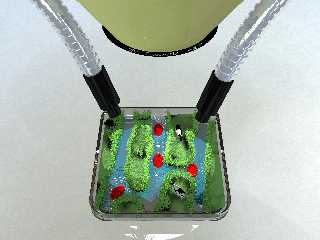
Much better than my attempt of (my god, i'm getting old) seven years
ago. I didn't dare to choose a close camera point at the time.

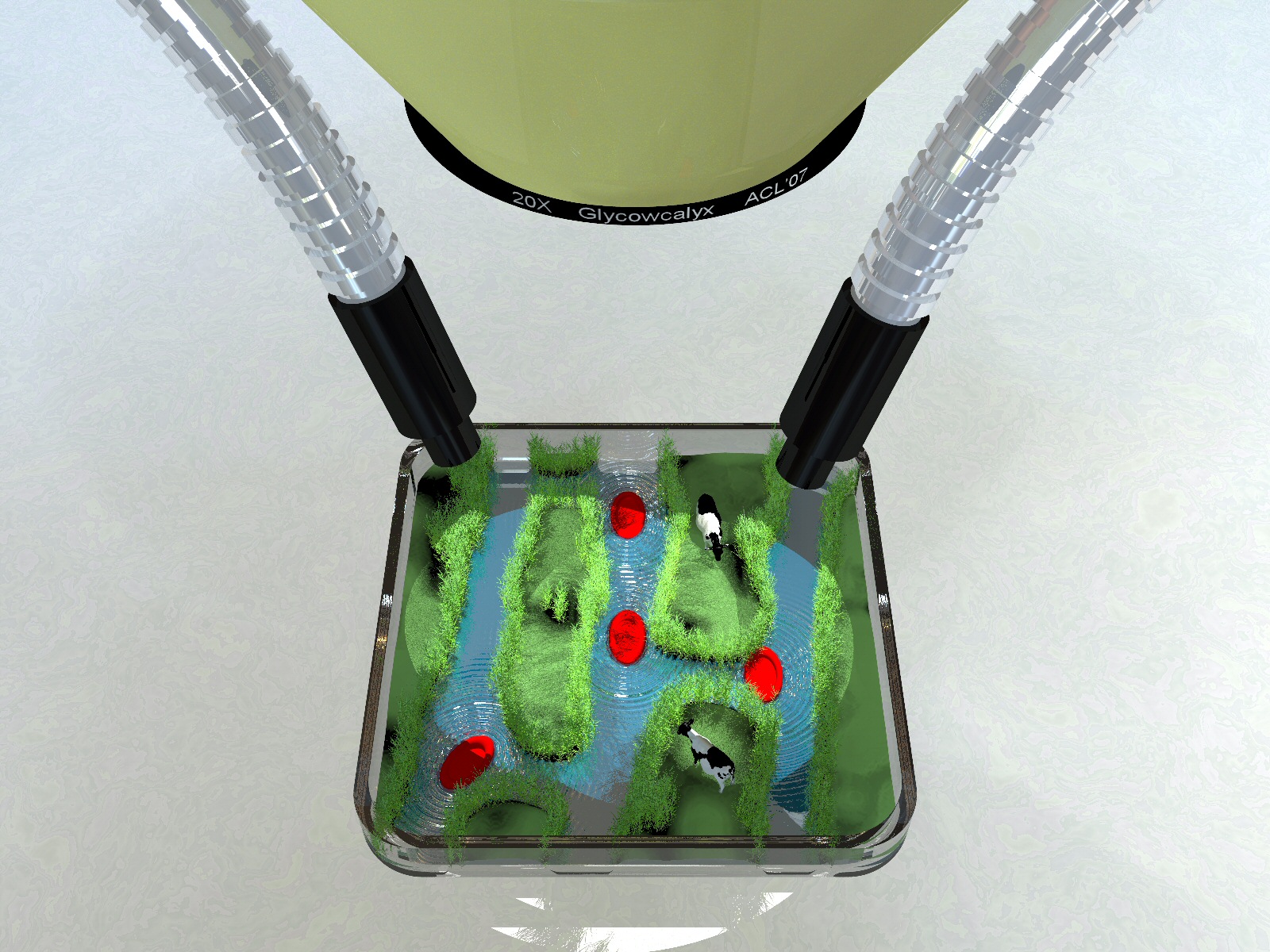
(The image is of course an illustarion of the glycocalyx, although I
don't expect many of you are familiar with that. It is the layer of long
proteins on the inside of bloodvessels that for a sort of gel and
protect the bloodcells from colliding with the walls.)


--
Everytime the IT department forbids something that a researcher deems
necessary for her work there will be another hole in the firewall.
Post a reply to this message
Attachments:
Download 'glycowcalyx.jpg' (564 KB)
Preview of image 'glycowcalyx.jpg'
|
|
| |
| |
|
|
|
|
| |
| |
|
|
On 22/09/2014 09:30, andrel wrote:
> On 19-9-2014 14:18, Thomas de Groot wrote:
>> I have attached my code and the used reed stalk, in p.b.s-f.
>>
>> Explore and enjoy!
>>
>> Thomas
>>
> Much better than my attempt of (my god, i'm getting old) seven years
> ago. I didn't dare to choose a close camera point at the time.
>
> (The image is of course an illustarion of the glycocalyx, although I
> don't expect many of you are familiar with that. It is the layer of long
> proteins on the inside of bloodvessels that for a sort of gel and
> protect the bloodcells from colliding with the walls.)
>
>

LOL
Well done.
Friesian cows I assume. But why?


--

Regards
     Stephen
Post a reply to this message
|
|
| |
| |
|
|
From: Thomas de Groot
Subject: Re: Proof of concept: The wind in the reeds
Date: 22 Sep 2014 07:19:02
Message: <542005a6@news.povray.org>
|
|
|
| |
| |
|
|
On 22-9-2014 10:30, andrel wrote:
> On 19-9-2014 14:18, Thomas de Groot wrote:
>> I have attached my code and the used reed stalk, in p.b.s-f.
>>
>> Explore and enjoy!
>>
>> Thomas
>>
> Much better than my attempt of (my god, i'm getting old) seven years
> ago. I didn't dare to choose a close camera point at the time.
>
> (The image is of course an illustarion of the glycocalyx, although I
> don't expect many of you are familiar with that. It is the layer of long
> proteins on the inside of bloodvessels that for a sort of gel and
> protect the bloodcells from colliding with the walls.)
>
>

Oh! I remember that one! A humoristic approach to Waterland indeed. ;-)

Thomas
Post a reply to this message
|
|
| |
| |
|
|
|
|
| |
| |
|
|
On 22-9-2014 12:15, Stephen wrote:
> LOL
> Well done.
> Friesian cows I assume. But why?
>

Why not? ;-)

Thomas
Post a reply to this message
|
|
| |
| |
|
|
|
|
| |
| |
|
|
On 22-9-2014 12:15, Stephen wrote:
> On 22/09/2014 09:30, andrel wrote:
>> On 19-9-2014 14:18, Thomas de Groot wrote:
>>> I have attached my code and the used reed stalk, in p.b.s-f.
>>>
>>> Explore and enjoy!
>>>
>>> Thomas
>>>
>> Much better than my attempt of (my god, i'm getting old) seven years
>> ago. I didn't dare to choose a close camera point at the time.
>>
>> (The image is of course an illustarion of the glycocalyx, although I
>> don't expect many of you are familiar with that. It is the layer of long
>> proteins on the inside of bloodvessels that for a sort of gel and
>> protect the bloodcells from colliding with the walls.)
>>
>>
>
> LOL
> Well done.
> Friesian cows I assume. But why?

to emphasize that the scene in the glass container is in fact microscopic.


--
Everytime the IT department forbids something that a researcher deems
necessary for her work there will be another hole in the firewall.
Post a reply to this message
|
|
| |
| |
|
|
|
|
| |
| |
|
|
On 22/09/2014 12:19, Thomas de Groot wrote:
> On 22-9-2014 12:15, Stephen wrote:
>> LOL
>> Well done.
>> Friesian cows I assume. But why?
>>
>
> Why not? ;-)
>

Why not indeed?

Do you take a proprietorial interest?

--

Regards
     Stephen
Post a reply to this message
|
|
| |
| |
|
|
|
|
| |
| |
|
|
On 22/09/2014 13:11, andrel wrote:
>> LOL
>> Well done.
>> Friesian cows I assume. But why?
>
> to emphasize that the scene in the glass container is in fact microscopic.

Ah! of course I get it now.

The spelling of glycocalyx is a pointer as well, I believe.
I really like that image. It tickles my fancy.

--

Regards
     Stephen
Post a reply to this message
|
|
| |
| |
|
|
|
|
| |
| |
|
|
On 22-9-2014 15:45, Stephen wrote:
> Why not indeed?
>
> Do you take a proprietorial interest?
>

LOL

Oh no, not at all!

What I find so fascinating in this image is its play with micro- and
macroscopic, where the two worlds indeed are able to merge perfectly. As
I see it, the islands with cows are an exact representation of a certain
landscape in NL: Waterland, North of Amsterdam, and at the same time the
waterways are the microscopic representations of blood vessels. Very
smart indeed.

Thomas
Post a reply to this message
|
|
| |
| |
|
|
|
|
| |
| |
|
|
Am 22.09.2014 16:29, schrieb Thomas de Groot:

> What I find so fascinating in this image is its play with micro- and
> macroscopic, where the two worlds indeed are able to merge perfectly. As
> I see it, the islands with cows are an exact representation of a certain
> landscape in NL: Waterland, North of Amsterdam, and at the same time the
> waterways are the microscopic representations of blood vessels. Very
> smart indeed.

I particularly like the rubber boat blood cells :-)
Post a reply to this message
|
|
| |
| |
|
|
|
|
| |
| |
|
|
On 22/09/2014 15:29, Thomas de Groot wrote:
> What I find so fascinating in this image is its play with micro- and
> macroscopic, where the two worlds indeed are able to merge perfectly. As
> I see it, the islands with cows are an exact representation of a certain
> landscape in NL: Waterland, North of Amsterdam, and at the same time the
> waterways are the microscopic representations of blood vessels. Very
> smart indeed.

Deeply symbolic with a touch of surrealism. An good to look at too.

+1010

--

Regards
     Stephen
Post a reply to this message
|
|
| |
| |
|
|
|
|
| |
| |
|
|
On 22/09/2014 16:42, Stephen wrote:
> An good to look at too.

"And" I need a new k/board.

--

Regards
     Stephen
Post a reply to this message
|
|
| |
| |
|
|
|
|
| |
| |
|
|
Thomas de Groot <tho### [at] degrootorg> wrote:
> I have attached my code and the used reed stalk, in p.b.s-f.
>
> Explore and enjoy!
>
> Thomas

That looks really nice. Water could use some work though.
Post a reply to this message
|
|
| |
| |
|
|
|
|
| |
| |
|
|
On 23-9-2014 4:17, jhu wrote:
> That looks really nice. Water could use some work though.
>

Water has never been the subject of this proof of concept :-D

Thomas
Post a reply to this message
|
|
| |
| |
|
|
|
|
| |
| |
|
|
On 22-9-2014 17:42, Stephen wrote:
> On 22/09/2014 15:29, Thomas de Groot wrote:
>> What I find so fascinating in this image is its play with micro- and
>> macroscopic, where the two worlds indeed are able to merge perfectly. As
>> I see it, the islands with cows are an exact representation of a certain
>> landscape in NL: Waterland, North of Amsterdam, and at the same time the
>> waterways are the microscopic representations of blood vessels. Very
>> smart indeed.
>
> Deeply symbolic with a touch of surrealism. An good to look at too.
>
> +1010
>
Thanks, a friend of mine was working on the glococalyx. I know the area
around Waterland well, because I am living close by. So when I connected
the two, I just had to make this image.

Possibly one of the last original images I made. After that I did things
with POV but mainly variations on a theme. I suffered from a sever case
of real life. I should have more time now (for reasons that are
off-topic), so hopefully I get some more inspiration. OTOH even without
a job my time seems completely filled.


--
Everytime the IT department forbids something that a researcher deems
necessary for her work there will be another hole in the firewall.
Post a reply to this message
|
|
| |
| |
|
|
|
|
| |
| |
|
|
On 22-9-2014 16:29, Thomas de Groot wrote:
> On 22-9-2014 15:45, Stephen wrote:
>> Why not indeed?
>>
>> Do you take a proprietorial interest?
>>
>
> LOL
>
> Oh no, not at all!
>
> What I find so fascinating in this image is its play with micro- and
> macroscopic, where the two worlds indeed are able to merge perfectly.

Thanks

> As I see it, the islands with cows are an exact representation of a certain
> landscape in NL: Waterland, North of Amsterdam, and at the same time the
> waterways are the microscopic representations of blood vessels.

indeed that is the area I was refering to

> Very smart indeed.

Thanks again and sorry for hijacking your thread.


--
Everytime the IT department forbids something that a researcher deems
necessary for her work there will be another hole in the firewall.
Post a reply to this message
|
|
| |
| |
|
|
|
|
| |
| |
|
|
On 23-9-2014 7:43, andrel wrote:
> Thanks again and sorry for hijacking your thread.

You are welcome. Should happen more often :-)

Thomas
Post a reply to this message
|
|
| |
| |
|
|
From: Thomas de Groot
Subject: Re: Proof of concept: The wind in the reeds
Date: 2 Oct 2014 10:36:01
Message: <542d62d1@news.povray.org>
|
|
|
| |
| |
|
|
On 17-9-2014 22:34, MichaelJF wrote:
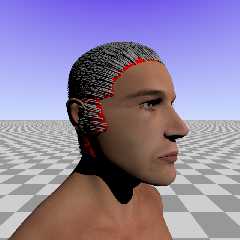
> Looks very much better in my eyes. In fact I'm working on a somewhat similiar
> issue at the moment.

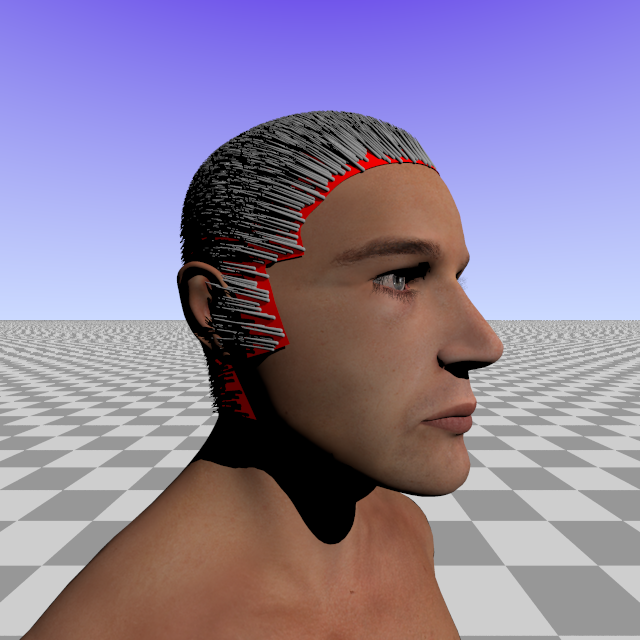
You inspired me to follow your steps, especially as I have problems
exporting hair from Poser: program crash as soon as lines are exported
in an .obj format file.

I intend to develop this a bit further of course. In red: the skullcap.

Thomas
Post a reply to this message
Attachments:
Download 'hairplanting_test.png' (264 KB)
Preview of image 'hairplanting_test.png'
|
|
| |
| |
|
|
|
|
| |