|
|
|
|
|
|
| |
| |
|
|
|
|
| |
| |
|
|
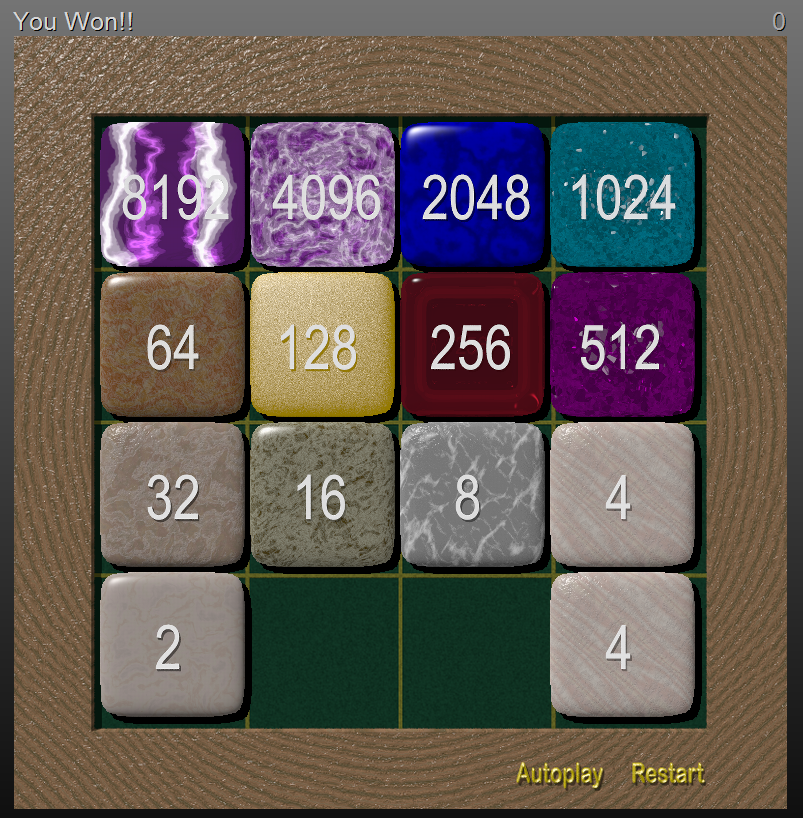
This picture is from a 2048 game I wrote in VisualWorks Smalltalk using
POVRay to render the board and all the tiles.  POVRay rendered PNG files
of the board and all tiles from 2 to 8196 which I then imported into the
game as bitmaps.  The game is actually playable and the tiles slide into
position with a small fireworks animation (using a 3D particle system)
when they merge.  The text at the top for the score and messages like
"You Won!" wasn't 3D rendered - it was just drawn as a standard text
object.  The tile shadows are faked.  They are just a black shadow image
rendered slightly below and to the right of a tile before the tile is
drawn on top.  The Autoplay and Restart buttons were rendered directly
onto the board using POVRay beveled text.  The values of the squares on
this particular board were (obviously) manually constructed to show all
tiles.  As you can imagine, it would be notoriously difficult to get
this configuration with a real 2048 game.

The auto-play feature achieves the 2048 tile in about 50% of the games
it plays and occasionally (once or twice every ten runs) achieves 4096.
  I've never seen it get an 8192 tile.

I wrote this game as my entry in the Cincom Smalltalk 2048 contest but I
plan to make a series of videos about how I wrote the game and rendered it.

For those interested in trying the program, you can get it from:

	http://www.simberon.com/downloads/Sim2048.exe

Note, this is a Windows executable file but you have my word that it
doesn't contain any viruses or malware.

If you're interested in looking at the Smalltalk source code, drop me an
e-mail and I can send you a link for it.

Questions and comments welcome
David (K) Buck
Post a reply to this message
Attachments:
Download 'alltiles.png' (1200 KB)
Preview of image 'alltiles.png'
|
|
| |
| |
|
|
|
|
| |
| |
|
|
> This picture is from a 2048 game I wrote in VisualWorks Smalltalk using
> POVRay to render the board and all the tiles.  POVRay rendered PNG files
> of the board and all tiles from 2 to 8196

What happens when you merge two 8192 tiles then? ;-)

> The auto-play feature achieves the 2048 tile in about 50% of the games
> it plays and occasionally (once or twice every ten runs) achieves 4096.
>   I've never seen it get an 8192 tile.
>
> I wrote this game as my entry in the Cincom Smalltalk 2048 contest but I
> plan to make a series of videos about how I wrote the game and rendered it.

I never considered writing an AI player for 2048, but it sounds fun.

What is the rule/algorithm for adding the new tile after each move? Is
it just placed in a random empty cell? On my version (Android) most
times I got a 2 but sometimes it gave me a 4.
Post a reply to this message
|
|
| |
| |
|
|
|
|
| |
| |
|
|
http://en.wikipedia.org/wiki/2048_(video_game)


Looks very good - nice work!
I'd be interested to see how it was written, and what the AI logic is.
How does the game determine what direction to slide the tiles?  Generating the
highest value tile, or combining the most tiles? (I'm leaning toward the latter)

{Oh, how I wish people with your talent would write (or at least fix) some
worthwhile apps for MS's Surface RT.  That Windows Store is mostly a collection
of shamelessly plagiarized junk that doesn't work.  Heck, the Store app itself
doesn't even work right...}

Keep up the good work!  :)
Post a reply to this message
|
|
| |
| |
|
|
|
|
| |
| |
|
|
> http://en.wikipedia.org/wiki/2048_(video_game)

It's open source, so I can answer my own question, the value of the new
tile that is randomly generated is chosen thus:

var value = Math.random() < 0.9 ? 2 : 4;

So it's a 90% chance of a 2, 10% chance of a 4. Interesting.

> Looks very good - nice work!
> I'd be interested to see how it was written, and what the AI logic is.
> How does the game determine what direction to slide the tiles?  Generating the
> highest value tile, or combining the most tiles? (I'm leaning toward the latter)

Yes I wondered that too, it looks like the answer lies in the "move"
function of "game_manager.js", but I don't have time to try and
understand it right now.
Post a reply to this message
|
|
| |
| |
|
|
|
|
| |
| |
|
|
On 2014-07-30 11:54 AM, scott wrote:>>
http://en.wikipedia.org/wiki/2048_(video_game)
 >
 > It's open source, so I can answer my own question, the value of the new
 > tile that is randomly generated is chosen thus:
 >
 > var value = Math.random() < 0.9 ? 2 : 4;
 >
 > So it's a 90% chance of a 2, 10% chance of a 4. Interesting.

Yes, interesting indeed.  My implementation makes it a 50-50 chance of
getting either a 2 or a 4.  Perhaps I should change my game to match.

 >
 >> Looks very good - nice work!
 >> I'd be interested to see how it was written, and what the AI logic is.
 >> How does the game determine what direction to slide the tiles?
 >> Generating the
 >> highest value tile, or combining the most tiles? (I'm leaning toward
 >> the latter)
 >
 > Yes I wondered that too, it looks like the answer lies in the "move"
 > function of "game_manager.js", but I don't have time to try and
 > understand it right now.
 >

I don't believe the open source implementation above includes a solver.

My algorithm is based on the one here:

http://2048strategy.com/2048-strategy/

This web page, however, doesn't include details on how to calculate
monotonicity and smoothness.  In my implementation, monotonicity is
weighted by the values of the cells and the smoothness uses a different
algorithm.  It's pretty effective, though.

David Buck
Post a reply to this message
|
|
| |
| |
|
|
|
|
| |
| |
|
|
On 2014-07-30 3:34 AM, scott wrote:
 >> This picture is from a 2048 game I wrote in VisualWorks Smalltalk using
 >> POVRay to render the board and all the tiles.  POVRay rendered PNG files
 >> of the board and all tiles from 2 to 8196
 >
 > What happens when you merge two 8192 tiles then?

Right now, the new square turns black .  I suppose I should fix that but
it's not a big priority for me.

 >
 >> The auto-play feature achieves the 2048 tile in about 50% of the games
 >> it plays and occasionally (once or twice every ten runs) achieves 4096.
 >>   I've never seen it get an 8192 tile.
 >>
 >> I wrote this game as my entry in the Cincom Smalltalk 2048 contest but I
 >> plan to make a series of videos about how I wrote the game and
 >> rendered it.
 >
 > I never considered writing an AI player for 2048, but it sounds fun.
 >
 > What is the rule/algorithm for adding the new tile after each move? Is
 > it just placed in a random empty cell? On my version (Android) most
 > times I got a 2 but sometimes it gave me a 4.
 >

The game just picks a random empty cell and randomly puts a 2 or 4 there.

David
Post a reply to this message
|
|
| |
| |
|
|
|
|
| |
| |
|
|
It's weird how the binary summation seems so natural.  Maybe I just do WAY too
much computer stuff.

It would be interesting to see it redone in Hex...  :D
Post a reply to this message
|
|
| |
| |
|
|
|
|
| |
| |
|
|
On 2014-07-30 11:54 AM, scott wrote:
>> http://en.wikipedia.org/wiki/2048_(video_game)
>
> It's open source, so I can answer my own question, the value of the new
> tile that is randomly generated is chosen thus:
>
> var value = Math.random() < 0.9 ? 2 : 4;
>
> So it's a 90% chance of a 2, 10% chance of a 4. Interesting.
>

Wow, that makes a huge difference to the game.  My solver now has an 80%
success rate at reaching 2048.

David Buck
Post a reply to this message
|
|
| |
| |
|
|
|
|
| |
| |
|
|
>  >> Looks very good - nice work!
>  >> I'd be interested to see how it was written, and what the AI logic is.
>  >> How does the game determine what direction to slide the tiles?
>  >> Generating the
>  >> highest value tile, or combining the most tiles? (I'm leaning toward
>  >> the latter)
>  >
>  > Yes I wondered that too, it looks like the answer lies in the "move"
>  > function of "game_manager.js", but I don't have time to try and
>  > understand it right now.
>  >
>
> I don't believe the open source implementation above includes a solver.

Oh I misread Bald Eagle's comment - I thought he meant how does the game
itself decide how to combine tile sequences like "2228" when you slide,
do you end up with "_428" or "_248"? What if you swipe left instead?

> My algorithm is based on the one here:
>
> http://2048strategy.com/2048-strategy/

I think I would like to have a go at writing a solver based on my
personal strategy for playing first, before being corrupted by superior
methods that I would have never have though of ;-)
Post a reply to this message
|
|
| |
| |
|
|
|
|
| |
| |
|
|
> It's weird how the binary summation seems so natural.  Maybe I just do WAY too
> much computer stuff.

Indeed, or immediately I saw the "8196" in the OP and thought "that's a
typo" :-)

> It would be interesting to see it redone in Hex...  :D

It would be quite boring though, more interesting would be base-9 or
something...
Post a reply to this message
|
|
| |
| |
|
|
|
|
| |
| |
|
|
On 2014-07-31 9:04 AM, scott wrote:
>> It's weird how the binary summation seems so natural.  Maybe I just do
>> WAY too
>> much computer stuff.
>
> Indeed, or immediately I saw the "8196" in the OP and thought "that's a
> typo" :-)

Indeed.  I hang my head in shame.  :-(

(I did get it right on the second occurrence of the number though)

A hex version of 2048 would be delightfully geeky - especially of the
tiles were labeled 0x2, 0x4, 0x8, 0x10, 0x20, 0x40, 0x80, 0x100, etc.

David
Post a reply to this message
|
|
| |
| |
|
|
|
|
| |
| |
|
|
On Wed, 30 Jul 2014 08:34:57 +0100, scott wrote:

> What happens when you merge two 8192 tiles then? ;-)

16384, naturally. :)

I found an Android version that let me fiddle around until I had filled
the grid to the maximum possible value - and the top end title showed a
value of 131072.  I forget what the score was, but it isn't possible to
go higher. :)

Jim


--
"I learned long ago, never to wrestle with a pig. You get dirty, and
besides, the pig likes it." - George Bernard Shaw
Post a reply to this message
|
|
| |
| |
|
|
|
|
| |
| |
|
|
David Buck <dav### [at] simberon com> wrote:
> This picture is from a 2048 game I wrote in VisualWorks Smalltalk using
> POVRay to render the board and all the tiles. POVRay rendered PNG files
> of the board and all tiles from 2 to 8196 which I then imported into the
> game as bitmaps. The game is actually playable and the tiles slide into
> position with a small fireworks animation (using a 3D particle system)
> when they merge. The text at the top for the score and messages like
> "You Won!" wasn't 3D rendered - it was just drawn as a standard text
> object. The tile shadows are faked. They are just a black shadow image
> rendered slightly below and to the right of a tile before the tile is
> drawn on top. The Autoplay and Restart buttons were rendered directly
> onto the board using POVRay beveled text. The values of the squares on
> this particular board were (obviously) manually constructed to show all
> tiles. As you can imagine, it would be notoriously difficult to get
> this configuration with a real 2048 game.
>
> The auto-play feature achieves the 2048 tile in about 50% of the games
> it plays and occasionally (once or twice every ten runs) achieves 4096.
> I've never seen it get an 8192 tile.
>
> I wrote this game as my entry in the Cincom Smalltalk 2048 contest but I
> plan to make a series of videos about how I wrote the game and rendered it.
>
> For those interested in trying the program, you can get it from:
>
> http://www.simberon.com/downloads/Sim2048.exe
>
> Note, this is a Windows executable file but you have my word that it
> doesn't contain any viruses or malware.
>
> If you're interested in looking at the Smalltalk source code, drop me an
> e-mail and I can send you a link for it.
>
> Questions and comments welcome
> David (K) Buck
Hi John I am interested in looking at the source code for this. I really want
to learn how to do this. My email is jpe### [at] gmailcom Thanks! com> wrote:
> This picture is from a 2048 game I wrote in VisualWorks Smalltalk using
> POVRay to render the board and all the tiles. POVRay rendered PNG files
> of the board and all tiles from 2 to 8196 which I then imported into the
> game as bitmaps. The game is actually playable and the tiles slide into
> position with a small fireworks animation (using a 3D particle system)
> when they merge. The text at the top for the score and messages like
> "You Won!" wasn't 3D rendered - it was just drawn as a standard text
> object. The tile shadows are faked. They are just a black shadow image
> rendered slightly below and to the right of a tile before the tile is
> drawn on top. The Autoplay and Restart buttons were rendered directly
> onto the board using POVRay beveled text. The values of the squares on
> this particular board were (obviously) manually constructed to show all
> tiles. As you can imagine, it would be notoriously difficult to get
> this configuration with a real 2048 game.
>
> The auto-play feature achieves the 2048 tile in about 50% of the games
> it plays and occasionally (once or twice every ten runs) achieves 4096.
> I've never seen it get an 8192 tile.
>
> I wrote this game as my entry in the Cincom Smalltalk 2048 contest but I
> plan to make a series of videos about how I wrote the game and rendered it.
>
> For those interested in trying the program, you can get it from:
>
> http://www.simberon.com/downloads/Sim2048.exe
>
> Note, this is a Windows executable file but you have my word that it
> doesn't contain any viruses or malware.
>
> If you're interested in looking at the Smalltalk source code, drop me an
> e-mail and I can send you a link for it.
>
> Questions and comments welcome
> David (K) Buck
Hi John I am interested in looking at the source code for this. I really want
to learn how to do this. My email is jpe### [at] gmailcom Thanks!
Post a reply to this message
|
|
| |
| |
|
|
|
|
| |