|
|
|
|
|
|
| |
| |
|
|
|
|
| |
| |
|
|
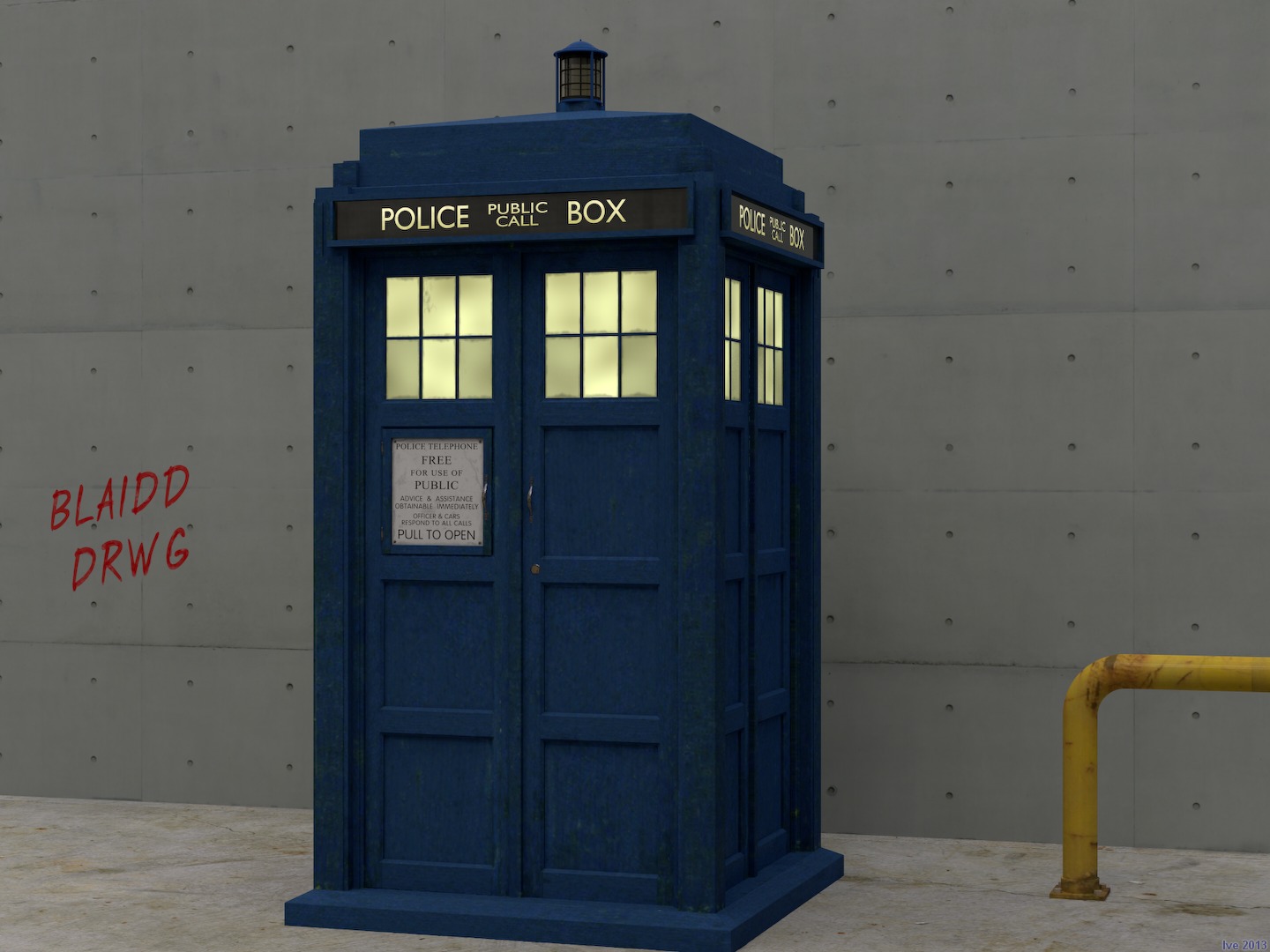
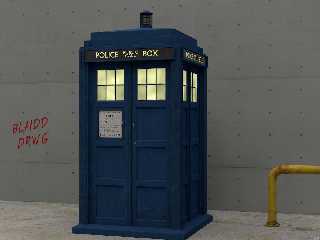
hi folks,

had no time for POV-Ray for about a year but todays cold and rainy
afternoon gave me opportunity for something quick.

Based on the original construction plans from BBC Cymru Wales 2004/2005
for the Eccleston/Tennant seasons - so all proportions of the Blue Box
should be quite accurate.
And no, it is not bigger on the inside - POV-Ray works not well with
Relative Dimensions In Space!

-Ive
Post a reply to this message
Attachments:
Download 'badwolf.jpg' (180 KB)
Preview of image 'badwolf.jpg'
|
|
| |
| |
|
|
|
|
| |
| |
|
|
Ive <ive### [at] lilysoft org> wrote:
> hi folks,
>
> had no time for POV-Ray for about a year but todays cold and rainy
> afternoon gave me opportunity for something quick.
>
> Based on the original construction plans from BBC Cymru Wales 2004/2005
> for the Eccleston/Tennant seasons - so all proportions of the Blue Box
> should be quite accurate.
> And no, it is not bigger on the inside - POV-Ray works not well with
> Relative Dimensions In Space!
>
> -Ive
Good! And you say it's something quick???
The doctor will thank you. org> wrote:
> hi folks,
>
> had no time for POV-Ray for about a year but todays cold and rainy
> afternoon gave me opportunity for something quick.
>
> Based on the original construction plans from BBC Cymru Wales 2004/2005
> for the Eccleston/Tennant seasons - so all proportions of the Blue Box
> should be quite accurate.
> And no, it is not bigger on the inside - POV-Ray works not well with
> Relative Dimensions In Space!
>
> -Ive
Good! And you say it's something quick???
The doctor will thank you.
Post a reply to this message
|
|
| |
| |
|
|
|
|
| |
| |
|
|
On 09/11/2013 05:40 PM, Ive wrote:
> hi folks,
>
> had no time for POV-Ray for about a year but todays cold and rainy
> afternoon gave me opportunity for something quick.
>
> Based on the original construction plans from BBC Cymru Wales 2004/2005
> for the Eccleston/Tennant seasons - so all proportions of the Blue Box
> should be quite accurate.
> And no, it is not bigger on the inside - POV-Ray works not well with
> Relative Dimensions In Space!
>
> -Ive
Brilliant! :-) I like it. All CSG?

Suppose you could stick a povray warp inside...

A complete aside, but I've always wondered how the wiring got to the
actual police call boxes in the day? The boxes seem too short to safely
drop wires to them off a pole or building.

Bill P.
Post a reply to this message
|
|
| |
| |
|
|
|
|
| |
| |
|
|
Am 12.09.2013 11:19, schrieb William F Pokorny:

> Brilliant! :-)
LOL. I heard immediately David Tennant's voice in my mind.

> All CSG?

Sure. Well, besides of the door handles.

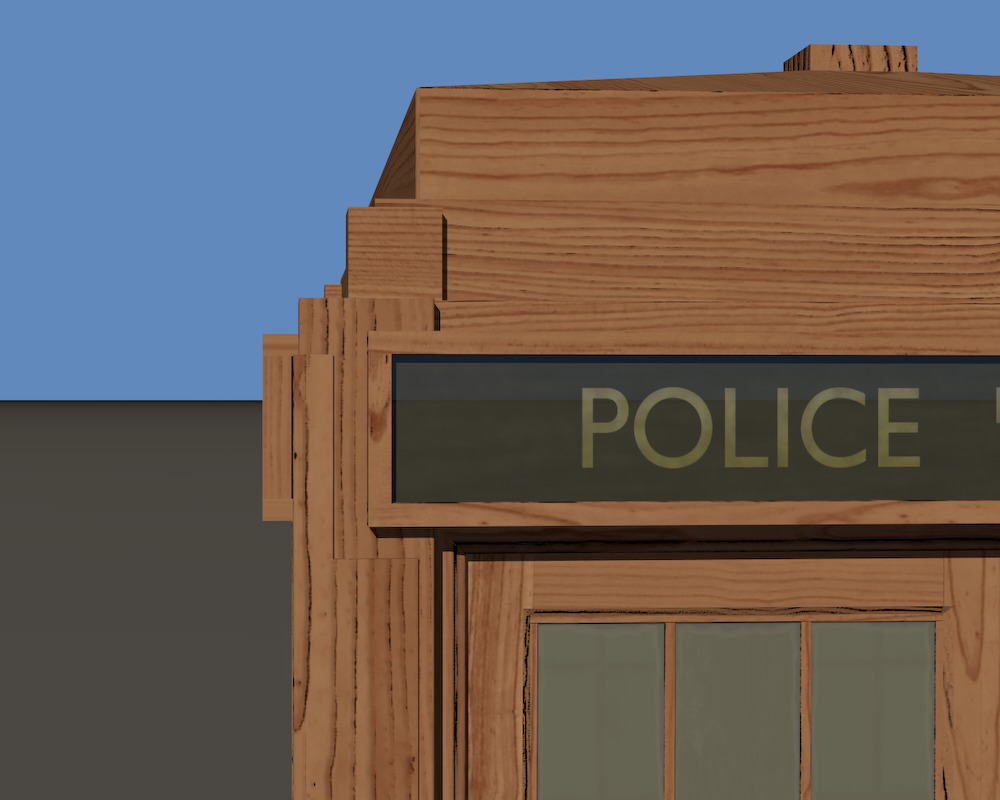
It is even build in the same way a carpenter would build the real thing.
This way it was easy to get the wood textures run always in the right
directions.

> A complete aside, but I've always wondered how the wiring got to the
> actual police call boxes in the day? The boxes seem too short to safely
> drop wires to them off a pole or building.
>
Given that the original boxes where usually mounted on a concrete base,
I suspect the wiring came from below.

-Ive
Post a reply to this message
Attachments:
Download 'tardis_build17.jpg' (88 KB)
Preview of image 'tardis_build17.jpg'
|
|
| |
| |
|
|
|
|
| |
| |
|
|
Am 12.09.2013 01:08, schrieb Fractracer:
> And you say it's something quick???

Well, given that there are scenes I'm working on since years, and also
given that in the past I've got render times measured in weeks - a scene
that was completely done in just one afternoon with a render time of
less than one hour is something I call quick.

-Ive
Post a reply to this message
|
|
| |
| |
|
|
|
|
| |
| |
|
|
On 12/09/2013 2:11 PM, Ive wrote:

>
> It is even build in the same way a carpenter would build the real thing.
> This way it was easy to get the wood textures run always in the right
> directions.
>

Even when painted, the grain would show through?
In my youth, when I was courting my wife. Her close (tenement entrance)
was next to a police box and a bus stop. So I had plenty of time to
study the police box after I had seen her home. I do not remember any
sign of a wood grain on that Tardis. Vomit and urine, yes. ;-)
Another thing I remember is that in my home city the police boxes were
pillar box red and when Dr Who was first shown it was in B&W so red they
always have been to me. As in my rendition in TC-RTC - British Airships
Past, Present and Future.
Your image is near perfect except for the colour. ;-)

>> A complete aside, but I've always wondered how the wiring got to the
>> actual police call boxes in the day? The boxes seem too short to safely
>> drop wires to them off a pole or building.
>>
> Given that the original boxes where usually mounted on a concrete base,
> I suspect the wiring came from below.
>

You suspect correctly. Any external wiring would have been cut off and
sold for scrap.


--
Regards
     Stephen
Post a reply to this message
|
|
| |
| |
|
|
|
|
| |
| |
|
|
Ive <ive### [at] lilysoftorg> wrote:
> Am 12.09.2013 01:08, schrieb Fractracer:
> > And you say it's something quick???
>
> Well, given that there are scenes I'm working on since years, and also
> given that in the past I've got render times measured in weeks - a scene
> that was completely done in just one afternoon with a render time of
> less than one hour is something I call quick.
>
> -Ive

Time is like the inside of the Tardis.
If I try to make a scene like this I will have work for some weeks. ;)
Post a reply to this message
|
|
| |
| |
|
|
|
|
| |
| |
|
|
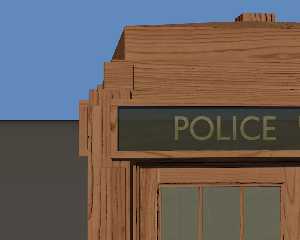
Am 12.09.2013 21:06, schrieb Stephen:

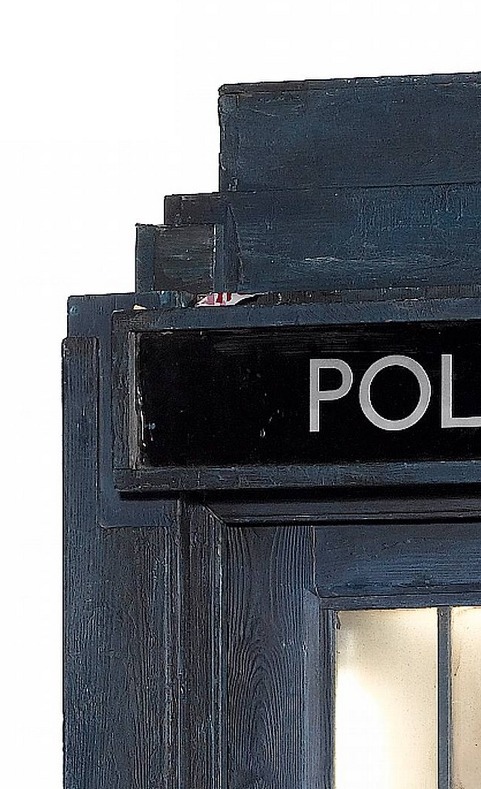
> Even when painted, the grain would show through?

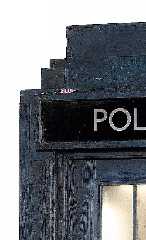
See attached image, a closeup of the original BBC prop.
I've used the wood grain mostly as normal-map to replicate this effect.


> In my youth, when I was courting my wife. Her close (tenement entrance)
> was next to a police box and a bus stop. So I had plenty of time to
> study the police box after I had seen her home. I do not remember any
> sign of a wood grain on that Tardis. Vomit and urine, yes. ;-)
> Another thing I remember is that in my home city the police boxes were
> pillar box red and when Dr Who was first shown it was in B&W so red they
> always have been to me. As in my rendition in TC-RTC - British Airships
> Past, Present and Future.

Ah, I remembered vaguely having seen some POV-Ray Daleks not *that* long
ago. This was it.

> Your image is near perfect except for the colour. ;-)
>

Sure ;)  You love the "Tooth and Claw" episode from 2006 when David
Tennant speaks in his *natural* accent, don't you?

> You suspect correctly. Any external wiring would have been cut off and
> sold for scrap.

;)

-Ive
Post a reply to this message
Attachments:
Download '2005box.jpg' (116 KB)
Preview of image '2005box.jpg'
|
|
| |
| |
|
|
|
|
| |
| |
|
|
On 12/09/2013 10:41 PM, Ive wrote:
> Am 12.09.2013 21:06, schrieb Stephen:
>
>> Even when painted, the grain would show through?
>
> See attached image, a closeup of the original BBC prop.
> I've used the wood grain mostly as normal-map to replicate this effect.
>
>
It is very well done.
But now that you make me think of it. The police boxes of my youth were
made of concrete. It made them harder to burn down.


>
> Ah, I remembered vaguely having seen some POV-Ray Daleks not *that* long
> ago. This was it.
>

The credit for those go to David Harris, whose Moray model can be
downloaded here. http://www.stmuc.com/moray/memisc.html

>> Your image is near perfect except for the colour. ;-)
>>
>
> Sure ;)  You love the "Tooth and Claw" episode from 2006 when David
> Tennant speaks in his *natural* accent, don't you?
>

No, I've never seen it. I stopped watching Dr. Who by the Sylvester
McCoy, incarnation.
Trivia: David Tennant was my wife's best friend's daughter's Sunday
school teacher, at one time.

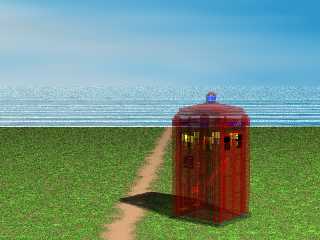
I did try to make my model of the Tardis de-materialise but it was not a
success. :-(


--
Regards
     Stephen
Post a reply to this message
Attachments:
Download 'tardis05c2_0000.png' (707 KB)
Preview of image 'tardis05c2_0000.png'
|
|
| |
| |
|
|
|
|
| |
| |
|
|
On Fri, 13 Sep 2013 05:09:12 +0100, Stephen wrote:

> Trivia: David Tennant was my wife's best friend's daughter's Sunday
> school teacher, at one time.

Which connects you to Peter Davison, whose daughter married Tennant.

Jim
Post a reply to this message
|
|
| |
| |
|
|
|
|
| |
| |
|
|
On 13-9-2013 6:09, Stephen wrote:
> It is very well done.
> But now that you make me think of it. The police boxes of my youth were
> made of concrete. It made them harder to burn down.

And me thinking they were made of steel....

> Trivia: David Tennant was my wife's best friend's daughter's Sunday
> school teacher, at one time.

Oooh... that's a difficult one ;-)

>
> I did try to make my model of the Tardis de-materialise but it was not a
> success. :-(

Difficult! Difficult! Bill Pragnell did some interesting things with
making a poser figure transparent.

Thomas
Post a reply to this message
|
|
| |
| |
|
|
|
|
| |
| |
|
|
Thomas de Groot <tho### [at] degrootorg> wrote:
> On 13-9-2013 6:09, Stephen wrote:
> > It is very well done.
> > But now that you make me think of it. The police boxes of my youth were
> > made of concrete. It made them harder to burn down.
>
> And me thinking they were made of steel....
>
> > Trivia: David Tennant was my wife's best friend's daughter's Sunday
> > school teacher, at one time.
>
> Oooh... that's a difficult one ;-)
>
> >
> > I did try to make my model of the Tardis de-materialise but it was not a
> > success. :-(
>
> Difficult! Difficult! Bill Pragnell did some interesting things with
> making a poser figure transparent.
>
> Thomas

Stephen has CSG here as he stated in his description how he made his entry. IIRC
Bill scaled the DAZ mesh Aiko 3 down along the normal a very small amount and
filled the difference with a media. I tried the same with my ghosts in my TC
entry May 2012, not as successful as Bill unfortunetally.

With CSG you cannot simply scale it down. For Bill's approach you must really
model an inner object, which can prove hard. I did this with the camera, the
table and the microphone wihtin this "Rose Garden" image and remember the
difficulties quite well enough.

Best regards,
Michael
Post a reply to this message
|
|
| |
| |
|
|
|
|
| |
| |
|
|
On 13/09/2013 6:26 PM, MichaelJF wrote:

> Stephen has CSG here as he stated in his description how he made his entry. IIRC
> Bill scaled the DAZ mesh Aiko 3 down along the normal a very small amount and
> filled the difference with a media. I tried the same with my ghosts in my TC
> entry May 2012, not as successful as Bill unfortunetally.
>
> With CSG you cannot simply scale it down. For Bill's approach you must really
> model an inner object, which can prove hard. I did this with the camera, the
> table and the microphone wihtin this "Rose Garden" image and remember the
> difficulties quite well enough.
>
Bill's 2006 IRTC entry for Absence is one of the best, IMO.

I tried to emulate it but found it too difficult to do. So in 2008 I
used a different method for the Wizard animation challenge. Described here:
http://www.tc-rtc.co.uk/member/imagenewdisplay/index176.html

The problem with making CSG or mesh models transparent, is the internal
parts show when it is partly transparent.
It just looks a mess.

--
Regards
     Stephen
Post a reply to this message
|
|
| |
| |
|
|
|
|
| |
| |
|
|
"MichaelJF" <mi-### [at] t-onlinede> wrote:
> Stephen has CSG here as he stated in his description how he made his entry. IIRC
> Bill scaled the DAZ mesh Aiko 3 down along the normal a very small amount and
> filled the difference with a media. I tried the same with my ghosts in my TC
> entry May 2012, not as successful as Bill unfortunetally.

Wow, you remember it better than I do :)

As I recall, it mostly worked automagically in Blender, but I spent a long time
tidying the 1% that wasn't perfect. Of course, the daz mesh was ready-made, so
'all' I had to do was the offset tinkering, and the media.

Bill
Post a reply to this message
|
|
| |
| |
|
|
|
|
| |
| |
|
|
Ive <ive### [at] lilysoftorg> wrote:
> had no time for POV-Ray for about a year but todays cold and rainy
> afternoon gave me opportunity for something quick.

Very nice. As a long-standing fan of the show, I keep meaning to build a tardis
model to insert in other scenes, but never seem to get round to it. Were the
plans publicy available? I should do one of my own :)

It would make a good easter egg in landscapes and architecture scenes.

Bill
Post a reply to this message
|
|
| |
| |
|
|
|
|
| |
| |
|
|
Stephen <mca### [at] aolcom> wrote:
> Bill's 2006 IRTC entry for Absence is one of the best, IMO.

It's just a shame I didn't get a chance to perfect the lighting before the
submission deadline - the version submitted had very blotchy radiosity
artifacts. I later rendered a faster, cleaner version using a large area_light
hidden in the ghost, which looked neater, but somehow slightly less real... I
should revisit it to polish it some more really.

> I tried to emulate it but found it too difficult to do. So in 2008 I
> used a different method for the Wizard animation challenge. Described here:
> http://www.tc-rtc.co.uk/member/imagenewdisplay/index176.html

I've mislaid my login details, but I'll take a look at this later.

> The problem with making CSG or mesh models transparent, is the internal
> parts show when it is partly transparent.
> It just looks a mess.

My issues exactly :/

Bill
Post a reply to this message
|
|
| |
| |
|
|
|
|
| |
| |
|
|
Stephen <mca### [at] aolcom> wrote:
> No, I've never seen it. I stopped watching Dr. Who by the Sylvester
> McCoy, incarnation.

You had stopped watching by this incarnation, or this incarnation stopped you
watching? ;-) An underrated doctor, in my opinion. The show had really started
to get dark and interesting by the time it was cancelled in '89, some of McCoy's
final stories were and remain among the show's best ever.

> I did try to make my model of the Tardis de-materialise but it was not a
> success. :-(

Hmm, perhaps if I made a mesh shell of it, scaled it along its normals...
Post a reply to this message
|
|
| |
| |
|
|
|
|
| |
| |
|
|
"Bill Pragnell" <bil### [at] hotmailcom> wrote:
> Stephen <mca### [at] aolcom> wrote:
> > Bill's 2006 IRTC entry for Absence is one of the best, IMO.
>
> It's just a shame I didn't get a chance to perfect the lighting before the
> submission deadline - the version submitted had very blotchy radiosity
> artifacts.

The composition made up for any flaws.

>I later rendered a faster, cleaner version using a large area_light
> hidden in the ghost, which looked neater, but somehow slightly less real... I
> should revisit it to polish it some more really.
>

When you have nothing else to do. :-)

> > I tried to emulate it but found it too difficult to do. So in 2008 I
> > used a different method for the Wizard animation challenge. Described here:
> > http://www.tc-rtc.co.uk/member/imagenewdisplay/index176.html
>
> I've mislaid my login details, but I'll take a look at this later.
>

Thomas will reset it, if you ask nicely. ;-)
I would do it but I've left my laptop at home as I won't have internet access,
this week.

In short, what I did was to difference my model from a large box then inverted
that to get a container for the media. This meant I could use the same box but
difference different meshes in the animation. The eyes glow but I thought that
it might be atmospheric. I had not used blender then and did not know about
scaling along the normal. I must remember that.

> > The problem with making CSG or mesh models transparent, is the internal
> > parts show when it is partly transparent.
> > It just looks a mess.
>
> My issues exactly :/
>
I've thought about this and I do not think that you can do it directly in Pov,
at least in one pass.

Stephen
Post a reply to this message
|
|
| |
| |
|
|
|
|
| |
| |
|
|
"Bill Pragnell" <bil### [at] hotmailcom> wrote:
> Stephen <mca### [at] aolcom> wrote:
> > No, I've never seen it. I stopped watching Dr. Who by the Sylvester
> > McCoy, incarnation.
>
> You had stopped watching by this incarnation, or this incarnation stopped you
> watching? ;-) An underrated doctor, in my opinion. The show had really started
> to get dark and interesting by the time it was cancelled in '89, some of McCoy's
> final stories were and remain among the show's best ever.
>

It was the silly question mark suit, that did it for me. Suspension of disbelief
is one thing but the suspension of stupidity is altogether different.

> > I did try to make my model of the Tardis de-materialise but it was not a
> > success. :-(
>
> Hmm, perhaps if I made a mesh shell of it, scaled it along its normals...

That would give a nice aura, I think.
Even if you choose a good angle a perspective camera would still show the far
side.

Just a thought. If you differenced it with a plane normal to the camera. You
might get away with it.

Stephen
Post a reply to this message
|
|
| |
| |
|
|
|
|
| |
| |
|
|
"Stephen" <mcavoys_AT_aolDOT.com> wrote:
> It was the silly question mark suit, that did it for me. Suspension of disbelief
> is one thing but the suspension of stupidity is altogether different.

Hm, I think the question mark had featured somewhere on the costume even as far
back as Tom Baker, if I remember correctly. Although not as prominently. Most
people disliked McCoy's interpretation of the character rather than the costume,
which was positively spartan after Colin Baker's psychedelic coat.

> > > I did try to make my model of the Tardis de-materialise but it was not a
> > > success. :-(
> > Hmm, perhaps if I made a mesh shell of it, scaled it along its normals...
> That would give a nice aura, I think.
> Even if you choose a good angle a perspective camera would still show the far
> side.

This won't work will it, all edges pointing at the camera will show up. That
trick worked well with the Daz mesh because the curved body shape only had
low-angle triangles at its horizon.

> Just a thought. If you differenced it with a plane normal to the camera. You
> might get away with it.

Or, staying with the mesh idea, using only single-sided triangles perhaps?

Bill
Post a reply to this message
|
|
| |
| |
|
|
|
|
| |
| |
|
|
"Stephen" <mcavoys_AT_aolDOT.com> wrote:
> > I've mislaid my login details, but I'll take a look at this later.
> Thomas will reset it, if you ask nicely. ;-)

No its ok, it's just slightly more effort to do it while I'm at work, I can
easily get in later on :)

[snip]

> I've thought about this and I do not think that you can do it directly in Pov,
> at least in one pass.

Well if you're using a suitable mesh defined externally, it might be possible to
read it into POV-Ray during parsing and do the offset in SDL. But it won't be
foolproof, and probably not always convenient. Better to use a triangle editor
to do the offset.
Post a reply to this message
|
|
| |
| |
|
|
|
|
| |
| |
|
|
Am 16.09.2013 10:30, schrieb Bill Pragnell:

> Very nice. As a long-standing fan of the show, I keep meaning to build a tardis
> model to insert in other scenes, but never seem to get round to it. Were the
> plans publicy available? I should do one of my own :)
>

Found it where guys are talking about building the "real" thing and a
great resource.
www.tardisbuilder.com ->
Reference ->
The Colin Richmond/Ed Thomas TARDIS (2005)

http://tardisbuilders.com/index.php?action=dlattach;k=-947;topic=4234.0;attach=57833;image

(not sure if this direct link works)

Anyway, my version is done by a macro that should (in case I'll find the
time) create all the various boxes from all doctor incarnations.
ATM only Hartnell, Tennant and Smith are supported - sorry no McCoy
Tardis yet.


> It would make a good easter egg in landscapes and architecture scenes.
>
(In the voice of River Song) Hush, spoilers!


-Ive
Post a reply to this message
|
|
| |
| |
|
|
|
|
| |
| |
|
|
Am 13.09.2013 06:09, schrieb Stephen:
> I did try to make my model of the Tardis de-materialise but it was not a
> success. :-(
>

In the CG industry this effect is usually done by rotoscoping.
This can easily be simulated within POV-Ray (by rendering the box and
the background separately and including shadows with some no_image
trickery and finally composing the images).

But I know, POV-Ray purists would consider this as cheating.

-Ive
Post a reply to this message
|
|
| |
| |
|
|
|
|
| |
| |
|
|
Ive <ive### [at] lilysoftorg> wrote:
> Anyway, my version is done by a macro that should (in case I'll find the
> time) create all the various boxes from all doctor incarnations.
> ATM only Hartnell, Tennant and Smith are supported

I see you count your doctors in binary.
Post a reply to this message
|
|
| |
| |
|
|
|
|
| |
| |
|
|
On 16-9-2013 15:07, Ive wrote:
> Found it where guys are talking about building the "real" thing and a
> great resource.
> www.tardisbuilder.com ->
> Reference ->
> The Colin Richmond/Ed Thomas TARDIS (2005)
>
>
http://tardisbuilders.com/index.php?action=dlattach;k=-947;topic=4234.0;attach=57833;image
>
>
> (not sure if this direct link works)
>

Well, those references are scammed. :-(

Thomas
Post a reply to this message
|
|
| |
| |
|
|
|
|
| |
| |
|
|
Am 16.09.2013 16:13, schrieb Thomas de Groot:
> On 16-9-2013 15:07, Ive wrote:
>> Found it where guys are talking about building the "real" thing and a
>> great resource.
>> www.tardisbuilder.com ->
>> Reference ->
>> The Colin Richmond/Ed Thomas TARDIS (2005)
>>
>>
http://tardisbuilders.com/index.php?action=dlattach;k=-947;topic=4234.0;attach=57833;image
>>
>>
>>
>> (not sure if this direct link works)
>>
>
> Well, those references are scammed. :-(
>
> Thomas
>
>

err, sorry, forgot the 's' it is

www.tardisbuilders.com ->
Reference ->
The Colin Richmond/Ed Thomas TARDIS (2005)

-Ive
Post a reply to this message
|
|
| |
| |
|
|
|
|
| |
| |
|
|
On 16-9-2013 16:35, Ive wrote:

> err, sorry, forgot the 's' it is
>
> www.tardisbuilders.com ->
> Reference ->
> The Colin Richmond/Ed Thomas TARDIS (2005)

I missed that :-)

Thanks!

Thomas
Post a reply to this message
|
|
| |
| |
|
|
|
|
| |
| |
|
|
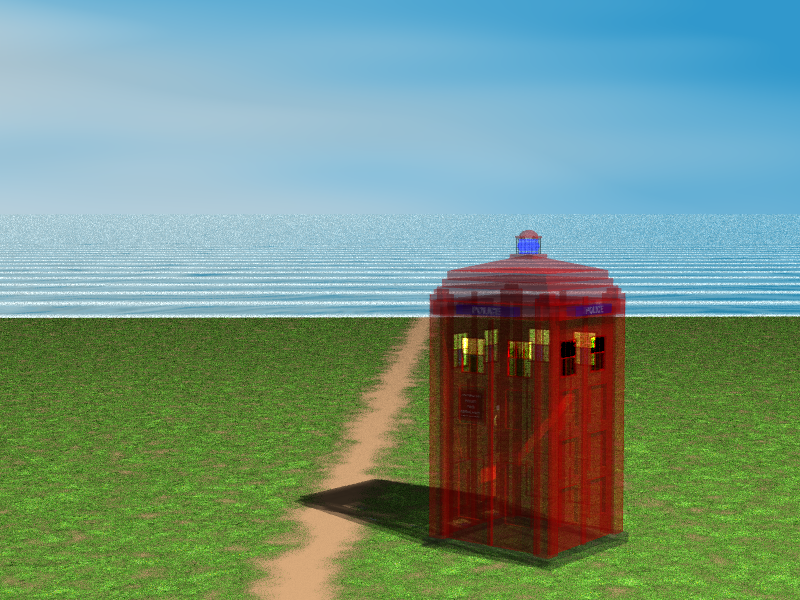
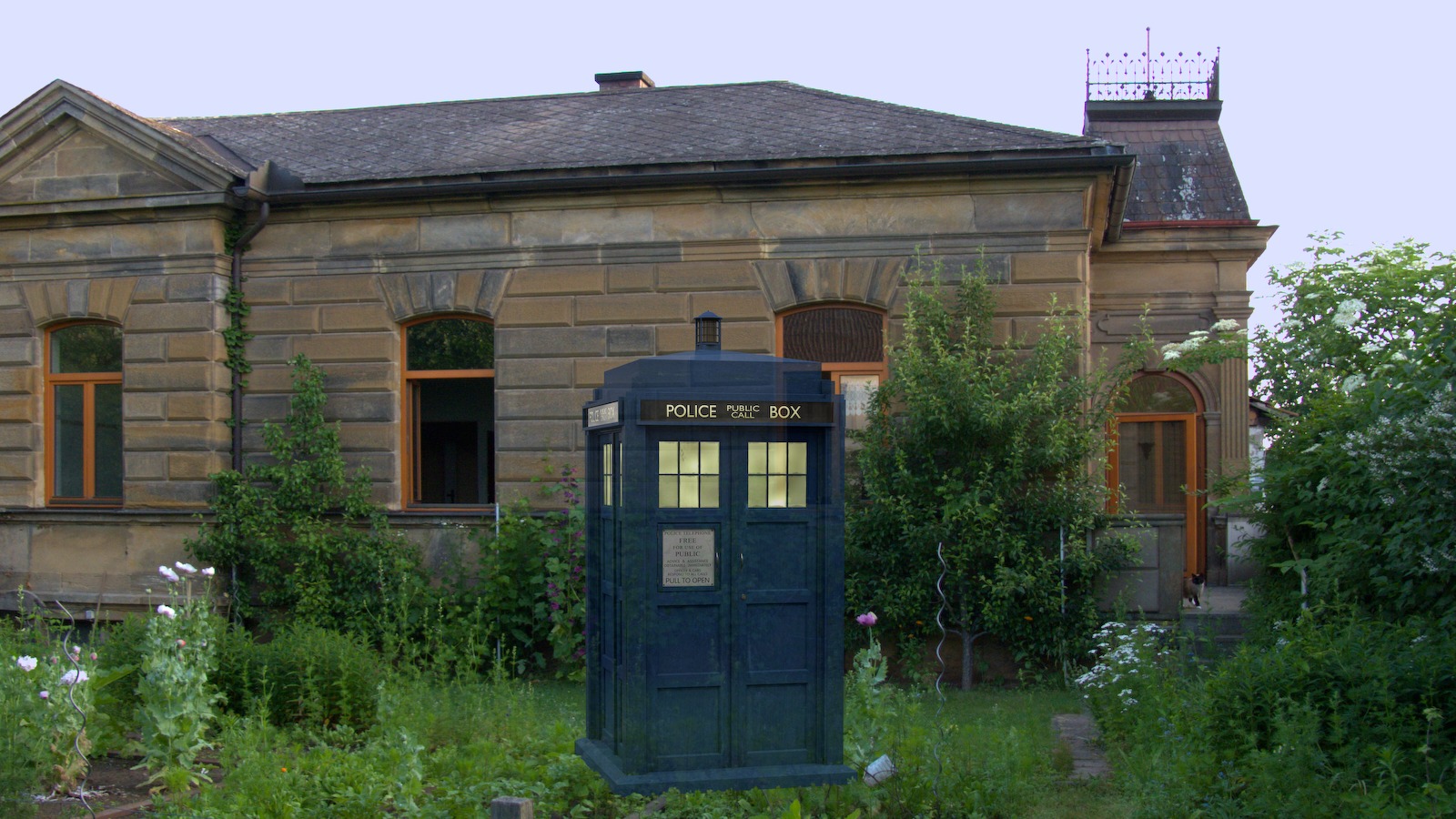
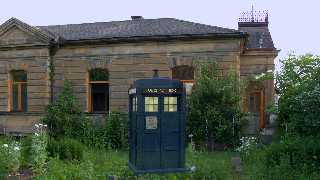
...in our garden, and Lucy Liu - not the actress, our cat - is quite
curious.

We moved to a new home (actually a house from the 18th century) this
spring and I couldn't resist to put the blue box into the garden.

Composing/rotoscoping done by using Photoshop and POV-Ray. The Tardis is
rendered with POV-Ray, masking done with Photoshop and the final
composing with POV-Ray again.
It was more easy with POV-Ray to add a bit of turbulence at the base of
the Tardis for the final composing step as it would have been with P'shop.

Far from perfect - and I did forget to turn on the roof lamp :( - but it
is just meant to test the method.

-Ive
Post a reply to this message
Attachments:
Download 'garden-03.jpg' (376 KB)
Preview of image 'garden-03.jpg'
|
|
| |
| |
|
|
|
|
| |
| |
|
|
Nice one! I shall have to try rotoscoping one day I guess ;-)

Nice house indeed. High ceilings. Not too cold in winter?

Thomas
Post a reply to this message
|
|
| |
| |
|
|
|
|
| |
| |
|
|
Am 17.09.2013 09:07, schrieb Thomas de Groot:
> High ceilings. Not too cold in winter?
>
We haven't spend winter there yet, but we have already a lot of firewood
for the old stove ;)
And in addition it has meanwhile also a contemporary central heating. A
lot of work with an old building like that - this means almost no time
for POV-Ray.

-Ive
Post a reply to this message
|
|
| |
| |
|
|
|
|
| |
| |
|
|
Stephen wrote:

> The problem with making CSG or mesh models transparent, is the internal
> parts show when it is partly transparent.

For plain CSG, can't this usually be avoided by combining
elements with "merge"? Of course I suppose this doesn't help for
meshes if the original mesh already has "internal" triangles.
Post a reply to this message
|
|
| |
| |
|
|
|
|
| |
| |
|
|
Christian Froeschlin <chr### [at] chrfrde> wrote:
> Stephen wrote:
>
> > The problem with making CSG or mesh models transparent, is the internal
> > parts show when it is partly transparent.
>
> For plain CSG, can't this usually be avoided by combining
> elements with "merge"? Of course I suppose this doesn't help for
> meshes if the original mesh already has "internal" triangles.

I have studied Bill's Code and all the hints he gave with his IRTC entry 2006
last year very carefully. So it is no wonder that I remember it quite well.
Fortunatelly Bill has posted the complete code of his entry and gave a lot of
hints. Many thanks for that to Bill, even after all the years!

IMO his main and wonderful idea is to create an eggshell from a figure and fill
this with a proper media. Having CSG objects every deviation from convexity is a
problem since you cannot simply scale down the figure a small amount to craft
thsi eggshell. This would only work in very convenient situations. With a mesh
you can move the vertices along the normals (Blender seems to able to do this,
but I used Wings for that) and you have an inner object to subtract from the
outer to gain this eggshell soon. Problems arise from vertices which are under
the surface in the original object (joints) or from holes. I remember well
having dived into Poser Jennies nose to close the holes there. Than I learned
about MeshLab and the problem of holes was fixed. So I hadn't to repair the hole
of "the mouth I don't speak with" to cite Till Eulenspiegel. Thanks to Thomas
for mentioning the works of Charles de Coster in another thread here.
I was unaware of his wonderful interpretation of the stuff so far.

But for the picture under discussion here: Really great work. And as ever, a
very good look for details.

Best regards,
Michael
Post a reply to this message
|
|
| |
| |
|
|
|
|
| |
| |
|
|
Le 17/09/2013 15:00, Ive a écrit :
> this means almost no time for POV-Ray.

This is good: small time to model many long to render beautiful scenes.
(or even an animation)

It's just: almost no time in front of computer, not for POV-Ray.
Post a reply to this message
|
|
| |
| |
|
|
|
|
| |
| |
|
|
El 16/09/13 15:13, Ive escribió:
> But I know, POV-Ray purists would consider this as cheating.

   I don't know if there is still any around here... ;)

   BTW, great work as usual. I hope to also make a comeback later this
month... my POV skills are starting to get rusty after almost a year
without poving.

--
Jaime
Post a reply to this message
|
|
| |
| |
|
|
|
|
| |
| |
|
|
Christian Froeschlin <chr### [at] chrfrde> wrote:
> Stephen wrote:
>
> > The problem with making CSG or mesh models transparent, is the internal
> > parts show when it is partly transparent.
>
> For plain CSG, can't this usually be avoided by combining
> elements with "merge"? Of course I suppose this doesn't help for
> meshes if the original mesh already has "internal" triangles.

There is more to it than that, Christian.
Imagine a simple box materialising. Do we want to see the hidden faces as it
goes from transparent to opaque? With a model of a police box all the internal
and hidden detail would show. If a person went from invisible to translucent to
visible, would you see their body under their clothes and what about all the
internal organs?
Now with a Tardis how do we see that the inside is larger than the outside?

100 Karma points to the person who can do a realistic (WTF) materialisation or
de-materialisation of a complex model. (With shadows and you get 500 Karma
points.)

Stephen
Post a reply to this message
|
|
| |
| |
|
|
|
|
| |
| |
|
|
On 18-9-2013 12:41, Stephen wrote:

> 100 Karma points to the person who can do a realistic (WTF) materialisation or
> de-materialisation of a complex model. (With shadows and you get 500 Karma
> points.)

/That/ would be an interesting TC-RTC Challenge indeed.

Thomas
Post a reply to this message
|
|
| |
| |
|
|
|
|
| |
| |
|
|
A few loose thoughts about this, just to get my ideas clear.

On 18-9-2013 12:41, Stephen wrote:
> There is more to it than that, Christian.
> Imagine a simple box materialising. Do we want to see the hidden faces as it
> goes from transparent to opaque?

No. It would be the /shape/ of the box, the outline if you want,
becoming transparent.

> With a model of a police box all the internal
> and hidden detail would show.

It shouldn't. While becoming transparent the inside remains hidden from
our eyes.

> If a person went from invisible to translucent to
> visible, would you see their body under their clothes and what about all the
> internal organs?

Again, invisible to the onlooker. Only the outward shape of the person
is involved.

> Now with a Tardis how do we see that the inside is larger than the outside?

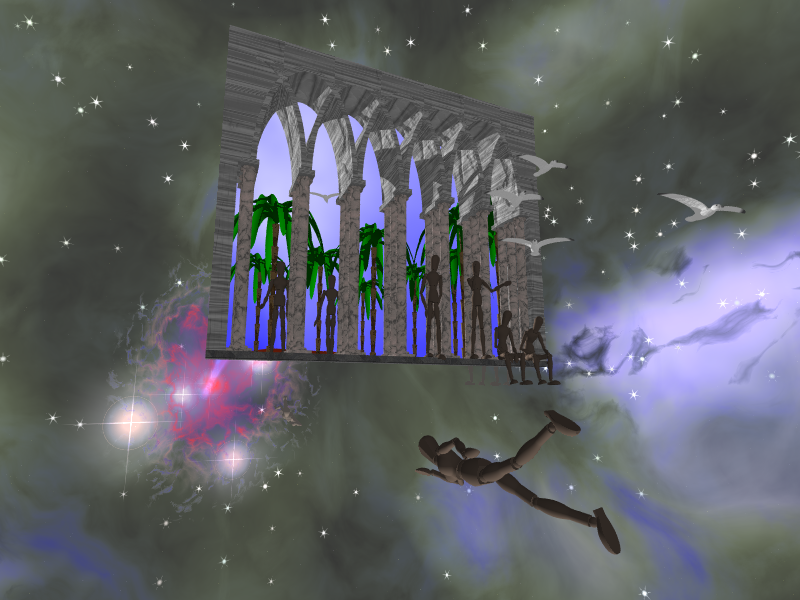
An interesting challenge would be to show both (open doors). I did
something similar a very long time ago (>10 years) with a door to
another dimension. I cheated somewhat: The door opened into space
(galaxy.inc) and was made of a vertical plane mirror (reflecting space)
with a differenced door. Behind the door was a landscape cut off by the
vertical plane. I must have the code somewhere...

Thomas
Post a reply to this message
|
|
| |
| |
|
|
|
|
| |
| |
|
|
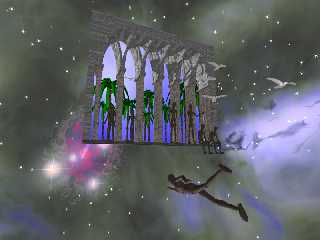
At least I found the image. Made in 2000.

Thomas
Post a reply to this message
Attachments:
Download 'portedepandore2.png' (474 KB)
Preview of image 'portedepandore2.png'
|
|
| |
| |
|
|
|
|
| |
| |
|
|
Thomas de Groot <tho### [at] degrootorg> wrote:
> A few loose thoughts about this, just to get my ideas clear.
>
> On 18-9-2013 12:41, Stephen wrote:
> > There is more to it than that, Christian.
> > Imagine a simple box materialising. Do we want to see the hidden faces as it
> > goes from transparent to opaque?
>
> No. It would be the /shape/ of the box, the outline if you want,
> becoming transparent.
>

That is what I think but we have grown up with special effects that show that
this is the way to do it.

> > With a model of a police box all the internal
> > and hidden detail would show.
>
> It shouldn't. While becoming transparent the inside remains hidden from
> our eyes.
>

It depends how you look at it, ;-)
If you change the transparency in Pov. You start seeing the internal structure.

> > If a person went from invisible to translucent to
> > visible, would you see their body under their clothes and what about all the
> > internal organs?
>
> Again, invisible to the onlooker. Only the outward shape of the person
> is involved.
>

But more interesting and medically valuable. :-)

> > Now with a Tardis how do we see that the inside is larger than the outside?
>
> An interesting challenge would be to show both (open doors). I did
> something similar a very long time ago (>10 years) with a door to
> another dimension. I cheated somewhat: The door opened into space
> (galaxy.inc) and was made of a vertical plane mirror (reflecting space)
> with a differenced door. Behind the door was a landscape cut off by the
> vertical plane. I must have the code somewhere...
>

I thought of using a df3 that depicted an internal scene. But then got
distracted with trying to use a proximity macro. Needless to say neither got
finished.

Stephen
Post a reply to this message
|
|
| |
| |
|
|
|
|
| |
| |
|
|
Jaime Vives Piqueres <jai### [at] ignoranciaorg> wrote:
>    BTW, great work as usual. I hope to also make a comeback later this
> month... my POV skills are starting to get rusty after almost a year
> without poving.

I'd love to see that.  Your rust will surely be better than mine.
Post a reply to this message
Attachments:
Download 'rusty_ball.jpg' (109 KB)
Preview of image 'rusty_ball.jpg'

|
|
| |
| |
|
|
|
|
| |
| |
|
|
On 18-9-2013 17:42, Stephen wrote:
> Thomas de Groot <tho### [at] degrootorg> wrote:
>> A few loose thoughts about this, just to get my ideas clear.
>>
>> On 18-9-2013 12:41, Stephen wrote:
>>> There is more to it than that, Christian.
>>> Imagine a simple box materialising. Do we want to see the hidden faces as it
>>> goes from transparent to opaque?
>>
>> No. It would be the /shape/ of the box, the outline if you want,
>> becoming transparent.
>>
>
> That is what I think but we have grown up with special effects that show that
> this is the way to do it.

Indeed. So there are two options really: the rotoscoping effect where
the internal parts are invisible, or the fully transparent effect where
the internal parts become visible too. It would be interesting to
explore the former in terms of POV-Ray technique ;-)

>
>>> With a model of a police box all the internal
>>> and hidden detail would show.
>>
>> It shouldn't. While becoming transparent the inside remains hidden from
>> our eyes.
>>
>
> It depends how you look at it, ;-)
> If you change the transparency in Pov. You start seeing the internal structure.

Yes, so, how could we do it in POV and still have the internal parts
invisible? Or maybe that is impossible? I don't really know the answer
for sure.

>
>>> If a person went from invisible to translucent to
>>> visible, would you see their body under their clothes and what about all the
>>> internal organs?
>>
>> Again, invisible to the onlooker. Only the outward shape of the person
>> is involved.
>>
>
> But more interesting and medically valuable. :-)

Ah yes indeed ;-)

>
>>> Now with a Tardis how do we see that the inside is larger than the outside?
>>
>> An interesting challenge would be to show both (open doors). I did
>> something similar a very long time ago (>10 years) with a door to
>> another dimension. I cheated somewhat: The door opened into space
>> (galaxy.inc) and was made of a vertical plane mirror (reflecting space)
>> with a differenced door. Behind the door was a landscape cut off by the
>> vertical plane. I must have the code somewhere...
>>
>
> I thought of using a df3 that depicted an internal scene. But then got
> distracted with trying to use a proximity macro. Needless to say neither got
> finished.

With a df3? hmm never thought of that...

Thomas
Post a reply to this message
|
|
| |
| |
|
|
|
|
| |
| |
|
|
On 19-9-2013 2:36, Cousin Ricky wrote:
> Jaime Vives Piqueres <jai### [at] ignoranciaorg> wrote:
>>     BTW, great work as usual. I hope to also make a comeback later this
>> month... my POV skills are starting to get rusty after almost a year
>> without poving.
>
> I'd love to see that.  Your rust will surely be better than mine.
>

I would not be ashamed of that ;-) maybe a bit stronger normals in the rust?

Thomas
Post a reply to this message
|
|
| |
| |
|
|
|
|
| |