|
|
|
|
|
|
| |
| |
|
|
|
|
| |
| |
|
|
If you have been following carefully my image naming, you will have
noticed one missing between numbers 1 and 6 ;-)

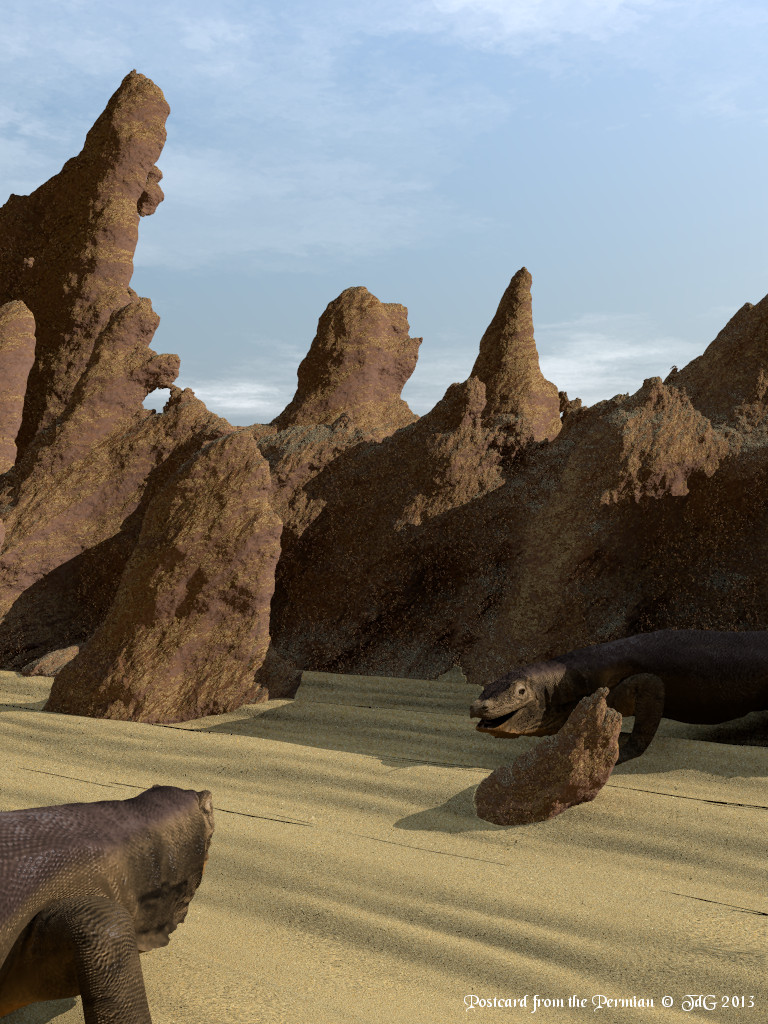
Elements of Geology 4 is about the Permian and the scene is situated in
a desert in the middle of supercontinent Pangea, south of the 'Central
Pangean Mountains' (alleghenian orogeny). It consists of isosurfaces and
Poser animals.

In this image a couple of issues remain: an artefact in the sand
isosurface, and one concerning radiosity on the shadow boundary between
the rock and the sand isosurfaces. Otherwise, the scene building part is
finished.

Thomas
Post a reply to this message
Attachments:
Download 'elements of geology4_06.jpg' (246 KB)
Preview of image 'elements of geology4_06.jpg'
|
|
| |
| |
|
|
|
|
| |
| |
|
|
Thomas de Groot <tho### [at] degroot org> wrote:
> If you have been following carefully my image naming, you will have
> noticed one missing between numbers 1 and 6 ;-)
>
> Elements of Geology 4 is about the Permian and the scene is situated in
> a desert in the middle of supercontinent Pangea, south of the 'Central
> Pangean Mountains' (alleghenian orogeny). It consists of isosurfaces and
> Poser animals.
>
> In this image a couple of issues remain: an artefact in the sand
> isosurface, and one concerning radiosity on the shadow boundary between
> the rock and the sand isosurfaces. Otherwise, the scene building part is
> finished.
>
> Thomas
Another fine one from you. Yes the sand needs some additional work. I propose to
change the skin of the lizards slightly to contrast them more from the rocks.
Not much, but may be a little bit more to green or orange or both.
Are you trying to best Normand with the image count this round?
Best regards,
Michael org> wrote:
> If you have been following carefully my image naming, you will have
> noticed one missing between numbers 1 and 6 ;-)
>
> Elements of Geology 4 is about the Permian and the scene is situated in
> a desert in the middle of supercontinent Pangea, south of the 'Central
> Pangean Mountains' (alleghenian orogeny). It consists of isosurfaces and
> Poser animals.
>
> In this image a couple of issues remain: an artefact in the sand
> isosurface, and one concerning radiosity on the shadow boundary between
> the rock and the sand isosurfaces. Otherwise, the scene building part is
> finished.
>
> Thomas
Another fine one from you. Yes the sand needs some additional work. I propose to
change the skin of the lizards slightly to contrast them more from the rocks.
Not much, but may be a little bit more to green or orange or both.
Are you trying to best Normand with the image count this round?
Best regards,
Michael
Post a reply to this message
|
|
| |
| |
|
|
|
|
| |
| |
|
|
On 27-7-2013 19:28, MichaelJF wrote:
> Another fine one from you. Yes the sand needs some additional work. I propose to
> change the skin of the lizards slightly to contrast them more from the rocks.
> Not much, but may be a little bit more to green or orange or both.

The sand surface function has now been worked on, although I am still
not entirely satisfied. I am tweaking the texture, and I have added
little quartz grains to the surface.

Yes, the skin could be improved. I shall investigate; thanks!

>
> Are you trying to best Normand with the image count this round?

It looks like it, doesn't it? ;-)  This will be the only time though, I
guess. The theme is so much part of my daily life that the images just
spill out of my hands.

Thomas
Post a reply to this message
|
|
| |
| |
|
|
From: Thomas de Groot
Subject: Re: Postcard from the Permian [wip 02]
Date: 28 Jul 2013 10:15:41
Message: <51f5278d@news.povray.org>
|
|
|
| |
| |
|
|
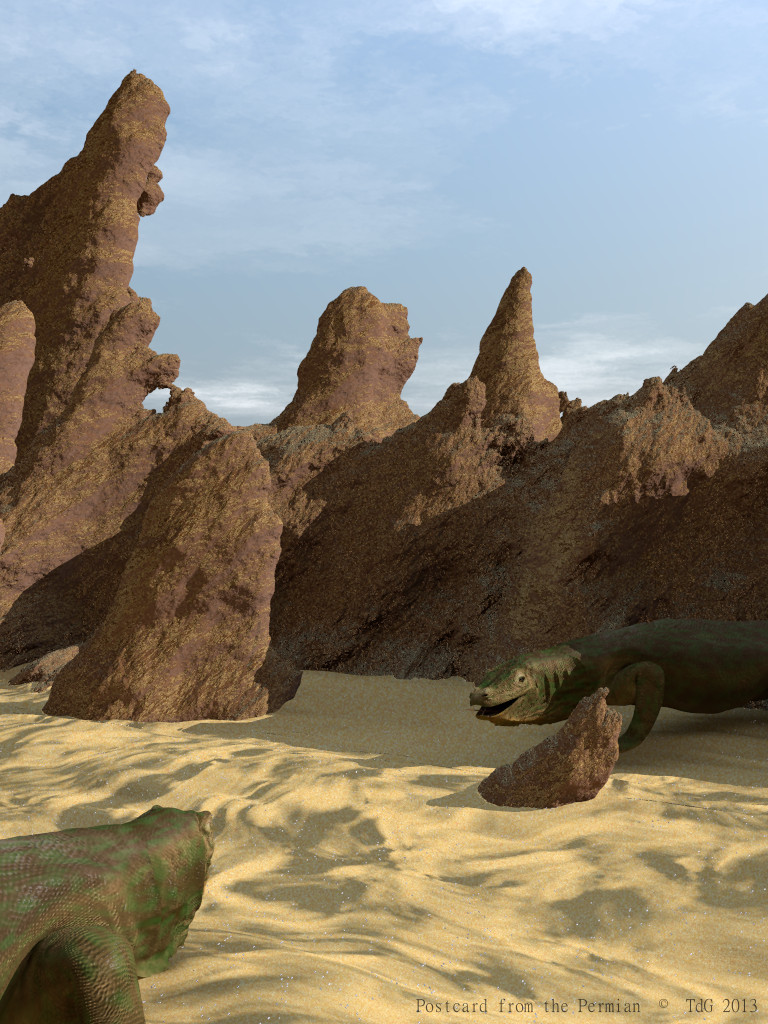
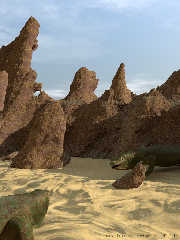
What about this?

I have some doubts about the quartz grains I added...

Thomas
Post a reply to this message
Attachments:
Download 'elements of geology4_07.jpg' (243 KB)
Preview of image 'elements of geology4_07.jpg'
|
|
| |
| |
|
|
|
|
| |
| |
|
|
On 07/28/2013 10:15 AM, Thomas de Groot wrote:
> What about this?

mo betta
Post a reply to this message
|
|
| |
| |
|
|
|
|
| |
| |
|
|
On 28-7-2013 16:17, James Holsenback wrote:
> On 07/28/2013 10:15 AM, Thomas de Groot wrote:
>> What about this?
>
> mo betta
>

This guy knows what I'm talking about ;-)
Post a reply to this message
|
|
| |
| |
|
|
|
|
| |
| |
|
|
On 28/07/2013 3:15 PM, Thomas de Groot wrote:
> What about this?
>
> I have some doubts about the quartz grains I added...
>

Very soft sand, indeed. It would make a nice beach in RL.


--
Regards
     Stephen
Post a reply to this message
|
|
| |
| |
|
|
|
|
| |
| |
|
|
Thomas de Groot <tho### [at] degrootorg> wrote:
> What about this?

The tetrapods are easier to see with the new skin colors.

The sand looks a bit too turbulent, but is otherwise an improvement over the
straight corrugation of the first draft.  Also, the form of the sand abruptly
almost disappears in the shadow areas, and the animal on the right looks like
it's floating.  Did you raise the radiosity error_bound for this draft?

> I have some doubts about the quartz grains I added...

They don't seem to scale with distance from the camera.
Post a reply to this message
|
|
| |
| |
|
|
|
|
| |
| |
|
|
Am 28.07.2013 19:41, schrieb Cousin Ricky:

> Also, the form of the sand abruptly
> almost disappears in the shadow areas,

Setting "radiosity { normal on }" should help with this; it does add to
the rendering time though.
Post a reply to this message
|
|
| |
| |
|
|
|
|
| |
| |
|
|
On 29-7-2013 6:46, clipka wrote:
> Am 28.07.2013 19:41, schrieb Cousin Ricky:
>
>> Also, the form of the sand abruptly
>> almost disappears in the shadow areas,
>
> Setting "radiosity { normal on }" should help with this; it does add to
> the rendering time though.
>

Not a problem. Only 40 minutes for this image :-)

Thomas
Post a reply to this message
|
|
| |
| |
|
|
|
|
| |
| |
|
|
On 28-7-2013 19:41, Cousin Ricky wrote:
> Thomas de Groot <tho### [at] degrootorg> wrote:
>> What about this?
>
> The tetrapods are easier to see with the new skin colors.
>
> The sand looks a bit too turbulent, but is otherwise an improvement over the
> straight corrugation of the first draft.  Also, the form of the sand abruptly
> almost disappears in the shadow areas, and the animal on the right looks like
> it's floating.  Did you raise the radiosity error_bound for this draft?

Yes... I am not entirely satisfied yet with the sand. The belly of the
animal is above ground; the visible paw is firmly on the ground.

>
>> I have some doubts about the quartz grains I added...
>
> They don't seem to scale with distance from the camera.

The distance is short anyway. I could scale them down with distance though.
Post a reply to this message
|
|
| |
| |
|
|
|
|
| |
| |
|
|
On 28-7-2013 19:41, Cousin Ricky wrote:
> The sand looks a bit too turbulent, but is otherwise an improvement over the
> straight corrugation of the first draft.

I just found out that the /turbulence/ is caused by a gross error of
mine in mistreating the texture ;-) This also made the quartz grains
stand out strangely against the sand.

Thomas
Post a reply to this message
|
|
| |
| |
|
|
From: Thomas de Groot
Subject: Re: Postcard from the Permian [wip 03]
Date: 29 Jul 2013 07:07:41
Message: <51f64cfd@news.povray.org>
|
|
|
| |
| |
|
|
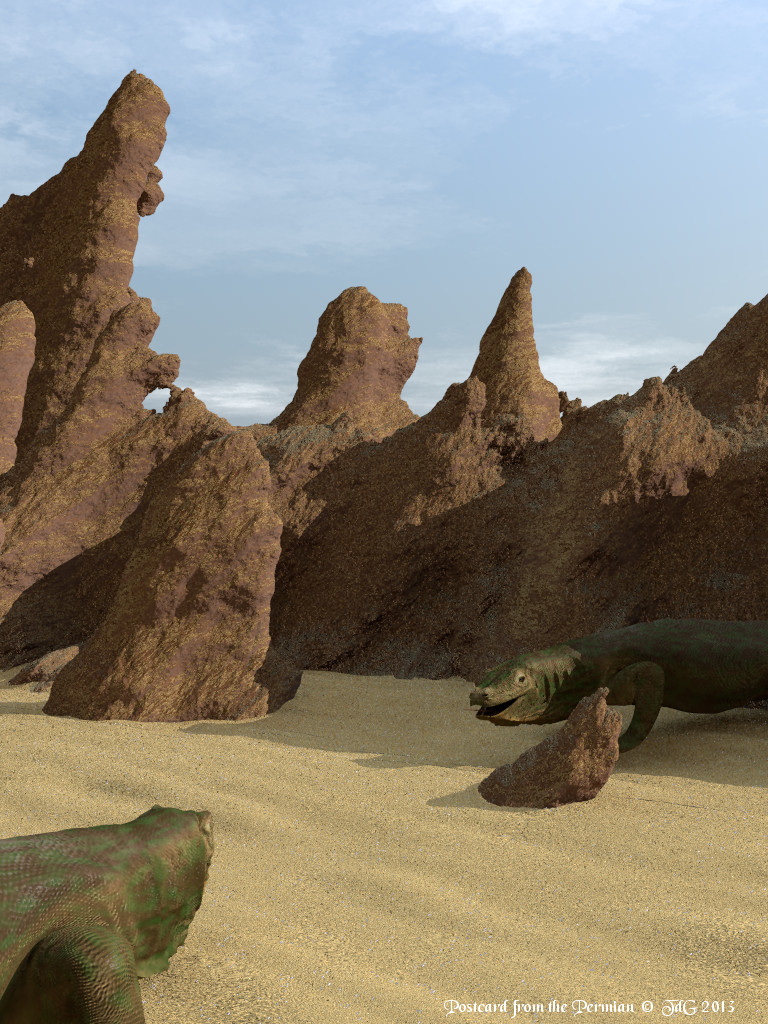
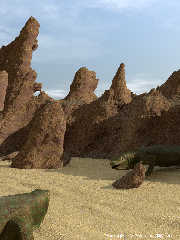
OK. This is what I want it to be.

Thomas
Post a reply to this message
Attachments:
Download 'elements of geology4_08.jpg' (259 KB)
Preview of image 'elements of geology4_08.jpg'
|
|
| |
| |
|
|
|
|
| |
| |
|
|
>Thomas de Groot  on date 29/07/2013 13.07 wrote:
> OK. This is what I want it to be.
>
> Thomas
>
Very impressive!
Paolo
Post a reply to this message
|
|
| |
| |
|
|
|
|
| |
| |
|
|
On 29-7-2013 13:31, Paolo Gibellini wrote:
> Very impressive!
> Paolo

Thanks, Paolo.

Thomas
Post a reply to this message
|
|
| |
| |
|
|
|
|
| |
| |
|
|
Thomas de Groot <tho### [at] degrootorg> wrote:
> OK. This is what I want it to be.

Much better!

Although the right animal's left forefoot still looks like it's floating; it
doesn't show enough ambient occlusion.  This suggests to me, "error_bound is too
high."  Lowering it would add to the render time, but without the high
turbulence on the sand, you might be able to forgo the radiosity normal on.
Post a reply to this message
|
|
| |
| |
|
|
|
|
| |
| |
|
|
"Cousin Ricky" <rickysttATyahooDOTcom> wrote:
> Thomas de Groot <tho### [at] degrootorg> wrote:
> > OK. This is what I want it to be.
>
> Much better!

Indeed!

> Although the right animal's left forefoot still looks like it's floating; it
> doesn't show enough ambient occlusion.  This suggests to me, "error_bound is too
> high."  Lowering it would add to the render time, but without the high
> turbulence on the sand, you might be able to forgo the radiosity normal on.

I cannot see that it's floating, but may be I'm just to blind for that having
only 50% eyesight. The problem may be the belly indeed. Smaller lizzards are
dragging it over the ground but your ones are more comparable to komodo dragons
which did not (all the time). So I think we should stop nitpicking and simply
admire Thomas's wonderful work.

Best regards,
Michael
Post a reply to this message
|
|
| |
| |
|
|
|
|
| |
| |
|
|
On 29-7-2013 21:33, MichaelJF wrote:
> "Cousin Ricky" <rickysttATyahooDOTcom> wrote:
>> Thomas de Groot <tho### [at] degrootorg> wrote:
>>> OK. This is what I want it to be.
>>
>> Much better!
>
> Indeed!
>
>> Although the right animal's left forefoot still looks like it's floating; it
>> doesn't show enough ambient occlusion.  This suggests to me, "error_bound is too
>> high."  Lowering it would add to the render time, but without the high
>> turbulence on the sand, you might be able to forgo the radiosity normal on.
>
> I cannot see that it's floating, but may be I'm just to blind for that having
> only 50% eyesight. The problem may be the belly indeed. Smaller lizzards are
> dragging it over the ground but your ones are more comparable to komodo dragons
> which did not (all the time). So I think we should stop nitpicking and simply
> admire Thomas's wonderful work.
>

Presently, my error_bound is 1.0 which might indeed still be a bit too
high. However, what is visible is the back part of the paw which is not
completely on the ground. The fore part is hidden by the rock.

Indeed Michael, this /is/ a Komodo dragon :-) Totally anachronistic but
who cares? The image is not intended to be published in Nature. There
are Permian animal models to be bought on the web at ContentParadise,
but I find it a bit silly to buy a model just for one image, even if the
price is affordable.

As far as belly dragging is concerned, reptiles lift their belly when
active, even crocodiles do. The reptiles from the Permian are often
pictured in an erect pose (Lystrosaurus, Moschops for instance); see
http://www.youtube.com/watch?v=AHJDejFGDwk. I am not too sure if that is
their most common pose considering their anatomy, but there it is.

Thomas
Post a reply to this message
|
|
| |
| |
|
|
|
|
| |
| |
|
|
On 30/07/2013 7:54 AM, Thomas de Groot wrote:
> Indeed Michael, this /is/ a Komodo dragon :-)

I have only seen a Komodo dragon once and this one looks too happy. o_O

 From what I was told by its keeper. They are really bad tempered and
show it. Yours looks quite amicable. :-)


> Totally anachronistic but who cares?

Not I, for one.

--
Regards
     Stephen
Post a reply to this message
|
|
| |
| |
|
|
|
|
| |
| |
|
|
Le 13-07-30 15:14, Stephen a écrit :
> On 30/07/2013 7:54 AM, Thomas de Groot wrote:
>> Indeed Michael, this /is/ a Komodo dragon :-)
>
> I have only seen a Komodo dragon once and this one looks too happy. o_O
>
>  From what I was told by its keeper. They are really bad tempered and
> show it. Yours looks quite amicable. :-)
>
>
>> Totally anachronistic but who cares?
>
> Not I, for one.
>

They may somewhat less bad tempered when among themselves, and who know,
those two may be in the middle of courtship....


Alain
Post a reply to this message
|
|
| |
| |
|
|
|
|
| |
| |
|
|
On 30-7-2013 21:14, Stephen wrote:
> On 30/07/2013 7:54 AM, Thomas de Groot wrote:
>> Indeed Michael, this /is/ a Komodo dragon :-)
>
> I have only seen a Komodo dragon once and this one looks too happy. o_O
>
>  From what I was told by its keeper. They are really bad tempered and
> show it. Yours looks quite amicable. :-)

ROFL You made my day Stephen. But why deny happiness to those poor
creatures? ;-)

This makes me think about how we humans unconsciously (and erroneously)
project on animals our own attitudes. The /smiling/ chimp is a good example.

Thomas
Post a reply to this message
|
|
| |
| |
|
|
|
|
| |
| |
|
|
Am 31.07.2013 09:12, schrieb Thomas de Groot:

> This makes me think about how we humans unconsciously (and erroneously)
> project on animals our own attitudes. The /smiling/ chimp is a good
> example.

Indeed. Never trust a chimp that shows its teeth. (Unless it's only the
upper ones, that is.)

Cats and smiles is an interesting story, too. Did you know that cats
actually "smile" at each other by closing their eyes?
Post a reply to this message
|
|
| |
| |
|
|
|
|
| |
| |
|
|
On 31-7-2013 10:14, clipka wrote:
> Cats and smiles is an interesting story, too. Did you know that cats
> actually "smile" at each other by closing their eyes?
>

Of course I do! I have been a long-time cat owner! Or more truthfully I
should say, I have been owned by cats. :-)

Applying it helps to make friends with cats too.

Thomas
Post a reply to this message
|
|
| |
| |
|
|
|
|
| |
| |
|
|
Am 31.07.2013 13:42, schrieb Thomas de Groot:
> On 31-7-2013 10:14, clipka wrote:
>> Cats and smiles is an interesting story, too. Did you know that cats
>> actually "smile" at each other by closing their eyes?
>
> Of course I do! I have been a long-time cat owner! Or more truthfully I
> should say, I have been owned by cats. :-)

The latter goes without saying. There's no such thing as a cat owner.

> Applying it helps to make friends with cats too.

|-)
Post a reply to this message
|
|
| |
| |
|
|
|
|
| |
| |
|
|
On 31-7-2013 14:13, clipka wrote:
> Am 31.07.2013 13:42, schrieb Thomas de Groot:
>> On 31-7-2013 10:14, clipka wrote:
>>> Cats and smiles is an interesting story, too. Did you know that cats
>>> actually "smile" at each other by closing their eyes?
>>
>> Of course I do! I have been a long-time cat owner! Or more truthfully I
>> should say, I have been owned by cats. :-)

>
> The latter goes without saying. There's no such thing as a cat owner.

That is why I prefer cats over dogs. I like arguing with them on an
equal basis ;-)

>
>> Applying it helps to make friends with cats too.
>
> |-)
>
And I forgot to say: when they are willing of course.

Thomas
Post a reply to this message
|
|
| |
| |
|
|
|
|
| |
| |
|
|
Thomas de Groot <tho### [at] degrootorg> wrote:
> On 30-7-2013 21:14, Stephen wrote:
> > On 30/07/2013 7:54 AM, Thomas de Groot wrote:
> >> Indeed Michael, this /is/ a Komodo dragon :-)
> >
> > I have only seen a Komodo dragon once and this one looks too happy. o_O
> >
> >  From what I was told by its keeper. They are really bad tempered and
> > show it. Yours looks quite amicable. :-)
>
> ROFL You made my day Stephen. But why deny happiness to those poor
> creatures? ;-)
>

Maybe it is saying to the other,
“Don’t look round, dinner has arrived.”


> This makes me think about how we humans unconsciously (and erroneously)
> project on animals our own attitudes. The /smiling/ chimp is a good example.
>

How true, although animals can have emotions similar to ours.
About the same time that I saw the Komodo dragon (I was working in a zoo). I was
with a keeper who was feeding Fairy Penguins. I said that they looked
affectionate but she told me that it was just greed. Wallabies exhibited similar
behavior, they would let people stroke them hoping for food.

Stephen
Post a reply to this message
|
|
| |
| |
|
|
|
|
| |
| |
|
|
clipka <ano### [at] anonymousorg> wrote:

> Cats and smiles is an interesting story, too. Did you know that cats
> actually "smile" at each other by closing their eyes?

I did not know that but since you mention it. I can see all those smiling cats
that I have known.

Stephen
Post a reply to this message
|
|
| |
| |
|
|
|
|
| |
| |
|
|
On 31-7-2013 16:11, Stephen wrote:

> Maybe it is saying to the other,
> “Don’t look round, dinner has arrived.”

That may well be true.

>
>
>> This makes me think about how we humans unconsciously (and erroneously)
>> project on animals our own attitudes. The /smiling/ chimp is a good example.
>>
>
> How true, although animals can have emotions similar to ours.
> About the same time that I saw the Komodo dragon (I was working in a zoo). I was
> with a keeper who was feeding Fairy Penguins. I said that they looked
> affectionate but she told me that it was just greed. Wallabies exhibited similar
> behavior, they would let people stroke them hoping for food.

I think that we often misinterpret their emotions into human
equivalents, except for those basic ones like pain and fear. Like you
tell, affective behaviour to get food for instance. Cats can gladly give
you all the affection of the world, but only in fair exchange of safety,
warmth, food, a welcome lap for a little nap. Not necessarily in that
order. And they can make you feel stupid too.

Thomas
Post a reply to this message
|
|
| |
| |
|
|
|
|
| |
| |
|
|
Thomas de Groot <tho### [at] degrootorg> wrote:
> On 31-7-2013 16:11, Stephen wrote:
>
> > Maybe it is saying to the other,
> > “Don’t look round, dinner has arrived.”
>
> That may well be true.
>
> >
> >
> >> This makes me think about how we humans unconsciously (and erroneously)
> >> project on animals our own attitudes. The /smiling/ chimp is a good example.
> >>
> >
> > How true, although animals can have emotions similar to ours.
> > About the same time that I saw the Komodo dragon (I was working in a zoo). I was
> > with a keeper who was feeding Fairy Penguins. I said that they looked
> > affectionate but she told me that it was just greed. Wallabies exhibited similar
> > behavior, they would let people stroke them hoping for food.
>
> I think that we often misinterpret their emotions into human
> equivalents, except for those basic ones like pain and fear. Like you
> tell, affective behaviour to get food for instance. Cats can gladly give
> you all the affection of the world, but only in fair exchange of safety,
> warmth, food, a welcome lap for a little nap. Not necessarily in that
> order. And they can make you feel stupid too.
>
> Thomas

Yes, that is true. To close your eyes to a cat is simply to say "I love you" or
better "I trust you" to the little beast. I'm hosted by three of them...

Best regads,
Michael
Post a reply to this message
|
|
| |
| |
|
|
|
|
| |
| |
|
|
Thomas de Groot <tho### [at] degrootorg> wrote:
> As far as belly dragging is concerned, reptiles lift their belly when
> active, even crocodiles do. The reptiles from the Permian are often
> pictured in an erect pose (Lystrosaurus, Moschops for instance); see
> http://www.youtube.com/watch?v=AHJDejFGDwk. I am not too sure if that is
> their most common pose considering their anatomy, but there it is.

Lystrosaurus and mostrops are both therapsids, which is the line that evolved
into mammals.  An erect posture would make sense.

(Therapsids dominated the mid to late Permian.  I have heard the Permian called
the "First Age of Mammals.")
Post a reply to this message
|
|
| |
| |
|
|
|
|
| |
| |
|
|
On 31/07/2013 7:10 PM, MichaelJF wrote:
> Yes, that is true. To close your eyes to a cat is simply to say "I love you" or
> better "I trust you" to the little beast. I'm hosted by three of them...

If you closed your eyes to the last Tom that I had. You would find that
the keys to the fridge were missing and an innocent (smug) look on his
face. ;-)

--
Regards
     Stephen
Post a reply to this message
|
|
| |
| |
|
|
|
|
| |
| |
|
|
On 31-7-2013 20:21, Cousin Ricky wrote:
> Lystrosaurus and mostrops are both therapsids, which is the line that evolved
> into mammals.  An erect posture would make sense.

Correct. Therapsids they are. Still, if you look at their anatomy,
Therapsids still have their legs sideways although less so than
reptiles. The first to develop truly anatomically /modern/ legs were the
dinosaurs, which contributed to their success.

>
> (Therapsids dominated the mid to late Permian.  I have heard the Permian called
> the "First Age of Mammals.")

Yes, although I disagree with the latter. Mammals only emerged at the
end of the Triassic. Therapsids have some mammal-like traits but are
certainly not mammals.

Thomas
Post a reply to this message
|
|
| |
| |
|
|
|
|
| |