|
|
|
|
|
|
| |
| |
|
|
|
|
| |
| |
|
|
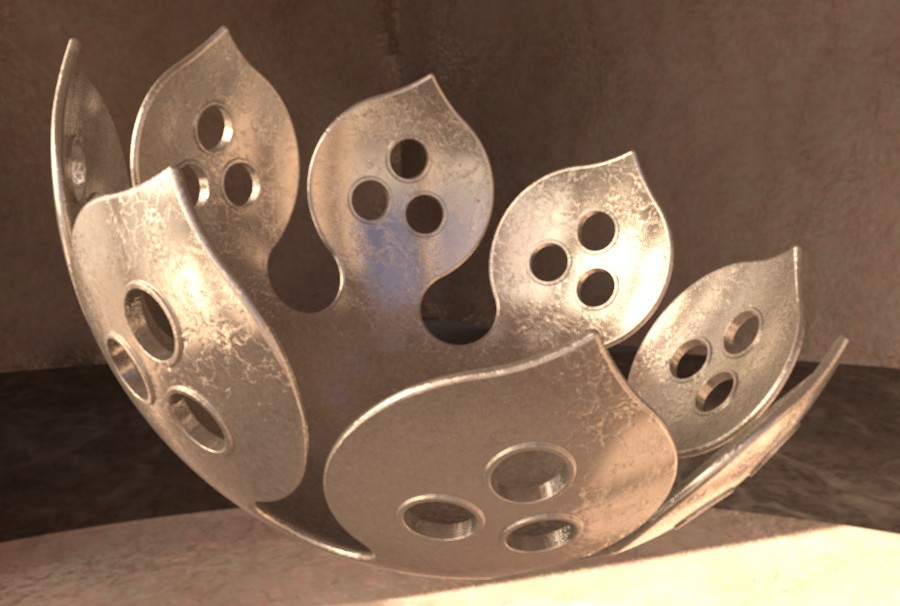
No blobs, SORs, isos, etc. Just the primitive primitives.

Maybe I'm off my game, but this one took some head-scratching. 559 pieces
with the bounding and clipping objects.

If you think you've got it figured out, try it. $50 to the POV-Ray wishlist
(presuming this still exists) if anyone else can get it.

Some nice geology renders since I've been here. Saving my comments for the
tcrtc.

 -Shay
Post a reply to this message
Attachments:
Download 'ikebana.jpg' (97 KB)
Preview of image 'ikebana.jpg'

|
|
| |
| |
|
|
|
|
| |
| |
|
|
"Shay" <non### [at] none com> wrote:
> No blobs, SORs, isos, etc. Just the primitive primitives.
>
> Maybe I'm off my game, but this one took some head-scratching. 559 pieces
> with the bounding and clipping objects.
>
> If you think you've got it figured out, try it. $50 to the POV-Ray wishlist
> (presuming this still exists) if anyone else can get it.
>
> Some nice geology renders since I've been here. Saving my comments for the
> tcrtc.
>
> -Shay
you're quite insane
and awesome too
no clue about those leafy shapes com> wrote:
> No blobs, SORs, isos, etc. Just the primitive primitives.
>
> Maybe I'm off my game, but this one took some head-scratching. 559 pieces
> with the bounding and clipping objects.
>
> If you think you've got it figured out, try it. $50 to the POV-Ray wishlist
> (presuming this still exists) if anyone else can get it.
>
> Some nice geology renders since I've been here. Saving my comments for the
> tcrtc.
>
> -Shay
you're quite insane
and awesome too
no clue about those leafy shapes
Post a reply to this message
|
|
| |
| |
|
|
|
|
| |
| |
|
|
On 24-7-2013 2:01, Shay wrote:
> No blobs, SORs, isos, etc. Just the primitive primitives.
>
> Maybe I'm off my game, but this one took some head-scratching. 559
> pieces with the bounding and clipping objects.
>
> If you think you've got it figured out, try it. $50 to the POV-Ray
> wishlist (presuming this still exists) if anyone else can get it.

At first sight, that looks quite straightforward ;-) but as you hint,
there is more to it than a simple construct. The rounded edges for one,
are an indication...

>
> Some nice geology renders since I've been here. Saving my comments for
> the tcrtc.

Good! Some more images coming I hope. I have not finished yet either...

Thomas
Post a reply to this message
|
|
| |
| |
|
|
|
|
| |
| |
|
|
"Shay" <non### [at] nonecom> wrote:
> If you think you've got it figured out, try it. $50 to the POV-Ray wishlist
> (presuming this still exists) if anyone else can get it.

I can visualize the parts that need to fit together.  The hard part will be the
non-Euclidian math needed to make them match up.
Post a reply to this message
|
|
| |
| |
|
|
|
|
| |
| |
|
|
Am 24.07.2013 16:19, schrieb Cousin Ricky:
> "Shay" <non### [at] nonecom> wrote:
>> If you think you've got it figured out, try it. $50 to the POV-Ray wishlist
>> (presuming this still exists) if anyone else can get it.
>
> I can visualize the parts that need to fit together.  The hard part will be the
> non-Euclidian math needed to make them match up.

Indeed!
Post a reply to this message
|
|
| |
| |
|
|
|
|
| |
| |
|
|
clipka <ano### [at] anonymousorg> wrote:
> Am 24.07.2013 16:19, schrieb Cousin Ricky:
> > "Shay" <non### [at] nonecom> wrote:
> >> If you think you've got it figured out, try it. $50 to the POV-Ray wishlist
> >> (presuming this still exists) if anyone else can get it.
> >
> > I can visualize the parts that need to fit together.  The hard part will be the
> > non-Euclidian math needed to make them match up.
>
> Indeed!

No, no non-Euclidian math is needed here. One can solve the puzzle only with
Euclid and Pythagoras but one has to think in polar coordinates instead of
Euclidian ones and heavily use rotate. I really liked this Little challenge
since I was a Little bit bored looking at Smoking mountains and needed a break.
But unfortunatelly I have not the time to accomplish the full Picture.

Best regards,
Michael
Post a reply to this message
|
|
| |
| |
|
|
|
|
| |
| |
|
|
On Wed, 24 Jul 2013 02:01:43 +0200, Shay <non### [at] nonecom> wrote:

> No blobs, SORs, isos, etc. Just the primitive primitives.
>
> Maybe I'm off my game, but this one took some head-scratching. 559 pieces
> with the bounding and clipping objects.
>
> If you think you've got it figured out, try it. $50 to the POV-Ray
> wishlist
> (presuming this still exists) if anyone else can get it.
>
> Some nice geology renders since I've been here. Saving my comments for
> the
> tcrtc.
>
>  -Shay

Getting the correct rotation for the tori on the edges of the petals is
the difficult part. I can imagine how to do it but I'm never sure when and
how to use vrotate etc.

--
-Nekar Xenos-
Post a reply to this message
|
|
| |
| |
|
|
|
|
| |
| |
|
|
"MichaelJF" <mi-### [at] t-onlinede> wrote:
> clipka <ano### [at] anonymousorg> wrote:
> > Am 24.07.2013 16:19, schrieb Cousin Ricky:
> > > "Shay" <non### [at] nonecom> wrote:
> > >> If you think you've got it figured out, try it. $50 to the POV-Ray wishlist
> > >> (presuming this still exists) if anyone else can get it.
> > >
> > > I can visualize the parts that need to fit together.  The hard part will be the
> > > non-Euclidian math needed to make them match up.
> >
> > Indeed!
>
> No, no non-Euclidian math is needed here. One can solve the puzzle only with
> Euclid and Pythagoras but one has to think in polar coordinates instead of
> Euclidian ones and heavily use rotate. I really liked this Little challenge
> since I was a Little bit bored looking at Smoking mountains and needed a break.
> But unfortunatelly I have not the time to accomplish the full Picture.
>
> Best regards,
> Michael

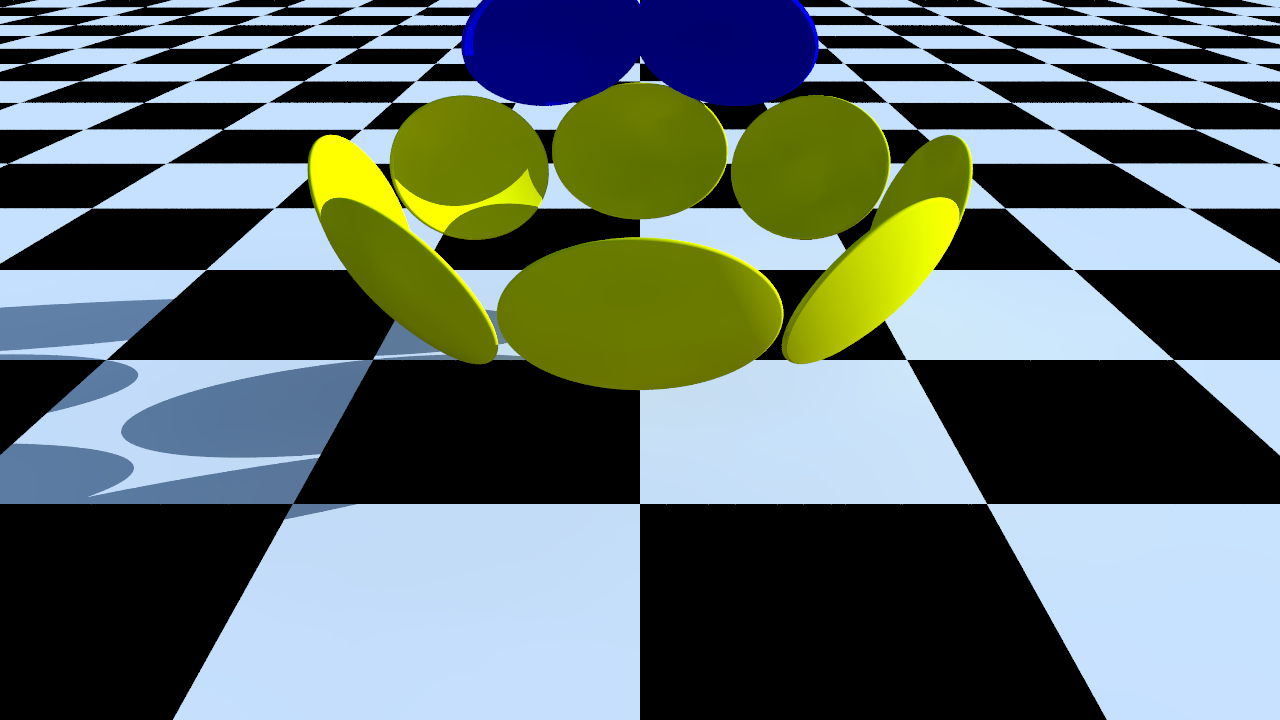
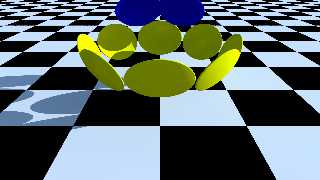
To illustrate this a bit. If you add a new slice of the surrounding sphere and
cut out the blue "circles" rotated eight times around the y-axis, fill in
appropriate scaled, cut and transformed tori and finally eight little spheres
you have solved the problem of the upper pikes.

Best regards,
Michael
Post a reply to this message
Attachments:
Download 'csg challenge.png' (120 KB)
Preview of image 'csg challenge.png'
|
|
| |
| |
|
|
|
|
| |
| |
|
|
Am 24.07.2013 21:09, schrieb MichaelJF:
> "MichaelJF" <mi-### [at] t-onlinede> wrote:
>> clipka <ano### [at] anonymousorg> wrote:
>>> Am 24.07.2013 16:19, schrieb Cousin Ricky:
>>>> "Shay" <non### [at] nonecom> wrote:
>>>>> If you think you've got it figured out, try it. $50 to the POV-Ray wishlist
>>>>> (presuming this still exists) if anyone else can get it.
>>>>
>>>> I can visualize the parts that need to fit together.  The hard part will be the
>>>> non-Euclidian math needed to make them match up.
>>>
>>> Indeed!
>>
>> No, no non-Euclidian math is needed here. One can solve the puzzle only with
>> Euclid and Pythagoras but one has to think in polar coordinates instead of
>> Euclidian ones and heavily use rotate. I really liked this Little challenge
>> since I was a Little bit bored looking at Smoking mountains and needed a break.
>> But unfortunatelly I have not the time to accomplish the full Picture.
>>
>> Best regards,
>> Michael
>
> To illustrate this a bit. If you add a new slice of the surrounding sphere and
> cut out the blue "circles" rotated eight times around the y-axis, fill in
> appropriate scaled, cut and transformed tori and finally eight little spheres
> you have solved the problem of the upper pikes.

I have no trouble coming up with the necessary CSG; buth the precise
placement of the elements seems less trivial to me.
Post a reply to this message
|
|
| |
| |
|
|
|
|
| |
| |
|
|
clipka <ano### [at] anonymousorg> wrote:
> Am 24.07.2013 21:09, schrieb MichaelJF:
> > "MichaelJF" <mi-### [at] t-onlinede> wrote:
> >> clipka <ano### [at] anonymousorg> wrote:
> >>> Am 24.07.2013 16:19, schrieb Cousin Ricky:
> >>>> "Shay" <non### [at] nonecom> wrote:
> >>>>> If you think you've got it figured out, try it. $50 to the POV-Ray wishlist
> >>>>> (presuming this still exists) if anyone else can get it.
> >>>>
> >>>> I can visualize the parts that need to fit together.  The hard part will be the
> >>>> non-Euclidian math needed to make them match up.
> >>>
> >>> Indeed!
> >>
> >> No, no non-Euclidian math is needed here. One can solve the puzzle only with
> >> Euclid and Pythagoras but one has to think in polar coordinates instead of
> >> Euclidian ones and heavily use rotate. I really liked this Little challenge
> >> since I was a Little bit bored looking at Smoking mountains and needed a break.
> >> But unfortunatelly I have not the time to accomplish the full Picture.
> >>
> >> Best regards,
> >> Michael
> >
> > To illustrate this a bit. If you add a new slice of the surrounding sphere and
> > cut out the blue "circles" rotated eight times around the y-axis, fill in
> > appropriate scaled, cut and transformed tori and finally eight little spheres
> > you have solved the problem of the upper pikes.
>
> I have no trouble coming up with the necessary CSG; buth the precise
> placement of the elements seems less trivial to me.
Certainly it is not trivial, that is why I pointed out all this things.

Beat regards,
Michael
Post a reply to this message
|
|
| |
| |
|
|
|
|
| |
| |
|
|
"MichaelJF" <mi-### [at] t-onlinede> wrote:
> No, no non-Euclidian math is needed here. One can solve the puzzle only with
> Euclid and Pythagoras but one has to think in polar coordinates instead of
> Euclidian ones and heavily use rotate.

Isn't that non-Euclidian?
Post a reply to this message
|
|
| |
| |
|
|
|
|
| |
| |
|
|
Nice

"MichaelJF" <mi-### [at] t-onlinede> wrote in message
news:web.51f026863a6d0c047d40b13d0@news.povray.org...
> "MichaelJF" <mi-### [at] t-onlinede> wrote:
>> clipka <ano### [at] anonymousorg> wrote:
>> > Am 24.07.2013 16:19, schrieb Cousin Ricky:
>> > > "Shay" <non### [at] nonecom> wrote:
>> > >> If you think you've got it figured out, try it. $50 to the POV-Ray
>> > >> wishlist
>> > >> (presuming this still exists) if anyone else can get it.
>> > >
>> > > I can visualize the parts that need to fit together.  The hard part
>> > > will be the
>> > > non-Euclidian math needed to make them match up.
>> >
>> > Indeed!
>>
>> No, no non-Euclidian math is needed here. One can solve the puzzle only
>> with
>> Euclid and Pythagoras but one has to think in polar coordinates instead
>> of
>> Euclidian ones and heavily use rotate. I really liked this Little
>> challenge
>> since I was a Little bit bored looking at Smoking mountains and needed a
>> break.
>> But unfortunatelly I have not the time to accomplish the full Picture.
>>
>> Best regards,
>> Michael
>
> To illustrate this a bit. If you add a new slice of the surrounding sphere
> and
> cut out the blue "circles" rotated eight times around the y-axis, fill in
> appropriate scaled, cut and transformed tori and finally eight little
> spheres
> you have solved the problem of the upper pikes.
>
> Best regards,
> Michael
>
Post a reply to this message
|
|
| |
| |
|
|
|
|
| |
| |
|
|
"Shay" <non### [at] nonecom> wrote:
> No blobs, SORs, isos, etc. Just the primitive primitives.
>
> Maybe I'm off my game, but this one took some head-scratching. 559 pieces
> with the bounding and clipping objects.
>
> If you think you've got it figured out, try it. $50 to the POV-Ray wishlist
> (presuming this still exists) if anyone else can get it.
>

I thought I was pretty good at CSG but this is amazing, I can see how I would
try it but my method relies more on basic math and trial and error rather than
anything scientific ;-)

The bevelling is the bit I would have most trouble with, unfortunately not a
good time for me to be attempting this but maybe in a few weeks I will find some
time to have a go, I like a challenge.

Sean
Post a reply to this message
|
|
| |
| |
|
|
|
|
| |
| |
|
|
I can't say exactly how close MichaelJF is, but I can say with confidence
that he may very well be further away that it seems. What made a monkey out
of me wasn't the difficulty (though, Euclidian or no, this is far beyond any
math I learned in school*). What made a monkey out of me was the *apparent*
simplicity. I only have a few minutes a day to work on POV, and I wasted too
many of those opportunities THINKING I had it figured out.

Either way, this is only one apparently simple piece of an apparently
simple (about 15k components) CSG construction.

 -Shay

* I learned most of my math from Povvers ABX and Tor.
Post a reply to this message
|
|
| |
| |
|
|
|
|
| |
| |
|
|
"s.day" <s.d### [at] uelacuk> wrote in message
news:web.51f041823a6d0c04467d02b40@news.povray.org...
> The bevelling is the bit I would have most trouble with, unfortunately not
> a
> good time for me to be attempting this but maybe in a few weeks I will
> find some
> time to have a go, I like a challenge.

Excellent. And the bounty will stand till someone collects it.
Post a reply to this message
|
|
| |
| |
|
|
|
|
| |
| |
|
|
Am 24.07.2013 02:01, schrieb Shay:
> No blobs, SORs, isos, etc. Just the primitive primitives.
>
> Maybe I'm off my game, but this one took some head-scratching. 559
> pieces with the bounding and clipping objects.
>
> If you think you've got it figured out, try it. $50 to the POV-Ray
> wishlist (presuming this still exists) if anyone else can get it.

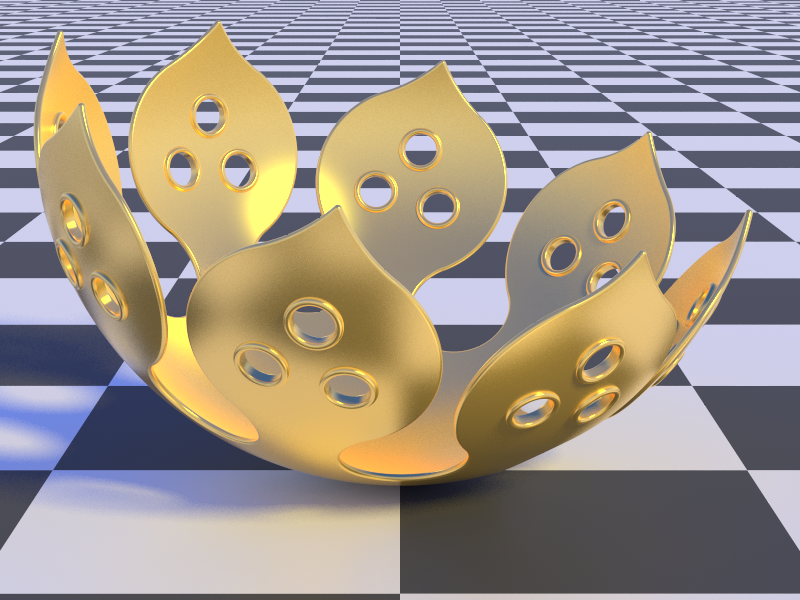
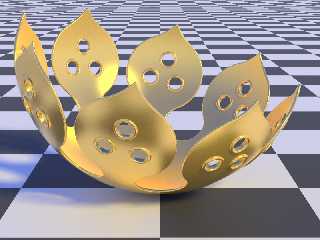
Maybe I'm missing something, but I come up with just 215 primitives + 69
containers (while for some reason I don't understand POV-Ray reports 82
finite objects and no infinite ones). Not using bounding though, which
makes it pretty slow to render, and I have no idea why I would want to
use clipping.

This is only proof of concept for the CSG though, with some of the
object placement parameters just being tweaked until they fit, rather
than having POV-Ray compute them automatically.

Ah, and of course I can't help but show off the blurred reflections
again :-P
Post a reply to this message
Attachments:
Download 'shays_challenge.png' (531 KB)
Preview of image 'shays_challenge.png'
|
|
| |
| |
|
|
|
|
| |
| |
|
|
"clipka" <ano### [at] anonymousorg> wrote in message
news:51f0627d@news.povray.org...
>
> Maybe I'm missing something, but I come up with just 215 primitives + 69
> containers (while for some reason I don't understand POV-Ray reports 82
> finite objects and no infinite ones).

NICE!!!!! And I'll bet it just so happens you're just the person to ask
about that POV-team Amazon wishlist.

> Not using bounding though, which
> makes it pretty slow to render, and I have no idea why I would want to
> use clipping.

Bounding objects will account for a lot of the difference. You mentioned
"containers"--not sure what you meant there if you didn't mean bounding.

Plus--and I'm not certain--it looks like your small-hole extrusions are
capped with tori. Mine are slightly curved then rounded with tiny tori. If
I'm right, there should be a difference of 24*8 objects there.

I used clipping on the tori, but that may not have been wise. You know a lot
more about the internal workings of POV than I do.

>
> This is only proof of concept for the CSG though, with some of the
> object placement parameters just being tweaked until they fit, rather
> than having POV-Ray compute them automatically.

BOO! Close enough, though.

 -Shay
Post a reply to this message
|
|
| |
| |
|
|
|
|
| |
| |
|
|
Am 25.07.2013 02:46, schrieb Shay:

>> Maybe I'm missing something, but I come up with just 215 primitives + 69
>> containers (while for some reason I don't understand POV-Ray reports 82
>> finite objects and no infinite ones).
>
> NICE!!!!! And I'll bet it just so happens you're just the person to ask
> about that POV-team Amazon wishlist.

You'd actually have to ask Chris Cason whether that Wishlist still
exists; I /think/ the books and hardware that were on that list have all
been donated by now.

>> Not using bounding though, which
>> makes it pretty slow to render, and I have no idea why I would want to
>> use clipping.
>
> Bounding objects will account for a lot of the difference. You mentioned
> "containers"--not sure what you meant there if you didn't mean bounding.

containers = union, difference, intersection (and, in theory, merge; I
didn't use that one though).

> Plus--and I'm not certain--it looks like your small-hole extrusions are
> capped with tori. Mine are slightly curved then rounded with tiny tori.
> If I'm right, there should be a difference of 24*8 objects there.

So what you are saying is that you also beveled the transition between
the "petals" and the tori forming the end of the small-hole extrusions;
is that the essence of it?

 From how I understand your description I suppose it should be possible
with just 9*8 additional primitives and 3 additional containers.

> I used clipping on the tori, but that may not have been wise. You know a
> lot more about the internal workings of POV than I do.

Sounds like you used clipping as a substitute for intersection, is that
what you're saying?

>> This is only proof of concept for the CSG though, with some of the
>> object placement parameters just being tweaked until they fit, rather
>> than having POV-Ray compute them automatically.
>
> BOO! Close enough, though.

Okay, okay - I'll try to come up with formulae for all those parameters...
Post a reply to this message
|
|
| |
| |
|
|
|
|
| |
| |
|
|
Very good indeed, except - as Shay mentioned - the tori in the holes.
They should be curved too. That was one of my main puzzles about Shay's
image.

Thomas
Post a reply to this message
|
|
| |
| |
|
|
|
|
| |
| |
|
|
>> No, no non-Euclidian math is needed here. One can solve the puzzle only with
>> Euclid and Pythagoras but one has to think in polar coordinates instead of
>> Euclidian ones and heavily use rotate.
>
> Isn't that non-Euclidian?

Seems like a confusion between the terms "cartesian" and "Euclidean".
Cartesian is just a coordinate system (xyz), along with polar,
spherical, intrinsic etc, all can be (and usually are) used with
Euclidean geometry.

In non-Euclidean geometry essentially it it not guaranteed that two
straight parallel lines in a plane never cross (which it is in Euclidean
no matter what coordinate system you use to describe the lines). POV-ray
is in no way set up to handle non-Euclidean geometry!
Post a reply to this message
|
|
| |
| |
|
|
|
|
| |
| |
|
|
"clipka"  wrote in message news:51f0ca6b@news.povray.org...
> You'd actually have to ask Chris Cason whether that Wishlist still exists;
> I /think/ the books and hardware that were on that list have all been
> donated by now.

I think I found the list. You're right: empty. Every programmer I know is
constantly reading books. Someone should put something up there.

> So what you are saying is that you also beveled the transition between the
> "petals" and the tori forming the end of the small-hole extrusions; is
> that the essence of it?

I /think/ so. For each small hole, I used 1 object for the hole, 1 object to
bound, and 16 objects to build the extrusion, though the 16 could be
optimized to 14. That's probably where the majority of the object count
difference can be found.

> Sounds like you used clipping as a substitute for intersection, is that
> what you're saying?

Correct. I didn't sit down and count intersection tests to make sure that
was the most efficient way. Maybe it isn't.

> Okay, okay - I'll try to come up with formulae for all those parameters...

As far as I'm concerned, hand-coding is hand-coding, by hook or by crook
(though my way seems a lot more fun).

Priggish professional programmers are the reason I don't post code in these
forums. One told me that I shouldn't be coding algorithms if I don't know
what a stack is. That's like my saying he shouldn't be writing newsgroup
posts if he doesn't know what a chiasmus is.

-Shay
Post a reply to this message
|
|
| |
| |
|
|
|
|
| |
| |
|
|
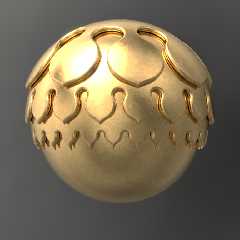
Cool CSG work, Shay!

For some reason I knew clipka would be the winner (that train he was working on
a while back was a clue).

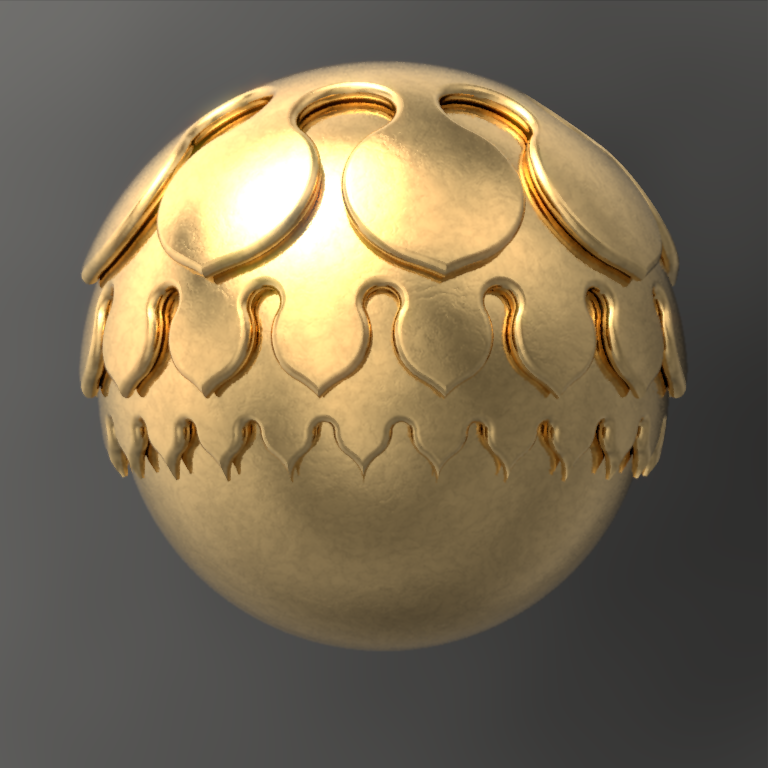
The attached image shows how far I got yesterday before quitting. Two features
are missing, AFAIK: the lobe tips aren't rounded; the lobe holes are
nonexistent. But at least it's all wrapped up in a (somewhat) tidy macro :)

Sam
Post a reply to this message
Attachments:
Download 'shaycsgchallengeb.png' (381 KB)
Preview of image 'shaycsgchallengeb.png'
|
|
| |
| |
|
|
|
|
| |
| |
|
|
On 07/25/2013 05:13 PM, Samuel Benge wrote:
> For some reason I knew clipka would be the winner (that train he was working on
> a while back was a clue).

LOL ... my money was on you ;-) Nice job!
Post a reply to this message
|
|
| |
| |
|
|
|
|
| |
| |
|
|
Clipka posted the CSG first. You posted the math first. Can we call it a
tie?

That train was impressive. Used prisms*, so, imo, a whole other animal.

A CSG (primitive primitives) sub-round of the tcrtc might draw some
interesting entries.

-Shay

* if you count prisms (and sweep approximations), you have to (?) count
triangles, and is it really CSG at that point? It's a somewhat arbitrary
distinction, but "real" CSG makes for a better game, imo.


"Samuel Benge" <stb### [at] hotmailcom> wrote in message
news:web.51f194e13a6d0c04eb1d220f0@news.povray.org...
> Cool CSG work, Shay!
>
> For some reason I knew clipka would be the winner (that train he was
> working on
> a while back was a clue).
>
> The attached image shows how far I got yesterday before quitting. Two
> features
> are missing, AFAIK: the lobe tips aren't rounded; the lobe holes are
> nonexistent. But at least it's all wrapped up in a (somewhat) tidy macro
> :)
>
> Sam
>
Post a reply to this message
|
|
| |
| |
|
|
|
|
| |
| |
|
|
James Holsenback <nom### [at] nonecom> wrote:
> LOL ... my money was on you ;-) Nice job!

It took me too long to figure out what was needed to produce the basic shape: 1)
a latitudinal torus macro (was easy to make); 2) a proper method for smoothly
joining torii together on a sphere (VAngle() was used for measuring distances
spherically between torus centers).

"Shay" <non### [at] nonecom> wrote:
> Clipka posted the CSG first. You posted the math first.

Who, me?

> Can we call it a tie?

If I were to claim a(ny) prize, I'd have sky_sphere-based textured fog make its
debut in the next version of POV-Ray :D (although I do realize it's not that
sort of wishlist :P)

> That train was impressive. Used prisms*, so, imo, a whole other animal.

Well if I remember correctly his train also used torii, cylinders and spheres to
smoothly join various types of surfaces with one another, and the kind of
thinking required to do that would go a long way toward meeting your challenge
advantageously ;)

> A CSG (primitive primitives) sub-round of the tcrtc might draw some
> interesting entries.

I vote for a CSG sub-round!

Sam
Post a reply to this message
Attachments:
Download 'shaycsgchallengec.jpg' (351 KB)
Preview of image 'shaycsgchallengec.jpg'

|
|
| |
| |
|
|
|
|
| |
| |
|
|
Am 25.07.2013 21:09, schrieb Shay:

>> So what you are saying is that you also beveled the transition between
>> the "petals" and the tori forming the end of the small-hole
>> extrusions; is that the essence of it?
>
> I /think/ so. For each small hole, I used 1 object for the hole, 1
> object to bound, and 16 objects to build the extrusion, though the 16
> could be optimized to 14. That's probably where the majority of the
> object count difference can be found.

Did you consider punching the hole through the petal /after/ adding the
extrusion? That might allow for a simpler extrusion, as you won't need
to punch a separate hole through it.

>> Sounds like you used clipping as a substitute for intersection, is
>> that what you're saying?
>
> Correct. I didn't sit down and count intersection tests to make sure
> that was the most efficient way. Maybe it isn't.

Thinking about it, I come to suspect that clipping is actually less
computationally intensive; after all, intersection testing is only
performed on the clipped object, while the clipping object is only
tested for insideness once an intersection has been found.

>> Okay, okay - I'll try to come up with formulae for all those
>> parameters...
>
> As far as I'm concerned, hand-coding is hand-coding, by hook or by crook
> (though my way seems a lot more fun).

I've got all the math sorted out by now (except for the more complex
hole extrusion stuff), so modifying the thing for e.g. 7-fold instead of
8-fold symmetry, changing the petals' size and other some such would now
be a piece of cake; no manual tweaking anymore.

> Priggish professional programmers are the reason I don't post code in
> these forums. One told me that I shouldn't be coding algorithms if I
> don't know what a stack is. That's like my saying he shouldn't be
> writing newsgroup posts if he doesn't know what a chiasmus is.

:-D

It's also like saying that a child shouldn't be playing with any toy if
it doesn't know how to play with it the way the designer intended.

Which is rubbish even if there is solid reason to play according to the
designer's rules (unless of course violation of those rules is seriously
dangerous); science has found out that children actually learn faster
how to use something properly if they've already spent some time toying
around with it as they seem fit, and there is plenty of reason to
suspect that this is the case for every learning process in every age.

As long as you code just for the fun of it, my stance is that coding is
fair game for everyone in every way they like.

(And no, I have not the slightest idea what a chiasmus is - I'd have to
google that ;-))
Post a reply to this message
|
|
| |
| |
|
|
|
|
| |
| |
|
|
Am 25.07.2013 23:13, schrieb Samuel Benge:
> Cool CSG work, Shay!
>
> For some reason I knew clipka would be the winner (that train he was working on
> a while back was a clue).

Hey, the (intended) winner was the POV-Ray wishlist :-)

> The attached image shows how far I got yesterday before quitting. Two features
> are missing, AFAIK: the lobe tips aren't rounded; the lobe holes are
> nonexistent. But at least it's all wrapped up in a (somewhat) tidy macro :)

Looks really great!

Asthetically I do favor this one a lot over my own.
Post a reply to this message
|
|
| |
| |
|
|
|
|
| |
| |
|
|
Am 26.07.2013 00:28, schrieb Shay:
> Clipka posted the CSG first. You posted the math first. Can we call it a
> tie?
>
> That train was impressive. Used prisms*, so, imo, a whole other animal.

No, not really. There, too, it was all about cutting stuff away and
adding stuff back in.

> * if you count prisms (and sweep approximations), you have to (?) count
> triangles, and is it really CSG at that point? It's a somewhat arbitrary
> distinction, but "real" CSG makes for a better game, imo.

The fun part is where you begin to round off the prisms. If you want to
both bevel the edges of the front and back sides as well as round off
the extruded shape itself (which is what I did for the train engine),
spine-based prisms won't get you anywhere, because (or so I believe for
certain reasons) if you widen or tighten a 3rd-order spline loop its new
path will generally not have a constant distance to the original path,
no matter how hard you try. So it's back to cylinders, tori and spheres
again.

The only places where I "cheated" were the smokestack, the sand boxes,
and the thick pipes leading from the boiler to the cylinders; these
elements were modeled using blobs.

Oh, and the person I placed on the engine wasn't CSG either of course :-).
Post a reply to this message
|
|
| |
| |
|
|
|
|
| |
| |
|
|
Am 26.07.2013 03:26, schrieb Samuel Benge:

> If I were to claim a(ny) prize, I'd have sky_sphere-based textured fog make its
> debut in the next version of POV-Ray :D (although I do realize it's not that
> sort of wishlist :P)

:-D

There's only one reason I'm currently /not/ planning on adding such a
feature to the branch I'm working on: There's reason to believe it'll
make it into POV-Ray 3.7.1 faster than you can say "pretty please" (*),
and I'd rather have my branch copy that feature from there than vice
versa :-)

(* And I also have reason to believe that the first POV-Ray 3.7.1 trial
versions will pop out just shortly after the 3.7.0 release proper, and
that the first release of my own branch will come out more or less at
the same time as 3.7.0 proper.)
Post a reply to this message
|
|
| |
| |
|
|
|
|
| |
| |
|
|
On 26-7-2013 4:55, clipka wrote:
> It's also like saying that a child shouldn't be playing with any toy if
> it doesn't know how to play with it the way the designer intended.
>
> Which is rubbish even if there is solid reason to play according to the
> designer's rules (unless of course violation of those rules is seriously
> dangerous); science has found out that children actually learn faster
> how to use something properly if they've already spent some time toying
> around with it as they seem fit, and there is plenty of reason to
> suspect that this is the case for every learning process in every age.

I thoroughly agree with that indeed!

Thomas
Post a reply to this message
|
|
| |
| |
|
|
|
|
| |
| |
|
|
On 26-7-2013 0:28, Shay wrote:
> A CSG (primitive primitives) sub-round of the tcrtc might draw some
> interesting entries.

I shall note this down for future reference. Once the new procedures are
in place (which will be soon I hope) we can launch indeed such a challenge.

Thomas
Post a reply to this message
|
|
| |
| |
|
|
|
|
| |
| |
|
|
"clipka" <ano### [at] anonymousorg> wrote in message
news:51f1eefb@news.povray.org...

>> That train was impressive. Used prisms*, so, imo, a whole other animal.
>
> No, not really. There, too, it was all about cutting stuff away and adding
> stuff back in.

Similar techniques and an equal challenge, for sure. But, if there's a
distinction between a "csg scene" and a "hand-coded scene", I see the
primitive primitives as the logical place to make that distinction.
Primitive primitives are the Neoplasticism of hand-coding.

 -Shay
Post a reply to this message
|
|
| |
| |
|
|
|
|
| |
| |
|
|
"clipka" <ano### [at] anonymousorg> wrote in message
news:51f1e658$1@news.povray.org...
>>
>> For some reason I knew clipka would be the winner (that train he was
>> working on
>> a while back was a clue).
>
> Hey, the (intended) winner was the POV-Ray wishlist :-)

Yeah, about that. I can find no way to support POV-Ray. The wishlist is
empty, and the 'support' link on the website links to the online forums
page. You're (to me) the most visible POV developer at the moment. Is there
a book or something you'd find useful?

 -Shay
Post a reply to this message
|
|
| |
| |
|
|
|
|
| |
| |
|
|
"Samuel Benge" <stb### [at] hotmailcom> wrote in message
news:web.51f1d0413a6d0c04ae2c701b0@news.povray.org...
>
> If I were to claim a(ny) prize, I'd have sky_sphere-based textured fog
> make its
> debut in the next version of POV-Ray :D (although I do realize it's not
> that
> sort of wishlist :P)

If there were that sort of wishlist, I'd wish for fudgable tangent-maps for
bicubic patches.

bicubic_patch {
    vertex_vectors ...
    normal_vectors ...
}

would allow, I think, one to smoothly (to the eye) join patches at valence
!= 4 vertices.

 -Shay
Post a reply to this message
|
|
| |
| |
|
|
|
|
| |
| |
|
|
Am 26.07.2013 11:32, schrieb Shay:
> "clipka" <ano### [at] anonymousorg> wrote in message
> news:51f1eefb@news.povray.org...
>
>>> That train was impressive. Used prisms*, so, imo, a whole other animal.
>>
>> No, not really. There, too, it was all about cutting stuff away and
>> adding stuff back in.
>
> Similar techniques and an equal challenge, for sure. But, if there's a
> distinction between a "csg scene" and a "hand-coded scene", I see the
> primitive primitives as the logical place to make that distinction.
> Primitive primitives are the Neoplasticism of hand-coding.

Would you consider boxes as primitive primitives for that matter?
Because I see not much of a conceptual difference between those and
(linear) prisms: Both can be replaced by a compound of planes.

I'd also like to note that the power of (linear) prisms does not lie in
being a shortcut in terms of CSG (after all it would be comparatively
easy to throw together a macro that takes an array of vertices and
generates a prism constructed from planes), but in being much faster to
render.

As for the terms "csg scene" and "hand-coded scene", here's how I'd
define them:

- CSG scene: Any scene that defines all its complex shapes as unions,
merges, intersections and/or differences of less complex solid shapes
(which in turn might also be defined this way); after all, that is
exactly what "CSG" means: "Constructive Solid Geometry". (In the strict
sense this would even allow for meshes, provided they have an
inside_vector, but I'd be ok with still disallowing them.)

- Hand-coded scene: Any scene that was created using nothing more than a
text editor and POV-Ray itself.

The two terms are perfectly orthogonal: The shapes in a CSG scene can be
both hand-coded and/or created with a CSG modeling tool, and a
hand-coded scene can have both CSG shapes and/or non-CSG shapes.
Post a reply to this message
|
|
| |
| |
|
|
|
|
| |
| |
|
|
Am 26.07.2013 11:40, schrieb Shay:
>
>
> "Samuel Benge" <stb### [at] hotmailcom> wrote in message
> news:web.51f1d0413a6d0c04ae2c701b0@news.povray.org...
>>
>> If I were to claim a(ny) prize, I'd have sky_sphere-based textured fog
>> make its
>> debut in the next version of POV-Ray :D (although I do realize it's
>> not that
>> sort of wishlist :P)
>
> If there were that sort of wishlist, I'd wish for fudgable tangent-maps
> for bicubic patches.
>
> bicubic_patch {
>     vertex_vectors ...
>     normal_vectors ...
> }
>
> would allow, I think, one to smoothly (to the eye) join patches at
> valence != 4 vertices.

You mean cases where two vertices of one patch coincide?

I'd rather have genuine triangular bicubic patches.
Post a reply to this message
|
|
| |
| |
|
|
|
|
| |
| |
|
|
Am 26.07.2013 11:36, schrieb Shay:

> Yeah, about that. I can find no way to support POV-Ray. The wishlist is
> empty, and the 'support' link on the website links to the online forums
> page.

Heh. The "support" link isn't meant to be for people intending to
support POV-Ray, but for people requesting support about POV-Ray :-P

> You're (to me) the most visible POV developer at the moment. Is
> there a book or something you'd find useful?

You've caught me off guard there - I'll try to come up with something.


Alternatively, I might point you to one of the following pages:

   http://www.lipka-koeln.de/%C3%BCber-pov-ray/
   http://www.lipka-koeln.de/%C3%BCber-pov-ray/%C3%BCberpov/

and draw your (and anyone else's) attention particularly to the small
green Flattr buttons.
Post a reply to this message
|
|
| |
| |
|
|
|
|
| |
| |
|
|
"clipka"  wrote in message news:51f1e517$1@news.povray.org...

> Did you consider punching the hole through the petal /after/
> adding the extrusion? That might allow for a simpler extrusion,
> as you won't need to punch a separate hole through it.

The most obvious way to save those "extra" holes would be to subtract 24
holes from 13*24+1 (13 each for optimized extrusions minus one hole and then
one sphere) objects. More elegant than the way I'm doing it now, but I'd
lose my individual bounding objects. I'm no programmer, but I know enough to
know that premature optimization is the root of all evil (even if it is it's
own fun little riddle).

> I've got all the math sorted out by now (except for the more complex hole
> extrusion stuff), so modifying the thing for e.g. 7-fold instead of 8-fold
> symmetry, changing the petals' size and other some such would now be a
> piece of cake; no manual tweaking anymore.

Nice. Though manual tweaking does have a silver lining. Once I make
something *too* easy, I have to face the temptation of re-using the same
tool over and over again. There's something to be said for looking at each
component and thinking "how the hell am I going to pull that off?"

> As long as you code just for the fun of it, my stance is that coding is
> fair game for everyone in every way they like.

Hear! Hear!

Right now, I'm trying to forget half of what I *do* know about programming.
I see myself doing less programming in the future, so I want to downsize to
a more maintainable skillset. Honestly, I can understand Perl I wrote 9
years ago better that some of the Python I wrote 2 years ago. Conscious
competence *quickly* withers on the vine.

> (And no, I have not the slightest idea what a chiasmus is - I'd have to
> google that ;-))

You're familiar with the structure, even if you don't know the word.
The definition might build your vocabulary, but it won't re-build your
narrative.

-Shay
Post a reply to this message
|
|
| |
| |
|
|
|
|
| |
| |
|
|
"clipka"  wrote in message news:51f250db$1@news.povray.org...

> You mean cases where two vertices of one patch coincide?

No, cases where more or less than four patches meet at one corner. C2 is
(afaict) impossible in most of these cases. The great thing about mesh is
that you can cheat a little bit to make things look near-perfect, even when
they're not. I'd like to *tell* the patch what its normal vectors are,
rather than having these vectors calculated by POV-ray.

> I'd rather have genuine triangular bicubic patches.

That too, but you'd have a hard time using them without the flexibility of
"normal maps".
Post a reply to this message
|
|
| |
| |
|
|
|
|
| |
| |
|
|
"clipka"  wrote in message news:51f25051$1@news.povray.org...

> - CSG scene: Any scene that defines all its complex shapes as unions,
> merges, intersections and/or differences of less complex solid shapes
> (which in turn might also be defined this way); after all, that is exactly
> what "CSG" means: "Constructive Solid Geometry". (In the strict sense this
> would even allow for meshes, provided they have an inside_vector, but I'd
> be ok with still disallowing them.)

> - Hand-coded scene: Any scene that was created using nothing more than a
> text editor and POV-Ray itself.

> The two terms are perfectly orthogonal: The shapes in a CSG scene can be
> both hand-coded and/or created with a CSG modeling tool, and a hand-coded
> scene can have both CSG shapes and/or non-CSG shapes.

Not perfectly, we can quibble on the definition of "strict sense" you
mentioned above. Even a triangle, can be replaced by a compound (ok,
difference) of planes.

If linear prisms are allowed, will curved prisms be allowed as well? I don’t
completely disagree with allowing linear prisms as a shortcut, but there's
something nice about being able to say a shape is made from planes, spheres,
boxes, cones, cylinders, and tori (rings). These shapes (ok, maybe not
planes) are known to children. Most people think of a prism as something to
make rainbows out of sunlight.

-Shay
Post a reply to this message
|
|
| |
| |
|
|
|
|
| |
| |
|
|
That (flattr) works. Thank you.

"clipka"  wrote in message news:51f256bf@news.povray.org...

Am 26.07.2013 11:36, schrieb Shay:

> Yeah, about that. I can find no way to support POV-Ray. The wishlist is
> empty, and the 'support' link on the website links to the online forums
> page.

Heh. The "support" link isn't meant to be for people intending to
support POV-Ray, but for people requesting support about POV-Ray :-P

> You're (to me) the most visible POV developer at the moment. Is
> there a book or something you'd find useful?

You've caught me off guard there - I'll try to come up with something.


Alternatively, I might point you to one of the following pages:

   http://www.lipka-koeln.de/%C3%BCber-pov-ray/
   http://www.lipka-koeln.de/%C3%BCber-pov-ray/%C3%BCberpov/

and draw your (and anyone else's) attention particularly to the small
green Flattr buttons.
Post a reply to this message
|
|
| |
| |
|
|
|
|
| |
| |
|
|
Am 26.07.2013 15:12, schrieb Shay:

> If linear prisms are allowed, will curved prisms be allowed as well?

Why, yes, of course.

> I don’t completely disagree with allowing linear prisms as a shortcut, but
> there's something nice about being able to say a shape is made from
> planes, spheres, boxes, cones, cylinders, and tori (rings). These shapes
> (ok, maybe not planes) are known to children. Most people think of a
> prism as something to make rainbows out of sunlight.

I have no problem with you considering this an art form of its own, but
assigning this concept to the term "CSG scene" is like assigning the
concept of haikus to the word "poetry": Sure, every haiku qualifies as
poetry, but if you ask me to write poetry don't necessarily expect me to
write a haiku.
Post a reply to this message
|
|
| |
| |
|
|
|
|
| |
| |
|
|
"clipka"  wrote in message news:51f27f3b@news.povray.org...

Am 26.07.2013 15:12, schrieb Shay:

>> If linear prisms are allowed, will curved prisms be allowed as well?

> Why, yes, of course.

But not triangles? Patches?

> I have no problem with you considering this an art form of its own, but
> assigning this concept to the term "CSG scene" is like assigning the
> concept of haikus to the word "poetry": Sure, every haiku qualifies as
> poetry, but if you ask me to write poetry don't necessarily expect me to
> write a haiku.

Maybe we need a third term. There's even some disagreement about what
qualifies as a haiku.

I'm just exploring what would be the most fun sandbox for a side-challenge
round of the tcrtc. I think we agree that some explication of "csg scene"
would be useful. It's all up to Thomas in the end, of course.

-Shay
Post a reply to this message
|
|
| |
| |
|
|
|
|
| |
| |
|
|
Am 26.07.2013 16:02, schrieb Shay:
>
>
> "clipka"  wrote in message news:51f27f3b@news.povray.org...
>
> Am 26.07.2013 15:12, schrieb Shay:
>
>>> If linear prisms are allowed, will curved prisms be allowed as well?
>
>> Why, yes, of course.
>
> But not triangles? Patches?

Why, no, of course not. They're not Solid Geometry, so don't fit the
bill of CSG = "Constructive Solid Geometry".

> Maybe we need a third term. There's even some disagreement about what
> qualifies as a haiku.

How about "hardcore CSG"? :-)
Post a reply to this message
|
|
| |
| |
|
|
|
|
| |
| |
|
|
"clipka"  wrote in message news:51f28bbb$1@news.povray.org...

>> Maybe we need a third term. There's even some disagreement about what
>> qualifies as a haiku.

> How about "hardcore CSG"? :-)

I like "Children'S Garden"
           ^            ^ ^
           C            S G

This is the root of kindergarten--don't know if that is a common term
outside the US

A great image for kindergarten:
http://upload.wikimedia.org/wikipedia/commons/5/53/Eakins%2C_Baby_at_Play_1876.jpg

-Shay
Post a reply to this message
|
|
| |
| |
|
|
|
|
| |
| |
|
|
Thomas de Groot <tho### [at] degrootorg> wrote:
> On 26-7-2013 0:28, Shay wrote:
> > A CSG (primitive primitives) sub-round of the tcrtc might draw some
> > interesting entries.
>
> I shall note this down for future reference. Once the new procedures are
> in place (which will be soon I hope) we can launch indeed such a challenge.
>
> Thomas

Yes indeed I would like such a challenge. But we must consider that not only
POVers participate in TC-RTC. We would exclude them with this approach.

Best regards,
Michael
Post a reply to this message
|
|
| |
| |
|
|
|
|
| |
| |
|
|
Am 26.07.2013 16:59, schrieb Shay:

> I like "Children'S Garden"
>            ^            ^ ^
>            C            S G
>
> This is the root of kindergarten--don't know if that is a common term
> outside the US

Well, at least over here in Germany it is :-P
Post a reply to this message
|
|
| |
| |
|
|
|
|
| |
| |
|
|
On 26-7-2013 21:36, MichaelJF wrote:
> Yes indeed I would like such a challenge. But we must consider that not only
> POVers participate in TC-RTC. We would exclude them with this approach.
>

That is true. However, if we can run two challenges simultaneously as is
the plan, one can be devoted to POV-Ray from time to time. After all,
the site was launched by this community ;-)

Thomas
Post a reply to this message
|
|
| |
| |
|
|
|
|
| |
| |
|
|
>Samuel Benge  on date 26/07/2013 3.26 wrote:
> I vote for a CSG sub-round!
>
> Sam
>
I like this version a lot
;-)
Paolo
Post a reply to this message
|
|
| |
| |
|
|
|
|
| |
| |
|
|
you guys are amazing

"Samuel Benge" <stb### [at] hotmailcom> wrote:
> James Holsenback <nom### [at] nonecom> wrote:
> > A CSG (primitive primitives) sub-round of the tcrtc might draw some
> > interesting entries.
>
> I vote for a CSG sub-round!

me too! :)
Post a reply to this message
|
|
| |
| |
|
|
|
|
| |