|
|
|
|
|
|
| |
| |
|
|
From: Thomas de Groot
Subject: Early Earth: The Late Heavy Bombardment
Date: 2 Jul 2012 10:48:44
Message: <4ff1b4cc@news.povray.org>
|
|
|
| |
| |
|
|
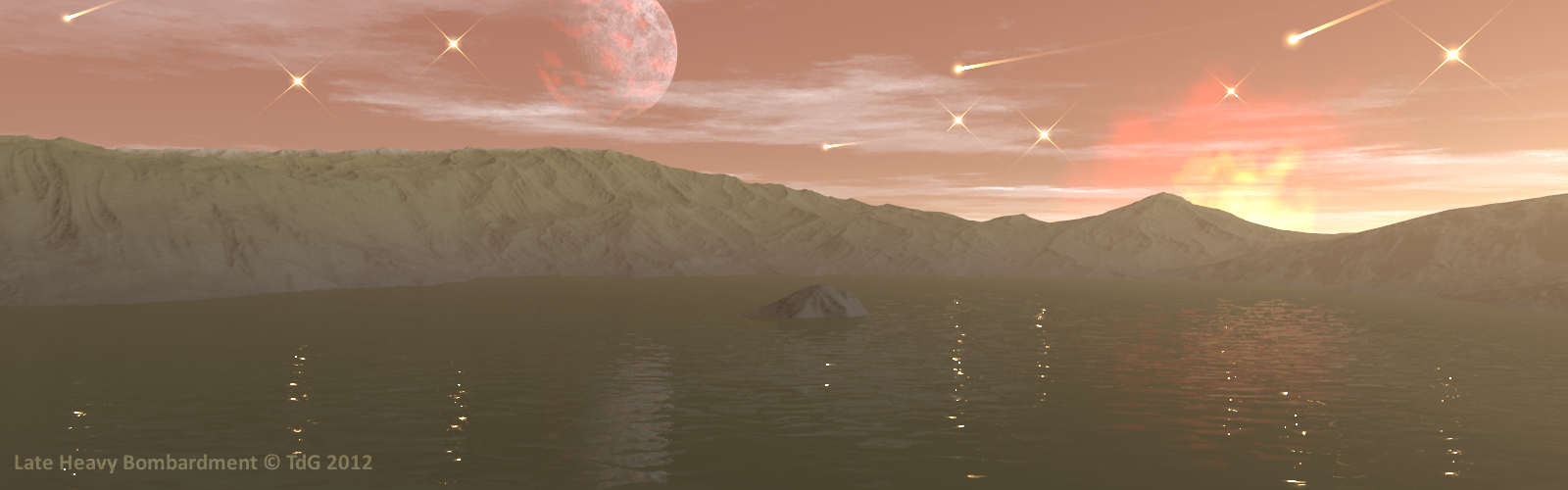
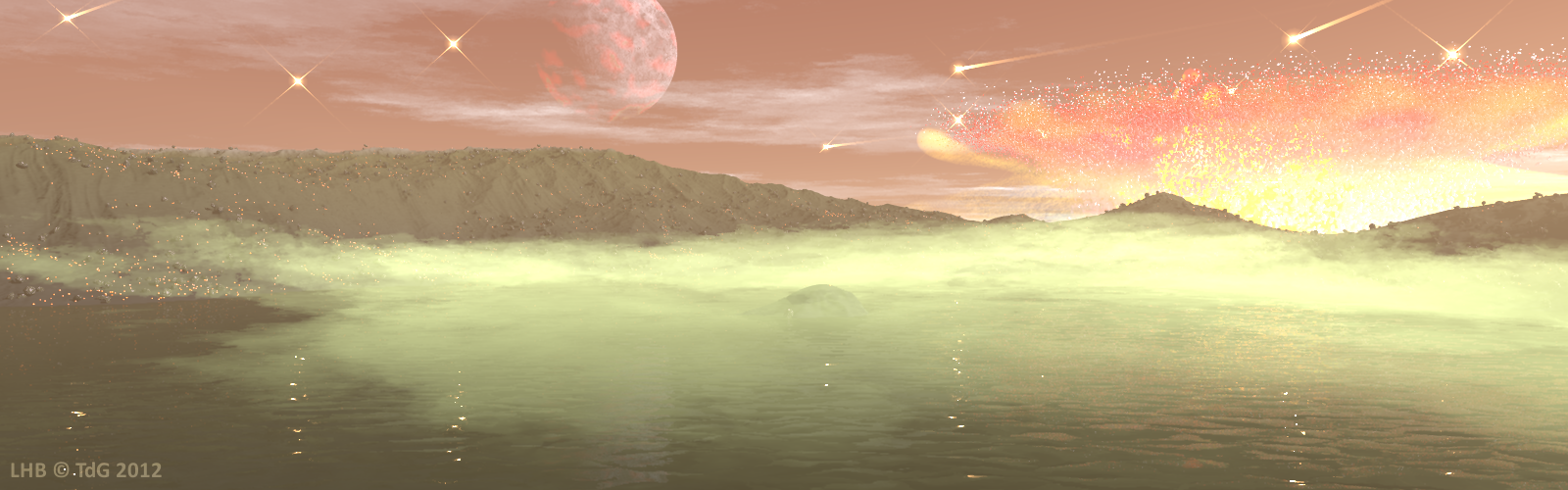
A first concept of this scene.

A view of the early Earth during the late Hadean, about 4.0 to 3.8
billion years ago, the time of the Late Heavy Bombardment (LHB) which
destroyed a significant part of the Hadean earlier crust (according to
modelling, about 25%) and possibly affected early developments of life
in the first ocean basins.

Still visible are a few of the ca 1000 sister stars, born in the same
cradle as our Sun (see Early Earth - The Beginning). Over time, these
stars will be smeared out over the local arm of the Milky Way. Soon
they will merge with the background stars.

See: http://palaeos.com/hadean/hadean.htm
http://en.wikipedia.org/wiki/Late_Heavy_Bombardment

Thomas
Post a reply to this message
Attachments:
Download 'earlyearth - lhb_03.png' (612 KB)
Preview of image 'earlyearth - lhb_03.png'
|
|
| |
| |
|
|
From: Thomas de Groot
Subject: Re: Early Earth: The Late Heavy Bombardment
Date: 3 Jul 2012 10:56:53
Message: <4ff30835@news.povray.org>
|
|
|
| |
| |
|
|
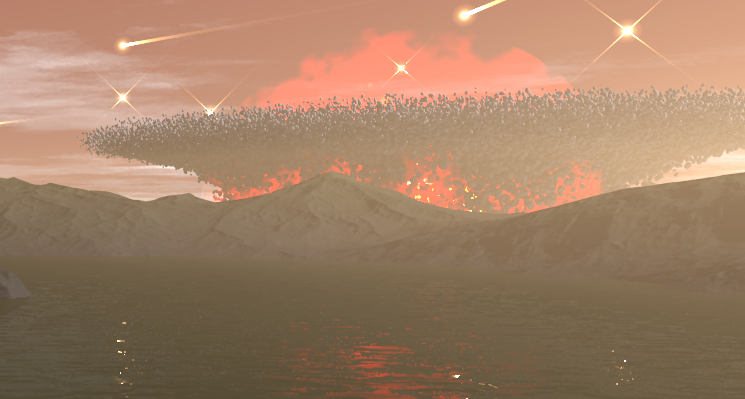
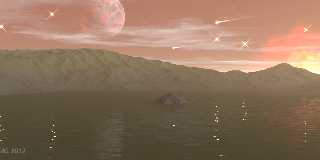
Modelling an impact

Thomas
Post a reply to this message
Attachments:
Download 'earlyearth - lhb.png' (269 KB)
Preview of image 'earlyearth - lhb.png'
|
|
| |
| |
|
|
|
|
| |
| |
|
|
Thomas de Groot <tho### [at] degroot org> wrote:
> Modelling an impact
Hey Thomas, this is quite an interesting series you're working on!
I'm wondering, does that ejecta seem a bit too grainy? I know there are bound to
be larger chunks of earth thrown high from such a large impact, though I'm
pretty sure the majority of particles would be tiny enough to appear as dust
from that distance.
Also, is this near the beginning of the LHB? If not, you might want to pock up
the crust a bit with craters, and dirty up the sky with pulverized earth. Here
are a couple reference photos of large dust clouds that you might find useful:
http://static.guim.co.uk/sys-images/Guardian/Pix/pictures/2009/9/25/1253891072286/A-huge-dust-cloud-rolls-o-006.jpg
http://img.dailymail.co.uk/i/pix/2007/04_03/1DustCloudAP_468x312.jpg
A gigantic meteoroid illuminating a dust cloud would be a very dramatic sight :)
(It's too bad nobody has developed a 3D fluid simulator that also exports to a
POV-Ray df3 file. We've got a bunch of POVvers around here who are also talented
programmers... we need more utilities! :D )
Sam org> wrote:
> Modelling an impact
Hey Thomas, this is quite an interesting series you're working on!
I'm wondering, does that ejecta seem a bit too grainy? I know there are bound to
be larger chunks of earth thrown high from such a large impact, though I'm
pretty sure the majority of particles would be tiny enough to appear as dust
from that distance.
Also, is this near the beginning of the LHB? If not, you might want to pock up
the crust a bit with craters, and dirty up the sky with pulverized earth. Here
are a couple reference photos of large dust clouds that you might find useful:
http://static.guim.co.uk/sys-images/Guardian/Pix/pictures/2009/9/25/1253891072286/A-huge-dust-cloud-rolls-o-006.jpg
http://img.dailymail.co.uk/i/pix/2007/04_03/1DustCloudAP_468x312.jpg
A gigantic meteoroid illuminating a dust cloud would be a very dramatic sight :)
(It's too bad nobody has developed a 3D fluid simulator that also exports to a
POV-Ray df3 file. We've got a bunch of POVvers around here who are also talented
programmers... we need more utilities! :D )
Sam
Post a reply to this message
|
|
| |
| |
|
|
|
|
| |
| |
|
|
On 3-7-2012 22:07, Samuel Benge wrote:
> Thomas de Groot <tho### [at] degrootorg> wrote:
>> Modelling an impact
>
> Hey Thomas, this is quite an interesting series you're working on!

Thanks indeed, Sam. I just want to get away a bit from Gancaloon... ;-)

>
> I'm wondering, does that ejecta seem a bit too grainy? I know there are bound to
> be larger chunks of earth thrown high from such a large impact, though I'm
> pretty sure the majority of particles would be tiny enough to appear as dust
> from that distance.

Yes, I think you are right. I may end up with a combination of chunks
and dust (mainly dust). That will be a scattering media then; as I have
already the ejecta geometry, I can easily change that to a container and
see what results that gives.

>
> Also, is this near the beginning of the LHB? If not, you might want to pock up
> the crust a bit with craters, and dirty up the sky with pulverized earth. Here
> are a couple reference photos of large dust clouds that you might find useful:
>
http://static.guim.co.uk/sys-images/Guardian/Pix/pictures/2009/9/25/1253891072286/A-huge-dust-cloud-rolls-o-006.jpg
> http://img.dailymail.co.uk/i/pix/2007/04_03/1DustCloudAP_468x312.jpg

I think that we should keep in mind the time scale of the whole event:
about 200 million years! That is a period of time equivalent to the one
since the late Triassic till today! Enough to severely rework the whole
Earth crust but it means also that the LHB, on a human time scale, was
not that "apocalyptic" in terms of impact frequencies. However, there
were of course more large impacts when impacts occurred, but in between
it would be more or less business as usual (with a lot of stress!).
Well, my (educated) guess ;-) and a bit of artistic flavour.

For the image, in fact a snapshot somewhere in the middle of the LHB,
this would mean (old) craters, like the scene shows (I hope) and an
impact once in a while, meteors streaking past, and a Moon with changing
molten areas.
>
> A gigantic meteoroid illuminating a dust cloud would be a very dramatic sight :)

Interesting... that would indeed be dramatic. I have to think about that
more...

> (It's too bad nobody has developed a 3D fluid simulator that also exports to a
> POV-Ray df3 file. We've got a bunch of POVvers around here who are also talented
> programmers... we need more utilities! :D )

Hear! Hear!

Thomas
Post a reply to this message
|
|
| |
| |
|
|
From: Thomas de Groot
Subject: Re: Early Earth: The Late Heavy Bombardment
Date: 5 Jul 2012 07:13:32
Message: <4ff576dc@news.povray.org>
|
|
|
| |
| |
|
|
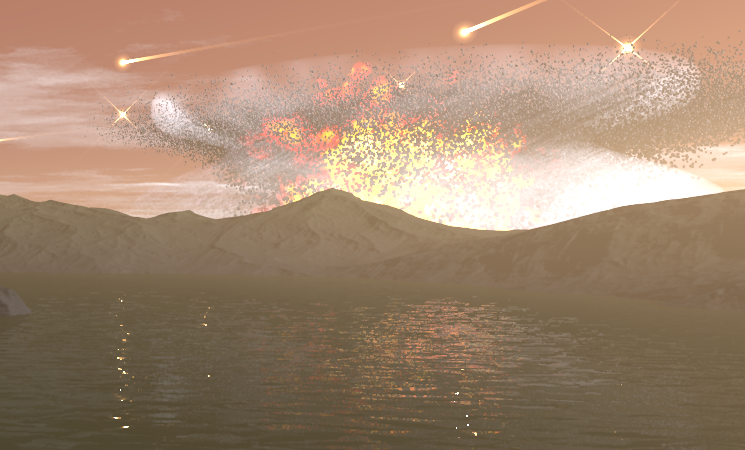
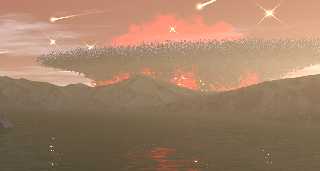
I second attempt at the impact, adding a scattering media (type 1) with
bozo density as simulation for the dust ejecta.

Hm. Better but still not entirely convincing. I have been looking at the
df3 generation code of Gilles Tran but that is done within a regular box
which is not useful here...

Thomas
Post a reply to this message
Attachments:
Download 'earlyearth - lhb.png' (380 KB)
Preview of image 'earlyearth - lhb.png'
|
|
| |
| |
|
|
|
|
| |
| |
|
|
Thomas de Groot <tho### [at] degrootorg> wrote:
> On 3-7-2012 22:07, Samuel Benge wrote:
> >
> > Also, is this near the beginning of the LHB? If not, you might want to pock up
> > the crust a bit with craters, and dirty up the sky with pulverized earth.
>
> I think that we should keep in mind the time scale of the whole event:
> about 200 million years! That is a period of time equivalent to the one
> since the late Triassic till today! Enough to severely rework the whole
> Earth crust but it means also that the LHB, on a human time scale, was
> not that "apocalyptic" in terms of impact frequencies.

Time enough between impacts to, say, allow weathering and erosion to obscure
previously formed craters?

> I second attempt at the impact, adding a scattering media (type 1) with
> bozo density as simulation for the dust ejecta.
>
> Hm. Better but still not entirely convincing. I have been looking at the
> df3 generation code of Gilles Tran but that is done within a regular box
> which is not useful here...

Why not? Wouldn't it be able to fit inside a cylinder?

Found a couple daytime fireball photos, since references are always handy:
http://www.utahskies.org/image_library/shallowsky/meteors/fireball_burnett_big-apod20031001.jpg
http://www.theblaze.com/wp-content/uploads/2012/04/Screen-shot-2012-04-22-at-6.37.33-PM-620x367.png

The second one went along with a news article about a loud explosion heard
around my area that is suspected to have been a large meteor entering (and
subsequently fragmenting) into the earth's atmosphere. (It's a stock NASA photo
of another fireball.) I actually heard it with my own ears, but at the time
figured it was just another of the many loud booming sounds that occur
frequently around here. (People are always shooting their firearms nearby, and
other explosions can be heard farther uphill that sound like a tunnel being dug
[probably by those top-secret black helicopter types ;)].)

Oh, and I was wondering, wouldn't the lake's water and the hills' dirt possibly
be disturbed by the impact? I've seen aerial footage of accidental ground-level
jet fuel ignition, and there's a discernible shock wave that precedes the
visible above-ground explosion. Would that not also occur in this case?
Post a reply to this message
|
|
| |
| |
|
|
|
|
| |
| |
|
|
Thomas de Groot <tho### [at] degrootorg> wrote:
>
> For the image, in fact a snapshot somewhere in the middle of the LHB,
> this would mean (old) craters
>
"Samuel Benge" <stb### [at] hotmailcom> wrote:
>
> Time enough between impacts to, say, allow weathering and erosion to obscure
> previously formed craters?
>

.... yeah :)
Post a reply to this message
|
|
| |
| |
|
|
|
|
| |
| |
|
|
Le 7/5/2012 5:09 PM, Samuel Benge a écrit :
> Thomas de Groot <tho### [at] degrootorg> wrote:
>> On 3-7-2012 22:07, Samuel Benge wrote:
>>>
>>> Also, is this near the beginning of the LHB? If not, you might want to pock up
>>> the crust a bit with craters, and dirty up the sky with pulverized earth.
>>
>> I think that we should keep in mind the time scale of the whole event:
>> about 200 million years! That is a period of time equivalent to the one
>> since the late Triassic till today! Enough to severely rework the whole
>> Earth crust but it means also that the LHB, on a human time scale, was
>> not that "apocalyptic" in terms of impact frequencies.
>
> Time enough between impacts to, say, allow weathering and erosion to obscure
> previously formed craters?

Probably. At that time, there are some other violent events appening.
Many medium ans small impacts, volcanic activity, wind, caustic rain...
Also, the crust was much thinner back then, and possibly softer. Those
big impacts are sure to punch right through the crust to the magma
underneth. In those condition, the sides of the craters can readily melt
away before the temperature cools down enough and the crust reforms.

>
>> I second attempt at the impact, adding a scattering media (type 1) with
>> bozo density as simulation for the dust ejecta.
>>
>> Hm. Better but still not entirely convincing. I have been looking at the
>> df3 generation code of Gilles Tran but that is done within a regular box
>> which is not useful here...
>
> Why not? Wouldn't it be able to fit inside a cylinder?
>
> Found a couple daytime fireball photos, since references are always handy:
>
http://www.utahskies.org/image_library/shallowsky/meteors/fireball_burnett_big-apod20031001.jpg
>
http://www.theblaze.com/wp-content/uploads/2012/04/Screen-shot-2012-04-22-at-6.37.33-PM-620x367.png
>
> The second one went along with a news article about a loud explosion heard
> around my area that is suspected to have been a large meteor entering (and
> subsequently fragmenting) into the earth's atmosphere. (It's a stock NASA photo
> of another fireball.) I actually heard it with my own ears, but at the time
> figured it was just another of the many loud booming sounds that occur
> frequently around here. (People are always shooting their firearms nearby, and
> other explosions can be heard farther uphill that sound like a tunnel being dug
> [probably by those top-secret black helicopter types ;)].)
>
> Oh, and I was wondering, wouldn't the lake's water and the hills' dirt possibly
> be disturbed by the impact? I've seen aerial footage of accidental ground-level
> jet fuel ignition, and there's a discernible shock wave that precedes the
> visible above-ground explosion. Would that not also occur in this case?
>

That impact is located a few 100Km away. The shock wave is not yet
there, but when it arives in less that a minute, it's supersonic and
blistering hot. It's presure may be high enough to fracture some rocks.
If you where to stand there, you'd be torn apart and your pieces burnt
to a crist.


Alain
Post a reply to this message
|
|
| |
| |
|
|
|
|
| |
| |
|
|
On 5-7-2012 23:09, Samuel Benge wrote:
> Time enough between impacts to, say, allow weathering and erosion to obscure
> previously formed craters?
Indeed yes.

>> Hm. Better but still not entirely convincing. I have been looking at the
>> df3 generation code of Gilles Tran but that is done within a regular box
>> which is not useful here...
>
> Why not? Wouldn't it be able to fit inside a cylinder?
Gille's cloud generation typically generates...clouds ;-) Something else
would be needed here, but I think that I can still tweak my media enough
to get a better result. The container, as you can see, is not a simple one.

>
> Found a couple daytime fireball photos, since references are always handy:
>
http://www.utahskies.org/image_library/shallowsky/meteors/fireball_burnett_big-apod20031001.jpg
>
http://www.theblaze.com/wp-content/uploads/2012/04/Screen-shot-2012-04-22-at-6.37.33-PM-620x367.png

Yes indeed. Also, if you google for "meteor impact" images, you get a
number of artist's impressions of what I am after. Not all are good,
especially in relation to size, but I think the physics shown are about
right.

>
> The second one went along with a news article about a loud explosion heard
> around my area that is suspected to have been a large meteor entering (and
> subsequently fragmenting) into the earth's atmosphere. (It's a stock NASA photo
> of another fireball.) I actually heard it with my own ears, but at the time
> figured it was just another of the many loud booming sounds that occur
> frequently around here. (People are always shooting their firearms nearby, and
> other explosions can be heard farther uphill that sound like a tunnel being dug
> [probably by those top-secret black helicopter types ;)].)
<grin> Black helicopters he? You bet!

>
> Oh, and I was wondering, wouldn't the lake's water and the hills' dirt possibly
> be disturbed by the impact? I've seen aerial footage of accidental ground-level
> jet fuel ignition, and there's a discernible shock wave that precedes the
> visible above-ground explosion. Would that not also occur in this case?
Yes, absolutely. In fact, some of the images I mentioned show this shock
wave as a spherical shell around the blast. I remember seeing them too
in some documentaries (Probably Myth Blasters). I may add it in my image.
As far as the lake is concerned, Alain is right in saying it is seconds
away from receiving the blast. I got my time machine out just in time ;-)

Thomas
Post a reply to this message
|
|
| |
| |
|
|
|
|
| |
| |
|
|
On 6-7-2012 4:32, Alain wrote:
> Probably. At that time, there are some other violent events appening.
> Many medium ans small impacts, volcanic activity, wind, caustic rain...
> Also, the crust was much thinner back then, and possibly softer. Those
> big impacts are sure to punch right through the crust to the magma
> underneth. In those condition, the sides of the craters can readily melt
> away before the temperature cools down enough and the crust reforms.

Exactly.

> That impact is located a few 100Km away. The shock wave is not yet
> there, but when it arives in less that a minute, it's supersonic and
> blistering hot. It's presure may be high enough to fracture some rocks.
> If you where to stand there, you'd be torn apart and your pieces burnt
> to a crist.

Yeah. It needs good timing to watch this scene.... ;-)

Thomas
Post a reply to this message
|
|
| |
| |
|
|
From: Thomas de Groot
Subject: Re: Early Earth: The Late Heavy Bombardment [latest image]
Date: 6 Jul 2012 08:02:25
Message: <4ff6d3d1@news.povray.org>
|
|
|
| |
| |
|
|
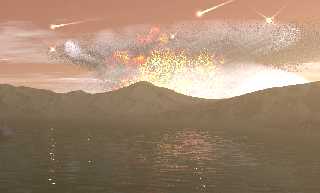
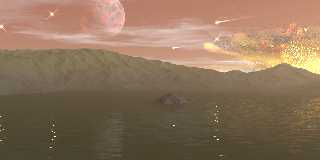
Maybe physically not entirely correct, but visually certainly attractive :-)

Thomas
Post a reply to this message
Attachments:
Download 'earlyearth - lhb_04.png' (781 KB)
Preview of image 'earlyearth - lhb_04.png'
|
|
| |
| |
|
|
From: Paolo Gibellini
Subject: Re: Early Earth: The Late Heavy Bombardment [latest image]
Date: 6 Jul 2012 10:09:26
Message: <4ff6f196$1@news.povray.org>
|
|
|
| |
| |
|
|
>Thomas de Groot  on date 06/07/2012 14.02 wrote:
> Maybe physically not entirely correct, but visually certainly attractive
> :-)
>
> Thomas
Wow, the explosion begins to become /great/!
;-)
Paolo
Post a reply to this message
|
|
| |
| |
|
|
From: Thomas de Groot
Subject: Re: Early Earth: The Late Heavy Bombardment [latest image]
Date: 6 Jul 2012 10:31:47
Message: <4ff6f6d3$1@news.povray.org>
|
|
|
| |
| |
|
|
On 6-7-2012 16:10, Paolo Gibellini wrote:
> Wow, the explosion begins to become /great/!
> ;-)

Thanks Paolo! I am rather happy with this so far. Again, it does not
need to be scientifically correct all the way but to suggest the impact.
A few more things to do.

Thomas
Post a reply to this message
|
|
| |
| |
|
|
From: Jörg 'Yadgar' Bleimann
Subject: Re: Early Earth: The Late Heavy Bombardment [latest image]
Date: 6 Jul 2012 17:42:45
Message: <4ff75bd5$1@news.povray.org>
|
|
|
| |
| |
|
|
Hi(gh)!

On 06.07.2012 14:02, Thomas de Groot wrote:
> Maybe physically not entirely correct, but visually certainly attractive

If the impact is several hundred kilometres afar, its blast should not
obscure the high wispy clouds...

See you in Khyberspace!

Yadgar
Post a reply to this message
|
|
| |
| |
|
|
From: Alain
Subject: Re: Early Earth: The Late Heavy Bombardment [latest image]
Date: 6 Jul 2012 21:55:23
Message: <4ff7970b$1@news.povray.org>
|
|
|
| |
| |
|
|
Le 7/6/2012 8:02 AM, Thomas de Groot a écrit :
> Maybe physically not entirely correct, but visually certainly attractive
> :-)
>
> Thomas

Now you'r talking. Mostly incandecent ejectae. Not unrealistic if you
think a secong about just how much heat is released by that impact...
Then, there is all that heating from the huge supersonic shock wave.


Alain
Post a reply to this message
|
|
| |
| |
|
|
From: Alain
Subject: Re: Early Earth: The Late Heavy Bombardment [latest image]
Date: 6 Jul 2012 21:58:47
Message: <4ff797d7$1@news.povray.org>
|
|
|
| |
| |
|
|
Le 7/6/2012 5:42 PM, Jörg 'Yadgar' Bleimann a écrit :
> Hi(gh)!
>
> On 06.07.2012 14:02, Thomas de Groot wrote:
>> Maybe physically not entirely correct, but visually certainly attractive
>
> If the impact is several hundred kilometres afar, its blast should not
> obscure the high wispy clouds...
>
> See you in Khyberspace!
>
> Yadgar
>
I agree. The top of the projection is probably climbing well abode those
clouds anyway, right up to the top of the statosphere, with some debrits
escaping back to outer space.


Alain
Post a reply to this message
|
|
| |
| |
|
|
|
|
| |
| |
|
|
With the light output of those meteors, shouldn't they be creating diffraction
artifacts in your time machine's camera similar to those of the stars?
Post a reply to this message
|
|
| |
| |
|
|
|
|
| |
| |
|
|
On 7-7-2012 4:33, Cousin Ricky wrote:
> With the light output of those meteors, shouldn't they be creating diffraction
> artifacts in your time machine's camera similar to those of the stars?
>
I have been hesitating about that. The answer should be yes, shouldn't
it? I shall add small ones...

Thomas
Post a reply to this message
|
|
| |
| |
|
|
From: Thomas de Groot
Subject: Re: Early Earth: The Late Heavy Bombardment [final image]
Date: 9 Jul 2012 08:03:53
Message: <4ffac8a9@news.povray.org>
|
|
|
| |
| |
|
|
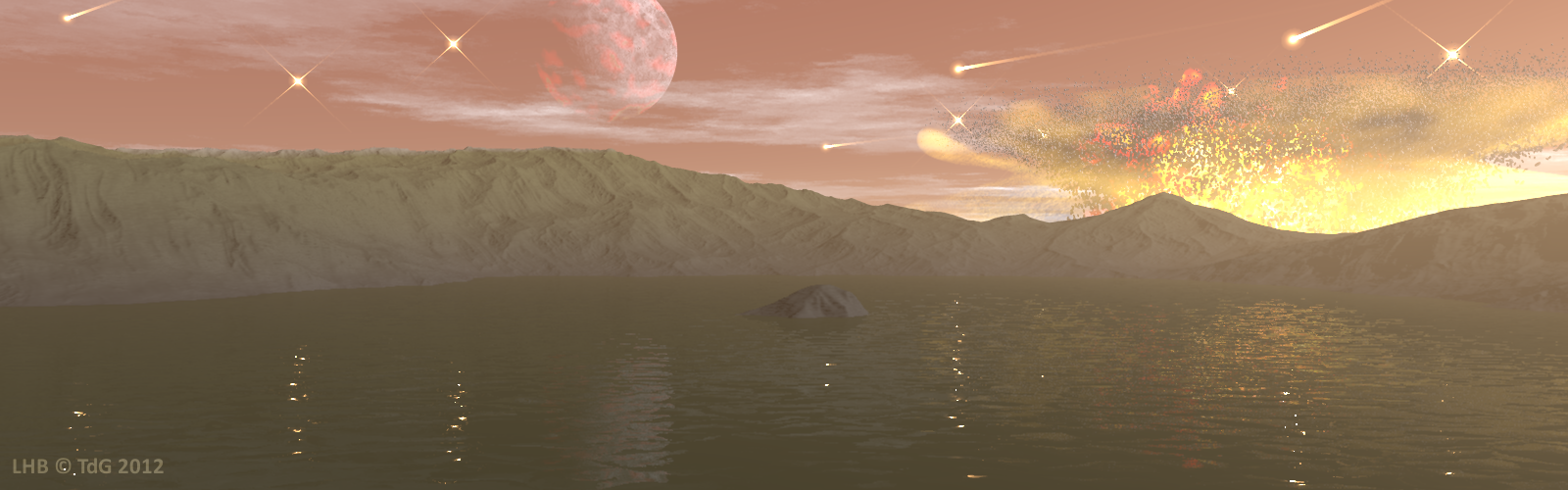
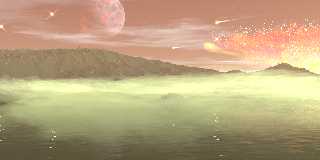
This should be the final development of the scene.

Thomas
Post a reply to this message
Attachments:
Download 'earlyearth - lhb_05.png' (835 KB)
Preview of image 'earlyearth - lhb_05.png'
|
|
| |
| |
|
|
From: Paolo Gibellini
Subject: Re: Early Earth: The Late Heavy Bombardment [final image]
Date: 10 Jul 2012 04:06:08
Message: <4ffbe270$1@news.povray.org>
|
|
|
| |
| |
|
|
>Thomas de Groot  on date 09/07/2012 14.03 wrote:
> This should be the final development of the scene.
>
> Thomas
Ooh.
The explosion is less terrifying (due to the daylight), but the sea and
the fog are very convincing.
;-)
Paolo
Post a reply to this message
|
|
| |
| |
|
|
From: Thomas de Groot
Subject: Re: Early Earth: The Late Heavy Bombardment [final image]
Date: 10 Jul 2012 07:32:34
Message: <4ffc12d2$1@news.povray.org>
|
|
|
| |
| |
|
|
On 10-7-2012 10:07, Paolo Gibellini wrote:
>  >Thomas de Groot  on date 09/07/2012 14.03 wrote:
>> This should be the final development of the scene.
>>
>> Thomas
> Ooh.
> The explosion is less terrifying (due to the daylight), but the sea and
> the fog are very convincing.
> ;-)

Thanks Paolo. I am still terrified though ;-)

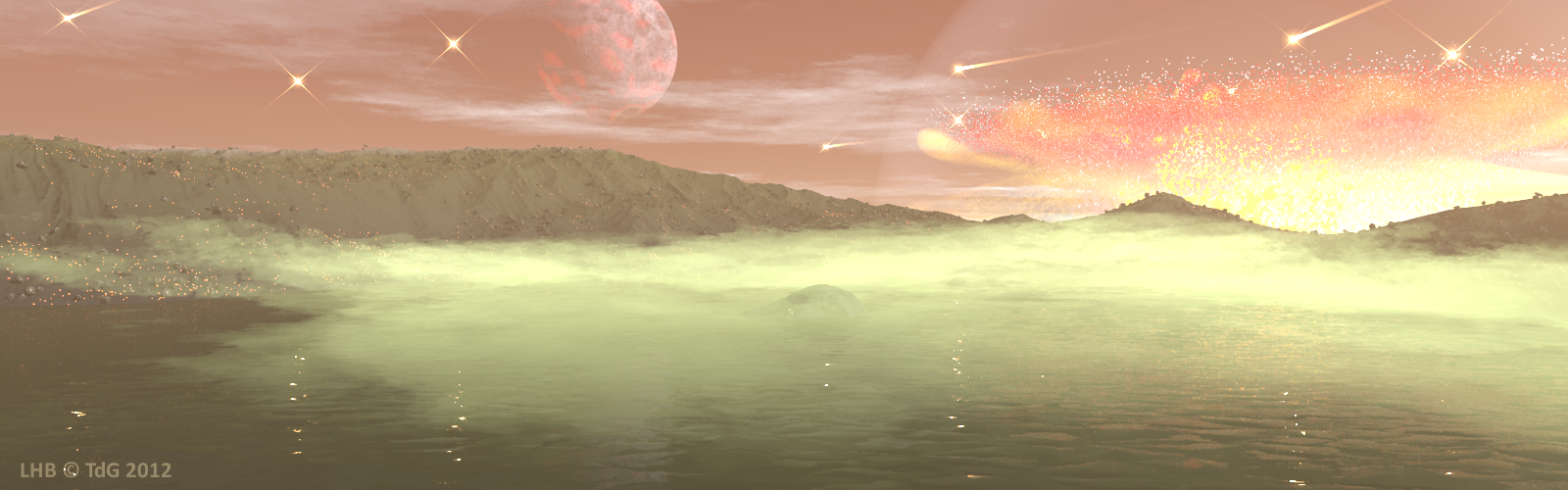
I am adding a spherical shock wave to complete the impact.

For the fog over the water I used a df3 file made with Gilles Tran's
MakeCloud.

Thomas
Post a reply to this message
|
|
| |
| |
|
|
From: Thomas de Groot
Subject: Re: Early Earth: The Late Heavy Bombardment [final image]
Date: 11 Jul 2012 07:32:20
Message: <4ffd6444@news.povray.org>
|
|
|
| |
| |
|
|
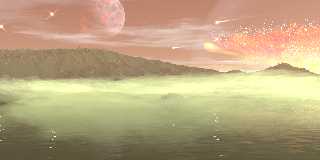
This is really the final image. Added a spherical shock wave.

Thomas
Post a reply to this message
Attachments:
Download 'earlyearth - lhb_final.png' (835 KB)
Preview of image 'earlyearth - lhb_final.png'
|
|
| |
| |
|
|
From: Alain
Subject: Re: Early Earth: The Late Heavy Bombardment [final image]
Date: 11 Jul 2012 16:30:51
Message: <4ffde27b$1@news.povray.org>
|
|
|
| |
| |
|
|
Le 7/11/2012 7:32 AM, Thomas de Groot a écrit :
> This is really the final image. Added a spherical shock wave.
>
> Thomas

I have some problem with that shock wave: It don't difract light.
A shell with an ior of about 1.1 to 1.17 would be more convincing.


Alain
Post a reply to this message
|
|
| |
| |
|
|
From: Thomas de Groot
Subject: Re: Early Earth: The Late Heavy Bombardment [final image]
Date: 12 Jul 2012 04:43:33
Message: <4ffe8e35@news.povray.org>
|
|
|
| |
| |
|
|
On 11-7-2012 22:31, Alain wrote:
> I have some problem with that shock wave: It don't difract light.
> A shell with an ior of about 1.1 to 1.17 would be more convincing.
>

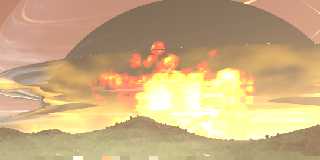
This gets me into problems :-(

For the example I switched off the solid ejecta. I also tuned down the
fog over the water.

For the shock wave I used an ior of 1.01. Obviously, now its media
interacts with the other media inside, especially the dust ejecta
container. Higher ior makes it worse.


Thomas
Post a reply to this message
Attachments:
Download 'earlyearth - lhb.png' (159 KB)
Preview of image 'earlyearth - lhb.png'
|
|
| |
| |
|
|
From: Alain
Subject: Re: Early Earth: The Late Heavy Bombardment [final image]
Date: 12 Jul 2012 18:49:11
Message: <4fff5467$1@news.povray.org>
|
|
|
| |
| |
|
|
Le 7/12/2012 4:43 AM, Thomas de Groot a écrit :
> On 11-7-2012 22:31, Alain wrote:
>> I have some problem with that shock wave: It don't difract light.
>> A shell with an ior of about 1.1 to 1.17 would be more convincing.
>>
>
> This gets me into problems :-(
>
> For the example I switched off the solid ejecta. I also tuned down the
> fog over the water.
>
> For the shock wave I used an ior of 1.01. Obviously, now its media
> interacts with the other media inside, especially the dust ejecta
> container. Higher ior makes it worse.
>
>
> Thomas
>
It looks like a solid, full, shell. Make the shock wave shell as a
difference of 2 spheres.
To bad we can't have variable ior, as in this case, it should go from 1
(in the air in front of the wave), raise in an S shape to maybe around
1.1, then drop slightly under 1 before returning to 1.

You may also try playing giving the area inside the sinside an ior
slightly less than 1, like 0.98 to 0.995...


Alain
Post a reply to this message
|
|
| |
| |
|
|
From: Thomas de Groot
Subject: Re: Early Earth: The Late Heavy Bombardment [final image]
Date: 13 Jul 2012 03:45:12
Message: <4fffd208$1@news.povray.org>
|
|
|
| |
| |
|
|
On 13-7-2012 0:49, Alain wrote:
> It looks like a solid, full, shell. Make the shock wave shell as a
> difference of 2 spheres.
I did too but that was not better, rather worse.

> To bad we can't have variable ior, as in this case, it should go from 1
> (in the air in front of the wave), raise in an S shape to maybe around
> 1.1, then drop slightly under 1 before returning to 1.
Yes, that would be cool.

>
> You may also try playing giving the area inside the sinside an ior
> slightly less than 1, like 0.98 to 0.995...
Yes, I tried too. It corrected somewhat the inner media but did not
change the chock wave appearance.

I shall still make a couple of experiments.

Thomas
Post a reply to this message
|
|
| |
| |
|
|
From: Thomas de Groot
Subject: Re: Early Earth: The Late Heavy Bombardment [final image]
Date: 13 Jul 2012 10:56:22
Message: <50003716@news.povray.org>
|
|
|
| |
| |
|
|
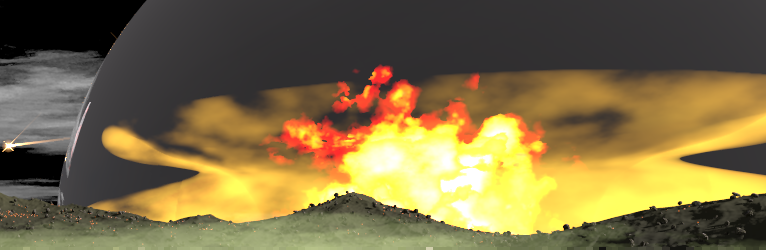
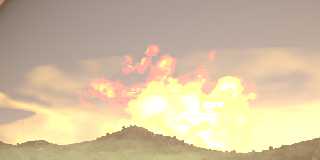
The best I can get at this stage (no good) using a differenced sphere
for the shock wave. Diffractions looks ok at the border but I cannot get
the transparency of the sphere right. The cloud layer is also
differenced (a tiny bit larger sphere) to ensure that no clouds are
present inside the shock wave.

Code snippet:

difference {
sphere {0, 1
   hollow
   texture {pigment {rgbt <1,1,1,1>} }
   interior {
	  ior 1.1
     media {
       intervals 1
       samples 10, 1000
       scattering {1, 0.000025
         extinction 1
       }
     }
   }
}
sphere {0, 0.98
   hollow
   texture {pigment {rgbt <1,1,1,1>} }
   interior {
	  ior 1.0
	}
}
   scale MediaScale * 1.52
   translate <CamLoc.x, CamLoc.y, 5000> + <2800, 0, 0>
}


Thomas
Post a reply to this message
Attachments:
Download 'earlyearth - lhb.png' (114 KB)
Preview of image 'earlyearth - lhb.png'
|
|
| |
| |
|
|
From: Thomas de Groot
Subject: Re: Early Earth: The Late Heavy Bombardment [experimental image #2]
Date: 14 Jul 2012 04:01:22
Message: <50012752@news.povray.org>
|
|
|
| |
| |
|
|
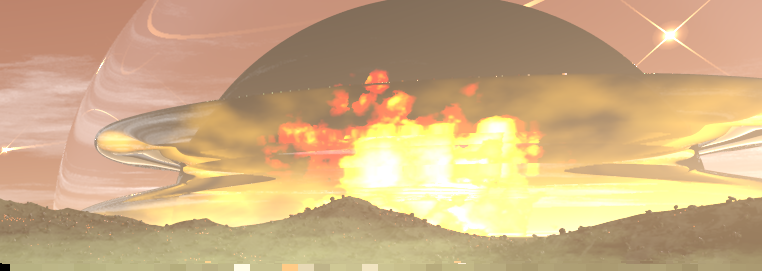
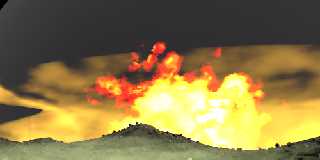
Trying to get at the problem. I here switched off the sphere
representing the sky and the atmospheric media. Also corrected the shock
wave container as follows:

//start code
difference {
   sphere {0, 1.00 hollow}
   sphere {0, 0.98 hollow}
   material {
     texture {pigment {rgbt <1,1,1,1>} }
     interior {
       ior 1.1 	//shock waved air
       media {
         intervals 1
         samples 10, 1000
         scattering {1, 0.0001
           extinction 1
         }
       }
     }
   }
   scale MediaScale * 1.52
   translate <CamLoc.x, CamLoc.y, 5000> + <2800, 0, 0>
}
//end code

While one can see /inside/ the shock wave, it is not possible to see the
stars through the opposite end of the sphere... why?

Thomas
Post a reply to this message
Attachments:
Download 'earlyearth - lhb.png' (145 KB)
Preview of image 'earlyearth - lhb.png'
|
|
| |
| |
|
|
From: Thomas de Groot
Subject: Re: Early Earth: The Late Heavy Bombardment [experimental image #3]
Date: 14 Jul 2012 08:13:06
Message: <50016252@news.povray.org>
|
|
|
| |
| |
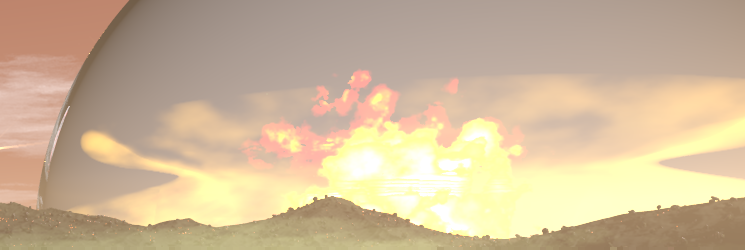
|
|
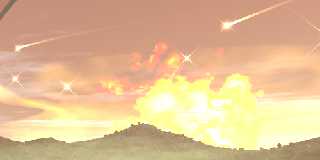
OK. Got the transparency solved. Just a stupid max_trace_level issue :-(

Next problem is to get rid of this sphere edge seen in cross section...

Thomas
Post a reply to this message
Attachments:
Download 'earlyearth - lhb_.png' (144 KB)
Preview of image 'earlyearth - lhb_.png'
|
|
| |
| |
|
|
From: clipka
Subject: Re: Early Earth: The Late Heavy Bombardment [experimental image #2]
Date: 14 Jul 2012 08:47:06
Message: <50016a4a$1@news.povray.org>
|
|
|
| |
| |
|
|
Am 14.07.2012 10:01, schrieb Thomas de Groot:

> While one can see /inside/ the shock wave, it is not possible to see the
> stars through the opposite end of the sphere... why?

max_trace_level maybe?
Post a reply to this message
|
|
| |
| |
|
|
From: clipka
Subject: Re: Early Earth: The Late Heavy Bombardment [experimental image #3]
Date: 14 Jul 2012 08:51:21
Message: <50016b49$1@news.povray.org>
|
|
|
| |
| |
|
|
Am 14.07.2012 14:12, schrieb Thomas de Groot:
> OK. Got the transparency solved. Just a stupid max_trace_level issue :-(
>
> Next problem is to get rid of this sphere edge seen in cross section...

... and here your real problems begin. You'll need to somehow mimic an
ior gradient.
Post a reply to this message
|
|
| |
| |
|
|
From: Alain
Subject: Re: Early Earth: The Late Heavy Bombardment [experimental image #3]
Date: 14 Jul 2012 20:03:20
Message: <500208c8$1@news.povray.org>
|
|
|
| |
| |
|
|
Le 7/14/2012 8:51 AM, clipka a écrit :
> Am 14.07.2012 14:12, schrieb Thomas de Groot:
>> OK. Got the transparency solved. Just a stupid max_trace_level issue :-(
>>
>> Next problem is to get rid of this sphere edge seen in cross section...
>
> ... and here your real problems begin. You'll need to somehow mimic an
> ior gradient.

Ugly cludge that can simulate an ior gradient:
Use many shells of decreasing thickness each varying in ior by a small
amount in the order of 0.002 or less.
The outer shell have an ior in the order of 1.001 or maybe even less,
then each other have a slightly larger ior.
Each thinner shells must reside inside any previous ones. No merge as
you need all those internal surfaces.


Big increase in rendering time and needs a large max_trace_level.


Alain
Post a reply to this message
|
|
| |
| |
|
|
From: Thomas de Groot
Subject: Re: Early Earth: The Late Heavy Bombardment [experimental image #2]
Date: 15 Jul 2012 03:11:19
Message: <50026d17$1@news.povray.org>
|
|
|
| |
| |
|
|
On 14-7-2012 14:46, clipka wrote:
> max_trace_level maybe?

I need to learn to count beyond five fingers... :-)

Thomas
Post a reply to this message
|
|
| |
| |
|
|
From: Thomas de Groot
Subject: Re: Early Earth: The Late Heavy Bombardment [experimental image #3]
Date: 15 Jul 2012 03:15:12
Message: <50026e00$1@news.povray.org>
|
|
|
| |
| |
|
|
On 15-7-2012 2:03, Alain wrote:
> Le 7/14/2012 8:51 AM, clipka a écrit :
>> Am 14.07.2012 14:12, schrieb Thomas de Groot:
>>> Next problem is to get rid of this sphere edge seen in cross section...
>>
>> ... and here your real problems begin. You'll need to somehow mimic an
>> ior gradient.
>
> Ugly cludge that can simulate an ior gradient:
> Use many shells of decreasing thickness each varying in ior by a small
> amount in the order of 0.002 or less.
> The outer shell have an ior in the order of 1.001 or maybe even less,
> then each other have a slightly larger ior.
> Each thinner shells must reside inside any previous ones. No merge as
> you need all those internal surfaces.
>
>
> Big increase in rendering time and needs a large max_trace_level.

Hmm, yes, that might work. I leave that experiment for later though, as
I want to get on with my raytracing life ;-)

Would this be something for POV-Ray 4.0?

Thomas
Post a reply to this message
|
|
| |
| |
|
|
From: clipka
Subject: Re: Early Earth: The Late Heavy Bombardment [experimental image #3]
Date: 15 Jul 2012 10:30:36
Message: <5002d40c@news.povray.org>
|
|
|
| |
| |
|
|
Am 15.07.2012 09:15, schrieb Thomas de Groot:
> On 15-7-2012 2:03, Alain wrote:
>> Le 7/14/2012 8:51 AM, clipka a écrit :
>>> Am 14.07.2012 14:12, schrieb Thomas de Groot:
>>>> Next problem is to get rid of this sphere edge seen in cross section...
>>>
>>> ... and here your real problems begin. You'll need to somehow mimic an
>>> ior gradient.
>>
>> Ugly cludge that can simulate an ior gradient:
>> Use many shells of decreasing thickness each varying in ior by a small
>> amount in the order of 0.002 or less.
>> The outer shell have an ior in the order of 1.001 or maybe even less,
>> then each other have a slightly larger ior.
>> Each thinner shells must reside inside any previous ones. No merge as
>> you need all those internal surfaces.
>>
>>
>> Big increase in rendering time and needs a large max_trace_level.
>
> Hmm, yes, that might work. I leave that experiment for later though, as
> I want to get on with my raytracing life ;-)
>
> Would this be something for POV-Ray 4.0?

I'm not sure whether a dedicated feature would be able to significantly
reduce that render time.
Post a reply to this message
|
|
| |
| |
|
|
From: Alain
Subject: Re: Early Earth: The Late Heavy Bombardment [experimental image #3]
Date: 15 Jul 2012 18:58:12
Message: <50034b04$1@news.povray.org>
|
|
|
| |
| |
|
|
Le 7/15/2012 10:30 AM, clipka a écrit :
> Am 15.07.2012 09:15, schrieb Thomas de Groot:
>> On 15-7-2012 2:03, Alain wrote:
>>> Le 7/14/2012 8:51 AM, clipka a écrit :
>>>> Am 14.07.2012 14:12, schrieb Thomas de Groot:
>>>>> Next problem is to get rid of this sphere edge seen in cross
>>>>> section...
>>>>
>>>> ... and here your real problems begin. You'll need to somehow mimic an
>>>> ior gradient.
>>>
>>> Ugly cludge that can simulate an ior gradient:
>>> Use many shells of decreasing thickness each varying in ior by a small
>>> amount in the order of 0.002 or less.
>>> The outer shell have an ior in the order of 1.001 or maybe even less,
>>> then each other have a slightly larger ior.
>>> Each thinner shells must reside inside any previous ones. No merge as
>>> you need all those internal surfaces.
>>>
>>>
>>> Big increase in rendering time and needs a large max_trace_level.
>>
>> Hmm, yes, that might work. I leave that experiment for later though, as
>> I want to get on with my raytracing life ;-)
>>
>> Would this be something for POV-Ray 4.0?
>
> I'm not sure whether a dedicated feature would be able to significantly
> reduce that render time.

It would require sampling along the ray path, determine the direction of
the ior gradient as well as it's value and deflect the ray accordingly.
In fact, you'll need to construct a spline that will describe the path
of each tracing ray through the object.
I don't think that it's unfeasible, but will be very computationaly
intencive and thus slow as hell. If the ior can be assumed to only
change relatively slowly, some interpolation and extrapolation may be
possible between rays that may help speeding thing. You'll need to use a
max_gradient just like in an isosurface.

With my cludge, you have the local normal and the ior is quantified into
discreete steps. It can be applyed to an isosurface by changing the
thressold. If applyed to a CSG object, the smaller versions need to have
individual components scalled separately from the whole object. Some
complexe primitives, like a julia_fractal or a some mesh, don't realy
support the needed scalling without self intersecting. A torus need to
have it's minor axis altered, but not it's major axis.
Heavy, potentialy memory hungry, SLOW, error prone, but should work.

With a sampling along the ray, you don't have any normal available to
help you and the ior may change in rather strange ways...


Alain
Post a reply to this message
|
|
| |
| |
|
|
|
|
| |