 |
|
|
|
|
|
| |
| |
|
|
|
|
| |
| |
|
|
Data are from the _Bright Star Catalogue_, 4th Edition, using the J2000
coordinates.

An extinction of magnitude 6.5 is subtracted from the stars.  I used an
extinction for aesthetic reasons because plotting the stars at their full
brightness showed a discordantly abrupt cutoff at the magnitude limits of
the survey.  I chose magnitude 6.5 because a histogram of the data reveals
a drop-off in the number of stars after approximately that magnitude.
Clearly, the survey of the dimmer magnitudes is incomplete, and I chose to
eliminate those stars rather than give the impression that those were all
the stars of their magnitudes.  In addition, I omitted 14 novae and
non-stellar objects.  The resulting images show 8352 of the 9110 objects
in the catalog.

I desaturated the colors of the dimmer stars, reflecting (in a
non-rigorous manner) the insensitivity of our cones to dim light.

The star delta Scorpii has brightened dramatically since the BSC4 was
published.  I fudged the datum accordingly.

Interestingly enough, proper motion makes a difference, even at this low
resolution!  At first, I mistakenly calculated 1 year of proper motion
instead of the 11.9 years that have elapsed since J2000.  The corrected
JPEG of the southern polar region differed from the old by 21 bytes--not
enough to see, but still calculable.

--
<Insert witty .sig here>
Post a reply to this message
Attachments:
Download 'bsc42.jpg' (43 KB)
Download 'bsc41.jpg' (225 KB)
Download 'bsc43.jpg' (47 KB)
Preview of image 'bsc42.jpg'

Preview of image 'bsc41.jpg'

Preview of image 'bsc43.jpg'

|
|
| |
| |
|
|
|
|
| |
| |
|
|
On Sun, 27 Nov 2011 16:45:45 -0400, Cousin Ricky wrote:

> Data are from the _Bright Star Catalogue_, 4th Edition, using the J2000
> coordinates.

WOW!  Very impressive, I might have to include these in a wallpaper
rotation. :)

Jim
Post a reply to this message
|
|
| |
| |
|
|
|
|
| |
| |
|
|
The stars look great, is the glow due to media?

A bit confusing though as I'm more used to a cutoff at
magnitude 4.5 to 5 in the city ;) Higher resolution would
be nice so the pleiades don't clump together so much.

Also I'm not quite sure what you mean by subtracting an
extinction of 6.5, unless magnitude 13 happens to be the
range where your magnitude to rgb mapping turns black.

> I desaturated the colors of the dimmer stars, reflecting (in a
> non-rigorous manner) the insensitivity of our cones to dim light.

The colors of the bright stars are probably still more intense
than what you can see with the naked eye, but its visually more
appealing this way.

> The corrected JPEG of the southern polar region differed from
> the old by 21 bytes -- not enough to see, but still calculable.

Try comparing the lossless png versions by blinking the two images,
even tiny differences should catch your eye then.
Post a reply to this message
|
|
| |
| |
|
|
|
|
| |
| |
|
|
Christian Froeschlin <chr### [at] chrfr de> wrote:
> The stars look great, is the glow due to media?
Yes.
> Also I'm not quite sure what you mean by subtracting an
> extinction of 6.5, unless magnitude 13 happens to be the
> range where your magnitude to rgb mapping turns black.
I converted magnitude to a linear brightness, then subtracted the linear
equivalent of magnitude 6.5.
> Try comparing the lossless png versions by blinking the two images,
> even tiny differences should catch your eye then.
Actually, it just occurred to me that anti-alias jitter could account for the
difference. It would be a bear to find out, because for some reason my -J flag
isn't working. (I *could* do it by rendering with -A +W3360 +H3360 and waiting
all night, or by rewriting all my #fors and reverting to 3.6.)
Post a reply to this message
|
|
| |
| |
|
|
|
|
| |
| |
|
|
Christian Froeschlin <chr### [at] chrfrde> wrote:
> A bit confusing though as I'm more used to a cutoff at
> magnitude 4.5 to 5 in the city ;)

I can get away from the city to about magnitude 6.0 before I run out of land.
(I live on a small island.)

> Higher resolution would
> be nice so the pleiades don't clump together so much.

Taurus attached, with a bit of Orion to the lower left.  Of course, the limited
data set and limited dynamic range don't do justice to the Pleiades.  If you've
never seen an open star cluster through a telescope, they are razor-sharp,
glittery pinpricks of light.  I describe them as diamond dust on velvet.

I would like to get more extensive data from other sources, but I haven't
figured out the best options yet.  I tried Hipparcos a few years ago, but I
noticed some prominent stars missing from M7 and M42.  I've since forgotten
where star chart software programs get their data.
Post a reply to this message
Attachments:
Download 'taurus.jpg' (31 KB)
Preview of image 'taurus.jpg'

|
|
| |
| |
|
|
|
|
| |
| |
|
|
Hi(gh)!

On 27.11.2011 21:45, Cousin Ricky wrote:
> Data are from the _Bright Star Catalogue_, 4th Edition, using the J2000
> coordinates.

Awesome! Where I compare this to my puny 900 stars collection from the
"Karkoschka" sky atlas I did some years ago... but I still plan to use
the Hipparcos catalogue in a more advanced version!

A question: did you define the stars as object pattern on a sky_sphere?
If so, I wonder how you got the glows working...

See you in Khyberspace!

Yadgar
Post a reply to this message
|
|
| |
| |
|
|
|
|
| |
| |
|
|
=?ISO-8859-15?Q?J=F6rg_=27Yadgar=27_Bleimann?= <yaz### [at] gmxde> wrote:
> A question: did you define the stars as object pattern on a sky_sphere?
> If so, I wonder how you got the glows working...

The stars are emissive media containers.  Slow, but I can't think of another way
in POV-Ray to get additive color from overlapping stars.

The background is just the default.  I used the orthographic camera and did the
projection math myself.
Post a reply to this message
|
|
| |
| |
|
|
|
|
| |
| |
|
|
Cousin Ricky wrote:

> Taurus attached, with a bit of Orion to the lower left.

sweet

> I would like to get more extensive data from other sources, but I haven't
> figured out the best options yet.  I tried Hipparcos a few years ago, but I
> noticed some prominent stars missing from M7 and M42.

Try NOMAD

http://www.usno.navy.mil/USNO/astrometry/optical-IR-prod/nomad
Post a reply to this message
|
|
| |
| |
|
|
|
|
| |
| |
|
|
wrote:

> Christian Froeschlin <chr### [at] chrfrde> wrote:
>> A bit confusing though as I'm more used to a cutoff at
>> magnitude 4.5 to 5 in the city ;)
>
> I can get away from the city to about magnitude 6.0 before I run out of
> land. (I live on a small island.)
>
>> Higher resolution would
>> be nice so the pleiades don't clump together so much.
>
> Taurus attached, with a bit of Orion to the lower left.  Of course, the
> limited
> data set and limited dynamic range don't do justice to the Pleiades.  If
> you've never seen an open star cluster through a telescope, they are
> razor-sharp,
> glittery pinpricks of light.  I describe them as diamond dust on velvet.
>
> I would like to get more extensive data from other sources, but I haven't
> figured out the best options yet.  I tried Hipparcos a few years ago, but
> I
> noticed some prominent stars missing from M7 and M42.  I've since
> forgotten where star chart software programs get their data.

You could have a look at ftp://cdsarc.u-strasbg.fr/pub/cats/I/317/
That is 38GB to download (148GB unpacked)
I would like to create a Hires full-sphere star sky out of that data (usable
in a HD animation) but don't have a real idea on how to do that.
--
Ger
Post a reply to this message
|
|
| |
| |
|
|
|
|
| |
| |
|
|
Cousin Ricky wrote:

> Data are from the _Bright Star Catalogue_, 4th Edition, using the J2000
> coordinates.
>
> An extinction of magnitude 6.5 is subtracted from the stars.  I used an
> extinction for aesthetic reasons because plotting the stars at their full
> brightness showed a discordantly abrupt cutoff at the magnitude limits of
> the survey.  I chose magnitude 6.5 because a histogram of the data reveals
> a drop-off in the number of stars after approximately that magnitude.
> Clearly, the survey of the dimmer magnitudes is incomplete, and I chose to
> eliminate those stars rather than give the impression that those were all
> the stars of their magnitudes.  In addition, I omitted 14 novae and
> non-stellar objects.  The resulting images show 8352 of the 9110 objects
> in the catalog.
>
> I desaturated the colors of the dimmer stars, reflecting (in a
> non-rigorous manner) the insensitivity of our cones to dim light.
>
> The star delta Scorpii has brightened dramatically since the BSC4 was
> published.  I fudged the datum accordingly.
>
> Interestingly enough, proper motion makes a difference, even at this low
> resolution!  At first, I mistakenly calculated 1 year of proper motion
> instead of the 11.9 years that have elapsed since J2000.  The corrected
> JPEG of the southern polar region differed from the old by 21 bytes--not
> enough to see, but still calculable.
>

I'm wondering how you calculated the color/brightness/size of the stars.
--
Ger
Post a reply to this message
|
|
| |
| |
|
|
|
|
| |
| |
|
|
Ger <No.### [at] ThankYou> wrote:
> I'm wondering how you calculated the color/brightness/size of the stars.

The BSC4 contains magnitude and color index data.  The color index, or B-V, is
the difference in magnitudes through different colored filters.

The color was reconstructed by mapping the B-V to a temperature, which was then
converted to a black body color.  All credit for the black body calculation goes
to Ive.  See the thread "NOMAD test--the Pleiades" for more information about
the B-V mapping.

The brightness was a straightforward magnitude-to-linear conversion:
   (100^0.2)^(-magnitude) * an arbitrary constant
I then subtracted an extinction constant, as noted.

The "size" of the stars in the image is a proxy for brightness, to compensate
for the low dynamic range of the visual medium.  It is the outcome of the
falloff function I used for the media containers.
Post a reply to this message
|
|
| |
| |
|
|
|
|
| |
| |
|
|
Cousin Ricky wrote:

> Data are from the _Bright Star Catalogue_, 4th Edition, using the J2000
> coordinates.
>
> An extinction of magnitude 6.5 is subtracted from the stars.  I used an
> extinction for aesthetic reasons because plotting the stars at their full
> brightness showed a discordantly abrupt cutoff at the magnitude limits of
> the survey.  I chose magnitude 6.5 because a histogram of the data reveals
> a drop-off in the number of stars after approximately that magnitude.
> Clearly, the survey of the dimmer magnitudes is incomplete, and I chose to
> eliminate those stars rather than give the impression that those were all
> the stars of their magnitudes.  In addition, I omitted 14 novae and
> non-stellar objects.  The resulting images show 8352 of the 9110 objects
> in the catalog.
>
> I desaturated the colors of the dimmer stars, reflecting (in a
> non-rigorous manner) the insensitivity of our cones to dim light.
>
> The star delta Scorpii has brightened dramatically since the BSC4 was
> published.  I fudged the datum accordingly.
>
> Interestingly enough, proper motion makes a difference, even at this low
> resolution!  At first, I mistakenly calculated 1 year of proper motion
> instead of the 11.9 years that have elapsed since J2000.  The corrected
> JPEG of the southern polar region differed from the old by 21 bytes--not
> enough to see, but still calculable.
>

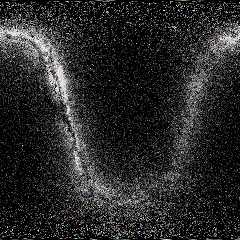
I can't get the colors figured out so I went with random (mostly white)
colors.


--
Ger
Post a reply to this message
Attachments:
Download 'starskyrc109.png' (3080 KB)
Preview of image 'starskyrc109.png'
|
|
| |
| |
|
|
From: Thomas de Groot
Subject: Re: Full spherical view with 2M stars
Date: 27 Dec 2011 03:10:00
Message: <4ef97d58@news.povray.org>
|
|
|
| |
| |
|
|
On 26-12-2011 23:57, Ger wrote:
> I can't get the colors figured out so I went with random (mostly white)
> colors.
>
>
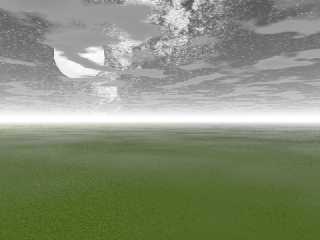
Nice, but used in one of POV's ready-made scenes a little
disappointing... ;-)

Thomas
Post a reply to this message
Attachments:
Download 'ger_nightsky_test.png' (522 KB)
Preview of image 'ger_nightsky_test.png'
|
|
| |
| |
|
|
|
|
| |
| |
|
|
wrote:

> On 26-12-2011 23:57, Ger wrote:
>> I can't get the colors figured out so I went with random (mostly white)
>> colors.
>>
>>
> Nice, but used in one of POV's ready-made scenes a little
> disappointing... ;-)
>

That's most likely because you'll need a MUCH higher resolution image to
wrap around your sky sphere. I use a 10K X 10K image.

--
Ger
Post a reply to this message
|
|
| |
| |
|
|
|
|
| |
| |
|
|
On 27-12-2011 18:56, Ger wrote:
>
> That's most likely because you'll need a MUCH higher resolution image to
> wrap around your sky sphere. I use a 10K X 10K image.
>

Yes, that is my thought too. I just could not resist to try it out ;-)

Thomas
Post a reply to this message
|
|
| |
| |
|
|
|
|
| |
| |
|
|
That's a great looking sky. Would you mind posting a small povray code example
demonstrating how to achieve this effect? I am povray newbie :-I

Many thanks!
Post a reply to this message
|
|
| |
| |
|
|
|
|
| |
| |
|
|
"Chocolate Cake" <nomail@nomail> wrote:
> That's a great looking sky. Would you mind posting a small povray code example
> demonstrating how to achieve this effect? I am povray newbie :-I

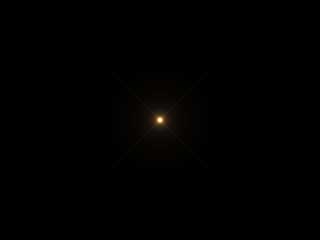
The following code demonstrates the media effects for a single star.  (The star
looks different from the stars in the original posts because I used a simpler
function here.)  Have fun!

/* star_media_demo.pov
 *
 * Copyright 2012 Richard Callwood III.  All rights reserved.
 * Fair use or similar concept may apply in your country.
 *
 * 20-jan-2012  Created.
 */
#version 3.6;

global_settings
{  assumed_gamma 1
   max_trace_level 10
}

camera
{  orthographic
   right 320 * x
   up 240 * y
}

#declare C_STAR = rgb <1.000, 0.477, 0.154>; //3000K

#declare fn_Disc = function (x) { 1 / (1 + pow (x, 3)) }

#declare fn_Spike = function (x) { 1 / (1 + pow (x, 2)) }

#declare Disc = cylinder
{  0, z, 50
   hollow
   pigment { rgbt 1 }
   interior
   {  media
      {  emission C_STAR * 10
         density { function { fn_Disc (sqrt (x*x + y*y)) } }
      }
   }
}

#declare Diffraction_spike = box
{  <-100, -0.5, 0>, <100, 0.5, 1>
   hollow
   pigment { rgbt 1 }
   interior
   {  media
      {  emission C_STAR * 2
         density { function { fn_Spike (abs(x)) } }
      }
   }
}

object { Disc translate <0, 0, 1> }

object { Diffraction_spike rotate 45*z translate <0, 0, 2.1> }

object { Diffraction_spike rotate -45*z translate <0, 0, 3.2> }
Post a reply to this message
Attachments:
Download 'star_media_demo.png' (6 KB)
Preview of image 'star_media_demo.png'
|
|
| |
| |
|
|
|
|
| |
| |
|
|
On 12-01-20 09:10 PM, Cousin Ricky wrote:
> "Chocolate Cake"<nomail@nomail>  wrote:
>> That's a great looking sky. Would you mind posting a small povray code example
>> demonstrating how to achieve this effect? I am povray newbie :-I
>
> The following code demonstrates the media effects for a single star.  (The star
> looks different from the stars in the original posts because I used a simpler
> function here.)  Have fun!

Well, it looks really cool.  But I tried using the code as listed below,
and hit a minor snag:  I can't move the star without translating the
media itself.

Is there any way of "pinning" the media within the box?
Post a reply to this message
|
|
| |
| |
|
|
|
|
| |
| |
|
|
On 6-2-2012 22:36, Tail Kinker wrote:

>
> Well, it looks really cool. But I tried using the code as listed below,
> and hit a minor snag: I can't move the star without translating the
> media itself.
>
> Is there any way of "pinning" the media within the box?
>

put the three objects in a union{} and translate that.

Thomas
Post a reply to this message
|
|
| |
| |
|
|
|
|
| |
| |
|
|
On 12-02-07 02:46 AM, Thomas de Groot wrote:
>
> put the three objects in a union{} and translate that.
>
Tried that.  It didn't work.  Then tried mucking with the textures as
well, and that worked even less.  Went back to trying the union...and it
worked.  Go fig.  Can't figure out what I did differently, but it worked.

I used the star in a video, which is currently uploading to my web page.
  I shall post the link in p.b.animations when it's done uploading.
Post a reply to this message
|
|
| |
| |
|
|
|
|
| |








