|
|
|
|
|
|
| |
| |
|
|
|
|
| |
| |
|
|
Hi All:

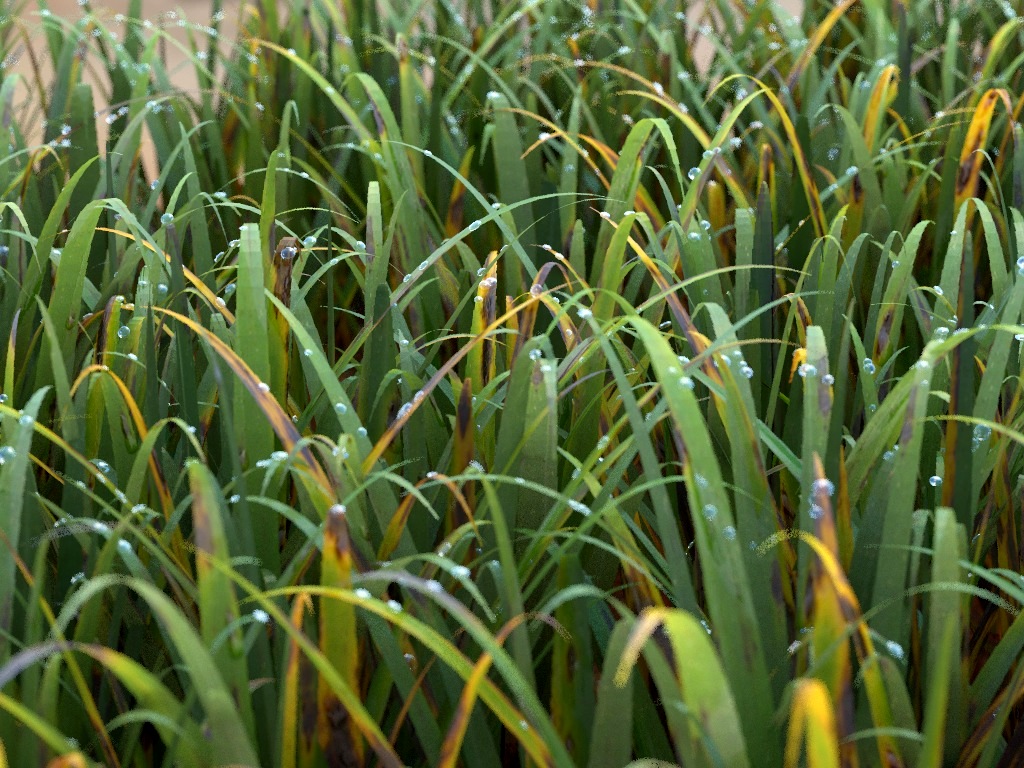
    Just a quick scene to try to get back at "just for fun" raytracing...

    The grass is a very old code of mine based on SDL-created meshes,
revised now to add uv mapping. The texture is a leaf picture from
mayang.com.

    The scene is surrounded with a cloudy HDRI sky, and the lighting as
reinforced with just a big area light above.

    The drops are blobs traced() from above, but they don't take yet into
account how wide it's the grass blade they rest on... that should be the
next and final step.

    This image is postprocessed with Gimp to add together two renders:
one with just pigments, and another with reflections and micro-normals
but without lighting (combined render times were about 2h).

--
Jaime Vives Piqueres

La Persistencia de la Ignorancia
http://www.ignorancia.org
Post a reply to this message
Attachments:
Download 'grass-pp-03.jpg' (295 KB)
Preview of image 'grass-pp-03.jpg'
|
|
| |
| |
|
|
|
|
| |
| |
|
|
Jaime Vives Piqueres <jai### [at] ignorancia org> wrote:
> Hi All:
>
> Just a quick scene to try to get back at "just for fun" raytracing...
>
> The grass is a very old code of mine based on SDL-created meshes,
> revised now to add uv mapping. The texture is a leaf picture from
> mayang.com.
>
> The scene is surrounded with a cloudy HDRI sky, and the lighting as
> reinforced with just a big area light above.
>
> The drops are blobs traced() from above, but they don't take yet into
> account how wide it's the grass blade they rest on... that should be the
> next and final step.
>
> This image is postprocessed with Gimp to add together two renders:
> one with just pigments, and another with reflections and micro-normals
> but without lighting (combined render times were about 2h).
>
> --
> Jaime Vives Piqueres
>
> La Persistencia de la Ignorancia
> http://www.ignorancia.org
Looks very nice. Obviously this is new, never been cut grass though :)
One thing I had tried a few years ago was similar, and placed and sized the
grass based on a pigment evalution like bozo. You could then apply a translate
to the pattern for an animation that could simulate wind blowing.
-tgq org> wrote:
> Hi All:
>
> Just a quick scene to try to get back at "just for fun" raytracing...
>
> The grass is a very old code of mine based on SDL-created meshes,
> revised now to add uv mapping. The texture is a leaf picture from
> mayang.com.
>
> The scene is surrounded with a cloudy HDRI sky, and the lighting as
> reinforced with just a big area light above.
>
> The drops are blobs traced() from above, but they don't take yet into
> account how wide it's the grass blade they rest on... that should be the
> next and final step.
>
> This image is postprocessed with Gimp to add together two renders:
> one with just pigments, and another with reflections and micro-normals
> but without lighting (combined render times were about 2h).
>
> --
> Jaime Vives Piqueres
>
> La Persistencia de la Ignorancia
> http://www.ignorancia.org
Looks very nice. Obviously this is new, never been cut grass though :)
One thing I had tried a few years ago was similar, and placed and sized the
grass based on a pigment evalution like bozo. You could then apply a translate
to the pattern for an animation that could simulate wind blowing.
-tgq
Post a reply to this message
|
|
| |
| |
|
|
|
|
| |
| |
|
|
Great texture on the grass, if it wasn't posted on this forum I would have just
assumed it was a photo but at closer inspection I think some of the rain drops
are a bit too spherical for their position on the grass.

Sean
Post a reply to this message
|
|
| |
| |
|
|
|
|
| |
| |
|
|
Le 2011/05/11 05:53, s.day a écrit :
> Great texture on the grass, if it wasn't posted on this forum I would have just
> assumed it was a photo but at closer inspection I think some of the rain drops
> are a bit too spherical for their position on the grass.
>
> Sean
>
>

There is also some visible fasceting on the blades.
Post a reply to this message
|
|
| |
| |
|
|
|
|
| |
| |
|
|
The grass is superb, I really like it. The drops are indeed a bit spherical as
"s day" mentioned. And some are a bit displaced, hanging on the edges of the
blades. I think that is what you meant with taking the width of the blades into
account.

My idea to address this both issues is to trace() 4 times at the "edges" of a
drop (4 points orthogonal in the ground plane at the boundary of the drops) to
find a place completely on a blade. Perhaps you can determine the general slope
of the blade from this points and place a little bit scaled and rotated version
of a drop. I know, this is easily said and much harder to accomplish... But...,
it was my first idea to the problem.

Regards,
Michael
Post a reply to this message
|
|
| |
| |
|
|
|
|
| |
| |
|
|
Second thought: 4 points are one to much. Better use only 3 in a equiliteral
traingle at the borders of the drops. Then the plane between this points on the
blade is well defined (4 points may not result in a plane) and the slopes can be
calculated.

Regards,
Michael
Post a reply to this message
|
|
| |
| |
|
|
|
|
| |
| |
|
|
"Jaime Vives Piqueres" <jai### [at] ignoranciaorg> schreef in bericht
news:4dc3d9a6@news.povray.org...
>    The drops are blobs traced() from above, but they don't take yet into
> account how wide it's the grass blade they rest on... that should be the
> next and final step.
>

Maybe not *all* grass, but generally the blades are a tiny bit folded around
a central - longitudinal - nerve. This helps also the blade to keep upright.
Water droplets then often concentrate in the fold.

Thomas
Post a reply to this message
|
|
| |
| |
|
|
|
|
| |
| |
|
|
"Thomas de Groot" <tDOTdegroot@interDOTnlANOTHERDOTnet> schreef in bericht
news:4dccda2d$1@news.povray.org...
> Maybe not *all* grass, but generally the blades are a tiny bit folded
> around a central - longitudinal - nerve. This helps also the blade to keep
> upright. Water droplets then often concentrate in the fold.

...but when I google grass blade images, they often do not seem to do what I
would like them to do.... ;-)

Thomas
Post a reply to this message
|
|
| |
| |
|
|
|
|
| |
| |
|
|
Am 12.05.2011 22:25, schrieb TawnyOwl:
> Second thought: 4 points are one to much. Better use only 3 in a equiliteral
> traingle at the borders of the drops. Then the plane between this points on the
> blade is well defined (4 points may not result in a plane) and the slopes can be
> calculated.

For determining the "slope" of the blade, retrieving the normal vector
from a single trace() call should suffice.

Tracing multiple rays is a good idea though to prevent drops from
hanging out too far at a blade edge.
Post a reply to this message
|
|
| |
| |
|
|
|
|
| |
| |
|
|
El 11/05/11 11:53, s.day escribió:
> Great texture on the grass, if it wasn't posted on this forum I would
> have just assumed it was a photo but at closer inspection I think
> some of the rain drops are a bit too spherical for their position on
> the grass.
>

   Yes, that's another problem apart from the placement on the blade
borders... I'm already using a blob with two components, the one below
having negative strength to make it look less spherical, but it isn't
doing a very good job (I admit that I didn't put much effort into it).

--
Jaime Vives Piqueres

La Persistencia de la Ignorancia
http://www.ignorancia.org
Post a reply to this message
|
|
| |
| |
|
|
|
|
| |
| |
|
|
El 12/05/11 05:01, Alain escribió:
> Le 2011/05/11 05:53, s.day a écrit :
>> Great texture on the grass, if it wasn't posted on this forum I
>> would have just assumed it was a photo but at closer inspection I
>> think some of the rain drops are a bit too spherical for their
>> position on the grass.
>>
>> Sean
>>
>>
>
> There is also some visible fasceting on the blades.

   Yeah... I had a very obvious bug on the loop which creates the blades,
and the point from one section to the the next weren't properly matched
(but somehow, I never traced it before at enough resolution to notice
it). It's corrected now for the final render... thanks!

--
Jaime Vives Piqueres

La Persistencia de la Ignorancia
http://www.ignorancia.org
Post a reply to this message
|
|
| |
| |
|
|
|
|
| |
| |
|
|
El 12/05/11 22:25, TawnyOwl escribió:
> Second thought: 4 points are one to much. Better use only 3 in a
> equiliteral traingle at the borders of the drops. Then the plane
> between this points on the blade is well defined (4 points may not
> result in a plane) and the slopes can be calculated.

   I was going to go for the 4 points approach, until you made this
useful suggestion... thanks! For the slope, as clipcka said, the normal
returned by the first trace() is enough to reorient the drop (and I was
already using it, even if it's not very noticeable because the drops are
too spherical).


--
Jaime Vives Piqueres

La Persistencia de la Ignorancia
http://www.ignorancia.org
Post a reply to this message
|
|
| |
| |
|
|
|
|
| |
| |
|
|
El 13/05/11 09:13, Thomas de Groot escribió:
> Maybe not *all* grass, but generally the blades are a tiny bit folded
> around a central - longitudinal - nerve. This helps also the blade to
> keep upright. Water droplets then often concentrate in the fold.

   The folding is universal, to my knowledge... just some kinds of grass
don't show it very well. In fact, it's something I noticed from day one,
but was too lazy to try it. I just looked now, and it was in fact very
easy to do, due to the way I'm constructing each blade. Thanks!


--
Jaime Vives Piqueres

La Persistencia de la Ignorancia
http://www.ignorancia.org
Post a reply to this message
|
|
| |
| |
|
|
|
|
| |
| |
|
|
Jaime Vives Piqueres <jai### [at] ignoranciaorg> wrote:
> El 12/05/11 22:25, TawnyOwl escribió:
> > Second thought: 4 points are one to much. Better use only 3 in a
> > equiliteral traingle at the borders of the drops. Then the plane
> > between this points on the blade is well defined (4 points may not
> > result in a plane) and the slopes can be calculated.
>
>    I was going to go for the 4 points approach, until you made this
> useful suggestion... thanks! For the slope, as clipcka said, the normal
> returned by the first trace() is enough to reorient the drop (and I was
> already using it, even if it's not very noticeable because the drops are
> too spherical).
>
>
> --
> Jaime Vives Piqueres
>
> La Persistencia de la Ignorancia
> http://www.ignorancia.org

Hi Jaime,
thanks for your response. The "more-then-2-points"-approach was not really meant
to determine the slope, but to ensure that the drop is completely on the blades,
the second issue I meant. You can determine the slopes from three vectors, but
of course you need only one. I was to entangled with a similar problem in
placing a mirror orthogonal to the viewpoint of the camera, where I used a
basis-transformation of two vectors with Shear_Trans() from the
transform-library to accomplish the correct rotation. The result is a WIP, which
is stalled for the moment, but may be you recognize the real author of this
scene...
Thank you for this! The trees are from arbaro.

Regards,
Michael
Post a reply to this message
Attachments:
Download 'tierra_first.png' (539 KB)
Preview of image 'tierra_first.png'

|
|
| |
| |
|
|
|
|
| |
| |
|
|
El 13/05/11 22:08, TawnyOwl escribió:
> thanks for your response. The "more-then-2-points"-approach was not
> really meant to determine the slope, but to ensure that the drop is
> completely on the blades,

   I finally had to use four... just 3 was not working well for some
reason. At the end it didn't come out as nice as I was expecting, but
it's at least half-convincing at a first glance (see final post on this
thread).

> I was to entangled with a similar problem in placing a mirror
> orthogonal to the viewpoint of the camera, where I used a
> basis-transformation of two vectors with Shear_Trans() from the
> transform-library to accomplish the correct rotation. The result is a
> WIP, which is stalled for the moment, but may be you recognize the
> real author of this scene...

   Yes, that landscape sounds familiar... ;) BTW, I've not the slightest
idea of what you're doing there...

--
Jaime Vives Piqueres

La Persistencia de la Ignorancia
http://www.ignorancia.org
Post a reply to this message
|
|
| |
| |
|
|
|
|
| |
| |
|
|
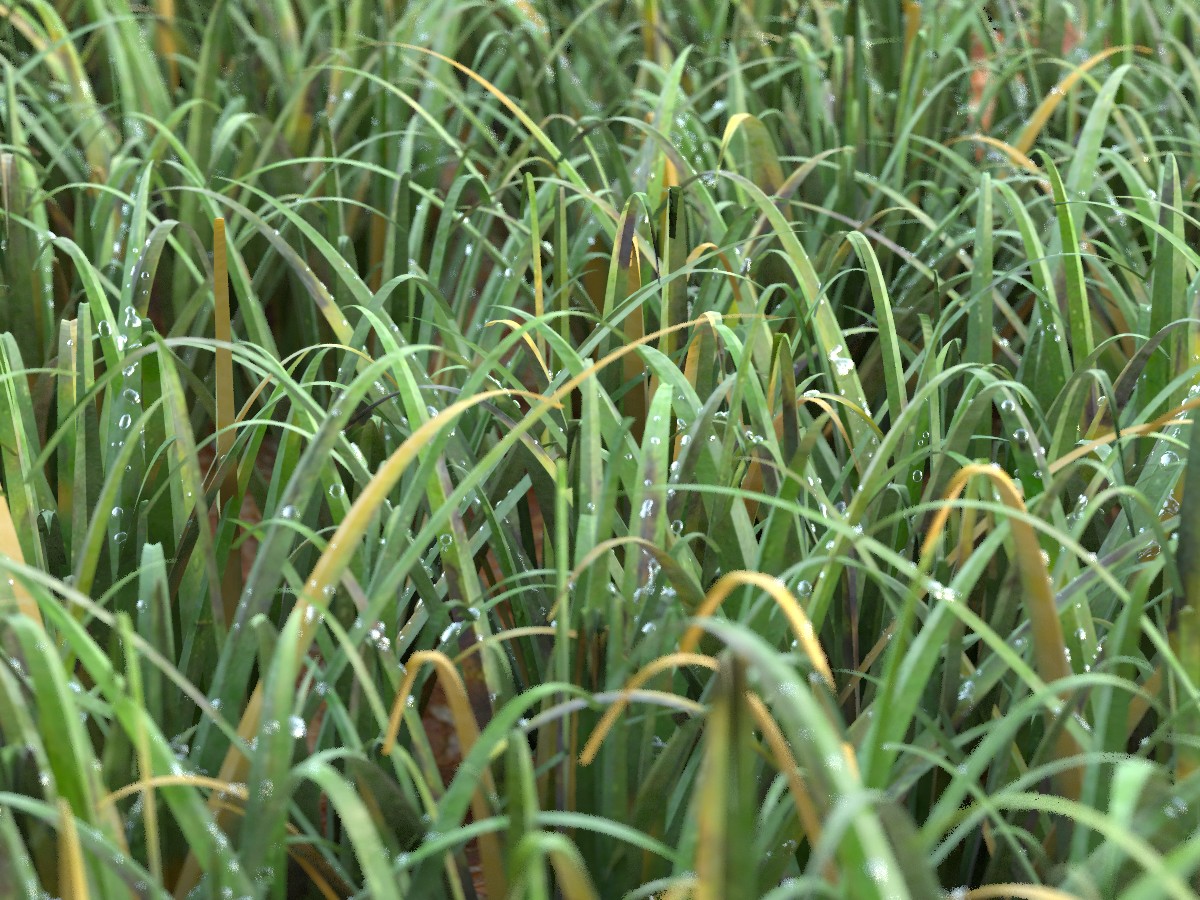
El 06/05/11 13:20, Jaime Vives Piqueres escribió:
> The drops are blobs traced() from above, but they don't take yet
> into account how wide it's the grass blade they rest on... that
> should be the next and final step.

    Finally used a 4-point trace() construct, testing if they rest likely
on the same blade by allowing just a little difference in height between
them.

    Also added the folding on the blades as Thomas suggested, and
increased the drop count to 30000... they don't look that great, but at
least the "bad spots" are not very distracting.

    Here is attached the final pic (and I meant FINAL, I promise),
post-processed to add reflections which were rendered as a separate
layer. Total render time: 2h15m on a Phenom X4.

    Regards,

--
Jaime Vives Piqueres

La Persistencia de la Ignorancia
http://www.ignorancia.org
Post a reply to this message
Attachments:
Download 'grass-06pp.jpg' (323 KB)
Preview of image 'grass-06pp.jpg'
|
|
| |
| |
|
|
|
|
| |
| |
|
|
On 18/05/2011 7:18 PM, Jaime Vives Piqueres wrote:
> Here is attached the final pic (and I meant FINAL, I promise),
> post-processed to add reflections which were rendered as a separate
> layer. Total render time: 2h15m on a Phenom X4.

Wow!. Beautiful work.

zutroi
Post a reply to this message
|
|
| |
| |
|
|
|
|
| |
| |
|
|
Well, well, well... what a nice photograph ;-)

I think this is very convincing.

Thomas
Post a reply to this message
|
|
| |
| |
|
|
|
|
| |