|
|
|
|
|
|
| |
| |
|
|
|
|
| |
| |
|
|
I believe it is time to reveal the state-of-the-art of my latest work for
the TC-RTC.

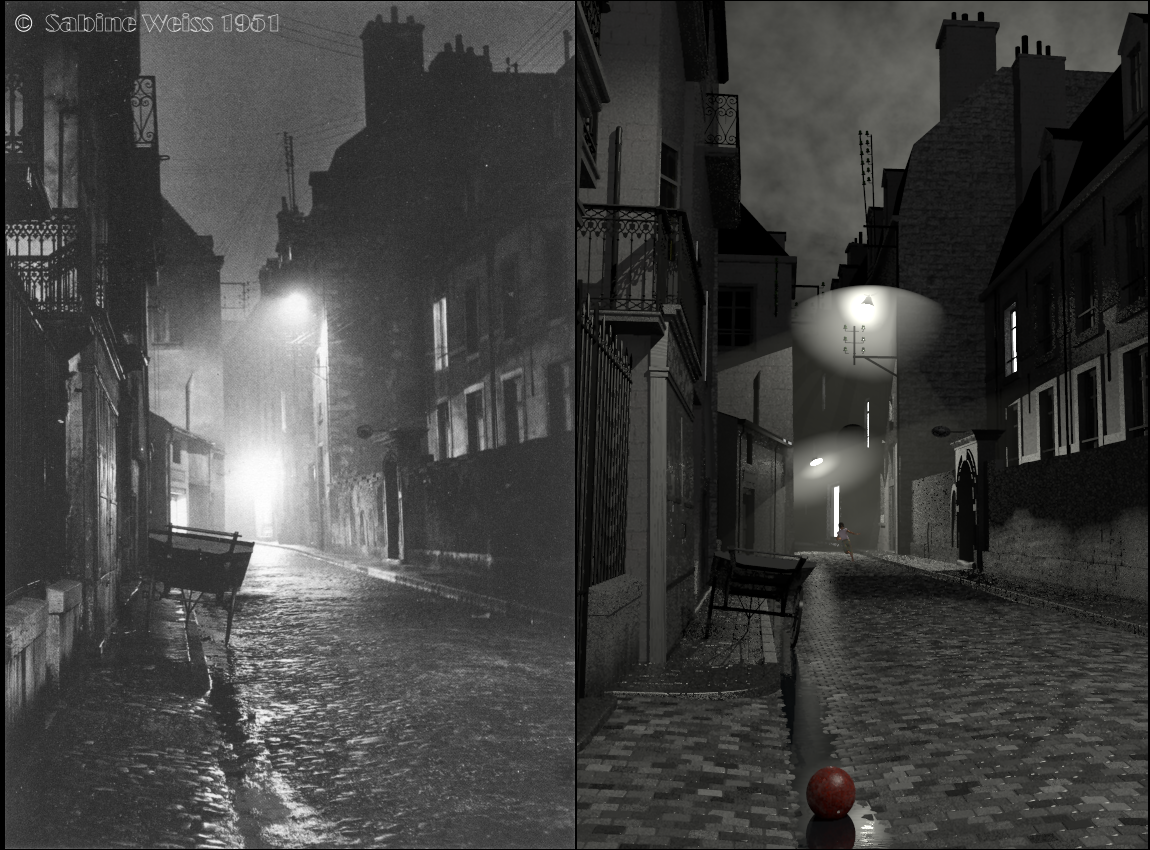
Left, is the original photograph by Sabine Weiss of a night time Paris
street in 1951, a period and place I remember well from my youth. Right, is
my reconstruction so far, mostly meshes built in Silo. POV-Ray 3.7 RC3 as
scene builder and renderer.

I made a quotation to another of Weiss's prints which I leave you to
discover yourselves ;-)  (Google is my friend)

This represents about two months work so far, with still a lot of details to
fill in, not in the least the electricity cables.

What is your impression?

Thomas
Post a reply to this message
Attachments:
Download 'Paris_1951_.png' (1000 KB)
Preview of image 'Paris_1951_.png'
|
|
| |
| |
|
|
|
|
| |
| |
|
|
On 26/03/2011 1:29 PM, Thomas de Groot wrote:
> What is your impression?

1950's Paris.

Except, shouldn't Kathy be dressed more as a ragamuffin?

I look forward to seeing the final render with atmosphere. It makes me
want to use/steal the print for my darkroom scene. ;-)

--
Regards
     Stephen
Post a reply to this message
|
|
| |
| |
|
|
|
|
| |
| |
|
|
"Stephen" <mcavoys_at@aoldotcom> schreef in bericht
news:4d8dfb20@news.povray.org...
> On 26/03/2011 1:29 PM, Thomas de Groot wrote:
>> What is your impression?
>
> 1950's Paris.

Yes, that was what I was hoping.

>
> Except, shouldn't Kathy be dressed more as a ragamuffin?

Point is: I want to suggest a time mix. In b/w is the period Paris of 1951,
while in color Cathy lives in a much later dimension, unaware of her
surroundings. Not really convincing maybe, but that is the idea.

>
> I look forward to seeing the final render with atmosphere. It makes me
> want to use/steal the print for my darkroom scene. ;-)

The atmosphere is already there, but difficult to fine tune. There is a
subtle scattering media beneath the street lamps which needs to be thickened
a bit probably.

Thomas
Post a reply to this message
|
|
| |
| |
|
|
|
|
| |
| |
|
|
"Stephen" <mcavoys_at@aoldotcom> schreef in bericht
news:4d8dfb20@news.povray.org...
 It makes me
> want to use/steal the print for my darkroom scene. ;-)

You are welcome... ;-)

Thomas
Post a reply to this message
|
|
| |
| |
|
|
|
|
| |
| |
|
|
On Sat, 26 Mar 2011 17:27:20 +0200, Thomas de Groot
<tDOTdegroot@interdotnlanotherdotnet> wrote:

>
> "Stephen" <mcavoys_at@aoldotcom> schreef in bericht
> news:4d8dfb20@news.povray.org...
>> On 26/03/2011 1:29 PM, Thomas de Groot wrote:
>>> What is your impression?
>>
>> 1950's Paris.
>
> Yes, that was what I was hoping.
>
>>
>> Except, shouldn't Kathy be dressed more as a ragamuffin?
>
> Point is: I want to suggest a time mix. In b/w is the period Paris of
> 1951,
> while in color Cathy lives in a much later dimension, unaware of her
> surroundings. Not really convincing maybe, but that is the idea.
>
>>
>> I look forward to seeing the final render with atmosphere. It makes me
>> want to use/steal the print for my darkroom scene. ;-)
>
> The atmosphere is already there, but difficult to fine tune. There is a
> subtle scattering media beneath the street lamps which needs to be
> thickened
> a bit probably.
>
> Thomas
>
You could try making the scattering media fill the whole scene as in the
photograph. If everything disappears and you need more control, try using
a density_map with 0 density at the camera and high density further away
(that's what I did in my sunflower scene btw).


--
-Nekar Xenos-
Post a reply to this message
|
|
| |
| |
|
|
|
|
| |
| |
|
|
"Nekar Xenos" <nek### [at] gmail com> schreef in bericht
news:op.vsyiv2maufxv4h@xena...
> You could try making the scattering media fill the whole scene as in the
> photograph. If everything disappears and you need more control, try using
> a density_map with 0 density at the camera and high density further away
> (that's what I did in my sunflower scene btw).
Presently, there is a background scattering media, in a separate light
group, for the night sky, and there is a scattering media in the street
which, however, does not reach the closest street lamp just behind the
camera. I did it that way for decreasing render time. I shall experiment
with your idea and include also the foreground in the media. The density
idea seems indeed a good suggestion here. Thanks a lot for that!
Thomas com> schreef in bericht
news:op.vsyiv2maufxv4h@xena...
> You could try making the scattering media fill the whole scene as in the
> photograph. If everything disappears and you need more control, try using
> a density_map with 0 density at the camera and high density further away
> (that's what I did in my sunflower scene btw).
Presently, there is a background scattering media, in a separate light
group, for the night sky, and there is a scattering media in the street
which, however, does not reach the closest street lamp just behind the
camera. I did it that way for decreasing render time. I shall experiment
with your idea and include also the foreground in the media. The density
idea seems indeed a good suggestion here. Thanks a lot for that!
Thomas
Post a reply to this message
|
|
| |
| |
|
|
|
|
| |
| |
|
|
On 03/26/2011 10:29 AM, Thomas de Groot wrote:
> What is your impression?

Wow ... the hard work you've put into it shows. You've captured the mood
of the original plus some ... excellent.

Curious (as I've had this problem too) ... why do the right side
buildings look straight up perfect, but the left side looks almost there
as well (except with the fence nearest the camera) ... I'm looking at
where the fence/building meet. I'm sure (well maybe not) this has to do
camera position and viewing angle. Not being critical of the work, but
just hoping to start a conversation about the best ways to solve this
problem ... what's your camera definition look like ... or is some kind
of transformation of the objects the best way to tackle this.

Oh ... yeah I like the contrasting idea of almost all b/w objects then
one or two objects in color ... nice touch!
Post a reply to this message
|
|
| |
| |
|
|
|
|
| |
| |
|
|
Jim Holsenback <jho### [at] povrayorg> wrote:
> On 03/26/2011 10:29 AM, Thomas de Groot wrote:
> > What is your impression?
>
> Wow ... the hard work you've put into it shows. You've captured the mood
> of the original plus some ... excellent.
>
> Curious (as I've had this problem too) ... why do the right side
> buildings look straight up perfect, but the left side looks almost there
> as well (except with the fence nearest the camera) ... I'm looking at
> where the fence/building meet. I'm sure (well maybe not) this has to do
> camera position and viewing angle. Not being critical of the work, but
> just hoping to start a conversation about the best ways to solve this
> problem ... what's your camera definition look like ... or is some kind
> of transformation of the objects the best way to tackle this.
>
> Oh ... yeah I like the contrasting idea of almost all b/w objects then
> one or two objects in color ... nice touch!

Likely more to do with real camera vs POV camera.  In real cameras lens
distortion effects like barrel distortion get introduced which POV doesn't.  Can
also be a simple perspective issue.  Bringin the camera in closer with a wider
veiwing angle will exagerate perspective more.

-tgq
Post a reply to this message
|
|
| |
| |
|
|
|
|
| |
| |
|
|
"Thomas de Groot" <tDOTdegroot@interDOTnlANOTHERDOTnet> wrote:
> What is your impression?
>
> Thomas

pretty damn good so far!

reconstructing scenes from photography is stimulating, isn't it?  And a hell of
a challenge for sure!  Still need some matching up with the right angle, but
after you complete this, seeing it from another angle is a must too.  After all,
this is not merely a 2D register. :)

how did you do the fine details like the fences?  Is it a texture?
Post a reply to this message
|
|
| |
| |
|
|
|
|
| |
| |
|
|
On 03/26/2011 01:10 PM, Trevor G Quayle wrote:
> Jim Holsenback<jho### [at] povrayorg>  wrote:
>> On 03/26/2011 10:29 AM, Thomas de Groot wrote:
>>> What is your impression?
>>
>> Wow ... the hard work you've put into it shows. You've captured the mood
>> of the original plus some ... excellent.
>>
>> Curious (as I've had this problem too) ... why do the right side
>> buildings look straight up perfect, but the left side looks almost there
>> as well (except with the fence nearest the camera) ... I'm looking at
>> where the fence/building meet. I'm sure (well maybe not) this has to do
>> camera position and viewing angle. Not being critical of the work, but
>> just hoping to start a conversation about the best ways to solve this
>> problem ... what's your camera definition look like ... or is some kind
>> of transformation of the objects the best way to tackle this.
>>
>> Oh ... yeah I like the contrasting idea of almost all b/w objects then
>> one or two objects in color ... nice touch!
>
> Likely more to do with real camera vs POV camera.  In real cameras lens
> distortion effects like barrel distortion get introduced which POV doesn't.  Can
> also be a simple perspective issue.  Bringin the camera in closer with a wider
> veiwing angle will exagerate perspective more.
>
> -tgq
>

cool ... thanks for the "teaching" moment ;-)
Post a reply to this message
|
|
| |
| |
|
|
|
|
| |
| |
|
|
"Thomas de Groot" <tDOTdegroot@interDOTnlANOTHERDOTnet> wrote:
> I believe it is time to reveal the state-of-the-art of my latest work for
> the TC-RTC.
>
> Left, is the original photograph by Sabine Weiss of a night time Paris
> street in 1951, a period and place I remember well from my youth. Right, is
> my reconstruction so far, mostly meshes built in Silo. POV-Ray 3.7 RC3 as
> scene builder and renderer.
>
> I made a quotation to another of Weiss's prints which I leave you to
> discover yourselves ;-)  (Google is my friend)
>
> This represents about two months work so far, with still a lot of details to
> fill in, not in the least the electricity cables.
>
> What is your impression?
>
> Thomas

Wow, I can really appreciate all the time you've put into the modelling, and
matching up all the details in the scene assembly. A couple of things that I
think would bring it closer to the original would include:

Use an image_pattern or pigment_pattern as a specularity/reflection mask for the
pavement to break up the highlights more, to show variation of wetness areas;
maybe with the (I'm assuming) height_field just a bit more jagged or exaggerated
to show that the pavers are not all the same height.

A similar image_pattern circular glow around the lights (or a spherical density
media) in addition to what you have already there would really tie the lights
into the "atmosphere" of the shot - there's quite a harsh line of separation
from the sky in the top light.

Overall, very impressive; this is looking great!
Rob

-------------------------------------------------
www.McGregorFineArt.com
Post a reply to this message
|
|
| |
| |
|
|
|
|
| |
| |
|
|
"Thomas de Groot" <tDOTdegroot@interDOTnlANOTHERDOTnet> wrote:
> I believe it is time to reveal the state-of-the-art of my latest work for
> the TC-RTC.
>
....
>
> What is your impression?

It's most excellent, Thomas! Your attention to detail and proficiency at
modeling really come through.

The atmosphere might need a little work. I'm not sure how to achieve realistic
scattering effects as I'm not too great at using media, but I wonder if you
could fake some of it with emitting media? MegaPOV's glows might also do the
trick, though it would require going back to 3.6.

More pronounced reflections on the surfaces also wouldn't hurt. I'm guessing
they would have more to reflect if the air was receiving more light...

All-in-all it's a superb modeling job and faithful reproduction of the original.
Good job!

~Sam
Post a reply to this message
|
|
| |
| |
|
|
|
|
| |
| |
|
|
"Jim Holsenback" <jho### [at] povrayorg> schreef in bericht
news:4d8e1ed1$1@news.povray.org...
> On 03/26/2011 01:10 PM, Trevor G Quayle wrote:
>> Likely more to do with real camera vs POV camera.  In real cameras lens
>> distortion effects like barrel distortion get introduced which POV
>> doesn't.  Can
>> also be a simple perspective issue.  Bringin the camera in closer with a
>> wider
>> veiwing angle will exagerate perspective more.
>>
> cool ... thanks for the "teaching" moment ;-)

That is indeed the explanation. There is an easy solution to that with
FieldCam.inc by Doctor John, a nice macro which sets buildings straight. I
have not used in the present image but I most probably will in the final
one.

Thomas
Post a reply to this message
|
|
| |
| |
|
|
|
|
| |
| |
|
|
"Jim Holsenback" <jho### [at] povrayorg> schreef in bericht
news:4d8e0a76$1@news.povray.org...
> On 03/26/2011 10:29 AM, Thomas de Groot wrote:
>> What is your impression?
>
> Wow ... the hard work you've put into it shows. You've captured the mood
> of the original plus some ... excellent.

Thank you Jim :-)

>
> Curious (as I've had this problem too) ... why do the right side buildings
> look straight up perfect, but the left side looks almost there as well
> (except with the fence nearest the camera) ... I'm looking at where the
> fence/building meet. I'm sure (well maybe not) this has to do camera
> position and viewing angle. Not being critical of the work, but just
> hoping to start a conversation about the best ways to solve this problem
> ... what's your camera definition look like ... or is some kind of
> transformation of the objects the best way to tackle this.

See later about this...

> Oh ... yeah I like the contrasting idea of almost all b/w objects then one
> or two objects in color ... nice touch!

Yes indeed. It is not really original and has been done here before by
better Povers than me ;-)

Thomas
Post a reply to this message
|
|
| |
| |
|
|
|
|
| |
| |
|
|
"nemesis" <nam### [at] gmailcom> schreef in bericht
news:web.4d8e1a1ed16f200eb568d5750@news.povray.org...
> "Thomas de Groot" <tDOTdegroot@interDOTnlANOTHERDOTnet> wrote:
> pretty damn good so far!

Thank you indeed :-)

>
> reconstructing scenes from photography is stimulating, isn't it?  And a
> hell of
> a challenge for sure!  Still need some matching up with the right angle,
> but
> after you complete this, seeing it from another angle is a must too.
> After all,
> this is not merely a 2D register. :)

It is a real challenge because so much is unknown - like real dimensions for
instance - and you have to infer a lot of things from 2D back to 3D. Getting
the camera right was the most difficult and subtle part however.
Overall I am quite happy, and both images almost coincide (that is also one
of the techniques I used with the help of Tim Nikias'glare macro). Things do
not need to coincide perfectly however, and I have taken some liberties here
and there.

> how did you do the fine details like the fences?  Is it a texture?

No, I modelled the fence elements in Silo (like all buildings in this scene)
and then copied them.

Thomas
Post a reply to this message
|
|
| |
| |
|
|
|
|
| |
| |
|
|
"Robert McGregor" <rob### [at] mcgregorfineartcom> schreef in bericht
news:web.4d8e3a38d16f200e94d713cc0@news.povray.org...
> Wow, I can really appreciate all the time you've put into the modelling,
> and
> matching up all the details in the scene assembly. A couple of things that
> I
> think would bring it closer to the original would include:

Thank you indeed Robert :-)

>
> Use an image_pattern or pigment_pattern as a specularity/reflection mask
> for the
> pavement to break up the highlights more, to show variation of wetness
> areas;
> maybe with the (I'm assuming) height_field just a bit more jagged or
> exaggerated
> to show that the pavers are not all the same height.

The pavement is made of individual stones (some 20k+ of them) using my
Cobblestone macro. They are aligned on an irregular surface (could be
increased some more) and have some irregularities in their placement. Each
stone has its own random texture variation of course. So, I am not sure how
to implement your suggestion here, but I shall think about it.

>
> A similar image_pattern circular glow around the lights (or a spherical
> density
> media) in addition to what you have already there would really tie the
> lights
> into the "atmosphere" of the shot - there's quite a harsh line of
> separation
> from the sky in the top light.

OK, this is the crux of my trials and errors. At the lamp locations are two
spherical emission media with spherical densities. What I did however, and
maybe I should attenuate that, I shifted the center of the density some way
up. My intention was to deform the halo a bit like one seems to notice in
the original: the halo is stronger below the lamp shade than above it.
However this causes this sharp boundary you mention.
In addition, a scattering media scatters the light cone a bit further.

>
> Overall, very impressive; this is looking great!

Again, thank you Robert.

Thomas
Post a reply to this message
|
|
| |
| |
|
|
|
|
| |
| |
|
|
"Samuel Benge" <stb### [at] hotmailcom> schreef in bericht
news:web.4d8e49f8d16f200e9e5cacc00@news.povray.org...
> It's most excellent, Thomas! Your attention to detail and proficiency at
> modeling really come through.

Thank you indeed Sam. Each modelling day comes with new tricks to learn...

>
> The atmosphere might need a little work. I'm not sure how to achieve
> realistic
> scattering effects as I'm not too great at using media, but I wonder if
> you
> could fake some of it with emitting media? MegaPOV's glows might also do
> the
> trick, though it would require going back to 3.6.

I used emitting media here for the halos, but obviously they need more work.
They were the primary reason why I reveled this image ;-)

>
> More pronounced reflections on the surfaces also wouldn't hurt. I'm
> guessing
> they would have more to reflect if the air was receiving more light...

Yes, I agree. Most surfaces have some measure of reflection (mostly
reflection {0, 0.1}) and I should perhaps increase the lower value.

>
> All-in-all it's a superb modeling job and faithful reproduction of the
> original.
> Good job!

Thanks again Sam :-)

Thomas
Post a reply to this message
|
|
| |
| |
|
|
|
|
| |
| |
|
|
On 26/03/2011 3:27 PM, Thomas de Groot wrote:
> "Stephen"<mcavoys_at@aoldotcom>  schreef in bericht
> news:4d8dfb20@news.povray.org...
>> On 26/03/2011 1:29 PM, Thomas de Groot wrote:
>>> What is your impression?
>>
>> 1950's Paris.
>
> Yes, that was what I was hoping.
>

Well it is certainly what you said ;-)

I did not visit Paris until the mid 70’s (it changed my gastronomic
life) but your image does remind me of my home town in the 50’s.

>>
>> Except, shouldn't Kathy be dressed more as a ragamuffin?
>
> Point is: I want to suggest a time mix. In b/w is the period Paris of 1951,
> while in color Cathy lives in a much later dimension, unaware of her
> surroundings. Not really convincing maybe, but that is the idea.
>

Great idea but I think it should be less subtle. Why not bring Cathy
nearer the camera?

>>
>> I look forward to seeing the final render with atmosphere. It makes me
>> want to use/steal the print for my darkroom scene. ;-)
>
> The atmosphere is already there, but difficult to fine tune. There is a
> subtle scattering media beneath the street lamps which needs to be thickened
> a bit probably.
>
Oops!

Since the containers are quite visible I think Nekar's suggestion of
filling the whole scene with media would be the right method. Lights
with a fade_distance > 2 could be used for effect.

>> want to use/steal the print for my darkroom scene. ;-)
>
> You are welcome... ;-)
>
> Thomas
>

Thanks, Now I will have to cut some more paper.
I do like the idea of shared universes.


--
Regards
     Stephen
Post a reply to this message
|
|
| |
| |
|
|
|
|
| |
| |
|
|
There is something else to be aware of in this scene: The building walls are
NOT straight! In particular the shop front at left is skewed, and I have
included that in my image (I may have exagerated it a bit too).

Thomas
Post a reply to this message
|
|
| |
| |
|
|
|
|
| |
| |
|
|
On Sun, 27 Mar 2011 09:27:33 +0200, Thomas de Groot
<tDOTdegroot@interdotnlanotherdotnet> wrote:

>
> "Robert McGregor" <rob### [at] mcgregorfineartcom> schreef in bericht
> news:web.4d8e3a38d16f200e94d713cc0@news.povray.org...

>> A similar image_pattern circular glow around the lights (or a spherical
>> density
>> media) in addition to what you have already there would really tie the
>> lights
>> into the "atmosphere" of the shot - there's quite a harsh line of
>> separation
>> from the sky in the top light.
>
> OK, this is the crux of my trials and errors. At the lamp locations are
> two
> spherical emission media with spherical densities. What I did however,
> and
> maybe I should attenuate that, I shifted the center of the density some
> way
> up. My intention was to deform the halo a bit like one seems to notice in
> the original: the halo is stronger below the lamp shade than above it.
> However this causes this sharp boundary you mention.
> In addition, a scattering media scatters the light cone a bit further.
>

I'm sure this will be corrected if you remove the spherical media at the
lights and use the method I described earlier in conjunction with
spotlights.

--
-Nekar Xenos-
Post a reply to this message
|
|
| |
| |
|
|
|
|
| |
| |
|
|
Le 2011/03/27 03:27, Thomas de Groot a écrit :
> "Robert McGregor"<rob### [at] mcgregorfineartcom>  schreef in bericht
> news:web.4d8e3a38d16f200e94d713cc0@news.povray.org...
>> Wow, I can really appreciate all the time you've put into the modelling,
>> and
>> matching up all the details in the scene assembly. A couple of things that
>> I
>> think would bring it closer to the original would include:
>
> Thank you indeed Robert :-)
>
>>
>> Use an image_pattern or pigment_pattern as a specularity/reflection mask
>> for the
>> pavement to break up the highlights more, to show variation of wetness
>> areas;
>> maybe with the (I'm assuming) height_field just a bit more jagged or
>> exaggerated
>> to show that the pavers are not all the same height.
>
> The pavement is made of individual stones (some 20k+ of them) using my
> Cobblestone macro. They are aligned on an irregular surface (could be
> increased some more) and have some irregularities in their placement. Each
> stone has its own random texture variation of course. So, I am not sure how
> to implement your suggestion here, but I shall think about it.
>

It's an old neibourhood. That street pavement is probably well over 70
years old, it have seen both WWI and WWII.

In the photo, the cobble stones are well worn and rounded. Your's looks
as if they are new and freshly layed.

Some are obviously brocken and are concave.
It also looks like some may be missing and the resulting hole filled
with gravel or sand.


Alain
Post a reply to this message
|
|
| |
| |
|
|
|
|
| |
| |
|
|
"Alain" <aze### [at] qwertyorg> schreef in bericht
news:4d8f7ecc$1@news.povray.org...
> It's an old neibourhood. That street pavement is probably well over 70
> years old, it have seen both WWI and WWII.

Absolutely.

>
> In the photo, the cobble stones are well worn and rounded. Your's looks as
> if they are new and freshly layed.
> Some are obviously brocken and are concave.
> It also looks like some may be missing and the resulting hole filled with
> gravel or sand.

Yes indeed. This should be the next implementation of my macro... Not sure
however if I can get that finished for the TC-RTC deadline, but certainly
worth the effort.

Thomas
Post a reply to this message
|
|
| |
| |
|
|
|
|
| |
| |
|
|
"Nekar Xenos" <nek### [at] gmailcom> schreef in bericht
news:op.vs0ao1i0ufxv4h@xena...
> I'm sure this will be corrected if you remove the spherical media at the
> lights and use the method I described earlier in conjunction with
> spotlights.

And get better halos? Remind me where you described this, I seem to have
forgotten... :-(

Thomas
Post a reply to this message
|
|
| |
| |
|
|
|
|
| |
| |
|
|
"Stephen" <mcavoys_at@aoldotcom> schreef in bericht
news:4d8eeda4@news.povray.org...
> I did not visit Paris until the mid 70’s (it changed my gastronomic life)
> but your image does remind me of my home town in the 50’s.

Yes, I can undestand that. The present street is not in the center of town
but probably more on the periphery. Interestingly, while the overall aspect
is rather downtrod, there still is a lawyer's office here: did you see the
telltale oval shield above the entrance at right? I found that an
interesting idea when I discovered (and remembered) what it represented
exactly.

> Great idea but I think it should be less subtle. Why not bring Cathy
> nearer the camera?

Yes, I probably should.

>
> Thanks, Now I will have to cut some more paper.
> I do like the idea of shared universes.

I agree. Looking forward to it :-)

Thomas
Post a reply to this message
|
|
| |
| |
|
|
|
|
| |
| |
|
|
On Mon, 28 Mar 2011 08:58:26 +0200, Thomas de Groot
<tDOTdegroot@interdotnlanotherdotnet> wrote:

>
> "Nekar Xenos" <nek### [at] gmailcom> schreef in bericht
> news:op.vs0ao1i0ufxv4h@xena...
>> I'm sure this will be corrected if you remove the spherical media at the
>> lights and use the method I described earlier in conjunction with
>> spotlights.
>
> And get better halos? Remind me where you described this, I seem to have
> forgotten... :-(
>

I think that if you remove your emissive halos and put spotlights there as
well as the scattering media over the whole scene it should work.
Light attenuation and media interaction should also be enabled. This works
for light shafts, so it should work for halos.

--
-Nekar Xenos-
Post a reply to this message
|
|
| |
| |
|
|
|
|
| |
| |
|
|
On Mon, 28 Mar 2011 08:58:26 +0200, Thomas de Groot
<tDOTdegroot@interdotnlanotherdotnet> wrote:

>
> "Nekar Xenos" <nek### [at] gmailcom> schreef in bericht
> news:op.vs0ao1i0ufxv4h@xena...
>> I'm sure this will be corrected if you remove the spherical media at the
>> lights and use the method I described earlier in conjunction with
>> spotlights.
>
> And get better halos? Remind me where you described this, I seem to have
> forgotten... :-(
>
> Thomas
>
>

I played a bit with media1.pov to get the effect:

///////////////begin code////////////////////////

//	Persistence of Vision Raytracer Scene Description File
//	File: media1.pov
//	Author:
//	Description:
// Participating media environment with spotlights.
//
// -w320 -h240
// -w800 -h600 +a0.3
//
//*******************************************

#version 3.6;
global_settings {assumed_gamma 1.0}

//
// The camera.
//

camera {
   location <10, 6, -20>
   direction <0, 0, 1.5>
   look_at <0, 4, 0>
}

//
// Add media.
//

media {
   scattering { 1, rgb 0.03}
   intervals 1
   samples 5
   method 3
}

//
// Light source not interacting with the atmosphere.
//
/*
light_source { <0, 15, 0> color rgb 0.7
   media_interaction off
   shadowless
}    */

//
// Spotlight
//

#declare Intensity = 2;


light_source {
   <0, 9, -5> color rgb 2
   spotlight
   point_at <0, 5, 0>
   radius 45
   falloff 60
   tightness 1
   fade_distance 5
   fade_power 2
   media_attenuation on
}
//
// Room.
//

box { <-20, 0, -20>, <20, 20, 20>
   pigment { rgb 1 }
   finish { ambient 0.2 diffuse 0.5 }
   hollow
}

//////////End code///////////////////


--
-Nekar Xenos-
Post a reply to this message
Attachments:
Download 'mediatest.png' (5 KB)
Preview of image 'mediatest.png'
|
|
| |
| |
|
|
|
|
| |
| |
|
|
On Mon, 28 Mar 2011 08:56:12 +0200, Thomas de Groot
<tDOTdegroot@interdotnlanotherdotnet> wrote:

>> In the photo, the cobble stones are well worn and rounded. Your's looks
>> as
>> if they are new and freshly layed.
>> Some are obviously brocken and are concave.
>> It also looks like some may be missing and the resulting hole filled
>> with
>> gravel or sand.
>
> Yes indeed. This should be the next implementation of my macro... Not
> sure
> however if I can get that finished for the TC-RTC deadline, but certainly
> worth the effort.
>

I posted the wall macro I used in my sunflower scene on
povray.text.scene-files just in case you want to play around with it...

--
-Nekar Xenos-
Post a reply to this message
|
|
| |
| |
|
|
|
|
| |
| |
|
|
On 28/03/2011 8:06 AM, Thomas de Groot wrote:
> "Stephen"<mcavoys_at@aoldotcom>  schreef in bericht
> news:4d8eeda4@news.povray.org...
>> I did not visit Paris until the mid 70’s (it changed my gastronomic life)
>> but your image does remind me of my home town in the 50’s.
>
> Yes, I can undestand that. The present street is not in the center of town
> but probably more on the periphery. Interestingly, while the overall aspect
> is rather downtrod, there still is a lawyer's office here: did you see the
> telltale oval shield above the entrance at right? I found that an
> interesting idea when I discovered (and remembered) what it represented
> exactly.
>

I saw the sign but did not realise the significance. I would have
expected the three balls of a pawnbroker in this district. ;-)
I actually prefer your sky to that of the photograph.

>> Great idea but I think it should be less subtle. Why not bring Cathy
>> nearer the camera?
>
> Yes, I probably should.
>

But you might not. :-P

>>
>> Thanks, Now I will have to cut some more paper.
>> I do like the idea of shared universes.
>
> I agree. Looking forward to it :-)
>

There is not much to see at the moment as your image is not very
contrast-y and doesn't show up well in the red light of the dark room.
When I've added a sink I'll be able to have some prints up to dry.

What ever you do please don't change the aspect ratio as it took me all
of Sunday morning to change the aspect ratio of the enlarger image and
prints. I was having a blond day.

--
Regards
     Stephen
Post a reply to this message
|
|
| |
| |
|
|
|
|
| |
| |
|
|
Le 2011/03/28 02:56, Thomas de Groot a écrit :
> "Alain"<aze### [at] qwertyorg>  schreef in bericht
> news:4d8f7ecc$1@news.povray.org...
>> It's an old neibourhood. That street pavement is probably well over 70
>> years old, it have seen both WWI and WWII.
>
> Absolutely.
>
>>
>> In the photo, the cobble stones are well worn and rounded. Your's looks as
>> if they are new and freshly layed.
>> Some are obviously brocken and are concave.
>> It also looks like some may be missing and the resulting hole filled with
>> gravel or sand.
>
> Yes indeed. This should be the next implementation of my macro... Not sure
> however if I can get that finished for the TC-RTC deadline, but certainly
> worth the effort.
>
> Thomas
>
>

The first thing to do would be to alter the mesh used for the
cobblestones for one that is more rounded. It may have a "broken"
underside. You then can use a random stream to verticaly flip some of them.
Then, also with a random stream, "forget" some.


Alain
Post a reply to this message
|
|
| |
| |
|
|
|
|
| |
| |
|
|
"Alain" <aze### [at] qwertyorg> schreef in bericht
news:4d90db27@news.povray.org...
>
> The first thing to do would be to alter the mesh used for the cobblestones
> for one that is more rounded. It may have a "broken" underside. You then
> can use a random stream to verticaly flip some of them.
> Then, also with a random stream, "forget" some.

Yes, that is one of the implementations I had in mind indeed, even extended
to 6 different faces. For the time being, I tweaked the surface representing
the dirt between the stones a bit further and the effect is better now. And
I put some more irregularities on the surface of the cobbles.

Thomas
Post a reply to this message
|
|
| |
| |
|
|
|
|
| |
| |
|
|
"Nekar Xenos" <nek### [at] gmailcom> schreef in bericht
news:op.vs2c8so9ufxv4h@xena...
>
> I posted the wall macro I used in my sunflower scene on
> povray.text.scene-files just in case you want to play around with it...

Thank you. I shall certainly do that,

Thomas
Post a reply to this message
|
|
| |
| |
|
|
|
|
| |
| |
|
|
I think we both mean the same thing :-)

As there is a lamp shade, I did not use a spotlight but simple point/area
lights within a scattering media. However, in both cases, the halo effect is
not really there like in the original, which is the reason for my emissive
media around the light source.

This is the media code I use for both halo and scattering:

//====start code
//Halo around the street lamps (partly from Gille Tran's Réverbère):
#local HaloScale    = 100;
#local colLum       = rgb <1.0, 1.0, 0.9>; // light color
#local haloTurb     = 0.1;                 // outer halo turbulence
#local haloStrength = 0.5;                 // inner and outer halo intensity
(outer halo is 50% inner halo intensity)
#local DensityShift = 0.6; //0.9      // shifts the density within the media

#local DensityHalo =
density {
  spherical
  turbulence haloTurb
  color_map {
    [0.4 rgb 0]
    [0.8 colLum*haloStrength*0.05]
    [1.0 colLum*haloStrength*0.5]
  }
  scale <1, 1, 1>
  translate DensityShift*y
}

#local mediaHalo =
media {
  emission haloStrength*0.5
  intervals 1
  samples 100
  confidence 0.9999
  variance 1/10
  density {DensityHalo}
}

#declare LampHalo =
sphere {0, 1
  texture {pigment {rgb 0 transmit 1} finish {ambient 0 diffuse 0}}
  interior {media {mediaHalo}}
  hollow no_shadow
  translate -DensityShift*y
  scale HaloScale
  translate <-0.09911, 1.861, 0.0> //locate halo center a bit within the
lamp shade
}

//__________________________________________________________________________________
// a scattering media around the street lamps
#if (Halo)
  #declare LampHalo2 =
  sphere {0, 1
    texture {pigment {rgb 0 transmit 1} finish {ambient 0 diffuse 0}}
    interior {
      media {
        intervals 1
        samples 100
        scattering {1, (colLum*0.1)/600}  //200
        density {
          spherical
          color_map {
            [0.5 rgb 1]
            [1.0 rgb 0]
          }
        }
      }
    }
    hollow no_shadow
    scale 600             //200
    translate CamLoc
    rotate CamRot*y
  }

  object {LampHalo2}
#end
//====end code

Thomas
Post a reply to this message
|
|
| |
| |
|
|
|
|
| |
| |
|
|
"Stephen" <mcavoys_at@aoldotcom> schreef in bericht
news:4d90d6d0$1@news.povray.org...
> On 28/03/2011 8:06 AM, Thomas de Groot wrote:
>> "Stephen"<mcavoys_at@aoldotcom>  schreef in bericht
>> news:4d8eeda4@news.povray.org...
>>> I did not visit Paris until the mid 70’s (it changed my gastronomic
>>> life)
>>> but your image does remind me of my home town in the 50’s.
>>
>> Yes, I can undestand that. The present street is not in the center of
>> town
>> but probably more on the periphery. Interestingly, while the overall
>> aspect
>> is rather downtrod, there still is a lawyer's office here: did you see
>> the
>> telltale oval shield above the entrance at right? I found that an
>> interesting idea when I discovered (and remembered) what it represented
>> exactly.
>>
>
> I saw the sign but did not realise the significance. I would have expected
> the three balls of a pawnbroker in this district. ;-)

This one is the sign of a bailiff, so the pawnbroker should not be far
away.... :-)

> I actually prefer your sky to that of the photograph.

Yes, me too. It has bit more structure.

>
>>> Great idea but I think it should be less subtle. Why not bring Cathy
>>> nearer the camera?
>>
>> Yes, I probably should.
>>
>
> But you might not. :-P

I might not indeed ;-) She was already shifted away from the camera, but who
knows?

>
>>>
>>> Thanks, Now I will have to cut some more paper.
>>> I do like the idea of shared universes.
>>
>> I agree. Looking forward to it :-)
>>
>
> There is not much to see at the moment as your image is not very
> contrast-y and doesn't show up well in the red light of the dark room.
> When I've added a sink I'll be able to have some prints up to dry.
>
> What ever you do please don't change the aspect ratio as it took me all of
> Sunday morning to change the aspect ratio of the enlarger image and
> prints. I was having a blond day.

I wont as the the aspect ratio is that of the original.

Thomas
Post a reply to this message
|
|
| |
| |
|
|
|
|
| |
| |
|
|
On 29/03/2011 8:20 AM, Thomas de Groot wrote:

>>
>> I saw the sign but did not realise the significance. I would have expected
>> the three balls of a pawnbroker in this district. ;-)
>
> This one is the sign of a bailiff, so the pawnbroker should not be far
> away.... :-)
>
Always good to know. ;-)

>> I actually prefer your sky to that of the photograph.
>
> Yes, me too. It has bit more structure.
>

Yes, I think that's why.

>>
>>>> Great idea but I think it should be less subtle. Why not bring Cathy
>>>> nearer the camera?
>>>
>>> Yes, I probably should.
>>>
>>
>> But you might not. :-P
>
> I might not indeed ;-) She was already shifted away from the camera, but who
> knows?
>

Maybe more colourful clothes, then.


>> What ever you do please don't change the aspect ratio as it took me all of
>> Sunday morning to change the aspect ratio of the enlarger image and
>> prints. I was having a blond day.
>
> I wont as the the aspect ratio is that of the original.
>

Good :-D


--
Regards
     Stephen
Post a reply to this message
|
|
| |
| |
|
|
|
|
| |
| |
|
|
"Thomas de Groot" <tDOTdegroot@interDOTnlANOTHERDOTnet> wrote:
> I think we both mean the same thing :-)
>
> As there is a lamp shade, I did not use a spotlight but simple point/area
> lights within a scattering media. However, in both cases, the halo effect is
> not really there like in the original, which is the reason for my emissive
> media around the light source.
>
> This is the media code I use for both halo and scattering:
>
> //====start code
> //Halo around the street lamps (partly from Gille Tran's Réverbère):
> #local HaloScale    = 100;
> #local colLum       = rgb <1.0, 1.0, 0.9>; // light color
> #local haloTurb     = 0.1;                 // outer halo turbulence
> #local haloStrength = 0.5;                 // inner and outer halo intensity
> (outer halo is 50% inner halo intensity)
> #local DensityShift = 0.6; //0.9      // shifts the density within the media
>
> #local DensityHalo =
> density {
>   spherical
>   turbulence haloTurb
>   color_map {
>     [0.4 rgb 0]
>     [0.8 colLum*haloStrength*0.05]
>     [1.0 colLum*haloStrength*0.5]
>   }
>   scale <1, 1, 1>
>   translate DensityShift*y
> }
>
> #local mediaHalo =
> media {
>   emission haloStrength*0.5
>   intervals 1
>   samples 100
>   confidence 0.9999
>   variance 1/10
>   density {DensityHalo}
> }

In reality, scattering media will additionally scatter the light itself, which
is why it gets illuminated outside of the direct light cone.  The scattering
media is not going to carry the light outside of the light cone (except maybe
with radiosity usage).  What I did to try to simulate this in my theatre scene
was add light sources within my media.  I ended up trying to tune a spotlight to
produce a similar illumination profile to the Henyey-Greenstein scattering
(actually a spot and a point as the spot will only cover the forward 180deg):

ecc=eccentricity for type 5 scattering
  #local I0=1/(4*pi)*(1-pow(ecc,2))/pow(1+pow(ecc,2)-2*ecc,3/2); //base
intensity
  #local I1=1/(4*pi)*(1-pow(ecc,2))/pow(1+pow(ecc,2),3/2); //maximum intensity
  union{
    light_source {0 //forward half of light scattering
      rgb (I0-I1)
      fade_power FP fade_distance FD
      spotlight
      point_at -y  // lighting direction
      radius 0     //use 0 for no hotspot
      falloff 90   //use full 90deg, doesn't work past 90
      tightness 6  //value of 6 is a good general relationship with ecc=0.6
      area_light <0, LRAD, 0> <0, 0, LRAD>  //area light parameters added to
soften if needed
      2, 2
      adaptive 1
      circular orient jitter
    }
    light_source {0  //general base fill for scattering
      rgb (I1)
      fade_power FP fade_distance FD
      area_light <0, LRAD, 0> <0, 0, LRAD>
      2, 2
      adaptive 1
      circular orient jitter
    }


I don't know how this will affect the media scattering as I turned off media
interaction in mine as I just wanted the general lighting, but it may give you
some ideas to start with.

-tgq
Post a reply to this message
|
|
| |
| |
|
|
|
|
| |
| |
|
|
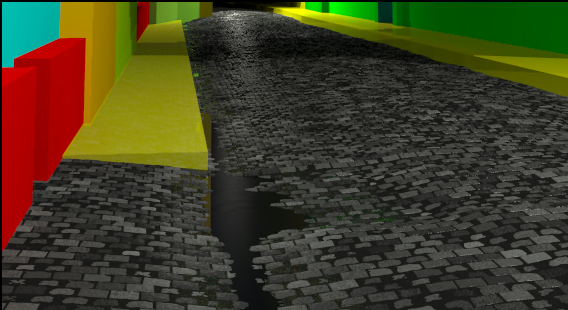
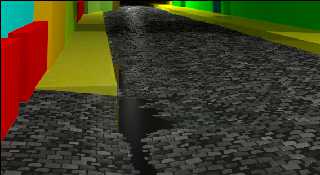
State of the art of the street surface just for your info. Placeholders
instead of buildings.

I roughened the surface a bit up and applied a slope/altitude texture to the
dirt for more reflections around the water and none higher up. I might be
able to use this same texture as a pigment_pattern to vary the cobbles'
finish in the same way.

Thomas
Post a reply to this message
Attachments:
Download 'Paris la nuit.png' (234 KB)
Preview of image 'Paris la nuit.png'
|
|
| |
| |
|
|
|
|
| |
| |
|
|
"Thomas de Groot" <tDOTdegroot@interDOTnlANOTHERDOTnet> wrote:
> State of the art of the street surface just for your info. Placeholders
> instead of buildings.
>
> I roughened the surface a bit up and applied a slope/altitude texture to the
> dirt for more reflections around the water and none higher up. I might be
> able to use this same texture as a pigment_pattern to vary the cobbles'
> finish in the same way.
>
> Thomas

Much more convincing.  Still more regular than cobblestones would be, but I
think I can live with it...

Have you ever tried adapting crackle pattern to cobblestones?  May be some
ptoential depending on form and metric used.  I have used it for random raindrop
ripples in water.

-tgq
Post a reply to this message
|
|
| |
| |
|
|
|
|
| |
| |
|
|
"Thomas de Groot" <tDOTdegroot@interDOTnlANOTHERDOTnet> wrote:
> I roughened the surface a bit up and applied a slope/altitude texture to the
> dirt for more reflections around the water and none higher up. I might be
> able to use this same texture as a pigment_pattern to vary the cobbles'
> finish in the same way.

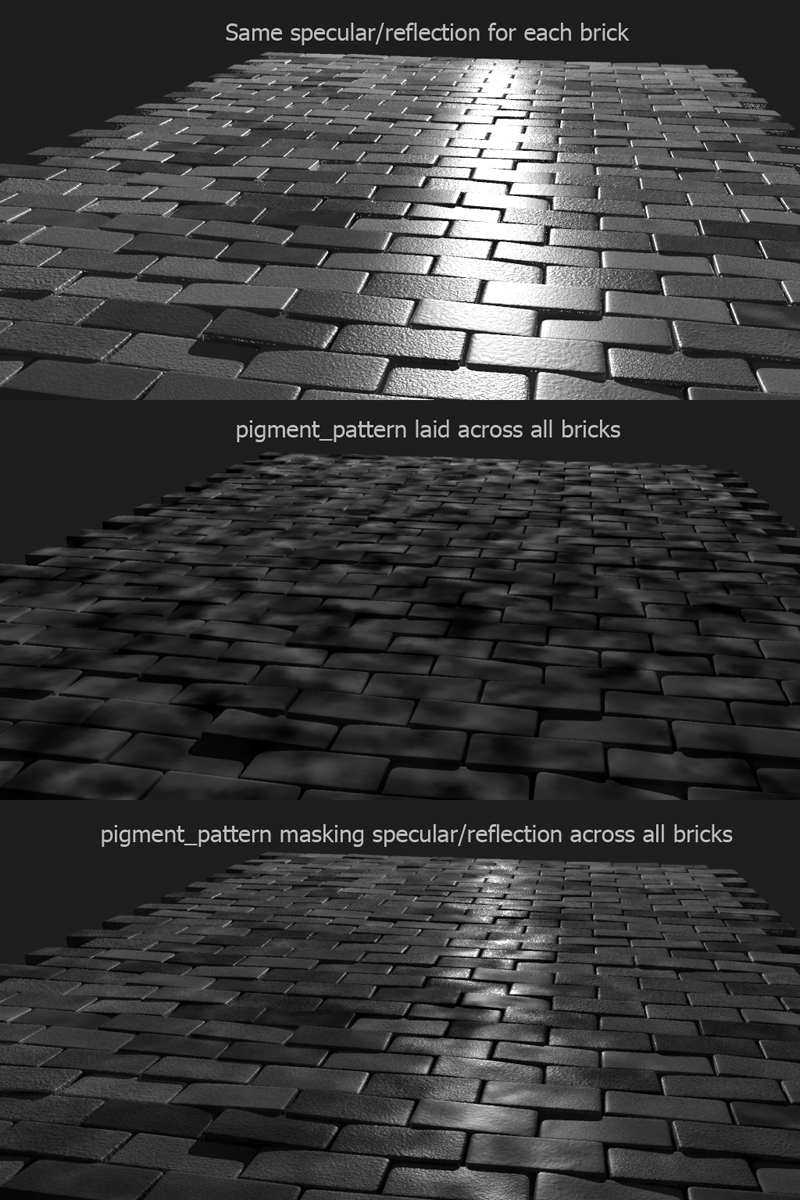
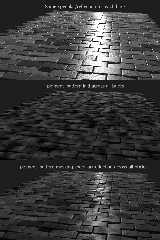
Thomas, here's a simple example of what I was suggesting about breaking up the
paver reflections more via a pigment_pattern mask.

In this way each brick can have its own unique pigment and normal, but the
finish is applied across the union of all bricks (as long as the texture is
applied /after/ the brick transformations):

//-------------------Start Code-------------------
#declare R = seed(0);
#declare R1 = seed(0);
#declare Brick = superellipsoid {<0.1,0.1> scale <8, 2.5, 4>/4 scale 0.975}

#declare Show_Pigment_Pattern = 0;

#macro Build_Texture()
   #local n1  = RRand(0.05,0.25,R);
   #local n2  = RRand(0.25,0.75,R);
   #local n3  = RRand(0,100,R);
   #local c1  = RRand(0.1,0.8,R1);
   #local c2  = RRand(0.1,0.8,R1);

   // simple mask to define scattered reflection areas
   pigment_pattern { dents scale 1.5 turbulence 0.5 }
   texture_map {
      [0
         #if (Show_Pigment_Pattern)
            pigment { rgb 0 }
         #else
            pigment { bozo pigment_map { [0.5 rgb c1][1 rgb c2] } }
            normal { granite n1 scale n2 translate n3 }
            finish { specular 0 reflection 0  diffuse 0.25 }
         #end
      ]
      [1
         #if (Show_Pigment_Pattern)
            pigment { rgb 1 }
         #else
            pigment { bozo pigment_map { [0 rgb c1][1 rgb c2] } }
            normal { granite n1 scale n2 translate n3 }
            finish {
               specular 1.5 roughness 0.02
               reflection { 0.5, 1 fresnel on } conserve_energy
            }
         #end
      ]
   }
#end

#declare Floor = object {
   Center_Object(
      union {
         #local cnt=0;
         #local xx=0;
         #local nx=0;
         #while (nx<10)
            #local zz=0;
            #local nz=0;
            #while (nz<30)
               object { Brick
                  rotate <RRand(-2,2,R),RRand(-2,2,R),RRand(-2,2,R)>
                  translate <xx, RRand(-0.05,0.05,R),zz>
                  #if (mod(cnt,2)=0) translate x*2 #end
                  texture { Build_Texture() }
               }
               #local cnt=cnt+1;
               #local zz=zz+2;
               #local nz=nz+1;
            #end
            #local xx=xx+4;
            #local nx=nx+1;
         #end
      },x+y+z
   )
}

object { Floor translate z*10 interior { ior 1.33 } }
//-------------------End Code-------------------

I hope this helps...

Cheers,
Rob

-------------------------------------------------
www.McGregorFineArt.com
Post a reply to this message
Attachments:
Download 'reflectionmaskingbricks.png' (760 KB)
Preview of image 'reflectionmaskingbricks.png'
|
|
| |
| |
|
|
|
|
| |
| |
|
|
Le 2011/03/29 03:14, Thomas de Groot a écrit :
> I think we both mean the same thing :-)
>
> As there is a lamp shade, I did not use a spotlight but simple point/area
> lights within a scattering media. However, in both cases, the halo effect is
> not really there like in the original, which is the reason for my emissive
> media around the light source.
> ...
> Thomas
>
>

What I would do, is to use a somewhat larger area_light using
are_illumination. If using a looks_like, make the area_light about
double to tripple the extent of that object.
Then, place it a little bit lower than where it should be.
The fade_distance would be shorter than the dimention of the light, on
par with the non-enlarged area_light.

If needed, I may also add another, weak, light slightly in front of the
reflector, possibly with a fade_power 3 or 4.

Using radiosity won't help as radiosity can be affected by your media,
but can never illuminate any media.

It may possibly be simulated using a small, hollow, transparent,
no_image, no_shadow, and partly reflective sphere, or maybe a disk, some
distance before the lamp and use photons to reflect some light into the
media.


We need something between scattering media and SSLT for such cases when
you have some multiple scattering. It will probably be very slow...


Alain
Post a reply to this message
|
|
| |
| |
|
|
|
|
| |
| |
|
|
"Alain" <aze### [at] qwertyorg> schreef in bericht
news:4d9255ef@news.povray.org...
> What I would do, is to use a somewhat larger area_light using
> are_illumination. If using a looks_like, make the area_light about double
> to tripple the extent of that object.
> Then, place it a little bit lower than where it should be.
> The fade_distance would be shorter than the dimention of the light, on par
> with the non-enlarged area_light.
>
> If needed, I may also add another, weak, light slightly in front of the
> reflector, possibly with a fade_power 3 or 4.
>
> Using radiosity won't help as radiosity can be affected by your media, but
> can never illuminate any media.
>
> It may possibly be simulated using a small, hollow, transparent, no_image,
> no_shadow, and partly reflective sphere, or maybe a disk, some distance
> before the lamp and use photons to reflect some light into the media.
>
>
> We need something between scattering media and SSLT for such cases when
> you have some multiple scattering. It will probably be very slow...
>

Thanks Alain. These are a couple of things I want to try out.

Thomas
Post a reply to this message
|
|
| |
| |
|
|
|
|
| |
| |
|
|
Yes, this is what I am after indeed, ultimately. Thanks for the example; I
am going to work on that too, besides all that is still to do :-)

Thomas
Post a reply to this message
|
|
| |
| |
|
|
|
|
| |
| |
|
|
"Trevor G Quayle" <Tin### [at] hotmailcom> schreef in bericht
news:web.4d91fa3ed16f200e81c811d20@news.povray.org...
> Much more convincing.  Still more regular than cobblestones would be, but
> I
> think I can live with it...
>
> Have you ever tried adapting crackle pattern to cobblestones?  May be some
> ptoential depending on form and metric used.  I have used it for random
> raindrop
> ripples in water.
>

That is something that has slipped my mind indeed. Thanks for reminding me
:-)

Thomas
Post a reply to this message
|
|
| |
| |
|
|
|
|
| |