|
|
|
|
|
|
| |
| |
|
|
|
|
| |
| |
|
|
Hello,

Here are some more variations...

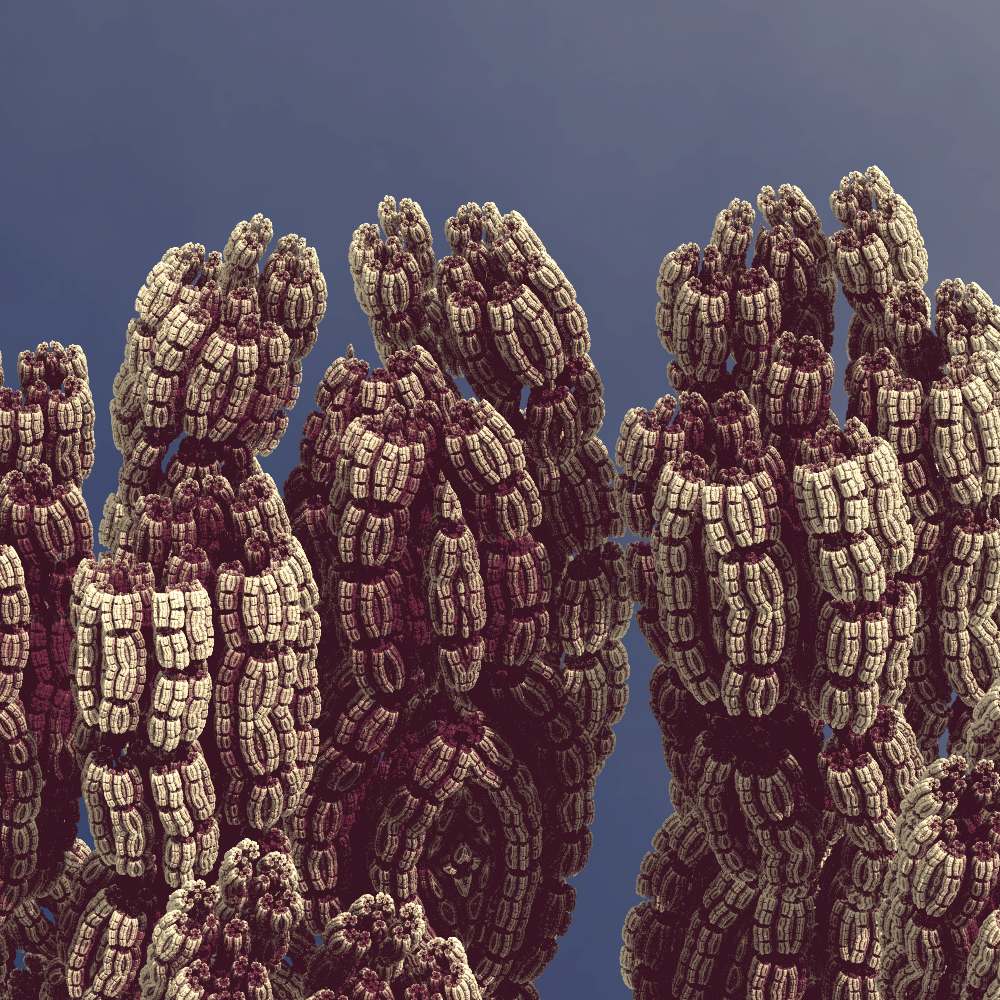
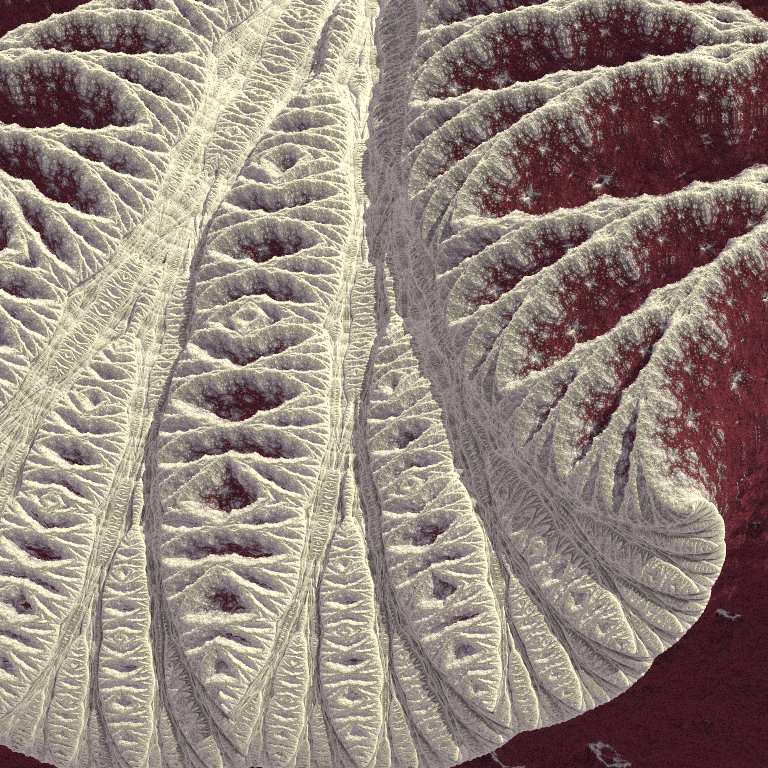
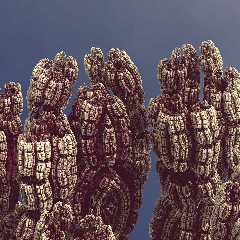
First up is something vaguely resembling coral. It uses cubic symmetry,
which tends to produce natural-looking formations.

Sam
Post a reply to this message
Attachments:
Download 'kifse1_17_53.jpg' (196 KB)
Preview of image 'kifse1_17_53.jpg'
|
|
| |
| |
|
|
|
|
| |
| |
|
|
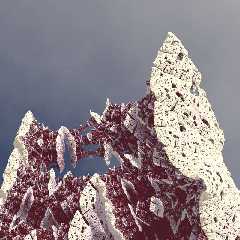
This ones uses cubic symmetry plus an extra reflection plane. Just one
light_source and the cavity shader with an ambient finish.
Post a reply to this message
Attachments:
Download 'kifse35_59.jpg' (91 KB)
Preview of image 'kifse35_59.jpg'
|
|
| |
| |
|
|
|
|
| |
| |
|
|
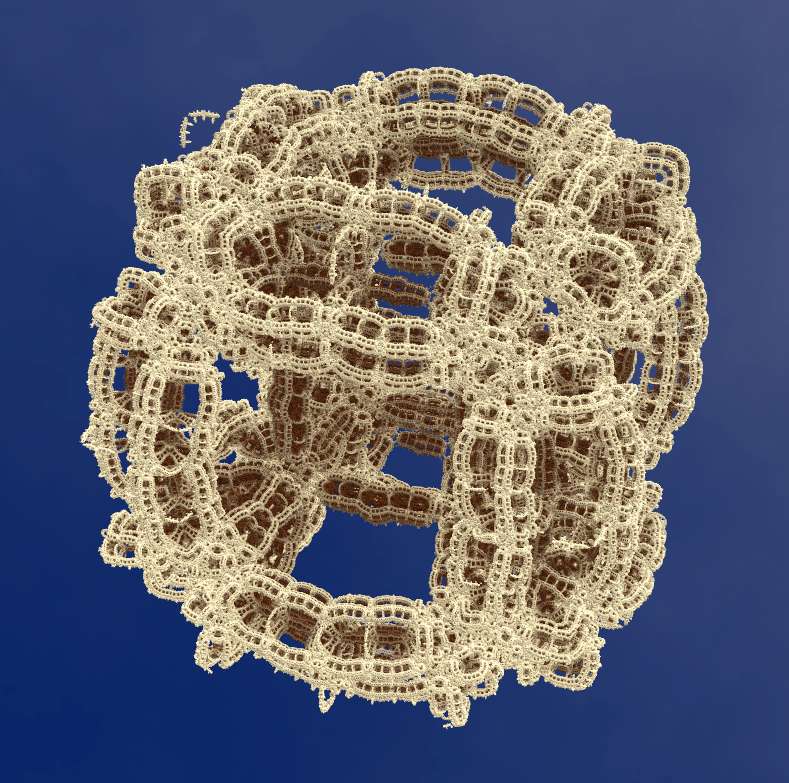
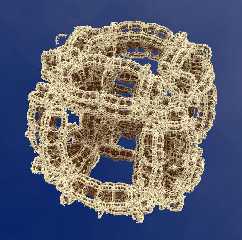
Octahedral symmetry with some transforms have produced lace-like
structures...
Post a reply to this message
Attachments:
Download 'kifse19_45.jpg' (108 KB)
Preview of image 'kifse19_45.jpg'
|
|
| |
| |
|
|
|
|
| |
| |
|
|
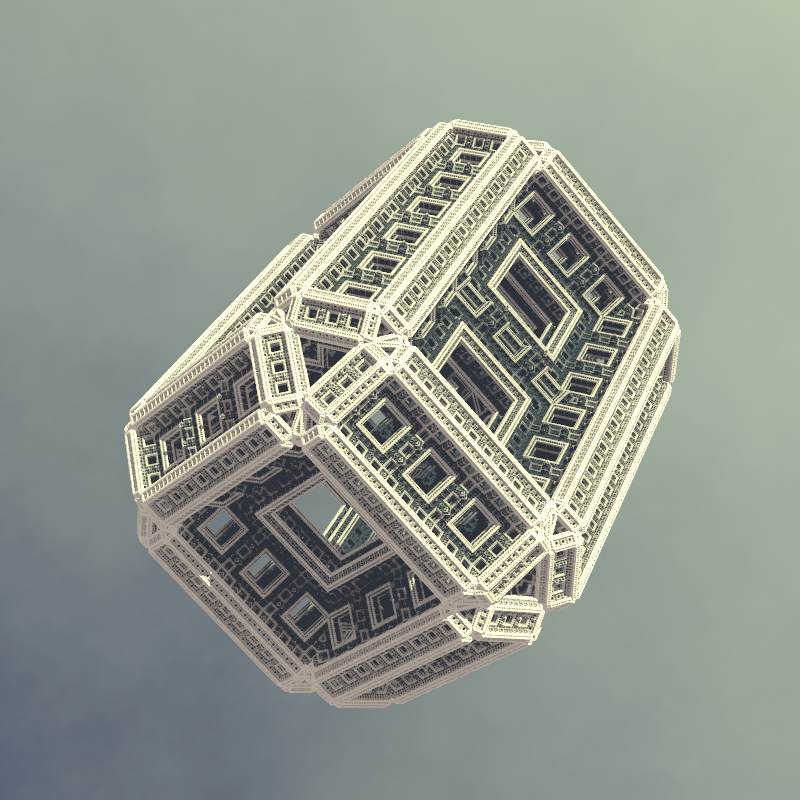
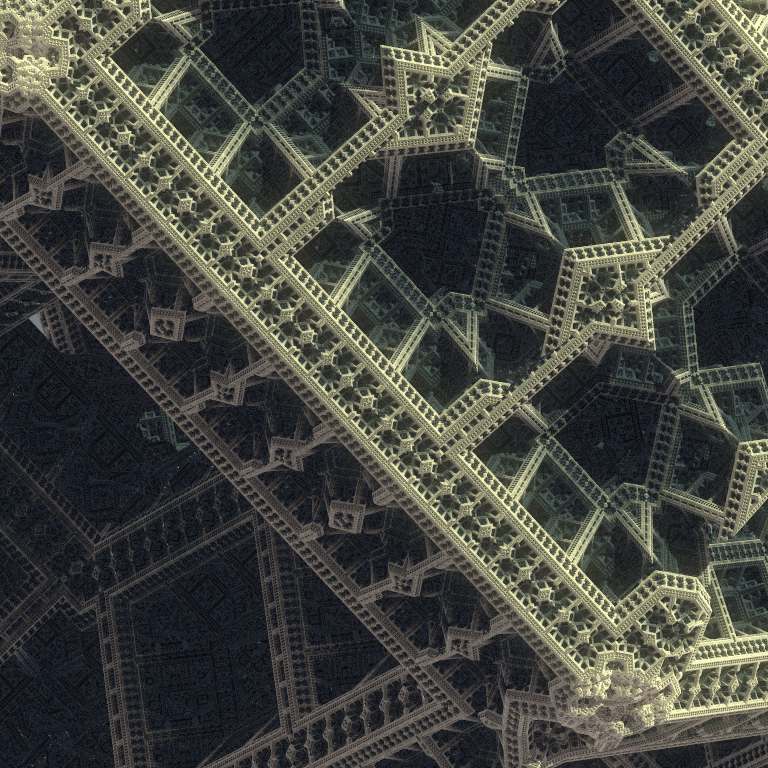
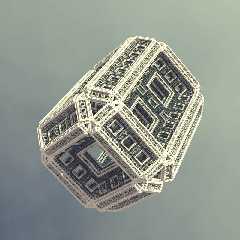
Mysterious doubling of the Menger Sponge with a z-rotation of 45 degrees
has produced some kind of architectural spacecraft.
Post a reply to this message
Attachments:
Download 'kifse19_38.jpg' (79 KB)
Preview of image 'kifse19_38.jpg'
|
|
| |
| |
|
|
|
|
| |
| |
|
|
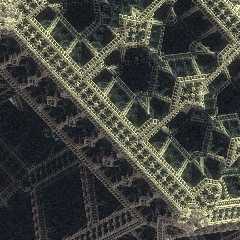
The Menger Sponge again, this time with an extra reflection plane and
two more rotations.
Post a reply to this message
Attachments:
Download 'kifse1_19_54.jpg' (113 KB)
Preview of image 'kifse1_19_54.jpg'
|
|
| |
| |
|
|
|
|
| |
| |
|
|
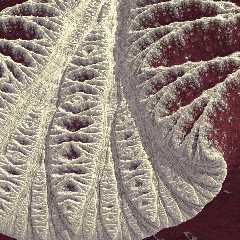
More cubic symmetry...
Post a reply to this message
Attachments:
Download 'kifse1_30_16.jpg' (126 KB)
Preview of image 'kifse1_30_16.jpg'
|
|
| |
| |
|
|
|
|
| |
| |
|
|
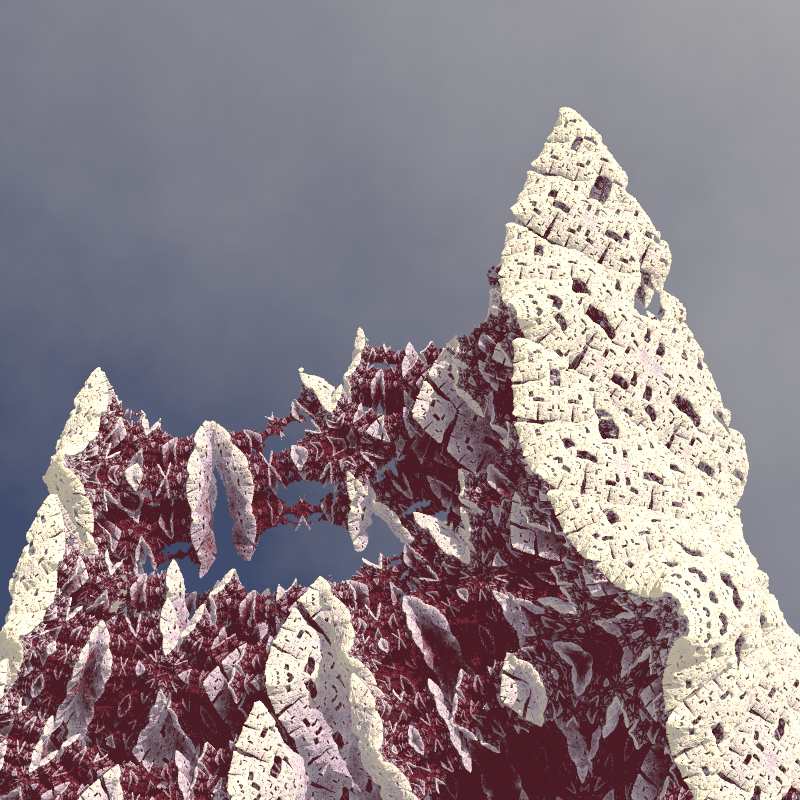
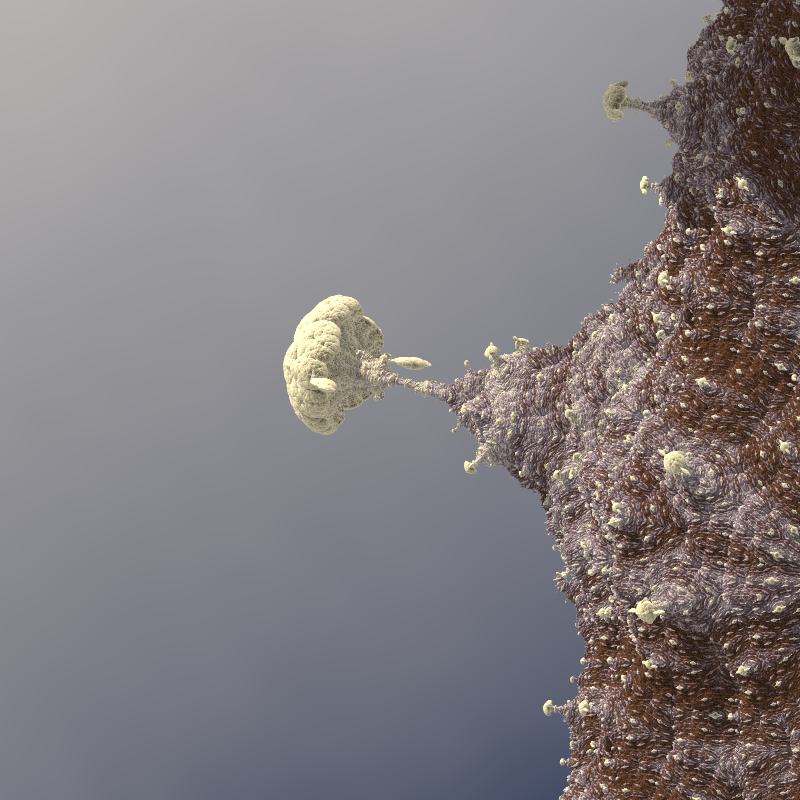
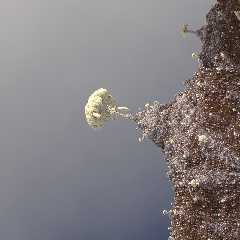
This one was a bit of a surprise. It uses cubic symmetry and a few basic
transformations.
Post a reply to this message
Attachments:
Download 'kifse35_48.jpg' (76 KB)
Preview of image 'kifse35_48.jpg'
|
|
| |
| |
|
|
|
|
| |
| |
|
|
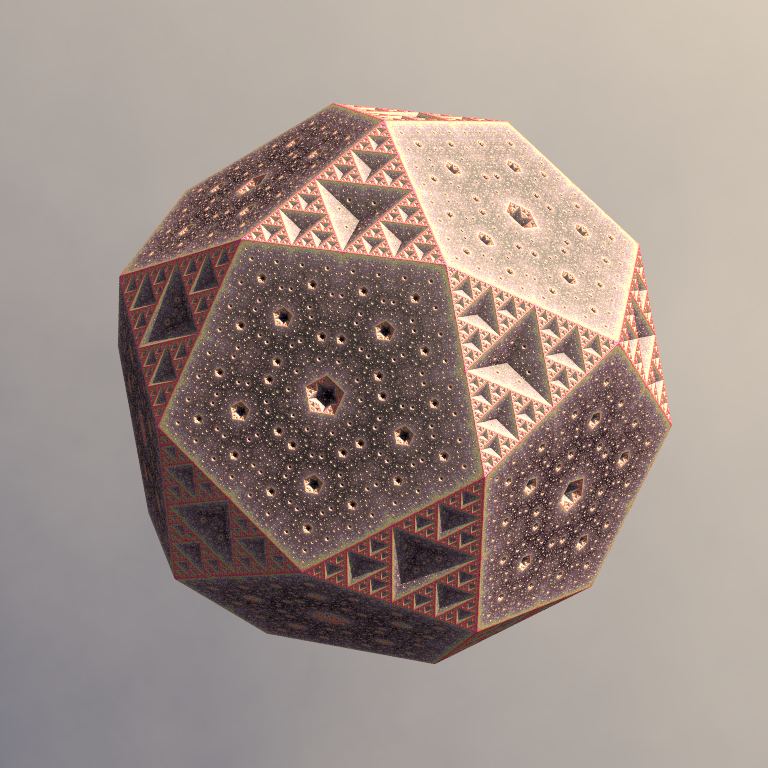
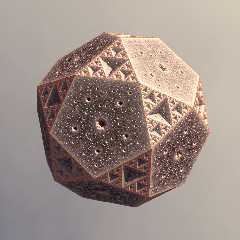
A truncated dodecahedron :)
Post a reply to this message
Attachments:
Download 'kifse1_09_48.jpg' (93 KB)
Preview of image 'kifse1_09_48.jpg'
|
|
| |
| |
|
|
|
|
| |
| |
|
|
stbenge <myu### [at] hotmail com> wrote:
> Hello,
>
> Here are some more variations...
>
> First up is something vaguely resembling coral. It uses cubic symmetry,
> which tends to produce natural-looking formations.
Very fascinating Sam !
--
Tor Olav
http://subcube.com com> wrote:
> Hello,
>
> Here are some more variations...
>
> First up is something vaguely resembling coral. It uses cubic symmetry,
> which tends to produce natural-looking formations.
Very fascinating Sam !
--
Tor Olav
http://subcube.com
Post a reply to this message
|
|
| |
| |
|
|
|
|
| |
| |
|
|
On 12/12/2010 12:28 PM, stbenge wrote:
> A truncated dodecahedron :)

My bad... that's an icosidodecahedron `:P
Post a reply to this message
|
|
| |
| |
|
|
|
|
| |
| |
|
|
On 12/12/2010 12:35 PM, Tor Olav Kristensen wrote:
> stbenge<myu### [at] hotmailcom>  wrote:
>> Hello,
>>
>> Here are some more variations...
>>
>> First up is something vaguely resembling coral. It uses cubic symmetry,
>> which tends to produce natural-looking formations.
>
> Very fascinating Sam !

Thanks Tor!
Post a reply to this message
|
|
| |
| |
|
|
|
|
| |
| |
|
|
stbenge <myu### [at] hotmailcom> wrote:
> This one was a bit of a surprise. It uses cubic symmetry and a few basic
> transformations.

Stunning!
Post a reply to this message
|
|
| |
| |
|
|
|
|
| |
| |
|
|
stbenge <myu### [at] hotmailcom> wrote:
> Just one
> light_source and the cavity shader with an ambient finish.

Could you elaborate a little more on the "cavity shader?" Does that mean you
generated the object using some other program that supported that feature, then
rendered the image with POV-Ray? Please pardon my ignorance if this has been
discussed before.

Regards,
Dave Blandston
Post a reply to this message
|
|
| |
| |
|
|
|
|
| |
| |
|
|
stbenge wrote:
> Here are some more variations...

Some of these remind me of some of the sorts of stuff you read about in SCP.

http://scp-wiki.wikidot.com/scp-610

--
Darren New, San Diego CA, USA (PST)
   Serving Suggestion:
     "Don't serve this any more. It's awful."
Post a reply to this message
|
|
| |
| |
|
|
|
|
| |
| |
|
|
stbenge <myu### [at] hotmailcom> wrote:
> More cubic symmetry...

seen from a satellite?
:)
Post a reply to this message
|
|
| |
| |
|
|
|
|
| |
| |
|
|
stbenge <myu### [at] hotmailcom> wrote:
> This one was a bit of a surprise. It uses cubic symmetry and a few basic
> transformations.

My favorite, after rotating. :)
STUNNING!
Post a reply to this message
|
|
| |
| |
|
|
|
|
| |
| |
|
|
On 12/12/2010 12:57 PM, Dave Blandston wrote:
> stbenge<myu### [at] hotmailcom>  wrote:
>> Just one
>> light_source and the cavity shader with an ambient finish.
>
> Could you elaborate a little more on the "cavity shader?" Does that mean you
> generated the object using some other program that supported that feature, then
> rendered the image with POV-Ray? Please pardon my ignorance if this has been
> discussed before.

It was all generated with POV-Ray; no other apps were used. The cavity
shader colors the object incrementally at each iteration, and is mapped
to produce darker values in the cavities. From what I understand, other
people were shading at each reflection, whereas mine is a spherical
incremented gradient hacked onto the main function. After trying some 2D
kaleidoscopic IFS functions it has become clear that my cavity shader
needs a lot more work. After all, I spent only a a short time developing
it :/
Post a reply to this message
|
|
| |
| |
|
|
|
|
| |
| |
|
|
On 12/12/2010 1:44 PM, Carlo C. wrote:
> stbenge<myu### [at] hotmailcom>  wrote:
>> More cubic symmetry...
>
> seen from a satellite?
> :)

Yeah, it's the world-renowned Alabaster Ravines of Rhode Island (also
known as the Industrial Wastes of Wee Isle).
Post a reply to this message
|
|
| |
| |
|
|
|
|
| |
| |
|
|
On 12/12/2010 12:49 PM, Dave Blandston wrote:
> stbenge<myu### [at] hotmailcom>  wrote:
>> This one was a bit of a surprise. It uses cubic symmetry and a few basic
>> transformations.
>
> Stunning!

Thank you, Sir ;)
Post a reply to this message
|
|
| |
| |
|
|
|
|
| |
| |
|
|
On 12/12/2010 1:47 PM, Carlo C. wrote:
> stbenge<myu### [at] hotmailcom>  wrote:
>> This one was a bit of a surprise. It uses cubic symmetry and a few basic
>> transformations.
>
> My favorite, after rotating. :)
> STUNNING!

Thanks! I think some of these would make great landscapes.
Post a reply to this message
|
|
| |
| |
|
|
|
|
| |
| |
|
|
On 12/12/2010 1:06 PM, Darren New wrote:
> stbenge wrote:
>> Here are some more variations...
>
> Some of these remind me of some of the sorts of stuff you read about in
> SCP.
>
> http://scp-wiki.wikidot.com/scp-610

"Subjects observed with this stage of infection have been recorded as
having three or more of a limb type such as arms or legs, the head may
become misshapen and elongate or widen out, parts of the subject may
split open from which additional branches of flesh will grow. "

This is old news. The government has been using genes derived from this
life form since the early Sixties to grow the "meat stock" necessary to
produce "Spam." I just wish I wasn't true.
Post a reply to this message
|
|
| |
| |
|
|
|
|
| |
| |
|
|
"stbenge" <myu### [at] hotmailcom> wrote in message
news:4d0553a0@news.povray.org...
> On 12/12/2010 1:47 PM, Carlo C. wrote:
>> stbenge<myu### [at] hotmailcom>  wrote:
>>> This one was a bit of a surprise. It uses cubic symmetry and a few basic
>>> transformations.
>>
>> My favorite, after rotating. :)
>> STUNNING!
>
> Thanks! I think some of these would make great landscapes.

Thats for sure!!!

Is this pic zoomed into the side of one of the cubic type fractals??

Cheers Dre
Post a reply to this message
|
|
| |
| |
|
|
|
|
| |
| |
|
|
stbenge <myu### [at] hotmailcom> wrote:
> It was all generated with POV-Ray; no other apps were used. The cavity
> shader colors the object incrementally at each iteration, and is mapped
> to produce darker values in the cavities. From what I understand, other
> people were shading at each reflection, whereas mine is a spherical
> incremented gradient hacked onto the main function. After trying some 2D
> kaleidoscopic IFS functions it has become clear that my cavity shader
> needs a lot more work. After all, I spent only a a short time developing
> it :/

I vaguely understand what you're describing, but making it work would be quite
an accomplishment. That makes your fractal images even more impressive!

Cavity shading would be a really cool thing to have built-in to POV!

Regards,
Dave Blandston
Post a reply to this message
|
|
| |
| |
|
|
|
|
| |
| |
|
|
On Sun, 12 Dec 2010 23:06:20 +0200, Darren New <dne### [at] sanrrcom> wrote:

> stbenge wrote:
>> Here are some more variations...
>
> Some of these remind me of some of the sorts of stuff you read about in
> SCP.
>
> http://scp-wiki.wikidot.com/scp-610
>

What is SCP?

-Nekar Xenos-
Post a reply to this message
|
|
| |
| |
|
|
|
|
| |
| |
|
|
>stbenge  on date 12/12/2010 21:27 wrote:
>
> This one was a bit of a surprise. It uses cubic symmetry and a few basic
> transformations.
Have you discovered some new kind of life there?
;-)
Paolo
Post a reply to this message
|
|
| |
| |
|
|
|
|
| |
| |
|
|
stbenge <myu### [at] hotmailcom> wrote:
> Here are some more variations...

Spectacular stuff. I love the naturalistic, complex look of the corals and
broccoli-like structures, but the icosidodecahedron (or whatever is was) is
wonderful too.

What sort of render times are you looking at?
Post a reply to this message
|
|
| |
| |
|
|
|
|
| |
| |
|
|
On 12/12/2010 6:33 PM, Dave Blandston wrote:
> stbenge<myu### [at] hotmailcom>  wrote:
>> It was all generated with POV-Ray; no other apps were used. The cavity
>> shader colors the object incrementally at each iteration, and is mapped
>> to produce darker values in the cavities. From what I understand, other
>> people were shading at each reflection, whereas mine is a spherical
>> incremented gradient hacked onto the main function. After trying some 2D
>> kaleidoscopic IFS functions it has become clear that my cavity shader
>> needs a lot more work. After all, I spent only a a short time developing
>> it :/
>
> I vaguely understand what you're describing, but making it work would be quite
> an accomplishment. That makes your fractal images even more impressive!

I don't always explain myself well :( The shading function is just one
extra line of code, and really needs some more work.

> Cavity shading would be a really cool thing to have built-in to POV!

Yes, it would be cool, but you can't apply it to any object. Mine works
because it uses almost the same function which produced the isosurface
in the first place; the surface is intimately tied to the shader function.
Post a reply to this message
|
|
| |
| |
|
|
|
|
| |
| |
|
|
Nekar Xenos wrote:
> On Sun, 12 Dec 2010 23:06:20 +0200, Darren New <dne### [at] sanrrcom> wrote:
>
>> stbenge wrote:
>>> Here are some more variations...
>>
>> Some of these remind me of some of the sorts of stuff you read about
>> in SCP.
>>
>> http://scp-wiki.wikidot.com/scp-610
>>
>
> What is SCP?

That's why I provided the link.

--
Darren New, San Diego CA, USA (PST)
   Serving Suggestion:
     "Don't serve this any more. It's awful."
Post a reply to this message
|
|
| |
| |
|
|
|
|
| |
| |
|
|
On 12/12/2010 5:51 PM, Dre wrote:
> "stbenge"<myu### [at] hotmailcom>  wrote in message
> news:4d0553a0@news.povray.org...
>> On 12/12/2010 1:47 PM, Carlo C. wrote:
>>> stbenge<myu### [at] hotmailcom>   wrote:
>>>> This one was a bit of a surprise. It uses cubic symmetry and a few basic
>>>> transformations.
>>>
>>> My favorite, after rotating. :)
>>> STUNNING!
>>
>> Thanks! I think some of these would make great landscapes.
>
> Thats for sure!!!
>
> Is this pic zoomed into the side of one of the cubic type fractals??

Yep, and I didn't have to go very far. One could theoretically zoom in
forever, without a loss detail, but of course no computer will allow
that. I still have yet to try a truly deep zoom, but it becomes more
difficult to manipulate the camera after a while :)
Post a reply to this message
|
|
| |
| |
|
|
|
|
| |
| |
|
|
On 12/13/2010 3:55 AM, Paolo Gibellini wrote:
>  >stbenge on date 12/12/2010 21:27 wrote:
>>
>> This one was a bit of a surprise. It uses cubic symmetry and a few basic
>> transformations.
> Have you discovered some new kind of life there?
> ;-)
> Paolo

It does look organic (c:
Post a reply to this message
|
|
| |
| |
|
|
|
|
| |
| |
|
|
On 12/13/2010 3:57 AM, Bill Pragnell wrote:
> stbenge<myu### [at] hotmailcom>  wrote:
>> Here are some more variations...
>
> Spectacular stuff. I love the naturalistic, complex look of the corals and
> broccoli-like structures, but the icosidodecahedron (or whatever is was) is
> wonderful too.

Thanks!

> What sort of render times are you looking at?

For the images I posted: between 20 minutes to 1 & 1/2 hours on three
2.4GHz cores. To see the specific render times, check out the names of
the image files. I've appended the render times like so: hr_min_sec, or
min_sec.

Isosurfaces are almost always slow, but these render times are
encouraging. I tried to keep the function as well-behaved as possible.
As a result, most of objects require only a low max_gradient--between
0.5 to 1.0--which is better than you could normally expect from any
function.
Post a reply to this message
|
|
| |
| |
|
|
|
|
| |
| |
|
|
Darren New wrote:
> Nekar Xenos wrote:
>> What is SCP?
> That's why I provided the link.

I actually followed the link and it still took me
about 15 minutes to figure out what SCP is :-P  But
it was some entertaining 15 minutes so no harm done.
Post a reply to this message
|
|
| |
| |
|
|
|
|
| |
| |
|
|
On Mon, 13 Dec 2010 20:19:08 +0200, Darren New <dne### [at] sanrrcom> wrote:

> Nekar Xenos wrote:
>> On Sun, 12 Dec 2010 23:06:20 +0200, Darren New <dne### [at] sanrrcom> wrote:
>>
>>> stbenge wrote:
>>>> Here are some more variations...
>>>
>>> Some of these remind me of some of the sorts of stuff you read about
>>> in SCP.
>>>
>>> http://scp-wiki.wikidot.com/scp-610
>>>
>>  What is SCP?
>
> That's why I provided the link.
>

Something like: Make your own x-files?
;)

--
-Nekar Xenos-

"The spoon is not real"
Post a reply to this message
|
|
| |
| |
|
|
|
|
| |
| |
|
|
Nekar Xenos wrote:
> Something like: Make your own x-files?

Precisely.

--
Darren New, San Diego CA, USA (PST)
   Serving Suggestion:
     "Don't serve this any more. It's awful."
Post a reply to this message
|
|
| |
| |
|
|
|
|
| |
| |
|
|
Wow man...
You continue to impress!

Fractals are another hobby of mine, so I can appreciate the difficulty in
finding and implementing truly new types. Amazing job.
I could use more programmers like you on my team! (So many lack vision,
purpose, pride in their work, and the ability to create simple elegant
solutions for poorly defined complex problems)

Ian

On Sun, 12 Dec 2010 15:07:32 -0500, stbenge <myu### [at] hotmailcom>
wrote:

> Hello,
>
> Here are some more variations...
>
> First up is something vaguely resembling coral. It uses cubic symmetry,
> which tends to produce natural-looking formations.
>
> Sam


--
Using Opera's revolutionary email client: http://www.opera.com/mail/
Post a reply to this message
|
|
| |
| |
|
|
|
|
| |
| |
|
|
On 12/12/2010 12:16 PM, stbenge wrote:
> Octahedral symmetry with some transforms have produced lace-like
> structures...


Now that's the shower loofah I need!  :)
Post a reply to this message
|
|
| |
| |
|
|
|
|
| |
| |
|
|
On 12/15/2010 3:09 PM, [GDS|Entropy] wrote:
> Wow man...
> You continue to impress!
>
> Fractals are another hobby of mine, so I can appreciate the difficulty
> in finding and implementing truly new types. Amazing job.

Thanks Ian!

> I could use more programmers like you on my team! (So many lack vision,
> purpose, pride in their work, and the ability to create simple elegant
> solutions for poorly defined complex problems)

I don't know how anyone can find a solution for a poorly defined
problem, let alone a simple and elegant one. Defining a problem is half
the battle. Every time I've been faced with a difficult challenge,
progress was only made when I could see exactly what needed to be done.
Even then I've come up with some very inelegant solutions ;)

What are you working on? If you need any insight, I can try to help, but
I'm only self-taught...

Sam
Post a reply to this message
|
|
| |
| |
|
|
|
|
| |
| |
|
|
stbenge <myu### [at] hotmailcom> wrote:
> The Menger Sponge again, this time with an extra reflection plane and
> two more rotations.

Oh... It's really beautiful.
Great Job, you got 1st class renders in this post.
Greetings.

Txemi Jendrix
http://www.txemijendrix.com
Post a reply to this message
|
|
| |
| |
|
|
|
|
| |
| |
|
|
On Thu, 16 Dec 2010 17:36:22 -0500, stbenge <myu### [at] hotmailcom>
wrote:

> On 12/15/2010 3:09 PM, [GDS|Entropy] wrote:
>> Wow man...
>> You continue to impress!
>>
>> Fractals are another hobby of mine, so I can appreciate the difficulty
>> in finding and implementing truly new types. Amazing job.
>
> Thanks Ian!

No problem. ;)
You really produce some very cool stuff, and at quite an impressive rate.

>> I could use more programmers like you on my team! (So many lack vision,
>> purpose, pride in their work, and the ability to create simple elegant
>> solutions for poorly defined complex problems)
>
> I don't know how anyone can find a solution for a poorly defined
> problem, let alone a simple and elegant one. Defining a problem is half
> the battle. Every time I've been faced with a difficult challenge,
> progress was only made when I could see exactly what needed to be done.
> Even then I've come up with some very inelegant solutions ;)

It is a challenge, that is for sure...but then thats half the fun. ;)
So many of my contracts have been the programming equivalent of replacing
the entire support structure of the empire state building without moving a
single paper-clip from the desks of its employees or impacting running
business processes.. :(

> What are you working on? If you need any insight, I can try to help, but
> I'm only self-taught...

I am self taught as well. I started with FractINT at 14, found Mand2POV
(which got me into pov-ray), Pov-Ray then accustomed me to C based
languages (add in some TRON influence from early childhood here [gfx and
programming]), and then surfing for pov stuff got me interested in HTML
and JavaScript, which led to C#/VB.NET/ASP/ASP.NET when I needed more
power. The same year I earned my first paid programming gig. Now I program
for a living, and the rest is history. Thanks Pov Team!

I am getting OT here now, I know, but how did you start?

If you don't mind, I'll send you an e-mail with some things which may
interest you. Let me know if you wish that I do so.

Otherwise I have a few macros for POV which have been pretty fun so far,
and are almost done.

Or, if you have some things you might want some help on, I'd be happy to
be a part of it.

> Sam

Ian

--
Using Opera's revolutionary email client: http://www.opera.com/mail/
Post a reply to this message
|
|
| |
| |
|
|
|
|
| |
| |
|
|
On 12/17/2010 4:18 PM, [GDS|Entropy] wrote:
> On Thu, 16 Dec 2010 17:36:22 -0500, stbenge <myu### [at] hotmailcom>
> wrote:
>
>> On 12/15/2010 3:09 PM, [GDS|Entropy] wrote:
>>> Wow man...
>>> You continue to impress!
>>>
>>> Fractals are another hobby of mine, so I can appreciate the difficulty
>>> in finding and implementing truly new types. Amazing job.
>>
>> Thanks Ian!
>
> No problem. ;)
> You really produce some very cool stuff, and at quite an impressive rate.
>
>>> I could use more programmers like you on my team! (So many lack vision,
>>> purpose, pride in their work, and the ability to create simple elegant
>>> solutions for poorly defined complex problems)
>>
>> I don't know how anyone can find a solution for a poorly defined
>> problem, let alone a simple and elegant one. Defining a problem is
>> half the battle. Every time I've been faced with a difficult
>> challenge, progress was only made when I could see exactly what needed
>> to be done. Even then I've come up with some very inelegant solutions ;)
>
> It is a challenge, that is for sure...but then thats half the fun. ;)
> So many of my contracts have been the programming equivalent of
> replacing the entire support structure of the empire state building
> without moving a single paper-clip from the desks of its employees or
> impacting running business processes.. :(
>
>> What are you working on? If you need any insight, I can try to help,
>> but I'm only self-taught...
>
> I am self taught as well. I started with FractINT at 14, found Mand2POV
> (which got me into pov-ray), Pov-Ray then accustomed me to C based
> languages (add in some TRON influence from early childhood here [gfx and
> programming]), and then surfing for pov stuff got me interested in HTML
> and JavaScript, which led to C#/VB.NET/ASP/ASP.NET when I needed more
> power. The same year I earned my first paid programming gig. Now I
> program for a living, and the rest is history. Thanks Pov Team!
>
> I am getting OT here now, I know, but how did you start?
>
> If you don't mind, I'll send you an e-mail with some things which may
> interest you. Let me know if you wish that I do so.
>
> Otherwise I have a few macros for POV which have been pretty fun so far,
> and are almost done.
>
> Or, if you have some things you might want some help on, I'd be happy to
> be a part of it.
>
>> Sam
>
> Ian
>
Main thing I find *slightly* annoying about these things though..
Basically, most things have some sort of clear constraint when an
object. Fractals *tend* not to necessarily have them, which makes it a
bit hard to say, limit the object to a given size, piece, fragment,
etc., or change it so that it grows "on" something, like one of the
corral like ones grown on the surface of a sphere, for example. It gets
really bad if it is something like Mandelbrot, where you could find damn
near any structure you might want in it *someplace*, but then its not
terribly clear how/if you bend that to fit what you actually need it
for, instead of having to use what would have normally been generated
anyway. I actually looked at this and thought, "Wow! Some color changes,
quirks, like refraction, or other things, applied to one of those, would
work a lot better for a project I have been thinking of." Only, about
two seconds later I then thought, "Ok, but how do you make any of that
stuff "grow" into similar sized, space constrained, forms, which
actually *can* be used for what I have planned?"

Frankly, I am no where near good enough to even guess how to do that. lol

--
void main () {
   If Schrödingers_cat is alive or version > 98 {
     if version = "Vista" {
       call slow_by_half();
       call DRM_everything();
     }
     call functional_code();
   }
   else
     call crash_windows();
}

<A HREF='http://www.daz3d.com/index.php?refid=16130551'>Get 3D Models,
3D Content, and 3D Software at DAZ3D!</A>
Post a reply to this message
|
|
| |
| |
|
|
|
|
| |
| |
|
|
On 12/17/2010 3:18 PM, [GDS|Entropy] wrote:
> On Thu, 16 Dec 2010 17:36:22 -0500, stbenge <myu### [at] hotmailcom>
> wrote:
>> Thanks Ian!
>
> No problem. ;)
> You really produce some very cool stuff, and at quite an impressive rate.

Well, maybe it's not so impressive considering how much free time I have :/

>> I don't know how anyone can find a solution for a poorly defined
>> problem, let alone a simple and elegant one. Defining a problem is
>> half the battle. Every time I've been faced with a difficult
>> challenge, progress was only made when I could see exactly what needed
>> to be done. Even then I've come up with some very inelegant solutions ;)
>
> It is a challenge, that is for sure...but then thats half the fun. ;)
> So many of my contracts have been the programming equivalent of
> replacing the entire support structure of the empire state building
> without moving a single paper-clip from the desks of its employees or
> impacting running business processes.. :(

Wow, you must have a lot of tolerance! I don't know how you do it :S I
imagine a big part of that is knowing how to mesh with people in a
productive fashion.

>> What are you working on? If you need any insight, I can try to help,
>> but I'm only self-taught...
>
> I am self taught as well. I started with FractINT at 14, found Mand2POV
> (which got me into pov-ray), Pov-Ray then accustomed me to C based
> languages (add in some TRON influence from early childhood here [gfx and
> programming]), and then surfing for pov stuff got me interested in HTML
> and JavaScript, which led to C#/VB.NET/ASP/ASP.NET when I needed more
> power. The same year I earned my first paid programming gig. Now I
> program for a living, and the rest is history. Thanks Pov Team!

You've definitely progressed faster than I have...

> I am getting OT here now, I know, but how did you start?

My recounting was taking too long, so here is the summarized
progression: <1984 - today>: Art; <1995 - 2000>: QBasic; <1999 - today>:
POV-Ray; <2001 - 2003>: Euphoria (an interpretive language); <2005 -
today>: C/C++; <2008 - today>: GLSL. Today: POV-Ray, C/C++; GLSL,
Processing, HTML/CSS (rudimentary, but functional). Pretty much anything
I can use to make graphics :)

Recently I've been more interested in complex behavior arising from
basic conditions. Fractals, cellular automata, cognitive processes,
these are all very interesting to me (and very important).

> If you don't mind, I'll send you an e-mail with some things which may
> interest you. Let me know if you wish that I do so.

Sure, go ahead, but keep in mind my interests (and abilities) only lie
in the graphics realm.

> Otherwise I have a few macros for POV which have been pretty fun so far,
> and are almost done.

Good work on the icicles/snow setup, not to mention presenting it during
the perfect time of year for it ;) I'm always thinking of weird
things... what if some stuff (not just air bubbles) got caught up in the
icicles? That's all I'm going to say about that :)

> Or, if you have some things you might want some help on, I'd be happy to
> be a part of it.

Well, there is the problem of getting the Menger Sponge to work with
KIFS... That's pretty much the only problem I have right now, other than
trying to come up with the next best Metroidvania...

Sam
Post a reply to this message
|
|
| |
| |
|
|
|
|
| |
| |
|
|
On 12/17/2010 7:30 PM, Patrick Elliott wrote:
> Main thing I find *slightly* annoying about these things though..
> Basically, most things have some sort of clear constraint when an
> object. Fractals *tend* not to necessarily have them, which makes it a
> bit hard to say, limit the object to a given size, piece, fragment,
> etc., or change it so that it grows "on" something, like one of the
> corral like ones grown on the surface of a sphere, for example. It gets
> really bad if it is something like Mandelbrot, where you could find damn
> near any structure you might want in it *someplace*, but then its not
> terribly clear how/if you bend that to fit what you actually need it
> for, instead of having to use what would have normally been generated
> anyway. I actually looked at this and thought, "Wow! Some color changes,
> quirks, like refraction, or other things, applied to one of those, would
> work a lot better for a project I have been thinking of." Only, about
> two seconds later I then thought, "Ok, but how do you make any of that
> stuff "grow" into similar sized, space constrained, forms, which
> actually *can* be used for what I have planned?"

These are precisely the reasons I like these systems; it's hard to
predict what can happen :)

> Frankly, I am no where near good enough to even guess how to do that. lol

Sometimes exploration will let you stumble across a structure you had
intended. Other times, you need a system suited for what you are doing.
For instance, cellular automata can be "grown" from a substrate, and
bounds can be made for it, but the end result is still something
unintended. Fairly recently someone invented a snowflake generator which
produces what appears to be physically-accurate results. Really cool,
but it takes days to grow the things :(

Sam
Post a reply to this message
|
|
| |
| |
|
|
|
|
| |
| |
|
|
On Sat, 18 Dec 2010 21:25:24 -0500, stbenge <myu### [at] hotmailcom>
wrote:

> On 12/17/2010 3:18 PM, [GDS|Entropy] wrote:
>> On Thu, 16 Dec 2010 17:36:22 -0500, stbenge <myu### [at] hotmailcom>
>> wrote:
>>> Thanks Ian!
>>
>> No problem. ;)
>> You really produce some very cool stuff, and at quite an impressive
>> rate.
>
> Well, maybe it's not so impressive considering how much free time I have
> :/

I wouldn't say that...the fact you are willing to devote so much time to
the pursuit of art, as well as the effort and many mediums involved in its
production merely accentuates my point. Think of how much knowledge you
have acquired in its name. Modesty is a good quality. ;)

>>> I don't know how anyone can find a solution for a poorly defined
>>> problem, let alone a simple and elegant one. Defining a problem is
>>> half the battle. Every time I've been faced with a difficult
>>> challenge, progress was only made when I could see exactly what needed
>>> to be done. Even then I've come up with some very inelegant solutions
>>> ;)
>>
>> It is a challenge, that is for sure...but then thats half the fun. ;)
>> So many of my contracts have been the programming equivalent of
>> replacing the entire support structure of the empire state building
>> without moving a single paper-clip from the desks of its employees or
>> impacting running business processes.. :(
>
> Wow, you must have a lot of tolerance! I don't know how you do it :S I
> imagine a big part of that is knowing how to mesh with people in a
> productive fashion.

I quickly found that it is very important to be able to separate work and
home life with an infinite gulf. Additionally one must be able to let go
of how you know a thing *should* be done in favor of fulfilling the
requirements of the business unit, especially when dealing with legacy
code. Don't get me wrong, I push when I need to, and make my objections
known when appropriate, but at the end of the day if you refuse to perform
a given task for idealogical or philosophical reasons the only thing you
will have accomplished is self-termination.

There are some contracts which I outright refuse. I have had offers...very
well paying ones...that were not more than malware authorship positions. I
will have nothing to do with that, period. I will never take or keep a
contract where I contribute in any way to something I consider immoral or
unethical. Money is *not* my god.

>>> What are you working on? If you need any insight, I can try to help,
>>> but I'm only self-taught...
>>
>> I am self taught as well. I started with FractINT at 14, found Mand2POV
>> (which got me into pov-ray), Pov-Ray then accustomed me to C based
>> languages (add in some TRON influence from early childhood here [gfx and
>> programming]), and then surfing for pov stuff got me interested in HTML
>> and JavaScript, which led to C#/VB.NET/ASP/ASP.NET when I needed more
>> power. The same year I earned my first paid programming gig. Now I
>> program for a living, and the rest is history. Thanks Pov Team!
>
> You've definitely progressed faster than I have...

I had an excess of free time. ;D

>> I am getting OT here now, I know, but how did you start?
>
> My recounting was taking too long, so here is the summarized
> progression: <1984 - today>: Art; <1995 - 2000>: QBasic; <1999 - today>:
> POV-Ray; <2001 - 2003>: Euphoria (an interpretive language); <2005 -
> today>: C/C++; <2008 - today>: GLSL. Today: POV-Ray, C/C++; GLSL,
> Processing, HTML/CSS (rudimentary, but functional). Pretty much anything
> I can use to make graphics :)

Very cool! It seems we followed a similar motivational path. I paint in
oils, acrylics and water colors as well...my wife found me in art
appreciation class in college. :)
I did a mid-term project on Gilles Tran...he was very helpful too. Very
nice guy, too bad he doesn't come around here anymore. :(

> Recently I've been more interested in complex behavior arising from
> basic conditions. Fractals, cellular automata, cognitive processes,
> these are all very interesting to me (and very important).

Ah..yes! These things I love! Have you seen Fractal Explorer? It has a
very nice formula compiler. You can obtain the source for merely hundreds.
I have been considering doing so.
I have some c# programs I have written which implement CA in various
forms. I am working on totalistic cellular automata now. If you would be
willing to download microsoft visual c# express edition (free) I can send
you a *lot* of source (I use Ultimate, but the solution/project files
should work with both). I have been working with diffusion limited
aggregation, CA, machine vision, GDI+ etc...I think you will like a lot of
my projects, and I will be happy to send the code to you. Better yet, I
will post it on my server. Just don't judge me by some of what I will
post, because it is in many cases the product of less than a few hours of
work, and is really rough and just recently fleshed out stuff. :p

http://www.gds-entropy.com/CellularAutomata.rar

This is based on "A new kind of science" (Wolfram) and (largely) some code
by Paul Bourke as well as the interface provided by
http://kidojo.com/cellauto/
It took me maybe an hour and it isn't quite right yet. I haven't worked on
it since 11/7/2010. Try selecting "Specify rule" and use rule 126 for a
Sierpinski gasket sort of automaton.
I wrote this as its capabilities are required by a far larger personal
project I am working on (a predictive model).

>> If you don't mind, I'll send you an e-mail with some things which may
>> interest you. Let me know if you wish that I do so.
>
> Sure, go ahead, but keep in mind my interests (and abilities) only lie
> in the graphics realm.

No problem; all of the algorithms I am currently working on have a visual
representation, and *many* cross-domain applications. :)

>> Otherwise I have a few macros for POV which have been pretty fun so far,
>> and are almost done.
>
> Good work on the icicles/snow setup, not to mention presenting it during
> the perfect time of year for it ;) I'm always thinking of weird
> things... what if some stuff (not just air bubbles) got caught up in the
> icicles? That's all I'm going to say about that :)

Thank you. :) It was a project started last year during my annual winter
poving. I hope to finish it (or release a usable alpha) this cycle.
I think I get what you are saying with other objects being trapped. The
way this macro is currently used, one can call it on the whole scene; it
is not limited to only a single object at a time, and can be called
recursively with different parameters (allowing a pass of just ice and
then snow on top of that, with further icicling if it is so desired). So,
for instance, if you have snow/ice coming from a roof, they will drip and
blob onto a nearby tree, and its sticks/leaves will be evaluated,
encapsulated by ice and iced/snowed as well. Perhaps this is close to what
you mean?

>> Or, if you have some things you might want some help on, I'd be happy to
>> be a part of it.
>
> Well, there is the problem of getting the Menger Sponge to work with
> KIFS... That's pretty much the only problem I have right now, other than
> trying to come up with the next best Metroidvania...

I do not know KIFS, but if you send me some code I should be able to wrap
my head around it fairly quickly.

> Sam

Ian

--
Using Opera's revolutionary email client: http://www.opera.com/mail/
Post a reply to this message
|
|
| |
| |
|
|
|
|
| |
| |
|
|
On 12/18/2010 8:00 PM, stbenge wrote:
>> Frankly, I am no where near good enough to even guess how to do that. lol
>
> Sometimes exploration will let you stumble across a structure you had
> intended. Other times, you need a system suited for what you are doing.
> For instance, cellular automata can be "grown" from a substrate, and
> bounds can be made for it, but the end result is still something
> unintended. Fairly recently someone invented a snowflake generator which
> produces what appears to be physically-accurate results. Really cool,
> but it takes days to grow the things :(
>
> Sam

Well, I meant in the specific sense of being able to "find" a way to
constrain it. Someone needs to come up with something like, I don't
know, a biologic constraint type thing, which can kind of "switch off"
growth, in a way that would still produce the fractal result, but not
necessarily something like looking for a specific shape in Mandelbrot,
but getting not just *that* shape, but the whole rest of the things you
didn't want too, or something.. Like I said, I know what you would need
to make it more predictable in terms of size, or even shape (like you
might get in some cases where the form is part of an object, but only
applies to say, a leg, or something), but actually having a clue how you
manage that is way beyond me.


--
void main () {
   If Schrödingers_cat is alive or version > 98 {
     if version = "Vista" {
       call slow_by_half();
       call DRM_everything();
     }
     call functional_code();
   }
   else
     call crash_windows();
}

<A HREF='http://www.daz3d.com/index.php?refid=16130551'>Get 3D Models,
3D Content, and 3D Software at DAZ3D!</A>
Post a reply to this message
|
|
| |
| |
|
|
|
|
| |
| |
|
|
On 12/18/2010 10:56 PM, [GDS|Entropy] wrote:
> There are some contracts which I outright refuse. I have had
> offers...very well paying ones...that were not more than malware
> authorship positions. I will have nothing to do with that, period. I
> will never take or keep a contract where I contribute in any way to
> something I consider immoral or unethical. Money is *not* my god.

Thank goodness software authors like you are taking that stance! Now if
we could educate most end-users about discerning between malware and
good apps. Even software claiming to be "good" will often insist on
loading some toolbar or system tray quick launcher, but these things,
when running in droves, can really bog things down... I try to tell
people not to install these "helpers," but it's no use :( Outright
malware is just an extension of the helper app., only it doesn't help
the end user, but rather some spammer or hacker.

>>> I am getting OT here now, I know, but how did you start?
>>
>> My recounting was taking too long, so here is the summarized
>> progression: <1984 - today>: Art; <1995 - 2000>: QBasic; <1999 -
>> today>: POV-Ray; <2001 - 2003>: Euphoria (an interpretive language);
>> <2005 - today>: C/C++; <2008 - today>: GLSL. Today: POV-Ray, C/C++;
>> GLSL, Processing, HTML/CSS (rudimentary, but functional). Pretty much
>> anything I can use to make graphics :)
>
> Very cool! It seems we followed a similar motivational path. I paint in
> oils, acrylics and water colors as well...my wife found me in art
> appreciation class in college. :)

Art appreciation indeed ;)

> I did a mid-term project on Gilles Tran...he was very helpful too. Very
> nice guy, too bad he doesn't come around here anymore. :(

Yeah, I think he's pretty much moved on from POV-Ray. I guess I would
too, but it seems there's always something new to try... POV-Ray is a
great sandbox.

>> Recently I've been more interested in complex behavior arising from
>> basic conditions. Fractals, cellular automata, cognitive processes,
>> these are all very interesting to me (and very important).
>
> Ah..yes! These things I love! Have you seen Fractal Explorer? It has a
> very nice formula compiler. You can obtain the source for merely
> hundreds. I have been considering doing so.

I currently use ChaosPro (CP), since it's free :) I usually develop new
ideas in either CP or POV-Ray, zoom into a set with CP and then make a
final render in POV using the rectangular coordinates from CP. I find
it's much easier to develop new coloring methods in POV. For instance, I
was able to implement normalized smoothing for the M-Set in POV in just
a few minutes and with a few tweaks.

> I have some c# programs I have written which implement CA in various
> forms. I am working on totalistic cellular automata now. If you would be
> willing to download microsoft visual c# express edition (free) I can
> send you a *lot* of source (I use Ultimate, but the solution/project
> files should work with both). I have been working with diffusion limited
> aggregation, CA, machine vision, GDI+ etc...I think you will like a lot
> of my projects, and I will be happy to send the code to you. Better yet,
> I will post it on my server. Just don't judge me by some of what I will
> post, because it is in many cases the product of less than a few hours
> of work, and is really rough and just recently fleshed out stuff. :p
>
> http://www.gds-entropy.com/CellularAutomata.rar

I really wish that I *could* download Visual C# or VC++... but my
bandwidth will not allow it since Miscrosoft insists on using their
proprietary download installer which isn't very accommodating as far
broken/resumed downloads go. I'm on a 24kpbs dialup connection, which
often dips down to 12-14kpbs during the rainy season. It's terrible,
because right to the West and to the East, people can have DSL, but my
neighborhood is stuck with half-speed dialup or expensive cable or
satellite connections :(

I was lucky to find Processing, and even more fortunate that someone
made an OpenGL library for it which supports GLSL shaders. Cellular
automata, when designed in GLSL, is much faster than other methods
(though still very slow when compared to HashLife), plus you can get
32-bit precision if needed. Some of my last projects involved
reaction-diffusion-esque systems in which areas were allowed to
crystallize. It forms branching structures.

> This is based on "A new kind of science" (Wolfram) and (largely) some
> code by Paul Bourke as well as the interface provided by
> http://kidojo.com/cellauto/
> It took me maybe an hour and it isn't quite right yet. I haven't worked
> on it since 11/7/2010. Try selecting "Specify rule" and use rule 126 for
> a Sierpinski gasket sort of automaton.

That's one of the first ones I tried :)

>> Good work on the icicles/snow setup, not to mention presenting it
>> during the perfect time of year for it ;) I'm always thinking of weird
>> things... what if some stuff (not just air bubbles) got caught up in
>> the icicles? That's all I'm going to say about that :)
>
> Thank you. :) It was a project started last year during my annual winter
> poving. I hope to finish it (or release a usable alpha) this cycle.
> I think I get what you are saying with other objects being trapped. The
> way this macro is currently used, one can call it on the whole scene; it
> is not limited to only a single object at a time, and can be called
> recursively with different parameters (allowing a pass of just ice and
> then snow on top of that, with further icicling if it is so desired).
> So, for instance, if you have snow/ice coming from a roof, they will
> drip and blob onto a nearby tree, and its sticks/leaves will be
> evaluated, encapsulated by ice and iced/snowed as well. Perhaps this is
> close to what you mean?

Actually, I was thinking more along the lines of a spider colony or
something, caught off guard by freezing rain. Sort of a beautiful tragedy...

>>> Or, if you have some things you might want some help on, I'd be happy to
>>> be a part of it.
>>
>> Well, there is the problem of getting the Menger Sponge to work with
>> KIFS... That's pretty much the only problem I have right now, other
>> than trying to come up with the next best Metroidvania...
>
> I do not know KIFS, but if you send me some code I should be able to
> wrap my head around it fairly quickly.

KIFS is just the shortened name for the original topic of this thread...
I have already posted the code to p.t.scene-files, and the first link in
the first KIFS thread takes you to the fractalforums topic which has an
example of the Menger Sponge. But it's not very important, it's just one
of those puzzles I wish to solve someday :)

Sam
Post a reply to this message
|
|
| |
| |
|
|
|
|
| |
| |
|
|
On 12/19/2010 1:37 PM, Patrick Elliott wrote:
> On 12/18/2010 8:00 PM, stbenge wrote:
>>> Frankly, I am no where near good enough to even guess how to do that.
>>> lol
>>
>> Sometimes exploration will let you stumble across a structure you had
>> intended. Other times, you need a system suited for what you are doing.
>> For instance, cellular automata can be "grown" from a substrate, and
>> bounds can be made for it, but the end result is still something
>> unintended. Fairly recently someone invented a snowflake generator which
>> produces what appears to be physically-accurate results. Really cool,
>> but it takes days to grow the things :(
>>
>> Sam
>
> Well, I meant in the specific sense of being able to "find" a way to
> constrain it. Someone needs to come up with something like, I don't
> know, a biologic constraint type thing, which can kind of "switch off"
> growth, in a way that would still produce the fractal result, but not
> necessarily something like looking for a specific shape in Mandelbrot,
> but getting not just *that* shape, but the whole rest of the things you
> didn't want too, or something.. Like I said, I know what you would need
> to make it more predictable in terms of size, or even shape (like you
> might get in some cases where the form is part of an object, but only
> applies to say, a leg, or something), but actually having a clue how you
> manage that is way beyond me.

You want controlled unpredictability... something organically grown, but
unexpected? Things like the Mandelbrot fractal aren't 'grown', but the
result of a complex number squared and iterated... They can be
constrained, but not without global consequences... Kaleidoscopic IFSs
are sort of grown, but not really... Maybe you need L-Systems? Or
perhaps something involving genetic evolution with fractal qualities?
Perhaps if you can define your problem to a finer degree, I can help
point the way to what you want...

There are Framsticks, and there is Spore, and there are plenty of
L-Systems out there with genetic evolutionary properties...

Sam
Post a reply to this message
|
|
| |
| |
|
|
|
|
| |
| |
|
|
On 12/19/2010 6:08 PM, stbenge wrote:
> On 12/19/2010 1:37 PM, Patrick Elliott wrote:
>> On 12/18/2010 8:00 PM, stbenge wrote:
>>>> Frankly, I am no where near good enough to even guess how to do that.
>>>> lol
>>>
>>> Sometimes exploration will let you stumble across a structure you had
>>> intended. Other times, you need a system suited for what you are doing.
>>> For instance, cellular automata can be "grown" from a substrate, and
>>> bounds can be made for it, but the end result is still something
>>> unintended. Fairly recently someone invented a snowflake generator which
>>> produces what appears to be physically-accurate results. Really cool,
>>> but it takes days to grow the things :(
>>>
>>> Sam
>>
>> Well, I meant in the specific sense of being able to "find" a way to
>> constrain it. Someone needs to come up with something like, I don't
>> know, a biologic constraint type thing, which can kind of "switch off"
>> growth, in a way that would still produce the fractal result, but not
>> necessarily something like looking for a specific shape in Mandelbrot,
>> but getting not just *that* shape, but the whole rest of the things you
>> didn't want too, or something.. Like I said, I know what you would need
>> to make it more predictable in terms of size, or even shape (like you
>> might get in some cases where the form is part of an object, but only
>> applies to say, a leg, or something), but actually having a clue how you
>> manage that is way beyond me.
>
> You want controlled unpredictability... something organically grown, but
> unexpected? Things like the Mandelbrot fractal aren't 'grown', but the
> result of a complex number squared and iterated... They can be
> constrained, but not without global consequences... Kaleidoscopic IFSs
> are sort of grown, but not really... Maybe you need L-Systems? Or
> perhaps something involving genetic evolution with fractal qualities?
> Perhaps if you can define your problem to a finer degree, I can help
> point the way to what you want...
>
> There are Framsticks, and there is Spore, and there are plenty of
> L-Systems out there with genetic evolutionary properties...
>
> Sam
Yeah. That is often the problem in a nutshell. Defining the problem.
Thing is, living things "have" controlled unpredictability, as you put
it. They can be constrained by what they grow on, in, around, how much
"fuel" they have to develop, and even their own "code", which can do
things like give them extra toes, if a stop codon had a mutation.
Fractals have the coincidence of often generating a lot of complex
shape, but they are an "unconstrained" version of the same math that
generates what we see in the real world, usually. Not always, but
usually. In the case of something like Mandelbrot, you can *find* just
about any thing you could ever imagine in there, but, its like trying to
create a beach, and having to manufacture a whole universe along with
it, because the rules you have to work with don't let you just produce
that *one* beach. If you see what I am saying.

And, its not always easy to find a subset of rules that produce the same
result.

--
void main () {
   If Schrödingers_cat is alive or version > 98 {
     if version = "Vista" {
       call slow_by_half();
       call DRM_everything();
     }
     call functional_code();
   }
   else
     call crash_windows();
}

<A HREF='http://www.daz3d.com/index.php?refid=16130551'>Get 3D Models,
3D Content, and 3D Software at DAZ3D!</A>
Post a reply to this message
|
|
| |
| |
|
|
|
|
| |
| |
|
|
On Sun, 19 Dec 2010 16:54:09 -0500, stbenge <myu### [at] hotmailcom>
wrote:

> On 12/18/2010 10:56 PM, [GDS|Entropy] wrote:
>> There are some contracts which I outright refuse. I have had
>> offers...very well paying ones...that were not more than malware
>> authorship positions. I will have nothing to do with that, period. I
>> will never take or keep a contract where I contribute in any way to
>> something I consider immoral or unethical. Money is *not* my god.
>
> Thank goodness software authors like you are taking that stance! Now if
> we could educate most end-users about discerning between malware and
> good apps. Even software claiming to be "good" will often insist on
> loading some toolbar or system tray quick launcher, but these things,
> when running in droves, can really bog things down... I try to tell
> people not to install these "helpers," but it's no use :( Outright
> malware is just an extension of the helper app., only it doesn't help
> the end user, but rather some spammer or hacker.

I could tell you stories....I will just say the most crapware I have
detected on one pc exceeded 3,000....took 20min to boot to desktop, and
you had a second or two to make any inputs...

And regular *hackers* are not bad....its crackers, phishers, script
kiddies and the black hats you have to look out for.

>>>> I am getting OT here now, I know, but how did you start?
>>>
>>> My recounting was taking too long, so here is the summarized
>>> progression: <1984 - today>: Art; <1995 - 2000>: QBasic; <1999 -
>>> today>: POV-Ray; <2001 - 2003>: Euphoria (an interpretive language);
>>> <2005 - today>: C/C++; <2008 - today>: GLSL. Today: POV-Ray, C/C++;
>>> GLSL, Processing, HTML/CSS (rudimentary, but functional). Pretty much
>>> anything I can use to make graphics :)
>>
>> Very cool! It seems we followed a similar motivational path. I paint in
>> oils, acrylics and water colors as well...my wife found me in art
>> appreciation class in college. :)
>
> Art appreciation indeed ;)
>
>> I did a mid-term project on Gilles Tran...he was very helpful too. Very
>> nice guy, too bad he doesn't come around here anymore. :(
>
> Yeah, I think he's pretty much moved on from POV-Ray. I guess I would
> too, but it seems there's always something new to try... POV-Ray is a
> great sandbox.

I can't see myself ever leaving pov...unless pov just dies. I don't want
to think about that though...

>>> Recently I've been more interested in complex behavior arising from
>>> basic conditions. Fractals, cellular automata, cognitive processes,
>>> these are all very interesting to me (and very important).
>>
>> Ah..yes! These things I love! Have you seen Fractal Explorer? It has a
>> very nice formula compiler. You can obtain the source for merely
>> hundreds. I have been considering doing so.
>
> I currently use ChaosPro (CP), since it's free :) I usually develop new
> ideas in either CP or POV-Ray, zoom into a set with CP and then make a
> final render in POV using the rectangular coordinates from CP. I find
> it's much easier to develop new coloring methods in POV. For instance, I
> was able to implement normalized smoothing for the M-Set in POV in just
> a few minutes and with a few tweaks.

Fractal explorer is free too; just not the source:
http://www.eclectasy.com/Fractal-Explorer/
You need the formula compiler to make your own fractals.

>> I have some c# programs I have written which implement CA in various
>> forms. I am working on totalistic cellular automata now. If you would be
>> willing to download microsoft visual c# express edition (free) I can
>> send you a *lot* of source (I use Ultimate, but the solution/project
>> files should work with both). I have been working with diffusion limited
>> aggregation, CA, machine vision, GDI+ etc...I think you will like a lot
>> of my projects, and I will be happy to send the code to you. Better yet,
>> I will post it on my server. Just don't judge me by some of what I will
>> post, because it is in many cases the product of less than a few hours
>> of work, and is really rough and just recently fleshed out stuff. :p
>>
>> http://www.gds-entropy.com/CellularAutomata.rar
>
> I really wish that I *could* download Visual C# or VC++... but my
> bandwidth will not allow it since Miscrosoft insists on using their
> proprietary download installer which isn't very accommodating as far
> broken/resumed downloads go. I'm on a 24kpbs dialup connection, which
> often dips down to 12-14kpbs during the rainy season. It's terrible,
> because right to the West and to the East, people can have DSL, but my
> neighborhood is stuck with half-speed dialup or expensive cable or
> satellite connections :(

Aw...dude...dial-up is brutal....do you want me to mail you a dvd or two?
I would be happy to...
If not that, then I can host what ever files you need...or chunk them up
for you...

> I was lucky to find Processing, and even more fortunate that someone
> made an OpenGL library for it which supports GLSL shaders. Cellular
> automata, when designed in GLSL, is much faster than other methods
> (though still very slow when compared to HashLife), plus you can get
> 32-bit precision if needed. Some of my last projects involved
> reaction-diffusion-esque systems in which areas were allowed to
> crystallize. It forms branching structures.

Processing looks cool but I have have not messed with it yet. Structure
Synth is also sweet, and I have played around with that.
http://structuresynth.sourceforge.net/

I think structure synth exports pov too.

>> This is based on "A new kind of science" (Wolfram) and (largely) some
>> code by Paul Bourke as well as the interface provided by
>> http://kidojo.com/cellauto/
>> It took me maybe an hour and it isn't quite right yet. I haven't worked
>> on it since 11/7/2010. Try selecting "Specify rule" and use rule 126 for
>> a Sierpinski gasket sort of automaton.
>
> That's one of the first ones I tried :)

What do you think of the sandbox? I know it needs work...I need to
implement totalistic CA as well.

>>> Good work on the icicles/snow setup, not to mention presenting it
>>> during the perfect time of year for it ;) I'm always thinking of weird
>>> things... what if some stuff (not just air bubbles) got caught up in
>>> the icicles? That's all I'm going to say about that :)
>>
>> Thank you. :) It was a project started last year during my annual winter
>> poving. I hope to finish it (or release a usable alpha) this cycle.
>> I think I get what you are saying with other objects being trapped. The
>> way this macro is currently used, one can call it on the whole scene; it
>> is not limited to only a single object at a time, and can be called
>> recursively with different parameters (allowing a pass of just ice and
>> then snow on top of that, with further icicling if it is so desired).
>> So, for instance, if you have snow/ice coming from a roof, they will
>> drip and blob onto a nearby tree, and its sticks/leaves will be
>> evaluated, encapsulated by ice and iced/snowed as well. Perhaps this is
>> close to what you mean?
>
> Actually, I was thinking more along the lines of a spider colony or
> something, caught off guard by freezing rain. Sort of a beautiful
> tragedy...

Ahh...well, while a very cool idea, I'll leave those scenes to you. ;)
I am most concerned with physical accuracy, as much as is possible, so my
thought processes regarding this topic and my macros are somewhat
singular. ;P

>>>> Or, if you have some things you might want some help on, I'd be happy
>>>> to
>>>> be a part of it.
>>>
>>> Well, there is the problem of getting the Menger Sponge to work with
>>> KIFS... That's pretty much the only problem I have right now, other
>>> than trying to come up with the next best Metroidvania...
>>
>> I do not know KIFS, but if you send me some code I should be able to
>> wrap my head around it fairly quickly.
>
> KIFS is just the shortened name for the original topic of this thread...
> I have already posted the code to p.t.scene-files, and the first link in
> the first KIFS thread takes you to the fractalforums topic which has an
> example of the Menger Sponge. But it's not very important, it's just one
> of those puzzles I wish to solve someday :)

Ok then I will download this and take a look; I am going to fork my time
between this, air bubbles in icicles (looking impractically slow so far),
icicles forking off into other icicles, the general snow macro and object
tessellation for the next decent amount of time.

> Sam

Ian

--
Using Opera's revolutionary email client: http://www.opera.com/mail/
Post a reply to this message
|
|
| |
| |
|
|
|
|
| |
| |
|
|
El 22/12/10 01:43, [GDS|Entropy] escribió:
> I can't see myself ever leaving pov...unless pov just dies. I don't
> want to think about that though...

   I don't see myself leaving POV unless *I* die... if POV-Ray as project
dies today, I still can play for ages with the current version. And I'm
sure I would die leaving some features unexplored... :(

--
Jaime Vives Piqueres

La Persistencia de la Ignorancia
http://www.ignorancia.org
Post a reply to this message
|
|
| |
| |
|
|
|
|
| |
| |
|
|
Ah! I must thank you sir, your stalactite code assisted me greatly in

learning to produce very nice icicle shapes. :)
It is amazing how simple the solutions to certain problems are when you


can see how another has tackled a similar issue.

I agree about the dying part...even if pov dies and I at least partially


move on, I can never truly imagine leaving it forever or completely. It
is

such a wonderful tool...I hope it never dies. I will start teaching my s
on

to use it when he is old enough, for the purposes of introduction to C

based languages (great way; you are gratified with images, not just ment
al

constructs) and to keep new generations contributing to and using the

software...hopefully...but children are their own people...so you never


know..

As a side note, getting it to compile with VS2010 Ultimate under .NET 4.
0

has proven to be a pain...I should spend more time on the issue.

Ian

On Wed, 22 Dec 2010 03:46:21 -0500, Jaime Vives Piqueres

<jai### [at] ignoranciaorg> wrote:

> El 22/12/10 01:43, [GDS|Entropy] escribió:
>> I can't see myself ever leaving pov...unless pov just dies. I don't
>> want to think about that though...
>
>    I don't see myself leaving POV unless *I* die... if POV-Ray as proj
ect
> dies today, I still can play for ages with the current version. And I'
m
> sure I would die leaving some features unexplored... :(
>


--

Using Opera's revolutionary email client: http://www.opera.com/mail/
Post a reply to this message
|
|
| |
| |
|
|
|
|
| |
|
|