|
|
|
|
|
|
| |
| |
|
|
|
|
| |
| |
|
|
Greetings!

Last May, "knighty" of fractalforums.com amazed fractal fans worldwide
when he presented a new class of escape time fractals he calls
"Kaleidoscopic IFS." Forum members quickly grasped the concept and
proceeded to create many interesting variants, many of which you can see
in this seminal thread:
http://www.fractalforums.com/3d-fractal-generation/kaleidoscopic-%28escape-time-ifs%29/?PHPSESSID=8fddfae07b02d36cd3c05e028fd6a7d9

Jos Leys then went on to describe these fractals in more detail:
http://images.math.cnrs.fr/Un-ballon-de-foot-fractal.html I highly
recommend checking out the rest of his site if you haven't done so
already; he's done some very cool things.

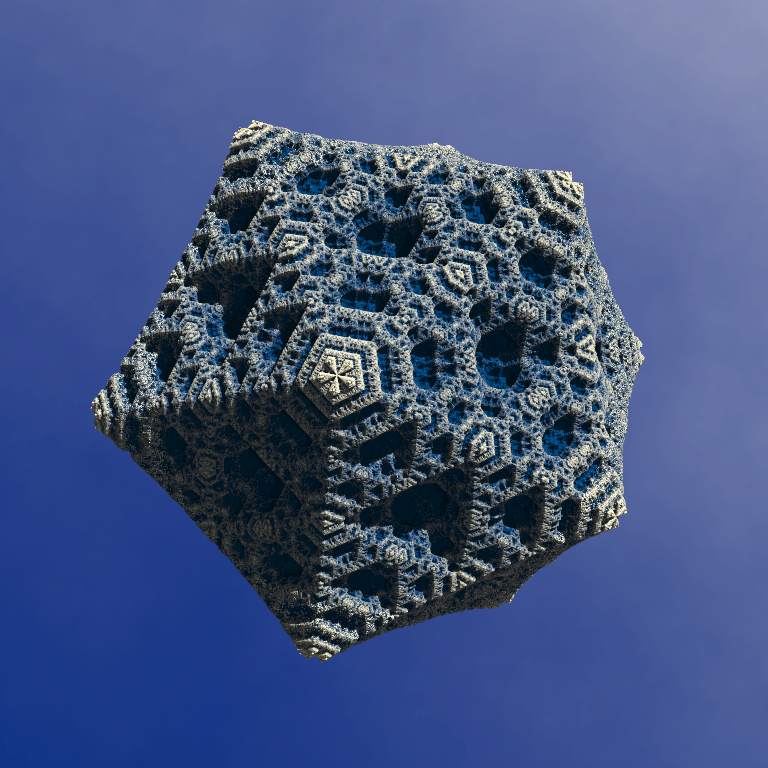
The theory behind these objects is that all polyhedra have a set of
symmetry planes about which geometry may be reflected. If an iterated
function is reflected, scaled off-center and tested against a sphere,
there will be an emergence of new, often unexpected shapes.

I have managed to make a full implementation of the five Platonic
solids, along with an ad-hoc cavity shader. You can find the scene file
here:
http://news.povray.org/povray.text.scene-files/thread/%3C4cff1d96%40news.povray.org%3E/

Perhaps you'll find these fractals as captivating as I do :)

Happy Raytracing!

-Sam
Post a reply to this message
Attachments:
Download 'kifse38_05.jpg' (99 KB)
Preview of image 'kifse38_05.jpg'
|
|
| |
| |
|
|
|
|
| |
| |
|
|
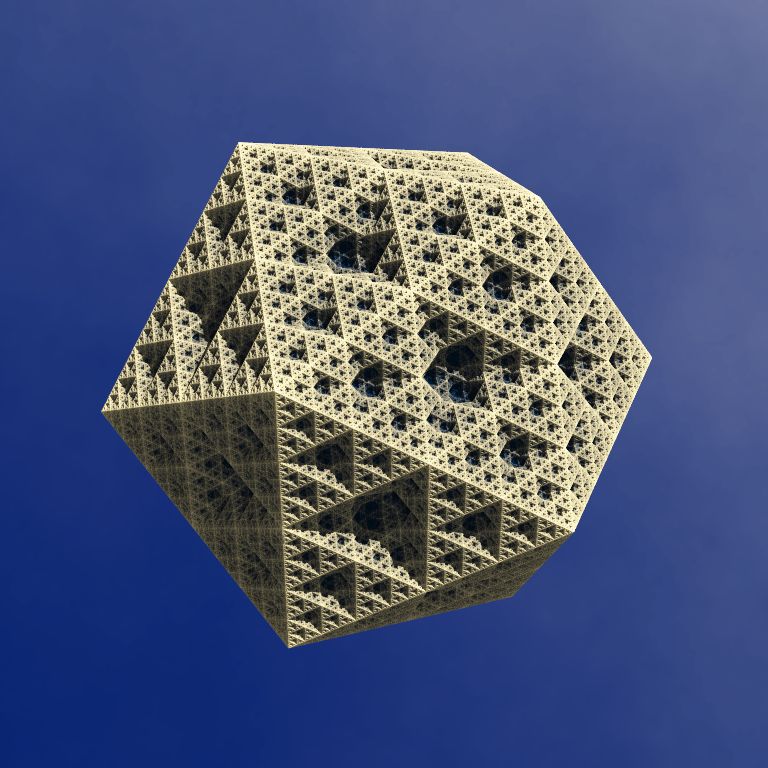
One of the many "soccer ball" fractals.
Post a reply to this message
Attachments:
Download 'kifsd14_49.jpg' (86 KB)
Preview of image 'kifsd14_49.jpg'
|
|
| |
| |
|
|
|
|
| |
| |
|
|
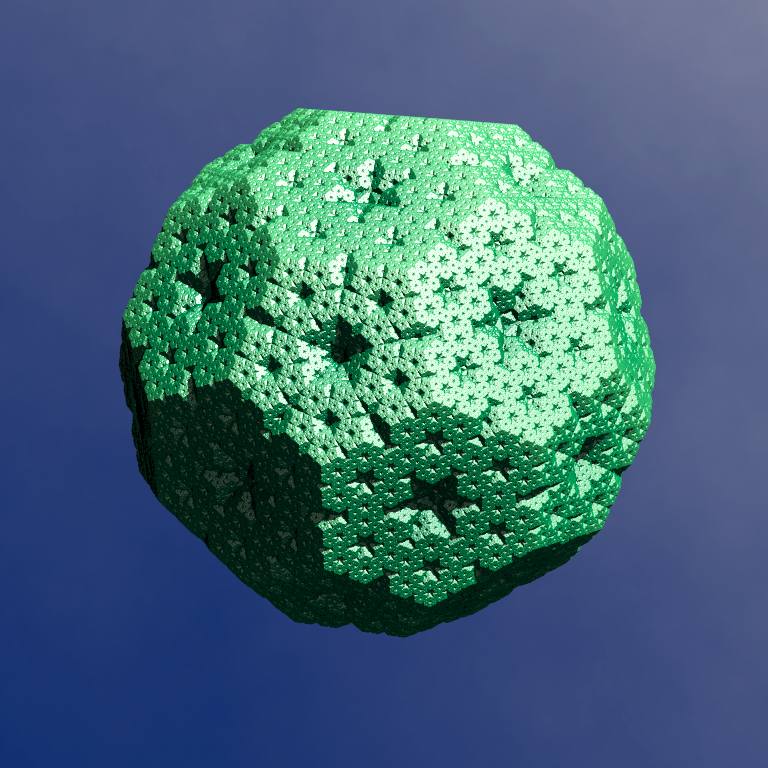
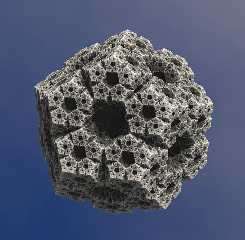
Here's one of the objects I made to "proof" the setup. I was a bit
heavy-handed with the shading...
Post a reply to this message
Attachments:
Download 'kifsd15_42.jpg' (81 KB)
Preview of image 'kifsd15_42.jpg'
|
|
| |
| |
|
|
|
|
| |
| |
|
|
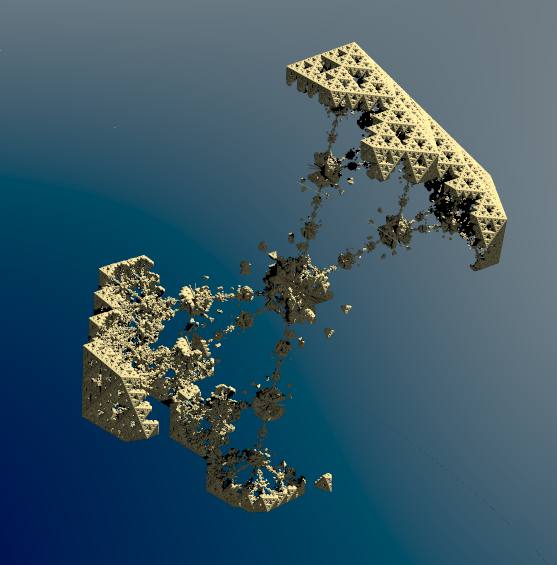
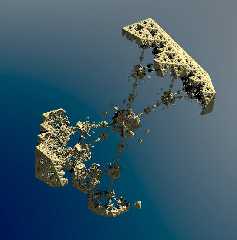
This was an early failed attempt. It's an example of how the
"plug-and-chug" method of not doing your homework can go terribly wrong.
It inspired me to find my own symmetry planes. It's actually not that
bad, might even make a nice alien space station :)
Post a reply to this message
Attachments:
Download 'kifsd7_43.jpg' (32 KB)
Preview of image 'kifsd7_43.jpg'
|
|
| |
| |
|
|
|
|
| |
| |
|
|
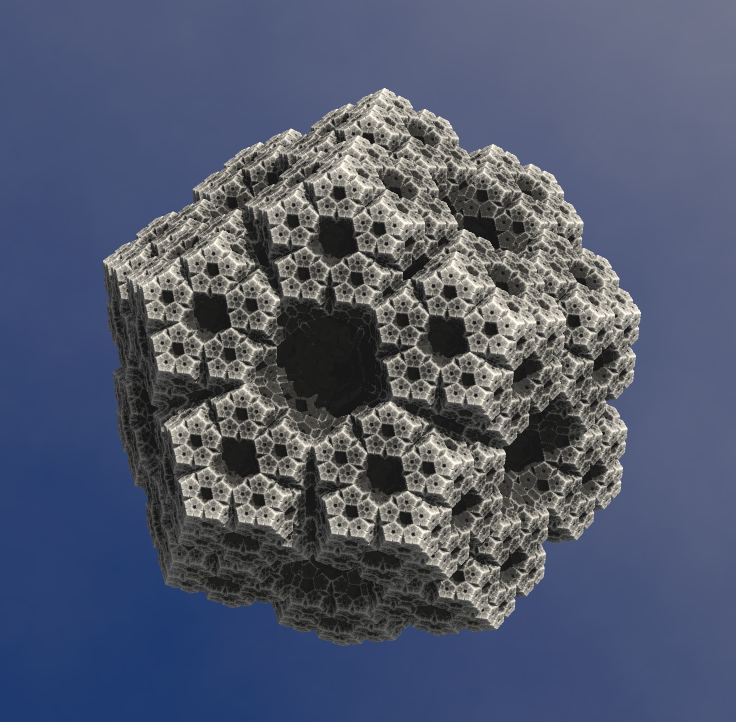
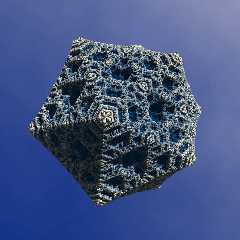
Another icosahedron, this time with a small rotation.
Post a reply to this message
Attachments:
Download 'kifsd21_05.jpg' (72 KB)
Preview of image 'kifsd21_05.jpg'
|
|
| |
| |
|
|
|
|
| |
| |
|
|
Gorgeous, Sam! All of them.

I like the alien space station.... ;-)

Thomas
Post a reply to this message
|
|
| |
| |
|
|
|
|
| |
| |
|
|
Awesome images. I especially like your 'proof' image of the dodecahedral
fractal. Heavy-handed on the shading? Maybe. Looks better for it? Definitely. :)

I shall check out these links too, that'll be my productivity gone for the day!

Bill
Post a reply to this message
|
|
| |
| |
|
|
|
|
| |
| |
|
|
Wonderful! That really is exciting! I'm constantly amazed at the things I see on
this forum. Thanks for sharing!

Regards,
Dave Blandston
Post a reply to this message
|
|
| |
| |
|
|
|
|
| |
| |
|
|
On 12/7/2010 11:58 PM, Thomas de Groot wrote:
> Gorgeous, Sam! All of them.
>
> I like the alien space station.... ;-)

Thanks, Thomas :) Aliens always build the best stuff <g>
Post a reply to this message
|
|
| |
| |
|
|
|
|
| |
| |
|
|
On 12/8/2010 1:24 AM, Bill Pragnell wrote:
> Awesome images. I especially like your 'proof' image of the dodecahedral
> fractal. Heavy-handed on the shading? Maybe. Looks better for it? Definitely. :)
>
> I shall check out these links too, that'll be my productivity gone for the day!

I think you might have been looking for an excuse ;)
Post a reply to this message
|
|
| |
| |
|
|
|
|
| |
| |
|
|
On 12/8/2010 9:48 AM, Dave Blandston wrote:
> Wonderful! That really is exciting! I'm constantly amazed at the things I see on
> this forum. Thanks for sharing!

I think it reflects well on this particular piece of freeware; you can
do practically anything with it. Mathematical concepts, photorealistic
rendering... logo creation... It's a good time to be a Povver :)
Post a reply to this message
|
|
| |
| |
|
|
|
|
| |
| |
|
|
>stbenge  on date 08/12/2010 07:13 wrote:
> Greetings!
>
> Last May, "knighty" of fractalforums.com amazed fractal fans worldwide
> when he presented a new class of escape time fractals he calls
> "Kaleidoscopic IFS." Forum members quickly grasped the concept and
> proceeded to create many interesting variants, many of which you can see
> in this seminal thread:
>
http://www.fractalforums.com/3d-fractal-generation/kaleidoscopic-%28escape-time-ifs%29/?PHPSESSID=8fddfae07b02d36cd3c05e028fd6a7d9
>
>
> Jos Leys then went on to describe these fractals in more detail:
> http://images.math.cnrs.fr/Un-ballon-de-foot-fractal.html I highly
> recommend checking out the rest of his site if you haven't done so
> already; he's done some very cool things.
>
> The theory behind these objects is that all polyhedra have a set of
> symmetry planes about which geometry may be reflected. If an iterated
> function is reflected, scaled off-center and tested against a sphere,
> there will be an emergence of new, often unexpected shapes.
>
> I have managed to make a full implementation of the five Platonic
> solids, along with an ad-hoc cavity shader. You can find the scene file
> here:
>
http://news.povray.org/povray.text.scene-files/thread/%3C4cff1d96%40news.povray.org%3E/
>
>
> Perhaps you'll find these fractals as captivating as I do :)
>
> Happy Raytracing!
>
> -Sam
Thank you for the interesting images, Sam, I've always been fascinated
by IFS: they are simple to write and may conduce to unexpected shapes
(the good of iterative algorithms - years ago I made a little 2D IFS
parser in POV-Ray).
;-)
Paolo
Post a reply to this message
|
|
| |
| |
|
|
|
|
| |
| |
|
|
On 12/9/2010 1:08 AM, Paolo Gibellini wrote:
> Thank you for the interesting images, Sam, I've always been fascinated
> by IFS: they are simple to write and may conduce to unexpected shapes
> (the good of iterative algorithms - years ago I made a little 2D IFS
> parser in POV-Ray).
> ;-)
> Paolo

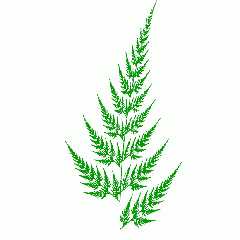
Hi Paolo, I wrote an IFS parser too, hoping to figure out how K-IFS
fractals work. It didn't really help, but it was a fun diversion <g>
It's intolerably slow and not very efficient... The attached image took
31 seconds to parse, and has 193317 objects from 28 iterations. The
reference I modeled it from used fewer samples, yet possessed higher detail.

Kaleidoscopic iterated function systems, when computed with an escape
time algorithm, are much more efficient. They take less than a second to
parse and have a minimal memory footprint... and the result is just one
object :)

Now if I could just get the Menger Sponge working... I'm about to
concede defeat :(
Post a reply to this message
Attachments:
Download 'ifsa0_35.png' (18 KB)
Preview of image 'ifsa0_35.png'
|
|
| |
| |
|
|
|
|
| |
| |
|
|
On 8/12/2010 5:31 PM, stbenge wrote:
> This was an early failed attempt. It's an example of how the
> "plug-and-chug" method of not doing your homework can go terribly wrong.
> It inspired me to find my own symmetry planes. It's actually not that
> bad, might even make a nice alien space station :)

exactly! not everything HAS to be symmetrical! i like it...

zutroi
Post a reply to this message
|
|
| |
| |
|
|
|
|
| |
| |
|
|
>stbenge  on date 09/12/2010 19:07 wrote:
> On 12/9/2010 1:08 AM, Paolo Gibellini wrote:
>> Thank you for the interesting images, Sam, I've always been fascinated
>> by IFS: they are simple to write and may conduce to unexpected shapes
>> (the good of iterative algorithms - years ago I made a little 2D IFS
>> parser in POV-Ray).
>> ;-)
>> Paolo
>
> Hi Paolo, I wrote an IFS parser too, hoping to figure out how K-IFS
> fractals work. It didn't really help, but it was a fun diversion <g>
> It's intolerably slow and not very efficient... The attached image took
> 31 seconds to parse, and has 193317 objects from 28 iterations. The
> reference I modeled it from used fewer samples, yet possessed higher
> detail.
>
> Kaleidoscopic iterated function systems, when computed with an escape
> time algorithm, are much more efficient. They take less than a second to
> parse and have a minimal memory footprint... and the result is just one
> object :)
>
> Now if I could just get the Menger Sponge working... I'm about to
> concede defeat :(
Your argumentation are as always convincing ;-), sorry I've no time now
to experiment Kaleidoscopic IFS now.

Paolo
Post a reply to this message
Attachments:
Download 'es_lsystems_20_1280_aa.jpg' (596 KB)
Download 'es_lsystems_08_800_no_aa.jpg' (246 KB)
Preview of image 'es_lsystems_20_1280_aa.jpg'
Preview of image 'es_lsystems_08_800_no_aa.jpg'
|
|
| |
| |
|
|
|
|
| |
| |
|
|
Paolo Gibellini <p.g### [at] gmail com> wrote:
> Your argumentation are as always convincing ;-), sorry I've no time now
> to experiment Kaleidoscopic IFS now.
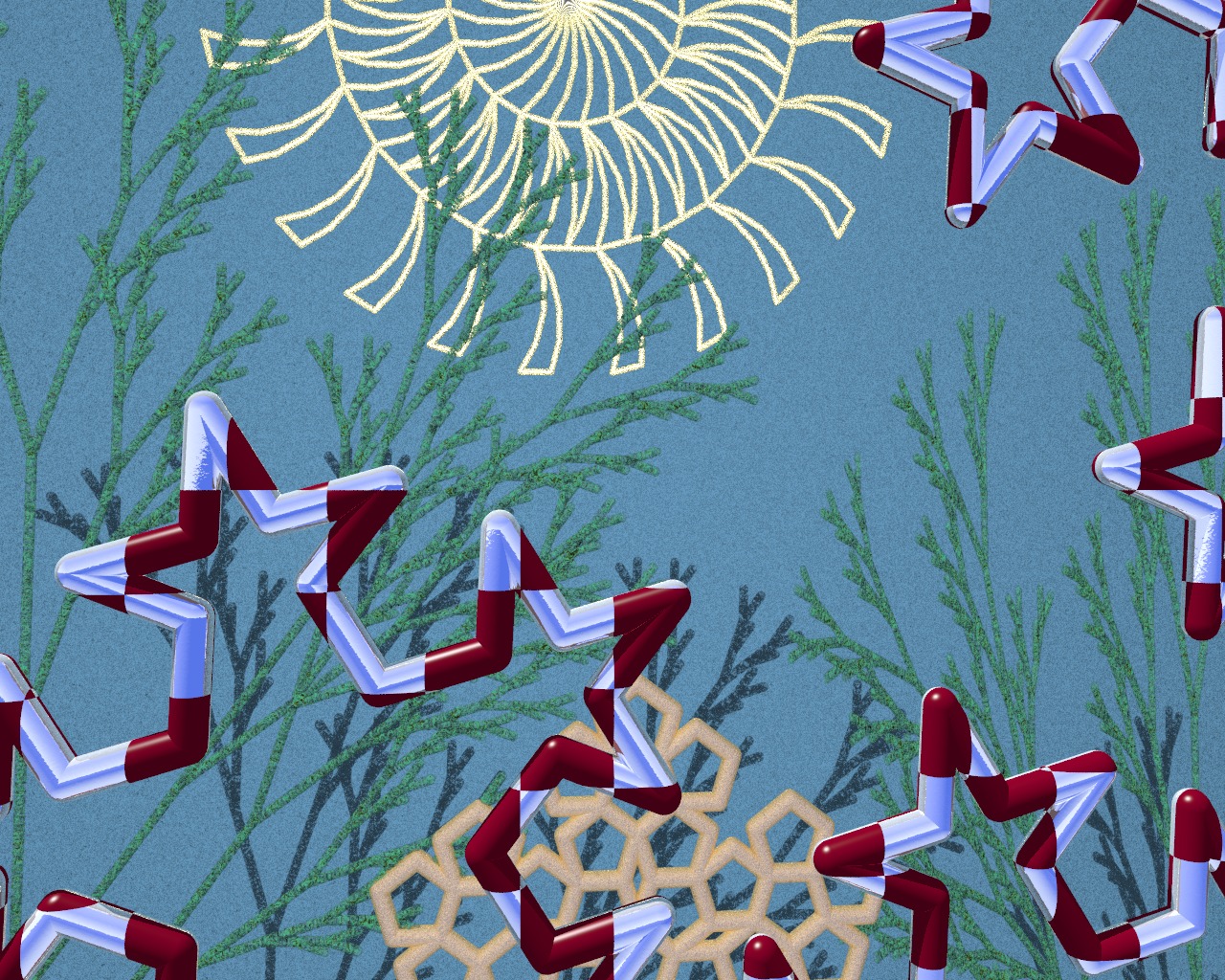
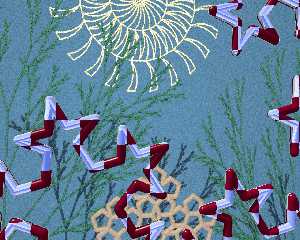
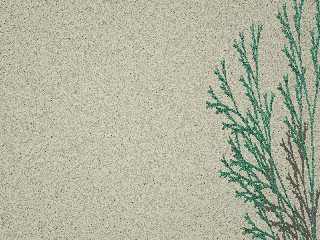
I like the second image. It reminds me of the dendrites (iron? manganese?) one
can sometimes find in rhyolite or sandstone. com> wrote:
> Your argumentation are as always convincing ;-), sorry I've no time now
> to experiment Kaleidoscopic IFS now.
I like the second image. It reminds me of the dendrites (iron? manganese?) one
can sometimes find in rhyolite or sandstone.
Post a reply to this message
|
|
| |
| |
|
|
|
|
| |
| |
|
|
>Samuel Benge  on date 11/12/2010 20:48 wrote:
> Paolo Gibellini<p.g### [at] gmailcom>  wrote:
>> Your argumentation are as always convincing ;-), sorry I've no time now
>> to experiment Kaleidoscopic IFS now.
>
> I like the second image. It reminds me of the dendrites (iron? manganese?) one
> can sometimes find in rhyolite or sandstone.
>
Thank you ;-)
The background is a plane with an a agate-based texture, and turning
antialiasing off there is this this granulated effect.
Paolo
Post a reply to this message
|
|
| |
| |
|
|
|
|
| |