|
|
|
|
|
|
| |
| |
|
|
|
|
| |
| |
|
|
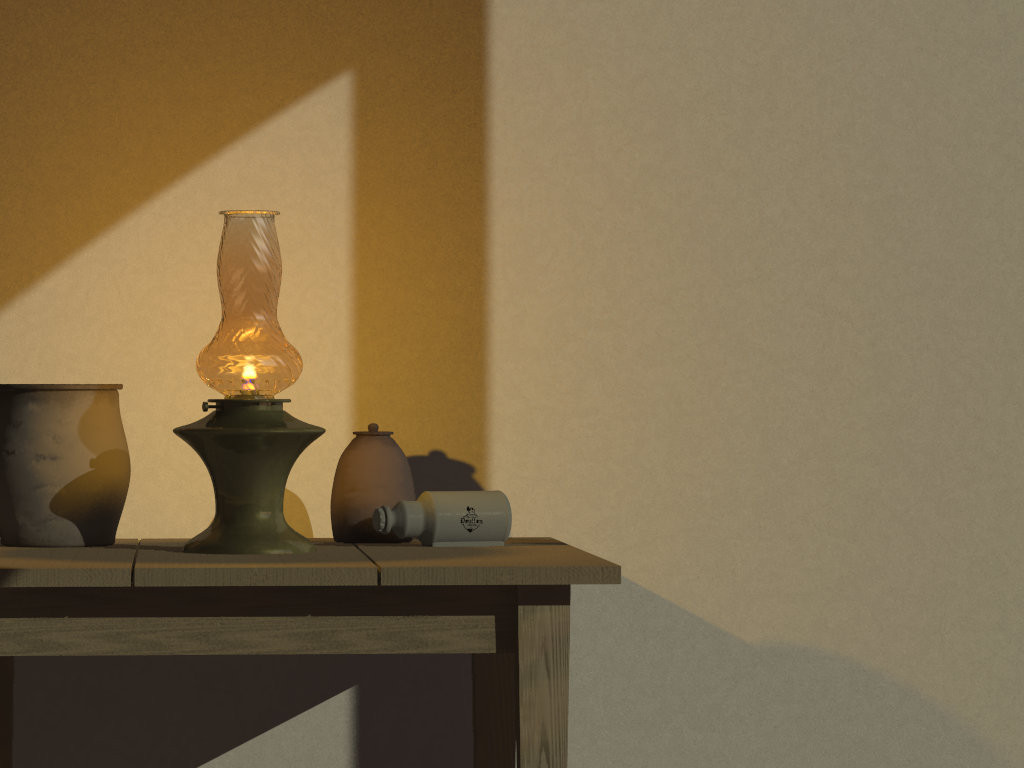
This is the brass lamp that I'd been working on for a while. I finally
solved the problems with the lamp globe.

Came up with the normal on the globe after working through Warps slope map
tutorial!

Jim
Post a reply to this message
Attachments:
Download 'BrassLamp.png' (808 KB)
Preview of image 'BrassLamp.png'
|
|
| |
| |
|
|
|
|
| |
| |
|
|
Impressive! I guess the normal work on the globe really makes it.

BTW, what's that grey flask on the right? What would anyone build a
vessel like that for? (Needs some more beveling work around its resting
surface and where the box meets the cylinder, btw... the table could
also need some.)
Post a reply to this message
|
|
| |
| |
|
|
|
|
| |
| |
|
|
"clipka" <ano### [at] anonymous org> wrote in message
news:4ab76d58@news.povray.org...
> Impressive! I guess the normal work on the globe really makes it.
>
> BTW, what's that grey flask on the right? What would anyone build a vessel
> like that for?
My guess would be that it's a traditional solution to the thick gloopy
liquid problem, before squeezy bottles and upside-down ketchup bottles were
invented, so you don't have to wait while it makes its way all the way from
the bottom to the spout each time you want some?
Anywhere close?
Regards,
Chris B. org> wrote in message
news:4ab76d58@news.povray.org...
> Impressive! I guess the normal work on the globe really makes it.
>
> BTW, what's that grey flask on the right? What would anyone build a vessel
> like that for?
My guess would be that it's a traditional solution to the thick gloopy
liquid problem, before squeezy bottles and upside-down ketchup bottles were
invented, so you don't have to wait while it makes its way all the way from
the bottom to the spout each time you want some?
Anywhere close?
Regards,
Chris B.
Post a reply to this message
|
|
| |
| |
|
|
|
|
| |
| |
|
|
"clipka" <ano### [at] anonymousorg> wrote in message
news:4ab76d58@news.povray.org...
> Impressive! I guess the normal work on the globe really makes it.

Yes it does! The problem (you and discussed) with the globe was even though
I could see through the lath object, it was rendering the volume of the
object until I figured out how to close the spline.

> BTW, what's that grey flask on the right? What would anyone build a vessel
> like that for? (Needs some more beveling work around its resting surface
> and where the box meets the cylinder, btw... the table could also need
> some.)

The grey object on the right is a bed warmer .... fill it with hot water and
it goes between the sheets (down by your toes), and yes perhaps a little
more work is needed! It's a union of lathe object and a rounded box. Any
ideas how to smooth the transition from base to lathe object?

The table could probably use a little more normal work, but the edges ...
well I have this table in the shop, pretty crude primitive construction. The
methods of the period (c1840) never broke the edges like you're suggesting.
Not round legs either ... basic straight egdes and tapered ... pegged
together, NO NAILS!!!

Thanks!
Jim
Post a reply to this message
|
|
| |
| |
|
|
|
|
| |
| |
|
|
> "clipka" <ano### [at] anonymousorg> wrote in message
> news:4ab76d58@news.povray.org...
>> BTW, what's that grey flask on the right? What would anyone build a
>> vessel like that for?
>
> My guess would be that it's a traditional solution to the thick gloopy
> liquid problem, before squeezy bottles and upside-down ketchup bottles
> were invented, so you don't have to wait while it makes its way all the
> way from the bottom to the spout each time you want some?
>
> Anywhere close?
>
> Regards,
> Chris B.

Way off (ha-ha) ... it's a bed warmer!

Jim
Post a reply to this message
|
|
| |
| |
|
|
|
|
| |
| |
|
|
On Mon, 21 Sep 2009 10:17:56 -0300, "Jim Holsenback" <jho### [at] povrayorg>
wrote:

>
>The grey object on the right is a bed warmer .... fill it with hot water and
>it goes between the sheets (down by your toes),


I would describe it as an old fashioned or stone "hot water" bottle.

> and yes perhaps a little
>more work is needed! It's a union of lathe object and a rounded box. Any
>ideas how to smooth the transition from base to lathe object?

I'm not sure that I can describe it in English but I will try,
Add a cylinder that is tangential to the lathe object and the base and has a
radius that suits your model (This is easier when you use a modeller and you can
see where things touch. :P). Add a box where one face goes through the tangents
of the cylinder and lathe object at the top and the cylinder and base. Turn that
into a CSG difference (you may need to add extra boxes to clean it up) with the
cylinder subtracted from the box. You should now have an object that is a
"filler".

I've not tried it but it is the way I do these things.
--

Regards
     Stephen
Post a reply to this message
|
|
| |
| |
|
|
|
|
| |
| |
|
|
"Jim Holsenback" <jho### [at] povrayorg> wrote in message
news:4ab77d74@news.povray.org...
>> "clipka" <ano### [at] anonymousorg> wrote in message
>> news:4ab76d58@news.povray.org...
>>> BTW, what's that grey flask on the right? What would anyone build a
>>> vessel like that for?
>>
>> My guess would be that it's a traditional solution to the thick gloopy
>> liquid problem, before squeezy bottles and upside-down ketchup bottles
>> were invented, so you don't have to wait while it makes its way all the
>> way from the bottom to the spout each time you want some?
>>
>> Anywhere close?
>>
>> Regards,
>> Chris B.
>
> Way off (ha-ha) ... it's a bed warmer!
>
> Jim


Doh!!
:-)
Post a reply to this message
|
|
| |
| |
|
|
|
|
| |
| |
|
|
Jim Holsenback schrieb:

> The grey object on the right is a bed warmer .... fill it with hot water and
> it goes between the sheets (down by your toes), and yes perhaps a little
> more work is needed! It's a union of lathe object and a rounded box. Any
> ideas how to smooth the transition from base to lathe object?

Yes: Hard math :-P

I'll need a macro for linking rectangular blocks to cylinders, too, but
so far I haven't figured out the details yet. ATM I could only give you
an example of how to round off the edges on a linear polygon with
circular arcs, but although it's presumably a closely related problem,
it's not exactly the same.

> The table could probably use a little more normal work, but the edges ...
> well I have this table in the shop, pretty crude primitive construction. The
> methods of the period (c1840) never broke the edges like you're suggesting.

Even without deliberate rounding, beveling or even sanding, boards will
/never/ have perfectly sharp edges - not to mention some deal of
involutary beveling by wear.

(That's why on my steam locomotive I'm actually beveling - or more
precisely, rounding off - /everyhing/ at least a tiny bit, even if it is
supposed to be machined steel instead of cast iron.)
Post a reply to this message
|
|
| |
| |
|
|
|
|
| |
| |
|
|
"Stephen" <mcavoysAT@aolDOTcom> wrote in message
news:pm0fb5tktbb0e3rbt22h12921hlap3udh5@4ax.com...
> I'm not sure that I can describe it in English but I will try,
> Add a cylinder that is tangential to the lathe object and the base and has
> a
> radius that suits your model (This is easier when you use a modeller and
> you can
> see where things touch. :P). Add a box where one face goes through the
> tangents
> of the cylinder and lathe object at the top and the cylinder and base.
> Turn that
> into a CSG difference (you may need to add extra boxes to clean it up)
> with the
> cylinder subtracted from the box. You should now have an object that is a
> "filler".

Ok ... (clipka's and yours) inputs have started some ideas. I'll sit down
with a sheet of graph paper (this computer doesn't have POV) while I'm
watching the shop.

Cheers!
Post a reply to this message
|
|
| |
| |
|
|
|
|
| |
| |
|
|
"clipka" <ano### [at] anonymousorg> wrote in message
news:4ab78f57$1@news.povray.org...
> (That's why on my steam locomotive I'm actually beveling - or more
> precisely, rounding off - /everyhing/ at least a tiny bit, even if it is
> supposed to be machined steel instead of cast iron.)

I took a look and YES I do see what you mean ... most excellent!
Post a reply to this message
|
|
| |
| |
|
|
|
|
| |
| |
|
|
Looks terrific & brings to mind an oil lamp my family used when the
electric would go out. We'd play cards by the light - flame looks just right to
me.
Bill

"Jim Holsenback" <jho### [at] povrayorg> wrote:
> This is the brass lamp that I'd been working on for a while. I finally
> solved the problems with the lamp globe.
>
> Came up with the normal on the globe after working through Warps slope map
> tutorial!
>
> Jim
Post a reply to this message
|
|
| |
| |
|
|
|
|
| |
| |
|
|
That's a great image. It's so crisp that I keep looking for artifacts, but I
can't find any. The lighting, the colors, and the shapes are all very
appealing.

 - Slime
 [ http://www.slimeland.com/ ]
Post a reply to this message
|
|
| |
| |
|
|
|
|
| |
| |
|
|
Excellent work, Jim. The only thing I find a bit perturbing is the big
yellowish shadow on the wall as it does not relate to something visible or
even recognizable in the scene. Maybe that needs some thought.

Thomas
Post a reply to this message
|
|
| |
| |
|
|
|
|
| |
| |
|
|
"Jim Holsenback" <jho### [at] povrayorg> wrote:
> This is the brass lamp that I'd been working on for a while. I finally
> solved the problems with the lamp globe.
>
> Came up with the normal on the globe after working through Warps slope map
> tutorial!
>
> Jim

The brass lamp seems really a brass lamp... very relistic!
(...and I like the "grainy effect" of the wall.)
Post a reply to this message
|
|
| |
| |
|
|
|
|
| |
| |
|
|
"Thomas de Groot" <tDOTdegroot@interDOTnlANOTHERDOTnet> wrote in message
news:4ab884a8@news.povray.org...
> Excellent work, Jim. The only thing I find a bit perturbing is the big
> yellowish shadow on the wall as it does not relate to something visible or
> even recognizable in the scene. Maybe that needs some thought.

Hmmm .... the lamp flame?
Post a reply to this message
|
|
| |
| |
|
|
|
|
| |
| |
|
|
"Carlo C." <nomail@nomail> wrote in message
news:web.4ab88924adad6a7aad917e280@news.povray.org...
>> The brass lamp seems really a brass lamp... very relistic!

thanks ...

> (...and I like the "grainy effect" of the wall.)

a scaled small agate normal
Post a reply to this message
|
|
| |
| |
|
|
|
|
| |
| |
|
|
"Slime" <fak### [at] emailaddress> wrote in message
news:4ab84c36$1@news.povray.org...
> That's a great image. It's so crisp that I keep looking for artifacts, but
> I can't find any. The lighting, the colors, and the shapes are all very
> appealing.

thanks! almost seven hours (not counting rad run) on my poor old single core
machine ... +am2 +a0.1 +r2
Post a reply to this message
|
|
| |
| |
|
|
|
|
| |
| |
|
|
The lamp is awesome!
Perhaps the edges of the table are too sharp compared to the object on
his surface.
Nice work!
;-)
Paolo

 >Jim Holsenback  on date 21/09/2009 13:50 wrote:
> This is the brass lamp that I'd been working on for a while. I finally
> solved the problems with the lamp globe.
>
> Came up with the normal on the globe after working through Warps slope map
> tutorial!
>
> Jim
>
>
>
Post a reply to this message
|
|
| |
| |
|
|
|
|
| |
| |
|
|
I like how you dared to put the lamp somewhere else than at the very
center of the image. The main object at the very center of the image is
almost always a very poor choice of composition (although there are some
exceptions). Being slightly on the side gives a much stronger artistic
feeling to the image.
Post a reply to this message
|
|
| |
| |
|
|
|
|
| |
| |
|
|
"Jim Holsenback" <jho### [at] povrayorg> schreef in bericht
news:4ab8ab53@news.povray.org...
> "Thomas de Groot" <tDOTdegroot@interDOTnlANOTHERDOTnet> wrote in message
> news:4ab884a8@news.povray.org...
>> Excellent work, Jim. The only thing I find a bit perturbing is the big
>> yellowish shadow on the wall as it does not relate to something visible
>> or even recognizable in the scene. Maybe that needs some thought.
>
> Hmmm .... the lamp flame?
>

That big shadow carving out a triangle on the back wall is not made by the
lamp flame I guess? or is it? I cannot relate it to something and it is what
troubles me :-)

Thomas
Post a reply to this message
|
|
| |
| |
|
|
|
|
| |
| |
|
|
"Thomas de Groot" <tDOTdegroot@interDOTnlANOTHERDOTnet> a écrit dans le
message de news: 4ab9e2ac@news.povray.org...
> That big shadow carving out a triangle on the back wall is not made by the
> lamp flame I guess? or is it? I cannot relate it to something and it is
> what troubles me :-)
>
I see it as a shadow from a more luminous and remote lamp to something as a
stair and its post.
I like it because it gives us a hint of the scene behind the camera :-)

Marc
Post a reply to this message
|
|
| |
| |
|
|
|
|
| |
| |
|
|
"m_a_r_c" <jac### [at] wanadoofr> schreef in bericht
news:4ab9fe9a$1@news.povray.org...
>>
> I see it as a shadow from a more luminous and remote lamp to something as
> a stair and its post.
> I like it because it gives us a hint of the scene behind the camera :-)

That is what I thought too... but there is something in the geometry or in
the relative position of this shadow that I find disturbing... I am unable
to be much clearer I am afraid.

On the other hand, it nicely frames the lamp.

Thomas
Post a reply to this message
|
|
| |
| |
|
|
|
|
| |
| |
|
|
"Thomas de Groot" <tDOTdegroot@interDOTnlANOTHERDOTnet> wrote in message
news:4ab9e2ac@news.povray.org...
> That big shadow carving out a triangle on the back wall is not made by the
> lamp flame I guess? or is it? I cannot relate it to something and it is
> what troubles me :-)
>
> Thomas

There is a big window and you are seeing the shadow of the framework of that
window (half moon shape in center with panels forming a larger half moon).
Having the light from the lamp as the only light source was a problem. The
wideness of the base just under the lamp globe made a zone of darkness and I
needed an outside light source to get the lamp base looking like I wanted.

Jim
Post a reply to this message
|
|
| |
| |
|
|
|
|
| |
| |
|
|
"Warp" <war### [at] tagpovrayorg> wrote in message
news:4ab8f036@news.povray.org...
>  I like how you dared to put the lamp somewhere else than at the very
> center of the image. The main object at the very center of the image is
> almost always a very poor choice of composition (although there are some
> exceptions). Being slightly on the side gives a much stronger artistic
> feeling to the image.

Thanks .... used a subtle trick I discovered by mistake! Basically the
camera orbits the table located at origin, depending how much "zoom" you use
a very small rotation of the camera around the origin works nicely. In this
case just 5 degrees.

Jim
Post a reply to this message
|
|
| |
| |
|
|
|
|
| |
| |
|
|
"Paolo Gibellini" <p.g### [at] gmailcom> wrote in message
news:4ab8e326$1@news.povray.org...
> The lamp is awesome!
> Perhaps the edges of the table are too sharp compared to the object on his
> surface.
> Nice work!
> ;-)
> Paolo

Ha-ha ... I've already started work on the table. I've made a "tool" (box
differened by a cylinder) that I'm using to trim some of the edges. The lamp
DID turn out nice .... Thanks
Post a reply to this message
|
|
| |
| |
|
|
|
|
| |
| |
|
|
"Jim Holsenback" <jho### [at] povrayorg> schreef in bericht
news:4abb350b@news.povray.org...
>
> There is a big window and you are seeing the shadow of the framework of
> that window (half moon shape in center with panels forming a larger half
> moon). Having the light from the lamp as the only light source was a
> problem. The wideness of the base just under the lamp globe made a zone of
> darkness and I needed an outside light source to get the lamp base looking
> like I wanted.
>

Yes, I thought it was something like that. Maybe it is the alignment of the
window's shadow with the table which should be shifted a tiny bit in order
to break its symmetry. It is rather subtle what I have in mind and would
need a bit of experimentation. Also the wall would be great with fine lines
or cracks here and there, and/or some irregularities... Oh well, I should
stop now ;-)

To be sure, this is a great scene anyway, Jim, especially the lamp, but also
the feeling/touch of the objects.

Thomas
Post a reply to this message
|
|
| |
| |
|
|
|
|
| |