|
|
|
|
|
|
| |
| |
|
|
|
|
| |
| |
|
|
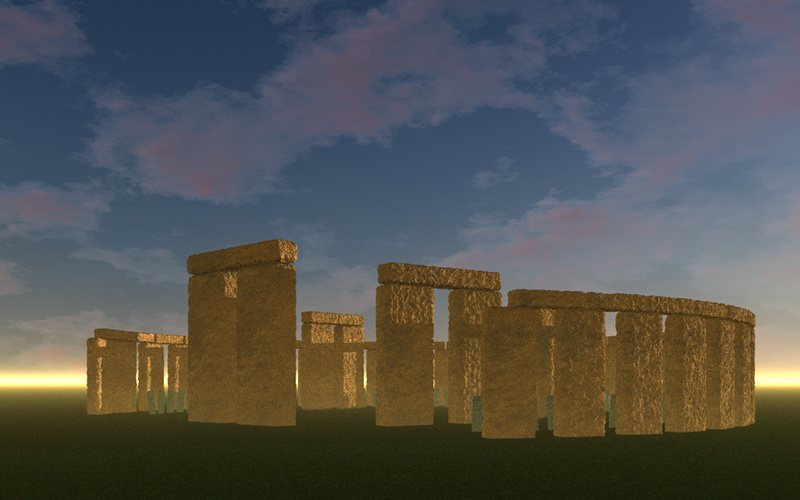
All stones are now isosufaces (all different i.e No #declares). Lots of
work still to do.
If you think the bluestones (the small greyish ones) look a bit wonky,
that's deliberate.

John
--
"Eppur si muove" - Galileo Galilei
Post a reply to this message
Attachments:
Download 'djrebirth_1.jpg' (123 KB)
Preview of image 'djrebirth_1.jpg'
|
|
| |
| |
|
|
|
|
| |
| |
|
|
Doctor John <joh### [at] home com> wrote:
> All stones are now isosufaces (all different i.e No #declares). Lots of
> work still to do.
> If you think the bluestones (the small greyish ones) look a bit wonky,
> that's deliberate.
>
That is very atmospheric John. Although I can’t help thinking that the stones
look like large weetabixs.
Stephen com> wrote:
> All stones are now isosufaces (all different i.e No #declares). Lots of
> work still to do.
> If you think the bluestones (the small greyish ones) look a bit wonky,
> that's deliberate.
>
That is very atmospheric John. Although I can’t help thinking that the stones
look like large weetabixs.
Stephen
Post a reply to this message
|
|
| |
| |
|
|
|
|
| |
| |
|
|
Nice render! Looking good. But I think the large stones are a bit too rough
and should have a more greyish texture. But then, it is a wip.

This may be a bit off-topic, but I cannot help but wonder how stonehenge
really did look when it was still "in use". I really doubt that there were
just the stones and nothing else - there should have been huts or primitive
tents and other things... even priests need to live somewhere.

How did the surrounding landscape look like? Nowadays it is green lawn amid
fields of wheat (or whatever corn). But was this so when the place was
built? Or where there woods? Do you have any idea? Does anybody?
Post a reply to this message
|
|
| |
| |
|
|
|
|
| |
| |
|
|
"TC" <do-not-reply@i-do get-enough-spam-already-2498.com> schreef in bericht
news:4a5dde83@news.povray.org...
> This may be a bit off-topic, but I cannot help but wonder how stonehenge
> really did look when it was still "in use". I really doubt that there were
> just the stones and nothing else - there should have been huts or
> primitive tents and other things... even priests need to live somewhere.
>
> How did the surrounding landscape look like? Nowadays it is green lawn
> amid fields of wheat (or whatever corn). But was this so when the place
> was built? Or where there woods? Do you have any idea? Does anybody?
>
Yes, dwelling quarters have been found, even quite extensive iirc.
http://www.shef.ac.uk/archaeology/research/stonehenge shows recent work done
on the site and new ideas about the possible use of the monument.

As far as I know, the landscape looked much different from today. More woods
certainly, but with open clearings for fields and meadows. However, the wood
extension is probably difficult to trace exactly. Some conclusions can be
drawn from pollen concentrations in ancient soils but that does not always
say much about the real extent, and much of the landscape has been
overhauled in later centuries of course.

Thomas
Post a reply to this message
|
|
| |
| |
|
|
|
|
| |
| |
|
|
Thank you for the link. Quite interesting!

Last time I was in Stonehenge was 16 years ago. Strange tricks memory plays
us - I remembered the stones to be more dark-grey.

Well, that trip was quite a disaster. What do you need if you go for a trip
to the UK? Yes, laryngitis! The one and only I had in my whole life. Couldn't
speak a single word the whole 14 days. And my camera decided to stop working
the first day -  all photos taken except the first few were not exposed to
sunlight at all - which I discovered on development of the films back home -
so no images of that vacation, including Stonehenge. Just my bad luck. the
pre digital era sometimes really did suck ;-(

"Thomas de Groot" <tDOTdegroot@interDOTnlANOTHERDOTnet> schrieb im
Newsbeitrag news:4a5de425$1@news.povray.org...
>
> "TC" <do-not-reply@i-do get-enough-spam-already-2498.com> schreef in
> bericht news:4a5dde83@news.povray.org...
>> This may be a bit off-topic, but I cannot help but wonder how stonehenge
>> really did look when it was still "in use". I really doubt that there
>> were just the stones and nothing else - there should have been huts or
>> primitive tents and other things... even priests need to live somewhere.
>>
>> How did the surrounding landscape look like? Nowadays it is green lawn
>> amid fields of wheat (or whatever corn). But was this so when the place
>> was built? Or where there woods? Do you have any idea? Does anybody?
>>
> Yes, dwelling quarters have been found, even quite extensive iirc.
> http://www.shef.ac.uk/archaeology/research/stonehenge shows recent work
> done on the site and new ideas about the possible use of the monument.
>
> As far as I know, the landscape looked much different from today. More
> woods certainly, but with open clearings for fields and meadows. However,
> the wood extension is probably difficult to trace exactly. Some
> conclusions can be drawn from pollen concentrations in ancient soils but
> that does not always say much about the real extent, and much of the
> landscape has been overhauled in later centuries of course.
>
> Thomas
>
>
Post a reply to this message
|
|
| |
| |
|
|
|
|
| |
| |
|
|
"Thomas de Groot" <tDOTdegroot@interDOTnlANOTHERDOTnet> wrote in message
news:4a5de425$1@news.povray.org...
>
> "TC" <do-not-reply@i-do get-enough-spam-already-2498.com> schreef in
> bericht news:4a5dde83@news.povray.org...
>> This may be a bit off-topic, but I cannot help but wonder how stonehenge
>> really did look when it was still "in use". I really doubt that there
>> were just the stones and nothing else - there should have been huts or
>> primitive tents and other things... even priests need to live somewhere.
>>
>> How did the surrounding landscape look like? Nowadays it is green lawn
>> amid fields of wheat (or whatever corn). But was this so when the place
>> was built? Or where there woods? Do you have any idea? Does anybody?
>>
> Yes, dwelling quarters have been found, even quite extensive iirc.
> http://www.shef.ac.uk/archaeology/research/stonehenge shows recent work
> done on the site and new ideas about the possible use of the monument.
>
> As far as I know, the landscape looked much different from today. More
> woods certainly, but with open clearings for fields and meadows. However,
> the wood extension is probably difficult to trace exactly. Some
> conclusions can be drawn from pollen concentrations in ancient soils but
> that does not always say much about the real extent, and much of the
> landscape has been overhauled in later centuries of course.
>
> Thomas
>

I did a fair bit of reading yesterday prompted by this thread. Stonehenge is
certainly just a small part of a big and complex set of structures in the
area including areas of habitation, barrows for burying the dead and large
enclosed areas that seem to be set aside for activities that nobody is quite
sure about (though plenty of different theories are available).

If I picked up the right message from the work described on the site Thomas
linked to it looks like the area may have supported a community of about
2000 people, probably living off a mixture of hunting and both arable and
livestock farming. There also seems to be evidence that people gathered
there from far afield to celebrate important dates in the calendar. Even the
Welsh guy who sold them the stones probably got an invite.

I've read that nobody is currently sure about the precise vegetation in this
area that long ago and it seems likely Stonehenge was developed during a
period of quite rapid transition from hunting in the woods to farming. The
first phase of ditches and banks were being built when large parts of
England were being deforested and it's quite possible that these earthworks
were initially around the edges of clearings, surrounded by forest or
woodland and early field systems.

In searching the Internet I came across an artists impression of what it
might have looked like if the area had still been forested when the stones
were built:
http://www.gardenvisit.com/blog/2009/06/30/stonehenge-as-a-woodland-site/

Pure conjecture of course, but it makes a pretty picture. Even if the
woodlands were never quite that close to the stones it seems likely to me
that there would have still been some nearby woodlands and that the
landscape wouldn't have been anywhere near as devoid of plant life as it is
today.

Regards,
Chris B.
Post a reply to this message
|
|
| |
| |
|
|
|
|
| |
| |
|
|
Doctor John <joh### [at] homecom> wrote:
> All stones are now isosufaces (all different i.e No #declares). Lots of
> work still to do.

Yup. For instance, you need much less ambient.
Post a reply to this message
|
|
| |
| |
|
|
|
|
| |
| |
|
|
"TC" <do-not-reply@i-do get-enough-spam-already-2498.com> wrote in message
news:4a5e0a0e$1@news.povray.org...
> Thank you for the link. Quite interesting!
>
> Last time I was in Stonehenge was 16 years ago. Strange tricks memory
> plays us - I remembered the stones to be more dark-grey.
>

Is this more how you remember them?
http://www.thelighthousewebsite.com/userimages/stonehenge.jpg

I think you need a sunrise and some color filters on your camera to get them
looking orange.  :-)

Chris B.
Post a reply to this message
|
|
| |
| |
|
|
|
|
| |
| |
|
|
"Chris B" <nom### [at] nomailcom> wrote:
> In searching the Internet I came across an artists impression of what it
> might have looked like if the area had still been forested when the stones
> were built:
> http://www.gardenvisit.com/blog/2009/06/30/stonehenge-as-a-woodland-site/

Beautiful picture, and an interesting thought. In such a setting, it would seem
perfectly fitting that the stones were much better finished on the inside than
on the outside. If stonehenge stood in the open, I'd have expected the outside
to be considered about equally important as the inside.
Post a reply to this message
|
|
| |
| |
|
|
|
|
| |
| |
|
|
"clipka" <nomail@nomail> wrote in message
news:web.4a5e196873084296a95afc190@news.povray.org...
> "Chris B" <nom### [at] nomailcom> wrote:
>> In searching the Internet I came across an artists impression of what it
>> might have looked like if the area had still been forested when the
>> stones
>> were built:
>> http://www.gardenvisit.com/blog/2009/06/30/stonehenge-as-a-woodland-site/
>
> Beautiful picture, and an interesting thought. In such a setting, it would
> seem
> perfectly fitting that the stones were much better finished on the inside
> than
> on the outside. If stonehenge stood in the open, I'd have expected the
> outside
> to be considered about equally important as the inside.
>

Ah! Well I think it's difficult to be sure how well the stones were
originally finished.

They were knocked about a good bit when tipped over and there's no certainty
that the reconstructions from the early part of the last century even got
the stones in the right place, let alone the right way round. And people
have been chipping souvenirs off the stones to take home with them since
well before Roman times, so a lot of surface stone may have dissappeared
over the last 4000 years.

Chris B.
Post a reply to this message
|
|
| |
| |
|
|
|
|
| |
| |
|
|
Yes, that's more like it. Thank you, again.


"Chris B" <nom### [at] nomailcom> schrieb im Newsbeitrag
news:4a5e0ce5@news.povray.org...
>
> "TC" <do-not-reply@i-do get-enough-spam-already-2498.com> wrote in message
> news:4a5e0a0e$1@news.povray.org...
>> Thank you for the link. Quite interesting!
>>
>> Last time I was in Stonehenge was 16 years ago. Strange tricks memory
>> plays us - I remembered the stones to be more dark-grey.
>>
>
> Is this more how you remember them?
> http://www.thelighthousewebsite.com/userimages/stonehenge.jpg
>
> I think you need a sunrise and some color filters on your camera to get
> them looking orange.  :-)
>
> Chris B.
Post a reply to this message
|
|
| |
| |
|
|
|
|
| |
| |
|
|
"Chris B" <nom### [at] nomailcom> wrote:
> Ah! Well I think it's difficult to be sure how well the stones were
> originally finished.
>
> They were knocked about a good bit when tipped over and there's no certainty
> that the reconstructions from the early part of the last century even got
> the stones in the right place, let alone the right way round.

Well, stones tipping over have a tendency to leave their "foot end" at about the
same place where it originally stood, right?

So if half of the toppled stones' ends form a distinct shape, chances are that's
where they originally stood, so this is a way to identify which end of each
stone is the "foot end".

Now given that the stones are significantly wider than deep, most will have
toppled without turning.

Thus, if some stones lay outward from the suspected placement, chances are their
outer side ended up down in the ground. And if they lay inward instead, chances
are their inner side ended up buried.

So, if the stones tipped over outward show a better finish on the upper side,
while the stones tipped over inward show a better finish on the lower side,
this would be a clear indication how they were originally finished, as it rules
out any later manipulation as the cause of the differences in finish.
Post a reply to this message
|
|
| |
| |
|
|
|
|
| |
| |
|
|
"Chris B" <nom### [at] nomailcom> schreef in bericht
news:4a5e0a2f$1@news.povray.org...
> In searching the Internet I came across an artists impression of what it
> might have looked like if the area had still been forested when the stones
> were built:
> http://www.gardenvisit.com/blog/2009/06/30/stonehenge-as-a-woodland-site/
>
> Pure conjecture of course, but it makes a pretty picture. Even if the
> woodlands were never quite that close to the stones it seems likely to me
> that there would have still been some nearby woodlands and that the
> landscape wouldn't have been anywhere near as devoid of plant life as it
> is today.

Interesting image, but wrong/anachronistic in several ways. Like you say,
the woods probably did not come up so close to the stones as suggested here,
not even after the site was "abandoned", a few hundred years only after
completion. Secondly, the forest shown looks too much like a modern
"managed" forest. The original woods were more dense and tangled with
underbrush imo. Before clearing of course. Still, a nice composition with a
nice mood.

Thomas
Post a reply to this message
|
|
| |
| |
|
|
|
|
| |
| |
|
|
"clipka" <nomail@nomail> wrote in message
news:web.4a5e431673084296a95afc190@news.povray.org...
> "Chris B" <nom### [at] nomailcom> wrote:
>> Ah! Well I think it's difficult to be sure how well the stones were
>> originally finished.
>>
>> They were knocked about a good bit when tipped over and there's no
>> certainty
>> that the reconstructions from the early part of the last century even got
>> the stones in the right place, let alone the right way round.
>
> Well, stones tipping over have a tendency to leave their "foot end" at
> about the
> same place where it originally stood, right?
>

Ah!... but :-)

The people tipping them over were attempting to permanently destroy their
religious symbolism or to cart stone away for building projects elsewhere.
Somewhere I've got a picture of drawings from Victorian times and they're
not all just layed out in a neat circle.

I read a piece yesterday that described an old standing stone just a few
miles from Stonehenge. The archeologists were only made aware of it when the
farmer was spotted by locals dragging it towards a dump where he was
planning to bury it to get it out of the way of his farm machinery. The
locals reported it, the council leapt in to stop him and made him drag it
back to roughly where it was before. Until that time it wasn't even listed
on the modern archeological records.

> Thus, if some stones lay outward from the suspected placement, chances are
> their
> outer side ended up down in the ground. And if they lay inward instead,
> chances
> are their inner side ended up buried.
>

Restorations in the past may have moved the stones because they weren't
always interested in archeological authenticity. Most of this sort of work
was done by businessmen wishing to present an imposing image to the tourists
coming along the main roads from Salisbury and London. The guys with the
crane in the photo from the 1930s  were probably most interested in getting
the bits back down to earth without crushing their toes.


> So, if the stones tipped over outward show a better finish on the upper
> side,
> while the stones tipped over inward show a better finish on the lower
> side,
> this would be a clear indication how they were originally finished, as it
> rules
> out any later manipulation as the cause of the differences in finish.
>

I suspect that, once a 30 ton stone was up in the air, turning on its cable,
they were probably more focused on getting it to look good than to respect
the original positions and orientations.

Some early archeologists may have had some influence during the more recent
reconstructions. But we know that the Romans had a big tourist industry and
the technology to move stones of that sort of size around, and I don't think
there are any records of how they changed Stonehenge through the 10
generations they were here. Likewise the masons of the middle ages and of
the Victorian era both demonstrated the ability to move stone of  that sort
of size and cpuld well have carted away stone for their buildings or may
have rearranged the stones to suit tourists of their age.

Regards,
Chris B.
Post a reply to this message
|
|
| |
| |
|
|
From: Doctor John
Subject: Re: Stonehenge - Spring equinox, dawn (wip) (adjusted)
Date: 16 Jul 2009 06:32:31
Message: <4a5f01bf@news.povray.org>
|
|
|
| |
| |
|
|
clipka wrote:
> Doctor John <joh### [at] homecom> wrote:
>> All stones are now isosufaces (all different i.e No #declares). Lots of
>> work still to do.
>
> Yup. For instance, you need much less ambient.
>
>
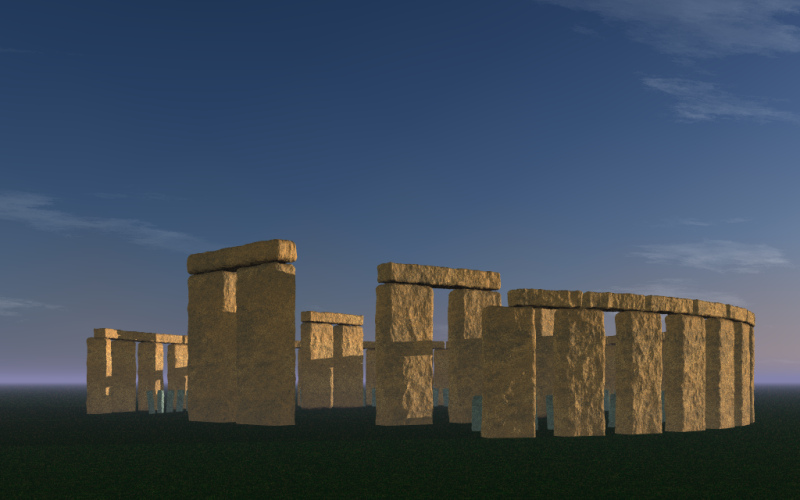
A few changes.
1. Adjustments to isosurfaces
2. Changed Lightsys parameters slightly
3. Changed ground fog

John
--
"Eppur si muove" - Galileo Galilei
Post a reply to this message
Attachments:
Download 'djrebirth_2.jpg' (120 KB)
Preview of image 'djrebirth_2.jpg'
|
|
| |
| |
|
|
|
|
| |
| |
|
|
Doctor John <joh### [at] homecom> wrote:
> A few changes.

Hm... still way too strong ambient on the stones. Or not enough on the ground.
In any case there's a mismatch there.
Post a reply to this message
|
|
| |
| |
|
|
From: Doctor John
Subject: Re: Stonehenge - Spring equinox, dawn (wip) (adjusted)
Date: 16 Jul 2009 07:01:30
Message: <4a5f088a$1@news.povray.org>
|
|
|
| |
| |
|
|
clipka wrote:
> Doctor John <joh### [at] homecom> wrote:
>> A few changes.
>
> Hm... still way too strong ambient on the stones. Or not enough on the ground.
> In any case there's a mismatch there.
>
>
I agree about the mismatch. There is no ambient or radiosity, I'm using
Lightsys for the lighting, sky and ground fog so I need to work on the
auxiliary fill-lights. I also need to work on the ground texture but
since I'm working on an isosurface to simulate the ground and some
nearby barrows that can wait.
In reply to the comment about habitation and woods etc: All in good
time, good things come to those who wait ;-)
Thanks all for the comments and encouragement

John
--
"Eppur si muove" - Galileo Galilei
Post a reply to this message
|
|
| |
| |
|
|
|
|
| |
| |
|
|
Stephen wrote:
>
> That is very atmospheric John. Although I can’t help thinking that the stones
> look like large weetabixs.
>

Can yer mither sew? ;-)

See adjusted image further down the thread

John
--
"Eppur si muove" - Galileo Galilei
Post a reply to this message
|
|
| |
| |
|
|
|
|
| |
| |
|
|
Doctor John <joh### [at] homecom> wrote:
> Stephen wrote:
> >
> > That is very atmospheric John. Although I can’t help thinking that the stones
> > look like large weetabixs.
> >
>
> Can yer mither sew? ;-)
>

Naw, she’s deid.

> See adjusted image further down the thread
>


I would move either the camera or the sun a fraction as there is a lineup of the
shadow from the outer circle and a horizontal stone, showing through the gap in
the centre. One of those “you couldn’t do it if you tried” things. :)

It is looking good.

Stephen
Post a reply to this message
|
|
| |
| |
|
|
From: Doctor John
Subject: Re: Stonehenge - Spring equinox, dawn (wip)
Date: 16 Jul 2009 07:38:40
Message: <4a5f1140@news.povray.org>
|
|
|
| |
| |
|
|
Stephen wrote:
>
> I would move either the camera or the sun a fraction as there is a lineup of the
> shadow from the outer circle and a horizontal stone, showing through the gap in
> the centre. One of those “you couldn’t do it if you tried” things. :)
>

Point duly noted, I'll move the camera, the sun position is rather tied
to season and time of day.

John
--
"Eppur si muove" - Galileo Galilei
Post a reply to this message
|
|
| |
| |
|
|
|
|
| |
| |
|
|
Doctor John <joh### [at] homecom> wrote:
> Stephen wrote:
> >
> > I would move either the camera or the sun a fraction as there is a lineup of the
> > shadow from the outer circle and a horizontal stone, showing through the gap in
> > the centre. One of those “you couldn’t do it if you tried” things. :)
> >
>
> Point duly noted, I'll move the camera, the sun position is rather tied
> to season and time of day.
>

What’s the point of being a minor deity if you can’t change the position of the
sun?

Stephen
Post a reply to this message
|
|
| |
| |
|
|
|
|
| |
| |
|
|
"Stephen" <mcavoys_AT_aolDOT.com> schreef in bericht
news:web.4a5f147b730842965fd99d9e0@news.povray.org...
>
> What's the point of being a minor deity if you can't change the position
> of the
> sun?
>
That's the difference between minor and major.... ;-)

Thomas
Post a reply to this message
|
|
| |
| |
|
|
From: Darren New
Subject: Re: Stonehenge - Spring equinox, dawn (wip) (adjusted)
Date: 16 Jul 2009 11:16:19
Message: <4a5f4443$1@news.povray.org>
|
|
|
| |
| |
|
|
The rocks on top in the middle seem to be floating. I'd expect a much
smaller gap there.

--
   Darren New, San Diego CA, USA (PST)
   "We'd like you to back-port all the changes in 2.0
    back to version 1.0."
   "We've done that already. We call it 2.0."
Post a reply to this message
|
|
| |
| |
|
|
From: Chris B
Subject: Re: Stonehenge - Spring equinox, dawn (wip) (adjusted)
Date: 16 Jul 2009 17:41:29
Message: <4a5f9e89@news.povray.org>
|
|
|
| |
| |
|
|
"Doctor John" <joh### [at] homecom> wrote in message
news:4a5f01bf@news.povray.org...
> A few changes.
> 1. Adjustments to isosurfaces
> 2. Changed Lightsys parameters slightly
> 3. Changed ground fog

As TC mentioned, the Stonehenge stones are grey. So the side facing the Sun
could appear Orange, but the bits in the shade should be grey.

I'm intrigued by this theory that one side could have been open and haven't
been able to find any mention of that on the Internet (and I checked the
calendar and it's definitely not April 1st). Do you have any reference for
that?

Regards,
Chris B.
Post a reply to this message
|
|
| |
| |
|
|
From: Doctor John
Subject: Re: Stonehenge - Spring equinox, dawn (wip) (adjusted)
Date: 17 Jul 2009 06:47:50
Message: <4a6056d6$1@news.povray.org>
|
|
|
| |
| |
|
|
Chris B wrote:
> I'm intrigued by this theory that one side could have been open and
> haven't been able to find any mention of that on the Internet (and I
> checked the calendar and it's definitely not April 1st). Do you have any
> reference for that?
>
> Regards,
> Chris B.

Right now I'm checking for a hardcopy citation but from Wikipedia comes
this:
"The stones were dressed and fashioned with mortise and tenon joints
before 30 were erected as a 33 metres (110 ft) diameter circle of
standing stones, with a ring of 30 lintel stones resting on top.
<snip>
A total of 74 stones would have been needed to complete the circle and,
unless some of the sarsens have since been removed from the site, it
would seem that the ring was left incomplete."

IIRC it was one of the Sheffield team who pointed out the symmetry in
the present opening and the lack of (backfilled or otherwise) holes for
the missing sarsens.

If I rediscover the original citation I'll let you know through p.o-t.

John
--
"Eppur si muove" - Galileo Galilei
Post a reply to this message
|
|
| |
| |
|
|
From: Doctor John
Subject: Re: Stonehenge - Spring equinox, dawn (wip) (adjusted)
Date: 17 Jul 2009 06:50:51
Message: <4a60578b@news.povray.org>
|
|
|
| |
| |
|
|
clipka wrote:
> Doctor John <joh### [at] homecom> wrote:
>> A few changes.
>
> Hm... still way too strong ambient on the stones. Or not enough on the ground.
> In any case there's a mismatch there.
>
>

As of today, I've abandoned using Lightsys and am going back to good old
radiosity with a sky_sphere. Present results are looking promising with
a better contrast level

John
--
"Eppur si muove" - Galileo Galilei
Post a reply to this message
|
|
| |
| |
|
|
From: Thomas de Groot
Subject: Re: Stonehenge - Spring equinox, dawn (wip) (adjusted)
Date: 18 Jul 2009 03:10:33
Message: <4a617569$1@news.povray.org>
|
|
|
| |
| |
|
|
"Doctor John" <joh### [at] homecom> schreef in bericht
news:4a6056d6$1@news.povray.org...
> Right now I'm checking for a hardcopy citation but from Wikipedia comes
> this:
> "The stones were dressed and fashioned with mortise and tenon joints
> before 30 were erected as a 33 metres (110 ft) diameter circle of
> standing stones, with a ring of 30 lintel stones resting on top.
> <snip>
> A total of 74 stones would have been needed to complete the circle and,
> unless some of the sarsens have since been removed from the site, it
> would seem that the ring was left incomplete."
>
> IIRC it was one of the Sheffield team who pointed out the symmetry in
> the present opening and the lack of (backfilled or otherwise) holes for
> the missing sarsens.
>
> If I rediscover the original citation I'll let you know through p.o-t.
>

Thank you! That is an intriguing possibility indeed.

Thomas
Post a reply to this message
|
|
| |
| |
|
|
|
|
| |
| |
|
|
The ground and the horizon are great, even gorgeous! The colors of the
stones fit, too.

But the emitting color of the stones  is too much, and the sky don't looks
realistic enough. The stones seem to cast no shadow, this also makes it a
bit unrealistic.
Post a reply to this message
|
|
| |
| |
|
|
|
|
| |