|
|
|
|
|
|
| |
| |
|
|
|
|
| |
| |
|
|
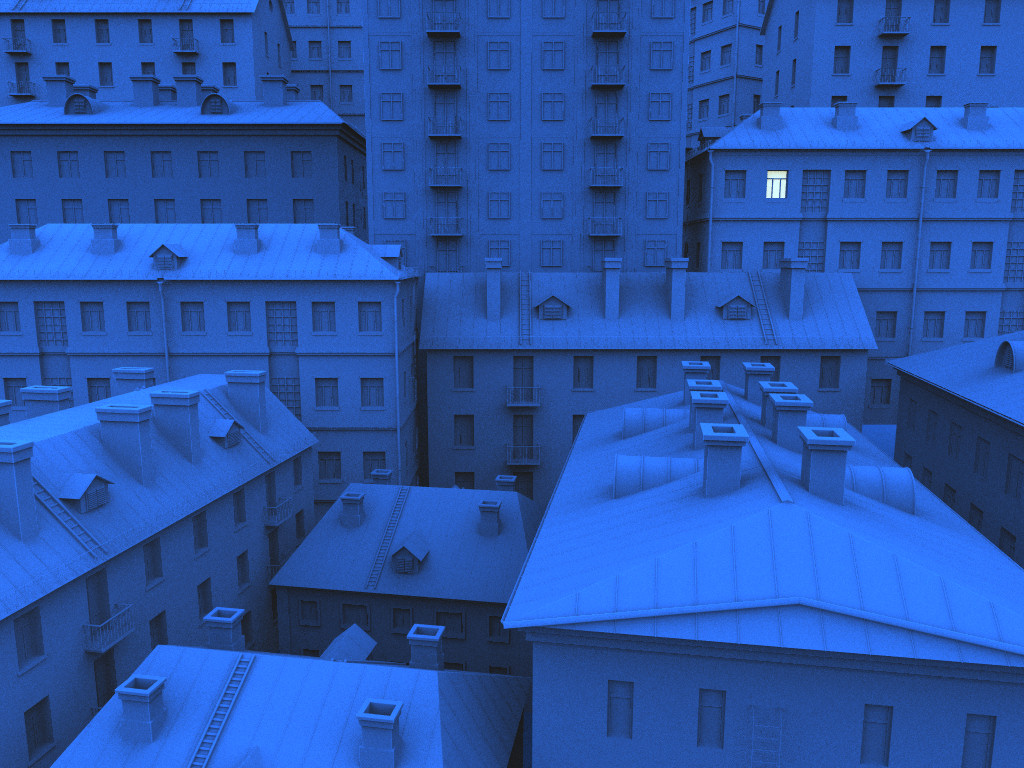
Carlo suggested this scene file for testing radiosity and it looked like a
perfect example for a kind of dome-like area light I made to the megapov
sources for povray 3.1g. I think I abandoned it because it really doesn't do
anything radiosity can't do with a recursion limit of 1. It seems to do a
good job with this scene in a relatively short amount of time though. This
uses an array of 91 vectors that processed like an area_light (I may have
changed something to allow diffuse calculation...it has been a long time).

According to the IRTC text file the original took 2 hours to render using
106 processors (1.9GHz P3s - 2.3GHz P4s) from Swinburne
Astrophysics and Supercomputing Farm, Australia. I assumed a render size of
1024x768 and used AA 0.03 from the quickres ini menu. Mine took 6h 27m 14s
using a Athlon X2 3.2ghz processor. It is dual core but the scene was
rendered in a single thread (peak memory used 14028998 bytes).

Original render http://www.irtc.org/ftp/pub/stills/2002-08-31/golonls2.jpg
Post a reply to this message
Attachments:
Download 'golonls2.jpg' (280 KB)
Preview of image 'golonls2.jpg'
|
|
| |
| |
|
|
|
|
| |
| |
|
|
Hello,

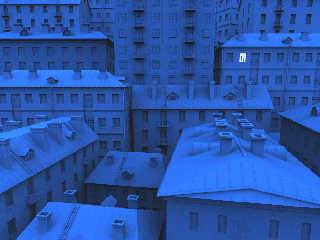
The same scene rendered with mcpov.
I think the rendering was around 8 hours on 4 cores (Intel Q6600 2.4 GHz).

Regards,
Fidos
Post a reply to this message
Attachments:
Download 'golonls2.jpg' (488 KB)
Preview of image 'golonls2.jpg'

|
|
| |
| |
|
|
|
|
| |
| |
|
|
"Mike Hough" <nos### [at] nospam com> wrote:
> Carlo suggested this scene file for testing radiosity and it looked like a
> perfect example for a kind of dome-like area light I made to the megapov
> sources for povray 3.1g. I think I abandoned it because it really doesn't do
> anything radiosity can't do with a recursion limit of 1. It seems to do a
> good job with this scene in a relatively short amount of time though. This
> uses an array of 91 vectors that processed like an area_light (I may have
> changed something to allow diffuse calculation...it has been a long time).
>
> According to the IRTC text file the original took 2 hours to render using
> 106 processors (1.9GHz P3s - 2.3GHz P4s) from Swinburne
> Astrophysics and Supercomputing Farm, Australia. I assumed a render size of
> 1024x768 and used AA 0.03 from the quickres ini menu. Mine took 6h 27m 14s
> using a Athlon X2 3.2ghz processor. It is dual core but the scene was
> rendered in a single thread (peak memory used 14028998 bytes).
>
> Original render http://www.irtc.org/ftp/pub/stills/2002-08-31/golonls2.jpg
In my opinion it is almost better than the original.
Bravo!
--
Carlo com> wrote:
> Carlo suggested this scene file for testing radiosity and it looked like a
> perfect example for a kind of dome-like area light I made to the megapov
> sources for povray 3.1g. I think I abandoned it because it really doesn't do
> anything radiosity can't do with a recursion limit of 1. It seems to do a
> good job with this scene in a relatively short amount of time though. This
> uses an array of 91 vectors that processed like an area_light (I may have
> changed something to allow diffuse calculation...it has been a long time).
>
> According to the IRTC text file the original took 2 hours to render using
> 106 processors (1.9GHz P3s - 2.3GHz P4s) from Swinburne
> Astrophysics and Supercomputing Farm, Australia. I assumed a render size of
> 1024x768 and used AA 0.03 from the quickres ini menu. Mine took 6h 27m 14s
> using a Athlon X2 3.2ghz processor. It is dual core but the scene was
> rendered in a single thread (peak memory used 14028998 bytes).
>
> Original render http://www.irtc.org/ftp/pub/stills/2002-08-31/golonls2.jpg
In my opinion it is almost better than the original.
Bravo!
--
Carlo
Post a reply to this message
|
|
| |
| |
|
|
|
|
| |
| |
|
|
"fidos" <fid### [at] wanadoofr> wrote:
> Hello,
>
> The same scene rendered with mcpov.
> I think the rendering was around 8 hours on 4 cores (Intel Q6600 2.4 GHz).
>
> Regards,
> Fidos

Long live the McPov!

--
Carlo
Post a reply to this message
|
|
| |
| |
|
|
|
|
| |
| |
|
|
"Carlo C." <nomail@nomail> wrote:
> "fidos" <fid### [at] wanadoofr> wrote:
> > Hello,
> >
> > The same scene rendered with mcpov.
> > I think the rendering was around 8 hours on 4 cores (Intel Q6600 2.4 GHz).
> >
> > Regards,
> > Fidos
>
> Long live the McPov!

When/if it gets a fancy release, it just begs to have a tartan POV logo :)
Post a reply to this message
|
|
| |
| |
|
|
|
|
| |
| |
|
|
"Mike Hough" <nos### [at] nospamcom> wrote:
> According to the IRTC text file the original took 2 hours to render using
> 106 processors (1.9GHz P3s - 2.3GHz P4s) from Swinburne
> Astrophysics and Supercomputing Farm, Australia.

Why on earth would such a shot take 10 CPU days to render?!

There's not even reflection in it.
Post a reply to this message
|
|
| |
| |
|
|
|
|
| |
| |
|
|
"clipka" <nomail@nomail> wrote:
> "Mike Hough" <nos### [at] nospamcom> wrote:
> > According to the IRTC text file the original took 2 hours to render using
> > 106 processors (1.9GHz P3s - 2.3GHz P4s) from Swinburne
> > Astrophysics and Supercomputing Farm, Australia.
>
> Why on earth would such a shot take 10 CPU days to render?!
>
> There's not even reflection in it.

Try to believe.
I have a suspicion:  error_bound 0.02

;-)

--
Carlo
Post a reply to this message
|
|
| |
| |
|
|
|
|
| |
| |
|
|
"Carlo C." <nomail@nomail> wrote:
> > Why on earth would such a shot take 10 CPU days to render?!
> >
> > There's not even reflection in it.
>
> Try to believe.
> I have a suspicion:  error_bound 0.02

In any case it smells like a bad choice of radiosity parameters...
Post a reply to this message
|
|
| |
| |
|
|
|
|
| |
| |
|
|
The low error bound is one reason but the scene is also constructed entirely
of CSG. Some manual bounding of the objects in the scene might help speed it
up.


"clipka" <nomail@nomail> wrote in message
news:web.49731cd19cf147cbfb23a32b0@news.povray.org...
> "Mike Hough" <nos### [at] nospamcom> wrote:
>> According to the IRTC text file the original took 2 hours to render using
>> 106 processors (1.9GHz P3s - 2.3GHz P4s) from Swinburne
>> Astrophysics and Supercomputing Farm, Australia.
>
> Why on earth would such a shot take 10 CPU days to render?!
>
> There's not even reflection in it.
>
>
Post a reply to this message
|
|
| |
| |
|
|
|
|
| |
| |
|
|
Very nice. My version is a bit grainy which makes me wonder if mcpov would
give the same result in the same amount of time.


"fidos" <fid### [at] wanadoofr> wrote in message
news:web.4972ead49cf147cb6cc3f9360@news.povray.org...
> Hello,
>
> The same scene rendered with mcpov.
> I think the rendering was around 8 hours on 4 cores (Intel Q6600 2.4 GHz).
>
> Regards,
> Fidos
>
Post a reply to this message
|
|
| |
| |
|
|
|
|
| |
| |
|
|
"clipka" <nomail@nomail> wrote:
> "Mike Hough" <nos### [at] nospamcom> wrote:
> > According to the IRTC text file the original took 2 hours to render using
> > 106 processors (1.9GHz P3s - 2.3GHz P4s) from Swinburne
> > Astrophysics and Supercomputing Farm, Australia.
>
> Why on earth would such a shot take 10 CPU days to render?!
>
> There's not even reflection in it.

This was back in 2002. :)

http://propro.ru/go/gallery/html/us2002.html

Perhaps it's because the scene consists of CSG primitives rather than
polygons...
Post a reply to this message
|
|
| |
| |
|
|
|
|
| |
| |
|
|
Hiya Mike!

Yours has more pop to it, other looks bland to me.
Something I noticed almost immediately, though, is how closer to street
level on the mid-ground left side the MCPOV rendering has a darkening that
makes more sense. But overall it seems dull. Question is then, I wonder why
yours lacks the darkness between buildings when other parts are actually
darker than in the MCPOV render...? Must be something about illumination
bounce over distance, I'm thinking.

First thought about this scene was the overwhelming blue... my favorite
color. Just confusing thing about possibly being twilight and would this
really be that blue if so. Can't imagine even totally white buildings being
that blue in the evening (or morning) I guess.  ;^)

Bob
Post a reply to this message
|
|
| |
| |
|
|
|
|
| |
| |
|
|
Hey Bob.  Been awhile.

It may be that my method doesn't take it account the lighting contribution
of nearby surfaces. All it does is test for shadows at each point using the
vectors defined by the user. It is a cheap trick but it works. At the time I
made the patch hemispherical lights were all the rage.

Mike


"Bob Hughes" <omniverse charter net> wrote in message
news:4973cded$1@news.povray.org...
> Hiya Mike!
>
> Yours has more pop to it, other looks bland to me.
> Something I noticed almost immediately, though, is how closer to street
> level on the mid-ground left side the MCPOV rendering has a darkening that
> makes more sense. But overall it seems dull. Question is then, I wonder
> why yours lacks the darkness between buildings when other parts are
> actually darker than in the MCPOV render...? Must be something about
> illumination bounce over distance, I'm thinking.
>
> First thought about this scene was the overwhelming blue... my favorite
> color. Just confusing thing about possibly being twilight and would this
> really be that blue if so. Can't imagine even totally white buildings
> being that blue in the evening (or morning) I guess.  ;^)
>
> Bob
>
Post a reply to this message
|
|
| |
| |
|
|
|
|
| |