|
|
|
|
|
|
| |
| |
|
|
|
|
| |
| |
|
|
Hello everyone,

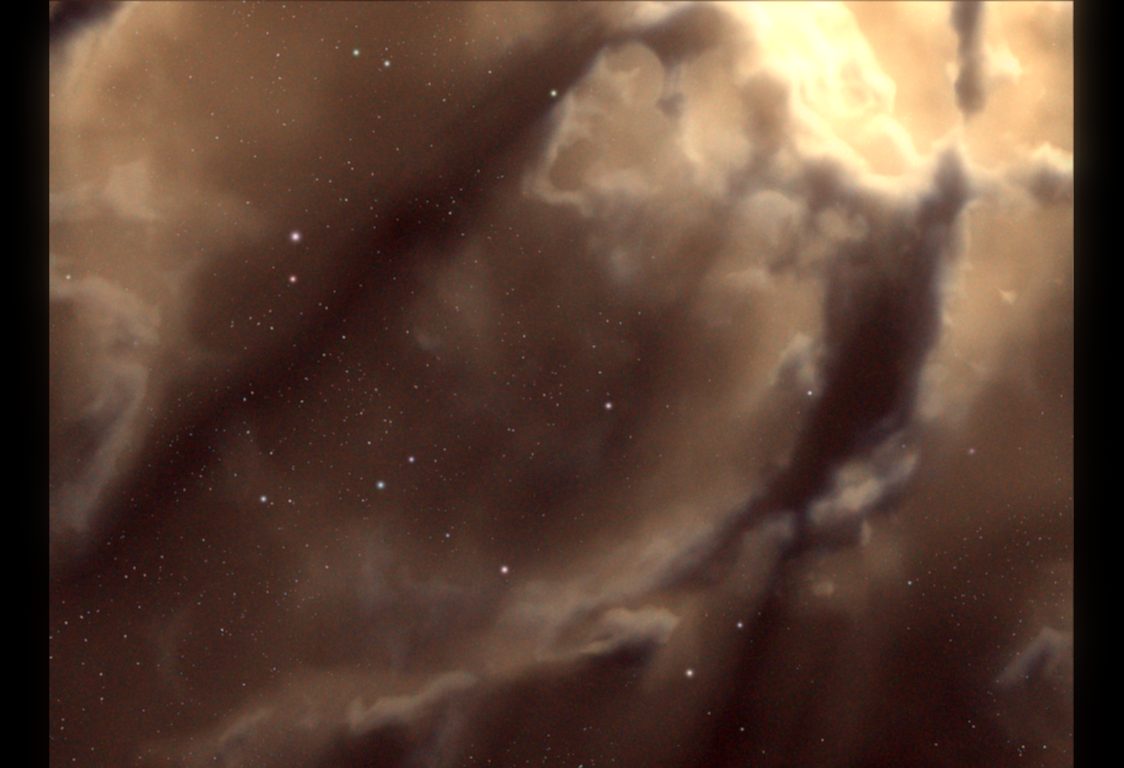
This image was rendered in four passes. I first rendered a star field. I
then rendered the nebula itself, plus a few larger stars thrown in for
good measure. This was rendered over the first star field. The third
render gave the image an appearance of having film grain. The last
render added the glare effect. It was all made in POV-Ray, except for
the black border on either side which was added in IrfanView between
steps 3 & 4.

I'll probably add some sort of space scene to it later, who knows.

I hope you enjoy it!

Sam
Post a reply to this message
Attachments:
Download 'lbtest2_43.jpg' (71 KB)
Preview of image 'lbtest2_43.jpg'
|
|
| |
| |
|
|
|
|
| |
| |
|
|
"stbenge" <stb### [at] hotmail com> schreef in bericht
news:4854624e@news.povray.org...
> Hello everyone,
>
> This image was rendered in four passes. I first rendered a star field. I
> then rendered the nebula itself, plus a few larger stars thrown in for
> good measure. This was rendered over the first star field. The third
> render gave the image an appearance of having film grain. The last
> render added the glare effect. It was all made in POV-Ray, except for
> the black border on either side which was added in IrfanView between
> steps 3 & 4.
>
> I'll probably add some sort of space scene to it later, who knows.
>
> I hope you enjoy it!
>
It certainly reminds one of some Hubble photographs. Very well done, Sam!
This needs a General Products Hull #3 in the foreground :-)
Thomas com> schreef in bericht
news:4854624e@news.povray.org...
> Hello everyone,
>
> This image was rendered in four passes. I first rendered a star field. I
> then rendered the nebula itself, plus a few larger stars thrown in for
> good measure. This was rendered over the first star field. The third
> render gave the image an appearance of having film grain. The last
> render added the glare effect. It was all made in POV-Ray, except for
> the black border on either side which was added in IrfanView between
> steps 3 & 4.
>
> I'll probably add some sort of space scene to it later, who knows.
>
> I hope you enjoy it!
>
It certainly reminds one of some Hubble photographs. Very well done, Sam!
This needs a General Products Hull #3 in the foreground :-)
Thomas
Post a reply to this message
|
|
| |
| |
|
|
|
|
| |
| |
|
|
It seems a scanned image.

As usual: WOW!
Post a reply to this message
|
|
| |
| |
|
|
|
|
| |
| |
|
|
Le Sun, 15 Jun 2008 02:28:31 +0200, stbenge <stb### [at] hotmailcom> a écrit:

> Hello everyone,
>
> This image was rendered in four passes. I first rendered a star field. I
> then rendered the nebula itself, plus a few larger stars thrown in for
> good measure. This was rendered over the first star field. The third
> render gave the image an appearance of having film grain. The last
> render added the glare effect. It was all made in POV-Ray, except for
> the black border on either side which was added in IrfanView between
> steps 3 & 4.
>
> I'll probably add some sort of space scene to it later, who knows.
>
> I hope you enjoy it!
>
> Sam

Congrats to you Sam. Well done!

     Bruno

--
Utilisant le client e-mail révolutionnaire d'Opera :
http://www.opera.com/mail/
Post a reply to this message
|
|
| |
| |
|
|
|
|
| |
| |
|
|
Thomas de Groot wrote:
>
> It certainly reminds one of some Hubble photographs. Very well done, Sam!

Thanks! I intended for it to look like the Hubble photos. In fact, I
used about five for reference :)

> This needs a General Products Hull #3 in the foreground  :-)

I don't know what that is, but I had originally planned to add some soft
of space craft in the foreground.

Sam
Post a reply to this message
|
|
| |
| |
|
|
|
|
| |
| |
|
|
Carlo C. wrote:
> It seems a scanned image.
>
> As usual: WOW!
>
Thank you :)

Sam
Post a reply to this message
|
|
| |
| |
|
|
|
|
| |
| |
|
|
Bruno Cabasson wrote:
> Congrats to you Sam. Well done!

Thank you, Bruno. I'm hoping the new HDR version of my luminous bloom
code will make the stars more realistic. I wasn't completely happy with
how they turned out in this image :(

Sam
Post a reply to this message
|
|
| |
| |
|
|
|
|
| |
| |
|
|
"stbenge" <stb### [at] hotmailcom> schreef in bericht
news:4855a841@news.povray.org...
> Thomas de Groot wrote:
>>
>
>> This needs a General Products Hull #3 in the foreground  :-)
>
> I don't know what that is, but I had originally planned to add some soft
> of space craft in the foreground.
>

Sorry, Sam. That's a spacecraft type commonly referred to in the Known Space
cycle of stories by Larry Niven. http://www.larryniven.org/
GP Hulls are generally transparant too.

Thomas
Post a reply to this message
|
|
| |
| |
|
|
|
|
| |
| |
|
|
Impressive!
Care to elaborate on how you did the 3rd step? media? procedurals? code? :)
Regards Roman
Post a reply to this message
|
|
| |
| |
|
|
|
|
| |
| |
|
|
Extremely well-done.  It has such an organic, 'art-sy' feel to it that it would,
IMO, fool most people into thinking it was a photo, or airbrushed
artwork--anything but CGI.

Ken W.
Post a reply to this message
|
|
| |
| |
|
|
|
|
| |
| |
|
|
Roman Reiner wrote:
> Impressive!

Thanks!

> Care to elaborate on how you did the 3rd step? media? procedurals? code? :)
> Regards Roman

The "film grain" is just a semi-transparent plane with a crackle solid
pigment applied to it. In hindsight, I think I should have used another
pigment so the colors could be more evenly distributed.

#declare noise = 0.175;

plane{z,-1
  pigment{
   crackle solid
   scale .001
   color_map{
    [0 rgb 0 transmit 1-noise]
    [1/6 rgb y transmit 1-noise]
    [2/6 rgb 0 transmit 1-noise]
    [3/6 rgb x transmit 1-noise]
    [4/6 rgb 0 transmit 1-noise]
    [5/6 rgb z transmit 1-noise]
   }
  }
}

It is placed over another plane containing an image of the previous
render. The last render used interpolate 2 in the image_map to smooth
the grains.

Sam
Post a reply to this message
|
|
| |
| |
|
|
|
|
| |
| |
|
|
Kenneth wrote:
> Extremely well-done.  It has such an organic, 'art-sy' feel to it that it would,
> IMO, fool most people into thinking it was a photo, or airbrushed
> artwork--anything but CGI.

Thank you. Many of the Hubble photographs look like oil paintings to me.

Sam
Post a reply to this message
|
|
| |
| |
|
|
|
|
| |
| |
|
|
go Sam go, did this one while thinking of you.


cheated actually with the Hubble Space Telescope

2008 June 17: Eta Carinae and the Homunculus Nebula
http://antwrp.gsfc.nasa.gov/apod/ap080617.html
Post a reply to this message
Attachments:
Download 'etacar2_hst.jpg' (165 KB)
Preview of image 'etacar2_hst.jpg'

|
|
| |
| |
|
|
|
|
| |
| |
|
|
stbenge wrote:
> Hello everyone,
>
> This image was rendered in four passes. I first rendered a star field. I
> then rendered the nebula itself, plus a few larger stars thrown in for
> good measure. This was rendered over the first star field. The third
> render gave the image an appearance of having film grain. The last
> render added the glare effect. It was all made in POV-Ray, except for
> the black border on either side which was added in IrfanView between
> steps 3 & 4.
>
> I'll probably add some sort of space scene to it later, who knows.
>
> I hope you enjoy it!

Really great!  If you hadn't told me, I would have thought it was real.

--
-The Mildly Infamous Blue Herring
Post a reply to this message
|
|
| |
| |
|
|
|
|
| |
| |
|
|
alphaQuad wrote:
> go Sam go, did this one while thinking of you.
>
>
> cheated actually with the Hubble Space Telescope
>
> 2008 June 17: Eta Carinae and the Homunculus Nebula
> http://antwrp.gsfc.nasa.gov/apod/ap080617.html

This should be the Cauliflower Nebula...

--
-The Mildly Infamous Blue Herring
Post a reply to this message
|
|
| |
| |
|
|
|
|
| |
| |
|
|
Oops, my bad! Actually i wanted to know how you created the nebula itself. That
would be step 2 then?

I'm asking because i have some experience with making nebulas in Photoshop and i
have no problems doing starfields, grain and bloom, but the nebulas itself
although handpainted never looked as good as in your image. Assuming that you
made the nebula with produrals too this is quite impressive.

I hope you can give me some info on this, and sorry again for asking for the
wrong thing ;)

Regards Roman


stbenge <stb### [at] hotmailcom> wrote:
> Roman Reiner wrote:
> > Impressive!
>
> Thanks!
>
> > Care to elaborate on how you did the 3rd step? media? procedurals? code? :)
> > Regards Roman
>
> The "film grain" is just a semi-transparent plane with a crackle solid
> pigment applied to it. In hindsight, I think I should have used another
> pigment so the colors could be more evenly distributed.
>
> #declare noise = 0.175;
>
> plane{z,-1
>   pigment{
>    crackle solid
>    scale .001
>    color_map{
>     [0 rgb 0 transmit 1-noise]
>     [1/6 rgb y transmit 1-noise]
>     [2/6 rgb 0 transmit 1-noise]
>     [3/6 rgb x transmit 1-noise]
>     [4/6 rgb 0 transmit 1-noise]
>     [5/6 rgb z transmit 1-noise]
>    }
>   }
> }
>
> It is placed over another plane containing an image of the previous
> render. The last render used interpolate 2 in the image_map to smooth
> the grains.
>
> Sam
Post a reply to this message
|
|
| |
| |
|
|
|
|
| |
| |
|
|
alphaQuad wrote:
> go Sam go, did this one while thinking of you.
>
> cheated actually with the Hubble Space Telescope
>
> 2008 June 17: Eta Carinae and the Homunculus Nebula
> http://antwrp.gsfc.nasa.gov/apod/ap080617.html

AQ,

Nebulae are one of the most visually striking celestial bodies out
there. Just imagine living on a planet close to one! Of course, you'd
probably be bombarded with intense radiation. Extrasolar organisms (if
they exist) living under those conditions probably have a high tolerance
to excessive radiation, though.

Considering the amount of light attenuation in a nebula, I'd have to say
that they are even less dense than our own atmosphere on Earth. From a
distance they look thick enough to possibly support life without a
planet. I sometimes wonder if there are creatures somewhere who can
thrive under such low density, radioactive gas. It would be interesting
to find out, but our methods for long-distance information gathering is
still quite... undeveloped :(

Sam

P.S. Did you manipulate that image in any way?
Post a reply to this message
|
|
| |
| |
|
|
|
|
| |
| |
|
|
Blue Herring wrote:

> Really great!  If you hadn't told me, I would have thought it was real.

Hey, thanks!

Sam
Post a reply to this message
|
|
| |
| |
|
|
|
|
| |
| |
|
|
"stbenge" <stb### [at] hotmailcom> schreef in bericht
news:48599751$1@news.povray.org...
>
> Nebulae are one of the most visually striking celestial bodies out there.
> Just imagine living on a planet close to one! Of course, you'd probably be
> bombarded with intense radiation. Extrasolar organisms (if they exist)
> living under those conditions probably have a high tolerance to excessive
> radiation, though.
>

One thing I wonder at: Most photographs of nebulae we are shown by NASA, are
in false colour? So, what is the real aspect? I suppose just a cloud of
fairly monochromatic light?

Thomas
Post a reply to this message
|
|
| |
| |
|
|
|
|
| |
| |
|
|
"Thomas de Groot" <t.d### [at] internlDOTnet> wrote:
> "stbenge" <stb### [at] hotmailcom> schreef in bericht
> news:48599751$1@news.povray.org...
> >
> > Nebulae are one of the most visually striking celestial bodies out there.
> > Just imagine living on a planet close to one! Of course, you'd probably be
> > bombarded with intense radiation. Extrasolar organisms (if they exist)
> > living under those conditions probably have a high tolerance to excessive
> > radiation, though.
> >
>
> One thing I wonder at: Most photographs of nebulae we are shown by NASA, are
> in false colour? So, what is the real aspect? I suppose just a cloud of
> fairly monochromatic light?
>
> Thomas

Not much to see in the visible spectrum

Detail in the visible wavelength is not as good as others so they take pictures
in the other wavelengths. The new detail gets a color, which could only be
"false" by default.

Your EMS:
http://imagine.gsfc.nasa.gov/docs/science/know_l1/emspectrum.html
http://www.lbl.gov/MicroWorlds/ALSTool/EMSpec/EMSpec2.html

 aQ
Post a reply to this message
Attachments:
Download 'emsurface.jpg' (95 KB)
Preview of image 'emsurface.jpg'

|
|
| |
| |
|
|
|
|
| |
| |
|
|
stbenge wrote:

> Considering the amount of light attenuation in a nebula, I'd have to say
> that they are even less dense than our own atmosphere on Earth.

Hah, that's a good one - it's called high-density nebulae
when it has about 10,000 atoms per cubic centimeter, which
is also called ultra high quality vacuum in earth labs ;)
Post a reply to this message
|
|
| |
| |
|
|
|
|
| |
| |
|
|
Christian Froeschlin wrote:
> stbenge wrote:
>
>> Considering the amount of light attenuation in a nebula, I'd have to
>> say that they are even less dense than our own atmosphere on Earth.
>
> Hah, that's a good one - it's called high-density nebulae
> when it has about 10,000 atoms per cubic centimeter, which
> is also called ultra high quality vacuum in earth labs ;)

Lol, I guess it's much worse than I imagined!

Sam
Post a reply to this message
|
|
| |
| |
|
|
|
|
| |
| |
|
|
Thomas de Groot wrote:
> "stbenge" <stb### [at] hotmailcom> schreef in bericht
> news:48599751$1@news.povray.org...
>> Nebulae are one of the most visually striking celestial bodies out there.
>> Just imagine living on a planet close to one! Of course, you'd probably be
>> bombarded with intense radiation. Extrasolar organisms (if they exist)
>> living under those conditions probably have a high tolerance to excessive
>> radiation, though.
>
> One thing I wonder at: Most photographs of nebulae we are shown by NASA, are
> in false colour? So, what is the real aspect? I suppose just a cloud of
> fairly monochromatic light?
>
> Thomas

Surely there must be *something* to see, even it is a bit of silver lining.

Sam
Post a reply to this message
|
|
| |
| |
|
|
|
|
| |
| |
|
|
alphaQuad wrote:
> "Thomas de Groot" <t.d### [at] internlDOTnet> wrote:
>> One thing I wonder at: Most photographs of nebulae we are shown by NASA, are
>> in false colour? So, what is the real aspect? I suppose just a cloud of
>> fairly monochromatic light?
>>
>> Thomas
>
> Not much to see in the visible spectrum
>
> Detail in the visible wavelength is not as good as others so they take pictures
> in the other wavelengths. The new detail gets a color, which could only be
> "false" by default.

Yeah, the visible spectrum is a sliver compared to everything else.
Nebulae *are* lit by stars, aren't they? Surely there must be something
to see, using *really* sensitive film. Night vision probably wouldn't
capture the real colors, so some other method would have to be used.

Sam
Post a reply to this message
|
|
| |
| |
|
|
|
|
| |
| |
|
|
stbenge napsal(a):
> Christian Froeschlin wrote:
>> stbenge wrote:
>>
>>> Considering the amount of light attenuation in a nebula, I'd have to
>>> say that they are even less dense than our own atmosphere on Earth.
>>
>> Hah, that's a good one - it's called high-density nebulae
>> when it has about 10,000 atoms per cubic centimeter, which
>> is also called ultra high quality vacuum in earth labs ;)
>
> Lol, I guess it's much worse than I imagined!
>
> Sam
they are also ultra-huge :-)

--
You know you've been raytracing too long when...
you ever saw a beautiful scenery and regretted not to take your 6"
reflective ball and a digital camera, thinking "this would have been a
perfect light probe"
		-Johnny D
Johnny D
Post a reply to this message
|
|
| |
| |
|
|
|
|
| |
| |
|
|
Roman Reiner wrote:
> Oops, my bad! Actually i wanted to know how you created the nebula itself. That
> would be step 2 then?
>
> I'm asking because i have some experience with making nebulas in Photoshop and i
> have no problems doing starfields, grain and bloom, but the nebulas itself
> although handpainted never looked as good as in your image. Assuming that you
> made the nebula with produrals too this is quite impressive.
>
> I hope you can give me some info on this, and sorry again for asking for the
> wrong thing ;)
>
> Regards Roman

Hi Roman,

Here is the code for the nebula and a few stars. This was rendered over
an image of a star field, the code for which I have left out. Making a
star field yourself isn't too hard (though it requires some tweaking to
look right), and you can place the resulting image behind the nebula
scene with Rune's illusion.inc file. The density pattern is kept simple
to reduce render times. Adding turbulence and/or density maps to it can
make the render times skyrocket. Also, notice how I kept the whole scene
very small, unit-wise. Media at larger sizes tends to have strange
artifacts for some reason.

#declare R=seed(005);

camera{
  right x*4/3 up y*1
  location<0,0,-20>
  look_at 0
  angle 10
}

// a macro star object
#macro bright_star(bsrgb)
disc{0,z,1
  pigment{
   pigment_pattern{
    cylindrical rotate x*90
    poly_wave 32
   }
   pigment_map{
    [0 rgb 0 transmit 1]
    [1 rgb bsrgb*2]
   }
   scale 2
  }
  finish{ambient 1 diffuse 0}
  scale .03
  hollow
}
#end
// a few stars placed behind and in front of the nebula
#declare V=0;
#while(V<100)
  object{
   bright_star(<rand(R),rand(R),rand(R)>+1) scale .2+rand(R)*5
   translate<-4+rand(R)*8,-2+rand(R)*4,1.01+rand(R)*2>
  }
  #if(rand(R)>.75)
   object{
    bright_star(<rand(R),rand(R),rand(R)>+1) scale .2+rand(R)*5
    translate<-4+rand(R)*8,-2+rand(R)*4,-1.01-rand(R)*2>
   }
  #end
  #declare V=V+1;
#end

// a light illuminating the nebula
light_source{<2,2.8,0>,10 fade_power 2 fade_distance 1}

// the nebula
box{
  <-3,-2,-1>,<3,2,1>
  pigment{rgbt 1}
  interior{
   media{
    // the overall media density
    #declare thick=40;
    scattering{5,<1,.7,.3>*thick}
    absorption thick-<1,.7,.3>*thick/4
    // change intervals to 1 for testing purposes
    intervals 5
    density{
     granite
     poly_wave 1.5
     translate z*23
     scale 8
     color_map{
      [0 rgb 1]
      [.05 rgb .025]
      [.125 rgb .0025]
      [.5 rgb 0]
     }
    }
   }
  }
  hollow
}

Sam
Post a reply to this message
|
|
| |
| |
|
|
|
|
| |
| |
|
|
"stbenge" <stb### [at] hotmailcom> schreef in bericht
news:485ad90c@news.povray.org...
> alphaQuad wrote:
>>
>> Not much to see in the visible spectrum
>>
>> Detail in the visible wavelength is not as good as others so they take
>> pictures
>> in the other wavelengths. The new detail gets a color, which could only
>> be
>> "false" by default.
>
> Yeah, the visible spectrum is a sliver compared to everything else.
> Nebulae *are* lit by stars, aren't they? Surely there must be something to
> see, using *really* sensitive film. Night vision probably wouldn't capture
> the real colors, so some other method would have to be used.
>

Indeed.
My point is that we are so used to see the false colour pictures that we
*think* that is really how we would see the nebulae, from a spaceship for
instance... Oh well, just nitpicking :-)  Those false colour images are
gorgeous anyway! ...and they are real too!

Thomas
Post a reply to this message
|
|
| |
| |
|
|
|
|
| |