|
|
|
|
|
|
| |
| |
|
|
|
|
| |
| |
|
|
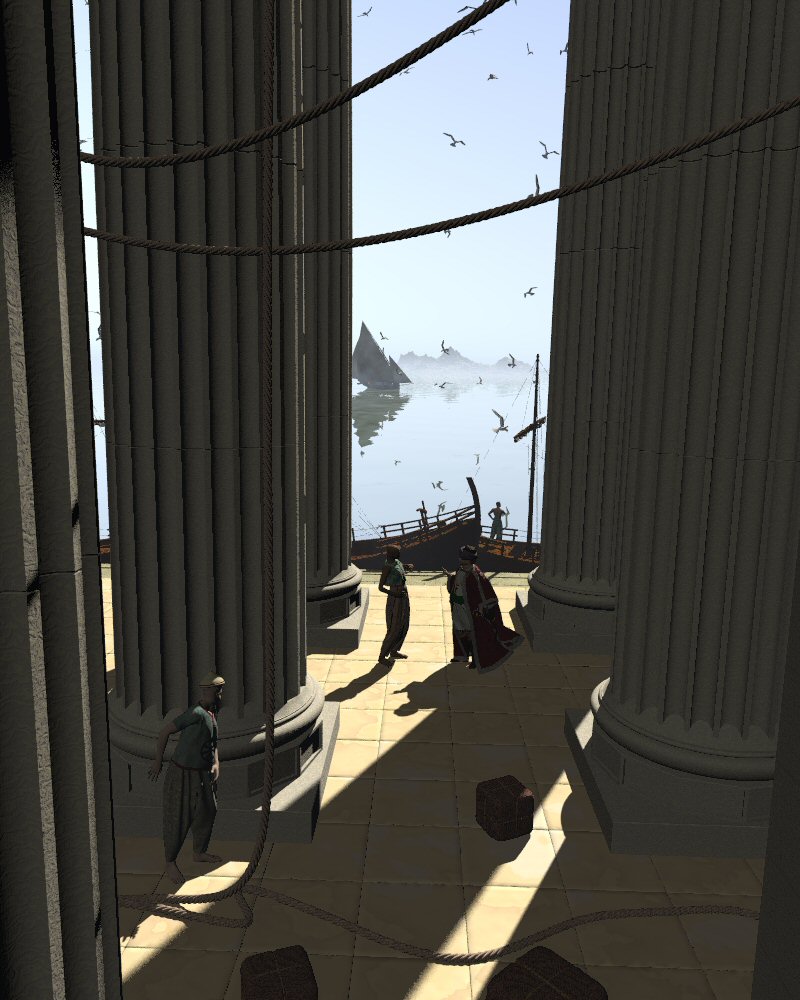
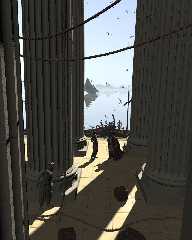
I have returned to last year's 'Eavesdropping', with the new figures I have
been working on for the last couple of months. This is a fast,
non-radiosity, render.

The title could now be: "Iskander learns something to his advantage".

Besides Iskander, the other figures are the Rais Abdul ibn Abdullah (of
course), and a newcomer: captain Adamastor. The place is the city of
Gancaloon, gate to the world of dreams.

Thomas
Post a reply to this message
Attachments:
Download 'Eavesdropping.jpg' (131 KB)
Preview of image 'Eavesdropping.jpg'
|
|
| |
| |
|
|
|
|
| |
| |
|
|
My compliments on your picture. The ropes are especially interesting to me.
Would you mind sharing your technique for creating them? Maybe even share
the source code?

Regards,
Dave
Post a reply to this message
|
|
| |
| |
|
|
|
|
| |
| |
|
|
"Dave Blandston" <nomail@nomail> schreef in bericht
news:web.46ac9a42160602482f98a5e30@news.povray.org...
> My compliments on your picture. The ropes are especially interesting to
> me.
> Would you mind sharing your technique for creating them? Maybe even share
> the source code?
>

Thank you indeed, Dave.
The rope macro is by Mike Williams, which I gladly acknowledge here. :-)
You can find Mike's rope macro here:
http://www.econym.demon.co.uk/pov/rope.htm

Thomas
Post a reply to this message
|
|
| |
| |
|
|
|
|
| |
| |
|
|
> http://www.econym.demon.co.uk/pov/rope.htm
Very ambitious, looks very nice.
Post a reply to this message
|
|
| |
| |
|
|
|
|
| |
| |
|
|
"Thomas de Groot" <t.d### [at] inter nlDOTnet> wrote:
> I have returned to last year's 'Eavesdropping', with the new figures I have
> been working on for the last couple of months. This is a fast,
> non-radiosity, render.
This is coming along nicely. Will we see a glimpse of Cathy skipping along
the quay?
Stephen nlDOTnet> wrote:
> I have returned to last year's 'Eavesdropping', with the new figures I have
> been working on for the last couple of months. This is a fast,
> non-radiosity, render.
This is coming along nicely. Will we see a glimpse of Cathy skipping along
the quay?
Stephen
Post a reply to this message
|
|
| |
| |
|
|
|
|
| |
| |
|
|
"Stephen" <mcavoys_AT_aolDOT.com> schreef in bericht
news:web.46af290816060248c4e49fa40@news.povray.org...
> "Thomas de Groot" <t.d### [at] internlDOTnet> wrote:
>> I have returned to last year's 'Eavesdropping', with the new figures I
>> have
>> been working on for the last couple of months. This is a fast,
>> non-radiosity, render.
>
>
> This is coming along nicely. Will we see a glimpse of Cathy skipping along
> the quay?
>
Hmm... No Cathy in this scene I'm afraid. However, in another one I am
planning, she might indeed appear as one of her avatars. Excellent idea
Stephen!

Thomas
Post a reply to this message
|
|
| |
| |
|
|
|
|
| |
| |
|
|
"Thomas de Groot" <t.d### [at] internlDOTnet> wrote:

> Hmm... No Cathy in this scene I'm afraid. However, in another one I am
> planning, she might indeed appear as one of her avatars. Excellent idea
> Stephen!
>
> Thomas

I thought that it might be a trademark. “Find Cathy in Thomas’s image” :-)

Stephen
Post a reply to this message
|
|
| |
| |
|
|
|
|
| |
| |
|
|
"Stephen" <mcavoys_AT_aolDOT.com> schreef in bericht
news:web.46af4fe116060248c4e49fa40@news.povray.org...
> "Thomas de Groot" <t.d### [at] internlDOTnet> wrote:
>
>> Hmm... No Cathy in this scene I'm afraid. However, in another one I am
>> planning, she might indeed appear as one of her avatars. Excellent idea
>> Stephen!
>>
>> Thomas
>
> I thought that it might be a trademark. "Find Cathy in Thomas's image" :-)
>

Indeed! Your earlier suggestion has given me an idea, and Cathy is going to
appear in this scene. Just wait and see...

Thomas
Post a reply to this message
|
|
| |
| |
|
|
|
|
| |
| |
|
|
Thomas de Groot wrote:
>

Excellent.

Realist full-scenes often impress on a computer screen, but there are
few I can imagine printed on a wall. Realist full-scenes seem so dry in
comparison to abstract, impressionist, or still-life works. This one
will be an exception if you can get an attractive render.

 -Shay
Post a reply to this message
|
|
| |
| |
|
|
From: Thomas de Groot
Subject: Re: Eavesdropping - new WIP (~130kB)
Date: 11 Aug 2007 03:06:09
Message: <46bd5fe1@news.povray.org>
|
|
|
| |
| |
|
|
"Shay" <shay@s.s> schreef in bericht news:46bcab00$1@news.povray.org...
> Thomas de Groot wrote:
>>
>
> Excellent.
Thank you, Shay !
>
> Realist full-scenes often impress on a computer screen, but there are
> few I can imagine printed on a wall. Realist full-scenes seem so dry in
> comparison to abstract, impressionist, or still-life works. This one
> will be an exception if you can get an attractive render.
>
I fully agree. A distinction should be made indeed and these kind of
images/scenes, in my view, are not intended to be hanging on a wall. At
best, they illustrate a story - which is tricky in itself - or they serve as
a basis for a story. They have no function whatsoever on a wall because they
would be rapidly boring and disappointing. I am, at heart, a storyteller and
not a painter. As such, these scenes are the materializations of visions
from my mind's eye.

Thomas
Post a reply to this message
|
|
| |
| |
|
|
|
|
| |
| |
|
|
"Thomas de Groot" <t.d### [at] internlDOTnet> wrote:
> I have returned to last year's 'Eavesdropping', with the new figures I have
> been working on for the last couple of months. This is a fast,
> non-radiosity, render.
>
> The title could now be: "Iskander learns something to his advantage".
>
> Besides Iskander, the other figures are the Rais Abdul ibn Abdullah (of
> course), and a newcomer: captain Adamastor. The place is the city of
> Gancaloon, gate to the world of dreams.
>
> Thomas

Oh, that's a very nice image! Congratulations!
I don't know if there's something wrong with my screen, but the shadow of
the column falling in the middle of the screen has strange fuzzy edges as
if it were painted with an irregural brush in a 2d program (which I don't
doubt for a second that it isn't ;-) ).
The ropes are great, and I can't imagine a pier without them, but the ropes
seemingly dangling from the columns strike me as peculiar.
Post a reply to this message
|
|
| |
| |
|
|
|
|
| |
| |
|
|
Thomas de Groot wrote:
> I fully agree. A distinction should be made indeed and these kind of
> images/scenes, in my view, are not intended to be hanging on a wall.

I hope you didn't miss my point that I believe this scene to be an
exception to that rule - perhaps because it's not as full a scene as it
appears to be. The focus of the image is narrow and obvious. The simple
surroundings frame rather than distract from the subject. Realist
stylizations don't allow for much editorialization, but I think you've
used what tools are available within that stylization very effectively.

 -Shay
Post a reply to this message
|
|
| |
| |
|
|
|
|
| |
| |
|
|
Hey Thomas, it has come about that I am trying to model fluted columns.
  Forgive me if you have talked about it before, but I am wondering how
you are modeling your columns?
Post a reply to this message
|
|
| |
| |
|
|
|
|
| |
| |
|
|
"Shay" <shay@s.s> schreef in bericht news:46bda93a$1@news.povray.org...
> Thomas de Groot wrote:
>> I fully agree. A distinction should be made indeed and these kind of
>> images/scenes, in my view, are not intended to be hanging on a wall.
>
> I hope you didn't miss my point that I believe this scene to be an
> exception to that rule - perhaps because it's not as full a scene as it
> appears to be. The focus of the image is narrow and obvious. The simple
> surroundings frame rather than distract from the subject. Realist
> stylizations don't allow for much editorialization, but I think you've
> used what tools are available within that stylization very effectively.
>

No, no! I got your point, Shay, and thanks indeed for it. It is what I want
to achieve, beyond the strictly anecdotal. Still, I have to say that it is a
difficult balancing act. In a sense, I want the beholder to become an
accomplice in the scene he/she is watching, turning him/her into a peeping
tom as it were.
I want to add one more element to this scene and I am aware that it may
destroy the effect, making it too explicit. If that is so, I shall leave it
out.

Thomas
Post a reply to this message
|
|
| |
| |
|
|
|
|
| |
| |
|
|
"Grassblade" <nomail@nomail> schreef in bericht
news:web.46bd944716060248364ceeb90@news.povray.org...
> Oh, that's a very nice image! Congratulations!
Thank you!

> I don't know if there's something wrong with my screen, but the shadow of
> the column falling in the middle of the screen has strange fuzzy edges as
> if it were painted with an irregural brush in a 2d program (which I don't
> doubt for a second that it isn't ;-) ).

What you see is the area_light effect. I may squeeze it a bit more indeed...

> The ropes are great, and I can't imagine a pier without them, but the
> ropes
> seemingly dangling from the columns strike me as peculiar.

Well, I can only say that this is a peculiar place. ;-)
As far as I know, it is an ancient temple turned into a storehouse because
of its convenient location alongside the harbour. So, all kinds of pullies
and ropes have been attached to the ceiling etc...

Thomas
Post a reply to this message
|
|
| |
| |
|
|
From: Thomas de Groot
Subject: Re: Eavesdropping - new WIP (~130kB)
Date: 12 Aug 2007 04:04:07
Message: <46bebef7@news.povray.org>
|
|
|
| |
| |
|
|
"Jim Charter" <jrc### [at] msncom> schreef in bericht
news:46bdd4f2$1@news.povray.org...
>
> Hey Thomas, it has come about that I am trying to model fluted columns.
>  Forgive me if you have talked about it before, but I am wondering how
> you are modeling your columns?

It has been a couple of years since I modelled these, so let me ponder...
(The first version I made in Wings3D, before switching everything over to
Silo)

I followed the Greek guideline that says that a column, to be appealing to
the eye, should not be a simple cone shape but bulge a tiny bit out at the
middle. I acchieved this by using a vertically very elongated sphere, cut at
the middle (i.e. the base of the column) and at the place where the top
should be. You have to experiment with the vertical elongation until you
have both bottom and top diameters correctly. An easy way to do this is to
first make a proxy model in Moray to get the measurements needed.

Once the shaft of the column is thus obtained, I used (again) vertically
very elongated toruses so that the curvature matched the curvature of the
shaft. Again, a proxy in Moray can help but is not strictly necessary. The
toruses have to be cut to the correct length of the flutes, provided with a
top end (a sphere) and a bottom end (an inclined section). Then, by boolean
substraction from the shaft, the flutes are successively modelled into the
column shaft.

If you want to follow the classical rules, number and form of the flutes are
fixed, but that is another discussion entirely.

Once you have the shaft modelled to your satisfaction, you can model
separately the different elements that form the base of the column, and the
top. The top part is particularly challenging because of the distinctive
capitals. I have not attempted the Corynthian order!! The Ionian order is
already difficult enough. I used a background image as a proxy for modelling
that particular spiral shape.

I won't speak now about corner columns!!! They have their own challenges in
the way to model the capitals.

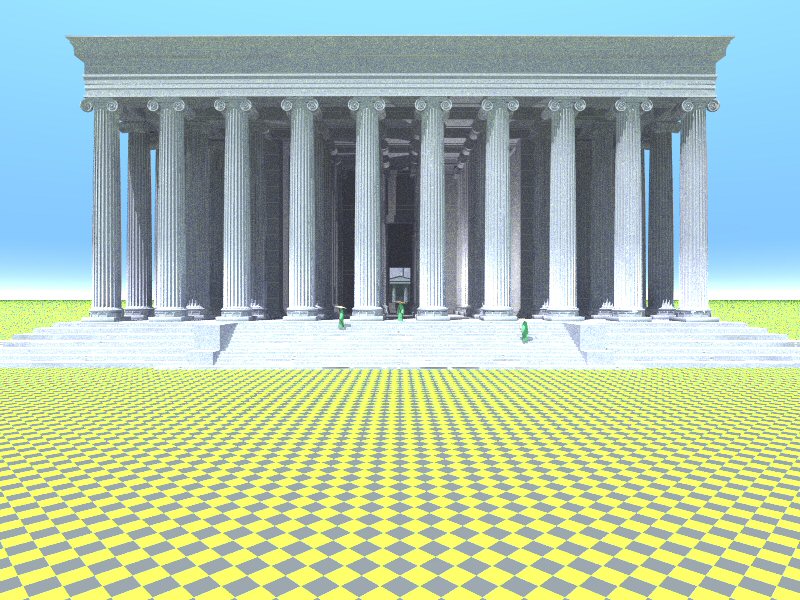
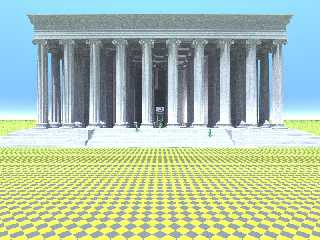
The result is shown in this low resolution image when I finished building
the complete temple.

Any doubts or questions? Just ask  :-)

Thomas
Post a reply to this message
Attachments:
Download 'ApolloTemple_11.jpg' (152 KB)
Preview of image 'ApolloTemple_11.jpg'
|
|
| |
| |
|
|
|
|
| |
| |
|
|
Thomas de Groot wrote:

>
> I followed the Greek guideline that says that a column, to be appealing to
> the eye, should not be a simple cone shape but bulge a tiny bit out at the
> middle. I acchieved this by using a vertically very elongated sphere, cut at
> the middle (i.e. the base of the column) and at the place where the top
> should be. You have to experiment with the vertical elongation until you
> have both bottom and top diameters correctly. An easy way to do this is to
> first make a proxy model in Moray to get the measurements needed.

Yes, my approach too.  I saw somewhere on the web that Roman columns
have more of a middle bulge but Greek have a curved taper but the base
is the thickest.  No idea if they knew what they were talking about.
http://www.uen.org/Centennial/08BuildingsA.html


>
> Once the shaft of the column is thus obtained, I used (again) vertically
> very elongated toruses so that the curvature matched the curvature of the
> shaft. Again, a proxy in Moray can help but is not strictly necessary. The
> toruses have to be cut to the correct length of the flutes, provided with a
> top end (a sphere) and a bottom end (an inclined section). Then, by boolean
> substraction from the shaft, the flutes are successively modelled into the
> column shaft.

Interestting.  So even though you are using mesh you used boolean
subtraction of torii?  Again I have been trying exactly the same
approach but with POV CSG.  The problem I had was getting the
circumference of the torus to decrease at an rate appropriate to the
diminishing circumference of the tapering shaft.

The other problem was how to position the spheres to difference out at
the top of the flutes.  The solution I thought for the second issue was
to begin with a sphere of radius square root two.  Then if I made the
cap of the column at height one unit before scaling, the radius there
would always be one unit no matter how I scaled it vertically, and using
the supposed Greek model, the bottom radius would remain root two. So
differencing spheres at both the top and bottoms of the column would be
a known quantity.  (Actually with a little more calculation a narrower
base could also be scaled down in the negative direction and have the
radius remain known)

But what screwed this method up was the fact that the vertically scaled
torii do not have a diminishing footprint on the diminishing
circumference of the shaft.  By overscaling by 5/4 vertically, (ie if I
wanted the top of the shaft to be at 20 units, I would scale the sphere
and torii by 25 times vertically), I managed to get the relationship
between the torii and the shaft circumference to look okay to the eye,
at least, though the flutes are still narrower at the base than at the
top.  But as soon as I did that I lost my ability to exactly position
the spheres at the top.  If there is a mathematical relationship
describing what the radius would be at the 4/5 point I couldn't find it.
  I finally managed an 'eyeballed' solution for positioning the spheres
but this feels as unsatisfying in so far as I doubt it would hold up for
different ratios of height to radius.

The obvious advantage of mesh it is that the polys match the contour of
the surface so that a vertical line of polys could be used to shape a
flute which would diminish in size appropriately. So now I an curious as
to why you used the boolean approach.


>
> If you want to follow the classical rules, number and form of the flutes are
> fixed, but that is another discussion entirely.

I would be intereseted if you have any references.  Right now I am using
18 flutes, so a 20 degree rotation.


>
> Once you have the shaft modelled to your satisfaction, you can model
> separately the different elements that form the base of the column, and the
> top. The top part is particularly challenging because of the distinctive
> capitals. I have not attempted the Corynthian order!! The Ionian order is
> already difficult enough. I used a background image as a proxy for modelling
> that particular spiral shape.

Yeah, I'll give that a wait.  Actually for my purposes I can diverge
from the strictly classical and indulge myself with my own caprices as
well as any 19th century neoclassical architect


>
> I won't speak now about corner columns!!! They have their own challenges in
> the way to model the capitals.

Hasn't come since it is a circular collonade but will remember that when
tempted to do the other.

>
> The result is shown in this low resolution image when I finished building
> the complete temple.

Very nice.  I am also impresses with the texture in 'Eavesdropping',
which, if you are using mesh, must be a perturbed normal?

-Jim
Post a reply to this message
|
|
| |
| |
|
|
From: Thomas de Groot
Subject: Re: Eavesdropping - new WIP (~130kB)
Date: 13 Aug 2007 04:00:31
Message: <46c00f9f@news.povray.org>
|
|
|
| |
| |
|
|
"Jim Charter" <jrc### [at] msncom> schreef in bericht
news:46bf60d1$1@news.povray.org...
[...]
> The obvious advantage of mesh it is that the polys match the contour of
> the surface so that a vertical line of polys could be used to shape a
> flute which would diminish in size appropriately. So now I an curious as
> to why you used the boolean approach.
>
I woke up this night with the sudden thought that I only used the boolean
approach with the Moray proxy. I remember now (It has been about 4 years ago
and I should have taken notes) that I modelled the flutes by moving the
appropriate faces inwards from the surface of the mesh shaft and
handcrafting the top and bottom. As you say, there are serious problems with
the boolean approach where the size of the flutes is concerned.
I think now that an easier workflow would be to slice a pie section from a
featureless shaft, exactly covering one flute width and twice the half rib
widths; to craft the flute and finally to apply a rotational sweep to
restore the complete shaft.

>
>>
>> If you want to follow the classical rules, number and form of the flutes
>> are fixed, but that is another discussion entirely.
>
> I would be intereseted if you have any references.  Right now I am using
> 18 flutes, so a 20 degree rotation.
24 seems to have been the general use in antiquity, at least in the
classical period. However, older columns could have up to 48 flutes. Ribs
were sharp during the Doric Order period, but flat (with deeper flutes)
later.
>
>
>>
>> Once you have the shaft modelled to your satisfaction, you can model
>> separately the different elements that form the base of the column, and
>> the top. The top part is particularly challenging because of the
>> distinctive capitals. I have not attempted the Corynthian order!! The
>> Ionian order is already difficult enough. I used a background image as a
>> proxy for modelling that particular spiral shape.
>
> Yeah, I'll give that a wait.  Actually for my purposes I can diverge from
> the strictly classical and indulge myself with my own caprices as well as
> any 19th century neoclassical architect
Great! :-)
That makes it a bit easier. My (calculated) handicap was that I wanted to
reconstruct the real thing. I had to make concessions of course.

>
>>
>> I won't speak now about corner columns!!! They have their own challenges
>> in the way to model the capitals.
>
> Hasn't come since it is a circular collonade but will remember that when
> tempted to do the other.
No problem then indeed.

>>
>> The result is shown in this low resolution image when I finished building
>> the complete temple.
>
> Very nice.  I am also impresses with the texture in 'Eavesdropping',
> which, if you are using mesh, must be a perturbed normal?
Yes, that is right.

Thomas
Post a reply to this message
|
|
| |
| |
|
|
|
|
| |
| |
|
|
"Jim Charter" <jrc### [at] msncom> schreef in bericht
news:46bf60d1$1@news.povray.org...
> Thomas de Groot wrote:
>
>>
>> I followed the Greek guideline that says that a column, to be appealing
>> to the eye, should not be a simple cone shape but bulge a tiny bit out at
>> the middle. I acchieved this by using a vertically very elongated sphere,
>> cut at the middle (i.e. the base of the column) and at the place where
>> the top should be. You have to experiment with the vertical elongation
>> until you have both bottom and top diameters correctly. An easy way to do
>> this is to first make a proxy model in Moray to get the measurements
>> needed.
>
> Yes, my approach too.  I saw somewhere on the web that Roman columns have
> more of a middle bulge but Greek have a curved taper but the base is the
> thickest.  No idea if they knew what they were talking about.
> http://www.uen.org/Centennial/08BuildingsA.html
Yes, the entasis (I forgot the name). I followed the Greek method.
Interestingly, I have a paper describing the 'blueprints' used by the Greek
in constructing the Apollo temple at Didyma in Turkey. They scratched the
plans on the walls or the floor under construction and took their
measurements from there. After completion, walls and floors were polished
and the scratchings removed. Thanks to the fact that the Apollo temple was
never finished, the blueprints survived.
In the same temple can be seen that they first built the columns and only
afterwards carved the flutes. The following French site gives some fair
examples of the ruins.
http://jfbradu.free.fr/GRECEANTIQUE/turquie/didymes/didymes-bas.htm

Thomas
Post a reply to this message
|
|
| |
| |
|
|
|
|
| |
| |
|
|
Jim Charter wrote:

> ... you used boolean subtraction of torii?  Again I have been
> trying exactly the same approach but with POV CSG.  The problem
> I had was getting the circumference of the torus to decrease at
> an rate appropriate to the diminishing circumference of the tapering
> shaft.

How about sphere_sweeps for column and flutes? Evaluating the spline
functions would give any circumference you need.

 -Shay
Post a reply to this message
|
|
| |
| |
|
|
From: Thomas de Groot
Subject: Re: Eavesdropping - new WIP (~130kB)
Date: 15 Aug 2007 05:15:26
Message: <46c2c42e@news.povray.org>
|
|
|
| |
| |
|
|
"Stephen" <mcavoys_AT_aolDOT.com> schreef in bericht
news:web.46af290816060248c4e49fa40@news.povray.org...
>
> This is coming along nicely. Will we see a glimpse of Cathy skipping along
> the quay?
>

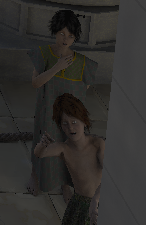
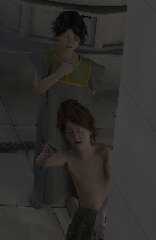
Well Stephen, look at this little vignette, taken from the lower right-hand
corner of the image. I have added Cathy (and her little brother), and it
seems that the observer/beholder has been exposed  :-)
This is a small test render using radiosity to see how that is going to
affect the scene.

Not so visible here, but I have used Soft Decoration Groups (Poser Cloth
Room) for the yellow braids on Cathy's dress. Up close, these show as the
three dimensional decorations they are in reality.

Thomas
Post a reply to this message
Attachments:
Download 'Oreille Indiscrete.png' (40 KB)
Preview of image 'Oreille Indiscrete.png'
|
|
| |
| |
|
|
|
|
| |
| |
|
|
"Thomas de Groot" <t.d### [at] internlDOTnet> wrote:
> "Stephen" <mcavoys_AT_aolDOT.com> schreef in bericht
> news:web.46af290816060248c4e49fa40@news.povray.org...
> >
> > This is coming along nicely. Will we see a glimpse of Cathy skipping along
> > the quay?
> >
>
> Well Stephen, look at this little vignette, taken from the lower right-hand
> corner of the image. I have added Cathy (and her little brother), and it
> seems that the observer/beholder has been exposed  :-)
> This is a small test render using radiosity to see how that is going to
> affect the scene.
>
> Not so visible here, but I have used Soft Decoration Groups (Poser Cloth
> Room) for the yellow braids on Cathy's dress. Up close, these show as the
> three dimensional decorations they are in reality.
>
> Thomas

Oh! That is intriguing. A bit small and out of context not to mention it is
a bit dark for my monitor. But I’ve mentioned that before :-) Is there
something wrong with their eyes? When I adjusted the size and contrast to
see it better the eyes look strange. I’ve noticed in a couple of my models
that I had to tweak the “Eyeball” material’s transparency because I was
getting a white eye look.

Stephen
Post a reply to this message
|
|
| |
| |
|
|
From: Thomas de Groot
Subject: Re: Eavesdropping - new WIP (~130kB)
Date: 15 Aug 2007 07:23:04
Message: <46c2e218@news.povray.org>
|
|
|
| |
| |
|
|
"Stephen" <mcavoys_AT_aolDOT.com> schreef in bericht
news:web.46c2d09716060248c4e49fa40@news.povray.org...
>
> Oh! That is intriguing. A bit small and out of context not to mention it
> is
> a bit dark for my monitor. But I've mentioned that before :-) Is there
> something wrong with their eyes? When I adjusted the size and contrast to
> see it better the eyes look strange. I've noticed in a couple of my models
> that I had to tweak the "Eyeball" material's transparency because I was
> getting a white eye look.
>

It is the same scale as the main image and is not intended to intrude too
much on the main story. It is a kind of sideline. And remember, we are in
the shadow here, the only light coming from the sunlight reflection on the
wall to the right, and diffused light coming from the left.

The eyeballs have been corrected with M_Glass3 (which FlyerX advised me to
use). I suppose that what you see is the reflection of the sunlight that is
reflected from the wall. However, the anti aliasing (0.3) is too coarse for
this image and should be finer. In the final render this will be brought
down to 0.1. Otherwise, I 'know' that the eyes are rendered correctly. Both
of them looking upwards increases in fact the amount of white visible too.

Thomas
Post a reply to this message
|
|
| |
| |
|
|
|
|
| |
| |
|
|
"Thomas de Groot" <t.d### [at] internlDOTnet> schreef in bericht
news:46c2e218@news.povray.org...
>
>
> The eyeballs have been corrected with M_Glass3 (which FlyerX advised me to
> use). I suppose that what you see is the reflection of the sunlight that
> is reflected from the wall. However, the anti aliasing (0.3) is too coarse
> for this image and should be finer. In the final render this will be
> brought down to 0.1. Otherwise, I 'know' that the eyes are rendered
> correctly. Both of them looking upwards increases in fact the amount of
> white visible too.
>

I can confirm this now: I rendered only the eyes with aa=0.01 and they
appear correctly, without white glare.

Thomas
Post a reply to this message
|
|
| |
| |
|
|
|
|
| |
| |
|
|
"Thomas de Groot" <t.d### [at] internlDOTnet> wrote:
> "Thomas de Groot" <t.d### [at] internlDOTnet> schreef in bericht
> news:46c2e218@news.povray.org...
> >
> >
> > The eyeballs have been corrected with M_Glass3 (which FlyerX advised me to
> > use). I suppose that what you see is the reflection of the sunlight that
> > is reflected from the wall. However, the anti aliasing (0.3) is too coarse
> > for this image and should be finer. In the final render this will be
> > brought down to 0.1. Otherwise, I 'know' that the eyes are rendered
> > correctly. Both of them looking upwards increases in fact the amount of
> > white visible too.
> >
>
> I can confirm this now: I rendered only the eyes with aa=0.01 and they
> appear correctly, without white glare.
>
> Thomas

I like the idea of having a little in joke that is unobtrusive. The problem
here is, any image will be looked at critically with respect to the poster,
yours, amongst others more than most. (Your own fault for being so good :-)
It’s interesting that FlyerX suggested M_Glass3 I’ve just been maxing the
PoseRay transparency.
Anti aliasing is something I’ve been experimenting with recently, trying to
get the fastest acceptable value for an animation. I’m having fun.

I'm looking forward to the next version.

Stephen
Post a reply to this message
|
|
| |
| |
|
|
|
|
| |
| |
|
|
"Stephen" <mcavoys_AT_aolDOT.com> schreef in bericht
news:web.46c30e8216060248c4e49fa40@news.povray.org...
>
> I like the idea of having a little in joke that is unobtrusive. The
> problem
> here is, any image will be looked at critically with respect to the
> poster,
> yours, amongst others more than most. (Your own fault for being so good
> :-)

Hm hm hm... I shall refrain from posting from now on..... :-)
Well, there is nothing wrong with a good bunch of criticism. Over the years
that has helped me a lot, sometimes by just discarding it as nonsense   :-)
In the end, one has to make one's own choices.
The idea of a little joke embedded in the image is always at the back of my
mind. Sometimes it is functional, sometimes not. In this case, I believe it
can add an interesting item: the observer is confronted to different story
lines, one as a neutral observer, one as a participant into the main drama
plot, one as an actor in the juvenile side story. Others may come to mind I
am sure. That is left to the observer.

> It's interesting that FlyerX suggested M_Glass3 I've just been maxing the
> PoseRay transparency.
To a question I asked him about the transparency issue with the eyes (Apollo
Maximus), FlyerX answered as follows
<quote>
In my opinion the iris for this model should not have any highlight. All the
surface gloss should come from the cornea and EyeWhite materials. If the
cornea is set to material{M_Glass3} and the iris set to black highlight you
should get a better result. See attached image. You can go into the POV-Ray
material tab and add the Glass3 material to the cornea. PoseRay will send
that material to POV-Ray at render time. For Victoria 2 models I also use
M_Glass3 as the eyeball material that covers the eye and gives much better
results that any Poser related material.
<unquote>

> Anti aliasing is something I've been experimenting with recently, trying
> to
> get the fastest acceptable value for an animation. I'm having fun.
I suppose that for an animation you can get away with a coarser anti
aliasing?

>
> I'm looking forward to the next version.
Wait and see :-) May take some time now because I am going to render with
radiosity...

Thomas
Post a reply to this message
|
|
| |
| |
|
|
|
|
| |
| |
|
|
"Thomas de Groot" <t.d### [at] internlDOTnet> wrote:
> "Stephen" <mcavoys_AT_aolDOT.com> schreef in bericht
> news:web.46c30e8216060248c4e49fa40@news.povray.org...
> >
> > I like the idea of having a little in joke that is unobtrusive. The
> > problem
> > here is, any image will be looked at critically with respect to the
> > poster,
> > yours, amongst others more than most. (Your own fault for being so good
> > :-)
>
> Hm hm hm... I shall refrain from posting from now on..... :-)
> Well, there is nothing wrong with a good bunch of criticism. Over the years
> that has helped me a lot, sometimes by just discarding it as nonsense   :-)
> In the end, one has to make one's own choices.

Oh please don’t stop posting. Peer review is always useful even if only to
confirm what a bunch of nitpicker we are :-)

> The idea of a little joke embedded in the image is always at the back of my
> mind. Sometimes it is functional, sometimes not. In this case, I believe it
> can add an interesting item: the observer is confronted to different story
> lines, one as a neutral observer, one as a participant into the main drama
> plot, one as an actor in the juvenile side story. Others may come to mind I
> am sure. That is left to the observer.

I’m interested in this both aesthetically and from something Sherry Shaw
said earlier about the way scenes are built. IIRC she preferred to build
scenes from the top down while I prefer to build them from the bottom up. I
find that my final image can vary considerably from my original concept as
each new object/character influences the way the scene develops. Sometimes
for technical reasons, often because the addition sends my mind’s eye in
another direction. Keep up including you family as a motif.


> > It's interesting that FlyerX suggested M_Glass3 I've just been maxing the
> > PoseRay transparency.
> To a question I asked him about the transparency issue with the eyes (Apollo
> Maximus), FlyerX answered as follows
[snip]

I did not have much time to look into this. My “Don” had the eyes of a blind
Kung Fu master. So I just eliminated the problem.

> > Anti aliasing is something I've been experimenting with recently, trying
> > to
> > get the fastest acceptable value for an animation. I'm having fun.
> I suppose that for an animation you can get away with a coarser anti
> aliasing?

I certainly hope so but as there is a lot of static components and I made
the mistake of using a CSG to make fluting on a couple of columns that give
a moiré effect with a perspective camera. No time to change it now.

> >
> > I'm looking forward to the next version.
> Wait and see :-) May take some time now because I am going to render with
> radiosity...
>

Have a book to hand.
BTW I've kept a couple of Ken Macleod paperbacks if you want them. Now I'm
here the postage would not signify

Stephen
Post a reply to this message
|
|
| |
| |
|
|
From: Thomas de Groot
Subject: Eavesdropping - final pre-radiosity WIP (~120kB)
Date: 16 Aug 2007 06:04:07
Message: <46c42117@news.povray.org>
|
|
|
| |
| |
|
|
"Stephen" <mcavoys_AT_aolDOT.com> schreef in bericht
news:web.46c4154216060248c4e49fa40@news.povray.org...
>
> Oh please don't stop posting. Peer review is always useful even if only to
> confirm what a bunch of nitpicker we are :-)
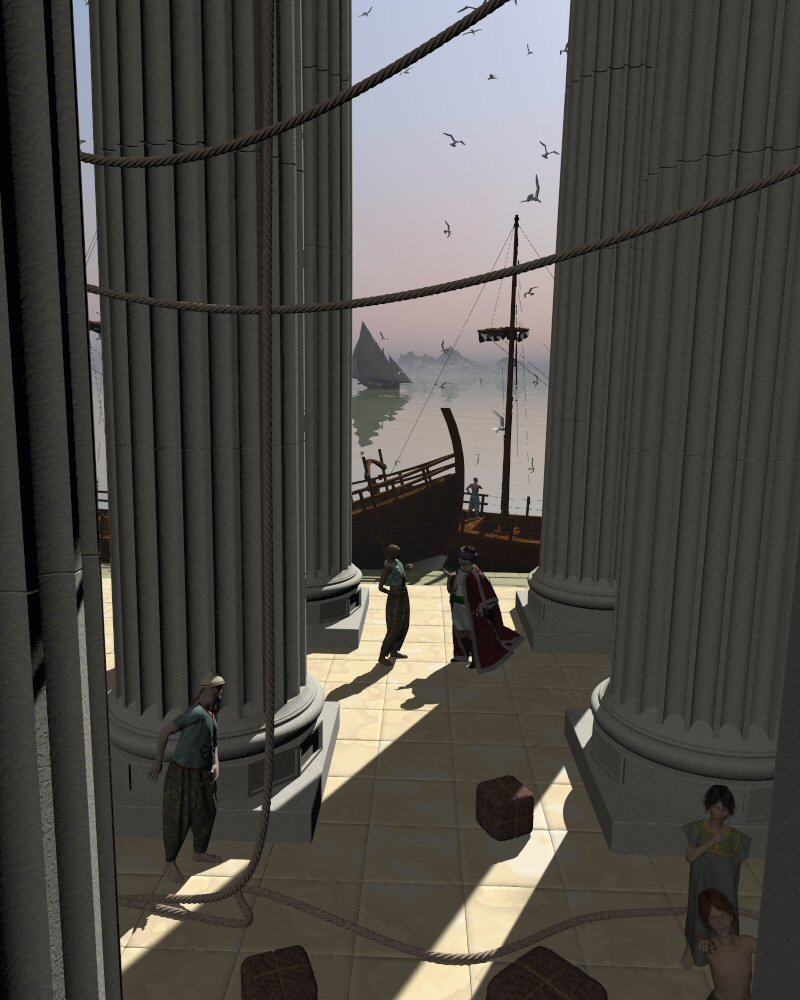
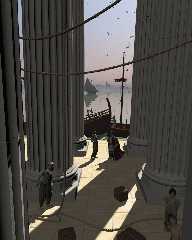
Allright. You asked for it. Here is a final WIP in pre-radiosity format,
with all latest changes (amongst others the use of LightSys)


>>
>
> Have a book to hand.
> BTW I've kept a couple of Ken Macleod paperbacks if you want them. Now I'm
> here the postage would not signify
Hey! That would be fantastic! Thank you! I'll send you my address
separately.

Thomas
Post a reply to this message
Attachments:
Download 'Eavesdropping.jpg' (120 KB)
Preview of image 'Eavesdropping.jpg'
|
|
| |
| |
|
|
|
|
| |
| |
|
|
"Thomas de Groot" <t.d### [at] internlDOTnet> wrote:
> "Stephen" <mcavoys_AT_aolDOT.com> schreef in bericht
> news:web.46c4154216060248c4e49fa40@news.povray.org...
> >
> > Oh please don't stop posting. Peer review is always useful even if only to
> > confirm what a bunch of nitpicker we are :-)
> Allright. You asked for it. Here is a final WIP in pre-radiosity format,
> with all latest changes (amongst others the use of LightSys)
>

I’ve not got time to look at this at work so later … :-)
> >>
> >
> > Have a book to hand.
> > BTW I've kept a couple of Ken Macleod paperbacks if you want them. Now I'm
> > here the postage would not signify
> Hey! That would be fantastic! Thank you! I'll send you my address
> separately.
>

I’ll look them out this weekend. I’ll be interested in your opinion.
I do a lot of reading when I’m Poving :-)


Stephen
Post a reply to this message
|
|
| |
| |
|
|
|
|
| |
| |
|
|
Shay wrote:

>
> How about sphere_sweeps for column and flutes? Evaluating the spline
> functions would give any circumference you need.
>


I am not really sure there is support for an interpolated or function
driven reduction of the radius in the sphere_sweep syntax but I have
only ever looked at it briefly. In any case I still would not be able to
compose such a function.

So I'll take a look. Of course I can improvise my own.  (I guess I do
that sort of thing a lot an so was hoping for some other way.)  Since
you prodded me with this post, though, I will probably improvise
something with spheres and cones along a spline.  I'll build the spline
using the trace function and sample the sphere surface after it is
already scaled.  I'll do it just to see how it works.

But constructing the thing in mesh is far and away the pragmatic
approach, it now seems obvious.
Post a reply to this message
|
|
| |
| |
|
|
|
|
| |
| |
|
|
Thomas de Groot wrote:


> I think now that an easier workflow would be to slice a pie section from a
> featureless shaft, exactly covering one flute width and twice the half rib
> widths; to craft the flute and finally to apply a rotational sweep to
> restore the complete shaft.
>

Thanks for that.  Probably how I will proceed.


>
>>>If you want to follow the classical rules, number and form of the flutes
>>>are fixed, but that is another discussion entirely.
>>
>>I would be intereseted if you have any references.  Right now I am using
>>18 flutes, so a 20 degree rotation.
>
> 24 seems to have been the general use in antiquity, at least in the
> classical period. However, older columns could have up to 48 flutes. Ribs
> were sharp during the Doric Order period, but flat (with deeper flutes)
> later.
>
>>

Interesting.  I have been making counts of visible flutes on coluns here
and there, (including the new MMA classical wing,) then doubling the
number, but it never seems quite that many.  I will have to pay closer
attention.
Post a reply to this message
|
|
| |
| |
|
|
|
|
| |
| |
|
|
"Jim Charter" <jrc### [at] msncom> a écrit dans le message de news:
46c5dabe$1@news.povray.org...
> Shay wrote:
>
>
>
> I am not really sure there is support for an interpolated or function
> driven reduction of the radius in the sphere_sweep syntax but I have only
> ever looked at it briefly. In any case I still would not be able to
> compose such a function.
>
Does that  fit your needs?

#declare P1=.7;
#declare P2=.9;
#declare P3=1.1;
#declare P4=1.15;


#declare Shaft=
sphere_sweep {

  cubic_spline

  5,
  <0, 7.5, 0>, P1
  <0, 5.5, 0>, P2
  <0, 0, 0>,P3
  <0, -5.5, 0>,P4
  <0, -7.5, 0>, P4
  pigment {color rgb 1 }
}

 #declare Flute =
  sphere_sweep {
  cubic_spline
  5,
  <P1, 7.5, 0>, 0.1
  <P2, 5, 0>, .1
  <P3, 0, 0>, .1
  <P4, -5, 0>,.1
  <P4, -7.5, 0>, .1
pigment {color rgb 1  }
}

#declare Flutes= union{
#declare C_Flute =0;

#while (C_Flute<20)
object{Flute rotate y*18*C_Flute}
   #declare C_Flute =C_Flute+1;
#end
}
difference{
object{Shaft}
object{Flutes}
}
Post a reply to this message
|
|
| |
| |
|
|
|
|
| |
| |
|
|
M_a_r_c wrote:

Thanks, yes, the constant radius on your flutes are one of the problems
I wanted to overcome, but obviously, tha can be adjusted by eyeball or a
static calulation beforehand, and I now see the possibilities.  Also it
renders much faster than my spline solution.
Post a reply to this message
|
|
| |
| |
|
|
|
|
| |
| |
|
|
"Jim Charter" <jrc### [at] msncom> a écrit dans le message de news:
46c615ec$1@news.povray.org...
> M_a_r_c wrote:
>
> Thanks, yes, the constant radius on your flutes are one of the problems I
> wanted to overcome, but obviously, tha can be adjusted by eyeball or a
> static calulation beforehand, and I now see the possibilities.  Also it
> renders much faster than my spline solution.

I didn't study the greek architecture, it's a fast try at a sphere_sweep
solution as Shay suggested :-)
I wondered wether the flute radius had to be constant or not but I see no
problem at making it vary as a fraction of the shaft radius.
That's better I think.


#declare P1=.7;
#declare P2=.9;
#declare P3=1.6;  // Obelix nudged my elbow here ;-) just to show as flute
radius follows shaft radius... better with 1.1
#declare P4=1.15;


#declare Shaft=
sphere_sweep {

  cubic_spline

  5,
  <0, 12.5, 0>, P1
  <0, 10.0, 0>, P2
  <0, 5, 0>,P3
  <0, 0.0, 0>,P4
  <0, -2.5, 0>, P4

}

#local N_flutes=20; //Number of flutes
#local Flute_Ratio=.95; //flute radial coverage
#local F_fctr=pi*Flute_Ratio/N_flutes;

 #declare Flute =
  sphere_sweep {
  cubic_spline
  5,
  <P1,  12.5,  0>, F_fctr*P1
  <P2,   10,   0>, F_fctr*P2
  <P3,   5,   0>, F_fctr*P3
  <P4,  0,   0>, F_fctr*P4
  <P4,  -2.5, 0>, F_fctr*P4
}

#declare Flutes= union{
#declare C_Flute =0;

#while (C_Flute<20)
object{Flute rotate y*C_Flute*360/N_flutes}
   #declare C_Flute =C_Flute+1;
#end
}
difference{
object{Shaft}
object{Flutes}
 pigment {color rgb 1 }
}
Post a reply to this message
|
|
| |
| |
|
|
|
|
| |
| |
|
|
"M_a_r_c" <jac### [at] wanadoofr> a écrit dans le message de news:
46c6b8cb$1@news.povray.org...
Last one, I think, now radius and y coordinate declared in the same 2d
vector
// radius and y coordinate declared in same 2d vector

#declare P1=<.7,12.5>;
#declare P2=<.9,10>;
#declare P3=<1.1,5>;
#declare P4=<1.15,0>;
#declare P5=<1.1,-2.5>;


#declare Shaft=
sphere_sweep {

  cubic_spline

  5,
  <0, P1.y, 0>, P1.x
  <0, P2.y, 0>, P2.x
  <0, P3.y, 0>, P3.x
  <0, P4.y, 0>, P4.x
  <0, P5.y, 0>, P5.x

}

#local N_flutes=25; //Number of flutes
#local Flute_Ratio=.9; //flute radial coverage
#local F_fctr=pi*Flute_Ratio/N_flutes;

 #declare Flute =
  sphere_sweep {
  cubic_spline
  5,
  <P1.x, P1.y, 0>, F_fctr*P1.x
  <P2.x, P2.y, 0>, F_fctr*P2.x
  <P3.x, P3.y, 0>, F_fctr*P3.x
  <P4.x, P4.y, 0>, F_fctr*P4.x
  <P5.x, P5.y, 0>, F_fctr*P4.x
}
Post a reply to this message
|
|
| |
| |
|
|
|
|
| |
| |
|
|
"M_a_r_c" <jac### [at] wanadoofr> a écrit dans le message de news:
46c6c1cf$1@news.povray.org...
Ooops

 #declare Flute =
  sphere_sweep {
  cubic_spline
  5,
  <P1.x, P1.y, 0>, F_fctr*P1.x
  <P2.x, P2.y, 0>, F_fctr*P2.x
  <P3.x, P3.y, 0>, F_fctr*P3.x
  <P4.x, P4.y, 0>, F_fctr*P4.x
  <P5.x, P5.y, 0>, F_fctr*P5.x  // not F_fctr*P4.x as in previous post
 }


Marc
Post a reply to this message
|
|
| |
| |
|
|
|
|
| |
| |
|
|
M_a_r_c wrote:
> "M_a_r_c" <jac### [at] wanadoofr> a écrit dans le message de news:
> 46c6c1cf$1@news.povray.org...
> Ooops
>
>  #declare Flute =
>   sphere_sweep {
>   cubic_spline
>   5,
>   <P1.x, P1.y, 0>, F_fctr*P1.x
>   <P2.x, P2.y, 0>, F_fctr*P2.x
>   <P3.x, P3.y, 0>, F_fctr*P3.x
>   <P4.x, P4.y, 0>, F_fctr*P4.x
>   <P5.x, P5.y, 0>, F_fctr*P5.x  // not F_fctr*P4.x as in previous post
>  }
>
>
> Marc
>
>
Poifect!  Thanks, I am immediately switching to this method.
Post a reply to this message
|
|
| |
| |
|
|
|
|
| |
|
|