|
|
|
|
|
|
| |
| |
|
|
|
|
| |
| |
|
|
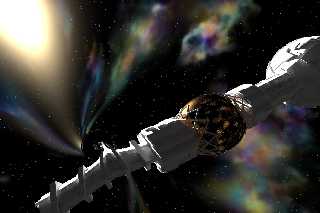
I seem to be suffering a bit of creative drought.

I had no idea what to POV next, but when I saw Gail Shaw's post I thought
"ooh I'd like to do a space ship!", then I saw Skip Talbot's post and
thought "ooh I'd like to fake a nebula in 2D on the sky_sphere". So in
addition to ripping off their ideas I also decided to rip off the films 2001
and Sphere. The only slightly original idea here was the black hole, though
it's no coincidence that the idea occured after I saw the current 3Drtc
topic: "the black cloak".

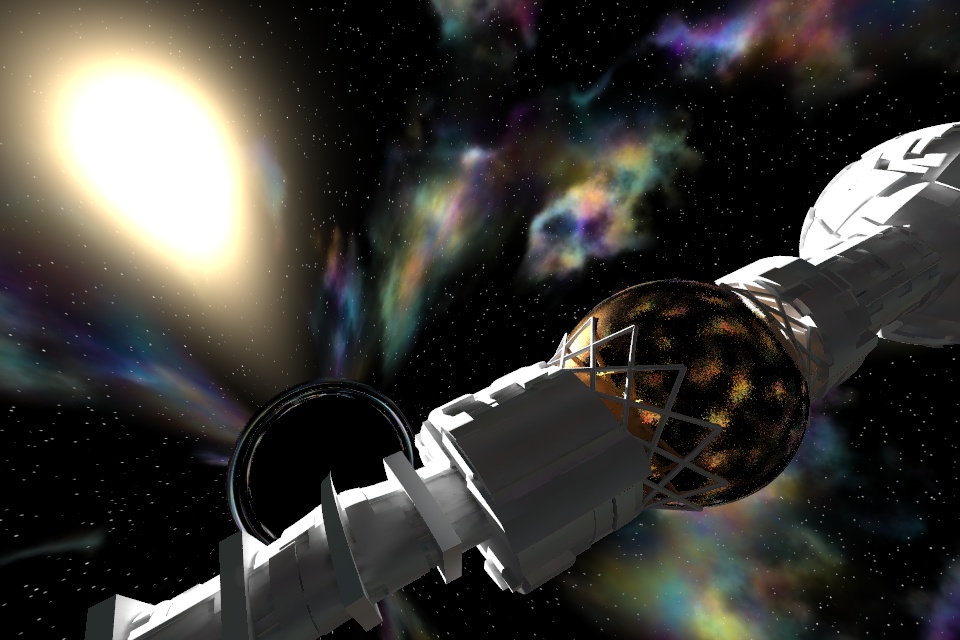
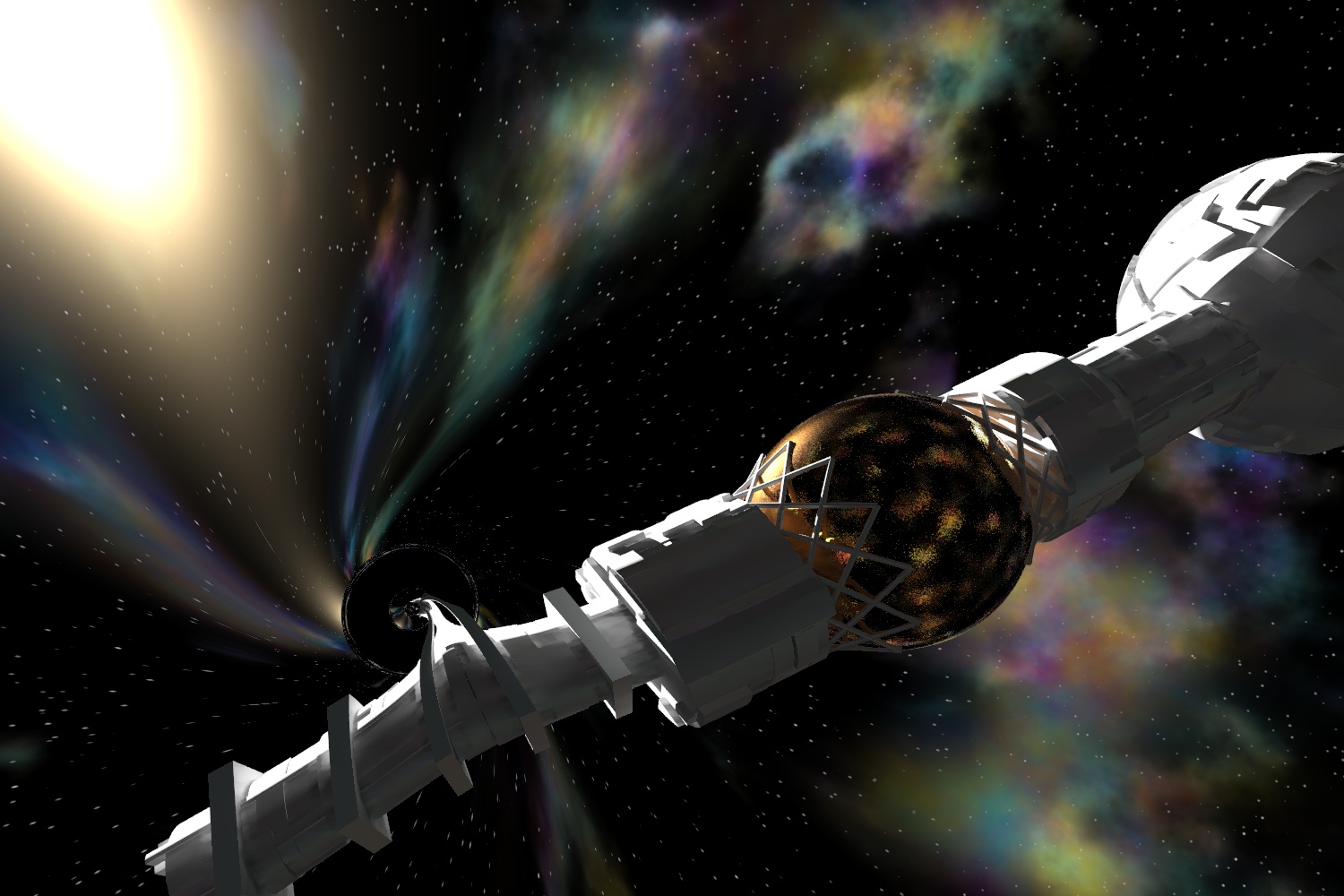
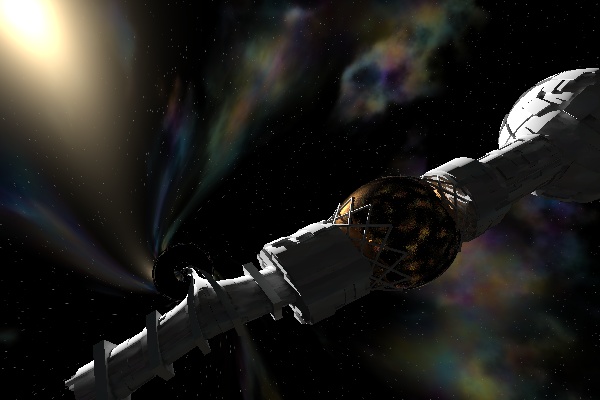
Uh... anyway... The cool black hole effect is achieved with a refractive
object shaped so that it has no refraction at the edges when viewed from the
camera's point of view, effectively making it a 2D distortion. I then use
several such objects at different distances to create the event horizon, the
"sucking" effect, and the smaller distortion on the ship.

Other than that it's all CSG on the spaceship, and the nebula, stars, and
sun are just a layered pigment on the sky_sphere.

comments? questions?
--
Tek
http://evilsuperbrain.com
Post a reply to this message
Attachments:
Download 'space simple.jpg' (173 KB)
Preview of image 'space simple.jpg'
|
|
| |
| |
|
|
|
|
| |
| |
|
|
"Tek" <tek### [at] evilsuperbrain com> schreef in bericht
news:463bf0e5@news.povray.org...
>I seem to be suffering a bit of creative drought.
Really?? :-)
> Uh... anyway... The cool black hole effect is achieved with a refractive
> object shaped so that it has no refraction at the edges when viewed from
> the camera's point of view, effectively making it a 2D distortion. I then
> use several such objects at different distances to create the event
> horizon, the "sucking" effect, and the smaller distortion on the ship.
I am not sure I understand the technical part, but it is very clever
nonetheless.
To make it even better: black holes spin usually, dragging light with them.
Could you simulate that distortion too?
Thomas com> schreef in bericht
news:463bf0e5@news.povray.org...
>I seem to be suffering a bit of creative drought.
Really?? :-)
> Uh... anyway... The cool black hole effect is achieved with a refractive
> object shaped so that it has no refraction at the edges when viewed from
> the camera's point of view, effectively making it a 2D distortion. I then
> use several such objects at different distances to create the event
> horizon, the "sucking" effect, and the smaller distortion on the ship.
I am not sure I understand the technical part, but it is very clever
nonetheless.
To make it even better: black holes spin usually, dragging light with them.
Could you simulate that distortion too?
Thomas
Post a reply to this message
|
|
| |
| |
|
|
|
|
| |
| |
|
|
"Tek" <tek### [at] evilsuperbraincom> wrote in message
news:463bf0e5@news.povray.org...
>
> comments? questions?

Very nice.

I'm not sure about the distortion ring. To me it looks like the black hold
is surrounded by a torus of glass. The other effects are really cool.
Post a reply to this message
|
|
| |
| |
|
|
|
|
| |
| |
|
|
"Thomas de Groot" <t.d### [at] internlDOTnet> wrote:
> "Tek" <tek### [at] evilsuperbraincom> schreef in bericht
> news:463bf0e5@news.povray.org...
> >I seem to be suffering a bit of creative drought.
>
> Really??  :-)

quick!  Someone hijacked Tek's news.povray.org account! :))

way cool, Tek!  Of course, a real black hole doesn't actually sucks things
ordinarily orbiting them safely away from the event horizon, but still...
Post a reply to this message
|
|
| |
| |
|
|
|
|
| |
| |
|
|
Mmm, I like it.

The ship itself seems a bit bland, but the rest of the image is really
quite good.
Post a reply to this message
|
|
| |
| |
|
|
|
|
| |
| |
|
|
Well the sucking effect is created using a funny shaped lens, but as far as
I know it's impossible to make a lens that will rotate things...
Although maybe if I stick a radial normal on there... hmm...

--
Tek
http://evilsuperbrain.com

"Thomas de Groot" <t.d### [at] internlDOTnet> wrote in message
news:463c363b$1@news.povray.org...
>
> "Tek" <tek### [at] evilsuperbraincom> schreef in bericht
> news:463bf0e5@news.povray.org...
>>I seem to be suffering a bit of creative drought.
>
> Really??  :-)
>
>> Uh... anyway... The cool black hole effect is achieved with a refractive
>> object shaped so that it has no refraction at the edges when viewed from
>> the camera's point of view, effectively making it a 2D distortion. I then
>> use several such objects at different distances to create the event
>> horizon, the "sucking" effect, and the smaller distortion on the ship.
>
> I am not sure I understand the technical part, but it is very clever
> nonetheless.
> To make it even better: black holes spin usually, dragging light with
> them. Could you simulate that distortion too?
>
> Thomas
>
>
Post a reply to this message
|
|
| |
| |
|
|
|
|
| |
| |
|
|
"Gail Shaw" <initialsurname@sentech sa dot com> wrote in message
news:463c3ab8@news.povray.org...
> I'm not sure about the distortion ring. To me it looks like the black hold
> is surrounded by a torus of glass. The other effects are really cool.

It's actually more of a cone shape, but it is very much a glass-like
material. I'll work on it a bit more to make it less obvious...

--
Tek
http://evilsuperbrain.com
Post a reply to this message
|
|
| |
| |
|
|
|
|
| |
| |
|
|
Tek nous apporta ses lumieres en ce 05-05-2007 07:42:
> Well the sucking effect is created using a funny shaped lens, but as far as
> I know it's impossible to make a lens that will rotate things...
> Although maybe if I stick a radial normal on there... hmm...
>
You may have a look at spiral normals, it's more evocative of a rotation.

--
Alain
-------------------------------------------------
Destroy the Borg?  Upload Windows 95 !
Post a reply to this message
|
|
| |
| |
|
|
|
|
| |
| |
|
|
The ship seems to be sitting awfully close to the event horizon.
It would probably need to orbit at relativistic speeds itself ;)
Post a reply to this message
|
|
| |
| |
|
|
|
|
| |
| |
|
|
Swirly effect! I added a radial normal to my distortion effect, which is
ramped up towards the middle of the effect to things get swirled more the
closer they get.

--
Tek
http://evilsuperbrain.com

"Tek" <tek### [at] evilsuperbraincom> wrote in message
news:463bf0e5@news.povray.org...
>I seem to be suffering a bit of creative drought.
>
> I had no idea what to POV next, but when I saw Gail Shaw's post I thought
> "ooh I'd like to do a space ship!", then I saw Skip Talbot's post and
> thought "ooh I'd like to fake a nebula in 2D on the sky_sphere". So in
> addition to ripping off their ideas I also decided to rip off the films
> 2001
> and Sphere. The only slightly original idea here was the black hole,
> though
> it's no coincidence that the idea occured after I saw the current 3Drtc
> topic: "the black cloak".
>
> Uh... anyway... The cool black hole effect is achieved with a refractive
> object shaped so that it has no refraction at the edges when viewed from
> the
> camera's point of view, effectively making it a 2D distortion. I then use
> several such objects at different distances to create the event horizon,
> the
> "sucking" effect, and the smaller distortion on the ship.
>
> Other than that it's all CSG on the spaceship, and the nebula, stars, and
> sun are just a layered pigment on the sky_sphere.
>
> comments? questions?
> --
> Tek
> http://evilsuperbrain.com
>
>
>
Post a reply to this message
Attachments:
Download 'space simple.jpg' (283 KB)
Preview of image 'space simple.jpg'
|
|
| |
| |
|
|
|
|
| |
| |
|
|
Mmm... that ship *is* too close to the event horizon! ;-)
Post a reply to this message
|
|
| |
| |
|
|
|
|
| |
| |
|
|
Orchid XP v3 nous apporta ses lumieres en ce 2007-05-06 09:21:
> Mmm... that ship *is* too close to the event horizon! ;-)
In space, it's extremely hard to corectly evaluate distances. The black hole may
be at a somewhat safe distance...
Post a reply to this message
|
|
| |
| |
|
|
|
|
| |
| |
|
|
Alain wrote:
> Orchid XP v3 nous apporta ses lumieres en ce 2007-05-06 09:21:
>
>> Mmm... that ship *is* too close to the event horizon! ;-)
>
> In space, it's extremely hard to corectly evaluate distances. The black
> hole may be at a somewhat safe distance...

Well, if it's a stellar black hole, the schwarzschild radius shouldn't
be more than a few hundred km and you don't want to see that as a disk.
If it's a super-massive black hole, you don't want to be close enough
to see a single star falling in as a large disk.
Post a reply to this message
|
|
| |
| |
|
|
|
|
| |
| |
|
|
-----BEGIN PGP SIGNED MESSAGE-----
Hash: SHA1

Alain wrote:
> Orchid XP v3 nous apporta ses lumieres en ce 2007-05-06 09:21:
>> Mmm... that ship *is* too close to the event horizon! ;-)
> In space, it's extremely hard to corectly evaluate distances. The black
> hole may be at a somewhat safe distance...

	But in that case, why is the ship distorted too?

		Jerome
- --
+------------------------- Jerome M. BERGER ---------------------+
|    mailto:jeb### [at] freefr      | ICQ:    238062172            |
|    http://jeberger.free.fr/     | Jabber: jeb### [at] jabberfr   |
+---------------------------------+------------------------------+
-----BEGIN PGP SIGNATURE-----
Version: GnuPG v1.4.7 (GNU/Linux)

iD8DBQFGPfwkd0kWM4JG3k8RAkdeAKCGWEv7XyMHjKe6ryP2IqtcUV2ZhwCfWKAV
QTQt2VhZt1G5vgcqa7YBBEg=
=Q+tD
-----END PGP SIGNATURE-----
Post a reply to this message
|
|
| |
| |
|
|
|
|
| |
| |
|
|
Alain wrote:
> In space, it's extremely hard to corectly evaluate distances.

Mmm, too true... ;-)
Post a reply to this message
|
|
| |
| |
|
|
|
|
| |
| |
|
|
The vortex effect add a lot to the picture.

I find it well balanced in that view. Congratulations

Chaps
Post a reply to this message
|
|
| |
| |
|
|
|
|
| |
| |
|
|
"Christian Froeschlin" <chr### [at] chrfrde> wrote in message
news:463dfbc5$1@news.povray.org...
> Alain wrote:
>> Orchid XP v3 nous apporta ses lumieres en ce 2007-05-06 09:21:
>>
>>> Mmm... that ship *is* too close to the event horizon! ;-)
>>
>> In space, it's extremely hard to corectly evaluate distances. The black
>> hole may be at a somewhat safe distance...
>
> Well, if it's a stellar black hole, the schwarzschild radius shouldn't
> be more than a few hundred km and you don't want to see that as a disk.
> If it's a super-massive black hole, you don't want to be close enough
> to see a single star falling in as a large disk.

Fascinating discussion, really, but I feel obliged to point out that any
resemblance to real spatial phenomena is entirely coincedental! :-D

My sum total knowledge of black holes consists of stuff I've picked up from
Star Trek and the song Supermassive Black Hole by Muse.

--
Tek
http://evilsuperbrain.com
Post a reply to this message
|
|
| |
| |
|
|
|
|
| |
| |
|
|
"Tek" <tek### [at] evilsuperbraincom> wrote in message
news:463e667b@news.povray.org...
> Fascinating discussion, really, but I feel obliged to point out that any
> resemblance to real spatial phenomena is entirely coincedental! :-D

Let's just say that at that distance from the hole, that ship is not leaving
again, unless it can travel at a speed very close to the speed of light.
Post a reply to this message
|
|
| |
| |
|
|
|
|
| |
| |
|
|
"Tek" <tek### [at] evilsuperbraincom> wrote in message
news:463dcd87@news.povray.org...
> Swirly effect! I added a radial normal to my distortion effect, which is
> ramped up towards the middle of the effect to things get swirled more the
> closer they get.
>

Very nice. I'm still not sure about the distortion ring around the hole,
though it looks better than before.

A suggestion for more 'realism'. Red-shift the colours slightly based on
their proximity to the hole.
Light travelling near a black hole looses energy, in addition to being bent
towards the hole. This loss of energy results in colours being shifted down
towards the red end of the spectrum.
I don't know how hard that will be, or how good it will look
Post a reply to this message
|
|
| |
| |
|
|
From: Thomas de Groot
Subject: Re: Black Hole Research - new version
Date: 7 May 2007 02:53:31
Message: <463ecceb@news.povray.org>
|
|
|
| |
| |
|
|
"Tek" <tek### [at] evilsuperbraincom> schreef in bericht
news:463dcd87@news.povray.org...
> Swirly effect! I added a radial normal to my distortion effect, which is
> ramped up towards the middle of the effect to things get swirled more the
> closer they get.
>

Nice indeed! Much better.
I agree with Gail about the ring. I imagine that the black hole would be
totally black.... Now, where did I read that black holes would have a
slightly bluish glow...??? I can't remember.

Thomas
Post a reply to this message
|
|
| |
| |
|
|
|
|
| |
| |
|
|
Thomas de Groot wrote:
> "Tek" <tek### [at] evilsuperbraincom> schreef in bericht
> news:463dcd87@news.povray.org...
>
>> Swirly effect! I added a radial normal to my distortion effect, which is
>> ramped up towards the middle of the effect to things get swirled more the
>> closer they get.
>>
>>
>
> Nice indeed! Much better.
> I agree with Gail about the ring. I imagine that the black hole would be
> totally black.... Now, where did I read that black holes would have a
> slightly bluish glow...??? I can't remember.
>
> Thomas
>
>
>
Makes you wonder what happens to the light that comes from a point
between us and the event horizon.
Post a reply to this message
|
|
| |
| |
|
|
|
|
| |
| |
|
|
Art Flint nous apporta ses lumieres en ce 7 / 05 / 2007 07:19:

> Makes you wonder what happens to the light that comes from a point
> between us and the event horizon.

Red shift!
Post a reply to this message
|
|
| |
| |
|
|
|
|
| |
| |
|
|
Okay, I can't shut up any longer. :-)

First off, the image is awesome. Your ship is great, your nebulae are
beautiful, and the black hole is trippy-cool.

Now, a personal pet peeve: In space, there is no "ambient" light.
There's no atmospheric scattering of light, so shadows are *black*. Take
a look at a crescent moon, and you'll see what I mean.

Almost everybody gets this wrong, including Hollywood. :-) At the same
time, I think there's some new artistic ground to cover here--you can
create some *really* dramatic images by fixing the shadows.

The big challenge is making the object still be *visible* when half of
it is black, and it is against a black background. I'm still kicking
some ideas around in my head for dealing with this.

You could bend physics a little with the lighting :-) such that both
edges of the craft are highlighted, outlining it and making the shape
visible.

Alternatively, you could take the route of not having space actually be
black. Make the stars a lot more dense, and beef up the nebulae until
the dark parts of the ship are silhouetted against the background. Take
a look at this guy's backgrounds: http://www.crimsondark.com (note that
he gets the shadows wrong, too...)

Finally, you could not go *all* the way, and just darken the shadows as
far as you can without making them actually disappear.

Or, you being The Incredible Tek, ;-) you could just come up with
something way better than anything I can imagine.

Anyway, the image is great as it is. Right now it's up there with
Hollywood. I just feel that you can do one better than Hollywood. :-D

--
William Tracy
+-+-+-+-+-+-+-+-+-+-+-+-+-+-+-+-+-+-+-+-+-+
|a|f|i|s|h|i|o|n|a|d|o|@|g|m|a|i|l|.|c|o|m|
+-+-+-+-+-+-+-+-+-+-+-+-+-+-+-+-+-+-+-+-+-+
+-+-+-+-+-+-+-+-+-+-+-+-+-+-+-+-+-+-+
|w|t|r|a|c|y|@|c|a|l|p|o|l|y|.|e|d|u|
+-+-+-+-+-+-+-+-+-+-+-+-+-+-+-+-+-+-+

You know you've been raytracing too long when you were ever dragged out
of a theater for yelling "Cheap rasterized graphics!!!" in the middle of
Toy Story.
Stephan Ahonen
Post a reply to this message
|
|
| |
| |
|
|
|
|
| |
| |
|
|
"William Tracy" <wtr### [at] calpolyedu> wrote in message
news:463f82bf$1@news.povray.org...

> Now, a personal pet peeve: In space, there is no "ambient" light.

There's still light reflected off other objects, planets, other ships, etc

> There's no atmospheric scattering of light, so shadows are *black*. Take
> a look at a crescent moon, and you'll see what I mean.

Actually, even with a crescent moon, the parts unlit by the sun are
relativly bright, from light reflected off the nearly full earth.
http://antwrp.gsfc.nasa.gov/apod/ap070428.html
Post a reply to this message
|
|
| |
| |
|
|
|
|
| |
| |
|
|
"Tek" <tek### [at] evilsuperbraincom> wrote:

> Uh... anyway... The cool black hole effect is achieved with a refractive
> object shaped so that it has no refraction at the edges when viewed from the
> camera's point of view, effectively making it a 2D distortion. I then use
> several such objects at different distances to create the event horizon, the
> "sucking" effect, and the smaller distortion on the ship.

Cool.  It looks a little sharper at the edges than I would have expected.  I
read that book "Black Holes and Time Warps" or something by Kip Thorne, but
I don't remember exactly how things LOOK as they fall in.  It would be an
interesting patch though to actually simulate it.  No idea how it's done,
but it looks like raytracing has been applied to both special and general
relativity.  A cool gif of a black hole on the page.

http://www.tat.physik.uni-tuebingen.de/~tmueller/visual.html

 - Ricky
Post a reply to this message
|
|
| |
| |
|
|
|
|
| |
| |
|
|
"Gail Shaw" <initialsurname@sentech sa dot com> wrote in message
news:463f956c@news.povray.org...
>
> "William Tracy" <wtr### [at] calpolyedu> wrote in message
> news:463f82bf$1@news.povray.org...
>
>> Now, a personal pet peeve: In space, there is no "ambient" light.
>
> There's still light reflected off other objects, planets, other ships, etc

Exactly! I have 0 ambient, it's all just light from the nebulae and bounced
off the ship (2-bounce radiosity).
Also you'll note the sunlight is incredibly bright because the brightness of
the image is adjusted to allow you to see nebulae (which would normally be
nearly black in a scene with such a bright sun, but I'm using a high
exposure so the directly lit surfaces saturate to white and we can see
details in the shadow). I think I've used fairly realistic lighting for a
star that's a bit further away than our sun.

>> There's no atmospheric scattering of light, so shadows are *black*. Take
>> a look at a crescent moon, and you'll see what I mean.
>
> Actually, even with a crescent moon, the parts unlit by the sun are
> relativly bright, from light reflected off the nearly full earth.
> http://antwrp.gsfc.nasa.gov/apod/ap070428.html

Great example :)

--
Tek
http://evilsuperbrain.com
Post a reply to this message
|
|
| |
| |
|
|
|
|
| |
| |
|
|
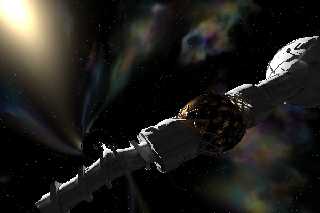
(with reference to my reply to Gail's post)

Here's a version taken with a lower exposure. I've lowered the exposure
enough to stop the lit side from saturating, so now you can see how much
darker the dark side is. Though it's still not black since there are a lot
of nebulae

--
Tek
http://evilsuperbrain.com


"William Tracy" <wtr### [at] calpolyedu> wrote in message
news:463f82bf$1@news.povray.org...
> Okay, I can't shut up any longer. :-)
>
> First off, the image is awesome. Your ship is great, your nebulae are
> beautiful, and the black hole is trippy-cool.
>
> Now, a personal pet peeve: In space, there is no "ambient" light.
> There's no atmospheric scattering of light, so shadows are *black*. Take
> a look at a crescent moon, and you'll see what I mean.
>
> Almost everybody gets this wrong, including Hollywood. :-) At the same
> time, I think there's some new artistic ground to cover here--you can
> create some *really* dramatic images by fixing the shadows.
>
> The big challenge is making the object still be *visible* when half of
> it is black, and it is against a black background. I'm still kicking
> some ideas around in my head for dealing with this.
>
> You could bend physics a little with the lighting :-) such that both
> edges of the craft are highlighted, outlining it and making the shape
> visible.
>
> Alternatively, you could take the route of not having space actually be
> black. Make the stars a lot more dense, and beef up the nebulae until
> the dark parts of the ship are silhouetted against the background. Take
> a look at this guy's backgrounds: http://www.crimsondark.com (note that
> he gets the shadows wrong, too...)
>
> Finally, you could not go *all* the way, and just darken the shadows as
> far as you can without making them actually disappear.
>
> Or, you being The Incredible Tek, ;-) you could just come up with
> something way better than anything I can imagine.
>
> Anyway, the image is great as it is. Right now it's up there with
> Hollywood. I just feel that you can do one better than Hollywood. :-D
>
> --
> William Tracy
> +-+-+-+-+-+-+-+-+-+-+-+-+-+-+-+-+-+-+-+-+-+
> |a|f|i|s|h|i|o|n|a|d|o|@|g|m|a|i|l|.|c|o|m|
> +-+-+-+-+-+-+-+-+-+-+-+-+-+-+-+-+-+-+-+-+-+
> +-+-+-+-+-+-+-+-+-+-+-+-+-+-+-+-+-+-+
> |w|t|r|a|c|y|@|c|a|l|p|o|l|y|.|e|d|u|
> +-+-+-+-+-+-+-+-+-+-+-+-+-+-+-+-+-+-+
>
> You know you've been raytracing too long when you were ever dragged out
> of a theater for yelling "Cheap rasterized graphics!!!" in the middle of
> Toy Story.
> Stephan Ahonen
Post a reply to this message
Attachments:
Download 'space simple.jpg' (64 KB)
Preview of image 'space simple.jpg'
|
|
| |
| |
|
|
|
|
| |
| |
|
|
Alain wrote:
> Art Flint nous apporta ses lumieres en ce 7 / 05 / 2007 07:19:
>
>> Makes you wonder what happens to the light that comes from a point
>> between us and the event horizon.
>
> Red shift!
So anything that comes from above the visible ligth range might be
shifted down to a bluish color?
Post a reply to this message
|
|
| |
| |
|
|
|
|
| |
| |
|
|
Art Flint nous apporta ses lumieres en ce 7 / 05 / 2007 21:29:
> Alain wrote:
>> Art Flint nous apporta ses lumieres en ce 7 / 05 / 2007 07:19:
>>
>>> Makes you wonder what happens to the light that comes from a point
>>> between us and the event horizon.
>>
>> Red shift!
> So anything that comes from above the visible ligth range might be
> shifted down to a bluish color?
Yes, and possibly more. If blue shift to red, then about all of the UV will
become visible from red to blue, X-rays will degrade to UV A and B and gamma
rays will become UV C and X-rays. If you go closer, then even gamma rays could
degrade into low frequency radio waves...

--
Alain
-------------------------------------------------
Don't kiss an elephant on the lips today.
Post a reply to this message
|
|
| |
| |
|
|
|
|
| |
| |
|
|
triple_r nous apporta ses lumieres en ce 7 / 05 / 2007 17:25:
> "Tek" <tek### [at] evilsuperbraincom> wrote:
>
>> Uh... anyway... The cool black hole effect is achieved with a refractive
>> object shaped so that it has no refraction at the edges when viewed from the
>> camera's point of view, effectively making it a 2D distortion. I then use
>> several such objects at different distances to create the event horizon, the
>> "sucking" effect, and the smaller distortion on the ship.
>
> Cool.  It looks a little sharper at the edges than I would have expected.  I
> read that book "Black Holes and Time Warps" or something by Kip Thorne, but
> I don't remember exactly how things LOOK as they fall in.  It would be an
> interesting patch though to actually simulate it.  No idea how it's done,
> but it looks like raytracing has been applied to both special and general
> relativity.  A cool gif of a black hole on the page.
>
> http://www.tat.physik.uni-tuebingen.de/~tmueller/visual.html
>
>  - Ricky
>
The visible star may not be faling in, it may be a great distance BEHIND the
black hole, then, it's light gets bent, the closer the light pass by the black
hole, the more it get's bent, leading to the observed distortion.

--
Alain
-------------------------------------------------
Tricks and treachery are the practice of fools, that don't have brains enough to
be honest.
Benjamin Franklin
Post a reply to this message
|
|
| |
| |
|
|
|
|
| |
| |
|
|
Nice images, and a good healthy discussion of astrophysics! I like the later
versions of the image better, the lighting looks more believable with the
'overexposed' look.

It might be worth pointing out that there's probably no point in discussing
the finer points of gravitational lensing and relativistic light-shifting
too much; anything which got that close to a real black hole or neutron
star would likely be torn apart by tidal forces, unless it were able to
'hover' over it (which would require a hell of a lot of thrust).

Nice spacecraft - is it just a section, or do you have a whole ship
modelled? Looks a lot like the spine sections on my 'Discovery' model.

Bill
Post a reply to this message
|
|
| |
| |
|
|
|
|
| |
| |
|
|
There's no ship beyond what you can see, the image was just quickly bashed
together. Plus I wrote a macro to do CSG greebles which will probably appear
in some more serious image in the future!

--
Tek
http://evilsuperbrain.com

"Bill Pragnell" <bil### [at] hotmailcom> wrote in message
news:web.4640785a7bdc3175731f01d10@news.povray.org...
> Nice images, and a good healthy discussion of astrophysics! I like the
> later
> versions of the image better, the lighting looks more believable with the
> 'overexposed' look.
>
> It might be worth pointing out that there's probably no point in
> discussing
> the finer points of gravitational lensing and relativistic light-shifting
> too much; anything which got that close to a real black hole or neutron
> star would likely be torn apart by tidal forces, unless it were able to
> 'hover' over it (which would require a hell of a lot of thrust).
>
> Nice spacecraft - is it just a section, or do you have a whole ship
> modelled? Looks a lot like the spine sections on my 'Discovery' model.
>
> Bill
>
Post a reply to this message
|
|
| |
| |
|
|
|
|
| |