|
|
|
|
|
|
| |
| |
|
|
|
|
| |
| |
|
|
Greetings:

I'm looking for a cover image for the fall/winter issue of Horizons, the
online magazine for the Houston section of AIAA (American Institute of
Aeronautics and Astronautics). See www.aiaa-houston.org/horizons. I'm the
volunteer editor for that publication. This issue features one or two
articles on futuristic propulsion concepts. I'm looking for an image of a
special, realistic, futuristic interstellar or intra-solar system
spacecraft, that illustrates powerful propulsion as part of its design. As a
long time user of POV-Ray, I figured this would be a good place to ask
around. If you have such an image and would be willing to let us use it in
exchange only for image credit and acknowledgement, I'd like to hear from
you.

"Horizons" has won first place nationally two years in a row, recognized for
excellence in production and content. Circulation (downloads) average about
5000 per issue (sometimes as high as 20,000 per issue). It is read with
interest in and around Johnson Space Center near Houston, Texas.

Also, if you are aware of any galleries of renderings (or paintings) of
futuristic spacecraft, I'd appreciate hearing about those, too.

Thanks!

Jon
Editor, Horizons
AIAA Houston
www.aiaa-houston.org/horizons
Post a reply to this message
|
|
| |
| |
|
|
|
|
| |
| |
|
|
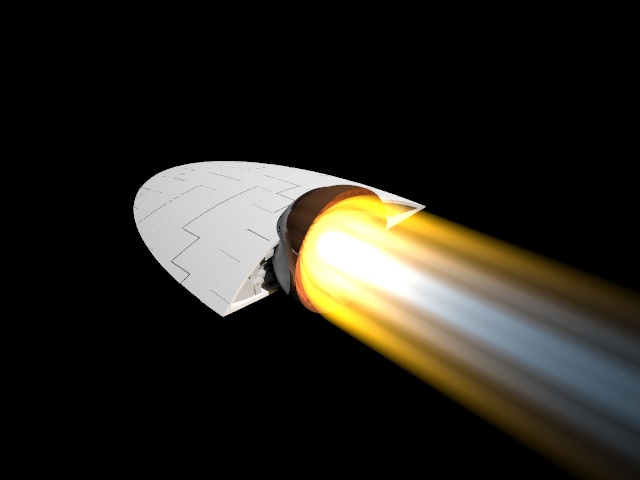
Okay I had a quick mess around with the idea, I'm not sure if "realistic"
and "futuristic" are contradictions, so I decided to go with "stupidly over
the top" and slap a huge booster on a tiny ship.
This is just a quick 10 minute nonsense but if it's at all suitable I could
add some more details to make it into a proper image :)
--
Tek
http://evilsuperbrain.com
"Jon S. Berndt" <jsb### [at] hal-pc org> wrote in message
news:457e1f6a@news.povray.org...
> Greetings:
>
> I'm looking for a cover image for the fall/winter issue of Horizons, the
> online magazine for the Houston section of AIAA (American Institute of
> Aeronautics and Astronautics). See www.aiaa-houston.org/horizons. I'm the
> volunteer editor for that publication. This issue features one or two
> articles on futuristic propulsion concepts. I'm looking for an image of a
> special, realistic, futuristic interstellar or intra-solar system
> spacecraft, that illustrates powerful propulsion as part of its design. As
> a
> long time user of POV-Ray, I figured this would be a good place to ask
> around. If you have such an image and would be willing to let us use it in
> exchange only for image credit and acknowledgement, I'd like to hear from
> you.
>
> "Horizons" has won first place nationally two years in a row, recognized
> for
> excellence in production and content. Circulation (downloads) average
> about
> 5000 per issue (sometimes as high as 20,000 per issue). It is read with
> interest in and around Johnson Space Center near Houston, Texas.
>
> Also, if you are aware of any galleries of renderings (or paintings) of
> futuristic spacecraft, I'd appreciate hearing about those, too.
>
> Thanks!
>
> Jon
> Editor, Horizons
> AIAA Houston
> www.aiaa-houston.org/horizons
>
> org> wrote in message
news:457e1f6a@news.povray.org...
> Greetings:
>
> I'm looking for a cover image for the fall/winter issue of Horizons, the
> online magazine for the Houston section of AIAA (American Institute of
> Aeronautics and Astronautics). See www.aiaa-houston.org/horizons. I'm the
> volunteer editor for that publication. This issue features one or two
> articles on futuristic propulsion concepts. I'm looking for an image of a
> special, realistic, futuristic interstellar or intra-solar system
> spacecraft, that illustrates powerful propulsion as part of its design. As
> a
> long time user of POV-Ray, I figured this would be a good place to ask
> around. If you have such an image and would be willing to let us use it in
> exchange only for image credit and acknowledgement, I'd like to hear from
> you.
>
> "Horizons" has won first place nationally two years in a row, recognized
> for
> excellence in production and content. Circulation (downloads) average
> about
> 5000 per issue (sometimes as high as 20,000 per issue). It is read with
> interest in and around Johnson Space Center near Houston, Texas.
>
> Also, if you are aware of any galleries of renderings (or paintings) of
> futuristic spacecraft, I'd appreciate hearing about those, too.
>
> Thanks!
>
> Jon
> Editor, Horizons
> AIAA Houston
> www.aiaa-houston.org/horizons
>
>
Post a reply to this message
Attachments:
Download 'somekindarocket.jpg' (26 KB)
Preview of image 'somekindarocket.jpg'
|
|
| |
| |
|
|
|
|
| |
| |
|
|
Have you checked some of the previous rounds of the IRTC?  I remember seeing
some fairly impressive images that might suite you.  By "realistic," do you
mean propulsion systems that are actually possible? or are already being
researched?  That would be a very different story, but I'm sure someone
might be up to the challenge if you provided a bit of education.
Post a reply to this message
|
|
| |
| |
|
|
|
|
| |
| |
|
|
Hi Jon!

It's really exciting to see someone from Houston on this forum AND
publishing magazines.  Looks like Tek has a very good ship for you.... would
you need background to go with it?  I've been rendering planets, including a
few to show in a movie...

Let me know if you need something...

"Jon S. Berndt" <jsb### [at] hal-pcorg> wrote in message
news:457e1f6a@news.povray.org...
> Greetings:
>
> I'm looking for a cover image for the fall/winter issue of Horizons, the
> online magazine for the Houston section of AIAA (American Institute of
> Aeronautics and Astronautics). See www.aiaa-houston.org/horizons. I'm the
> volunteer editor for that publication. This issue features one or two
> articles on futuristic propulsion concepts. I'm looking for an image of a
> special, realistic, futuristic interstellar or intra-solar system
> spacecraft, that illustrates powerful propulsion as part of its design. As
> a long time user of POV-Ray, I figured this would be a good place to ask
> around. If you have such an image and would be willing to let us use it in
> exchange only for image credit and acknowledgement, I'd like to hear from
> you.
>
> "Horizons" has won first place nationally two years in a row, recognized
> for excellence in production and content. Circulation (downloads) average
> about 5000 per issue (sometimes as high as 20,000 per issue). It is read
> with interest in and around Johnson Space Center near Houston, Texas.
>
> Also, if you are aware of any galleries of renderings (or paintings) of
> futuristic spacecraft, I'd appreciate hearing about those, too.
>
> Thanks!
>
> Jon
> Editor, Horizons
> AIAA Houston
> www.aiaa-houston.org/horizons
>
>
Post a reply to this message
|
|
| |
| |
|
|
|
|
| |
| |
|
|
"EagleSun" <nomail@nomail> wrote in message
news:457f2619$1@news.povray.org...
> Hi Jon!
>
> It's really exciting to see someone from Houston on this forum AND
> publishing magazines.  Looks like Tek has a very good ship for you....
> would you need background to go with it?  I've been rendering planets,
> including a few to show in a movie...
>
> Let me know if you need something...

  Eh? Why didn't you just show something that you've worked on?

    ~Steve~
Post a reply to this message
|
|
| |
| |
|
|
|
|
| |
| |
|
|
I'm of the opinion that a large enough power source, such as
a nuclear reactor, could produce enough electric power to fuel a large
ion thuster. If a thrust to power ratio of around 50 mN/kW is assumed, and
a total ship weight of 10 tons then we're looking for a power source of
about 2 gigawatts. This would let a ship accelerate a little over 1G for
extended periods. Such a ship could make a round trip to Alpha Centari A in
about 9 years. If such a vehicle was unmanned then little of the radiation
shielding would be needed, which is what turns a reactor into a big building
with 6ft thick cement walls.
Post a reply to this message
|
|
| |
| |
|
|
|
|
| |
| |
|
|
"Kirk Andrews" <kir### [at] hotmailcom> wrote in message
news:web.457ebca6ff75702c9033e1160@news.povray.org...
> Have you checked some of the previous rounds of the IRTC?  I remember
> seeing
> some fairly impressive images that might suite you.  By "realistic," do
> you
> mean propulsion systems that are actually possible? or are already being
> researched?  That would be a very different story, but I'm sure someone
> might be up to the challenge if you provided a bit of education.

Hi, Kirk, and Tek, EagleSun, and all:

The cover story for the upcoming issue is written by someone from Ad Astra
Rocket Company in Houston. See http://www.adastrarocket.com/. They are doing
R&D on the VASIMR. They have some info at the web site. Also, there are
these articles:

http://www.space.com/businesstechnology/technology/vasimr_rocket_020807-1.html

http://www.nasatech.com/Briefs/Sep01/MSC23041.html

http://www.daviddarling.info/encyclopedia/V/VASIMR.html

It's a really fascinating concept - really high-powered stuff. In the same
issue, there will also be an article on the Mach Lorenz Thruster, which is a
much more "out there" concept. However, if brought to fruition, it would be
a major, major, breakthrough.  You can read about those here:

http://www.americanantigravity.com/articles/339/1/Machs-Principle-Evolves/Page1.html

http://www.woodwardeffect.org/

As for spacecraft and level of detail, I can say this: I like the plume in
the image created by Tek, but I'd prefer a blue-ish plume, very bright (as
you have it) near the nozzle exit and transitioning to a darker blue farther
out. I suspect that any plume from a VASIMR would extend for quite a ways
(several thousand feet?). The proposed ship is cool, but I think I'm looking
for something different. Think about the space station. It's modular. I'm
thinking that this ship would be comprised of components launched on a very
big booster, in parts. Perhaps it would be made up of six to twelve module,
50 feet long and 20 feet in diameter. Perhaps a few of them would have
several windows. Perhaps the propulsion section would be isolated or
protected from the habitable sections. Perhaps there would be structural
provision for some kind of rotation for artificial gravity after the main
propulsive phase had been completed. I'd *like* to see this kind of detail
(or better !):

http://www.okino.com/nrs/pics/nrs_bab4.jpg

http://www.povplace.com/gallery/SciFi%20-%20Star%20Wars/19.jpg

The above are just some ideas. I know it's a lot to ask, and a lot to
digest. That's why I was asking for something that might already be done,
because I wouldn't feel right asking someone to do this specifically for the
issue, in case it was not used. I'll check the IRTC competition pages. With
that said, if someone does want to give it a try, I'll check back here
daily. Feel free to contact me directly via email, too
(edi### [at] aiaa-houstonorg). If I don't use a particular image, I have been
thinking of an issue that features futuristic spacecraft artwork.

Thanks,

Jon
Post a reply to this message
|
|
| |
| |
|
|
|
|
| |
| |
|
|
"Tim Attwood" <tim### [at] comcastnet> wrote:
> I'm of the opinion that a large enough power source, such as
> a nuclear reactor, could produce enough electric power to fuel a large
> ion thuster. If a thrust to power ratio of around 50 mN/kW is assumed, and
> a total ship weight of 10 tons then we're looking for a power source of
> about 2 gigawatts. This would let a ship accelerate a little over 1G for
> extended periods. Such a ship could make a round trip to Alpha Centari A in
> about 9 years. If such a vehicle was unmanned then little of the radiation
> shielding would be needed, which is what turns a reactor into a big building
> with 6ft thick cement walls.

Tim, Tim! How un-friendly sending an unshielded nuclear reactor to our
nearest neighbour :-(
What are you trying to do, start an interstellar war?


Stephen
Post a reply to this message
|
|
| |
| |
|
|
|
|
| |
| |
|
|
> Tim, Tim! How un-friendly sending an unshielded nuclear reactor to our
> nearest neighbour :-(
> What are you trying to do, start an interstellar war?

Maybe we should build one before they do...

Besides, I'm sure it's worth a couple trillion for some perty pictures,
after
all, the politicians just blow it on dumb stuff already.
Post a reply to this message
|
|
| |
| |
|
|
|
|
| |
| |
|
|
"Tim Attwood" <tim### [at] comcastnet> wrote in message
news:457fd71f$1@news.povray.org...
>> Tim, Tim! How un-friendly sending an unshielded nuclear reactor to our
>> nearest neighbour :-(
>> What are you trying to do, start an interstellar war?
>
> Maybe we should build one before they do...
>
> Besides, I'm sure it's worth a couple trillion for some perty pictures,
> after all, the politicians just blow it on dumb stuff already.

Good point, Tim....

Well Pov artists.. let's get started!
Post a reply to this message
|
|
| |
| |
|
|
|
|
| |
| |
|
|
"Tim Attwood" <tim### [at] comcastnet> wrote:
> I'm of the opinion that a large enough power source, such as
> a nuclear reactor, could produce enough electric power to fuel a large
> ion thuster. If a thrust to power ratio of around 50 mN/kW is assumed, and
> a total ship weight of 10 tons then we're looking for a power source of
> about 2 gigawatts. This would let a ship accelerate a little over 1G for
> extended periods. Such a ship could make a round trip to Alpha Centari A in
> about 9 years. If such a vehicle was unmanned then little of the radiation
> shielding would be needed, which is what turns a reactor into a big building
> with 6ft thick cement walls.

Does this estimate take relativistics effects into account?  (I've long
forgotten how to do the math.)  A vehicle that gets to Alpha cen in 4.5
years has to go pretty close to the speed of light.  The relativistic mass
gain would surely affect the thruster's ability to maintain acceleration.
Post a reply to this message
|
|
| |
| |
|
|
|
|
| |
| |
|
|
Cousin Ricky wrote:
> gain would surely affect the thruster's ability to maintain acceleration.

It depends on whether you measure the acceleration inside or outside the
ship. The passengers can continue to experience 1G indefinitely.

--
   Darren New / San Diego, CA, USA (PST)
     Scruffitarianism - Where T-shirt, jeans,
     and a three-day beard are "Sunday Best."
Post a reply to this message
|
|
| |
| |
|
|
|
|
| |
| |
|
|
"Cousin Ricky" <ric### [at] yahoocom> wrote in message
news:web.458015c7ff75702c85de7b680@news.povray.org...
> "Tim Attwood" <tim### [at] comcastnet> wrote:
>> I'm of the opinion that a large enough power source, such as
>> a nuclear reactor, could produce enough electric power to fuel a large
>> ion thuster. If a thrust to power ratio of around 50 mN/kW is assumed,
>> and
>> a total ship weight of 10 tons then we're looking for a power source of
>> about 2 gigawatts. This would let a ship accelerate a little over 1G for
>> extended periods. Such a ship could make a round trip to Alpha Centari A
>> in
>> about 9 years. If such a vehicle was unmanned then little of the
>> radiation
>> shielding would be needed, which is what turns a reactor into a big
>> building
>> with 6ft thick cement walls.
>
> Does this estimate take relativistics effects into account?  (I've long
> forgotten how to do the math.)  A vehicle that gets to Alpha cen in 4.5
> years has to go pretty close to the speed of light.  The relativistic mass
> gain would surely affect the thruster's ability to maintain acceleration.

You're thinking about this way too hard! ;-)

Jon
Post a reply to this message
|
|
| |
| |
|
|
|
|
| |
| |
|
|
"Jon S. Berndt" <jsb### [at] hal-pcorg> wrote:
> "Cousin Ricky" <ric### [at] yahoocom> wrote in message
> news:web.458015c7ff75702c85de7b680@news.povray.org...
> >
> > Does this estimate take relativistics effects into account?  (I've long
> > forgotten how to do the math.)  A vehicle that gets to Alpha cen in 4.5
> > years has to go pretty close to the speed of light.  The relativistic mass
> > gain would surely affect the thruster's ability to maintain acceleration.
>
> You're thinking about this way too hard! ;-)

Well, he *did* say "realistic."  It's details like this that cause
expensive, taxpayer-funded space probes to vanish without a trace.
Post a reply to this message
|
|
| |
| |
|
|
|
|
| |
| |
|
|
"Cousin Ricky" <ric### [at] yahoocom> wrote:
> "Jon S. Berndt" <jsb### [at] hal-pcorg> wrote:
> > "Cousin Ricky" <ric### [at] yahoocom> wrote in message
> > news:web.458015c7ff75702c85de7b680@news.povray.org...
> > >
> > > Does this estimate take relativistics effects into account?  (I've long
> > > forgotten how to do the math.)  A vehicle that gets to Alpha cen in 4.5
> > > years has to go pretty close to the speed of light.  The relativistic mass
> > > gain would surely affect the thruster's ability to maintain acceleration.
> >
> > You're thinking about this way too hard! ;-)
>
> Well, he *did* say "realistic."  It's details like this that cause
> expensive, taxpayer-funded space probes to vanish without a trace.

No it’s getting Imperial and Metric units mixed up that costs
taxpayer-funded space probes to vanish without a trace.
Ok there was a trace :-)

Stephen
Post a reply to this message
|
|
| |
| |
|
|
|
|
| |
| |
|
|
"Stephen" <mcavoys_AT_aolDOT.com> schreef in bericht
news:web.45810d28ff75702cf1cb1e660@news.povray.org...
 Ok there was a trace :-)
>
trace( ) ??  :-)

Thomas
Post a reply to this message
|
|
| |
| |
|
|
|
|
| |
| |
|
|
"Thomas de Groot" <t.d### [at] internlDOTnet> wrote:
> "Stephen" <mcavoys_AT_aolDOT.com> schreef in bericht
> news:web.45810d28ff75702cf1cb1e660@news.povray.org...
>  Ok there was a trace :-)
> >
> trace( ) ??  :-)
>
> Thomas

I’d say it was subconscious but that would imply I’m conscious.

"Pun (n.): the lowest form of humour" —Samuel Johnson, lexicographer
"Hanging is too good for a man who makes puns; he should be drawn and
quoted." —Fred Allen
"The pun is mightier than the sword." — James Joyce
"Puns are the last refuge of the witless."
"Immanuel doesn't pun; he Kant."


Stephen
Post a reply to this message
|
|
| |
| |
|
|
|
|
| |
| |
|
|
"Stephen" <mcavoys_AT_aolDOT.com> wrote:
> "Cousin Ricky" <ric### [at] yahoocom> wrote:
> > "Jon S. Berndt" <jsb### [at] hal-pcorg> wrote:
> > > "Cousin Ricky" <ric### [at] yahoocom> wrote in message
> > > news:web.458015c7ff75702c85de7b680@news.povray.org...
> > > >
> > > > Does this estimate take relativistics effects into account?  (I've long
> > > > forgotten how to do the math.)  A vehicle that gets to Alpha cen in 4.5
> > > > years has to go pretty close to the speed of light.  The relativistic mass
> > > > gain would surely affect the thruster's ability to maintain acceleration.
> > >
> > > You're thinking about this way too hard! ;-)
> >
> > Well, he *did* say "realistic."  It's details like this that cause
> > expensive, taxpayer-funded space probes to vanish without a trace.
>
> No it’s getting Imperial and Metric units mixed up that costs
> taxpayer-funded space probes to vanish without a trace.

don't forget to put povray units in the mix too and get strange results for
things really far too big and far away... thankfully, no tax paying... ;)
Post a reply to this message
|
|
| |
| |
|
|
|
|
| |
| |
|
|
> Does this estimate take relativistics effects into account?  (I've long
> forgotten how to do the math.)  A vehicle that gets to Alpha cen in 4.5
> years has to go pretty close to the speed of light.  The relativistic mass
> gain would surely affect the thruster's ability to maintain acceleration.

I think 9 years is more likely to be the one-way trip, assuming you
accelerate at 1g to halfway and then turn round and decelerate ass-first
the rest of the way. A round trip would be more like 16-18 years. The crew
would only see it as 7-8 years, of course.

This is based on this page:
http://math.ucr.edu/home/baez/physics/Relativity/SR/rocket.html

I haven't checked the maths but it looks right!

The mass gain is irrelevant, really. From the ship's point of view,
acceleration is constant and the universe deforms. :-)

Bill
Post a reply to this message
|
|
| |
| |
|
|
|
|
| |
| |
|
|
"Stephen" <mcavoys_AT_aolDOT.com> wrote:
> "Cousin Ricky" <ric### [at] yahoocom> wrote:
> >
> > Well, he *did* say "realistic."  It's details like this that cause
> > expensive, taxpayer-funded space probes to vanish without a trace.
>
> No it’s getting Imperial and Metric units mixed up that costs
> taxpayer-funded space probes to vanish without a trace.
> Ok there was a trace :-)

Or relying on the atmospheric pressure for altimeter readings for when to
cut the landing thrusters (a possible fate of Beagle).

Or forgetting to take the Doppler effect into account in radio
communications.  This almost happened to Cassini-Huygens; luckily (or
prudently), the error was discovered during the dry run when Cassini
returned to Earth for a gravitational assist.

Or sending your lander into the kitchen without building it to stand the 740
kelvin and show grace under 9100 kilopascals (all of the early Veneris
missions).  (Kudos to the former Soviets as the only country to
successfully land on Venus, and the only country other than the USA to land
*anywhere* successfully.)

Or typing a period in a computer program where there should have been a
comma.  Er... OK, so it *could* have happened if NASA hadn't caught the bug
in time.  Unfortunately, they didn't catch the missing hyphen in Mariner 1's
backup guidance software...

And the most grievous error of all:  Sending your space ship to Mars!  After
Spirit and Opportunity successfully docked with the Angry Red Planet, NASA
convened a study to find out what went *right*. :-O
Post a reply to this message
|
|
| |
| |
|
|
|
|
| |
| |
|
|
"Stephen" <mcavoys_AT_aolDOT.com> wrote:
> "Pun (n.): the lowest form of humour" —Samuel Johnson, lexicographer
> "Hanging is too good for a man who makes puns; he should be drawn and
> quoted." —Fred Allen
> "The pun is mightier than the sword." — James Joyce
> "Puns are the last refuge of the witless."
> "Immanuel doesn't pun; he Kant."

punish (v) to tell a pun.
punishment (n) the telling of a pun.
--unknown
Post a reply to this message
|
|
| |
| |
|
|
|
|
| |
| |
|
|
"Bill Pragnell" <bil### [at] hotmailcom> wrote in message
news:web.458138e3ff75702c731f01d10@news.povray.org...
>> Does this estimate take relativistics effects into account?  (I've long
>> forgotten how to do the math.)  A vehicle that gets to Alpha cen in 4.5
>> years has to go pretty close to the speed of light.  The relativistic
>> mass
>> gain would surely affect the thruster's ability to maintain acceleration.
>
> I think 9 years is more likely to be the one-way trip, assuming you
> accelerate at 1g to halfway and then turn round and decelerate ass-first
> the rest of the way. A round trip would be more like 16-18 years. The crew
> would only see it as 7-8 years, of course.

I omitted relativity, the 9 years would be shipboard time, including
some fudge factor for midpoint turn around time and time for the
actual mission...
We don't really know what would happen at those speeds, we
only know that we have observed relativity at the slow end of
the curve IRL.
Post a reply to this message
Attachments:
Download 'space_thruster.jpg' (33 KB)
Preview of image 'space_thruster.jpg'
|
|
| |
| |
|
|
|
|
| |
| |
|
|
"Cousin Ricky" <ric### [at] yahoocom> wrote in message

> Or typing a period in a computer program where there should have been a
> comma.  Er... OK, so it *could* have happened if NASA hadn't caught the
> bug
> in time.  Unfortunately, they didn't catch the missing hyphen in Mariner
> 1's
> backup guidance software...
>
> And the most grievous error of all:  Sending your space ship to Mars!
> After
> Spirit and Opportunity successfully docked with the Angry Red Planet, NASA
> convened a study to find out what went *right*. :-O

Actually, it's good to keep in mind that NASA has landed 5 spacecraft
successfully on Mars out of 6 attempts (the accidental attempt to land an
*orbiter* doesn't count! ;-) -  I'm referring to MCO; I'm also not counting
penetrators).

Mars has "eaten" a lot of spacecraft. The former USSR tried several times
and was unsuccessful. Beagle was a high-risk attempt that failed. It's too
bad these probes were not heard from again, because I'm sure they would have
produced fascinating results. To provide some balance, the former USSR was
successful twice at returning images from the surface of Venus - an
admirable accomplishment when you consider the conditions on the surface of
that hellish place.

Recently, the images returned by the Soviet Venera craft have been
reprocessed using modern techniques. The newly revitalized images are very
nice and worth a long look:

http://tinyurl.com/yn7dtf

Space exploration, planets, etc. are all a great field to take inspiration
for POV art!

Jon
Post a reply to this message
|
|
| |
| |
|
|
|
|
| |
| |
|
|
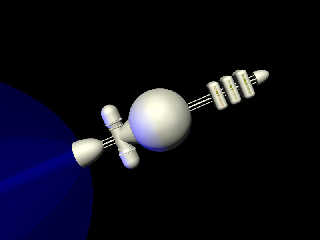
"Tim Attwood" <tim### [at] comcastnet> wrote

Hey, I kind of like this (I think I've seen something like this in my
kitchen, too!)

A couple of notes:

1) There should be no over-expansion of the nozzle, I think. All of the flow
would be almost all directed aft.

2) I'm sure this is a WIP, but thought I'd mention that there would be more
to the engine (a lot of equipment creating magnetic fields - coils and
stuff, supply lines for fuel, etc.)

3) The structural elements would include more bracing, similar to the
trusses you see on the space station. Maybe some antennas, too (a large-ish
dish?)
Post a reply to this message
|
|
| |
| |
|
|
|
|
| |
| |
|
|
Jon S. Berndt nous apporta ses lumieres en ce 14-12-2006 22:07:
> "Tim Attwood" <tim### [at] comcastnet> wrote

> Hey, I kind of like this (I think I've seen something like this in my
> kitchen, too!)

> A couple of notes:

> 1) There should be no over-expansion of the nozzle, I think. All of the flow
> would be almost all directed aft.
The over-expansion is unavoidable. All you can do, is try to minimise it.

> 2) I'm sure this is a WIP, but thought I'd mention that there would be more
> to the engine (a lot of equipment creating magnetic fields - coils and
> stuff, supply lines for fuel, etc.)
Depending on the scale, that can be all contained within the nozle.

> 3) The structural elements would include more bracing, similar to the
> trusses you see on the space station. Maybe some antennas, too (a large-ish
> dish?)


--
Alain
-------------------------------------------------
Do not bite at the bait of pleasure, till you know there is no hook beneath
it.
Thomas Jefferson
Post a reply to this message
|
|
| |
| |
|
|
|
|
| |
| |
|
|
"EagleSun" <nomail@nomail> wrote in message news:457f2619

> Hi Jon!
>
> It's really exciting to see someone from Houston on this forum AND
> publishing magazines.  Looks like Tek has a very good ship for you....
> would you need background to go with it?  I've been rendering planets,
> including a few to show in a movie...
>
> Let me know if you need something...

If a ship does come out of this, a planet might be a nice background. Not
sure if the image would portray braking into orbit or leaving ... hmmm.

Jon
Post a reply to this message
|
|
| |
| |
|
|
|
|
| |
| |
|
|
"Alain" <ele### [at] netscapenet> wrote in message
news:45828032@news.povray.org...
> Jon S. Berndt nous apporta ses lumieres en ce 14-12-2006 22:07:
>> "Tim Attwood" <tim### [at] comcastnet> wrote
>
>> Hey, I kind of like this (I think I've seen something like this in my
>> kitchen, too!)
>
>> A couple of notes:
>
>> 1) There should be no over-expansion of the nozzle, I think. All of the
>> flow would be almost all directed aft.

> The over-expansion is unavoidable. All you can do, is try to minimise it.

>> 2) I'm sure this is a WIP, but thought I'd mention that there would be
>> more to the engine (a lot of equipment creating magnetic fields - coils
>> and stuff, supply lines for fuel, etc.)

> Depending on the scale, that can be all contained within the nozle.

Visually, what I would like to see is probably best illustrated by looking
at a Hall thruster:

http://fluid.ippt.gov.pl/sbarral/hall.html

(see Pratt and Whitney thruster at bottom of this page)
http://www.engin.umich.edu/dept/aero/spacelab/thrusters/thrusters.html

http://www.adastrarocket.com/Plasma.html

There is little, if any, overexpansion of exhaust in these images. The image
by Tek was very good in this respect.

Jon
Post a reply to this message
|
|
| |
| |
|
|
|
|
| |
| |
|
|
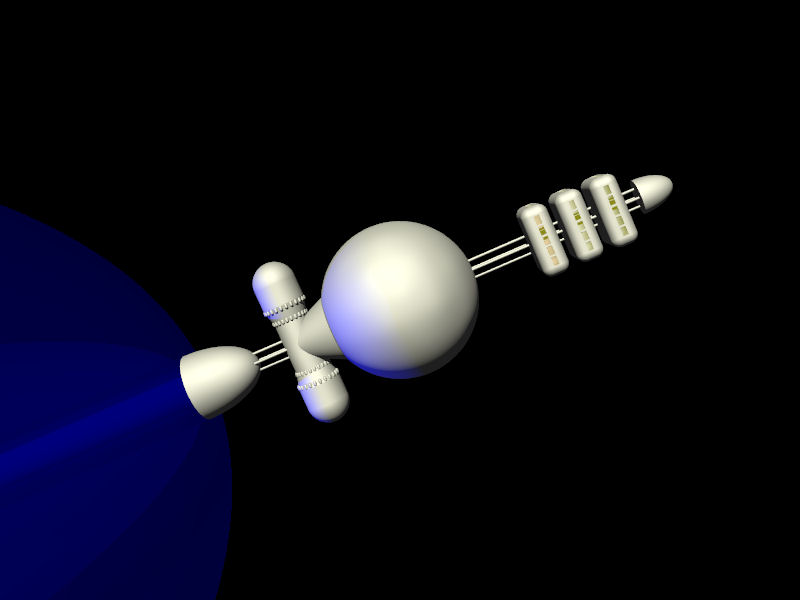
Here's what I've come up with so far.  Needs a lot of texturing and all
still.  The basic idea is a cargo hold up front, fuel tanks and solar
panels surrounding a central living area, and some engines in the back.
The cargo acts as impact shielding, the hydrogen acts as
radiation shielding, and the engines make it go.  A lot of it is
parameratized, so it's tweakable.  Here's one configuration
Post a reply to this message
|
|
| |
| |
|
|
|
|
| |
| |
|
|
And another
Post a reply to this message
|
|
| |
| |
|
|
|
|
| |
| |
|
|
"o.bb.spammed" <o.b### [at] gmailcom> wrote:
> Here's what I've come up with so far.  Needs a lot of texturing and all
> still.  The basic idea is a cargo hold up front, fuel tanks and solar
> panels surrounding a central living area, and some engines in the back.
> The cargo acts as impact shielding, the hydrogen acts as
> radiation shielding, and the engines make it go.  A lot of it is
> parameratized, so it's tweakable.  Here's one configuration

Errr.  Oops
Post a reply to this message
Attachments:
Download 'ship_back_1.jpg' (40 KB)
Preview of image 'ship_back_1.jpg'

|
|
| |
| |
|
|
|
|
| |
| |
|
|
"o.bb.spammed" <o.b### [at] gmailcom> wrote:
> And another

More oops...
Post a reply to this message
Attachments:
Download 'ship_front.jpg' (44 KB)
Preview of image 'ship_front.jpg'

|
|
| |
| |
|
|
|
|
| |
| |
|
|
"o.bb.spammed" <o.b### [at] gmailcom> wrote in message
news:web.4582cda3ff75702cbc81efaa0@news.povray.org...
> "o.bb.spammed" <o.b### [at] gmailcom> wrote:
>> And another
>
> More oops...


Oh, yeah, this is good!

Jon
Post a reply to this message
|
|
| |
| |
|
|
|
|
| |
| |
|
|
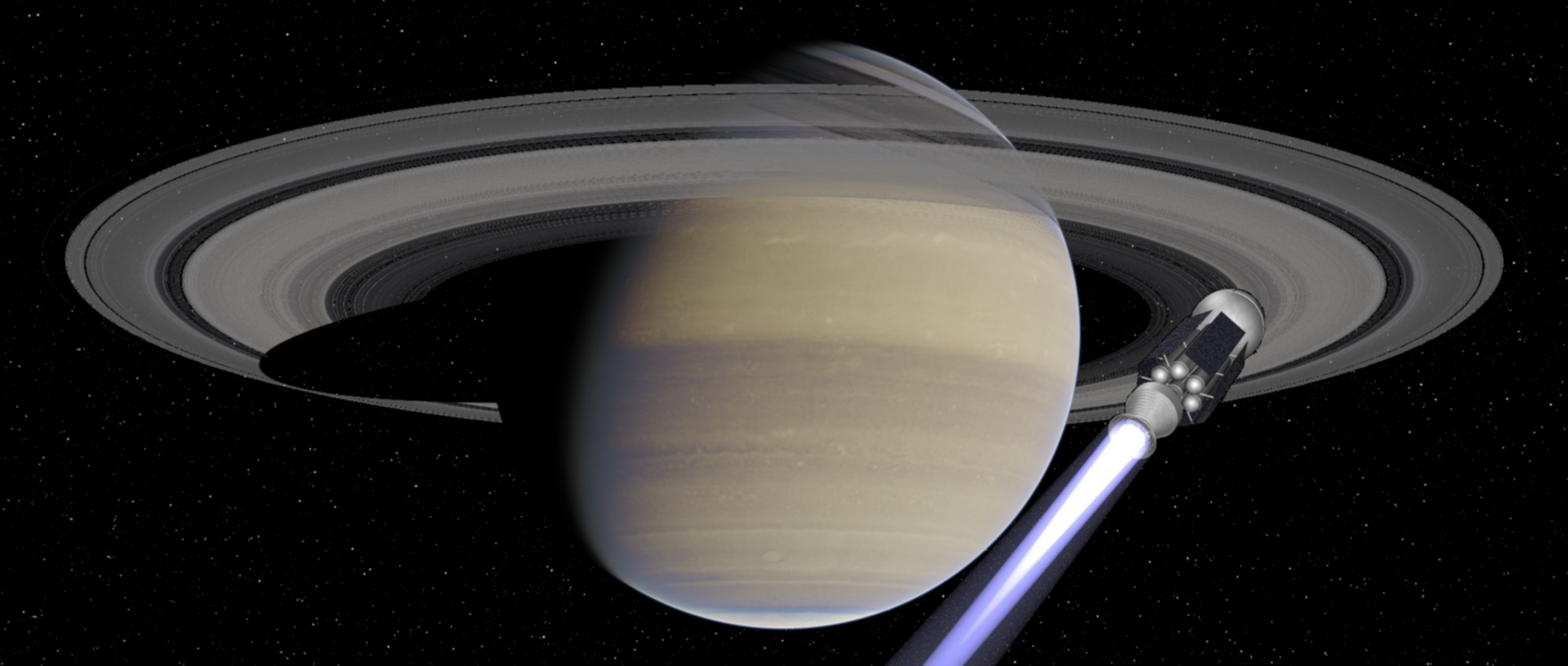
Very nice. With Jupiter or Saturn in the background, this would be really
cool.

Jon
Post a reply to this message
|
|
| |
| |
|
|
|
|
| |
| |
|
|
Jon S. Berndt nous apporta ses lumieres en ce 15-12-2006 06:48:
> "Alain" <ele### [at] netscapenet> wrote in message
> news:45828032@news.povray.org...
>> Jon S. Berndt nous apporta ses lumieres en ce 14-12-2006 22:07:
>>> "Tim Attwood" <tim### [at] comcastnet> wrote
>>> Hey, I kind of like this (I think I've seen something like this in my
>>> kitchen, too!)
>>> A couple of notes:
>>> 1) There should be no over-expansion of the nozzle, I think. All of the
>>> flow would be almost all directed aft.

>> The over-expansion is unavoidable. All you can do, is try to minimise it.

>>> 2) I'm sure this is a WIP, but thought I'd mention that there would be
>>> more to the engine (a lot of equipment creating magnetic fields - coils
>>> and stuff, supply lines for fuel, etc.)

>> Depending on the scale, that can be all contained within the nozle.

> Visually, what I would like to see is probably best illustrated by looking
> at a Hall thruster:

> http://fluid.ippt.gov.pl/sbarral/hall.html

> (see Pratt and Whitney thruster at bottom of this page)
> http://www.engin.umich.edu/dept/aero/spacelab/thrusters/thrusters.html

> http://www.adastrarocket.com/Plasma.html

> There is little, if any, overexpansion of exhaust in these images. The image
> by Tek was very good in this respect.

> Jon


Plasma or ion engines, indeed, don't show overexpansion. The reason is that the
plasma have very neglegible pressure. It don't have presure as it's not
accelerated by the presure but by magnetic and electric fields. I was thinking
more about chemical or nuclear powered rocket engines. In those cases, the
exaust have a prety high residual presure as it leave the engine, and that
residual presure is what causes the overexpansion.

--
Alain
-------------------------------------------------
When the bosses talk about improving productivity, they are never talking about
themselves.
Post a reply to this message
|
|
| |
| |
|
|
|
|
| |
| |
|
|
"Alain" <ele### [at] netscapenet> wrote in message news:45833d66

> Plasma or ion engines, indeed, don't show overexpansion. The reason is
> that the plasma have very neglegible pressure. It don't have presure as
> it's not accelerated by the presure but by magnetic and electric fields. I
> was thinking more about chemical or nuclear powered rocket engines.

Egg-zactly.  :^)

> In those cases, the exaust have a prety high residual presure as it leave
> the engine, and that residual presure is what causes the overexpansion.
>
> Alain

Ideally, rocket nozzles are designed so that the flow is optimally expanded
over the altitude range (pressure range) it operates in. You can't "have it
all".

Jon
--
Jon S. Berndt
Aerospace Engineer
Houston, TX
--
Editor, Horizons, AIAA Houston
http://www.aiaa-houston.org/horizons
--
Project Development Coordinator, JSBSim
http://www.jsbsim.org
Post a reply to this message
|
|
| |
| |
|
|
|
|
| |
| |
|
|
Jon S. Berndt wrote:
> Greetings:
>
> I'm looking for a cover image for the fall/winter issue of Horizons, the
> online magazine for the Houston section of AIAA (American Institute of
> Aeronautics and Astronautics). See www.aiaa-houston.org/horizons. I'm the
> volunteer editor for that publication. This issue features one or two
> articles on futuristic propulsion concepts. I'm looking for an image of a
> special, realistic, futuristic interstellar or intra-solar system
> spacecraft, that illustrates powerful propulsion as part of its design. As a
> long time user of POV-Ray, I figured this would be a good place to ask
> around. If you have such an image and would be willing to let us use it in
> exchange only for image credit and acknowledgement, I'd like to hear from
> you.
>
> "Horizons" has won first place nationally two years in a row, recognized for
> excellence in production and content. Circulation (downloads) average about
> 5000 per issue (sometimes as high as 20,000 per issue). It is read with
> interest in and around Johnson Space Center near Houston, Texas.
>
> Also, if you are aware of any galleries of renderings (or paintings) of
> futuristic spacecraft, I'd appreciate hearing about those, too.
>
> Thanks!
>
> Jon
> Editor, Horizons
> AIAA Houston
> www.aiaa-houston.org/horizons
>
>
>
I am surprised that no one posted this link
http://www.bisbos.com/rocketscience/spacecraft/daedalus/image_general1.html
Post a reply to this message
|
|
| |
| |
|
|
|
|
| |
| |
|
|
> Ideally, rocket nozzles are designed so that the flow is optimally
> expanded over the altitude range (pressure range) it operates in. You
> can't "have it all".
>
> Jon
> --
> Jon S. Berndt
> Aerospace Engineer
> Houston, TX

If I remember correctly the engine bells of the 1st, 2nd and 3rd stages of
the Saturn V were quite different shapes to accomodate this.

This is one of the advantages of the aerospike type of engine... It
effectively uses the atmosphere as the outer wall of the expansion chamber,
thus it automatically adjusts to external atmospheric pressure.   What a
great pity the X33 and Venturestar programs were shelved!

Assuming the spacecraft didn't need to enter atmosphere, i.e. it was an
interplanetary craft, its engines would only need to operate in a vacuum, so
no adjustment would be required.

Rarius
Post a reply to this message
|
|
| |
| |
|
|
|
|
| |
| |
|
|
"Art Flint" <afl### [at] stxrrcom> wrote in message

> I am surprised that no one posted this link
> http://www.bisbos.com/rocketscience/spacecraft/daedalus/image_general1.html

An excellent link. Thanks!

Jon
Post a reply to this message
|
|
| |
| |
|
|
|
|
| |
| |
|
|
"Jon S. Berndt" <jsb### [at] hal-pcorg> wrote:

> "Art Flint" <afl### [at] stxrrcom> wrote in message
>
>> I am surprised that no one posted this link
>> http://www.bisbos.com/rocketscience/spacecraft/daedalus/image_general1.html
>
> An excellent link. Thanks!
>
> Jon

I contacted Adrian Mann (who produced the images at the link, above), and he
is willing to let me use some of those. Thanks. I'll check back here in case
anyone finishes up another craft.

Jon
Post a reply to this message
|
|
| |
| |
|
|
|
|
| |
| |
|
|
"Jon S. Berndt" <jsb### [at] hal-pcorg> wrote:
> "EagleSun" <nomail@nomail> wrote in message news:457f2619
>
> > Hi Jon!
> >
> > It's really exciting to see someone from Houston on this forum AND
> > publishing magazines.  Looks like Tek has a very good ship for you....
> > would you need background to go with it?  I've been rendering planets,
> > including a few to show in a movie...
> >
> > Let me know if you need something...
>
> If a ship does come out of this, a planet might be a nice background. Not
> sure if the image would portray braking into orbit or leaving ... hmmm.
>
> Jon

Would a foreign planet portray the fact that it left earth and arrived
somewhere far?

Thanks for writing again... I've also been away mainly because I gave up my
old computer and received a new one, and I'm just getting myself setup on
it.

It's quite difficult to search what you are looking for, hoping it already
exists.  Typically when I search for something, I give myself about 3
months to search, where either I find it after 2 months, or conclude it
doesn't exist.  To get what you want, your best chance is to describe it
and let the volunteers make it.  And I think we would be happy to make
something for a high-profile magazine.

OK, describing my collection...

[America        ][Africa/Asia   ][Planet Houston][Himalayas     ]
[Europe/Asia                    ][Borentuu Sys. ][Uranus        ]
[Saturn Portrait by Cassini     ][Space City    ][              ]

I'm from Houston too, so I like to make planet Houston.
Post a reply to this message
Attachments:
Download 'compile.jpg' (103 KB)
Preview of image 'compile.jpg'

|
|
| |
| |
|
|
|
|
| |
| |
|
|
"EagleSun" <nomail@nomail> wrote in message

> It's quite difficult to search what you are looking for, hoping it already
> exists.  Typically when I search for something, I give myself about 3
> months to search, where either I find it after 2 months, or conclude it
> doesn't exist.  To get what you want, your best chance is to describe it
> and let the volunteers make it.  And I think we would be happy to make
> something for a high-profile magazine.

Well, I actually got extremely lucky, due to a tip received here (see the
previous posts). Adrian Mann has created some incredible pieces that are
very appropriate. I'm using a couple of those, with his permission. I'm now
working feverishly on completing the publication. I hope to be done within a
couple of days.

After that, I have had a picture in mind of my own to do in POV-Ray, and
hope to actually accomplish that over the Christmas break. It should be very
cool. I may also use Terragen for part of it.

Jon
Post a reply to this message
|
|
| |
| |
|
|
|
|
| |
| |
|
|
>> "EagleSun" <nomail@nomail> wrote in message news:457f2619

> Would a foreign planet portray the fact that it left earth and arrived
> somewhere far?
>
> Thanks for writing again... I've also been away mainly because I gave up
> my
> old computer and received a new one, and I'm just getting myself setup on
> it.
>
> It's quite difficult to search what you are looking for, hoping it already
> exists.  Typically when I search for something, I give myself about 3
> months to search, where either I find it after 2 months, or conclude it
> doesn't exist.  To get what you want, your best chance is to describe it
> and let the volunteers make it.  And I think we would be happy to make
> something for a high-profile magazine.

By the way, the answer to your question above is, yes. A fictional planet
would be a cool backdrop. Don't give up on creating an image. I suspect I
will need some more images in the near future. I've also toyed with the idea
over the past year of having our section sponsor a digital space art
competition, with monetary prizes. We'll see where that goes.

Jon
Post a reply to this message
|
|
| |
| |
|
|
|
|
| |
| |
|
|
"Jon S. Berndt" <jsb### [at] hal-pcorg> wrote in message
news:4588904c@news.povray.org...
> "EagleSun" <nomail@nomail> wrote in message
>
> After that, I have had a picture in mind of my own to do in POV-Ray, and
> hope to actually accomplish that over the Christmas break. It should be
> very cool. I may also use Terragen for part of it.
>
> Jon
>
>

OK... that's so cool!  I use Terragen too sometimes.
Post a reply to this message
|
|
| |
| |
|
|
|
|
| |
| |
|
|
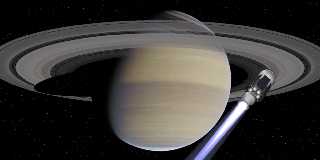
"Jon S. Berndt" <jsb### [at] hal-pcorg> wrote in message
news:45833c78$1@news.povray.org...
> Very nice. With Jupiter or Saturn in the background, this would be really
> cool.
>
> Jon
>
>

Here it is again with Saturn in background... this is just a simple
cut/paste.  So if you really want this, this will have to be re-done.. and
of course, the parts would be placed better.
Post a reply to this message
Attachments:
Download 'ship-with-sat.jpg' (396 KB)
Preview of image 'ship-with-sat.jpg'
|
|
| |
| |
|
|
|
|
| |
| |
|
|
"Jon S. Berndt" <jsb### [at] hal-pcorg> wrote:
> >> "EagleSun" <nomail@nomail> wrote in message news:457f2619
>
> > Would a foreign planet portray the fact that it left earth and arrived
> > somewhere far?
>
> By the way, the answer to your question above is, yes. A fictional planet
> would be a cool backdrop. Don't give up on creating an image. I suspect I
> will need some more images in the near future. I've also toyed with the idea
> over the past year of having our section sponsor a digital space art
> competition, with monetary prizes. We'll see where that goes.
>
> Jon

Houston... we've just discovered a planetary system....

This is Borentuu system.  So far, we have identified 3 moons which orbit the
ringed planet, where the second moon supports life.  The ringed planet
itself is surrounded by a powerful magnetic force, which allows for the
sustaining of ice rings, similar to those of Saturn, even while orbiting in
close proximity to its sun.  The surface of the giant is believed to be
water in liquid state while yet at smoldering temperatures of 400 degrees
Fahrenheit, and is believed that its liquid state is being maintained by
its intense atmospheric pressure.  The second moon sports a foresty
mountainous terrain, blanketed mostly by fog in the lower altitudes.  The
absence of specular effects does not represent an absence of water, as it
was noted thick vegetation in the lower altitudes completely cover and
horde the water for their own benefit, and yet substantial water does
evaporate and fill the air.  Floating cities were discovered, which
suggests the terrain and conditions are not friendly toward surface
urbanization.  The highest mountain altitudes appear to support the most
comfortable conditions for human-like life forms which created the floating
cities hovering at similar altitudes.  The network of cities suggests
knowledge of advanced engineering in their civilization.
Post a reply to this message
Attachments:
Download 'bb.png' (562 KB)
Preview of image 'bb.png'

|
|
| |
| |
|
|
|
|
| |
| |
|
|
"EagleSun" <nomail@nomail> wrote in message

> Houston... we've just discovered a planetary system....
>
> This is Borentuu system.  So far, we have identified 3 moons which orbit
> the
> ringed planet, where the second moon supports life.  The ringed planet
> ...

Nice. It might also be cool to have the system's "Sun" more inline with the
planets and visible, illuminating the planets from the opposite side (from
the viewer) and with the atmosphere more visible.

Jon
Post a reply to this message
|
|
| |
| |
|
|
|
|
| |
| |
|
|
Wow! Once more a picture of great vision! I like the ideas!

Go on, EagleSun!

Sven


"EagleSun" <nomail@nomail> schrieb im Newsbeitrag
news:458afe7d$1@news.povray.org...
>
> "Jon S. Berndt" <jsb### [at] hal-pcorg> wrote in message
> news:4588904c@news.povray.org...
>> "EagleSun" <nomail@nomail> wrote in message
>>
>> After that, I have had a picture in mind of my own to do in POV-Ray, and
>> hope to actually accomplish that over the Christmas break. It should be
>> very cool. I may also use Terragen for part of it.
>>
>> Jon
>>
>>
>
> OK... that's so cool!  I use Terragen too sometimes.
>
>
>
Post a reply to this message
|
|
| |
| |
|
|
|
|
| |
|
|