|
|
|
|
|
|
| |
| |
|
|
From: Thomas de Groot
Subject: Eavesdropping WIP - radiosity issues
Date: 14 Sep 2006 11:12:49
Message: <45097171@news.povray.org>
|
|
|
| |
| |
|
|
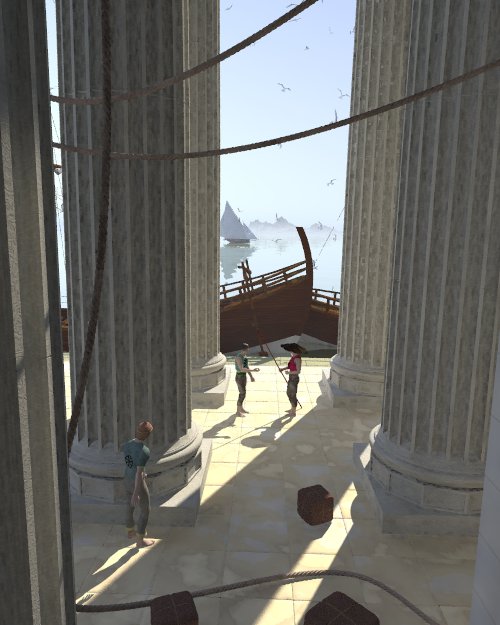
I need your expert comments :-)

This is the first serious render of the scene with radiosity. It is a 2-pass
job (first gathering radiosity data on an image half the size of this one;
took about 5+ hours; second pass was just about 45 minutes). There are still
ugly artifacts visible, especially on the columns. What is the best way to
go from here? I include the radiosity settings used so far. Normal and media
are off; Megapov settings were used

Thanks for the help!!

Thomas

//==== start code ====
      radiosity {
        //saving radiosity data:
        #if (RadSave)
          save_file "Oreille2.rad"
          pretrace_start 0.01
          pretrace_end   0.005
          nearest_count 6
          always_sample on
          #if (MPov)
            samples 1
            adaptive 2
            error_bound {0.1 adaptive 1.5, 50}
          #else
            error_bound 0.1
          #end

        //reading radiosity data:
        #else
          load_file "Oreille2.rad"
          pretrace_start 1
          pretrace_end 1
          nearest_count 6
          always_sample off
          #if (MPov)
             samples 1
             adaptive 1
             error_bound {0.1 adaptive 1.8, 20}
          #else
             error_bound 0.1
          #end
        #end

        //common settings:
        low_error_factor 0.5
        gray_threshold 0
        adc_bailout 0.01/2
        minimum_reuse 0.015
        count 150
        brightness 1.0
        recursion_limit 3
        normal Nor
        media Med

      }
//==== end code ====
Post a reply to this message
Attachments:
Download 'Eavesdropping_wip06.jpg' (58 KB)
Preview of image 'Eavesdropping_wip06.jpg'
|
|
| |
| |
|
|
|
|
| |
| |
|
|
Is that texturing you added to the columns and tiles or is that the
artifacting?  If it is, it almost looks like a nice texture.  ;)

Typically I drop the recursion limit down to 1 or 2 and jack the count
setting way up.  Although a significant portion of your image is in the
shadow, and with the nooks and crannies in the architecture you are
using, keeping it at 3 is probably best.  You might want to try 2 and
see if you can get away with it.  The reason you'd want to lower it is
to save time, because your count is way too low.  I'd bump up to 1000 at
least, and at a recursion limit of 3 thats going to take forever.

The biggest factor here might be your error bound.  A value of 0.1 is
very accurate and requires a very high count (and ages to render).
Maxing out at 1600 you are still going to see artifacts probably.  I'd
raise that up to at least 0.5 and you might want to go all the way to 1.
  Your lighting won't be as accurate but it will be much smoother.
Remember, as your error bound lowers, the count has to go up.

Nearest count could also be increased to take a few artifacts out.

Skip
Post a reply to this message
|
|
| |
| |
|
|
|
|
| |
| |
|
|
Thomas de Groot wrote:
> I need your expert comments :-)
>
> This is the first serious render of the scene with radiosity. It is a 2-pass
> job (first gathering radiosity data on an image half the size of this one;
> took about 5+ hours; second pass was just about 45 minutes). There are still
> ugly artifacts visible, especially on the columns. What is the best way to
> go from here? I include the radiosity settings used so far. Normal and media
> are off; Megapov settings were used

Well, what I usually do when using the two-pass method, is to use a
lower error_bound on the first pass, and double or quadruple (always 2
with an exponent attached) the error_bound on the loading pass. What
this does is average more of the samples together, in effect smoothening
the radiosity results somewhat. Of course this leads to loss of details,
but detailed errors are smoothened away as well. You could have a look
at my website as well, I've experimented a little with radiosity some
time back:
http://www.nolights.de/projects/radiosity/radiosity.html

Hope that helps, even if just a little.

Regards,
Tim

--
aka "Tim Nikias"
Homepage: <http://www.nolights.de>
Post a reply to this message
|
|
| |
| |
|
|
|
|
| |
| |
|
|
"Skip Talbot" <Ski### [at] aol com> wrote in message
news:45098a9f$1@news.povray.org...
> Is that texturing you added to the columns and tiles or is that the
> artifacting? If it is, it almost looks like a nice texture. ;)
That's what I wanted to say! Really, I admire Thomas' work, but I too
have no experience with Rad, and consequently, don't know what an 'artifact'
is. When they're spoken of, I always find it hard to see what the author is
seeing.
I actually see this image as an improvement on the last one. It looks
good to me.
~Steve~
> Skip com> wrote in message
news:45098a9f$1@news.povray.org...
> Is that texturing you added to the columns and tiles or is that the
> artifacting? If it is, it almost looks like a nice texture. ;)
That's what I wanted to say! Really, I admire Thomas' work, but I too
have no experience with Rad, and consequently, don't know what an 'artifact'
is. When they're spoken of, I always find it hard to see what the author is
seeing.
I actually see this image as an improvement on the last one. It looks
good to me.
~Steve~
> Skip
Post a reply to this message
|
|
| |
| |
|
|
|
|
| |
| |
|
|
Thomas de Groot wrote:
> I need your expert comments :-)
>
> This is the first serious render of the scene with radiosity. It is a 2-pass
> job (first gathering radiosity data on an image half the size of this one;
> took about 5+ hours; second pass was just about 45 minutes). There are still
> ugly artifacts visible, especially on the columns. What is the best way to
> go from here? I include the radiosity settings used so far. Normal and media
> are off; Megapov settings were used

I don't understand your use of the MegaPOV adaptive error_bound - if you
use it in the first pass you will loose control over the accuracy of the
radiosity data taken and stored.  Furthermore using tighter settings in
the final pass will increase the number of samples taken there (and
using always_sample off at the same time could lead to low quality).

I would try to decrease recursion_limit to 2 and use the saved time to
improve quality if that does not change the appearance too much.

Christoph

--
POV-Ray tutorials, include files, Landscape of the week:
http://www.imagico.de/ (Last updated 20 Aug. 2006)
MegaPOV with mechanics simulation: http://megapov.inetart.net/
Post a reply to this message
|
|
| |
| |
|
|
|
|
| |
| |
|
|
Thomas,
I'm curious about this fascinating scene...
  lateen rigged caravel
  collosal greco/roman pillars
  traditional chinese laborer's hat
Where? When?

DLM

"Thomas de Groot" <t.d### [at] internlnet> wrote in message
news:45097171@news.povray.org...
>I need your expert comments :-)
>
> This is the first serious render of the scene with radiosity. It is a
> 2-pass job (first gathering radiosity data on an image half the size of
> this one; took about 5+ hours; second pass was just about 45 minutes).
> There are still ugly artifacts visible, especially on the columns. What is
> the best way to go from here? I include the radiosity settings used so
> far. Normal and media are off; Megapov settings were used
>
> Thanks for the help!!
>
> Thomas
>
> //==== start code ====
>      radiosity {
>        //saving radiosity data:
>        #if (RadSave)
>          save_file "Oreille2.rad"
>          pretrace_start 0.01
>          pretrace_end   0.005
>          nearest_count 6
>          always_sample on
>          #if (MPov)
>            samples 1
>            adaptive 2
>            error_bound {0.1 adaptive 1.5, 50}
>          #else
>            error_bound 0.1
>          #end
>
>        //reading radiosity data:
>        #else
>          load_file "Oreille2.rad"
>          pretrace_start 1
>          pretrace_end 1
>          nearest_count 6
>          always_sample off
>          #if (MPov)
>             samples 1
>             adaptive 1
>             error_bound {0.1 adaptive 1.8, 20}
>          #else
>             error_bound 0.1
>          #end
>        #end
>
>        //common settings:
>        low_error_factor 0.5
>        gray_threshold 0
>        adc_bailout 0.01/2
>        minimum_reuse 0.015
>        count 150
>        brightness 1.0
>        recursion_limit 3
>        normal Nor
>        media Med
>
>      }
> //==== end code ====
>
>
Post a reply to this message
|
|
| |
| |
|
|
From: Thomas de Groot
Subject: Re: Eavesdropping WIP - radiosity issues
Date: 15 Sep 2006 02:48:55
Message: <450a4cd7@news.povray.org>
|
|
|
| |
| |
|
|
"St." <dot### [at] dotcom> schreef in bericht news:4509911a@news.povray.org...
>
> "Skip Talbot" <Ski### [at] aolcom> wrote in message
> news:45098a9f$1@news.povray.org...
>> Is that texturing you added to the columns and tiles or is that the
>> artifacting?  If it is, it almost looks like a nice texture.  ;)
>
>    That's what I wanted to say! Really, I admire Thomas' work, but I too
> have no experience with Rad, and consequently, don't know what an
> 'artifact' is. When they're spoken of, I always find it hard to see what
> the author is seeing.
>

Yes, a good question Skip and Steve! I am not sure what it is. I use an
averaged texture for the columns and I think that partly it is texture what
you see. But only partly. I suspect them to be mostly artifacts because the
texture without any radiosity or fancy adds looks much smoother, especially
at the middle distance.

>      I actually see this image as an improvement on the last one. It looks
> good to me.
>
Thank you Steve! I thought so too. I always try to put radiosity in because
the look becomes more natural. However, the render times and the tuning of
it is really arduous in my experience.

Thomas
Post a reply to this message
|
|
| |
| |
|
|
|
|
| |
| |
|
|
"Christoph Hormann" <chr### [at] gmxde> schreef in bericht
news:eec9lp$llh$1@chho.imagico.de...
>
> I don't understand your use of the MegaPOV adaptive error_bound - if you
> use it in the first pass you will loose control over the accuracy of the
> radiosity data taken and stored.  Furthermore using tighter settings in
> the final pass will increase the number of samples taken there (and using
> always_sample off at the same time could lead to low quality).
>
Thanks Christoph! I had not realised the consequences of the adaptive
error_bound in the first pass. Quite simply I thought it would - at the same
time - speed up calculations and increase accuracy! Well well well... Things
are never as simple as one believes...

> I would try to decrease recursion_limit to 2 and use the saved time to
> improve quality if that does not change the appearance too much.
>
Yes, the recursion_limit is an issue I have been thinking about. I had
already tried as a test a value of 1 but that was ugly.

Thanks for your comments. Much appreciated!

Thomas
Post a reply to this message
|
|
| |
| |
|
|
|
|
| |
| |
|
|
"dlm" <me### [at] addressinvalid> schreef in bericht
news:4509b646$1@news.povray.org...
> Thomas,
> I'm curious about this fascinating scene...
>  lateen rigged caravel
>  collosal greco/roman pillars
>  traditional chinese laborer's hat
> Where? When?
>

He he!! Yes... all that is true. This is an a-historic mixture of elements
from different cultures and different times.
- The ship in the background is, I believe, a fairly recent (perhaps 19th
century) Mediterranean ship;
- The ships at the quay are ancient Greek merchant ships. The model is based
on the one found at Kyrenia (Cyprus).
- Pillars: This is a reconstruction of the Greek temple of Apollo at Dydima
(Turkey). In fact it is in a state it never was in reality, as the
construction was never finished after a last earthquake destroyed part of
the work.
- Chinese hat: yes, or rather: a variation upon the chinese hat;
- one could add: clothings that reminds of the mythical Middle East of
Haroun Al Rachid;

...So.... it is a story, a myth, a dream... whatever you want... :-)
Still, I feel it important that the elements seem to go together, and blend
into a credible scene.

Thomas
Post a reply to this message
|
|
| |
| |
|
|
|
|
| |
| |
|
|
"Tim Nikias" <JUS### [at] gmxnetWARE> schreef in bericht
news:45098c3c@news.povray.org...
>
> Well, what I usually do when using the two-pass method, is to use a lower
> error_bound on the first pass, and double or quadruple (always 2 with an
> exponent attached) the error_bound on the loading pass. What this does is
> average more of the samples together, in effect smoothening the radiosity
> results somewhat. Of course this leads to loss of details, but detailed
> errors are smoothened away as well. You could have a look at my website as
> well, I've experimented a little with radiosity some time back:
> http://www.nolights.de/projects/radiosity/radiosity.html
>

Thank you Tim, I shall visit again your site. Everything helps. I try to
understand what I am doing especially by studying what others have done,
however with radiosity this is not always easy.

Thomas
Post a reply to this message
|
|
| |
| |
|
|
|
|
| |
| |
|
|
"St." <dot### [at] dotcom> schreef in bericht news:4509911a@news.povray.org...
>
>
>    That's what I wanted to say! Really, I admire Thomas' work, but I too
> have no experience with Rad, and consequently, don't know what an
> 'artifact' is. When they're spoken of, I always find it hard to see what
> the author is seeing.
>
I did not answer fully your comment. Sorry for that.
Apart from the column shafts, you can see those black spots towards the
base, on the horizontal surface just below the torus. Those are definitely
artefacts. So, although I feel not happy about the shafts, the image is
almost there.

Thomas
Post a reply to this message
|
|
| |
| |
|
|
From: Thomas de Groot
Subject: Re: Eavesdropping WIP 07 - better radiosity
Date: 15 Sep 2006 11:06:27
Message: <450ac173@news.povray.org>
|
|
|
| |
| |
|
|
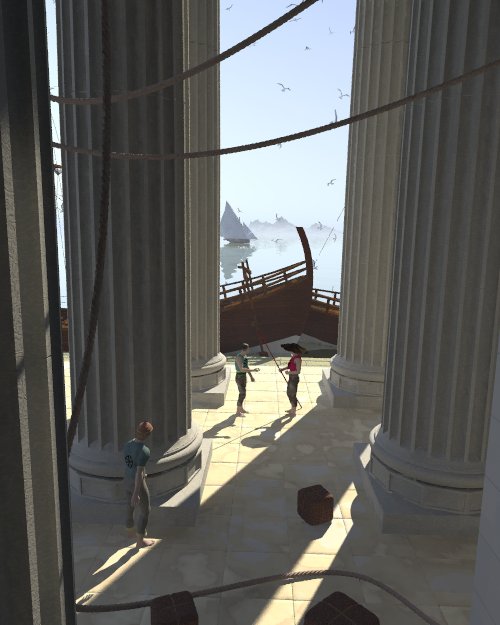
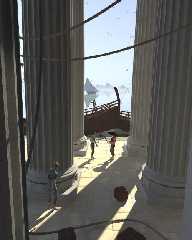
This is almost 'perfect' :-)
Still a bit of artifacts visible, but not much.
Essentially, what I have changed since the preceding render are:
increasing nearest_count to 10
increasing error_bound at 0.5 in the first pass
increasing low_error_factor to 0.9
increasing count to 250
decreasing recursion_limit to 2
decreasing brightness to 0.8 in the second pass

...and I gained a couple of hours at the first pass! So I can use that to
increase count even more.

Again, many thanks to all for your very helpful comments!!
People! listen carefully to your betters!!!  :-)

Thomas
Post a reply to this message
Attachments:
Download 'Eavesdropping_wip07.jpg' (52 KB)
Preview of image 'Eavesdropping_wip07.jpg'
|
|
| |
| |
|
|
|
|
| |
| |
|
|
"Thomas de Groot" <t.d### [at] internlnet> wrote in message
news:450ac173@news.povray.org...
> This is almost 'perfect' :-)

    Agreed. This is looking much better! And yes, I now see where the
artefacts were.  ;)

     But, you've got to do something about that texture (on the lower
pillars), because it looked SO good in your other image! Perhaps some kind
of procedural crackle might do it? (Not sure).

       ~Steve~


> Thomas
Post a reply to this message
|
|
| |
| |
|
|
|
|
| |
| |
|
|
Thomas de Groot wrote:

> ...So.... it is a story, a myth, a dream... whatever you want... :-)
> Still, I feel it important that the elements seem to go together, and blend
> into a credible scene.
>
Thanks to Gena, we know it's a "Capriccio"
Post a reply to this message
|
|
| |
| |
|
|
|
|
| |
| |
|
|
Thomas de Groot wrote:

> Again, many thanks to all for your very helpful comments!!
> People! listen carefully to your betters!!!  :-)
>
>
Oh, and what do you know? I have been "eavesdropping" on *that* little
conversation.

With the technical problems gone, this image takes on a compelling
narrative interest. Figure gestures, camera angle, and so on. Nice work.
  Don't know where all this is coming from, or going to, but I love it.
  Are your images collected anywhere such that we might see the development?
Post a reply to this message
|
|
| |
| |
|
|
|
|
| |
| |
|
|
Thomas de Groot wrote:
> This is almost 'perfect' :-)
> Still a bit of artifacts visible, but not much.
> Essentially, what I have changed since the preceding render are:
> increasing nearest_count to 10
> increasing error_bound at 0.5 in the first pass
> increasing low_error_factor to 0.9
> increasing count to 250
> decreasing recursion_limit to 2
> decreasing brightness to 0.8 in the second pass

It looks much better (although difficult to judge at this small size)
but under the aspect of the argument i gave concerning the adaptive
error_bound using a higher one in the pretrace than in the final trace
is counterproductive.  Of course the adaptation will automatically
increase it in the final pass but this will make it slower than
necessary.  If you set the starting value of the adaptation to the same
as in the pretrace this will probably make it quite a bit faster and not
much worse (although it is difficult to say for sure). Since there have
not been a lot of tests made with the adaptive error_bound it might be
interesting to see the (non-jpeg-compressed) results of this in
comparison.   If you could quote the number of samples taken in pretrace
and in the final pass that would also help to say if these assumptions
are correct.

BTW using different brightness in two passes is handled by POV-Ray AFAIK
but there is not much point in doing this.

Christoph

--
POV-Ray tutorials, include files, Landscape of the week:
http://www.imagico.de/ (Last updated 20 Aug. 2006)
MegaPOV with mechanics simulation: http://megapov.inetart.net/
Post a reply to this message
|
|
| |
| |
|
|
From: Thomas de Groot
Subject: Re: Eavesdropping WIP - radiosity issues
Date: 16 Sep 2006 03:00:31
Message: <450ba10f@news.povray.org>
|
|
|
| |
| |
|
|
"Jim Charter" <jrc### [at] msncom> schreef in bericht
news:450af2a3$1@news.povray.org...
> Thomas de Groot wrote:
>
>> ...So.... it is a story, a myth, a dream... whatever you want... :-)
>> Still, I feel it important that the elements seem to go together, and
>> blend into a credible scene.
>>
> Thanks to Gena, we know it's a "Capriccio"

Thanks Jim! That is exactly the right description. Forgot about Gena's.

Thomas
Post a reply to this message
|
|
| |
| |
|
|
|
|
| |
| |
|
|
"Jim Charter" <jrc### [at] msncom> schreef in bericht
news:450af426$1@news.povray.org...
.
>
> With the technical problems gone, this image takes on a compelling
> narrative interest. Figure gestures, camera angle, and so on. Nice work.
> Don't know where all this is coming from, or going to, but I love it. Are
> your images collected anywhere such that we might see the development?

Thank you indeed, Jim! It is going in the direction I want it to go.
I have no idea where the image is coming from. It is one of those typical
hunches/visions I often have about scenes, stories, projects. Most of the
time, it comes to nothing; sometimes I try to keep a record on them; in a
few instances they turn into images, stories, or projects. It depends very
much on how compelling the hunches really are. Sometimes the vision is so
compelling that I work on it for a couple of days/weeks, totally mesmerized,
like if somebody was dictating me what to do (sounds familiar?) and then
most often, it remains dormant for a long time.... or forever.
Quite possibly, this images is going to turn into a short story one day, or
become part of a larger whole. I don't know. With a friend, we write an
unending stream of short stories (in Portuguese), sometimes based on
randomly selected old photographs or pictures. It's fun to do.
Interestingly, before even knowing about Gilles Tran's Book of Beginnings, I
had started something similar but with finished very short texts around an
image. It too started suddenly as a hunch.
I am working on a website where (part of) my work will be on display. I
admit that I started it already years and years ago, but since a few weeks
it seems to pick up speed. So... be patient.

Thomas
Post a reply to this message
|
|
| |
| |
|
|
|
|
| |
| |
|
|
"St." <dot### [at] dotcom> schreef in bericht news:450ae56f$1@news.povray.org...
>
>     But, you've got to do something about that texture (on the lower
> pillars), because it looked SO good in your other image! Perhaps some kind
> of procedural crackle might do it? (Not sure).
>
Steve, I am not sure I get your meaning. The texture is not looking so much
different from the non-radiosity image I believe. There is already a (agate)
turbulence/normal controlling the layered, averaged texture (visible on the
closest pillar to the left). Towards the middle distance this becomes
necessarily less visible. The same would hold for a crackle (for instance),
so you would not really see it. And then, radiosity is also playing its part
here.

Thomas
Post a reply to this message
|
|
| |
| |
|
|
|
|
| |
| |
|
|
"Christoph Hormann" <chr### [at] gmxde> schreef in bericht
news:eeesuu$npn$1@chho.imagico.de...
> Thomas de Groot wrote:
>> This is almost 'perfect' :-)
>> Still a bit of artifacts visible, but not much.
>> Essentially, what I have changed since the preceding render are:
>> increasing nearest_count to 10
>> increasing error_bound at 0.5 in the first pass
>> increasing low_error_factor to 0.9
>> increasing count to 250
>> decreasing recursion_limit to 2
>> decreasing brightness to 0.8 in the second pass
>
> It looks much better (although difficult to judge at this small size) but
> under the aspect of the argument i gave concerning the adaptive
> error_bound using a higher one in the pretrace than in the final trace is
> counterproductive.  Of course the adaptation will automatically increase
> it in the final pass but this will make it slower than necessary.  If you
> set the starting value of the adaptation to the same as in the pretrace
> this will probably make it quite a bit faster and not much worse (although
> it is difficult to say for sure). Since there have not been a lot of tests
> made with the adaptive error_bound it might be interesting to see the
> (non-jpeg-compressed) results of this in comparison.   If you could quote
> the number of samples taken in pretrace and in the final pass that would
> also help to say if these assumptions are correct.
>
Thanks Christoph. I much appreciate your comments as I feel that I still
have a lot to learn about this matter. Forgive me if I seem obtuse, but I
find this a difficult matter to understand, despite the excellent tutorials,
by the way, of you and others.
Let's see if I get this correctly.
Concerning error_bound, what I should do is (for instance):
error_bound 0.5 //first pass
error_bound {0.5 adaptive 1.5, 20} //second pass
OK? The quality of the results might then dictate using 0.5 or lower (or
higher, to see where acceptable boundaries are).
My initial assumption was that by making error_bound adaptive (at least in
the final pass) megapov would determine automatically what the necessary
values were, thus gaining time and quality.

I saved the message files fortunately. These are the number of samples taken
during pretrace:
Radiosity samples calculated:           424116 (1.34 %)
Radiosity samples reused:             31208079
  Samples (final trace)                  59336
  Samples (recursion 1)                  78012
  Samples (recursion 2)                 346104

And these of the samples taken during the second pass:
Radiosity samples calculated:            65094 (1.16 %)
Radiosity samples reused:              5549135
  Samples (final trace)                  64420
  Samples (recursion 1)                   7061
  Samples (recursion 2)                  58033

With the changes to error_bound, I shall make a new render and post both
images (the present one and the new one) together in png format.

> BTW using different brightness in two passes is handled by POV-Ray AFAIK
> but there is not much point in doing this.
>
Oh? I confess I followed the teachings of  Tim Nikias in this matter.

Thomas
Post a reply to this message
|
|
| |
| |
|
|
From: Thomas de Groot
Subject: Re: Eavesdropping WIP 07 - Testing error_bound settings
Date: 16 Sep 2006 06:16:21
Message: <450bcef5@news.povray.org>
|
|
|
| |
| |
|
|
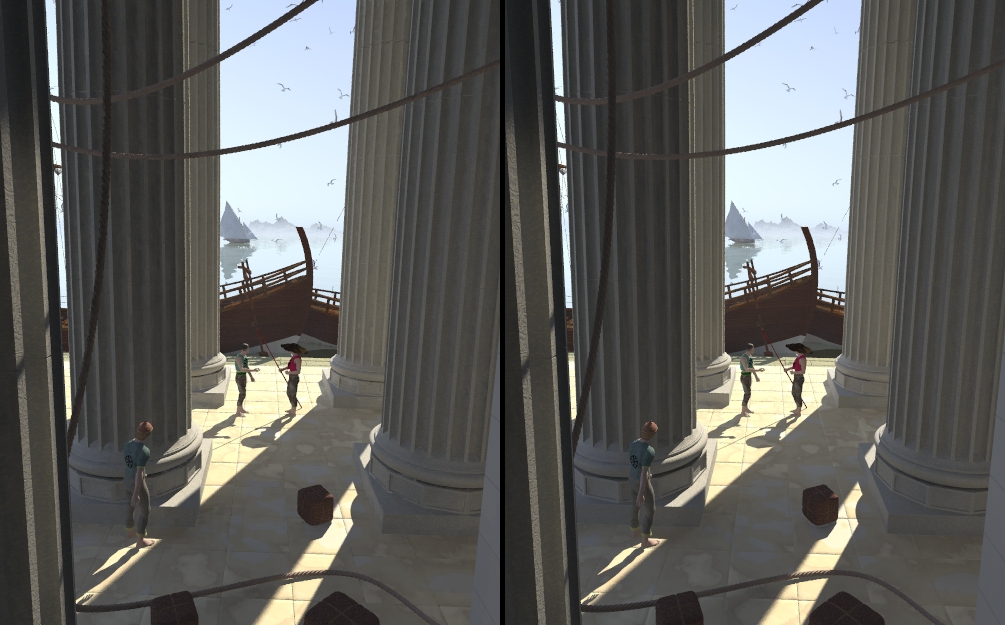
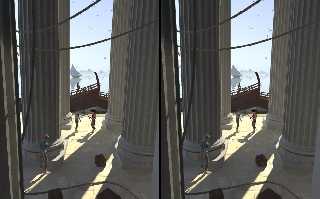
This is a test with the two settings for error_bound, all other settings
being equal. The images here are uncompressed jpg.

the image to the left, is the original one, with:
error_bound 0.5 //first pass
error_bound {0.1 adaptive 1.5, 20} //second pass

The image to the right has the settings:
error_bound 0.5 //first pass
error_bound {0.5 adaptive 1.5, 20} //second pass

samples for this image were:
Radiosity samples calculated:             1124 (0.03 %)
Radiosity samples reused:              3571781
  Samples (final trace)                   1124
  Samples (recursion 1)                    188
  Samples (recursion 2)                    936

and render time about 20 minutes.

The image to the right is the better of the two IMO.

Thomas
Post a reply to this message
Attachments:
Download 'Eavesdropper_wip7test.jpg' (357 KB)
Preview of image 'Eavesdropper_wip7test.jpg'
|
|
| |
| |
|
|
From: Tim Attwood
Subject: Re: Eavesdropping WIP 07 - Testing error_bound settings
Date: 16 Sep 2006 08:44:47
Message: <450bf1bf$1@news.povray.org>
|
|
|
| |
| |
|
|
I like your image, but I find one thing odd...
the eavesdropper is looking almost directly
into the sun.
Post a reply to this message
|
|
| |
| |
|
|
From: Thomas de Groot
Subject: Re: Eavesdropping WIP 07 - Testing error_bound settings
Date: 16 Sep 2006 08:50:49
Message: <450bf329$1@news.povray.org>
|
|
|
| |
| |
|
|
"Tim Attwood" <tim### [at] comcastnet> schreef in bericht
news:450bf1bf$1@news.povray.org...
>I like your image, but I find one thing odd...
> the eavesdropper is looking almost directly
> into the sun.
>
Yes, well he could not choose his spot obviously :-) Must certainly be
unconfortable, to say the least...

Thomas
Post a reply to this message
|
|
| |
| |
|
|
|
|
| |
| |
|
|
Thomas de Groot wrote:
>>
> Thanks Christoph. I much appreciate your comments as I feel that I still
> have a lot to learn about this matter. Forgive me if I seem obtuse, but I
> find this a difficult matter to understand, despite the excellent tutorials,
> by the way, of you and others.
> Let's see if I get this correctly.
> Concerning error_bound, what I should do is (for instance):
> error_bound 0.5 //first pass
> error_bound {0.5 adaptive 1.5, 20} //second pass
> OK? The quality of the results might then dictate using 0.5 or lower (or
> higher, to see where acceptable boundaries are).

Yes, you should notice however that the interaction between those
settings can be quite complicated and especially error_bound (which is
relevant both when taking and when reusing samples) can have quite
unexpected effects.  So it is possible that what you used has some
positive effect in some situations.  It would be a pretty advanced
experiment however. :-)

> My initial assumption was that by making error_bound adaptive (at least in
> the final pass) megapov would determine automatically what the necessary
> values were, thus gaining time and quality.

Error_bound is a user quality setting - there is no way for POV-Ray to
determine it automatically.  What the adaptation does is modifying the
error_bound to avoid taking additional samples.  But as said the
interactions with other settings are complicated so the influences on
the render results can be as well.

Christoph

--
POV-Ray tutorials, include files, Landscape of the week:
http://www.imagico.de/ (Last updated 20 Aug. 2006)
MegaPOV with mechanics simulation: http://megapov.inetart.net/
Post a reply to this message
|
|
| |
| |
|
|
|
|
| |
| |
|
|
"Thomas de Groot" <t.d### [at] internlnet> wrote in message
news:450bb0c8$1@news.povray.org...
>
> "St." <dot### [at] dotcom> schreef in bericht news:450ae56f$1@news.povray.org...
>>
>>     But, you've got to do something about that texture (on the lower
>> pillars), because it looked SO good in your other image!

 (The rad artefact image).


Perhaps some kind
>> of procedural crackle might do it? (Not sure).
>>
> Steve, I am not sure I get your meaning.

   I'm just saying that what happened with the rad artefacts is exactly what
you want for those pillar textures, that's all. Now replicate them somehow.


     ~Steve~


>
> Thomas
>
Post a reply to this message
|
|
| |
| |
|
|
|
|
| |
| |
|
|
Also, (and I'm not being picky here), compared to the people, that rope is
a heavy rope - and it should be laying flat against the ground (where the
sunlight hits it).

   ~Steve~
Post a reply to this message
|
|
| |
| |
|
|
|
|
| |
| |
|
|
"St." <dot### [at] dotcom> schreef in bericht news:450c2eea@news.povray.org...
>  Also, (and I'm not being picky here), compared to the people, that rope
> is a heavy rope - and it should be laying flat against the ground (where
> the sunlight hits it).
>
Arrgh!!! You noticed!!! :-(
Yes, you a re perfectly right. That comes from the difficulty to get the
rope coming from the ceiling, to bend correctly and lie flat. Either I
should add more control points to the spline, or make two separate ropes. It
is something I have still to do.

Thomas
Post a reply to this message
|
|
| |
| |
|
|
From: Thomas de Groot
Subject: Re: Eavesdropping WIP 07 - better radiosity
Date: 17 Sep 2006 03:18:58
Message: <450cf6e2@news.povray.org>
|
|
|
| |
| |
|
|
"St." <dot### [at] dotcom> schreef in bericht news:450c2b54@news.povray.org...
>
>
>   I'm just saying that what happened with the rad artefacts is exactly
> what you want for those pillar textures, that's all. Now replicate them
> somehow.
>
>
Yes, I see... Well, I am not that happy about the idea of an 'artifact'-type
texture. I prefer something smoother ans mor subtle.
But the idea is still an interesting one. I have to think about alternatives
for other scenes :-)

Thomas
Post a reply to this message
|
|
| |
| |
|
|
From: Jaime Vives Piqueres
Subject: Re: Eavesdropping WIP - radiosity issues
Date: 18 Sep 2006 05:55:04
Message: <450e6cf8@news.povray.org>
|
|
|
| |
| |
|
|
Hi Thomas:

   Not what you asked for, but I've a composition comment: I think the
"eavesdropping" effect would be even better if you can make the figure
pose more like if it were trying to hide behind the column, perhaps
leaning on the column with the left hand?

   Great work...

--

Jaime
Post a reply to this message
|
|
| |
| |
|
|
|
|
| |
| |
|
|
"Jaime Vives Piqueres" <jai### [at] ignoranciaorg> schreef in bericht
news:450e6cf8@news.povray.org...
> Hi Thomas:
>
>   Not what you asked for, but I've a composition comment: I think the
> "eavesdropping" effect would be even better if you can make the figure
> pose more like if it were trying to hide behind the column, perhaps
> leaning on the column with the left hand?
>
>   Great work...
>
Thank you Jaime!! Much appreciated!!
Yes, you are right and I am working on a version where the figure is indeed
leaning on the column like you suggest. I think it was Janet who said
something in the same line a couple of wips ago. These wips were mainly to
solve the radiosity and other problems (the rope for example, which is now
solved).
I am now going to work seriously on the figure again.

Thomas
Post a reply to this message
|
|
| |
| |
|
|
|
|
| |
| |
|
|
> I am now going to work seriously on the figure again.
The composition is elegant, and the textures are very nice (always one of
your strengths), but I think the figures are still a little stiff *
stylised. Did you know Poser 5 is now available free? It was a big
improvement in naturalism over Poser 4. Poser 6 is even better, but the
bugs and technical problems make it very frustrating to use.
Post a reply to this message
|
|
| |
| |
|
|
|
|
| |
| |
|
|
"Joanne Simpson" <cor### [at] onewhiteravencom> schreef in bericht
news:web.45111c65c506d8bc3caff7290@news.povray.org...
>> I am now going to work seriously on the figure again.
> The composition is elegant, and the textures are very nice (always one of
> your strengths), but I think the figures are still a little stiff *
> stylised. Did you know Poser 5 is now available free? It was a big
> improvement in naturalism over Poser 4. Poser 6 is even better, but the
> bugs and technical problems make it very frustrating to use.
>
>
Thank you indeed, Joanne! Much appreciated.
Yes, I am aware about the figures. To tell the truth, I did the poses
rapidly in Daz|Studio without too much thinking and more intuitively. There
certainly is much more room for improvement. If I am not too lazy and/or
taken up by other projects (like the IRTC).
I was aware of Poser 5 being free (until sept 4th; now it is sold very
cheap), but I hesitate (still) because I do not like to fill in a whole form
with personal info for ContentParadise's Passport.

I still can develop a lot more with Daz, but I'll have to reserve time for
that :-)

Thomas
Post a reply to this message
|
|
| |
| |
|
|
|
|
| |