|
|
|
|
|
|
| |
| |
|
|
|
|
| |
| |
|
|
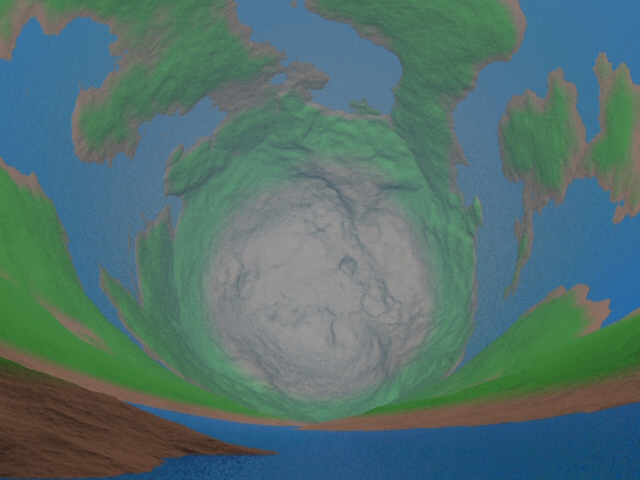
This is a semi-serious WIP that I might or might not ever finish, depending
on how  good / realistic later versions end up looking.

Anyway, my challenge to you is: what is it? Answers on a post, first correct
answer gets... er, well, nothing very much really. You'll just have to
settle for a virtual pat on the back.

The sci-fi fans out there may find this an easy question... bit of a hint,
that!

Bill
Post a reply to this message
Attachments:
Download 'whatsthisthen.jpg' (126 KB)
Preview of image 'whatsthisthen.jpg'
|
|
| |
| |
|
|
|
|
| |
| |
|
|
Bill Pragnell wrote:
> This is a semi-serious WIP that I might or might not ever finish, depending
> on how  good / realistic later versions end up looking.
>
> Anyway, my challenge to you is: what is it? Answers on a post, first correct
> answer gets... er, well, nothing very much really. You'll just have to
> settle for a virtual pat on the back.
>
> The sci-fi fans out there may find this an easy question... bit of a hint,
> that!
>
> Bill
>
>
> ------------------------------------------------------------------------
>

don't how it's written correctly, but I would guess it's the inner of a
"dysons sphere" or to say it in other words a world turned inside out.
As boy I was a big fan of Larry Niven so I allways liked the idea of the
  "ringworld" more as you still could see the stars.

... dave
Post a reply to this message
|
|
| |
| |
|
|
|
|
| |
| |
|
|
"Bill Pragnell" <bil### [at] hotmail com> wrote in message
news:web.434d3354bcf9acee731f01d10@news.povray.org...
> Anyway, my challenge to you is: what is it? Answers on a post, first
> correct
Without looking ahead at the other posts.... The lost continent of Atlantis?
Kenneth Hutson com> wrote in message
news:web.434d3354bcf9acee731f01d10@news.povray.org...
> Anyway, my challenge to you is: what is it? Answers on a post, first
> correct
Without looking ahead at the other posts.... The lost continent of Atlantis?
Kenneth Hutson
Post a reply to this message
|
|
| |
| |
|
|
|
|
| |
| |
|
|
Apart from the absence of the plasma tube, I'd say it was Thistledown.

Where does your hollow asteroid get its light from?

--
Mike Williams
Gentleman of Leisure
Post a reply to this message
|
|
| |
| |
|
|
|
|
| |
| |
|
|
"Bill Pragnell" <bil### [at] hotmailcom> a écrit dans le message de
news:web.434d3354bcf9acee731f01d10@news.povray.org...
> This is a semi-serious WIP that I might or might not ever finish,
depending
> on how  good / realistic later versions end up looking.
>
> Anyway, my challenge to you is: what is it? Answers on a post, first
correct
> answer gets... er, well, nothing very much really. You'll just have to
> settle for a virtual pat on the back.
>
> The sci-fi fans out there may find this an easy question... bit of a hint,
> that!
>
> Bill
>
It could be a beginning for the inside of Rama if the sea was a ring

But it must be in space and cylindrical, rotating to give an artificial
gravity

Marc
Post a reply to this message
|
|
| |
| |
|
|
|
|
| |
| |
|
|
-----BEGIN PGP SIGNED MESSAGE-----
Hash: SHA1

	Vapaus? How many Roger McBride Allen fans are there here, anyway?

		Jerome
- --
******************************
*      Jerome M. Berger      *
*  mailto:jeb### [at] freefr   *
*  http://jeberger.free.fr/  *
******************************
-----BEGIN PGP SIGNATURE-----
Version: GnuPG v1.4.0 (GNU/Linux)

iD8DBQFDTUREqIYJdJhyixIRAmHnAJ0URg6qCh1GICf9DCENuJQp0hdQTACePjM1
M55dV0pl/fxErvTfHKXMI6Y=
=hoNX
-----END PGP SIGNATURE-----
Post a reply to this message
|
|
| |
| |
|
|
|
|
| |
| |
|
|
David El Tom nous apporta ses lumieres en ce 2005-10-12 12:16:
> Bill Pragnell wrote:
>
>
> don't how it's written correctly, but I would guess it's the inner of a
> "dysons sphere" or to say it in other words a world turned inside out.
> As boy I was a big fan of Larry Niven so I allways liked the idea of the
>  "ringworld" more as you still could see the stars.
>
> ... dave

I have a BIG problem with Dyson spheres! Inside an hollow sphere, there is NO gravity,
if the sphere
is built around a star, everything not held in place will fall in the star. If you
make it spin, all
the air will collect at the equator, untill the sphere collapses unto itself. The
equatorial part
goes flying away and the poles plunging into the star.

--
Alain
-------------------------------------------------
Inside every older person is a younger person wondering what happened.
Post a reply to this message
|
|
| |
| |
|
|
|
|
| |
| |
|
|
Bill Pragnell nous apporta ses lumieres en ce 2005-10-12 12:01:
> This is a semi-serious WIP that I might or might not ever finish, depending
> on how  good / realistic later versions end up looking.
>
> Anyway, my challenge to you is: what is it? Answers on a post, first correct
> answer gets... er, well, nothing very much really. You'll just have to
> settle for a virtual pat on the back.
>
> The sci-fi fans out there may find this an easy question... bit of a hint,
> that!
>
> Bill
>
>
> ------------------------------------------------------------------------
>
Inside some hollow cylindrical world, looking parallel to the axis of rotation? It
can't be the Rama
world-ship, the sea is not rign shaped, and there is no "light canions".

--
Alain
-------------------------------------------------
He who laughs last, thinks slowest.
Post a reply to this message
|
|
| |
| |
|
|
|
|
| |
| |
|
|
Alain wrote:
> I have a BIG problem with Dyson spheres! Inside an hollow sphere, there
> is NO gravity, if the sphere is built around a star, everything not held
> in place will fall in the star. If you make it spin, all the air will
> collect at the equator, untill the sphere collapses unto itself. The
> equatorial part goes flying away and the poles plunging into the star.

Why is there no gravity?  If you take a sun-sized star and build a
sphere of Earths around it at 1 AU (dunno where you'd get that many
Earths), does the now hollow sphere not have gravity on either its
inside or outside surface?

--
Tim Cook
http://home.bellsouth.net/p/PWP-empyrean

-----BEGIN GEEK CODE BLOCK-----
Version: 3.12
GFA dpu- s: a?-- C++(++++) U P? L E--- W++(+++)>$
N++ o? K- w(+) O? M-(--) V? PS+(+++) PE(--) Y(--)
PGP-(--) t* 5++>+++++ X+ R* tv+ b++(+++) DI
D++(---) G(++) e*>++ h+ !r--- !y--
------END GEEK CODE BLOCK------
Post a reply to this message
|
|
| |
| |
|
|
|
|
| |
| |
|
|
Mike Williams wrote:
> Apart from the absence of the plasma tube, I'd say it was Thistledown.
>
> Where does your hollow asteroid get its light from?
>
Wow.  Someone else reads what I read.

A.D.B.

P.S. Alain,  Gravity is based on mass.  A sphere the size of earth's
orbit with a shell thick enough to withstand impacts would naturally
have a reasonable amount of gravity on it's inside surface.
Post a reply to this message
|
|
| |
| |
|
|
|
|
| |
| |
|
|
"Tim Cook" <z99### [at] bellsouthnet> a écrit dans le message de
news:434da298$1@news.povray.org...
> Why is there no gravity?  If you take a sun-sized star and build a
> sphere of Earths around it at 1 AU (dunno where you'd get that many
> Earths), does the now hollow sphere not have gravity on either its
> inside or outside surface?
>
> --
> Tim Cook
> http://home.bellsouth.net/p/PWP-empyrean
>
Yes finding so much matter should be a problem but Alain is still right:
what could prevent other parts than equator falling in the star.

Marc
Post a reply to this message
|
|
| |
| |
|
|
|
|
| |
| |
|
|
"Anthony D. Baye" <Sha### [at] hotmailcom> wrote:
> Mike Williams wrote:
> > Apart from the absence of the plasma tube, I'd say it was Thistledown.
> >
> > Where does your hollow asteroid get its light from?
> >
> Wow.  Someone else reads what I read.
>
> A.D.B.
>
> P.S. Alain,  Gravity is based on mass.  A sphere the size of earth's
> orbit with a shell thick enough to withstand impacts would naturally
> have a reasonable amount of gravity on it's inside surface.

Sorry Anthony,
but Alain is right. Inside a sphere there is no gravity from the sphere -
ask any physics guy ( me, eg ;-) ); at least if the sphere is homogeneuos
(spelling?). While Your statement definitely sounds convincing, this is one
of the few cases proving common sense can go wrong without dealing with
quantum mechanics ...

Happy Raytracing to all

Karl
Post a reply to this message
|
|
| |
| |
|
|
|
|
| |
| |
|
|
Wasn't it Tim Cook who wrote:
>Alain wrote:
>> I have a BIG problem with Dyson spheres! Inside an hollow sphere, there
>> is NO gravity, if the sphere is built around a star, everything not held
>> in place will fall in the star. If you make it spin, all the air will
>> collect at the equator, untill the sphere collapses unto itself. The
>> equatorial part goes flying away and the poles plunging into the star.
>
>Why is there no gravity?  If you take a sun-sized star and build a
>sphere of Earths around it at 1 AU (dunno where you'd get that many
>Earths), does the now hollow sphere not have gravity on either its
>inside or outside surface?

There's gravity on the outside, but not on the inside. It just so
happens that the strong contributions from the small regions under your
feet are exactly cancelled out by the weaker contributions from the much
larger regions over your head. I don't think there's any simple way to
demonstrate that, you have to calculate the integral like Newton did.

--
Mike Williams
Gentleman of Leisure
Post a reply to this message
|
|
| |
| |
|
|
|
|
| |
| |
|
|
Alain wrote:
>>>I have a BIG problem with Dyson spheres! Inside an hollow sphere, there
>>>is NO gravity, if the sphere is built around a star, everything not held
>>>in place will fall in the star. If you make it spin, all the air will
>>>collect at the equator, untill the sphere collapses unto itself. The
>>>equatorial part goes flying away and the poles plunging into the star.

Wasn't it Tim Cook who wrote:
>>Why is there no gravity?  If you take a sun-sized star and build a
>>sphere of Earths around it at 1 AU (dunno where you'd get that many
>>Earths), does the now hollow sphere not have gravity on either its
>>inside or outside surface?

Mike Williams wrote:
> There's gravity on the outside, but not on the inside. It just so
> happens that the strong contributions from the small regions under your
> feet are exactly cancelled out by the weaker contributions from the much
> larger regions over your head. I don't think there's any simple way to
> demonstrate that, you have to calculate the integral like Newton did.

There's a good lot of discussion on Wikipedia. Search for Dyson Sphere
and then go to the discussion page (tab at the top). Talks about the
calculations et. al.

There'd be neutral gravity on the inside, but if you spin the sphere
fast enough, then momentum-in-a-circular-restriction (aka centrifical
force) will stick you to the sphere. Something like 32km/s (or 320 ..
it's been a while) for a 1AU sphere.

(And the gravity on the outside would be horrendous, the gases from the
sun would kill you, there's not enough matter to make it .. yada yada ..
great concept for SciFi, and ray tracing, but not real life!)

Cheers!
Rick Measham
Post a reply to this message
|
|
| |
| |
|
|
|
|
| |
| |
|
|
Wasn't it Rick Measham who wrote:
>
>There'd be neutral gravity on the inside, but if you spin the sphere
>fast enough, then momentum-in-a-circular-restriction (aka centrifical
>force) will stick you to the sphere. Something like 32km/s (or 320 ..
>it's been a while) for a 1AU sphere.

But only the people standing on the equator would get vertical gravity
at full strength.

The strength of the force varies with cos(latitude) and the angle to the
local vertical is proportional to latitude. So people standing near the
poles get very little force, and what force there is would be almost
horizontal.
Post a reply to this message
|
|
| |
| |
|
|
|
|
| |
| |
|
|
Mike Williams wrote:
> The strength of the force varies with cos(latitude) and the angle to the
> local vertical is proportional to latitude. So people standing near the
> poles get very little force, and what force there is would be almost
> horizontal.

Which is where the original argument came from (and I agree) .. the
poles would implode, thus degrading the structure and causing the
equator to explode.

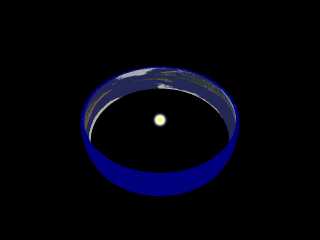
One poster (somewhere, not here) suggested a band rather than a sphere.
The 'band' would be the equatorial region and would (somehow) hold
together as it spun.
Post a reply to this message
Attachments:
Download 'animated.gif' (62 KB)
Preview of image 'animated.gif'
|
|
| |
| |
|
|
|
|
| |
| |
|
|
Anthony D. Baye nous apporta ses lumieres en ce 2005-10-12 20:50:
> Mike Williams wrote:
>
>> Apart from the absence of the plasma tube, I'd say it was Thistledown.
>>
>> Where does your hollow asteroid get its light from?
>>
> Wow.  Someone else reads what I read.
>
> A.D.B.
>
> P.S. Alain,  Gravity is based on mass.  A sphere the size of earth's
> orbit with a shell thick enough to withstand impacts would naturally
> have a reasonable amount of gravity on it's inside surface.

The gravitational pull from the relatively small but very near region under your feet
is exactly
countered by that of the extremely large and distant part over your head.
That leave you with ONLY the gravity from the sun witch is straight up... NOT a good
thing.

--
Alain
-------------------------------------------------
'hAS ANYONE SEEN MY cAPSLOCK KEY?'
Post a reply to this message
|
|
| |
| |
|
|
|
|
| |
| |
|
|
Karl Anders wrote:
> at least if the sphere is homogeneuos
<English swot>
Homogenuous!
</English swot>

See you in Khyberspace!

Yadgar

Now playing: Starship Trooper (Yes)
Post a reply to this message
|
|
| |
| |
|
|
|
|
| |
| |
|
|
Alain wrote:
> Anthony D. Baye nous apporta ses lumieres en ce 2005-10-12 20:50:
>
>> Mike Williams wrote:
>>
>>> Apart from the absence of the plasma tube, I'd say it was Thistledown.
>>>
>>> Where does your hollow asteroid get its light from?
>>>
>> Wow.  Someone else reads what I read.
>>
>> A.D.B.
>>
>> P.S. Alain,  Gravity is based on mass.  A sphere the size of earth's
>> orbit with a shell thick enough to withstand impacts would naturally
>> have a reasonable amount of gravity on it's inside surface.
>
>
> The gravitational pull from the relatively small but very near region
> under your feet is exactly countered by that of the extremely large and
> distant part over your head.
> That leave you with ONLY the gravity from the sun witch is straight
> up... NOT a good thing.
>
Far be it from me to dislike being proved wrong.

but an interesting factoid:  Larry Niven's Ringworld, which was
conceived as an intermediate step toward a dyson sphere, spun at 770
mi/h.  It was determined that, in order to withstand the shearing forces
from the spin, the base material which measured 1000' thick would have
had to have had a tensile strength on the order of the force which holds
the nucleus of an atom together.

A.D.B.
Post a reply to this message
|
|
| |
| |
|
|
|
|
| |
| |
|
|
Alain wrote:
> The gravitational pull from the relatively small but very near region
> under your feet is exactly countered by that of the extremely large and
> distant part over your head.
> That leave you with ONLY the gravity from the sun witch is straight
> up... NOT a good thing.

Let me get this straight.  If you put a hypothetical mass, say, ten
times the mass of the earth, in an orbit exactly opposite the earth, the
gravity under your feet will be countered by a certain amount by the
extremely large and distant mass over your head?  In other words, to
simplify things, without extra masses...you weigh less at noon?

--
Tim Cook
http://home.bellsouth.net/p/PWP-empyrean

-----BEGIN GEEK CODE BLOCK-----
Version: 3.12
GFA dpu- s: a?-- C++(++++) U P? L E--- W++(+++)>$
N++ o? K- w(+) O? M-(--) V? PS+(+++) PE(--) Y(--)
PGP-(--) t* 5++>+++++ X+ R* tv+ b++(+++) DI
D++(---) G(++) e*>++ h+ !r--- !y--
------END GEEK CODE BLOCK------
Post a reply to this message
|
|
| |
| |
|
|
|
|
| |
| |
|
|
"Tim Cook" <z99### [at] bellsouthnet> a écrit dans le message de
news:434e9f3b$1@news.povray.org...
In other words, to
> simplify things, without extra masses...you weigh less at noon?
>
Don't tides work this way?

Marc
Post a reply to this message
|
|
| |
| |
|
|
|
|
| |
| |
|
|
Anthony D. Baye wrote:
> Alain wrote:
>
>> Anthony D. Baye nous apporta ses lumieres en ce 2005-10-12 20:50:
>>
>>> Mike Williams wrote:
>>>
>>>> Apart from the absence of the plasma tube, I'd say it was Thistledown.
>>>>
>>>> Where does your hollow asteroid get its light from?
>>>>
>>> Wow.  Someone else reads what I read.
>>>
>>> A.D.B.
>>>
>>> P.S. Alain,  Gravity is based on mass.  A sphere the size of earth's
>>> orbit with a shell thick enough to withstand impacts would naturally
>>> have a reasonable amount of gravity on it's inside surface.
>>
>>
>>
>> The gravitational pull from the relatively small but very near region
>> under your feet is exactly countered by that of the extremely large
>> and distant part over your head.
>> That leave you with ONLY the gravity from the sun witch is straight
>> up... NOT a good thing.
>>
> Far be it from me to dislike being proved wrong.
>
> but an interesting factoid:  Larry Niven's Ringworld, which was
> conceived as an intermediate step toward a dyson sphere, spun at 770
> mi/h.  It was determined that, in order to withstand the shearing forces
> from the spin, the base material which measured 1000' thick would have
> had to have had a tensile strength on the order of the force which holds
> the nucleus of an atom together.
>
> A.D.B.
Still, if it were spun up for gravitational effects, and only the area
around the equator were used for habitation, and the rest was used for
energy collection, storage, life support and suchlike, then there would
still be a massive amount of livable area.  f/ex. if the sphere were the
size of earth's orbit, and assuming that the livable area were a million
miles wide,  then the total inside surface area (Not accounting for
variations in topography) would be 2(pi)(9.28e6)(1e6) mi^2 that's
several thousand times the surface area of earth.

A.D.B.
Post a reply to this message
|
|
| |
| |
|
|
|
|
| |
| |
|
|
Tim Cook <z99### [at] bellsouthnet> wrote:
> Alain wrote:
> > I have a BIG problem with Dyson spheres! Inside an hollow sphere, there
> > is NO gravity, if the sphere is built around a star, everything not held
> > in place will fall in the star. If you make it spin, all the air will
> > collect at the equator, untill the sphere collapses unto itself. The
> > equatorial part goes flying away and the poles plunging into the star.
>
> Why is there no gravity?  If you take a sun-sized star and build a
> sphere of Earths around it at 1 AU (dunno where you'd get that many
> Earths), does the now hollow sphere not have gravity on either its
> inside or outside surface?

A spherical shell exerts no gravity on anything within.  If you do the math
it turns out that no matter where you are within the shell, the gravity
from the material behind you exactly cancels the gravity from the material
in front of you.

Outside the shell, gravity works like you'd expect.
Post a reply to this message
|
|
| |
| |
|
|
|
|
| |
| |
|
|
Mike Williams <nos### [at] econymdemoncouk> wrote:
> Apart from the absence of the plasma tube, I'd say it was Thistledown.
>
> Where does your hollow asteroid get its light from?

....except that Thistledown was indefinitely long inside.  This one appears
to stop.
Post a reply to this message
|
|
| |
| |
|
|
|
|
| |
| |
|
|
"Anthony D. Baye" <Sha### [at] hotmailcom> wrote:
> Mike Williams wrote:
> > Apart from the absence of the plasma tube, I'd say it was Thistledown.
> >
> > Where does your hollow asteroid get its light from?
> >
> Wow.  Someone else reads what I read.
>
> A.D.B.
>
> P.S. Alain,  Gravity is based on mass.  A sphere the size of earth's
> orbit with a shell thick enough to withstand impacts would naturally
> have a reasonable amount of gravity on it's inside surface.

Actually the gravity felt at a distance underground is that due to the
sphere that you are standing on alone.  Remove that sphere of material and
you are in free-fall.  The easy way to think of this is that a small amount
of material nearby is balanced by a lot at a distance.

Andy
Post a reply to this message
|
|
| |
| |
|
|
|
|
| |
| |
|
|
Wasn't it Marc Jacquier who wrote:
>
>"Tim Cook" <z99### [at] bellsouthnet> a écrit dans le message de
>news:434e9f3b$1@news.povray.org...
>In other words, to
>> simplify things, without extra masses...you weigh less at noon?
>>
>Don't tides work this way?

Not at all. If that was how tides worked, there would only be one tide
per day instead of two. Tidal forces also make you lighter when the
extra mass is directly below your feet.

--
Mike Williams
Gentleman of Leisure
Post a reply to this message
|
|
| |
| |
|
|
|
|
| |
| |
|
|
Wasn't it Mack Tuesday who wrote:
>Mike Williams <nos### [at] econymdemoncouk> wrote:
>> Apart from the absence of the plasma tube, I'd say it was Thistledown.
>>
>> Where does your hollow asteroid get its light from?
>
>....except that Thistledown was indefinitely long inside.  This one appears
>to stop.

I was thinking of one of the first six chambers. (I had to think for a
while for the term "plasma tube", I knew that I didn't want to say
"flaw").

--
Mike Williams
Gentleman of Leisure
Post a reply to this message
|
|
| |
| |
|
|
|
|
| |
| |
|
|
"Mike Williams" <nos### [at] econymdemoncouk> a écrit dans le message de
news:Cra### [at] econymdemoncouk...
> Wasn't it Marc Jacquier who wrote:
> >
> >"Tim Cook" <z99### [at] bellsouthnet> a écrit dans le message de
> >news:434e9f3b$1@news.povray.org...
> >In other words, to
> >> simplify things, without extra masses...you weigh less at noon?
> >>
> >Don't tides work this way?
>
> Not at all. If that was how tides worked, there would only be one tide
> per day instead of two. Tidal forces also make you lighter when the
> extra mass is directly below your feet.
>
> --
The secon rise is due to a resonnance, an harmonic

Marc
Post a reply to this message
|
|
| |
| |
|
|
|
|
| |
| |
|
|
Marc Jacquier wrote:
> "Mike Williams" <nos### [at] econymdemoncouk> a écrit dans le message de
> news:Cra### [at] econymdemoncouk...
>
>>Wasn't it Marc Jacquier who wrote:
>>
>>>"Tim Cook" <z99### [at] bellsouthnet> a écrit dans le message de
>>>news:434e9f3b$1@news.povray.org...
>>>In other words, to
>>>
>>>>simplify things, without extra masses...you weigh less at noon?
>>>>
>>>
>>>Don't tides work this way?
>>
>>Not at all. If that was how tides worked, there would only be one tide
>>per day instead of two. Tidal forces also make you lighter when the
>>extra mass is directly below your feet.
>>
>>--
>
> The secon rise is due to a resonnance, an harmonic
>
> Marc
>

No, it's not a resonnance.  The way I've heard the two tides explained
is that the ocean is raised by the moon's gravity on that side of the
earth, but it also pulls the _earth_ away from the water on the far
side.  So the high tide on the far side is not that the water is higher,
but that the earth is lower.

      -=- Larry -=-
Post a reply to this message
|
|
| |
| |
|
|
|
|
| |
| |
|
|
Rick Measham wrote:
> Mike Williams wrote:
>
>> The strength of the force varies with cos(latitude) and the angle to the
>> local vertical is proportional to latitude. So people standing near the
>> poles get very little force, and what force there is would be almost
>> horizontal.
>
>
> Which is where the original argument came from (and I agree) .. the
> poles would implode, thus degrading the structure and causing the
> equator to explode.
>
> One poster (somewhere, not here) suggested a band rather than a sphere.
> The 'band' would be the equatorial region and would (somehow) hold
> together as it spun.

And then some other killjoy did the math and realized that if the ring
were to be moved so that the star was no longer in the center, the
situation would not correct itself naturally; if there were no
artificial corrective measures, the ring would eventually collide with
the sun.  Roll the credits.

BTW, Dyson himself did not postulate a solid sphere, but a large number
of small bodies which collectively capture all of the output from a
given star.

Regards,
John
Post a reply to this message
|
|
| |
| |
|
|
|
|
| |
| |
|
|
Wasn't it Marc Jacquier who wrote:
>
>"Mike Williams" <nos### [at] econymdemoncouk> a écrit dans le message de
>news:Cra### [at] econymdemoncouk...
>> Wasn't it Marc Jacquier who wrote:
>> >
>> >"Tim Cook" <z99### [at] bellsouthnet> a écrit dans le message de
>> >news:434e9f3b$1@news.povray.org...
>> >In other words, to
>> >> simplify things, without extra masses...you weigh less at noon?
>> >>
>> >Don't tides work this way?
>>
>> Not at all. If that was how tides worked, there would only be one tide
>> per day instead of two. Tidal forces also make you lighter when the
>> extra mass is directly below your feet.
>>
>> --
>The secon rise is due to a resonnance, an harmonic

Actually it isn't.

--
Mike Williams
Gentleman of Leisure
Post a reply to this message
|
|
| |
| |
|
|
|
|
| |
| |
|
|
"Larry Hudson" <org### [at] yahoocom> a écrit dans le message de
news:434f00d0$1@news.povray.org...
> No, it's not a resonnance.  The way I've heard the two tides explained
> is that the ocean is raised by the moon's gravity on that side of the
> earth, but it also pulls the _earth_ away from the water on the far
> side.  So the high tide on the far side is not that the water is higher,
> but that the earth is lower.
>
>       -=- Larry -=-

A kind of (squared) gradient of gravity?

Marc
Post a reply to this message
|
|
| |
| |
|
|
|
|
| |
| |
|
|
"John VanSickle" <evi### [at] hotmailcom> a écrit dans le message de
news:434f0dfe$1@news.povray.org...

> BTW, Dyson himself did not postulate a solid sphere, but a large number
> of small bodies which collectively capture all of the output from a
> given star.
>
How to avoid collisions between these bodies then?

Marc
Post a reply to this message
|
|
| |
| |
|
|
|
|
| |
| |
|
|
John VanSickle <evi### [at] hotmailcom> wrote:
> Rick Measham wrote:
> > Mike Williams wrote:
> >
> >> The strength of the force varies with cos(latitude) and the angle to the
> >> local vertical is proportional to latitude. So people standing near the
> >> poles get very little force, and what force there is would be almost
> >> horizontal.
> >
> >
> > Which is where the original argument came from (and I agree) .. the
> > poles would implode, thus degrading the structure and causing the
> > equator to explode.
> >
> > One poster (somewhere, not here) suggested a band rather than a sphere.
> > The 'band' would be the equatorial region and would (somehow) hold
> > together as it spun.
>
> And then some other killjoy did the math and realized that if the ring
> were to be moved so that the star was no longer in the center, the
> situation would not correct itself naturally; if there were no
> artificial corrective measures, the ring would eventually collide with
> the sun.  Roll the credits.
>
> BTW, Dyson himself did not postulate a solid sphere, but a large number
> of small bodies which collectively capture all of the output from a
> given star.
>
> Regards,
> John

For practicality I prefer Banks' 'Culture' ring model which is to have a
smaller ring orbiting in a star's life zone, spinning once per day to give
one g of centripetal accelleration and with a small rotation plane offset
from the sun. If I got my calculation right (a = lw^2) the radius is about
1.85 million km, which still gives a huge surface area for a reasonable
ring width - and you can build several in one system :-)

(Wanders off, dreaming of how to reduce Jupiter to workable material ...)

Mike.
Post a reply to this message
|
|
| |
| |
|
|
|
|
| |
| |
|
|
Larry Hudson wrote:
> No, it's not a resonnance.  The way I've heard the two tides explained
> is that the ocean is raised by the moon's gravity on that side of the
> earth, but it also pulls the _earth_ away from the water on the far
> side.

Um, not really.

Tides are caused when any large body orbits a point. Consider two rocks
on the moon, one on the ground very close to the Earth, one on the
ground on the side we never see. The one on the ground close to the
Earth is going slower than it would if it were all by itself in the same
orbit without the moon. A lower orbit is a faster orbit, so the rock
there is going too slow, so it should fall down towards the earth. A
higher orbit is a slower orbit, but the rock on the far side is actually
travelling faster than the rock on the near side instead of slower, so
it would normally be "flung away" from the center. The smaller the
radius of orbit compared to the size of the orbiting body, the more
evident the effect. The stronger the gravity, of course, the more
evident the effect.

It hasn't anything to do with pulling the centers of planets towards or
away from anything. It has to do with the fact that from outside a
system, gravity can be calculated as a point source, but inside a system
you have to account for distances.

When a body gets close enough that the orbital pull overcomes its
gravity, it breaks up. That limit (for a fluid, where only gravity is
holding it together) is called the Roche limit.

http://en.wikipedia.org/wiki/Roche_limit

See the pictures for an explanation of tides that is actually correct. :-)


--
   Darren New / San Diego, CA, USA (PST)
    Neither rocks nor slush nor salted rims
    shall keep us from our appointed rounds.
Post a reply to this message
|
|
| |
| |
|
|
|
|
| |
| |
|
|
Rick Measham schrieb:
>
> (And the gravity on the outside would be horrendous, the gases from the
> sun would kill you, there's not enough matter to make it .. yada yada ..
> great concept for SciFi, and ray tracing, but not real life!)
>
> Cheers!
> Rick Measham

That's another reason why I prefer the idea of a "ringworld" of the
concept of the dysons sphere. Make a rim with walls on both side so that
the atmosphere is kept inside and spin it. Solves at least the problem
of atmosphere distribution and variable gravity which is an inherent
problem of the concept of a spinning hollow sphere. AND you don't need
that much materia to build it. But even Larry Niven (AFAIK a physician
writing SciFi) had to introduce some sort of hyperdense material so that
this small hull want fly apart.

... dave
Post a reply to this message
|
|
| |
| |
|
|
|
|
| |
| |
|
|
Rick Measham schrieb:
> Mike Williams wrote:
>
>> The strength of the force varies with cos(latitude) and the angle to the
>> local vertical is proportional to latitude. So people standing near the
>> poles get very little force, and what force there is would be almost
>> horizontal.
>
>
> Which is where the original argument came from (and I agree) .. the
> poles would implode, thus degrading the structure and causing the
> equator to explode.
>
> One poster (somewhere, not here) suggested a band rather than a sphere.
> The 'band' would be the equatorial region and would (somehow) hold
> together as it spun.
>
> ------------------------------------------------------------------------
>
this is exactly the idea of the "ringworld". Larry Niven wrote about
twenty novells or so around a fictive world like this.
... dave
Post a reply to this message
|
|
| |
| |
|
|
|
|
| |
| |
|
|
On Fri, 14 Oct 2005 22:01:07 +0200, David El Tom wrote:

> But even Larry Niven (AFAIK a physician writing
> SciFi)

Larry Niven holds a BA in Mathematics and a minor in Psychology.

http://en.wikipedia.org/wiki/Larry_Niven

Jim
Post a reply to this message
|
|
| |
| |
|
|
|
|
| |
| |
|
|
Nobody has yet mentioned the *quantitative* demonstration that the
gravity of an uniform hollow sphere is cancelled inside.

Consider a particle within the sphere and a pair of equal and opposite
narrow cones whose apex is that particle.  Each cone meets the sphere in
an ellipse.  (The ellipses have similar shape because the axis of the
cones meets the sphere at the same angle on both sides.)  The area of
the ellipse, and thus the amount of mass pulling the particle in that
direction, is proportional to the square of the distance from that part
of the sphere to the particle.  But to get the amount of force you must
then divide by, guess what, the square of that same distance.  Thus the
forces on the particle from the two opposite cones are equal and opposite.

--
Anton Sherwood, http://www.ogre.nu/
"How'd ya like to climb this high *without* no mountain?" --Porky Pine
Post a reply to this message
|
|
| |
| |
|
|
|
|
| |
| |
|
|
> "John VanSickle" a escrit
>> BTW, Dyson himself did not postulate a solid sphere, but a large
>> number of small bodies which collectively capture all of the output
>> from a given star.

Marc Jacquier wrote:
> How to avoid collisions between these bodies then?

They orbit at slightly different distances.

And I'll bet Dyson qualified the conjecture with some such phrase as "in
the limit", i.e. he doesn't expect perfectly complete capture, but the
amount of light captured gets ever more complete over time.

--
Anton Sherwood, http://www.ogre.nu/
"How'd ya like to climb this high *without* no mountain?" --Porky Pine
Post a reply to this message
|
|
| |
| |
|
|
|
|
| |
| |
|
|
> this is exactly the idea of the "ringworld". Larry Niven wrote
> about twenty novells or so around a fictive world like this.

I forget whether "twenty" in this case means three or four.

--
Anton Sherwood, http://www.ogre.nu/
"How'd ya like to climb this high *without* no mountain?" --Porky Pine
Post a reply to this message
|
|
| |
| |
|
|
|
|
| |
| |
|
|
David El Tom wrote:
> . . . . But even Larry Niven had to introduce some sort of
> hyperdense material so that this small hull want fly apart.

Hyperstrong, not hyperdense; making it heavier only adds to the problem.

--
Anton Sherwood, http://www.ogre.nu/
"How'd ya like to climb this high *without* no mountain?" --Porky Pine
Post a reply to this message
|
|
| |
| |
|
|
|
|
| |
| |
|
|
Mike Williams wrote:
> Where does your hollow asteroid get its light from?

Perhaps the other end is glass.

--
Anton Sherwood, http://www.ogre.nu/
"How'd ya like to climb this high *without* no mountain?" --Porky Pine
Post a reply to this message
|
|
| |
| |
|
|
|
|
| |
| |
|
|
> "Larry Hudson" a escrit
>> No, it's not a resonnance.  The way I've heard the two tides
>> explained is that the ocean is raised by the moon's gravity on that
>> side of the earth, but it also pulls the _earth_ away from the
>> water on the far side.  So the high tide on the far side is not
>> that the water is higher, but that the earth is lower.

Marc Jacquier wrote:
> A kind of (squared) gradient of gravity?

Why squared?

--
Anton Sherwood, http://www.ogre.nu/
"How'd ya like to climb this high *without* no mountain?" --Porky Pine
Post a reply to this message
|
|
| |
| |
|
|
|
|
| |
| |
|
|
> Larry Hudson wrote:
>> No, it's not a resonnance.  The way I've heard the two tides explained
>> is that the ocean is raised by the moon's gravity on that side of the
>> earth, but it also pulls the _earth_ away from the water on the far side.

Darren New wrote:
> Um, not really.

I don't see why not.

> Tides are caused when any large body orbits a point. Consider two rocks
> on the moon, one on the ground very close to the Earth, one on the
> ground on the side we never see.  [snip orbital mechanics]

This does not contradict Larry's version.

> It hasn't anything to do with pulling the centers of planets towards
> or away from anything. It has to do with the fact that from outside
> a system, gravity can be calculated as a point source, but inside
> a system you have to account for distances.

So if the Moon were a point mass Earth would not experience tides?
Bzzt, try again.

Newton showed that a spherically symmetric body - i.e. one whose density
varies only with radius - produces the same g-field (outside its
surface) as a point mass.  I guess what you mean by this "inside a
system" jazz is that the g-field of a less regular body, or group of
bodies, can be considered spherically symmetric from far enough away but
not up close.  (I wonder how far away a space-probe gets before its
navigation can safely treat the Earth-Moon system as a single body.)

--
Anton Sherwood, http://www.ogre.nu/
"How'd ya like to climb this high *without* no mountain?" --Porky Pine
Post a reply to this message
|
|
| |
| |
|
|
|
|
| |
| |
|
|
Wasn't it Anton Sherwood who wrote:
>
>And I'll bet Dyson qualified the conjecture with some such phrase as "in
>the limit", i.e. he doesn't expect perfectly complete capture, but the
>amount of light captured gets ever more complete over time.

Perhaps he's expecting the inhabitants to have a biological imperative
to reproduce without limit, so that their population tends to rise
exponentially. If the practical limit to the population of a star system
is the amount of energy they can capture from the star, then there'd be
strenuous efforts to capture the energy that leaks through the last few
gaps.

--
Mike Williams
Gentleman of Leisure
Post a reply to this message
|
|
| |
| |
|
|
|
|
| |
| |
|
|
Wasn't it Anton Sherwood who wrote:
>> this is exactly the idea of the "ringworld". Larry Niven wrote
>> about twenty novells or so around a fictive world like this.
>
>I forget whether "twenty" in this case means three or four.

The four main ones are "Ringworld", "Ringworld Engineers", "The
Ringworld Throne" and "Ringworld's Children", but many other Niven
"known space" books portray a universe where the existence of the
Ringworld has some slight effect (even if only in hindsight). In
particular "Crashlander", "Protector" and several of the Man-Kzin wars
series.

--
Mike Williams
Gentleman of Leisure
Post a reply to this message
|
|
| |
| |
|
|
|
|
| |
| |
|
|
Anton Sherwood schrieb:
>> this is exactly the idea of the "ringworld". Larry Niven wrote
>> about twenty novells or so around a fictive world like this.
>
>
> I forget whether "twenty" in this case means three or four.
>

yepp, .. , I Know what you mean, but in opposite to D. Admas with his
five-part trilogy's or so, Niven was quiet productive. With a quick look
at my bookshelf I see at least 7 novells dealing directly with ringworld
("ringworld epos"), at least 5 playing in the same universe ("kzin
wars") and 12 more books spawning other universers and following other
strange SciFi ideas. And these are only the ones I can call my own.
So roughly 10000 pages of brain washing lyrics for little boys ;-)

By the way, ..., a world Niven spawned a story around was a solar-system
without planets at all. Just a torus shaped dense rotating atmosphere
around a sun. Live developed in form of and on integral shaped trees.
Seas and oceans where just blobs of water drifting in the cloud.

... dave
Post a reply to this message
|
|
| |
| |
|
|
|
|
| |
| |
|
|
"Mike Andrews" <nomail@nomail> schreef in bericht
news:web.434fc6b84ff5b998c717c9af0@news.povray.org...
>
> For practicality I prefer Banks' 'Culture' ring model which is to have a
> smaller ring orbiting in a star's life zone, spinning once per day to give
> one g of centripetal accelleration and with a small rotation plane offset
> from the sun. If I got my calculation right (a = lw^2) the radius is about
> 1.85 million km, which still gives a huge surface area for a reasonable
> ring width - and you can build several in one system :-)
>
> (Wanders off, dreaming of how to reduce Jupiter to workable material ...)
>

And there you get the Ringworld described by Larry Niven!!

Thomas
Post a reply to this message
|
|
| |
| |
|
|
|
|
| |
| |
|
|
Jim Henderson schrieb:
> On Fri, 14 Oct 2005 22:01:07 +0200, David El Tom wrote:
>
>
>>But even Larry Niven (AFAIK a physician writing
>>SciFi)
>
>
> Larry Niven holds a BA in Mathematics and a minor in Psychology.
>
> http://en.wikipedia.org/wiki/Larry_Niven
>
> Jim
Anton Sherwood schrieb:
 > David El Tom wrote:
 >
 >> . . . . But even Larry Niven had to introduce some sort of
 >> hyperdense material so that this small hull want fly apart.
 >
 >
 > Hyperstrong, not hyperdense; making it heavier only adds to the problem.
 >

thanks both for correction, it's now at least 10 years that last read
these books, but's not a good appology, I know ;-)
Wright now I hardly find the time to read novells, instead I have to
read API documentations and program references in my spare time ;-)
... dave
Post a reply to this message
|
|
| |
| |
|
|
|
|
| |